B Meson Semi-Invisible Decays via Perturbative QCD
Pith reviewed 2026-06-27 21:24 UTC · model grok-4.3
The pith
B meson semi-invisible decays to light baryons plus dark particles reach branching ratios of order 10^{-5}.
A machine-rendered reading of the paper's core claim, the machinery that carries it, and where it could break.
Core claim
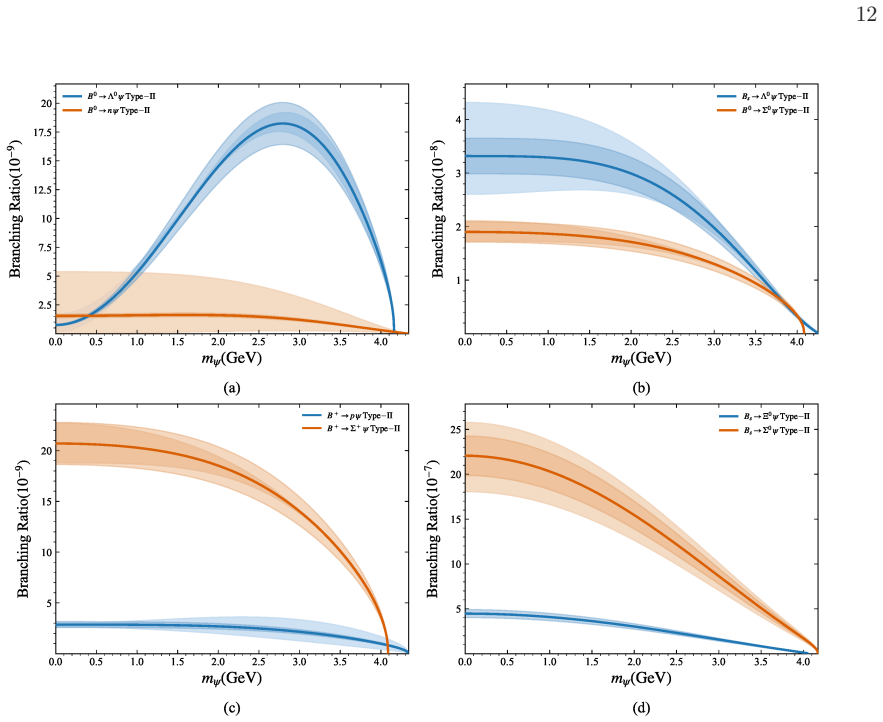
Using the perturbative QCD approach combined with flavor symmetry analysis, the branching ratios for B meson decays to light baryons and dark baryons are computed within two B-Mesogenesis scenarios. A detailed discussion of the B to B8 form factors supports the evaluation of effective couplings. The numerical analysis yields branching ratios on the order of 10^{-5} for the channels B^0 to Lambda psi and Bs^0 to Xi^0 psi in the Type-I model.
What carries the argument
Perturbative QCD factorization of B to octet-baryon form factors combined with flavor-symmetry relations to fix the effective couplings for dark-sector final states.
If this is right
- Branching ratios reach O(10^{-5}) for B^0 to Lambda psi and Bs^0 to Xi^0 psi in the Type-I model.
- The same framework produces smaller but still sizable rates for other channels and for the Type-II scenario.
- The derived B to B8 form factors enter directly into the numerical branching-ratio predictions.
- Such semi-invisible modes are expected to be searchable at hadron colliders and B factories.
Where Pith is reading between the lines
- Observation of these modes at the predicted level would constrain the coupling strengths between visible and dark baryons in B-Mesogenesis models.
- Non-observation at current sensitivity would tighten the allowed parameter space for the dark baryon masses and interactions.
- The form-factor treatment could be reused for analogous semi-invisible decays of other heavy mesons.
- Relative rates between the two model types could serve as a diagnostic once data become available.
Load-bearing premise
The perturbative QCD factorization and flavor symmetry relations remain valid when applied to the dark-sector final states.
What would settle it
An experimental upper limit on the branching fraction of B^0 to Lambda plus missing energy that lies well below 10^{-6} would contradict the calculated rate.
Figures


read the original abstract
This paper focuses on the dark sector decay processes of $B$ mesons ($B\to \mathcal{B}_8\ +$ invisible). Using the perturbative QCD (pQCD) approach combined with flavor symmetry analysis, we calculate the branching ratios for decays from $B$ mesons into light baryons and dark baryons within two distinct $B$-Mesogenesis scenarios. A detailed discussions of the form factor $B\to \mathcal{B}_8$ are presented. Based on the derived form factors and effective couplings, we then reach the final numerical analysis. The results show that the branching ratios are sizable, especially for $B^0\to \Lambda\psi$ and $B_s^0\to\Xi^0\psi$ in Type-I model, with values on the order of $\mathcal{O}(10^{-5})$ . Such processes are expected to facilitate the search for dark matter at hadron colliders and B factories.
Editorial analysis
A structured set of objections, weighed in public.
Referee Report
Summary. The manuscript calculates branching ratios for B meson semi-invisible decays (B → ℬ₈ + invisible) in two B-Mesogenesis scenarios by combining perturbative QCD factorization with SU(3) flavor symmetry to obtain B → ℬ₈ form factors and effective couplings to the dark baryon ψ. It reports that the branching ratios are sizable, reaching O(10^{-5}) especially for B⁰ → Λψ and B_s⁰ → Ξ⁰ψ in the Type-I model.
Significance. If the pQCD factorization and flavor-symmetry relations remain valid for the dark-sector final states, the O(10^{-5}) predictions would supply concrete targets for dark-matter searches at B factories and hadron colliders.
minor comments (3)
- [Abstract] Abstract: the claim that branching ratios reach O(10^{-5}) is stated without any quoted central values, uncertainties, or input parameters, making it impossible to judge the numerical robustness from the abstract alone.
- The manuscript should supply at least one explicit form-factor expression (e.g., the leading-twist expression used for B → Λ or B_s → Ξ) together with the numerical inputs adopted for the effective couplings.
- No error estimates or variation ranges are mentioned for the final branching-ratio numbers; these should be added to the numerical-analysis section.
Simulated Author's Rebuttal
We thank the referee for the positive assessment of our work on B meson semi-invisible decays using pQCD and flavor symmetry, and for recommending minor revision. No specific major comments were provided in the report.
Circularity Check
No significant circularity
full rationale
The derivation applies standard pQCD factorization to B→B8 transitions and flavor symmetry to obtain form factors and couplings for the dark baryon final states. Branching ratios are computed numerically from these derived quantities in the two B-Mesogenesis scenarios. No step reduces by construction to a fitted input renamed as prediction, no self-citation is load-bearing for the central result, and no ansatz or uniqueness claim is smuggled via prior author work. The calculation chain is self-contained against external benchmarks and does not exhibit any of the enumerated circular patterns.
Axiom & Free-Parameter Ledger
Reference graph
Works this paper leans on
-
[1]
For the non-perturbative input wave functions, we adopt the light b aryon light cone distribution amplitude (LCDA) up to twist-6 and the leading-order B-meson LCDA
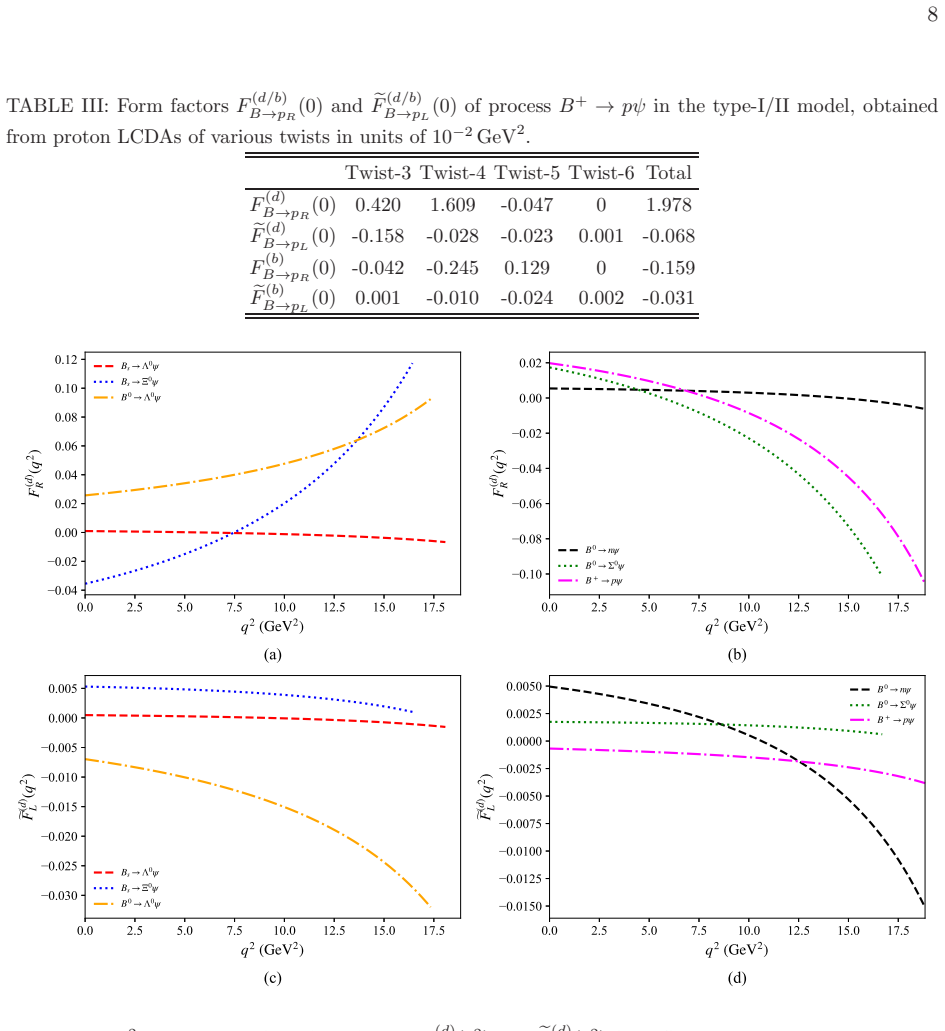
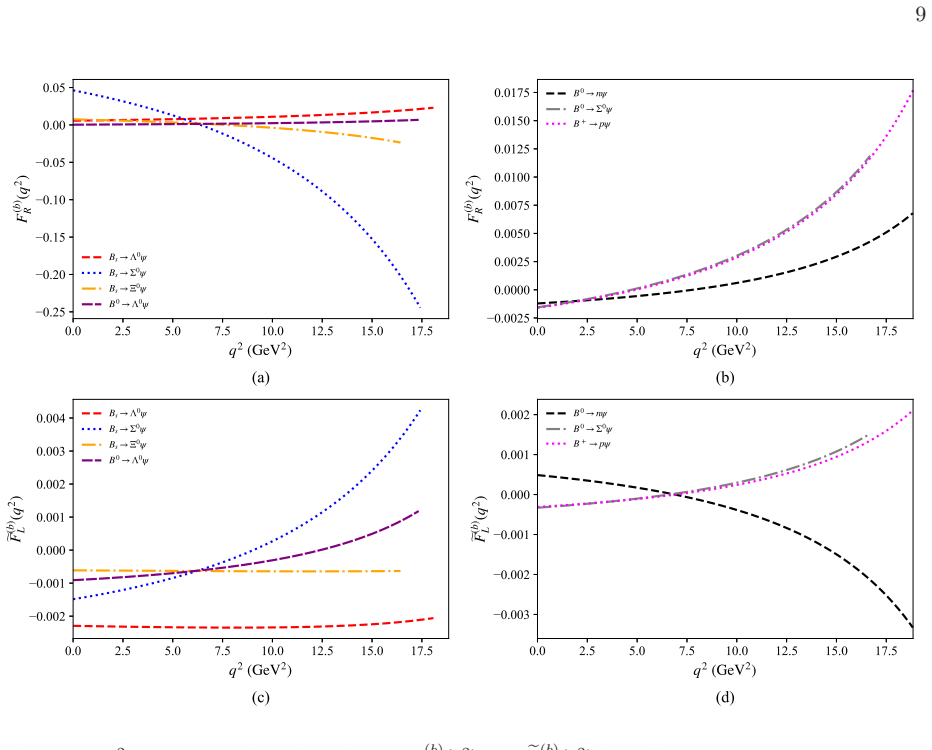
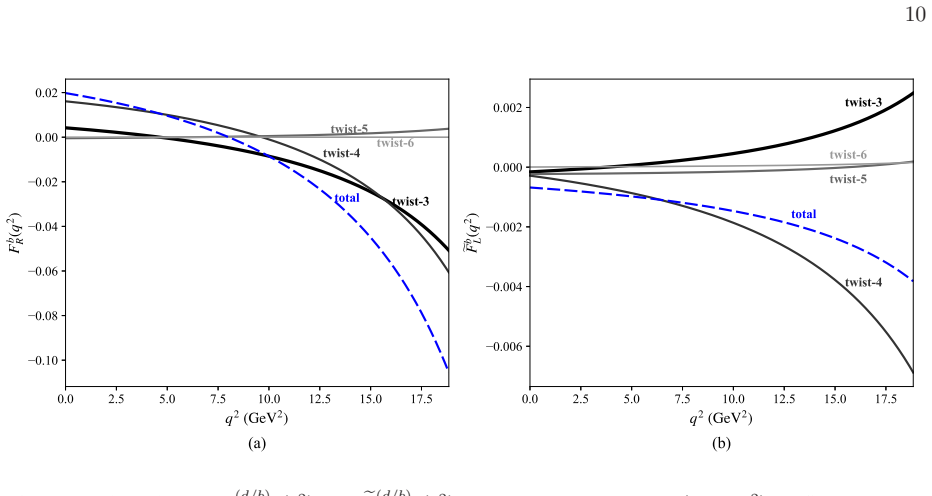
Following the standard pQCD procedure, we can perturbatively calculate the hard kernels correspon ding to these three diagrams. For the non-perturbative input wave functions, we adopt the light b aryon light cone distribution amplitude (LCDA) up to twist-6 and the leading-order B-meson LCDA. After performing the convolution of the hard kernels with the wa...
-
[2]
large” and “small
Usually, they can be constrained by LHC experiments, which provide upper 7 TABLE II: Form factors for the decay channels in the type-I/-II model at q2 = 0 (in units of 10 − 2). The uncertainties arise from the variation of Λ QCD and the wave function parameters. this work LCSR[25] LCSR[23, 24, 51] twist(3) twist(3-6) a1 twist(3) twist(3-6) B+ → p F (d) B→...
-
[3]
+ (ξ− 5 − φ − 5 +ψ 0 5 )x3 + (ξ+ 5 − φ + 5 − ψ 0 5 )(1 − 2x3)]. (A9) • Twist-6 LCDAs 14 V6(xi) =2[φ 0 6 +φ + 6 (1 − 3x3)], A6(xi) =2(x2 − x1)φ − 6, T6(xi) =2[φ 0 6 + 1 2 (φ − 6 − φ + 6 )(1 − 3x3)], (A10) For Λ baryon, • Twist-3 LCDAs V1(xi) =120x1x2x3(x1 − x2) ( 21 √ 6 4 φ 11 − 7 √ 6 4 φ 10 ) , A1(xi) =120x1x2x3 [ −fΛ + 7 √ 6 4 (φ 11 +φ 10)(x1 +x2) − 14 √...
-
[4]
+ 20m2 Bφ 0 3x1x2x3x4η ) ˆPL +mBmΣ + ( − 8φ ′ 4x1x2x3 +x4(40φ ′ 3x1x2x3 +x1(− 1 +x2 − x3 +x4)ξ0 4 +(x3 +x4)(x2ξ0 4 − x3ξ0 4 +ξ′ 4 − x4ξ′ 4)η) ) ̸ ¯n ̸n ˆPL ])] , (B5) Mc′ = ΛQCDCFm2 BηφB 288 √ 3ηπ E(tc) ∫ 1 0 da2da4da5 ∫ 1/ Λ QCD 0 b3db3b4db4h(x1,x 3,x 4,b 1,b 3,b 4) [ 8mΣ + ( m2 Σ +(x3 +x4)(φ 0 6 − 12φ 0 4x2x3 − 3φ 0 5x4 + 60φ 0 3x2x3x4 + 6ψ 0 4x4(− 1 +x...
-
[5]
+ 40m2 Bφ 0 3x1x2x3x4η ) ˆPL + ( 2m2 Σ +(x3 +x4)(ψ 5(1 +x2 − x3 − x4) +x4(−φ 0 5 + 20φ 0 3x2x3 +4ψ 0 4(− 1 +x2 − x3 +x4))) − 40m2 Bφ 0 3x1x2x3x4η +mBmΣ +(x2 − x3)(8x4ξ0 4 − ξ0 5 +ξ′ 5)(x1 + (x3 +x4)η) ) ̸ ¯n ̸n ˆPL ])] . (B6) 19 The hard functions hi(xi, bi)s are obtained by performing the Fourier transformation fr om mo- mentum space to impact-parameter ...
-
[6]
− 2x2x3ψ 0 4 } +mN (x1 − x2)(4x3ξ0 4 +ξ0 5) ] + Λ QCDCFm2 BmN ΦB 72 √ 3πη E(tc)b3b4h(x1,x 3,x 4,b 1,b 3,b 4) × [ − 12η2m2 Bsx2x3ψ 0 4 − 3ηmBsmN (− 2 +ηx2) ( 4x2 3ξ′0 4 − 4x3(x1ξ0 4 − x2ξ0 4 +ξ′0 4 ) + 2x3φ ′0 5 − x1ξ0 5 +x2ξ0 5 +x1ξ′0 5 +x2ξ′0 5 ) + 2m2 N (− 1 +ηx2) [ 60x1x2x3φ 0 3 − 12x1x2φ 0 4 − 6x3ψ 0 4 + 6x1x3ψ 0 4 + 6x2 3ψ 0 4 − 6x2x3ψ 0 4 − 3x3φ 0 5...
-
[7]
− 2x2x3ψ 0 4 } +mN (x1 − x2)(4x3ξ0 4 +ξ0 5) ] + √ 3 Λ QCDCFm2 Bm2 Bsη 36π E(tc)b3b4h(x1,x 3,x 4,b 1,b 3,b 4)x3ΦB × [ 20ηmBsx1x2(− 2 +ηx2)φ ′0 3 + 2mNx2(− 1 +ηx2)ψ 0 4 ]} . (B14) F4 = ∫ 1 0 dx1dx3dx4 ∫ 1/ Λ QCD 0 db1db3db4 { √ 6 Λ QCDCFm2 BmBsΦB 72π E(ta)b1b4h(x1,x 4,b 1,b 4) 21 × [ 20η2m2 Bsx1x2x3φ 0 3 +ηmBsmN [ − 8x1x2(− 1 +ηx2)φ ′0 4 +x3 ( 40x1x2(− 1 +η...
-
[8]
+φ 0 5 ) − 2x2ψ 0 5 ]] + √ 6 Λ QCDCFm2 BmBsΦB 144π E(tb)b3b4h(x1,x 3,x 4,b 1,b 3,b 4) × [ − 20η2m2 Bsx1x2x3φ 0 3 + 4η2mBsmNx2x3(x1 − x2)ξ0 4 − m2 N (− 1 +ηx2) { x3 [ − 4(5x1x2φ 0 3 − 2x2ψ 0
-
[9]
+φ 0 5 ] − 2x2ψ 0 5 }] + √ 6 Λ QCDCFm2 BmBsΦB 144π E(tc)b3b4h(x1,x 3,x 4,b 1,b 3,b 4) × [ 20η2m2 Bsx1x2x3φ 0 3 − 2ηmBsmN (− 2 +ηx2) ( − 40x1x2x3φ ′0 3 + 8x1x2φ ′0 4 − (x1 +x2)x3(ξ0 4 +ξ′0 4 ) ) +m2 N (− 1 +ηx2) [ x3 ( − 4(5x1x2φ 0 3 − 2x2ψ 0
-
[10]
+φ 0 5 ) − 2x2ψ 0 5 ]]} . (B15)
-
[11]
G. Elor, M. Escudero and A. Nelson, Phys. Rev. D 99 (2019) no.3, 035031 doi:10.1103/PhysRevD.99.035031 [arXiv:1810.00880 [hep-ph]]
work page internal anchor Pith review Pith/arXiv arXiv doi:10.1103/physrevd.99.035031 2019
-
[13]
F. Elahi, G. Elor and R. McGehee, Phys. Rev. D 105 (2022) no.5, 055024 doi:10.1103/PhysRevD.105.055024 [arXiv:2109.09751 [hep-ph]]
-
[14]
A. E. Nelson and H. Xiao, Phys. Rev. D 100 (2019) no.7, 075002 doi:10.1103/PhysRevD.100.075002 [arXiv:1901.08141 [hep-ph]]
-
[15]
C. Mir´ o, M. Escudero and M. Nebot, Phys. Rev. D 110 (2024) no.11, 115033 doi:10.1103/PhysRevD.110.115033 [arXiv:2410.13936 [hep-ph]]
-
[16]
Y. Zheng, J. N. Ding, D. H. Li, L. Y. Li, C. D. L¨ u and F. S. Yu, Chin. Phys. C 48 (2024) no.8, 083109 doi:10.1088/1674-1137/ad4afa [arXiv:2404.04337 [hep-ph]]
-
[17]
A. Khodjamirian, B. Meli´ c and Y. M. Wang, Eur. Phys. J. ST 233 (2024) no.2, 271-298 doi:10.1140/epjs/s11734-023-01046-6 [arXiv:2311.08700 [hep-ph ]]
-
[18]
A. Lenz, M. L. Piscopo and A. V. Rusov, JHEP 01 (2023), 004 doi:10.1007/JHEP01(2023)004 [arXiv:2208.02643 [hep-ph]]
-
[19]
A. Azatov, M. Vanvlasselaer and W. Yin, JHEP 10 (2021), 043 doi:10.1007/JHEP10(2021)043 [arXiv:2106.14913 [hep-ph]]
-
[20]
D. Bodeker and W. Buchmuller, Rev. Mod. Phys. 93 (2021) no.3, 3 doi:10.1103/RevModPhys.93.035004 [arXiv:2009.07294 [hep-ph]]
-
[21]
G. Alonso- ´Alvarez, G. Elor, A. E. Nelson and H. Xiao, JHEP 03 (2020), 046 doi:10.1007/JHEP03(2020)046 [arXiv:1907.10612 [hep-ph]]
-
[22]
Baryogenesis from neutron-dark matter oscillations
T. Bringmann, J. M. Cline and J. M. Cornell, Phys. Rev. D 99 (2019) no.3, 035024 22 doi:10.1103/PhysRevD.99.035024 [arXiv:1810.08215 [hep-ph]]
work page internal anchor Pith review Pith/arXiv arXiv doi:10.1103/physrevd.99.035024 2019
-
[23]
P. H. Gu, M. Lindner, U. Sarkar and X. Zhang, Phys. Rev. D 83 (2011), 055008 doi:10.1103/PhysRevD.83.055008 [arXiv:1009.2690 [hep-ph]]
work page internal anchor Pith review Pith/arXiv arXiv doi:10.1103/physrevd.83.055008 2011
-
[24]
J. R. Ellis, M. K. Gaillard and D. V. Nanopoulos, Phys. Lett. B 80 (1979), 360 [erratum: Phys. Lett. B 82 (1979), 464] doi:10.1016/0370-2693(79)91190-0
-
[25]
Recent Progress in Baryogenesis
A. Riotto and M. Trodden, Ann. Rev. Nucl. Part. Sci. 49 (1999), 35-75 doi:10.1146/annurev.nucl.49.1.35 [arXiv:hep-ph/9901362 [hep-ph]]
work page internal anchor Pith review Pith/arXiv arXiv doi:10.1146/annurev.nucl.49.1.35 1999
- [26]
-
[27]
X. Ai, W. Altmannshofer, P. Athron, X. Bai, L. Calibbi, L. Cao, Y. Che, C. Chen, J. Y. Chen and L. Chen, et al. Chin. Phys. C 49 (2025) no.10, 103003 doi:10.1088/1674-1137/adf1f0 [arXiv:2412.1 9743 [hep-ex]]
-
[28]
J. P. Lees et al. [BaBar], Phys. Rev. D 111 (2025) no.3, L031101 doi:10.1103/PhysRevD.111.L031101 [arXiv:2412.06950 [hep-ex]]
-
[29]
J. P. Lees et al. [BaBar], Phys. Rev. Lett. 131 (2023) no.20, 201801 doi:10.1103/PhysRevLett.131.201801 [arXiv:2306.08490 [hep-ex]]
-
[30]
J. P. Lees et al. [BaBar], Phys. Rev. D 107 (2023) no.9, 092001 doi:10.1103/PhysRevD.107.092001 [arXiv:2302.00208 [hep-ex]]
-
[31]
Shi [BESIII], PoS EPS-HEP2021 (2022), 663 doi:10.22323/1.398.0663
X. Shi [BESIII], PoS EPS-HEP2021 (2022), 663 doi:10.22323/1.398.0663
-
[32]
C. Hadjivasiliou et al. [Belle], Phys. Rev. D 105 (2022) no.5, L051101 doi:10.1103/PhysRevD.105.L051101 [arXiv:2110.14086 [hep-ex]]
-
[33]
A. Khodjamirian and M. Wald, Phys. Lett. B 834 (2022), 137434 doi:10.1016/j.physletb.2022.137434 [arXiv:2206.11601 [hep-ph]]
-
[34]
A. Boushmelev and M. Wald, Phys. Rev. D 109 (2024) no.5, 055049 doi:10.1103/PhysRevD.109.055049 [arXiv:2311.13482 [hep-ph]]
-
[35]
G. Elor and A. W. M. Guerrera, JHEP 02 (2023), 100 doi:10.1007/JHEP02(2023)100 [arXiv:2211.10553 [hep-ph]]
- [36]
-
[38]
Y. J. Shi, Y. Xing and Z. P. Xing, Eur. Phys. J. C 84 (2024) no.3, 306 doi:10.1140/epjc/s10052-024- 12663-3 [arXiv:2401.14120 [hep-ph]]
-
[39]
L. Y. Li, C. D. L¨ u, J. Wang and Y. B. Wei, Phys. Rev. D 109 (2024) no.11, 116012 doi:10.1103/PhysRevD.109.116012 [arXiv:2401.11978 [hep-ph]]
-
[40]
Y. Xing, Y. J. Shi and X. H. Hu, Phys. Rev. D 112 (2025) no.11, 116018 doi:10.1103/xr47-p5n2 [arXiv:2508.05181 [hep-ph]]
-
[41]
G. Alonso- ´Alvarez, G. Elor and M. Escudero, Phys. Rev. D 104 (2021) no.3, 035028 doi:10.1103/PhysRevD.104.035028 [arXiv:2101.02706 [hep-ph]]
-
[42]
Y. Xing and Z. P. Xing, Chin. Phys. C 43 (2019) no.7, 073103 doi:10.1088/1674-1137/43/7/073103 [arXiv:1903.04255 [hep-ph]]
-
[43]
J. J. Han, Y. Li, H. n. Li, Y. L. Shen, Z. J. Xiao and F. S. Yu, Eur. Phys. J. C 82 (2022) no.8, 686 doi:10.1140/epjc/s10052-022-10642-0 [arXiv:2202.04804 [hep-ph ]]
-
[44]
X. G. He, T. Li, X. Q. Li and Y. M. Wang, Phys. Rev. D 74 (2006), 034026 doi:10.1103/PhysRevD.74.034026 [arXiv:hep-ph/0606025 [hep-ph]]. 23
work page internal anchor Pith review Pith/arXiv arXiv doi:10.1103/physrevd.74.034026 2006
-
[45]
R. H. Li, C. D. Lu, W. Wang and X. X. Wang, Phys. Rev. D 79 (2009), 014013 doi:10.1103/PhysRevD.79.014013 [arXiv:0811.2648 [hep-ph]]
work page internal anchor Pith review Pith/arXiv arXiv doi:10.1103/physrevd.79.014013 2009
-
[46]
Z. Rui, C. Q. Zhang, J. M. Li and M. K. Jia, Phys. Rev. D 106 (2022) no.5, 053005 doi:10.1103/PhysRevD.106.053005 [arXiv:2206.04501 [hep-ph]]
-
[47]
J. Ou-Yang, R. H. Li and S. H. Zhou, Phys. Rev. D 112 (2025) no.5, 056005 doi:10.1103/vl97-y4ql [arXiv:2506.14675 [hep-ph]]
-
[48]
Q. Chang, D. H. Yao and X. Liu, Eur. Phys. J. C 85 (2025) no.3, 292 doi:10.1140/epjc/s10052-025- 13939-y [arXiv:2501.01075 [hep-ph]]
-
[49]
C. Q. Zhang, J. Sun, Z. P. Xing and R. L. Zhu, Phys. Rev. D 111 (2025) no.11, 113003 doi:10.1103/6g56- v496 [arXiv:2501.00512 [hep-ph]]
-
[50]
J. L. Ren, M. Q. Li, X. Liu, Z. T. Zou, Y. Li and Z. J. Xiao, Eur. Ph ys. J. C 84 (2024) no.4, 358 doi:10.1140/epjc/s10052-024-12702-z [arXiv:2311.16824 [hep-ph ]]
-
[51]
J. Chai and S. Cheng, JHEP 06 (2025), 229 doi:10.1007/JHEP06(2025)229 [arXiv:2501.08783 [hep- ph]]
-
[52]
H. n. Li and G. F. Sterman, Nucl. Phys. B 381 (1992), 129-140 doi:10.1016/0550-3213(92)90643-P
-
[53]
H. n. Li and H. L. Yu, Phys. Rev. Lett. 74 (1995), 4388-4391 doi:10.1103/PhysRevLett.74.4388 [arXiv:hep-ph/9409313 [hep-ph]]
work page internal anchor Pith review Pith/arXiv arXiv doi:10.1103/physrevlett.74.4388 1995
-
[54]
H. n. Li, C. D. Lu and F. S. Yu, Phys. Rev. D 86 (2012), 036012 doi:10.1103/PhysRevD.86.036012 [arXiv:1203.3120 [hep-ph]]
work page internal anchor Pith review Pith/arXiv arXiv doi:10.1103/physrevd.86.036012 2012
-
[55]
M. J. Savage and M. B. Wise, Phys. Rev. D 39 (1989), 3346 [erratum: Phys. Rev. D 40 (1989), 3127] doi:10.1103/PhysRevD.39.3346
-
[56]
C. W. Chiang, M. Gronau, J. L. Rosner and D. A. Suprun, Phys. Rev. D 70 (2004), 034020 doi:10.1103/PhysRevD.70.034020 [arXiv:hep-ph/0404073 [hep-ph]]
work page internal anchor Pith review Pith/arXiv arXiv doi:10.1103/physrevd.70.034020 2004
-
[57]
N. Li, Y. Xing and X. H. Hu, Eur. Phys. J. C 83 (2023) no.11, 1013 doi:10.1140/epjc/s10052-023- 12188-1 [arXiv:2303.08008 [hep-ph]]
-
[58]
Y. Xing, Eur. Phys. J. C 80 (2020) no.1, 57 doi:10.1140/epjc/s10052-020-7625-3 [arXiv:1910 .11593 [hep-ph]]
-
[59]
Y. J. Shi, W. Wang, Y. Xing and J. Xu, Eur. Phys. J. C 78 (2018) no.1, 56 doi:10.1140/epjc/s10052- 018-5532-7 [arXiv:1712.03830 [hep-ph]]
work page internal anchor Pith review Pith/arXiv arXiv doi:10.1140/epjc/s10052- 2018
-
[60]
Model-independent description of $B\to \pi l\nu$ decays and a determination of $|V_{ub}|$
C. Bourrely, I. Caprini and L. Lellouch, Phys. Rev. D 79 (2009), 013008 [erratum: Phys. Rev. D 82 (2010), 099902] doi:10.1103/PhysRevD.82.099902 [arXiv:0807.2722 [hep-ph]]
work page internal anchor Pith review Pith/arXiv arXiv doi:10.1103/physrevd.82.099902 2009
-
[61]
M. A. Abri, N. Hajirasouliha and K. Azizi, [arXiv:2605.13701 [hep-ph ]]
-
[62]
I. D. King and C. T. Sachrajda, Nucl. Phys. B 279 (1987), 785-803 doi:10.1016/0550-3213(87)90019-8
-
[63]
V. Braun, R. J. Fries, N. Mahnke and E. Stein, Nucl. Phys. B 589 (2000), 381-409 [erratum: Nucl. Phys. B 607 (2001), 433-433] doi:10.1016/S0550-3213(00)00516-2 [arXiv:he p-ph/0007279 [hep-ph]]
-
[64]
G. S. Bali et al. [RQCD], Eur. Phys. J. A 55 (2019) no.7, 116 doi:10.1140/epja/i2019-12803-6 [arXiv:1903.12590 [hep-lat]]
work page internal anchor Pith review Pith/arXiv arXiv doi:10.1140/epja/i2019-12803-6 2019
-
[65]
Y. L. Liu, C. Y. Cui and M. Q. Huang, Phys. Rev. D 89 (2014) no.3, 035005 doi:10.1103/PhysRevD.89.035005 [arXiv:1311.5960 [hep-ph]]
work page internal anchor Pith review Pith/arXiv arXiv doi:10.1103/physrevd.89.035005 2014
-
[66]
A. Ali, G. Kramer, Y. Li, C. D. Lu, Y. L. Shen, W. Wang and Y. M. Wa ng, Phys. Rev. D 76 (2007), 074018 doi:10.1103/PhysRevD.76.074018 [arXiv:hep-ph/0703162 [he p-ph]]
work page internal anchor Pith review Pith/arXiv arXiv doi:10.1103/physrevd.76.074018 2007
discussion (0)
Sign in with ORCID, Apple, or X to comment. Anyone can read and Pith papers without signing in.