The quantum harmonic oscillator in a dissipative bath of anyon pairs
Pith reviewed 2026-05-08 09:43 UTC · model grok-4.3
The pith
A dissipative harmonic oscillator coupled to an anyon bath exhibits relaxation dynamics with anyonic features most pronounced at intermediate temperatures.
A machine-rendered reading of the paper's core claim, the machinery that carries it, and where it could break.
Core claim
We generalize the formalism of open quantum systems to introduce anyon baths composed of independent pairs of one-dimensional harmonically bound anyons with one statistical parameter. Using a mapping of these anyons to a bosonic bath with rescaled oscillator frequencies, the bilinear system-bath coupling takes a non-polynomial form. The imaginary-time path integral formalism together with a generalization of Wick's theorem in the form of a smearing formula allows approximate calculation of the anyon bath spectral density, which acquires a nontrivial temperature dependence. The corresponding relaxation dynamics of the dissipative harmonic oscillator in an anyon bath is found, with well-efined
What carries the argument
Mapping of harmonically bound anyon pairs to a bosonic bath with rescaled oscillator frequencies, together with the smearing formula for approximating the spectral density.
Load-bearing premise
The mapping of the harmonically bound anyon pairs to a bosonic bath with rescaled frequencies preserves the essential dissipative physics and permits the bilinear coupling to be treated via the smearing formula.
What would settle it
An experiment realizing a system coupled to anyon pairs that measures the relaxation rate as a function of temperature and checks whether the anyonic signatures peak at intermediate temperatures rather than following standard bosonic behavior.
Figures
read the original abstract
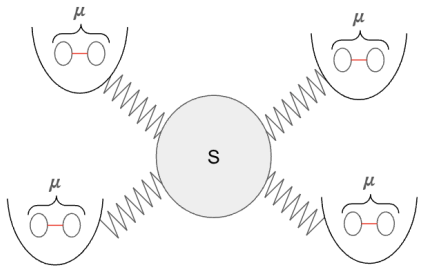
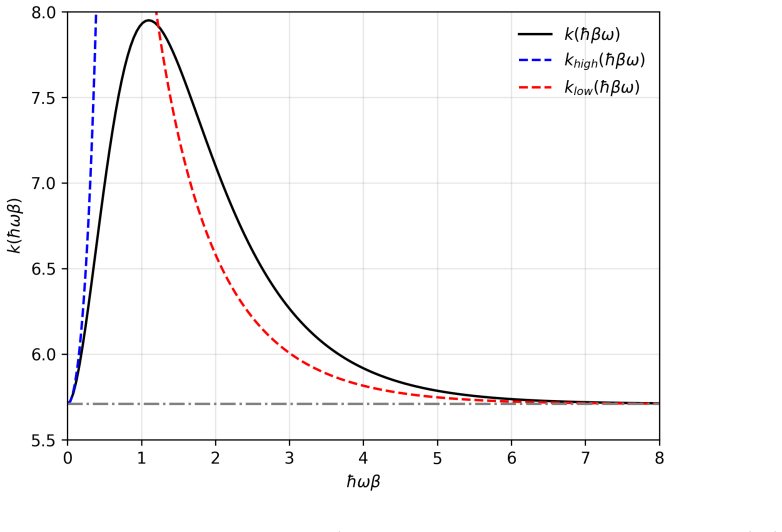
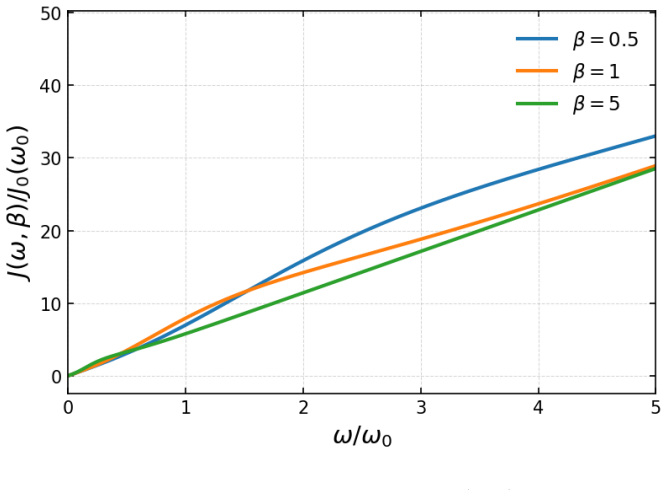
We generalize the formalism of open quantum systems to introduce anyon baths. In particular, we work out a dissipative anyon bath composed of independent pairs of one-dimensional Grundberg-Hansson harmonically bound anyons, which are characterized by one statistical parameter. Using a mapping of these anyons to a bosonic bath with rescaled oscillator frequencies, we show that the original bilinear system-bath coupling assumes a particular non-polynomial form. To determine the relaxation properties, we use the imaginary-time path integral formalism together with a generalization of Wick's theorem in the form of a smearing formula. The latter allows to approximately calculate the anyon bath spectral density, which acquires a nontrivial temperature dependence. The corresponding relaxation dynamics of the dissipative harmonic oscillator in an anyon bath is found. Well defined limits are revealed for both low and high temperatures. Anyonic features turn out to be most pronounced in the regime of intermediate temperatures.
Editorial analysis
A structured set of objections, weighed in public.
Referee Report
Summary. The manuscript generalizes open quantum systems to anyon baths composed of independent pairs of one-dimensional Grundberg-Hansson harmonically bound anyons characterized by a single statistical parameter. It maps these anyons to a bosonic bath with rescaled oscillator frequencies, converting the bilinear system-bath coupling into a non-polynomial form. Using the imaginary-time path integral formalism together with a smearing formula that generalizes Wick's theorem, the anyon bath spectral density is approximated and shown to acquire nontrivial temperature dependence. The relaxation dynamics of the dissipative quantum harmonic oscillator in this bath are derived, with well-defined limits at low and high temperatures and anyonic features reported to be most pronounced at intermediate temperatures.
Significance. If the central approximation is controlled, the work provides a tractable framework for incorporating fractional statistics into dissipative quantum dynamics, which could be relevant for modeling open systems in topological phases or fractional quantum Hall contexts. The identification of an intermediate-temperature regime where anyonic effects dominate offers a falsifiable prediction that distinguishes the model from standard bosonic baths. The mapping and path-integral approach are strengths that allow analytic progress, though their accuracy must be verified.
major comments (2)
- [Spectral density and smearing formula] The smearing formula is used to approximate the anyon bath spectral density after the anyon-to-boson mapping (which rescales frequencies and produces non-polynomial coupling). No quantitative error bounds, convergence analysis, or explicit checks against exact results in the bosonic limit (integer values of the statistical parameter) are supplied. This is load-bearing for the central claim, as the reported nontrivial temperature dependence of the spectral density—and thus the conclusion that anyonic features are most pronounced at intermediate temperatures—originates directly from this approximation.
- [Anyon-to-boson mapping] The mapping of Grundberg-Hansson harmonically bound anyon pairs to a bosonic bath is asserted to preserve the essential dissipative physics while allowing the bilinear coupling to be treated via the smearing formula. However, the manuscript does not demonstrate how the rescaling affects the bath correlation functions or provide a limit check showing recovery of standard Caldeira-Leggett results when the statistical parameter becomes integer. This justification is necessary to support the validity of the subsequent relaxation dynamics.
minor comments (2)
- [Abstract] The abstract states that 'well defined limits' are revealed for low and high temperatures but does not specify their explicit forms (e.g., recovery of Markovian or non-Markovian regimes); stating these limits briefly would improve readability.
- [Introduction] The range and physical meaning of the statistical parameter could be stated more explicitly in the introduction, including how it interpolates between bosonic and fermionic cases, to aid readers outside the anyon literature.
Simulated Author's Rebuttal
We thank the referee for their thorough review and insightful comments on our manuscript. We address each major comment below and outline the revisions we plan to make to improve the clarity and rigor of the presentation.
read point-by-point responses
-
Referee: [Spectral density and smearing formula] The smearing formula is used to approximate the anyon bath spectral density after the anyon-to-boson mapping (which rescales frequencies and produces non-polynomial coupling). No quantitative error bounds, convergence analysis, or explicit checks against exact results in the bosonic limit (integer values of the statistical parameter) are supplied. This is load-bearing for the central claim, as the reported nontrivial temperature dependence of the spectral density—and thus the conclusion that anyonic features are most pronounced at intermediate temperatures—originates directly from this approximation.
Authors: We agree that the absence of quantitative error bounds and explicit checks against the bosonic limit represents a gap in the current manuscript. The smearing formula provides an approximate evaluation of the anyonic correlation functions via a generalization of Wick's theorem, and while it is motivated by the structure of the mapped operators, we did not supply a dedicated error analysis or numerical validation in the original submission. In the revised manuscript we will add a new subsection that (i) derives an analytical estimate of the approximation error in the high-temperature limit, (ii) demonstrates exact recovery of the bosonic spectral density when the statistical parameter is an integer, and (iii) presents a direct numerical comparison of the approximated versus exact spectral density for representative integer values of the parameter. These additions will make the control of the central approximation explicit. revision: yes
-
Referee: [Anyon-to-boson mapping] The mapping of Grundberg-Hansson harmonically bound anyon pairs to a bosonic bath is asserted to preserve the essential dissipative physics while allowing the bilinear coupling to be treated via the smearing formula. However, the manuscript does not demonstrate how the rescaling affects the bath correlation functions or provide a limit check showing recovery of standard Caldeira-Leggett results when the statistical parameter becomes integer. This justification is necessary to support the validity of the subsequent relaxation dynamics.
Authors: The mapping is constructed so that the statistical phase of the anyons is absorbed into a rescaling of the oscillator frequencies while preserving the form of the bilinear system-bath interaction. This rescaling propagates directly into the bath spectral density and the associated imaginary-time correlation functions that enter the path-integral expression for the relaxation rates. In the integer limit the phase factor vanishes and the rescaled frequencies revert to their bare values, recovering the standard Caldeira-Leggett spectral density. We acknowledge that the original manuscript presents this recovery only implicitly. In the revision we will insert an explicit derivation of the post-mapping bath correlation functions together with a dedicated paragraph that verifies the reduction to the bosonic Caldeira-Leggett model, thereby confirming consistency of the relaxation dynamics with established results. revision: yes
Circularity Check
No circularity: forward derivation from mapping and smearing formula
full rationale
The paper constructs the anyon bath via the stated mapping to rescaled bosonic oscillators, then applies the smearing formula (generalized Wick theorem) as an explicit approximation to obtain the T-dependent spectral density, from which the relaxation dynamics follow by standard path-integral methods. No step reduces a claimed prediction to a fitted parameter, self-definition, or load-bearing self-citation; the intermediate-T features are outputs of the approximation rather than inputs, and low/high-T limits are reported as consistency checks. The derivation chain is therefore self-contained against external benchmarks.
Axiom & Free-Parameter Ledger
free parameters (1)
- statistical parameter
axioms (2)
- domain assumption Mapping of Grundberg-Hansson anyon pairs to bosonic oscillators with rescaled frequencies
- domain assumption Generalized Wick's theorem via smearing formula
invented entities (1)
-
Anyon bath composed of independent pairs of 1D Grundberg-Hansson harmonically bound anyons
no independent evidence
discussion (0)
Sign in with ORCID, Apple, or X to comment. Anyone can read and Pith papers without signing in.