REVIEW 3 major objections 4 minor 41 references
Shedding light on the origin of the broken misaligned circumtriple disk around GW Ori
T0 review · 3 major / 4 minor · reviewed 2026-08-11 · deepseek-v4-flash
Pith's one-line read The broken misaligned circumtriple disk around GW Ori is unlikely to have been produced by the torque of its three stars, because the disk is too thick to break under those forces.
desk verdict A useful reconciliation of the GW Ori disk-breaking disagreement, but the analytic H/r estimate likely overestimates the disk thickness by using the primary mass instead of the total triple mass, making the central conclusion fragile. read the letter →
The pith
A machine-rendered reading of the paper's core claim, the machinery that carries it, and where it could break.
The reading
What carries the argument
The disk aspect ratio H/r is the controlling quantity. It determines whether the warp evolves in the bending wave regime (H/r > alpha) or the diffusive regime (H/r < alpha), and thinner disks break more easily because pressure communicates less effectively across radii. The paper estimates H/r from the irradiated flaring disk temperature profile (Equations 4 and 5) and compares it to a simulation threshold between 0.02 and 0.05.
What would settle it
A measurement of GW Ori's disk scale height from resolved gas kinematics (e.g., millimeter-wave CO observations) at radii 40-100 au that yields H/r below 0.05 would place the disk in the regime where the stellar torque breaks it, supporting the stellar-torque interpretation over the planet interpretation.
Extended reading notes
Core claim
The central claim is that the GW Ori circumtriple disk is too thick to be torn apart by differential precession driven by the triple star system. Using 3D hydrodynamic simulations with two initial disk misalignments (38 and 28 degrees) and two disk aspect ratios, the paper finds that H/r = 0.02 leads to disk breaking while H/r = 0.05 remains intact. The observationally motivated aspect ratio from a simple irradiated flaring disk model, with a flaring angle of 0.02 and stellar luminosity of 48 solar luminosities, is H/r ~ 0.06 at 40 au, and never as low as 0.02. Therefore the broken inner disk most plausibly results from a circumtriple planet, not the stars.
Load-bearing premise
The conclusion depends on the assumption that the irradiated flaring disk model with flaring angle 0.02, luminosity 48 solar luminosities, and mean molecular weight 2.3 gives the true vertical thickness of GW Ori's disk, so the real H/r is about 0.06 at 40 au and never as low as 0.02.
Editorial extensions
If this is right
- The earlier claim that GW Ori's disk was torn by stellar torques rested on an atypically thin disk (H/r = 0.02); with the physically motivated thicker disk the torque does not break it.
- The observed misaligned rings and gap around GW Ori are more plausibly produced by one or more giant circumtriple planets, as proposed in earlier work.
- The disk breaking radius depends on the initial misalignment: about 70 au for a 38-degree tilt and 95 au for a 28-degree tilt.
- Protoplanetary disks generally have H/r above 0.05 and lie in the bending wave regime, so similar disks around other multiple-star systems may resist breaking by stellar torques.
Reading between the lines
- The same aspect-ratio threshold could apply to other misaligned disks around binary and triple stars, making the disk's vertical thickness a quick discriminant between star-driven and planet-driven gap origins.
- If circumtriple planets are confirmed around GW Ori, it would imply that planet formation can proceed around the entire triple system, rather than only around individual stars.
- A testable extension is to run the same simulations with self-consistent vertical temperature structure from stellar irradiation, which may alter the breaking threshold.
- The dependence of breaking radius on initial tilt suggests that measuring the break location could constrain the original misalignment history of the disk.
Editorial analysis
A structured set of objections, weighed in public.
Referee Report
Summary. This letter revisits the origin of the misaligned broken disk around GW Ori. The authors run four 3D SPH simulations with Phantom for a circumtriple disk, varying the initial disk tilt (38 and 28 degrees) and the constant aspect ratio H/r (0.02 and 0.05). They report that the thin disks break at 70-95 au while the thick disks do not. They then estimate the actual disk aspect ratio of GW Ori using an irradiated flaring-disk model (Eqs. 4 and 5), obtaining H/r ~ 0.06 at 40 au, and conclude that H/r ~ 0.02 is observationally unlikely. Therefore, they argue, stellar torques alone are unlikely to explain the observed gap, and a giant circumtriple planet scenario remains the most plausible alternative. The paper also claims that earlier conflicting SPH results are reconciled once the same parameters are used.
Significance. If the numerical result holds, the letter is a useful step: it isolates the disk aspect ratio as the key parameter controlling disk breaking in GW Ori and resolves an apparent contradiction between previous SPH studies. The four simulations are clearly designed, and the thin-versus-thick dichotomy is physically expected from warp-propagation theory. The paper does not, however, establish the planet hypothesis; that relies on prior work. The main new quantitative bridge to GW Ori is the Section 4 estimate of H/r, and this is the weakest part of the paper: the stellar mass used in Eq. (5) is unspecified, and when the total triple mass is used the estimated H/r drops to about 0.04 at 40 au, close to the numerical no-break threshold rather than comfortably above it. The observational-motivation claim therefore needs substantial revision.
major comments (3)
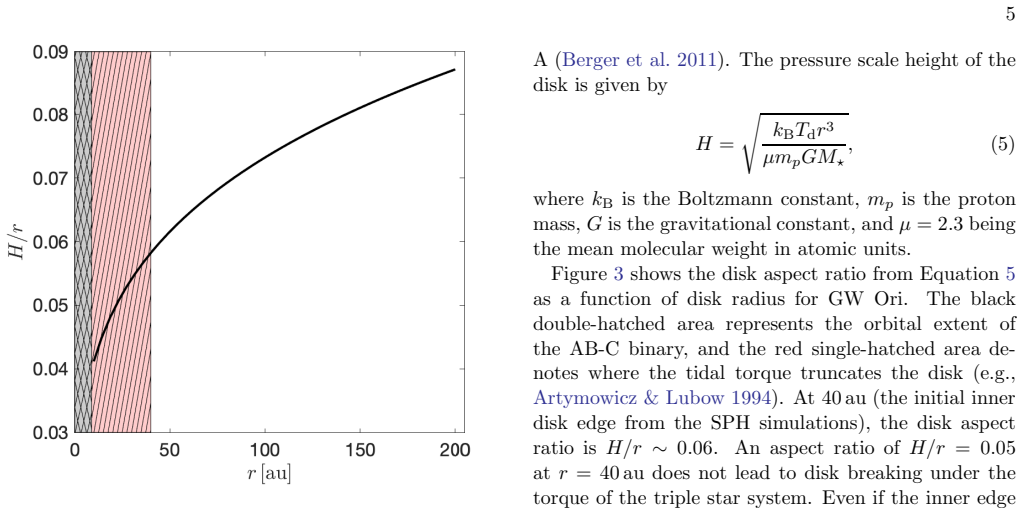
- [§4, Eq. (5)] The stellar mass M_* in Eq. (5) is never stated. Reproducing the quoted H/r ~ 0.06 at 40 au requires M_* ~ 2.4 M_sun, i.e., approximately the primary mass M_A alone. For a circumtriple disk at r = 40 au, roughly 4.5 times the outer binary separation, the appropriate mass entering the vertical hydrostatic balance is the total system mass M_A + M_B + M_C ~ 5.26 M_sun. With this mass and T_d ~ 52 K, Eq. (5) gives H/r ~ 0.04 at 40 au and H/r ~ 0.05 at 70-95 au, which are exactly the radii where the H/r = 0.02 simulations break. The observationally estimated disk is thus essentially at the H/r = 0.05 no-break threshold of Table 1, not safely above it. The authors should state M_* explicitly, justify its value for a circumtriple disk, recompute Figure 3, and propagate uncertainties in L_sun, phi, and mu. If the corrected value is below about 0.05, the abstract's conclusion that the disk is unlikely to break is not supported by the present simulations.
- [§2, Eq. (1) and §3] The initial surface density index is inconsistent. Section 2 states 'We set p = 0.5,' while Section 3 and the caption of Figure 2 state 'the initial power-law index is set to p = 1.5.' Because the surface density profile controls the angular-momentum distribution and can affect both the location and depth of a break, the authors must state which value was actually used, correct the contradiction, and comment on whether the breaking outcome is sensitive to p.
- [§4] The H/r estimate has no propagated errors and no sensitivity analysis. The claim that H/r = 0.02 is 'unlikely' rests on the fixed choices phi = 0.02, L_star = 48 L_sun, and mu = 2.3, with no uncertainty budget. After correcting Eq. (5) to use the total triple mass, the margin above the 0.05 threshold disappears, so the robustness of the conclusion depends on parameters such as the flaring angle, luminosity, and possible self-shadowing. A parameter scan over plausible phi and luminosity values, or at least an explicit statement of the resulting range in H/r, is needed before the observational-motivation argument can carry the central claim.
minor comments (4)
- [Figure 2 caption] The caption describes the initial surface density profile as a 'flat black line,' but a power-law profile with p = 0.5 or 1.5 is not flat in a log-log plot; this wording should be clarified.
- [References] The reference list contains two entries for Kraus et al. (2020) with different arXiv identifiers and no clear labeling of version 1 versus version 2; the text should make the version distinction explicit and consistent.
- [Title and abstract] The title uses 'circum triple disk' while the abstract and body use 'circumtriple disk'; the spelling should be harmonized.
- [Figure 3] The red-hatched 'tidal torque truncation' region is not defined quantitatively; the authors should state the criterion used, for example the cavity size estimate of Artymowicz and Lubow (1994).
Circularity Check
No load-bearing circularity: the no-break result is a genuine simulation outcome; Section 4's H/r estimate carries a parameter-identification caveat (M*) that is a robustness risk, not a circular construction.
full rationale
The paper's new claim (unlikely break for observationally motivated H/r) is not circular. The break/no-break dichotomy in Table 1 is a numerical outcome for fixed inputs (H/r=0.02 vs 0.05, i0=28/38 degrees, alpha~0.015), not a quantity fitted to match GW Ori's rings. The Section 4 aspect-ratio estimate is computed from standard passive-disk formulas (Eqs. 4-5) with literature values (phi=0.02, L*=48 Lsun, mu=2.3), and no parameter is tuned to force H/r>=0.05; the stated H/r~0.06 at 40 au is a direct substitution into those equations. The strongest caveat is a missing-support issue rather than circularity: the M* entering Eq. 5 is never specified, although the value 0.06 is consistent with using the primary mass M_A~2.47 Msun, while using the total triple mass ~5.26 Msun gives H/r~0.04 at 40 au and about 0.05 near the simulation break radius (70-95 au), eroding the margin above the no-break threshold. This is a robustness/correctness concern, not a construction in which the conclusion equals the input. The self-citation to Smallwood et al. (2021) supports the alternative planet scenario, but that scenario is an independent published simulation study, and the new stellar-torque result is demonstrated by the present runs.
Assumptions & free parameters
free parameters (6)
- Disk aspect ratio H/r =
0.02 and 0.05
- Flaring angle phi =
0.02
- Stellar luminosity Lstar =
48 Lsun
- Viscosity parameter alpha =
about 0.0151
- Surface density power-law index p =
0.5 in Section 2, 1.5 in Figure 2 caption
- Disk mass =
0.1 Msun
assumptions (6)
- domain assumption Protoplanetary disks typically have H/r greater than or similar to 0.05.
- domain assumption The simple irradiated flaring disk model with flaring angle phi=0.02 describes GW Ori's temperature structure.
- domain assumption Self-gravity is negligible and does not affect the nodal precession rate.
- domain assumption The disk can be modeled as locally isothermal with a constant aspect ratio.
- domain assumption Truncating the outer disk at 200 au preserves the relevant angular momentum distribution.
- standard math The Phantom SPH code correctly implements the equations of gas hydrodynamics for warped disks.
Cite this review
Pith. "Pith review of Shedding light on the origin of the broken misaligned circumtriple disk around GW Ori." pith.science (2026). https://pith.science/paper/I7SS2CRS
@misc{pith2026241214955,
  author       = {Pith},
  title        = {Pith review of: Shedding light on the origin of the broken misaligned circumtriple disk around GW Ori},
  year         = {2026},
  howpublished = {\url{https://pith.science/paper/I7SS2CRS}},
  note         = {Machine review of arXiv:2412.14955}
}
abstract
We revisit the origin of the observed misaligned rings in the circumtriple disk around GW Ori. Previous studies appeared to disagree on whether disk breaking is caused by the differential precession driven in the disk by the triple star system. In this letter, we show that the previous studies are in agreement with each other when using the same set of parameters. But for observationally motivated parameters of a typical protoplanetary disk, the disk is unlikely to break due to interactions with the triple star system. We run 3-dimensional hydrodynamical simulations of a circumtriple disk around GW Ori with different disk aspect ratios. For a disk aspect ratio typical of protoplanetary disks, $H/r \gtrsim 0.05$, the disk does not break. An alternative scenario for the gap's origin consistent with the expected disk aspect ratio involves the presence of giant circumtriple planets orbiting GW Ori.
Figures


Reference graph
Works this paper leans on
-
[1]
Artymowicz, P., & Lubow, S. H. 1994, ApJ, 421, 651, doi: 10.1086/173679
doi:10.1086/173679 1994
-
[2]
Bate, M. R. 2018, MNRAS, 475, 5618, doi: 10.1093/mnras/sty169
-
[3]
Bate, M. R., Bonnell, I. A., & Price, N. M. 1995, MNRAS, 277, 362, doi: 10.1093/mnras/277.2.362
-
[4]
Benz, W., Bowers, R. L., Cameron, A. G. W., & Press, W. H. . 1990, ApJ, 348, 647, doi: 10.1086/168273
doi:10.1086/168273 1990
-
[5]
Berger, J. P., Monnier, J. D., Millan-Gabet, R., et al. 2011, A&A, 529, L1, doi: 10.1051/0004-6361/201016219
-
[6]
2020, ApJL, 895, L18, doi: 10.3847/2041-8213/ab8eb4
Bi, J., van der Marel, N., Dong, R., et al. 2020, ApJL, 895, L18, doi: 10.3847/2041-8213/ab8eb4
-
[7]
2022, MNRAS, 514, 906, doi: 10.1093/mnras/stac1390
Ceppi, S., Cuello, N., Lodato, G., et al. 2022, MNRAS, 514, 906, doi: 10.1093/mnras/stac1390
-
[8]
Chiang, E. I., & Goldreich, P. 1997, ApJ, 490, 368, doi: 10.1086/304869 D’Alessio, P., Cant¨ o, J., Calvet, N., & Lizano, S. 1998, ApJ, 500, 411, doi: 10.1086/305702
doi:10.1086/304869 1997
Show all 41 references
-
[9]
J., & Lodato, G
Dipierro, G., Laibe, G., Price, D. J., & Lodato, G. 2016, MNRAS, 459, L1, doi: 10.1093/mnrasl/slw032
2016 doi
-
[10]
2018, ApJ, 866, 110, doi: 10.3847/1538-4357/aadadd Doˇ gan, S., Nixon, C
Dong, R., Li, S., Chiang, E., & Li, H. 2018, ApJ, 866, 110, doi: 10.3847/1538-4357/aadadd Doˇ gan, S., Nixon, C. J., King, A. R., & Pringle, J. E. 2018, MNRAS, 476, 1519, doi: 10.1093/mnras/sty155
2018 doi
-
[11]
P., Dominik, C., & Natta, A
Dullemond, C. P., Dominik, C., & Natta, A. 2001, ApJ, 560, 957, doi: 10.1086/323057
2001 doi
-
[12]
P., Birnstiel, T., Huang, J., et al
Dullemond, C. P., Birnstiel, T., Huang, J., et al. 2018, ApJL, 869, L46, doi: 10.3847/2041-8213/aaf742
2018 doi
-
[13]
Facchini, S., Lodato, G., & Price, D. J. 2013, MNRAS, 433, 2142, doi: 10.1093/mnras/stt877
2013 doi
-
[14]
20 14, A&A, 570, A118, doi: 10.1051/0004-6361/201424146
Fang, M., Sicilia-Aguilar, A., Roccatagliata, V., et al. 20 14, A&A, 570, A118, doi: 10.1051/0004-6361/201424146
-
[15]
M., Hughes, A
Flaherty, K. M., Hughes, A. M., Rosenfeld, K. A., et al. 2015, ApJ, 813, 99, doi: 10.1088/0004-637X/813/2/99
2015 doi
-
[16]
M., Hughes, A
Flaherty, K. M., Hughes, A. M., Teague, R., et al. 2018, ApJ, 856, 117, doi: 10.3847/1538-4357/aab615 Garufi, A., Ginski, C., van Holstein, R. G., et al. 2024, A&A, 685, A53, doi: 10.1051/0004-6361/202347586
2018 doi
-
[17]
2021, ApJL, 908, L25, doi: 10.3847/2041-8213/abdf57 7
Ginski, C., Facchini, S., Huang, J., et al. 2021, ApJL, 908, L25, doi: 10.3847/2041-8213/abdf57 7
2021 doi
-
[18]
1998, ApJ, 495, 385, doi: 10.1086/305277
Hartmann, L., Calvet, N., Gullbring, E., & D’Alessio, P. 1998, ApJ, 495, 385, doi: 10.1086/305277
1998 doi
- [19]
-
[20]
K., et al
Kraus, S., Kreplin, A., Young, A. K., et al. 2020, arXiv e-prints, arXiv:2004.01204. https://arxiv.org/abs/2004.01204
2020 arXiv
-
[21]
K., et al
Kraus, S., Kreplin, A., Young, A. K., et al. 2020 v1, A triple star system with a misaligned and warped circumstellar disk shaped by disk tearing, doi: https://doi.org/10.1126/science.aba4633 Kuffmeier, M., Dullemond, C. P., Reissl, S., & Goicovic, F. G. 2021, A&A, 656, A161, d...
2020 doi
-
[22]
D., & Papaloizou, J
Larwood, J. D., & Papaloizou, J. C. B. 1997, MNRAS, 285, 288, doi: 10.1093/mnras/285.2.288
1997 doi
-
[23]
G., & Lubow, S
Lepp, S., Martin, R. G., & Lubow, S. H. 2023, ApJL, 943, L4, doi: 10.3847/2041-8213/acaf6d
2023 doi
-
[24]
2023, in Astronomical Society of the Pacific Conference Series, Vol
Lesur, G., Flock, M., Ercolano, B., et al. 2023, in Astronomical Society of the Pacific Conference Series, Vol. 534, Protostars and Planets VII, ed. S. Inutsuka, Y. Aikawa, T. Muto, K. Tomida, & M. Tamura, 465, doi: 10.48550/arXiv.2203.09821
-
[26]
J., & Nixon, C
Nealon, R., Price, D. J., & Nixon, C. J. 2015, MNRAS, 448, 1526, doi: 10.1093/mnras/stv014
2015 doi
-
[27]
2016, in Lecture Notes in Physics, Berlin Springer Verlag, ed
Nixon, C., & King, A. 2016, in Lecture Notes in Physics, Berlin Springer Verlag, ed. F. Haardt, V. Gorini, U. Moschella, A. Treves, & M. Colpi, Vol. 905, 45, doi: 10.1007/978-3-319-19416-5 2
2016 doi
-
[28]
2013a, MNRAS, 434, 1946, doi: 10.1093/mnras/stt1136 —
Nixon, C., King, A., & Price, D. 2013a, MNRAS, 434, 1946, doi: 10.1093/mnras/stt1136 —. 2013b, MNRAS, 434, 1946, doi: 10.1093/mnras/stt1136
1946 doi
-
[29]
Nixon, C. J. 2012, MNRAS, 423, 2597, doi: 10.1111/j.1365-2966.2012.21072.x
2012
-
[30]
Ogilvie, G. I. 1999, MNRAS, 304, 557, doi: 10.1046/j.1365-8711.1999.02340.x
1999
-
[31]
Papaloizou, J. C. B., & Pringle, J. E. 1983, MNRAS, 202, 1181, doi: 10.1093/mnras/202.4.1181
1983 doi
-
[32]
Papaloizou, J. C. B., & Terquem, C. 1995, MNRAS, 274, 987, doi: 10.1093/mnras/274.4.987
1995 doi
- [33]
-
[34]
Pinte, C., Dent, W. R. F., M´ enard, F., et al. 2016, ApJ, 816, 25, doi: 10.3847/0004-637X/816/1/25
2016 doi
-
[35]
Price, D. J. 2012, Journal of Computational Physics, 231, 759, doi: 10.1016/j.jcp.2010.12.011
2012 doi
-
[36]
J., & Federrath, C
Price, D. J., & Federrath, C. 2010, MNRAS, 406, 1659, doi: 10.1111/j.1365-2966.2010.16810.x
2010
-
[37]
J., Wurster, J., Tricco, T
Price, D. J., Wurster, J., Tricco, T. S., et al. 2018, PASA, 35, e031, doi: 10.1017/pasa.2018.25
2018 doi
-
[38]
Rabago, I., Zhu, Z., Lubow, S., & Martin, R. G. 2024, MNRAS, 533, 360, doi: 10.1093/mnras/stae1787
2024 doi
-
[39]
L., Nealon, R., Chen, C., et al
Smallwood, J. L., Nealon, R., Chen, C., et al. 2021, MNRAS, 508, 392, doi: 10.1093/mnras/stab2624
2021 doi
-
[40]
2016, A&A, 592, A49, doi: 10.1051/0004-6361/201628550
Teague, R., Guilloteau, S., Semenov, D., et al. 2016, A&A, 592, A49, doi: 10.1051/0004-6361/201628550
2016 doi
-
[41]
Whitworth, A. P. 2011, MNRAS, 417, 1817, doi: 10.1111/j.1365-2966.2011.19390.x
2011
-
[42]
K., Stevenson, S., Nixon, C
Young, A. K., Stevenson, S., Nixon, C. J., & Rice, K. 2023, MNRAS, 525, 2616, doi: 10.1093/mnras/stad2451
2023 doi
Reviewed August 11, 2026 · model on record in the stance chip above.
Discussion (0). Continue with ORCID to comment.