REVIEW 3 major objections 6 minor 23 references
Aligned language models often prefer the wrong answer in mid layers and only rescue correctness late—hiding fragility that compression and surface-only fine-tuning can expose.
Reviewed by Pith at T0; open to challenge. T0 means a machine referee read the full paper against a public rubric. the ladder, T0–T4 →
T0 review · grok-4.5
2026-07-11 15:57 UTC pith:IBP2FU7P
load-bearing objection Careful multi-model causal story of late rescue: item-level wrong-dip predicts structural compression risk, is recipe-specific, and can be trained down—scope is controlled instruments, not open dialogue. the 3 major comments →
Wrong Before Right: Late Rescue and Interface Failure in Aligned Language Models
The pith
A machine-rendered reading of the paper's core claim, the machinery that carries it, and where it could break.
Core claim
Correctness in aligned language models is often assembled by late rescue: mid-layer internal preference transiently commits to the wrong answer (the wrong-dip), and only late layers correct it. The phenomenon is measured by layer-wise difference-in-differences trajectories on polarity-controlled minimal pairs, verified causally by patchscope-style activation transplantation across 17 models spanning three families and 0.5B–32B, and shown to govern structural compression risk, post-training internal quality, and a separable class of natural-language evaluation failures while remaining invisible to output accuracy.
What carries the argument
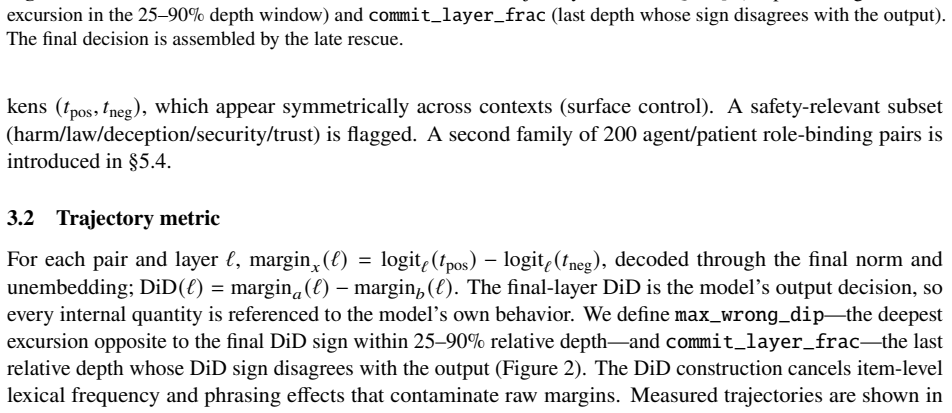
The wrong-dip, measured item-wise as max_wrong_dip (deepest wrong-direction excursion of the DiD trajectory in the 25–90% depth window) and commit_layer_frac (last relative depth whose internal preference still disagrees with the final output), and verified by transplanting mid-layer hidden states into a neutral decoding context so the model produces the wrong token.
Load-bearing premise
The load-bearing premise is that polarity-controlled minimal pairs scored by layer-wise difference-in-differences, plus mid-layer activation transplants into a neutral context, are a faithful enough proxy for how models assemble correctness on the relation-assembly tasks that matter in real deployment.
What would settle it
If items with large intact-model wrong-dips do not flip at substantially higher rates than low-dip items under genuine late-layer structural damage (low-rank compression, block dropping, or structured pruning) on held-out natural vignettes with semantic-candidate readouts—while the same items remain unpredictive under quantization—the late-rescue account would fail.
If this is right
- High-dip items on the intact model are 3–7× more likely to flip under late-layer low-rank compression, block dropping, or structured pruning, while quantization flips are dip-blind.
- Output-only supervised fine-tuning can reach perfect surface accuracy while worsening the causal internal dip by up to 2.8×, increasing hidden structural risk.
- A LoRA fine-tune that adds a mid-layer wrong-margin hinge penalty can cut the causal dip 67–70% at matched accuracy and transfer mid-layer compression robustness.
- Alignment amplification of the causal dip is recipe-specific and emergent (appears at 3B and peaks at 32B in Qwen2.5; reverses in Llama-3-8B), so the dip audits recipes rather than alignment itself.
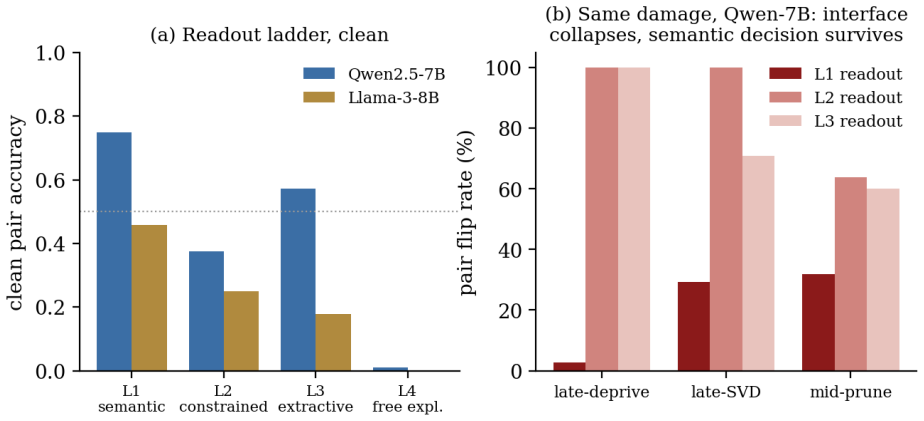
- Once readouts are controlled, free-form evaluation fragility separates into a dip-auditable late-rescue failure and a dip-blind interface-binding failure.
Where Pith is reading between the lines
- Safety and capability certifications that look only at final answers may systematically overstate reliability for models that will later be pruned, low-rank compressed, or further fine-tuned.
- Family differences in how correctness is delegated (late-layer patch versus mid-layer rewrite) may help explain known gaps in low-bit quantization survival without separate ad-hoc mechanisms for each failure mode.
- Tracking the wrong-dip after output accuracy saturates could become a practical post-training monitor that flags recipes polishing only the surface before any compression test is run.
- If relational assembly load drives the dip, multi-binding tasks may be the primary hidden failure surface under structural damage even when single-token accuracy looks intact.
Editorial analysis
A structured set of objections, weighed in public.
Referee Report
Summary. The paper argues that output-level correctness in aligned LMs can hide a late-rescue process: on polarity-controlled minimal pairs, mid-layer DiD trajectories (25–90% depth) transiently prefer the incorrect answer (the wrong-dip), and late layers correct it. The dip is verified causally by patchscope-style mid-layer activation transplantation across 17 models (three families, 0.5B–32B). Four claims follow: (1) alignment amplification of the causal dip is recipe-specific and emergent (emerges at 3B in Qwen2.5, peaks at 32B; reverses in Llama-3-8B); (2) intact-model dip predicts item flips under late-layer SVD, block dropping, and structured pruning (3–7×) but not under quantization—a double dissociation confirmed by late residual attenuation; (3) a mid-layer wrong-margin LoRA penalty matches output-only SFT accuracy while cutting the causal dip 67–70% and improving mid-SVD retention, whereas output-only SFT can worsen the causal dip up to 2.8×; (4) with semantic-candidate readouts the phenomenon extends to naturalistic vignettes, and free-form fragility separates into a dip-auditable late-rescue layer and a dip-blind interface layer.
Significance. If the results hold, the paper supplies a concrete, item-level account of how correctness is assembled rather than merely whether the final answer is right, with direct consequences for structural compression risk, post-training quality, and evaluation design. Strengths that raise the contribution above a pure observational finding include: causal patchscopes on the full n=278 set across the scale ladder; de-circularized prediction (dip always measured on the intact model); causal re-measurement of all trained arms; multi-seed McNemar significance for 7B robustness transfer; and an explicit structural-vs-quantization double dissociation with late residual deprivation. The recipe taxonomy and training-time monitor are practically useful. External validity to fully open-ended dialogue remains a stated scope boundary, but within the controlled instruments the evidence is unusually thorough for an internal-mechanism paper.
major comments (3)
- §5.6 Acts 1–4 and Limitations: free-generation mechanism stratification is left open, and free-form failure is shown to be cliff-like and family-dependent under the damage titration. Finding (4) and the abstract claim that free-form fragility separates into a dip-auditable late-rescue layer and a dip-blind interface layer therefore rest primarily on the semantic-candidate (L1) and constrained (L2) rungs of the bridge ladder, not on open generation. The paper should either (a) report a successful mild-damage free-generation stratification on the graded Llama regime, or (b) narrow the abstract/§8 claim so that the interface split is stated only for controlled semantic/constrained readouts, with free-generation listed as feasibility-only.
- §5.7 and Limitations: the relational-complexity ladder’s long-distance tier was retired post hoc as a design flaw (redundant cue near the query). The upgrade from a “negation finding” to a “relation-assembly under late correction budget” claim therefore rests on the remaining three tiers plus the agent/patient pairs. A short sensitivity check—re-running the two-relation peak after removing any residual surface confounds, or replacing the retired tier with a clean long-distance construction—would make the core-mechanism claim load-bearing rather than provisional.
- §6.3–6.5 and Table 4: multi-seed significance and the dip→retention forecast are established for mid-SVD r64 on Qwen2.5-7B (and partially on 1.5B), but late-SVD and block-drop transfer of the regularizer are not reported with the same seed structure, and Llama-8B ceilings the retention scale. Because the audit’s strongest predictive signal is late-layer structural damage (§5.2–5.3), the intervention’s claim that “the fix transfers to structural-compression robustness” should either include late-SVD/block-drop McNemar results or be scoped explicitly to mid-layer structural operators.
minor comments (6)
- §3.3: the raw-logit-lens overestimate for Llama (0.72 vs causal 0.023) is an important methodological warning; consider elevating it to a short boxed note or table so cross-family readers do not miss it.
- Figure 3 / Figure 5: axis labels and depth-window shading for the 25–90% band would make the wrong-dip visually self-explanatory without the caption.
- Table 1: report exact n and whether the paired t is two-sided; a one-line note on multiple-comparison handling across the ladder would help.
- §6.1: the hinge depth band (30–85%) and λ grid are free parameters; a one-sentence ablation or default-choice justification would reduce the free-parameter list.
- Reproducibility Statement: the public repository link is promised for the arXiv update; ensure the three-tier package (no-GPU / 24GB / 96GB) is actually present before camera-ready.
- Typos / style: “isassembledinside” (abstract), “genuinestructural”, “difference-in-differences (DiD) trajectories” is fine but DiD is sometimes written without expansion on first use in §3.
Circularity Check
No significant circularity: claims are empirical measurements with explicit de-circularization (intact-model dips, causal patchscopes, out-of-domain lens), not results forced by definition or self-citation.
full rationale
This is an empirical/mechanistic paper, not a first-principles derivation. The wrong-dip is defined from layer-wise DiD trajectories (margin_a − margin_b, referenced to the model’s own final DiD sign) and then independently stress-tested: (i) mid-layer states transplanted into neutral contexts drive the wrong token (patchscopes, n=278, 12 ladder models); (ii) dips used to predict compression flips are always measured on the intact model before damage; (iii) late residual attenuation selectively flips high-dip items; (iv) training effects optimized on logit-lens margins are re-measured with causal patchscopes, cutting the causal dip 67–70% while output-only SFT worsens it; (v) an out-of-domain tuned lens restores the dip that an in-domain lens shrinks. These steps break the main circularity risks (lens circularity, post-damage circularity, probe learning the phenomenon). There are no load-bearing self-citations by the author, no uniqueness theorems imported from prior own work, no fitted parameters renamed as predictions of the same quantity, and no mere renaming of a known result without new item-level causal/predictive content. The DiD’s reference to final output is a measurement design choice, not a claim that Y is derived from X when X is defined as Y. Scope limits (free-generation stratification left open, retired ladder tier) are external-validity issues, not circularity. Score 0 is therefore the correct finding.
Axiom & Free-Parameter Ledger
free parameters (4)
- max_wrong_dip depth window (25–90% relative depth)
- dip-regularization hinge depth band (30–85%) and λ ∈ {0.05, 0.2, 0.5}
- late residual attenuation fraction (last 15% of blocks) and α grid
- compression ranks / prune fractions / block-drop fraction (e.g., SVD r64/r128, 50% channel prune, 12.5% depth drop)
axioms (5)
- domain assumption Layer-wise DiD of polarity-controlled minimal pairs cancels item-level lexical frequency and phrasing confounds so residual sign tracks internal preference relative to the model’s own final decision.
- domain assumption Transplanting a mid-layer hidden state into a neutral decoding context (patchscopes) reveals the token preference causally carried by that representation.
- domain assumption Late-layer low-rank compression, block dropping, and structured pruning preferentially consume a late correction budget, whereas whole-depth quantization damages more diffusely.
- domain assumption Single-token or semantic-candidate logprob readouts, when length-controlled at the DiD level, are valid bridges from internal preference to naturalistic vignette decisions.
- standard math Standard transformer residual-stream decoding through final norm and unembedding yields meaningful intermediate margins (logit/tuned lens).
invented entities (3)
-
wrong-dip (max_wrong_dip and commit_layer_frac)
independent evidence
-
late-rescue production process / late correction budget
no independent evidence
-
dip-blind answer-interface layer
no independent evidence
read the original abstract
We study how correctness is assembled inside aligned language models, not only whether the final answer is right. Using layer-wise difference-in-differences (DiD) trajectories over polarity-controlled minimal pairs, we identify the wrong-dip: in mid layers (25-90% depth), internal preference transiently commits to the incorrect answer and is rescued only by late-layer correction. We verify this causally with patchscope-style activation transplantation across 17 models, three families, and 64x scale (0.5B-32B). Four findings follow. (1) Alignment amplification of the causal wrong-dip is recipe-specific and emergent: it emerges at 3B in Qwen2.5, remains high, and peaks at 32B (paired t up to 9.7), reverses in Llama-3-8B (t=-2.31), and sits between for Mistral-7B. (2) The dip predicts real compression failures: high-dip items are 3-7x more likely to flip under late-layer low-rank compression, block dropping, or structured pruning, while quantization flips are dip-blind, a double dissociation confirmed by late-layer ablation. (3) The dip is trainable: a LoRA fine-tune with a mid-layer wrong-margin penalty matches output-only SFT accuracy while cutting the causal dip by 67-70% and improving compression robustness; output-only SFT worsens the causal dip by up to 2.8x at perfect surface accuracy. (4) With controlled readouts, the phenomenon survives natural-language I/O: dip stratification of structural-damage failures is significant on naturalistic vignettes, and free-form fragility separates into a dip-auditable late-rescue layer and a dip-blind interface layer. Together, output-level correctness can hide a late-rescue process that governs compression risk, post-training quality, and evaluation distortion.
Figures






Reference graph
Works this paper leans on
-
[1]
Interpreting GPT: the logit lens
nostalgebraist. Interpreting GPT: the logit lens. Blog post,LessWrong, 2020.https://www.lesswrong.com/ posts/AcKRB8wDpdaN6v6ru/interpreting-gpt-the-logit-lens
2020
-
[2]
Eliciting latent predictions from transformers with the tuned lens.arXiv:2303.08112, 2023
Belrose, N., et al. Eliciting latent predictions from transformers with the tuned lens.arXiv:2303.08112, 2023
Pith/arXiv arXiv 2023
-
[3]
Patchscopes: A unifying framework for inspecting hidden representations of language models.ICML, 2024
Ghandeharioun, A., et al. Patchscopes: A unifying framework for inspecting hidden representations of language models.ICML, 2024
2024
-
[4]
Locating and editing factual associations in GPT.NeurIPS, 2022
Meng, K., et al. Locating and editing factual associations in GPT.NeurIPS, 2022
2022
-
[5]
Towards best practices of activation patching in language models: Metrics and methods
Zhang, F., Nanda, N. Towards best practices of activation patching in language models: Metrics and methods. ICLR, 2024
2024
-
[6]
Overthinking the truth: Understanding how language models process false demonstrations
Halawi, D., et al. Overthinking the truth: Understanding how language models process false demonstrations. arXiv:2307.09476, 2023
Pith/arXiv arXiv 2023
-
[7]
The hydra effect: Emergent self-repair in language model computations.arXiv:2307.15771, 2023
McGrath, T., et al. The hydra effect: Emergent self-repair in language model computations.arXiv:2307.15771, 2023
Pith/arXiv arXiv 2023
-
[8]
The unreasonable ineffectiveness of the deeper layers.arXiv:2403.17887, 2024
Gromov, A., et al. The unreasonable ineffectiveness of the deeper layers.arXiv:2403.17887, 2024
Pith/arXiv arXiv 2024
-
[9]
Men,X.,etal.ShortGPT:Layersinlargelanguagemodelsaremoreredundantthanyouexpect.arXiv:2403.03853, 2024
Pith/arXiv arXiv 2024
-
[10]
The truth is in there: Improving reasoning in language models with layer-selective rank reduction.ICLR, 2024
Sharma, P., Ash, J., Misra, D. The truth is in there: Improving reasoning in language models with layer-selective rank reduction.ICLR, 2024
2024
-
[11]
Emergent abilities of large language models.TMLR, 2022
Wei, J., et al. Emergent abilities of large language models.TMLR, 2022
2022
-
[12]
Are emergent abilities of large language models a mirage?NeurIPS, 2023
Schaeffer, R., Miranda, B., Koyejo, S. Are emergent abilities of large language models a mirage?NeurIPS, 2023
2023
-
[13]
LLM.int8(): 8-bit matrix multiplication for transformers at scale.NeurIPS, 2022
Dettmers, T., et al. LLM.int8(): 8-bit matrix multiplication for transformers at scale.NeurIPS, 2022
2022
-
[14]
GPTQ: Accurate post-training quantization for generative pre-trained transformers.ICLR, 2023
Frantar, E., et al. GPTQ: Accurate post-training quantization for generative pre-trained transformers.ICLR, 2023
2023
-
[15]
AWQ: Activation-aware weight quantization for LLM compression and acceleration.MLSys, 2024
Lin, J., et al. AWQ: Activation-aware weight quantization for LLM compression and acceleration.MLSys, 2024
2024
-
[16]
An empirical study of Qwen3 quantization.arXiv:2505.02214, 2025
Zheng, X., Li, Y., Chu, H., Feng, Y., Ma, X., Luo, J., Guo, J., Qin, H., Magno, M., Liu, X. An empirical study of Qwen3 quantization.arXiv:2505.02214, 2025
Pith/arXiv arXiv 2025
-
[17]
Decoding compressed trust: Scrutinizing the trustworthiness of efficient LLMs under compression
Hong, J., et al. Decoding compressed trust: Scrutinizing the trustworthiness of efficient LLMs under compression. ICML, 2024. 15
2024
-
[18]
Compressing LLMs: The truth is rarely pure and never simple.ICLR, 2024
Jaiswal, A., et al. Compressing LLMs: The truth is rarely pure and never simple.ICLR, 2024
2024
-
[19]
Representation engineering: A top-down approach to AI transparency.arXiv:2310.01405, 2023
Zou, A., et al. Representation engineering: A top-down approach to AI transparency.arXiv:2310.01405, 2023
Pith/arXiv arXiv 2023
-
[20]
LoRA: Low-rank adaptation of large language models.ICLR, 2022
Hu, E., et al. LoRA: Low-rank adaptation of large language models.ICLR, 2022
2022
-
[21]
Qwen2.5 technical report.arXiv:2412.15115, 2024
Yang, A., et al. Qwen2.5 technical report.arXiv:2412.15115, 2024
Pith/arXiv arXiv 2024
-
[22]
The Llama 3 herd of models.arXiv:2407.21783, 2024
Dubey, A., et al. The Llama 3 herd of models.arXiv:2407.21783, 2024
Pith/arXiv arXiv 2024
-
[23]
Mistral 7B.arXiv:2310.06825, 2023
Jiang, A., et al. Mistral 7B.arXiv:2310.06825, 2023. 16
Pith/arXiv arXiv 2023
discussion (0)
Sign in with ORCID, Apple, or X to comment. Anyone can read and Pith papers without signing in.