Hybrid quantum-classical physics-informed neural networks for solving nonlinear PDEs: when and where hybridization is effective?
Pith reviewed 2026-06-28 06:01 UTC · model grok-4.3
The pith
Hybrid quantum-classical PINNs achieve up to fivefold error reduction on stiff nonlinear PDEs by enriching the solution representation with a parameterized quantum circuit.
A machine-rendered reading of the paper's core claim, the machinery that carries it, and where it could break.
Core claim
The central claim is that carefully designed hybrid quantum-classical architectures mitigate key limitations of classical PINNs on nonlinear PDEs with sharp gradients, stiff dynamics, high-frequency content, or multiscale structure. By integrating a classical neural-network backbone with a parameterized quantum circuit, the HQPINN enriches the solution representation, leading to smoother training dynamics, reduced loss oscillations, and improved final accuracy. The largest gains occur in stiff and multiscale regimes, with relative L2 error decreasing by about fourfold for Burgers' equation and fivefold for the Allen-Cahn equation.
What carries the argument
The hybrid integration of a classical neural-network backbone with a parameterized quantum circuit (PQC) that enriches the function space for approximating PDE solutions.
If this is right
- Across all benchmarks, HQPINNs exhibit smoother training dynamics and reduced loss oscillations.
- Improved final accuracy is observed, with largest gains in stiff and multiscale regimes.
- Relative L2 error decreases by about fourfold for Burgers' equation and fivefold for the Allen-Cahn equation.
- Improvements for the KdV equation are more moderate.
- Systematic sensitivity analysis provides practical design guidance on qubit count, circuit depth, and placement.
Where Pith is reading between the lines
- Similar hybridization might benefit other neural network approaches to differential equations beyond the PINN framework.
- If the quantum circuit's role is confirmed, it could guide the development of hybrid models for high-dimensional or chaotic systems.
- The sensitivity results on collocation density and network width could be tested in purely classical settings to isolate effects.
Load-bearing premise
The observed accuracy gains arise specifically from the quantum circuit enriching the function space and mitigating spectral bias, rather than from incidental increases in total model capacity or differences in hyperparameter tuning.
What would settle it
An experiment that matches the total number of trainable parameters between the hybrid and classical models, uses identical hyperparameter optimization, and still finds no accuracy improvement in the hybrid version would falsify the claim that the quantum component drives the gains.
Figures
read the original abstract
Physics-informed neural networks (PINNs) often struggle on nonlinear partial differential equations (PDEs) with sharp gradients, stiff dynamics, high-frequency content, or multiscale structure. Such limitations, rooted in spectral bias, ill-conditioned optimization, and unstable convergence, restrict PINN accuracy in regimes where advanced solvers are most needed. In this work, we develop a hybrid quantum-classical physics-informed neural network (HQPINN) that integrates a classical neural-network backbone with a parameterized quantum circuit (PQC) to enrich the solution representation. The framework is benchmarked against a classical PINN on three representative nonlinear PDEs: Burgers' equation, the Allen-Cahn equation, and the Korteweg-de Vries (KdV) equation. The framework is further examined through a systematic sensitivity analysis of qubit count, circuit depth, PQC placement, collocation density, and classical-network width. Across all benchmarks, HQPINNs exhibit smoother training dynamics, reduced loss oscillations, and improved final accuracy, with the largest gains occurring in stiff and multiscale regimes. Relative L2 error decreases by about fourfold for Burgers' equation and fivefold for the Allen-Cahn equation, while improvements for the KdV equation are more moderate. Overall, the results demonstrate that carefully co-designed hybrid quantum-classical architectures can mitigate key limitations of classical PINNs and provide practical design guidance for near-term quantum-enhanced PDE solvers.
Editorial analysis
A structured set of objections, weighed in public.
Referee Report
Summary. The manuscript develops hybrid quantum-classical physics-informed neural networks (HQPINNs) that augment a classical neural-network backbone with a parameterized quantum circuit (PQC) to solve nonlinear PDEs. It benchmarks the approach against classical PINNs on Burgers' equation, the Allen-Cahn equation, and the Korteweg-de Vries equation, reporting smoother training dynamics, reduced loss oscillations, and improved final accuracy, with the largest gains in stiff and multiscale regimes. Relative L2 error reductions of approximately fourfold (Burgers') and fivefold (Allen-Cahn) are stated, alongside a sensitivity analysis over qubit count, circuit depth, PQC placement, collocation density, and classical-network width.
Significance. If the accuracy improvements can be shown to arise specifically from the PQC rather than from unmatched model capacity or tuning differences, the work would supply useful empirical guidance on when and where hybrid quantum-classical PINNs are advantageous, especially for stiff or multiscale problems. The systematic sensitivity sweeps constitute a clear strength that supports the practical-design claims.
major comments (1)
- [Abstract] Abstract: the central claim that HQPINNs deliver fourfold and fivefold L2-error reductions because the PQC enriches the function space or mitigates spectral bias requires that the classical PINN baseline possess equivalent total trainable parameters and receive identical hyperparameter-optimization effort. The abstract supplies no such statement, leaving open the possibility that observed gains are due to incidental capacity increases.
Simulated Author's Rebuttal
We thank the referee for the constructive comment on the abstract. We agree that explicit clarification of the baseline comparison is warranted and will revise the manuscript accordingly.
read point-by-point responses
-
Referee: [Abstract] Abstract: the central claim that HQPINNs deliver fourfold and fivefold L2-error reductions because the PQC enriches the function space or mitigates spectral bias requires that the classical PINN baseline possess equivalent total trainable parameters and receive identical hyperparameter-optimization effort. The abstract supplies no such statement, leaving open the possibility that observed gains are due to incidental capacity increases.
Authors: We agree that the abstract should explicitly state the conditions under which the comparison is performed. In the full manuscript the classical PINN baselines were constructed with matched total trainable parameter counts (via width/depth adjustments) and received comparable hyperparameter sweeps, as documented in the experimental setup and sensitivity sections. To remove any ambiguity we will revise the abstract to include a concise statement to this effect, e.g., “Classical PINN baselines are matched in total trainable parameters and receive equivalent hyperparameter optimization.” This change directly addresses the concern while preserving the reported accuracy gains. revision: yes
Circularity Check
No circularity in empirical benchmarking of hybrid vs classical PINNs
full rationale
The paper reports an empirical comparison of HQPINN against classical PINN baselines on Burgers', Allen-Cahn, and KdV equations, with sensitivity sweeps over architectural hyperparameters. No derivation chain, uniqueness theorem, or fitted-parameter-as-prediction is present; accuracy gains are presented as observed outcomes rather than mathematically forced by construction. The central claims rest on direct numerical benchmarks against independent classical models, with no self-citation load-bearing the results or ansatz smuggled via prior work. This is a standard self-contained experimental study.
Axiom & Free-Parameter Ledger
Reference graph
Works this paper leans on
-
[1]
1 Hybrid quantum-classical physics-informed neural networks for solving nonlinear PDEs: when and where hybridization is effective? Kaveh Zabihi1, Hamid Montazeri2,3, Akke S.J. Suiker1 1Chair of Applied Mechanics, Department of the Built Environment, Eindhoven University of Technology, PO Box 513, 5600 MB Eindhoven, The Netherlands 2Power & Flow Group, Dep...
2025
-
[2]
Reference Simulator Circuit Arch
Literature review of variational quantum and continuous-variable approaches for physics-informed neural network. Reference Simulator Circuit Arch. (No. qubits/qumodes) Sens. Analysis NN Type PDE Type (Dimension) Yew Leong et al., 2025 PL PQC (3) Arch, L Hybrid Euler (1D); Transonic airfoil flow (2D) Sedykh et al., 2024 QMware VQC (3) Qb, L Hybrid NS (3D) ...
2025
-
[3]
First, the input coordinates are processed by a classical feed-forward neural network, which transforms the low-dimensional physical inputs into a compact latent representation
The model consists of three main stages. First, the input coordinates are processed by a classical feed-forward neural network, which transforms the low-dimensional physical inputs into a compact latent representation. This classical backbone serves to extract structured, problem-adapted features from the input domain. Second, the latent representation is...
2022
-
[4]
with the rotation angle given by the corresponding latent component 𝑧': 𝑅*G𝑧𝑖H=expL−𝑖2𝑧' 𝜎+O=Pcos(𝑧'2)−𝑖 sin(𝑧'2)−𝑖 sin(𝑧'2)cos(𝑧'2)U (3) where 𝜎V+ denotes the Pauli-X operator. The resulting state of the 𝑖-th qubit is: |𝜓'(𝑧')⟩=𝑅*(𝑧')|0⟩=cos.𝑧'21X0⟩−𝑖 sin.𝑧'21X1⟩ (4) The full quantum state after encoding is given by the tensor product over all qubits: |𝛹...
2022
-
[5]
No problem-specific tuning of optimizer hyperparameters is introduced
is employed to refine the solution and improve final accuracy (Berger et al., 2025; Raissi et al., 2019; Urbán et al., 2025). No problem-specific tuning of optimizer hyperparameters is introduced. All models share the same optimizer schedule to ensure fair and controlled comparison across PDEs and sensitivity-analysis cases. Further discussion of the impa...
2025
-
[6]
These parameters are systematically varied to characterize their impacts on model accuracy, convergence behavior, and training stability across different PDE regimes
4.3 Sensitivity analysis To examine how HQPINN performance depends on quantum-circuit design, a structured sensitivity analysis is conducted with respect to two key quantum-resource parameters: the number of qubits, 𝑛#∈ {3,4,5,6,7}, and the number of variational layers 𝑚∈ {3,4,5,6,7}. These parameters are systematically varied to characterize their impact...
2021
-
[7]
Equation Grid resolution No
Numerical parameters and circuit configurations for the reference benchmark cases. Equation Grid resolution No. of qubits (𝑛!) No. of variational layers (m) No. of iterations Adam L-BFGS Burgers 256 × 100 5 5 200 300 Allen-Cahn 512 × 201 5 5 10000 15000 KdV 512 × 201 5 5 5000 5000 8 equation, reinforcing the observation that HQPINNs yield the largest gain...
2022
-
[8]
For Burgers’ equation (Fig
and ensures that neither initial/boundary constraints nor interior physics dominate the loss function. For Burgers’ equation (Fig. 7a), the HQPINN consistently achieves lower errors than the classical PINN across all sampling levels. The hybrid model is especially robust in the low-data regime (150 points), maintaining stable accuracy even with only 150 s...
2021
-
[9]
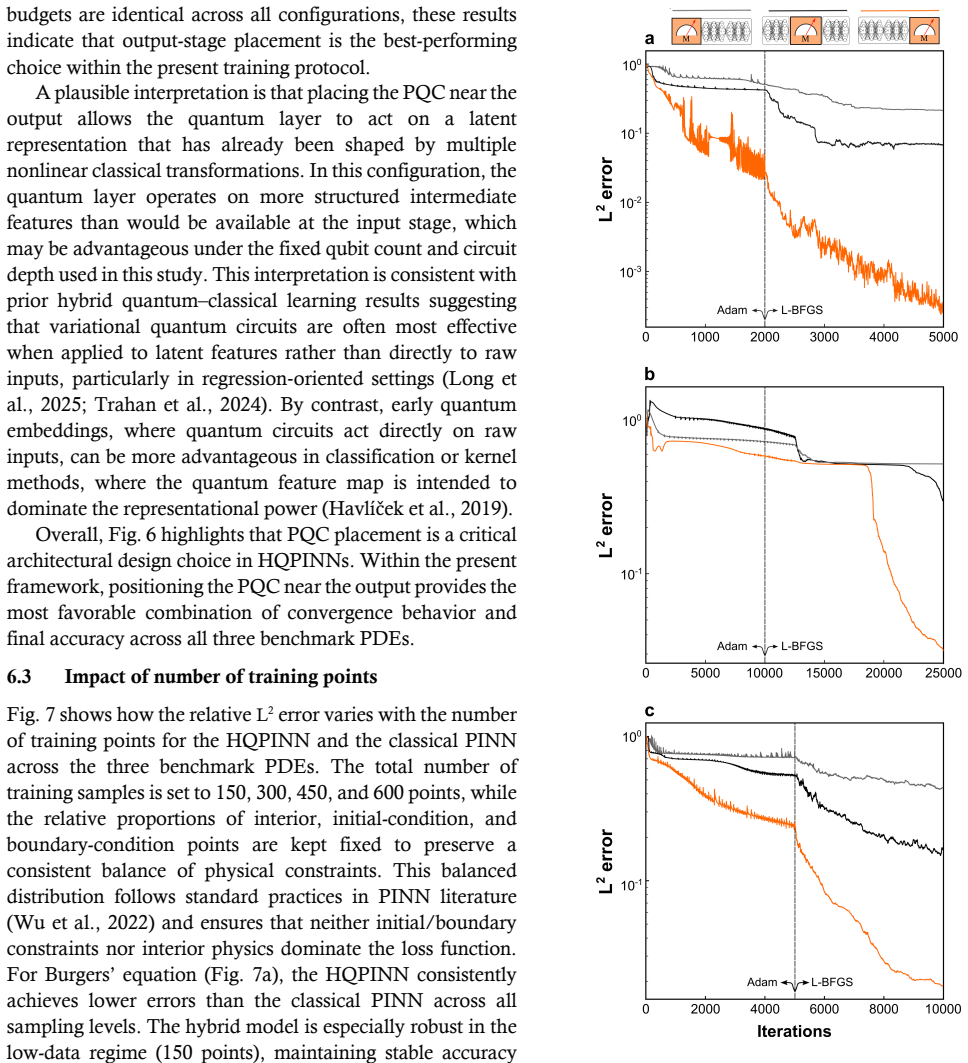
Sensitivity of HQPINN performance to the position of the parameterized quantum circuit for (a) Burgers’ equation, (b) Allen–Cahn equation, and (c) KdV equation. The relative L2 error s plotted against training iterations for three PQC placements: input stage, middle hidden-layer stage, and after the final classical hidden layer. Dashed vertical lines mark...
-
[10]
https://doi.org/10.1007/s10915-022-01939-z de Keijzer, R. J. P. T., Visser, L. Y., Tse, O., & Kokkelmans, S. J. (2025). Fidelity-enhanced variational quantum optimal control. Physical Review A 111, 052625. https://doi.org/10.1103/PhysRevA.111.052625 Dehaghani, N. B., Aguiar, A. P., & Wisniewski, R. (2024). A Hybrid Quantum-Classical Physics-Informed Neura...
-
[11]
https://doi.org/10.1038/s41467-018-07090-4 Michaloglou, A., Papadimitriou, I., Gialampoukidis, I., Vrochidis, S., & Kompatsiaris, I. (2025). Physics-informed neural networks in materials modeling and design: A review. Archives of Computational Methods in Engineering 33, 5223-5260. https://doi.org/10.1007/s11831-025-10448-9 Panichi, G., Corli, S., & Prati,...
-
[12]
https://doi.org/10.3390/e26080649 Urbán, J. F., Stefanou, P., & Pons, J. A. (2025). Unveiling the optimization process of physics informed neural networks: How accurate and competitive can PINNs be? Journal of Computational Physics 523, 113656. https://doi.org/10.1016/j.jcp.2024.113656 Vadyala, S. R., & Betgeri, S. N. (2023). General implementation of qua...
discussion (0)
Sign in with ORCID, Apple, or X to comment. Anyone can read and Pith papers without signing in.