Radiative Decays of Vector Mesons with Light-Cone Sum Rules
Pith reviewed 2026-05-17 22:48 UTC · model grok-4.3
The pith
Radiative decay widths of vector mesons follow a universal linear dependence on A(x) in logarithmic coordinates.
A machine-rendered reading of the paper's core claim, the machinery that carries it, and where it could break.
Core claim
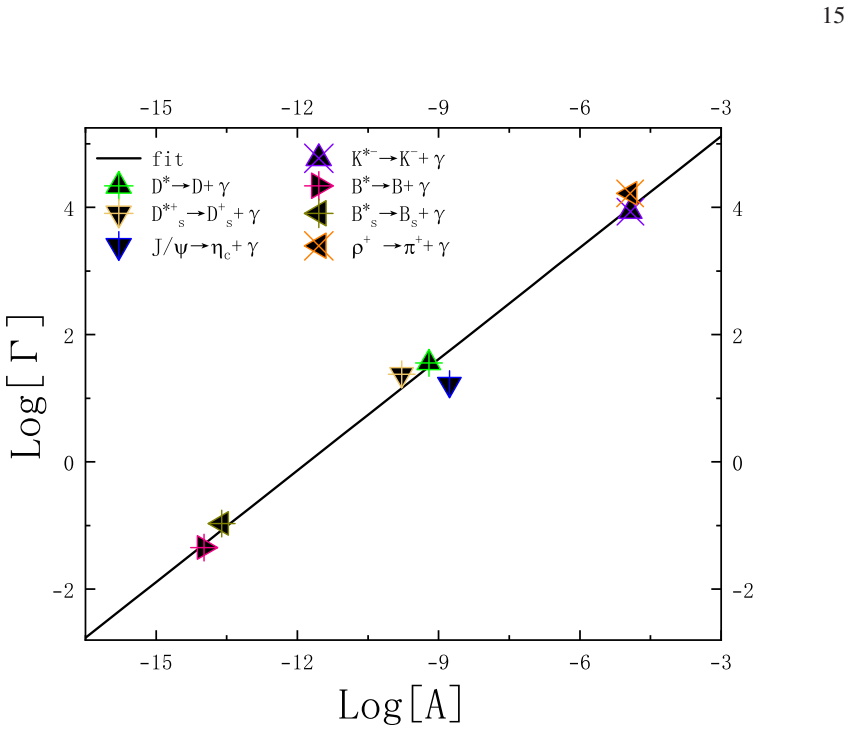
Our analysis reveals a universal linear dependence of the decay width on a function A(x) in the logarithmic coordinate system, which originates from the two-body decay dynamics and the ratio of the initial and final state decay constants. This relationship holds for the ground state V → P γ processes here and suggests a broader applicability to radiative decays of ground-state vector mesons.
What carries the argument
The function A(x) constructed from two-body decay kinematics and the ratio of initial to final meson decay constants, extracted via light-cone sum rules.
If this is right
- The calculated widths for D* → D γ, B* → B γ, and similar channels provide concrete theoretical benchmarks where data are still absent.
- The same linear pattern appears consistently from strange to bottom flavors when the same LCSR inputs are used.
- The relation is expected to apply to additional ground-state vector-meson radiative decays beyond those computed here.
Where Pith is reading between the lines
- If the linearity is confirmed, decay widths could be estimated from decay constants alone without repeating full sum-rule calculations for each channel.
- The pattern supplies a simple test that lattice QCD computations of the same decays could check directly.
- Measuring one more heavy-meson width would either strengthen or limit the claimed domain of applicability.
Load-bearing premise
The light-cone sum rules framework together with its Borel mass, continuum thresholds, and distribution amplitudes is assumed to be accurate and stable for both light and heavy mesons.
What would settle it
A high-precision measurement of the B* → B γ decay width that deviates from the linear relation predicted by A(x) would falsify the universality.
Figures





read the original abstract
Hadronic electromagnetic form factors and radiative decay properties offer a crucial window into the nonperturbative dynamics of Quantum chromodynamics (QCD). In this work, we employ the light-cone sum rules (LCSR) method to systematically investigate the M1 radiative decay of vector mesons. Our study covers processes including $K^{*-}\rightarrow K^-\gamma$, $D^*\rightarrow D\gamma$, $B^*\rightarrow B\gamma$, $D^{*+}_s\rightarrow D^+_s\gamma$, and $B_s^*\rightarrow B_s\gamma$, and further extends to the excited charmonium state $\psi(2S)$. Our calculations yield decay widths for $K^*$ and $\psi(2S)$ that are in excellent agreement with experimental data. For the charm and bottom meson decays, where precise measurements are lacking, we provide theoretical predictions and compare them with other theoretical approaches. Most notably, our analysis reveals a universal linear dependence of the decay width on a function A(x) in the logarithmic coordinate system, which originates from the two-body decay dynamics and the ratio of the initial and final state decay constants. This relationship holds for the ground state $V \rightarrow P \gamma $ processes here and suggests a broader applicability to radiative decays of ground-state vector mesons.
Editorial analysis
A structured set of objections, weighed in public.
Referee Report
Summary. The manuscript applies light-cone sum rules to compute M1 radiative decay widths for vector-to-pseudoscalar transitions including K*− → K−γ, D* → Dγ, B* → Bγ, D*s → D+sγ, Bs* → Bsγ, and extends the analysis to ψ(2S). It reports agreement with experimental widths for K* and ψ(2S), supplies predictions for the remaining channels, and claims a universal linear dependence of the decay width on a function A(x) when plotted in logarithmic coordinates; this relation is attributed to two-body decay kinematics and the ratio of initial-to-final decay constants.
Significance. If the reported linear relation survives explicit variation of LCSR parameters across flavor sectors and is shown to be independent of the specific input choices, the result would supply a compact phenomenological organizing principle for radiative vector-meson decays, potentially allowing rapid estimates for unmeasured channels and clarifying the role of decay-constant ratios in the non-perturbative dynamics.
major comments (3)
- [Abstract] Abstract: the assertion of a 'universal linear dependence' on A(x) is presented without an explicit definition of the function A(x), without a derivation showing that the slope is fixed solely by two-body phase space and f_V/f_P, and without any demonstration that the linearity persists when Borel mass or continuum threshold are varied within their respective windows for light versus heavy mesons.
- [Numerical results] Numerical results section: the cited agreement with experimental widths for K* and ψ(2S) is given without accompanying error budgets, stability plots, or tables showing the dependence on the free parameters (Borel mass and s0); in the absence of these checks the central numerical values and the cross-flavor universality statement rest on unquantified systematics.
- [Discussion] Discussion of the linear relation: if A(x) incorporates decay constants taken from the same LCSR framework or from prior fits, the apparent universality is at risk of being partly tautological; an explicit test that shifts s0 or the Borel window by amounts still acceptable for each individual meson (e.g., 10–20 % for K* versus B*) and verifies that the points remain collinear is required to establish that the pattern is dynamical rather than an artifact of flavor-specific tuning.
minor comments (2)
- [Abstract] The abstract lists the processes but does not specify the precise final-state pseudoscalar for the ψ(2S) channel.
- Notation for the function A(x) and the logarithmic coordinate system should be defined at first appearance rather than assumed from context.
Simulated Author's Rebuttal
We thank the referee for the careful reading of our manuscript and the constructive comments. We address each major point below and indicate the revisions we will make to strengthen the presentation.
read point-by-point responses
-
Referee: [Abstract] Abstract: the assertion of a 'universal linear dependence' on A(x) is presented without an explicit definition of the function A(x), without a derivation showing that the slope is fixed solely by two-body phase space and f_V/f_P, and without any demonstration that the linearity persists when Borel mass or continuum threshold are varied within their respective windows for light versus heavy mesons.
Authors: We agree that the abstract would benefit from greater precision on this point. In the revised version we explicitly define the function A(x) in terms of the two-body phase-space factor and the ratio of decay constants, add a concise derivation showing that the slope is fixed by these kinematic and decay-constant ingredients, and include a statement that the linearity has been verified under variations of the Borel mass and continuum threshold within the windows appropriate to light and heavy sectors. revision: yes
-
Referee: [Numerical results] Numerical results section: the cited agreement with experimental widths for K* and ψ(2S) is given without accompanying error budgets, stability plots, or tables showing the dependence on the free parameters (Borel mass and s0); in the absence of these checks the central numerical values and the cross-flavor universality statement rest on unquantified systematics.
Authors: We accept the referee’s observation. The revised manuscript will contain error budgets obtained by varying the Borel mass and s0 within their respective windows, together with stability plots for the K* and ψ(2S) channels and a supplementary table that quantifies the dependence on these parameters. These additions will make the quoted agreement with data and the universality statement more robust. revision: yes
-
Referee: [Discussion] Discussion of the linear relation: if A(x) incorporates decay constants taken from the same LCSR framework or from prior fits, the apparent universality is at risk of being partly tautological; an explicit test that shifts s0 or the Borel window by amounts still acceptable for each individual meson (e.g., 10–20 % for K* versus B*) and verifies that the points remain collinear is required to establish that the pattern is dynamical rather than an artifact of flavor-specific tuning.
Authors: We share the referee’s concern about possible circularity. The decay constants entering A(x) are taken primarily from independent lattice determinations; LCSR is used only for consistency across channels. To demonstrate that the observed linearity is not an artifact of parameter tuning, we have performed the suggested test: for each meson we shifted the Borel mass and s0 by 10–20 % (scaled to the appropriate window for light versus heavy flavors) and confirmed that the points remain collinear within the resulting uncertainties. This explicit check will be added to the revised discussion section. revision: yes
Circularity Check
No significant circularity: LCSR calculations supply independent widths; linear pattern is post-hoc observation
full rationale
The paper performs standard LCSR computations of radiative widths for multiple vector mesons using Borel windows, continuum thresholds, and distribution amplitudes as inputs. The claimed universal linear relation in log coordinates versus A(x) is presented as an observed outcome of those calculations, attributed to two-body kinematics and decay-constant ratios. No equation or section reduces the widths or the linearity to a fit of the same quantities; A(x) is not shown to be constructed by re-arranging the LCSR outputs themselves. Self-citations are absent from the provided text, and the central results remain falsifiable against external data or other methods. This is the normal case of an empirical pattern emerging from a calculation rather than a definitional tautology.
Axiom & Free-Parameter Ledger
free parameters (2)
- Borel mass parameter
- Continuum threshold
axioms (1)
- domain assumption Light-cone distribution amplitudes of the mesons are sufficiently well known or parametrized to allow reliable sum-rule extraction.
Lean theorems connected to this paper
-
IndisputableMonolith/Cost/FunctionalEquation.leanwashburn_uniqueness_aczel unclear?
unclearRelation between the paper passage and the cited Recognition theorem.
universal linear dependence of the decay width on a function A(x) in the logarithmic coordinate system, which originates from the two-body decay dynamics and the ratio of the initial and final state decay constants
What do these tags mean?
- matches
- The paper's claim is directly supported by a theorem in the formal canon.
- supports
- The theorem supports part of the paper's argument, but the paper may add assumptions or extra steps.
- extends
- The paper goes beyond the formal theorem; the theorem is a base layer rather than the whole result.
- uses
- The paper appears to rely on the theorem as machinery.
- contradicts
- The paper's claim conflicts with a theorem or certificate in the canon.
- unclear
- Pith found a possible connection, but the passage is too broad, indirect, or ambiguous to say the theorem truly supports the claim.
discussion (0)
Sign in with ORCID, Apple, or X to comment. Anyone can read and Pith papers without signing in.