REVIEW 4 major objections 7 minor 13 references
MVLight: Relightable Text-to-3D Generation via Light-conditioned Multi-View Diffusion
T0 review · 4 major / 7 minor · reviewed 2026-08-12 · deepseek-v4-flash
Pith's one-line read MVLight feeds HDR lighting into multi-view diffusion, enabling text-to-3D assets whose albedo and relighting separate cleanly.
desk verdict MVLight is a plausible engineering advance with a valuable dataset, but a renderer-conditioning mismatch in Stage 1 undercuts the central relighting claim. read the letter →
The pith
A machine-rendered reading of the paper's core claim, the machinery that carries it, and where it could break.
The reading
What carries the argument
The central object is the light-conditioned multi-view diffusion model MVLight. It injects an HDR environment map through a light cross-attention module, with the map decomposed into high-frequency (log-mapped detail) and low-frequency (tone-mapped color) components embedded via separate MLPs; learnable normal and albedo embeddings let the same network output those modalities. This model is then used as the score prior in a two-stage SDS pipeline: stage one optimizes a hash-grid NeRF with separate MLPs for density, albedo, and per-light ambient color, and stage two freezes geometry and fine-tunes albedo, roughness, and metallic MLPs while the diffusion model and PBR renderer share one HDR map.
What would settle it
Generate a fixed object from a fixed text prompt under two different HDR maps with MVLight, render the resulting PBR asset under a third unseen HDR map, and compare the albedo maps: if the albedo changes with the relighting environment, or if shading baked into the first render persists under the new light, the claimed decoupling is false. A second check is to compare MVLight's predicted normal map with the normal implied by its predicted shaded RGB under the known light direction; a systematic mismatch would show the independent modality outputs break SDS.
Extended reading notes
Core claim
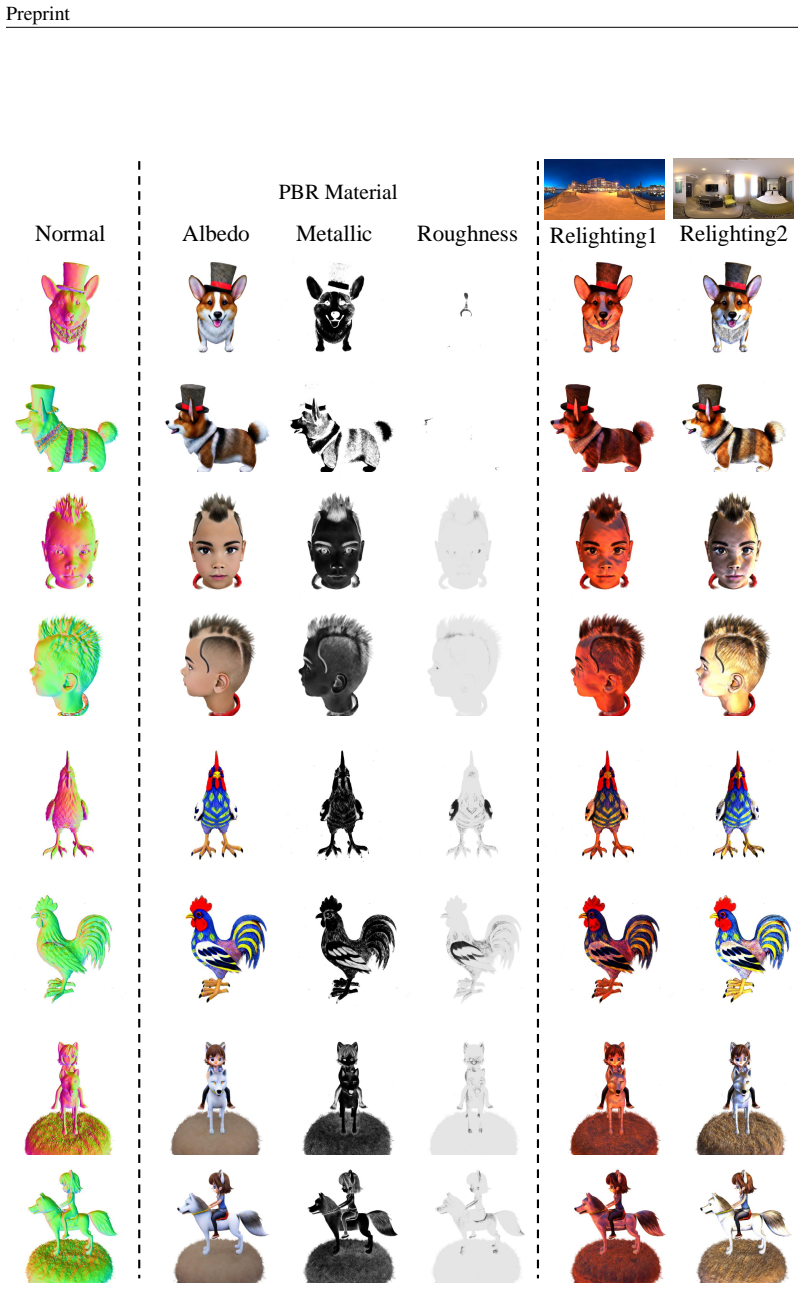
MVLight's central claim is that explicitly conditioning a multi-view diffusion model on an HDR lighting environment, and then using the identical HDR map during PBR material optimization, breaks the blind-estimation bottleneck in relightable text-to-3D generation. The model extends a multi-view U-Net with a light cross-attention module fed by high-frequency and low-frequency decompositions of the HDR map, and it learns to generate shaded RGB, normal maps, and albedo maps for multiple views under the specified light. Distilling these outputs through SDS jointly supervises geometry, albedo, and appearance, while the aligned lighting in the PBR fine-tuning stage prevents shadows and highlights from being baked into albedo. The authors demonstrate the claim with comparisons against prior PBR-based generators and a user study, reporting higher CLIP alignment and cleaner material decomposition.
Load-bearing premise
The method assumes the diffusion model's independently sampled normal, albedo, and RGB predictions are consistent enough that a single SDS gradient can push the 3D scene in one direction; the paper's own limitation section says there is no guarantee those modalities align because they are synthesized independently.
Editorial extensions
If this is right
- Text-to-3D generation can be made relightable without a second text-to-image model for PBR estimation; one light-conditioned multi-view model supplies geometry, albedo, and appearance.
- Sharing the HDR map between SDS and PBR fine-tuning prevents baked-in lighting, so relighting with unseen HDR environments preserves albedo.
- Jointly supervising normal, albedo, and RGB during SDS yields smoother normals and more distinct albedo than supervising color alone.
- Because albedo, normal, and shaded color come from one network, the approach inherits the text-to-image base's semantic flexibility for arbitrary prompts.
Reading between the lines
- A natural extension the author does not pursue is using the light-conditioned model for inverse rendering: given a single image, search over HDR maps and poses to recover both lighting and albedo; the trained light cross-attention would provide a prior for that search.
- If the modality-alignment limitation were fixed by cross-modal attention, the same HDR-conditioned prior could supervise material estimation directly without SDS, which would be a faster and more stable optimization.
- The 450 HDR maps used for training and 5 unseen maps for evaluation suggest the method's generality to arbitrary lighting is bounded by the diversity and dynamic range of those maps; testing on extreme synthetic or captured HDR probes would clarify that bound.
- The claim that alignment between diffusion and PBR lighting matters could be tested directly by ablating the HDR map sharing while holding the model fixed, which the paper only does indirectly through the blind-PBR comparison.
Editorial analysis
A structured set of objections, weighed in public.
Referee Report
Summary. The paper proposes MVLight, a multi-view diffusion model conditioned on HDR environment maps that jointly generates multi-view RGB, albedo, and normal maps. This model is then used for score distillation sampling (SDS) in a two-stage text-to-3D pipeline: stage 1 optimizes NeRF geometry and appearance with an albedo MLP and per-light ambient MLPs, and stage 2 fine-tunes PBR materials (albedo, roughness, metallic) with frozen geometry, using the same HDR map for both the diffusion prior and PBR rendering. The authors claim that this light-conditioned design yields better geometric fidelity, more accurate PBR material decomposition, and improved relighting compared with DreamFusion, Fantasia3D, MVDream, and RichDreamer, supported by qualitative results, a CLIP score table, an ablation, and a user study.
Significance. If the central claims hold, MVLight would be a useful step toward controllable relightable text-to-3D generation: a single multi-view diffusion model explicitly conditioned on lighting, with multi-modal outputs, is a natural extension of MVDream and addresses a real limitation of blind PBR estimation in prior work. The paper is strong on implementation detail, uses a large synthesized training corpus (about 8.6M images from 90k Objaverse objects), evaluates on HDR maps unseen during training, and compares against external baselines rather than only self-comparisons. Its main weakness is that the core claims about material decomposition and relighting accuracy are supported almost entirely by qualitative figures; the only quantitative metric is CLIP score, which does not measure relighting or material correctness.
major comments (4)
- [§3.2, Eq. (2)] The stage-1 renderer x_l is defined as albedo multiplied by per-light ambient MLPs whose lighting intensity is uniform across the object's surface. However, the SDS target \hat{x}_l is a full HDR-shaded image with directional shadows, highlights, and spatially varying illumination. Because x_l structurally cannot represent this directional shading, the loss in Eq. (2) contains an irreducible residual that can only be absorbed by the albedo MLP and the density field. This is exactly the lighting-baking failure the paper attributes to blind PBR baselines, and it undercuts the claim that using the same HDR map for diffusion and PBR aligns lighting conditions during stage 1. The stage-2 PBR fine-tuning cannot repair geometry that is already frozen, and it starts from an albedo initialization that may already contain baked-in lighting. Please provide a diagnostic experiment that tests whether stage-1 albedo and geometry are invariant to the HDR map used during optimization, or modify the stage-1 renderer to support directional lighting.
- [§4.2, Table 1] The only quantitative comparison is the CLIP score, which measures text-image alignment and not relighting quality or material decomposition. The reported margin over MVDream is 0.44 (31.21 vs. 30.77), yet no error bars, number of views, seeds, or statistical significance test are given, so this difference may be within noise. The central claims of 'more accurate PBR material estimation' and 'superior relighting performance' are therefore not quantitatively validated. I ask for metrics that directly evaluate relighting and material separation, such as PSNR/LPIPS on held-out HDR renders, or synthetic scenes with known albedo and lighting, along with variance estimates.
- [§3.2 and Limitation] The three SDS supervision terms in Eq. (2) use normal, albedo, and RGB images generated independently by the diffusion model, and the Limitation section explicitly states that 'there is no guarantee of alignment between these modalities.' If the predicted normal, albedo, and shaded color conflict, the joint SDS gradient can pull the NeRF representation in inconsistent directions, which may degrade geometry or albedo despite the qualitative ablation in Fig. 5. Since the paper's improved geometry and material decomposition claims rest on this multi-modal SDS, the authors should either provide quantitative evidence that misalignment is benign (e.g., measuring cross-modality consistency on held-out data) or modify the training to enforce alignment without sacrificing output quality.
- [§4.2, Fig. 4 and user study] The user study uses only 24 participants and reports a single preference percentage (63% for MVLight) without confidence intervals or statistical testing. It is not clear how many pairwise or multi-way comparisons each participant made, how the 40 results per method were selected, or whether participants evaluated relighting performance as opposed to overall visual appeal. This evidence is suggestive but too weak to support the strong claim of superiority over all baselines; please add significance testing or at least report per-question breakdowns and participant agreement.
minor comments (7)
- [§4.1, Fig. 8 caption] The caption contains the typo 'MVVLight'; please correct it to 'MVLight'.
- [§4.1] The text says 'light-awrae PBR fine-tuning'; this should be 'light-aware'.
- [§2.2] The phrase 'the denosing U-Net' should be 'the denoising U-Net'.
- [Fig. 4 caption] The order of method names in the caption ('MVDream Ours Fantasia3D DreamFusion RichDreamer') does not clearly map to the pie-chart colors and percentages; please label the chart directly or reformat the caption.
- [§3.1] Please specify how the unbounded HDR values are scaled or clamped before VAE encoding, and clarify whether the high-frequency and low-frequency components are encoded separately and then concatenated or combined in another way.
- [§3.1, Eq. (1)] In the loss, the definition of e covers albedo, normal, and light embeddings, but for LAION text-to-image samples where ζ and L are empty it is not clear which embedding (if any) is used; please state explicitly how these samples are fed into the model.
- [§4.1] The sentence about 'random sampling from 5 unseen HDR maps' should clarify whether the same sampled HDR map is used for the diffusion conditioning and the PBR render within each SDS iteration, and whether 'unseen' means these maps were not part of the 450-map training pool.
Circularity Check
No significant circularity: MVLight's supervision is an external diffusion prior trained on Objaverse ground truth and tested on unseen HDR maps; the stage-1 renderer mismatch is a correctness risk, not a circular reduction.
full rationale
MVLight's derivation chain is self-contained against external evidence rather than circular. The SDS loss in Eq. 2 compares NeRF renderings (x_n, x_a, x_l) to targets (\hat{x}_0^n, \hat{x}_0^a, \hat{x}_0^l) produced by the frozen MVLight diffusion model; the diffusion model itself was trained with Eq. 1 on Objaverse renders with ground-truth normal and albedo maps under 450 HDR environments, and the relighting evaluation uses HDR maps not seen during training. The claimed benefit of using the same HDR in SDS and PBR is an experimental condition tested in the ablation of Fig. 6, not a definitional identity: the PBR renderer and the diffusion prior are different functions, so making the lighting condition match does not force the loss to zero. Self-citations to MVDream (architecture initialization and baseline) are supported by the publicly available MVDream model/checkpoints and by direct comparison in Table 1 and Fig. 7, so they are not load-bearing circularity. Two genuine limitations are disclosed and weigh on the strength of the central claim, but not on circularity: Section 5 admits 'there is no guarantee of alignment between these modalities, as they are synthesized independently,' and Section 3.2's stage-1 renderer assumes 'the lighting intensity is assumed to be uniform across the object's surface for each lighting environment,' which cannot express the directional HDR shading the diffusion model is conditioned on. That mismatch can cause lighting to bake into albedo, exactly the failure the paper attributes to blind PBR, but it is a correctness/fidelity risk rather than an equivalence between the prediction and its input. No fitted parameter is renamed as a prediction, and no uniqueness theorem from the authors' prior work is imported to force a choice.
Assumptions & free parameters
free parameters (4)
- Nl, number of random lighting environments per object in the training set =
4
- Probability p for sampling albedo/normal/light conditions =
1/6 (with Nl=4)
- Fraction of training iterations run as 2D text-to-image =
30%
- Number of HDR maps in the training pool =
450
assumptions (5)
- domain assumption The model is initialized from MVDream and inherits multi-view consistency.
- domain assumption HDR lighting information survives the VAE encoding and MLP embedding of its high/low frequency components.
- ad hoc to paper The simplified PBR model in stage 1 (albedo multiplied by per-light ambient terms, uniform per surface) is sufficient for geometry and albedo optimization.
- domain assumption The reconstructed x0-based SDS gradient is a valid supervisor for 3D optimization.
- domain assumption Randomly sampled lighting and camera views during SDS produce a consistent enough optimization signal.
Cite this review
Pith. "Pith review of MVLight: Relightable Text-to-3D Generation via Light-conditioned Multi-View Diffusion." pith.science (2026). https://pith.science/paper/IGVFDKAU
@misc{pith2026241111475,
  author       = {Pith},
  title        = {Pith review of: MVLight: Relightable Text-to-3D Generation via Light-conditioned Multi-View Diffusion},
  year         = {2026},
  howpublished = {\url{https://pith.science/paper/IGVFDKAU}},
  note         = {Machine review of arXiv:2411.11475}
}
read the original abstract
Recent advancements in text-to-3D generation, building on the success of high-performance text-to-image generative models, have made it possible to create imaginative and richly textured 3D objects from textual descriptions. However, a key challenge remains in effectively decoupling light-independent and lighting-dependent components to enhance the quality of generated 3D models and their relighting performance. In this paper, we present MVLight, a novel light-conditioned multi-view diffusion model that explicitly integrates lighting conditions directly into the generation process. This enables the model to synthesize high-quality images that faithfully reflect the specified lighting environment across multiple camera views. By leveraging this capability to Score Distillation Sampling (SDS), we can effectively synthesize 3D models with improved geometric precision and relighting capabilities. We validate the effectiveness of MVLight through extensive experiments and a user study.
Figures


Figures from the paper (7 more)




Reference graph
Works this paper leans on
-
[4]
3d gaussian splat- ting for real-time radiance field rendering
Bernhard Kerbl, Georgios Kopanas, Thomas Leimk¨uhler, and George Drettakis. 3d gaussian splat- ting for real-time radiance field rendering. SIGGRAPH ’23: ACM SIGGRAPH 2023 Conference Proceedings,
work page 2023
-
[5]
Auto-encoding variational bayes
Diederik P Kingma. Auto-encoding variational bayes. arXiv preprint arXiv:1312.6114,
-
[6]
Unidream: Unifying diffusion priors for relightable text-to-3d generation
Zexiang Liu, Yangguang Li, Youtian Lin, Xin Yu, Sida Peng, Yan-Pei Cao, Xiaojuan Qi, Xiaoshui Huang, Ding Liang, and Wanli Ouyang. Unidream: Unifying diffusion priors for relightable text-to-3d generation. arXiv preprint arXiv:2312.08754,
-
[7]
Decoupled weight decay regularization
I Loshchilov. Decoupled weight decay regularization. arXiv preprint arXiv:1711.05101,
-
[9]
Ben Poole, Ajay Jain, Jonathan T Barron, and Ben Mildenhall
Accessed: 2024-08-01. Ben Poole, Ajay Jain, Jonathan T Barron, and Ben Mildenhall. Dreamfusion: Text-to-3d using 2d diffusion. In The Eleventh International Conference on Learning Representations ,
work page 2024
-
[10]
Score jaco- bian chaining: Lifting pretrained 2d diffusion models for 3d generation
Haochen Wang, Xiaodan Du, Jiahao Li, Raymond A Yeh, and Greg Shakhnarovich. Score jaco- bian chaining: Lifting pretrained 2d diffusion models for 3d generation. In Proceedings of the IEEE/CVF Conference on Computer Vision and Pattern Recognition , pp. 12619–12629, 2023a. Zhengyi Wang, Cheng Lu, Yikai Wang, Fan Bao, Chongxuan Li, Hang Su, and Jun Zhu. Pro-...
-
[11]
Illuminerf: 3d relighting without inverse rendering
Xiaoming Zhao, Pratul P Srinivasan, Dor Verbin, Keunhong Park, Ricardo Martin Brualla, and Philipp Henzler. Illuminerf: 3d relighting without inverse rendering. arXiv preprint arXiv:2406.06527,
-
[12]
12 Preprint A A DDITIONAL QUALITATIVE RESULTS We present additional qualitative comparisons of text-to-3D generation performance, exhibiting our proposed MVLight model alongside other existing (relightable) text-to-3D models, including DreamFusion (Poole et al., 2023), Fantasia3D (Chen et al., 2023), MVDream (Shi et al., 2024), and RichDreamer (Qiu et al....
work page 2023
Show all 13 references
-
[2016]
Placiddreamer: Advancing harmony in text-to-3d generation
Shuo Huang, Shikun Sun, Zixuan Wang, Xiaoyu Qin, Pengfei Wan, Di ZHANG, Jia Jia, et al. Placiddreamer: Advancing harmony in text-to-3d generation. In ACM Multimedia 2024,
2024
-
[2020]
Instant neural radiance fields
11 Preprint Thomas M¨uller, Alex Evans, Christoph Schied, Marco Foco, Andr´as B´odis-Szomor´u, Isaac Deutsch, Michael Shelley, and Alexander Keller. Instant neural radiance fields. In ACM SIGGRAPH 2022 Real-Time Live!, pp. 1–2. ACM,
2022
-
[2022]
a DSLR photo of a very cool and trendy pair of sneakers, studio lighting
and MVDream (Shi et al., 2024), it may also inherit inherent biases and limitations that could lead to unintended outputs. We emphasize the importance of clearly presenting the outputs from MVLight as synthetic and urge that generated images or 3D models be critically evaluate...
2024
-
[2023]
High dynamic range imaging
Paul Debevec, Erik Reinhard, Greg Ward, and Sumanta Pattanaik. High dynamic range imaging. In ACM SIGGRAPH 2004 Course Notes , pp. 14–es. ACM Graphics,
2004
-
[2024]
Neural gaffer: Relighting any object via diffusion
Haian Jin, Yuan Li, Fujun Luan, Yuanbo Xiangli, Sai Bi, Kai Zhang, Zexiang Xu, Jin Sun, and Noah Snavely. Neural gaffer: Relighting any object via diffusion. arXiv preprint arXiv:2406.07520 ,
Reviewed August 12, 2026 · model on record in the stance chip above.
Discussion (0). Continue with ORCID to comment.