REVIEW 3 major objections 6 minor 204 references
Calibrated Lanthanide Atomic Data for Kilonova Radiative Transfer. I. Atomic Structure and Opacities
T0 review · 3 major / 6 minor · reviewed 2026-08-06 · deepseek-v4-flash
Pith's one-line read This paper builds a wavelength-calibrated lanthanide atomic dataset—66,591 transitions pinned to experiment out of 28.7 million—so kilonova spectra can be matched line by line.
desk verdict A useful lanthanide dataset with a real but addressable calibration-validation gap; the opacity benchmarks are solid, but the 66k calibrated wavelengths need a direct test before line-identification claims carry weight. read the letter →
The pith
A machine-rendered reading of the paper's core claim, the machinery that carries it, and where it could break.
The reading
What carries the argument
The load-bearing machinery is a two-stage pipeline. First, the Flexible Atomic Code diagonalizes the Dirac–Coulomb Hamiltonian for a carefully chosen set of configurations, with the local central potential optimized by a Bayesian sequential-model optimization (SMBO) that minimizes a Boltzmann-weighted root-mean-square deviation between computed and reference energies—this weighting is what makes low-lying levels, the ones thermally populated in kilonova ejecta, come out right. Second, a manual calibration step converts the code's $jj$-coupled levels into LS labels via a transformation routine, matches them to experimental energies within parity and total-angular-momentum groups, and applies corrections that range from a direct replacement (when the dominant LS component exceeds 0.7) through a scaled partial correction (0.5–0.7) to a symmetry-group average (below 0.5). The output carries per-level and per-transition metadata stating whether both, one, or neither endpoint was matched to experiment, which is what lets a modeler trust the 66,591 calibrated wavelengths and treat the rest as statistically placed lines.
What would settle it
Take a random sample of the 66,591 calibrated transitions for ions with independent high-resolution laboratory data, such as Fourier-transform spectra recorded after this dataset was assembled, and check whether each predicted wavelength coincides with an observed line within the paper's stated calibration uncertainty. A mismatch rate well above the few-percent level for transitions flagged as having both levels matched to experiment would show the manual level-assignment step is biased, whereas near-complete agreement would confirm the method and the opacities derived from it.
Extended reading notes
Core claim
On its own terms, the paper's central claim is that the bottleneck for identifying heavy elements in kilonova spectra is not a lack of lines but a lack of lines with trustworthy wavelengths, and the paper removes that bottleneck for the lanthanides. Using the Flexible Atomic Code with an optimized local central potential, the authors computed relativistic configuration-interaction structures for all 28 singly and doubly ionized lanthanide ions (La II/III through Yb II/III), yielding 146,856 bound energy levels below the ionization threshold and 28,690,443 E1 transitions between them, with the correct ground-state configuration recovered for every ion except Gd II. Low-lying levels were then matched by hand, within parity and total-angular-momentum groups, to experimental levels from standard databases, shifting or partially correcting each theoretical level so that 66,591 transitions have both endpoints anchored to measurement; the average calibration corrections are about 2950 $\mathrm{cm}^{-1}$ for singly and 2571 $\mathrm{cm}^{-1}$ for doubly ionized species. The authors further claim that strong transitions ($\log(gf) > -1$) agree with experimental and semi-empirical values to a scatter of roughly 0.5 dex, while theoretical weak lines are systematically weaker than measured ones; that the resulting LTE opacities agree with the updated HULLAC and GRASP datasets to within about 20 percent but disagree with one recent HFR dataset whose near-ground level density is judged inconsistent with experiment; and that calibrating the energies leaves the opacities almost unchanged, because the bulk of the opacity comes from the many uncalibrated lines that fill in between the measured ones.
Load-bearing premise
The load-bearing premise is that the manual matching of computed levels to measured ones—which the authors note is ambiguous because multiple computed levels share the same dominant LS label—is essentially correct; a modest rate of mismatch would silently corrupt the 66,591 calibrated wavelengths and everything built on them.
Editorial extensions
If this is right
- Radiative-transfer models fitted to AT2017gfo can now be run with wavelength-calibrated lanthanide line lists, and any synthetic feature that survives this test becomes a candidate real line rather than a numerical artifact.
- The 66,591 calibrated lines constitute a concrete search list of optical and near-infrared wavelengths where lanthanide absorption should appear, giving observers a direct target for confirming or excluding third-peak r-process elements.
- Because strong lines are reliable to about 0.5 dex while theoretical weak lines are systematically too weak, opacity and ejecta-mass inferences from synthetic spectra should be re-checked for sensitivity to the weak-line population.
- The comparison discriminates between existing opacity datasets: calibrated FAC opacities sit within about 20% of the updated HULLAC and GRASP results, while the HFR dataset's factor-of-several higher opacities for some ions are explained by level densities that conflict with measured level counts.
- Per-transition calibration flags let future spectral synthesis report, for every predicted absorption feature, whether its wavelengths are experimentally anchored or purely theoretical.
Reading between the lines
- If the manual matching bottleneck could be automated, the same calibration pipeline would transfer to actinides and to higher ionization stages, where experimental anchors are sparser and the payoff for kilonova and supernova modeling would be comparable.
- The systematic weakness of theoretical gf values for faint lines, which the authors note appears across independent codes and experiments, implies that light-curve models built purely on strong-line data may understate line blanketing; testing this would mean recomputing synthetic spectra with the weak-line population boosted to match experiment.
- Since calibration moves opacities little but moves wavelengths a lot, the dataset's decisive test is spectral: synthetic spectra computed with calibrated lines should match narrow observed absorption features in AT2017gfo markedly better than the same model with uncalibrated lines.
- The authors' statement that Pm III alone lacks calibration anchors suggests promethium will remain the hardest lanthanide to identify; a targeted laboratory measurement campaign on Pm III would be the most direct way to extend the calibrated list.
Editorial analysis
A structured set of objections, weighed in public.
Referee Report
Summary. This manuscript presents FAC-based relativistic configuration-interaction calculations of atomic structure and E1 transitions for all 28 singly and doubly ionized lanthanide ions (La II through Yb III). The authors optimize the fractional-mean-configuration potential with an SMBO algorithm (Eq. 3) and then manually calibrate computed levels to NIST and DREAM reference data (§II C). The headline deliverable is a public dataset of 146,856 levels, 28,690,443 E1 transitions, and 66,591 transitions whose upper and lower levels are both flagged as calibrated, which the abstract claims carry 'experimentally calibrated wavelength information.' The paper benchmarks level energies, oscillator strengths against experimental and semi-empirical data (§IV A), and LTE expansion and Planck-mean opacities against HULLAC, GRASP, and HFR datasets (§IV B). The authors report roughly 0.5 dex scatter for strong transitions (log(gf) > -1), agreement of Planck-mean opacities with HULLAC V2 and GRASP to within about 20%, and factors-of-several-to-ten differences with newer HFR opacities, which they attribute to level-density differences at intermediate excitation energies.
Significance. The dataset addresses a recognized bottleneck in kilonova spectroscopy: the scarcity of wavelength-calibrated atomic data for lanthanides. If the calibration pipeline is trustworthy, the 66,591 anchored transitions would materially advance line-identification efforts for AT2017gfo-like spectra, and the level/transition tables plus the Zenodo data release provide a reproducible resource for radiative-transfer modeling. Strengths of the paper include systematic coverage of 28 ions, explicit benchmarks against several independent codes (HULLAC V2, GRASP, HFR) and against recent laboratory gf measurements, a transparent statement of the non-bijective JJ2LSJ labeling problem, and machine-readable public data. The oscillator-strength and opacity benchmarks are genuinely independent and generally supportive of the calculations. The main risk is concentrated in the unvalidated manual level-matching step that underpins the calibrated-wavelength count; this is fixable within the manuscript's scope because the authors already cite the measured line lists needed for a direct wavelength validation.
major comments (3)
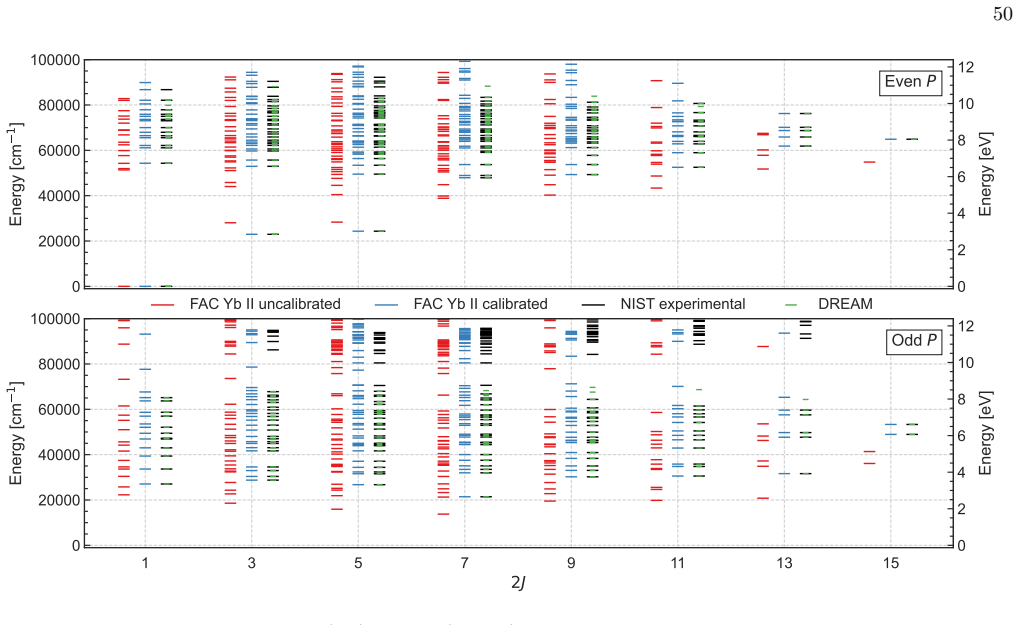
- [II C, IV A, Table V] The paper's headline deliverable, the 66,591 transitions claimed to have 'experimentally calibrated wavelength information' (abstract; Table V), is not validated against independent measured wavelengths. The calibration pipeline in §II C depends entirely on manual LS-label matching between FAC levels and NIST/DREAM levels, with the JJ2LSJ transformation explicitly acknowledged to be non-bijective and with all calibrations performed by hand. The reported benchmarks do not test the correctness of these matches: Figures 1-2 show residuals for the very levels used in the calibration, and Figures 6-9 compare oscillator strengths, not line positions, for transitions whose levels were both identified. Because a wrong match still receives the 'xmatch' flag and produces a Ritz wavelength that can be off by thousands of cm-1, the abstract's feasibility claim for line identifications is not yet supported. I request a direct validation of the calibrated wavelengths against measured line positions, for example the NIST line lists and the Ferrara et al. (2024), Den Hartog et al. (2024), and Voith et al. (2025) line lists already used in §IV A, or a hold-out test in which a subset of known levels is excluded from calibration and used only for verification.
- [II C, Table V] The 'experimentally calibrated' label overstates the anchoring for a substantial, unquantified fraction of the 66,591 transitions. Section II C states that calibration aligns computed levels with 'experimental energy levels from the NIST ASD and, where applicable, theoretical data from DREAM'; DREAM is a semi-empirical HFR database, not a set of measurements. Table V shows DREAM reference levels for many ions (e.g., Ce II, Pr II, Tm II), so some of the 66,591 transitions are anchored on both ends to theoretical levels. The abstract and §III B should either qualify the claim (for example, 'experimentally or semi-empirically anchored') or report the breakdown of NIST-anchored versus DREAM-anchored transitions in Table V. This is not a purely semantic point: a user relying on the calibrated wavelengths for line identifications needs to know which transitions carry which anchoring status.
- [II B, II C, Figures 1-2] The level-energy 'agreement' reported in Figures 1-2 and discussed throughout §III is partly by construction and should be framed as fit residuals rather than predictive validation. The FMC occupation weights are optimized against experimental reference levels via the loss function in Eq. (3), and the calibration shifts of §II C are applied to the same experimental levels that are then used as benchmarks. The genuinely independent accuracy evidence comes from the gf comparisons against experiments (§IV A) and the opacity comparisons against other codes (§IV B), and that evidence is supportive; however, the manuscript should state this distinction explicitly and, ideally, report residuals on levels lying above the calibration range or on a hold-out subset of levels. In addition, because 'all calibrations were performed manually,' the Zenodo release should include the mapping between each matched FAC level and the specific NIST or DREAM energy level; without that mapping, the 66,591-transition claim is not auditable by other groups.
minor comments (6)
- [Figures 1 and 2 captions] The captions of Figures 1 and 2 both read 'doubly ionized lanthanide ions,' but the ion labels and the text of §II C indicate that Figure 1 shows singly ionized species and Figure 2 doubly ionized species; please correct the Figure 1 caption.
- [II B] The sentence 'These constraints ensure that the optimization explores physically meaningful configurations while allowing sufficient flexibility to improve the accuracy of the calculations.' appears twice verbatim; please delete the duplicate.
- [III A 8 and Table IV] The text in the gadolinium subsection states that the FAC calculation 'recover[s] a ground state configuration of 4f7 5d1 6s1, which differs from the experimental ground state 4f7 5d2,' whereas Table IV lists the FAC ground state as 4f7 5d2 and the NIST ground state as 4f7 5d1 6s1; these statements contradict each other and must be reconciled.
- [Table VII excerpt] The transition table excerpt contains formatting artifacts in which wavelength and log(gf) values run together (e.g., '7068.15-1.0213' and '4437.09.-1.4071'); the machine-readable version may be unaffected, but the printed excerpt should be cleaned up.
- [Tables II and III headers] The continuation tables of Table I are headed 'TABLE II. *' and 'TABLE III. *'; the stray asterisk placeholder should be removed.
- [Figure 36 caption] The caption of Figure 36 says the black horizontal lines show NIST experimental data, but the text of §III A 10 states that Dy III calibration uses level information from Spector et al. (1997) because the NIST ASD only contains the ground state for Dy III; the caption should be updated to reflect the actual calibration source.
Circularity Check
No significant circularity: the calibration and FMC optimization are explicit fits, and the central quantitative claims are benchmarked against independent experiments and independent atomic-structure calculations.
full rationale
The paper's calibration procedure and FMC-weight optimization are openly fitting procedures, not disguised predictions. The loss function (Eq. 3) and the calibration description (Sec. II C) use experimental NIST/DREAM levels to adjust computed energies, and the reported deviations in Figs. 1-2 are pre-calibration residuals; the paper does not claim that the calibrated level energies are independent predictions. The central quantitative claims that could be construed as predictions—the oscillator-strength agreement for strong lines (Figs. 6-9) and the opacity comparisons (Figs. 11-14)—are benchmarked against external experimental data (Ferrara et al., Den Hartog et al., Voith et al.) and independent calculations (HULLAC, GRASP, HFR, DREAM) that were not used to set the FMC weights or calibration shifts. The 66,591 experimentally calibrated transitions are explicitly presented as calibrated data products rather than as derived predictions. The self-citations to refs. [42] and [61] provide methodological background and are not invoked as uniqueness theorems or as the sole support for any load-bearing claim. The remaining caveat concerning manual LS-label matching is a correctness/validation risk, not a circularity, because no quoted step reduces a prediction to its own input by construction.
Assumptions & free parameters
free parameters (3)
- FMC occupation weights per ion =
Listed in Table I; e.g., La II: 4f 1.62, 5d 0.38; Ce II: 4f 1.86, 5d 0.96, 6s 0.10, 6p 0.08
- Calibration corrections for energy levels =
Per ion median corrections 617-9047 cm^-1; individual level shifts in Zenodo release
- Excitation temperature T in SMBO loss function =
not stated
assumptions (6)
- domain assumption FAC's Dirac-Coulomb Hamiltonian with local central potential and screened hydrogenic QED corrections is adequate for lanthanide ions.
- domain assumption Experimental energy levels from NIST ASD and DREAM have correct energies, configurations, and term assignments.
- ad hoc to paper The LS label purity threshold of 0.7 reliably identifies a theoretical level with its experimental counterpart.
- ad hoc to paper The manual matching of theoretical to experimental levels is correct for the matched levels.
- domain assumption LTE and Saha/Boltzmann statistics apply in kilonova ejecta at 2500-8500 K.
- domain assumption The Sobolev approximation is valid for the expanding kilonova ejecta.
Cite this review
Pith. "Pith review of Calibrated Lanthanide Atomic Data for Kilonova Radiative Transfer. I. Atomic Structure and Opacities." pith.science (2026). https://pith.science/paper/IKZG2ZGM
@misc{pith2026250707785,
  author       = {Pith},
  title        = {Pith review of: Calibrated Lanthanide Atomic Data for Kilonova Radiative Transfer. I. Atomic Structure and Opacities},
  year         = {2026},
  howpublished = {\url{https://pith.science/paper/IKZG2ZGM}},
  note         = {Machine review of arXiv:2507.07785}
}
abstract
The early spectra of the kilonova (KN) AT2017gfo following the binary neutron star merger GW170817 exhibit numerous features shaped by r-process nucleosynthesis products. Although a few species were tentatively detected, no third-peak elements were unambiguously identified, as the amount of atomic data required for radiative transfer modeling is immense. Although comprehensive atomic data, including atomic opacities, is now available for many elements, wavelength-calibrated data remains limited to a select few ions. To examine the atomic opacities of all singly and doubly ionized lanthanides, from La (Z = 57) to Yb (Z = 70), we perform atomic structure calculations using the FAC code. Our calculations incorporate an innovative optimization of the local central potential and the number of configurations considered, alongside a calibration technique aimed at enhancing agreement between theoretical and experimental atomic energy levels. We assess the accuracy of the computed data, including energy levels and electric dipole (E1) transition strengths, as well as their impact on KN opacities. We find that strong transitions ($\log(gf)>-1$) are in good agreement with both experiments and semi-empirical calculations. For ions with substantial experimental data, the computed opacities exhibit good agreement with prior calculations. By calibrating low-lying energy levels with experimental data, we have identified 66,591 transitions with experimentally calibrated wavelength information, rendering future lanthanide line identifications through radiative transfer modeling feasible. In total, our calculations encompass 28 ions, yielding 146,856 energy levels below the ionization threshold and 28,690,443 transitions among these levels.
Figures


Figures from the paper (40 more)



Reference graph
Works this paper leans on
-
[1]
Un- der these conditions, lanthanides are partially ionized, with the dominant contributions to the opacity arising from singly and doubly ionized species, as shown in fig- ure 10
Lanthanide Expansion Opacity Expansion opacities, computed using Equations 7 through 9, were evaluated for a gas withT= 5000 K andρ= 10 −13 g cm−3 at an epoch oft= 1 day. Un- der these conditions, lanthanides are partially ionized, with the dominant contributions to the opacity arising from singly and doubly ionized species, as shown in fig- ure 10. Compa...
-
[2]
Planck Mean Opacity Line-by-line radiative transfer calculations generally provide the highest accuracy for modeling emergent spec- tra. However, gray opacities remain a widely used sim- plification in KN light curve models where radiative dif- fusion is the dominant transport mechanism. The Planck mean opacity is defined by: κmean = R ∞ 0 Bλ(T)κ exp(λ)dλ...
-
[3]
D. A. Coulteret al., Swope Supernova Survey 2017a (SSS17a), the optical counterpart to a grav- itational wave source, Science358, 1556 (2017), arXiv:1710.05452 [astro-ph.HE]
arXiv 2017
-
[4]
P. S. Cowperthwaiteet al., The Electromagnetic Coun- terpart of the Binary Neutron Star Merger LIGO/Virgo GW170817. II. UV, Optical, and Near-infrared Light Curves and Comparison to Kilonova Models, Astrophys, J.848, L17 (2017), arXiv:1710.05840 [astro-ph.HE]
arXiv 2017
-
[5]
S. J. Smarttet al., A kilonova as the electromagnetic counterpart to a gravitational-wave source, Nature551, 75 (2017), arXiv:1710.05841 [astro-ph.HE]
arXiv 2017
-
[6]
M. R. Droutet al., Light curves of the neutron star merger GW170817/SSS17a: Implications for r- process nucleosynthesis, Science358, 1570 (2017), arXiv:1710.05443 [astro-ph.HE]
arXiv 2017
-
[7]
Y. Utsumiet al., J-GEM observations of an elec- tromagnetic counterpart to the neutron star merger GW170817, PASJ69, 101 (2017), arXiv:1710.05848 [astro-ph.HE]
arXiv 2017
-
[8]
B. P. Abbottet al., Multi-messenger Observations of a Binary Neutron Star Merger, Astrophys, J.848, L12 (2017), arXiv:1710.05833 [astro-ph.HE]
arXiv 2017
Show all 204 references
-
[9]
B. P. Abbottet al., GW170817: Observation of Grav- itational Waves from a Binary Neutron Star Inspiral, Phys. Rev. Lett.119, 161101 (2017), arXiv:1710.05832 [gr-qc]
2017 arXiv
-
[10]
J. M. Lattimer and D. N. Schramm, Black-Hole- Neutron-Star Collisions, Astrophys, J.192, L145 (1974)
1974
-
[11]
Symbalisty and D
E. Symbalisty and D. N. Schramm, Neutron Star Colli- sions and the r-Process, Astrophys. Lett.22, 143 (1982)
1982
-
[12]
Eichler, M
D. Eichler, M. Livio, T. Piran, and D. N. Schramm, Nucleosynthesis, neutrino bursts andγ-rays from coa- lescing neutron stars, Nature340, 126 (1989)
1989
-
[13]
Freiburghaus, S
C. Freiburghaus, S. Rosswog, and F. K. Thielemann, R-Process in Neutron Star Mergers, Astrophys, J.525, L121 (1999)
1999
-
[14]
Goriely, A
S. Goriely, A. Bauswein, and H.-T. Janka, r-process Nu- cleosynthesis in Dynamically Ejected Matter of Neu- tron Star Mergers, Astrophys, J.738, L32 (2011), arXiv:1107.0899 [astro-ph.SR]
2011 arXiv
-
[15]
Bauswein, T
A. Bauswein, T. W. Baumgarte, and H. T. Janka, Prompt Merger Collapse and the Maximum Mass of Neutron Stars, Phys. Rev. Lett.111, 131101 (2013), arXiv:1307.5191 [astro-ph.SR]
2013 arXiv
-
[16]
Wanajo, Y
S. Wanajo, Y. Sekiguchi, N. Nishimura, K. Kiuchi, K. Kyutoku, and M. Shibata, Production of All the r-process Nuclides in the Dynamical Ejecta of Neu- tron Star Mergers, Astrophys, J.789, L39 (2014), arXiv:1402.7317 [astro-ph.SR]
2014 arXiv
-
[17]
Li and B
L.-X. Li and B. Paczy´ nski, Transient Events from Neu- tron Star Mergers, Astrophys, J.507, L59 (1998), arXiv:astro-ph/9807272 [astro-ph]
1998 arXiv
-
[18]
S. R. Kulkarni, Modeling Supernova-like Explosions As- sociated with Gamma-ray Bursts with Short Durations, arXiv e-prints , astro-ph/0510256 (2005), arXiv:astro- ph/0510256 [astro-ph]
2005 arXiv
-
[19]
B. D. Metzger, G. Mart ´ ınez-Pinedo, S. Darbha, E. Quataert, A. Arcones, D. Kasen, R. Thomas, P. Nu- gent, I. V. Panov, and N. T. Zinner, Electromagnetic 31 counterparts of compact object mergers powered by the radioactive decay of r-process nuclei, Mon. Not. R. As- tron. Soc...
2010 arXiv
-
[20]
Kasen, N
D. Kasen, N. R. Badnell, and J. Barnes, Opacities and Spectra of the r-process Ejecta from Neutron Star Mergers, Astrophys. J.774, 25 (2013), arXiv:1303.5788 [astro-ph.HE]
2013 arXiv
-
[21]
Tanaka and K
M. Tanaka and K. Hotokezaka, Radiative Transfer Sim- ulations of Neutron Star Merger Ejecta, Astrophys. J. 775, 113 (2013), arXiv:1306.3742 [astro-ph.HE]
2013 arXiv
-
[22]
B. D. Metzger and R. Fern´ andez, Red or blue? A po- tential kilonova imprint of the delay until black hole for- mation following a neutron star merger, Mon. Not. R. Astron. Soc.441, 3444 (2014), arXiv:1402.4803 [astro- ph.HE]
2014 arXiv
-
[23]
Kasen, B
D. Kasen, B. Metzger, J. Barnes, E. Quataert, and E. Ramirez-Ruiz, Origin of the heavy elements in binary neutron-star mergers from a gravitational-wave event, Nature551, 80 (2017), arXiv:1710.05463 [astro-ph.HE]
2017 arXiv
-
[24]
Barnes, D
J. Barnes, D. Kasen, M.-R. Wu, and G. Mart ´ ınez- Pinedo, Radioactivity and Thermalization in the Ejecta of Compact Object Mergers and Their Impact on Kilo- nova Light Curves, Astrophys. J.829, 110 (2016), arXiv:1605.07218 [astro-ph.HE]
2016 arXiv
-
[25]
Tanaka, D
M. Tanaka, D. Kato, G. Gaigalas, P. Rynkun, L. Radˇ zi¯ ut˙ e, S. Wanajo, Y. Sekiguchi, N. Nakamura, H. Tanuma, I. Murakami, and H. A. Sakaue, Properties of Kilonovae from Dynamical and Post-merger Ejecta of Neutron Star Mergers, Astrophys. J.852, 109 (2018), arXiv:1708.09101 ...
2018 arXiv
-
[26]
Tanaka, D
M. Tanaka, D. Kato, G. Gaigalas, and K. Kawaguchi, Systematic opacity calculations for kilonovae, Mon. Not. R. Astron. Soc.496, 1369 (2020), arXiv:1906.08914 [astro-ph.HE]
2020 arXiv
-
[27]
L. J. Shingles, C. E. Collins, V. Vijayan, A. Fl¨ ors, O. Just, G. Leck, Z. Xiong, A. Bauswein, G. Mart ´ ınez- Pinedo, and S. A. Sim, Self-consistent 3D Radia- tive Transfer for Kilonovae: Directional Spectra from Merger Simulations, Astrophys, J.954, L41 (2023), arXiv:2306.1...
2023 arXiv
-
[28]
C. E. Collins, L. J. Shingles, A. Bauswein, S. A. Sim, T. Soultanis, V. Vijayan, A. Fl¨ ors, O. Just, G. Leck, G. Lioutas, G. Mart ´ ınez-Pinedo, A. Sneppen, D. Wat- son, and Z. Xiong, Towards inferring the geometry of kilonovae, Mon. Not. R. Astron. Soc.529, 1333 (2024), arXi...
2024 arXiv
-
[29]
Barnes, Y
J. Barnes, Y. L. Zhu, K. A. Lund, T. M. Sprouse, N. Vassh, G. C. McLaughlin, M. R. Mumpower, and R. Surman, Kilonovae Across the Nuclear Physics Land- scape: The Impact of Nuclear Physics Uncertainties on r-process-powered Emission, Astrophys. J.918, 44 (2021), arXiv:2010.1118...
2021 arXiv
-
[30]
Barnes and D
J. Barnes and D. Kasen, Effect of a High Opacity on the Light Curves of Radioactively Powered Transients from Compact Object Mergers, Astrophys. J.775, 18 (2013), arXiv:1303.5787 [astro-ph.HE]
2013 arXiv
-
[31]
Kasen, R
D. Kasen, R. Fern´ andez, and B. D. Metzger, Kilonova light curves from the disc wind outflows of compact object mergers, Mon. Not. R. Astron. Soc.450, 1777 (2015), arXiv:1411.3726 [astro-ph.HE]
2015 arXiv
-
[32]
C. J. Fontes, C. L. Fryer, A. L. Hungerford, P. Hakel, J. Colgan, D. P. Kilcrease, and M. E. Sherrill, Relativis- tic opacities for astrophysical applications, High Energy Density Physics16, 53 (2015)
2015
-
[33]
Banerjee, M
S. Banerjee, M. Tanaka, K. Kawaguchi, D. Kato, and G. Gaigalas, Simulations of Early Kilonova Emission from Neutron Star Mergers, Astrophys. J.901, 29 (2020), arXiv:2008.05495 [astro-ph.HE]
2020 arXiv
-
[34]
Carvajal Gallego, J
H. Carvajal Gallego, J. C. Berengut, P. Palmeri, and P. Quinet, Large-scale atomic data calculations in Ce V - X ions for application to early kilonova emission from neutron star mergers, Mon. Not. R. Astron. Soc.509, 6138 (2022)
2022
-
[35]
Carvajal Gallego, J
H. Carvajal Gallego, J. C. Berengut, P. Palmeri, and P. Quinet, Atomic data and opacity calculations in La V-X ions for the investigation of kilonova emission spec- tra, Mon. Not. R. Astron. Soc.513, 2302 (2022)
2022
-
[36]
Banerjee, M
S. Banerjee, M. Tanaka, D. Kato, G. Gaigalas, K. Kawaguchi, and N. Domoto, Opacity of the Highly Ionized Lanthanides and the Effect on the Early Kilo- nova, Astrophys. J.934, 117 (2022), arXiv:2204.06861 [astro-ph.HE]
2022 arXiv
-
[37]
Carvajal Gallego, J
H. Carvajal Gallego, J. Deprince, J. C. Berengut, P. Palmeri, and P. Quinet, Opacity calculations in four to nine times ionized Pr, Nd, and Pm atoms for the spectral analysis of kilonovae, Mon. Not. R. Astron. Soc. 518, 332 (2023)
2023
-
[38]
Banerjee, M
S. Banerjee, M. Tanaka, D. Kato, and G. Gaigalas, Di- versity of Early Kilonova with the Realistic Opacities of Highly Ionized Heavy Elements, Astrophys. J.968, 64 (2024), arXiv:2304.05810 [astro-ph.HE]
2024 arXiv
-
[39]
Carvajal Gallego, J
H. Carvajal Gallego, J. Deprince, L. Maison, P. Palmeri, and P. Quinet, Overview of the contributions from all lanthanide elements to kilonova opacity in the temper- ature range from 25 000 to 40 000 K, Astron. & Astro- phys.685, A91 (2024)
2024
-
[40]
Gaigalas, P
G. Gaigalas, P. Rynkun, L. Radˇ zi¯ ut˙ e, D. Kato, M. Tanaka, and P. J¨ onsson, Energy Level Structure and Transition Data of Er 2+, ApJS248, 13 (2020), arXiv:2002.07615 [physics.atom-ph]
2020 arXiv
-
[41]
Carvajal Gallego, P
H. Carvajal Gallego, P. Palmeri, and P. Quinet, Multi- configuration Dirac-Hartree-Fock radiative parameters for emission lines in Ce II-IV ions and cerium opacity calculations for kilonovae, Mon. Not. R. Astron. Soc. 501, 1440 (2021), arXiv:2009.13192 [physics.atom-ph]
2021 arXiv
-
[42]
J. H. Gillanders, M. McCann, S. A. Sim, S. J. Smartt, and C. P. Ballance, Constraints on the presence of platinum and gold in the spectra of the kilonova AT2017gfo, Mon. Not. R. Astron. Soc.506, 3560 (2021), arXiv:2101.08271 [astro-ph.HE]
2021 arXiv
-
[43]
R. F. Silva, J. M. Sampaio, P. Amaro, A. Fl¨ ors, G. Mart ´ ınez-Pinedo, and J. P. Marques, Structure Cal- culations in Nd III and U III Relevant for Kilonovae Modelling, Atoms10, 18 (2022)
2022
-
[44]
Fl¨ ors, R
A. Fl¨ ors, R. F. Silva, J. Deprince, H. Carvajal Gallego, G. Leck, L. J. Shingles, G. Mart ´ ınez-Pinedo, J. M. Sam- paio, P. Amaro, J. P. Marques, S. Goriely, P. Quinet, P. Palmeri, and M. Godefroid, Opacities of singly and doubly ionized neodymium and uranium for kilonova e...
2023
-
[45]
Gaigalas, P
G. Gaigalas, P. Rynkun, N. Domoto, M. Tanaka, D. Kato, and L. Kitovien˙ e, Theoretical investigation of energy levels and transitions for Ce III with applica- tions to kilonova spectra, Mon. Not. R. Astron. Soc. 530, 5220 (2024), arXiv:2405.05463 [astro-ph.HE]. 32
2024 arXiv
-
[46]
C. J. Fontes, C. L. Fryer, A. L. Hungerford, R. T. Wollaeger, and O. Korobkin, A line-binned treatment of opacities for the spectra and light curves from neu- tron star mergers, Mon. Not. R. Astron. Soc.493, 4143 (2020), arXiv:1904.08781 [astro-ph.HE]
2020 arXiv
-
[47]
Radˇ zi¯ ut˙ e, G
L. Radˇ zi¯ ut˙ e, G. Gaigalas, D. Kato, P. Rynkun, and M. Tanaka, Extended Calculations of Energy Levels and Transition Rates for Singly Ionized Lanthanide Ele- ments. I. Pr-Gd, ApJS248, 17 (2020), arXiv:2002.08075 [physics.atom-ph]
2020 arXiv
-
[48]
Radˇ zi¯ ut˙ e, G
L. Radˇ zi¯ ut˙ e, G. Gaigalas, D. Kato, P. Rynkun, and M. Tanaka, Extended Calculations of Energy Levels and Transition Rates for Singly Ionized Lanthanide El- ements. II. Tb-Yb, ApJS257, 29 (2021)
2021
-
[49]
C. J. Fontes, C. L. Fryer, R. T. Wollaeger, M. R. Mumpower, and T. M. Sprouse, Actinide opacities for modelling the spectra and light curves of kilo- novae, Mon. Not. R. Astron. Soc.519, 2862 (2023), arXiv:2209.12759 [astro-ph.HE]
2023 arXiv
-
[50]
D. Kato, M. Tanaka, G. Gaigalas, L. Kitovien˙ e, and P. Rynkun, Systematic opacity calculations for kilono- vae - II. Improved atomic data for singly ionized lan- thanides, Mon. Not. R. Astron. Soc.535, 2670 (2024), arXiv:2501.13286 [astro-ph.HE]
2024 arXiv
-
[51]
Deprince, G
J. Deprince, G. Wagle, S. Ben Nasr, H. Carvajal Gal- lego, M. Godefroid, S. Goriely, O. Just, P. Palmeri, P. Quinet, and S. Van Eck, Kilonova ejecta opacity in- ferred from new large-scale HFR atomic calculations in all elements between Ca (Z = 20) and Lr (Z = 103), As- tron. ...
2025 arXiv
-
[52]
W. Even, O. Korobkin, C. L. Fryer, C. J. Fontes, R. T. Wollaeger, A. Hungerford, J. Lippuner, J. Miller, M. R. Mumpower, and G. W. Misch, Composition Effects on Kilonova Spectra and Light Curves. I, Astrophys. J. 899, 24 (2020), arXiv:1904.13298 [astro-ph.HE]
2020 arXiv
-
[53]
N. R. Badnell, AUTOSTRUCTURE: General program for calculation of atomic and ionic properties, As- trophysics Source Code Library, record ascl:1612.014 (2016)
2016
-
[54]
M. F. Gu, The flexible atomic code, Canadian Journal of Physics86, 675 (2008)
2008
-
[55]
Froese Fischer, G
C. Froese Fischer, G. Gaigalas, P. J¨ onsson, and J. Biero´ n, GRASP2018-A Fortran 95 version of the Gen- eral Relativistic Atomic Structure Package, Computer Physics Communications237, 184 (2019)
2019
-
[56]
Bar-Shalom, M
A. Bar-Shalom, M. Klapisch, and J. Oreg, HULLAC, an integrated computer package for atomic processes in plasmas, J. Quant. Spectrosc. Radiative Transfer71, 169 (2001)
2001
-
[57]
R. D. Cowan,The theory of atomic structure and spectra (1981)
1981
-
[58]
C. J. Fontes, H. L. Zhang, J. Abdallah, Jr., R. E. H. Clark, D. P. Kilcrease, J. Colgan, R. T. Cunningham, P. Hakel, N. H. Magee, and M. E. Sherrill, The Los Alamos suite of relativistic atomic physics codes, Jour- nal of Physics B Atomic Molecular Physics48, 144014 (2015)
2015
-
[59]
J. P. Desclaux, A multiconfiguration relativistic DIRAC-FOCK program, Computer Physics Communi- cations9, 31 (1975)
1975
-
[60]
Domoto, M
N. Domoto, M. Tanaka, D. Kato, K. Kawaguchi, K. Ho- tokezaka, and S. Wanajo, Lanthanide Features in Near- infrared Spectra of Kilonovae, Astrophys. J.939, 8 (2022), arXiv:2206.04232 [astro-ph.HE]
2022 arXiv
-
[61]
Q. Lu, C. L. Yan, J. Meng, G. Q. Xu, Y. Yang, C. Y. Chen, J. Xiao, J. G. Li, J. G. Wang, and Y. Zou, Visible spectra of W8+ in an electron-beam ion trap, Phys. Rev. A103, 022808 (2021), arXiv:2101.11193 [physics.atom- ph]
2021 arXiv
-
[62]
McCann, S
M. McCann, S. Bromley, S. D. Loch, and C. P. Ballance, Atomic data calculations for Au I-Au III and explo- ration in the application of collisional-radiative theory to laboratory and neutron star merger plasmas, Mon. Not. R. Astron. Soc.509, 4723 (2022)
2022
-
[63]
Ferreira da Silva, A
R. Ferreira da Silva, A. Fl¨ ors, L. Leit˜ ao, J. P. Mar- ques, G. Mart ´ ınez-Pinedo, and J. M. Sampaio, System- atic bayesian optimization for atomic structure calcu- lations of heavy elements, Phys. Rev. A112, 012802 (2025)
2025
-
[64]
Hoffman, E
M. Hoffman, E. Brochu, and N. de Freitas, Portfolio al- location for bayesian optimization, inProceedings of the Twenty-Seventh Conference on Uncertainty in Artificial Intelligence, UAI’11 (AUAI Press, Arlington, Virginia, USA, 2011) p. 327–336
2011
-
[65]
M. Ding, A. N. Ryabtsev, E. Y. Kononov, T. Ryabchikova, C. P. Clear, F. Concepcion, and J. C. Pickering, Spectrum and energy levels of the low-lying configurations of Nd III, Astron. & Astrophys. 684, A149 (2024), arXiv:2307.09282 [physics.atom-ph]
2024 arXiv
-
[66]
Kramida, Yu
A. Kramida, Yu. Ralchenko, J. Reader, and and NIST ASD Team, NIST Atomic Spectra Database (ver. 5.9) (2021), national Institute of Standards and Technology, Gaithersburg, MD
2021
-
[67]
Quinet and P
P. Quinet and P. Palmeri, Current Status and Develop- ments of the Atomic Database on Rare-Earths at Mons University (DREAM), Atoms8, 18 (2020)
2020
-
[68]
Gaigalas, C
G. Gaigalas, C. Fischer, P. Rynkun, and P. J¨ onsson, JJ2LSJ Transformation and Unique Labeling for Energy Levels, Atoms5, 6 (2017)
2017
-
[69]
Ferrara, M
C. Ferrara, M. Giarrusso, and F. Leone, Experimental atomic data of spectral lines - I. Cs, Ba, Pr, Nd, Sm, Eu, Gd, Tb, Dy, Ho, Er, Tm, Yb, Lu, Hf, Re, and Os in the 370-1000 nm interval, Mon. Not. R. Astron. Soc. 527, 4440 (2024)
2024
-
[70]
E. A. Den Hartog, G. T. Voith, and I. U. Roed- erer, Atomic Transition Probabilities for Ultraviolet and Optical Lines of Tm II, ApJS274, 9 (2024), arXiv:2407.15911 [astro-ph.SR]
2024 arXiv
-
[71]
G. T. Voith, E. A. Den Hartog, and I. U. Roederer, Atomic Transition Probabilities for UV and Optical Lines of Gd II, ApJS278, 7 (2025), arXiv:2503.21948 [astro-ph.SR]
2025 arXiv
-
[72]
W. F. Meggers, Regularities in the arc spectrum of lan- thanum, Journal of the Washington Academy of Sci- ences17, 25 (1927)
1927
-
[73]
H. N. Russell and W. F. Meggers, An analysis of lan- thanum spectra (La I, La II, La III), Bureau of Stan- dards Journal of Research9, 625 (1932)
1932
-
[74]
G. R. Harrison, N. Rosen, and J. Rand McNally, J., Zeeman Effect Data for the Spectra of Lanthanum—La I and La II, Journal of the Optical Society of America (1917-1983)35, 658 (1945)
1945
-
[75]
G¨ uzel¸ cimen, M
F. G¨ uzel¸ cimen, M. Tonka, Z. Uddin, N. A. Bhatti, L. Windholz, S. Kr¨ oger, and G. Ba¸ sar, Revised energy levels of singly ionized lanthanum, J. Quant. Spectrosc. Radiative Transfer211, 188 (2018). 33
2018
-
[76]
R. C. Gibbs and H. E. White, Rubidium and Caesium- Like Doublets of Stripped Atoms, Proceedings of the National Academy of Science12, 551 (1926)
1926
-
[77]
J. S. Badami, The spectrum of trebly-ionized cerium (Ce IV), Proceedings of the Physical Society43, 53 (1931)
1931
-
[78]
R. J. Lang, The Spectrum of Trebly Ionized Cerium, Canadian Journal of Research13, 1 (1935)
1935
-
[79]
Sugar, Analyses of lanthanide and actinide spectra, Journal of the Optical Society of America55, 1283 (1965)
J. Sugar, Analyses of lanthanide and actinide spectra, Journal of the Optical Society of America55, 1283 (1965)
1965
-
[80]
Odabasi, Spectrum of Doubly Ionized Lanthanum (La iii)*, Journal of the Optical Society of America (1917-1983)57, 1459 (1967)
H. Odabasi, Spectrum of Doubly Ionized Lanthanum (La iii)*, Journal of the Optical Society of America (1917-1983)57, 1459 (1967)
1967
-
[81]
W. C. Martin, Atomic energy levels: The rare earth elements (the spectra of lanthanum, cerium, praseodymium, neodymium, promethium, samarium, europium, gadolinium, terbium, dysprosium, holmium, ebrium, thulium, ytterbium, and lutetium) (1978)
1978
-
[82]
W. E. Albertson and G. R. Harrison, Preliminary Anal- ysis of the First Spark Spectrum of Cerium-Ce II, Phys- ical Review52, 1209 (1937)
1937
-
[83]
G. R. Harrison, W. E. Albertson, and N. F. Hosford, Zeeman Effect Data and Further Classification of the First Spark Spectrum of Cerium—Ce II, Journal of the Optical Society of America (1917-1983)31, 439 (1941)
1941
-
[84]
C. H. Corliss, Wavelengths and Energy Levels of the Second Spectrum of Cerium (Ce ii), Journal of research of the National Bureau of Standards77A, 419 (1973)
1973
-
[85]
T. L. Bruin, J. N. Lier, and H. J. va de Vliet, The zeeman-effect of doubly ionized cerium, Proc. Roy. Acad. Amsterdam40, 334–339 (1937)
1937
-
[86]
H. N. Russell, R. B. King, and R. J. Lang, The third spectrum of cerium (ce iii), Phys. Rev.52, 456 (1937)
1937
-
[87]
Johansson and U
S. Johansson and U. Litz´ en, The 4f 2-4f5d Lines of Ce III, Phys. Scr.6, 139 (1972)
1972
-
[88]
Rosen, G
N. Rosen, G. R. Harrison, and J. R. McNally, Zeeman Effect Data and Preliminary Classification of the Spark Spectrum of Praseodymium-Pr II, Physical Review60, 722 (1941)
1941
-
[89]
Ginibre, Fine and hyperfine structures of singly ion- ized praseodymium: I
A. Ginibre, Fine and hyperfine structures of singly ion- ized praseodymium: I. energy levels, hyperfine struc- tures and Zeeman effect, classified lines, Phys. Scr.39, 694 (1989)
1989
-
[90]
Ginibre, Fine and hyperfine structures of singly ionised praseodymium: II
A. Ginibre, Fine and hyperfine structures of singly ionised praseodymium: II. parametric interpretation of fine and hyperfine structures for the even levels of singly ionised praseodymium, Phys. Scr.39, 710 (1989)
1989
-
[91]
Ivarsson, U
S. Ivarsson, U. Litz´ en, and G. M. Wahlgren, Accurate Wavelengths, Oscillator Strengths and Hyperfine Struc- ture in Selected Praseodymium Lines of Astrophysical Interest, Phys. Scr.64, 455 (2001)
2001
-
[92]
Furmann, D
B. Furmann, D. Stefa´ nska, E. Stachowska, J. Ruczkowski, and J. Dembczy´ nski, Hyperfine- structure measurements and new levels evaluation in singly ionized praseodymium, European Physical Journal D17, 275 (2001)
2001
-
[93]
Furmann, D
B. Furmann, D. Stefa´ nska, J. Dembczy´ nski, and E. Sta- chowska, New Levels and Hyperfine Structure Evalua- tion in Singly Ionized Praseodymium, Phys. Scr.72, 300 (2005)
2005
-
[94]
Furmann, D
B. Furmann, D. Stefa´ nska, J. Dembczy´ nski, and E. Sta- chowska, New electron levels and classified lines in Pr II from hyperfine structure measurements, Atomic Data and Nuclear Data Tables93, 127 (2007)
2007
-
[95]
Sugar, Analysis of the Third Spectrum of Praseodymium*, Journal of the Optical Society of America (1917-1983)53, 831 (1963)
J. Sugar, Analysis of the Third Spectrum of Praseodymium*, Journal of the Optical Society of America (1917-1983)53, 831 (1963)
1963
-
[96]
Sugar, The third spectrum of praseodymium (pr iii) in the vacuum ultraviolet, Journal of research of the National Bureau of Standards
J. Sugar, The third spectrum of praseodymium (pr iii) in the vacuum ultraviolet, Journal of research of the National Bureau of Standards. Section A, Physics and chemistry73A, 333—381 (1969)
1969
-
[97]
Crosswhite, H
H. Crosswhite, H. M. Crosswhite, and B. R. Judd, Mag- netic Parameters for the Configuration f 3, Physical Re- view174, 89 (1968)
1968
-
[98]
Sugar, Spectrum of Doubly Ionized Praseodymium from 2107 ˚A to 10716 ˚A, Journal of research of the National Bureau of Standards
J. Sugar, Spectrum of Doubly Ionized Praseodymium from 2107 ˚A to 10716 ˚A, Journal of research of the National Bureau of Standards. Section A, Physics and chemistry78A, 555 (1974)
1974
-
[99]
J. F. Wyart, J. Blaise, and P. Camus, Progr` es R´ ecents dans l’Interpr´ etation des Configurations 4fN (5d + 6s) des Lanthanides II. Etude Param´ etrique des Configura- tions, Phys. Scr.9, 325 (1974)
1974
-
[100]
W. C. Martin, R. Zalubas, and L. Hagan,Atomic energy levels - The rare-Earth elements(1978)
1978
-
[101]
W. E. Albertson, G. R. Harrison, and J. R. McNally, First Spark Spectrum of Neodymium-Preliminary Clas- sification and Zeeman Effect Data, Physical Review61, 167 (1942)
1942
-
[102]
J. F. Wyart, Ph.D. thesis, Univ. Paris, Orsay (1968)
1968
-
[103]
Kielkopf, Ph.D
R. Kielkopf, Ph.D. thesis, Univ. Amsterdam (1969)
1969
-
[104]
Blaise, J
J. Blaise, J. Chevillard, J. Verg` es, and J. F. Wyart, Etude des spectres d’´ emission dans l’infrarouge par l’emploi d’un SISAM—IV. spectre d’´ emission du n´ eodyme, Spectrochimica Acta - Part B: Atomic Spec- troscopy25, 333 (1970)
1970
-
[105]
Blaise, J
J. Blaise, J. F. Wyart, R. Hoekstra, and P. J. G. Kruiver, Present state of the analysis of Nd I and Nd II., Journal of the Optical Society of America (1917-1983) 61, 1335 (1971)
1971
-
[106]
Blaise, (unpublished analysis, 2002)
J. Blaise, (unpublished analysis, 2002)
2002
-
[107]
Crosswhite, (unpublished analysis, 1976)
H. Crosswhite, (unpublished analysis, 1976)
1976
-
[108]
G. H. Dieke, H. M. Crosswhite, and B. Dunn, Emission Spectra of the Doubly and Triply Ionized Rare Earths*, Journal of the Optical Society of America (1917-1983) 51, 820 (1961)
1961
-
[109]
G. H. Dieke and H. M. Crosswhite, The spectra of the doubly and triply ionized rare earths, Appl. Opt.2, 675 (1963)
1963
-
[110]
Aldenius, Ph.D
M. Aldenius, Ph.D. thesis, Univ. of Lund (2001)
2001
-
[111]
Ryabchikova, A
T. Ryabchikova, A. Ryabtsev, O. Kochukhov, and S. Bagnulo, Rare-earth elements in the atmosphere of the magnetic chemically peculiar star HD 144897. New classification of the Nd III spectrum, Astron. & Astro- phys.456, 329 (2006), arXiv:astro-ph/0604546 [astro- ph]
2006 arXiv
-
[112]
J. A. Weinman, Promethium spectra: Pm II and Pm III, Physical Review78, 628 (1950)
1950
-
[113]
R. G. Gutmacher, J. G. Conway, and C. E. Moore, The second spectrum of promethium, Journal of the Optical Society of America48, 389 (1958)
1958
-
[114]
R. Otto, H. Huhnermann, J. Reader, and J. F. Wyart, Hyperfine structure investigations and identification of new energy levels in the ionic spectrum of 147Pm, Jour- nal of Physics B Atomic Molecular Physics28, 3615 (1995)
1995
-
[115]
W. C. Martin, Energy levels and classified lines in the second spectrum of thorium (Th II), Journal of the Op- tical Society of America61, 1682 (1971). 34
1971
-
[116]
Albertson, Analysis of the Spectrum of Singly Ion- ized Samarium, Astrophys
W. Albertson, Analysis of the Spectrum of Singly Ion- ized Samarium, Astrophys. J.84, 26 (1936)
1936
-
[117]
Blaise, C
J. Blaise, C. Morillon, M.-G. Schweighofer, and J. Verges, Etude des spectres d’´ emission dans l’infrarouge par l’emploi d’un SISAM—III. Spectre d’´ emission du samarium, Spectrochimica Acta - Part B: Atomic Spectroscopy24, 405 (1969)
1969
-
[118]
Dupont, Spectrum of Sm iii*, Journal of the Optical Society of America (1917-1983)57, 867 (1967)
A. Dupont, Spectrum of Sm iii*, Journal of the Optical Society of America (1917-1983)57, 867 (1967)
1967
-
[119]
Albertson, The Spectrum of Singly Ionized Eu- ropium, Physical Review45, 499 (1934)
W. Albertson, The Spectrum of Singly Ionized Eu- ropium, Physical Review45, 499 (1934)
1934
-
[120]
H. N. Russell, W. Albertson, and D. N. Davis, The Spark Spectrum of Europium, Eu II, Physical Review 60, 641 (1941)
1941
-
[121]
Furmann and D
B. Furmann and D. Stefa´ nska, Experimental determina- tion of core relaxation and screening effects on the wave- function at a nucleus for stable isotopes of — 151,153Eu II, European Physical Journal Special Topics222, 2279 (2013)
2013
-
[122]
Sugar and N
J. Sugar and N. Spector, Spectrum and energy levels of doubly ionized europium (Eu III)., Journal of the Optical Society of America (1917-1983)64, 1484 (1974)
1974
-
[123]
J. F. Wyart, W. ¨U. L. Tchang-Brillet, S. S. Churilov, and A. N. Ryabtsev, Extended analysis of the Eu III spectrum, Astron. & Astrophys.483, 339 (2008)
2008
-
[124]
W. E. Albertson, H. Bruynes, and R. Hanau, The Nor- mal Electron Configuration of Singly Ionized Gadolin- ium, Physical Review57, 292 (1940)
1940
-
[125]
H. N. Russell, The Arc and Spark Spectra of Gadolin- ium, Journal of the Optical Society of America (1917- 1983)40, 550 (1950)
1950
-
[126]
Blaise, J
J. Blaise, J. Chevillard, J. Verges, J. F. Wyart, and T. A. M. van Kleef, Etude des spectres d’´ emission dans l’infrarouge par l’emploi d’un SISAM—V. Spectre d’´ emission du gadolinium, Spectrochimica Acta - Part B: Atomic Spectroscopy26, 1 (1971)
1971
-
[127]
Venugopalan, S
A. Venugopalan, S. M. Afzal, and S. A. Ahmad, Iso- tope shift studies in the UV spectrum of singly ionised gadolinium, Spectrochimica Acta - Part B: Atomic Spectroscopy53, 633 (1998)
1998
-
[128]
Spector, Analysis of even configurations in the second spectrum of gadolinium (Gd II), Journal of the Optical Society of America60, 763 (1970)
N. Spector, Analysis of even configurations in the second spectrum of gadolinium (Gd II), Journal of the Optical Society of America60, 763 (1970)
1970
-
[129]
W. R. Callahan,The Spectrum of Doubly Ionized Gadolinium., Ph.D. thesis, Johns Hopkins University, Maryland (1962)
1962
-
[130]
W. R. Callahan, Spectrum of Doubly Ionized Gadolin- ium*, Journal of the Optical Society of America (1917- 1983)53, 695 (1963)
1963
-
[131]
J. F. J. Kielkopf, Ph.D. thesis, Johns Hopkins University (1969)
1969
-
[132]
Meinders, Classification of tb ii-lines in connection with hyperfine structure., Physica, 42: 427-38(May 15, 1969).1, 10.1016/0031-8914(69)90035-4 (1969)
E. Meinders, Classification of tb ii-lines in connection with hyperfine structure., Physica, 42: 427-38(May 15, 1969).1, 10.1016/0031-8914(69)90035-4 (1969)
1969 doi
-
[133]
P. F. A. Klinkenberg, Interpretation of zeeman patterns of tb ii-lines, Opt. Pura Apl.10(1977)
1977
-
[134]
Blaise, P
J. Blaise, P. Camus, and J. Wyart,Gmelin Hand- buch der Anorganischen Chemie, Vol. 39 (Springer Vlg., 1976)
1976
-
[135]
Meinders, T
E. Meinders, T. A. M. Van Kleef, and J. F. Wyart, The analysis of doubly ionized terbium (Tb III), Physica61, 443 (1972)
1972
-
[136]
Paulson, Wave-lengths of elements at high tempera- tures, Astrophysical Journal40, 298 (1914)
E. Paulson, Wave-lengths of elements at high tempera- tures, Astrophysical Journal40, 298 (1914)
1914
-
[137]
W. F. Meggers, Series regularities in the spectra of the lanthanide rare earths, Reviews of Modern Physics14, 96 (1942)
1942
-
[138]
J. M. Blank, Zeeman effect of Dy II, Journal of the Optical Society of America42, 117 (1952)
1952
-
[139]
V. G. Mossotti and V. A. Fassel, Emission flame spec- trometry of the rare earths, Spectrochimica Acta20, 1117 (1964)
1964
-
[140]
K. L. Vander Sluis and J. R. McNally, Zeeman effect in Dy II, Journal of the Optical Society of America60, 1209 (1970)
1970
-
[141]
J. G. Conway and E. F. Worden, Preliminary Level Analysis of the First and Second Spectra of Dyspro- sium, Dy i and Dy ii*, Journal of the Optical Society of America (1917-1983)61, 704 (1971)
1971
-
[142]
Wyart, Dysprosium levels II: Odd configurations, Spectrochimica Acta Part B: Atomic Spectroscopy27, 443 (1972)
J.-F. Wyart, Dysprosium levels II: Odd configurations, Spectrochimica Acta Part B: Atomic Spectroscopy27, 443 (1972)
1972
-
[143]
Wyart, Dysprosium levels III: Even configurations, Spectrochimica Acta Part B: Atomic Spectroscopy27, 616 (1972)
J.-F. Wyart, Dysprosium levels III: Even configurations, Spectrochimica Acta Part B: Atomic Spectroscopy27, 616 (1972)
1972
-
[144]
Wyart, Analyse param´ etrique de la configuration 4f95d6s de Dy II, Physica89, 361 (1976)
J.-F. Wyart, Analyse param´ etrique de la configuration 4f95d6s de Dy II, Physica89, 361 (1976)
1976
-
[145]
Nave and U
G. Nave and U. Griesmann, New Energy Levels and Classifications of Spectral Lines from Neutral and Singly-Ionized Dysprosium (Dy I and Dy II), Phys. Scr. 62, 463 (2000)
2000
-
[146]
H. M. Crosswhite, Spectra of quadruply ionized praseodymium (Pr V), doubly and triply ionized neodymium (Nd III and Nd IV), and doubly ionized dysprosium (Dy III), Journal of the Optical Society of America53, 202 (1963)
1963
-
[147]
Spector, J
N. Spector, J. Sugar, and J.-F. Wyart, Analysis of the third spectrum of dysprosium (Dy III ), Journal of the Optical Society of America B Optical Physics14, 511 (1997)
1997
-
[148]
Sugar, Energy levels of neutral and singly ionized holmium (Ho I and Ho II), Journal of the Optical Soci- ety of America58, 1519 (1968)
J. Sugar, Energy levels of neutral and singly ionized holmium (Ho I and Ho II), Journal of the Optical Soci- ety of America58, 1519 (1968)
1968
-
[149]
A. E. J. Livingston and E. H. Pinnington, Spectrum of singly-ionized holmium (Ho II), Journal of the Optical Society of America61, 1429 (1971)
1971
-
[150]
Wyart, J
J.-F. Wyart, J. Blaise, and T. A. M. Van Kleef, A para- metric study of the 4f 116p configuration of Ho II, Jour- nal of Physics B: Atomic and Molecular Physics7, 1111 (1974)
1974
-
[151]
Gurell, G
J. Gurell, G. M. Wahlgren, G. Nave, and J.-F. Wyart, The spectrum of singly ionized holmium (Ho II), Phys- ica Scripta79, 035306 (2009)
2009
-
[152]
J. H. McElaney,The Spectrum of Doubly Ionized Homium., Ph.D. thesis, Johns Hopkins University, Maryland (1966)
1966
-
[153]
J. H. McElaney, Spectrum of Ho iii*, Journal of the Optical Society of America (1917-1983)57, 870 (1967)
1967
-
[154]
Becher,Theoretical Investigation of Doubly-Ionized and Triply-Ionized Lanthanides, and the Empirical Analysis of Erbium, Ph.D
J. Becher,Theoretical Investigation of Doubly-Ionized and Triply-Ionized Lanthanides, and the Empirical Analysis of Erbium, Ph.D. thesis, Johns Hopkins Uni- versity, Maryland (1965)
1965
-
[155]
Hussain,The Spectra of Dysprosium-Iv and Holmium-Iii, Ph.D
R. Hussain,The Spectra of Dysprosium-Iv and Holmium-Iii, Ph.D. thesis, Johns Hopkins University, Maryland (1973). 35
1973
-
[156]
J. F. Wyart, H. M. Crosswhite, and R. Hussain, Energy levels of Ho III, Physica B+C85, 386 (1976)
1976
-
[157]
J. R. McNally and K. L. V. Sluis, Low levels of the arc spectrum of erbium (Er II), Journal of the Optical Society of America49, 200 (1959)
1959
-
[158]
J. W. Lindner and S. P. Davis, Zeeman effect in the arc spectrum of erbium, Journal of the Optical Society of America48, 542 (1958)
1958
-
[159]
Gatterer and J
A. Gatterer and J. Junkes,Spektren der Seltenen Erden (Specola Vaticana, Vatican City, 1945)
1945
-
[160]
B. R. Judd and L. C. Marquet, A pair coupling scheme for 4f126s, Journal of the Optical Society of America52, 504 (1962)
1962
-
[161]
C. H. Corliss, Electrostatic parameters for erbium in the spectra Er II and Er III, Astrophysical Journal138, 272 (1963)
1963
-
[162]
L. C. Marquet and S. P. Davis, Atomic Energy Levels of Neutral Erbium*, Journal of the Optical Society of America (1917-1983)55, 471 (1965)
1965
-
[163]
K. L. V. Sluis and J. R. McNally, Zeeman effect of Er II, Journal of the Optical Society of America60, 94 (1970)
1970
-
[164]
Spector, New Low Even Levels of Singly Ionized Er- bium (Er Ii), Astrophys
N. Spector, New Low Even Levels of Singly Ionized Er- bium (Er Ii), Astrophys. J.167, 205 (1971)
1971
-
[165]
Spector, A study of infrared spectra of lanthanide and actinide free ions in yttrium and lanthanum trichlo- ride matrices, Journal of the Optical Society of America 61, 1495 (1971)
N. Spector, A study of infrared spectra of lanthanide and actinide free ions in yttrium and lanthanum trichlo- ride matrices, Journal of the Optical Society of America 61, 1495 (1971)
1971
-
[166]
Wyart and J
J.-F. Wyart and J. E. Lawler, Assessment and optimiza- tion of the Er II spectroscopic data, Physica Scripta79, 035301 (2009)
2009
-
[167]
G. H. Dieke, H. M. Crosswhite, and B. Dunn, Interpre- tations of the spectra of the third spectra of the rare earths, Journal of the Optical Society of America51, 337 (1961)
1961
-
[168]
Spector, Level structure of doubly ionized erbium (Er III)., Journal of the Optical Society of America (1917- 1983)63, 358 (1973)
N. Spector, Level structure of doubly ionized erbium (Er III)., Journal of the Optical Society of America (1917- 1983)63, 358 (1973)
1973
-
[169]
J. F. Wyart, J. J. A. Koot, and T. A. M. Van Kleef, The configuration 4f 116p in the lanthanide spectra, Physica 77, 159 (1974)
1974
-
[170]
J. F. Wyart and C. Bauche-Arnoult, Interpr´ etation des Configurations 4f N 5d et 4f N 6s par la M´ ethode Param´ etrique G´ en´ eralis´ ee, Phys. Scr.22, 583 (1980)
1980
-
[171]
J. F. Wyart, J. Blaise, W. P. Bidelman, and C. R. Cow- ley, Energy levels and transition probabilities in doubly- ionized erbium (Er III)., Phys. Scr.56, 446 (1997)
1997
-
[172]
Blaise and P
J. Blaise and P. Camus, Spectre d’arc du thulium, Jour- nal de Physique26, 605 (1965)
1965
-
[173]
Camus, A
P. Camus, A. Gatterer, and J. Junkes, The spectrum of the singly ionized thulium atom (Tm II), Spectrochim- ica Acta Part B: Atomic Spectroscopy24, 367 (1969)
1969
-
[174]
Spector, Spectrum of singly ionized thulium (Tm II), Journal of the Optical Society of America57, 1358 (1967)
N. Spector, Spectrum of singly ionized thulium (Tm II), Journal of the Optical Society of America57, 1358 (1967)
1967
-
[175]
Camus and J
P. Camus and J. Sugar, Analysis of the even-parity con- figurations in the second spectrum of thulium, Physica Scripta3, 231 (1971)
1971
-
[176]
Wyart, J
J.-F. Wyart, J. Blaise, and P. Camus, A parametric study of the 4f 136p configuration of Tm II, Journal of Physics B: Atomic and Molecular Physics7, 1112 (1974)
1974
-
[177]
Wyart, Analysis of the low-lying levels of doubly ionized thulium (Tm III), Canadian Journal of Physics 89, 451 (2011)
J.-F. Wyart, Analysis of the low-lying levels of doubly ionized thulium (Tm III), Canadian Journal of Physics 89, 451 (2011)
2011
-
[178]
Li and V
J.-G. Li and V. A. Dzuba, Testing bohr–weisskopf ef- fect and accuracy of electronic structure calculations with hyperfine structure of Tm II, Journal of Physics B: Atomic, Molecular and Optical Physics53, 035004 (2020)
2020
-
[179]
Sugar, Energy levels of doubly ionized thulium (Tm III), Journal of the Optical Society of America59, 1383 (1969)
J. Sugar, Energy levels of doubly ionized thulium (Tm III), Journal of the Optical Society of America59, 1383 (1969)
1969
-
[180]
Sugar, Spectrum of Doubly Ionized Thulium (Tm iii)*, Journal of the Optical Society of America (1917- 1983)60, 454 (1970)
J. Sugar, Spectrum of Doubly Ionized Thulium (Tm iii)*, Journal of the Optical Society of America (1917- 1983)60, 454 (1970)
1970
-
[181]
Wyart, Analysis of the third spectrum of thulium (Tm III), Physica Scripta4, 53 (1971)
J.-F. Wyart, Analysis of the third spectrum of thulium (Tm III), Physica Scripta4, 53 (1971)
1971
-
[182]
W. F. Meggers, Spectra of the singly ionized rare earths, Journal of the Optical Society of America57, 396 (1967)
1967
-
[183]
Spector, The spectrum of singly ionized ytterbium (Yb II), Journal of the Optical Society of America58, 837 (1968)
N. Spector, The spectrum of singly ionized ytterbium (Yb II), Journal of the Optical Society of America58, 837 (1968)
1968
-
[184]
Wyart and P
J.-F. Wyart and P. Camus, Interpretation of 4f 135d6p, 4f135d2, and 4f 136p2 configurations of Yb II, Journal of Quantitative Spectroscopy and Radiative Transfer21, 115 (1979)
1979
-
[185]
B. W. Bryant, The spectra of doubly and triply ionized ytterbium, Johns Hopkins Spectroscopic Report No. 21 (1961)
1961
-
[186]
B. W. Bryant, Spectra of doubly and triply ionized yt- terbium, yb iii and yb iv†, J. Opt. Soc. Am.55, 771 (1965)
1965
-
[187]
Sugar, Configuration 4f ˆ135d of Doubly Ionized Ytter- bium, Journal of the Optical Society of America (1917- 1983)60, 571 (1970)
J. Sugar, Configuration 4f ˆ135d of Doubly Ionized Ytter- bium, Journal of the Optical Society of America (1917- 1983)60, 571 (1970)
1970
-
[188]
Gaigalas, D
G. Gaigalas, D. Kato, P. Rynkun, L. Radˇ zi¯ ut˙ e, and M. Tanaka, Extended Calculations of Energy Levels and Transition Rates of Nd II-IV Ions for Applica- tion to Neutron Star Mergers, ApJS240, 29 (2019), arXiv:1901.10671 [astro-ph.SR]
2019 arXiv
-
[189]
R. G. Eastman and P. A. Pinto, Spectrum Formation in Supernovae: Numerical Techniques, Astrophys. J.412, 731 (1993)
1993
-
[190]
V. V. Sobolev,Moving Envelopes of Stars(Harvard Uni- versity Press, Cambridge, MA and London, England, 1960)
1960
-
[191]
H. J. G. L. M. Lamers and J. P. Cassinelli,Introduction to Stellar Winds(1999)
1999
-
[192]
Pognan, A
Q. Pognan, A. Jerkstrand, and J. Grumer, NLTE effects on kilonova expansion opacities, Mon. Not. R. Astron. Soc.513, 5174 (2022), arXiv:2202.09245 [astro-ph.HE]
2022 arXiv
-
[193]
Hotokezaka, M
K. Hotokezaka, M. Tanaka, D. Kato, and G. Gaigalas, Nebular emission from lanthanide-rich ejecta of neu- tron star merger, Mon. Not. R. Astron. Soc.506, 5863 (2021), arXiv:2102.07879 [astro-ph.HE]
2021 arXiv
-
[194]
J. H. Gillanders, S. J. Smartt, S. A. Sim, A. Bauswein, and S. Goriely, Modelling the spectra of the kilonova AT2017gfo - I. The photospheric epochs, Mon. Not. R. Astron. Soc.515, 631 (2022), arXiv:2202.01786 [astro- ph.HE]
2022 arXiv
-
[195]
Pian, Binary neutron star mergers: a multi- messenger revolution, Frontiers in Astronomy and Space Sciences7, 108 (2021), arXiv:2009.12255 [astro-ph.HE]
E. Pian, Binary neutron star mergers: a multi- messenger revolution, Frontiers in Astronomy and Space Sciences7, 108 (2021), arXiv:2009.12255 [astro-ph.HE]
2021 arXiv
-
[196]
Watson, C
D. Watson, C. J. Hansen, J. Selsing, A. Koch, D. B. Malesani, A. C. Andersen, J. P. U. Fynbo, A. Ar- cones, A. Bauswein, S. Covino, A. Grado, K. E. Heintz, L. Hunt, C. Kouveliotou, G. Leloudas, A. J. Levan, 36 P. Mazzali, and E. Pian, Identification of strontium in the merger ...
2019
-
[197]
C. E. Collins, A. Bauswein, S. A. Sim, V. Vijayan, G. Mart ´ ınez-Pinedo, O. Just, L. J. Shingles, and M. Kromer, 3D radiative transfer kilonova modelling for binary neutron star merger simulations, Mon. Not. R. Astron. Soc.521, 1858 (2023), arXiv:2209.05246 [astro- ph.HE]
2023 arXiv
-
[198]
54499/2023.14470.PEX(2025), this project has received funding from Funda¸ c˜ ao para a Ciˆ encia e a Tecnologia (FCT)
Spectral analysis and radiative data for elemental kilo- novae identification (sparkle),https://doi.org/10. 54499/2023.14470.PEX(2025), this project has received funding from Funda¸ c˜ ao para a Ciˆ encia e a Tecnologia (FCT)
2025
-
[199]
Astropy Collaboration, T. P. Robitaille, E. J. Tollerud, P. Greenfield, M. Droettboom, E. Bray, T. Aldcroft, M. Davis, A. Ginsburg, and A. M. Price-Whelan, As- tropy: A community Python package for astronomy, Astron. & Astrophys.558, A33 (2013), arXiv:1307.6212 [astro-ph.IM]
2013 arXiv
-
[200]
Astropy Collaboration, A. M. Price-Whelan, B. M. Sip˝ ocz, H. M. G¨ unther, P. L. Lim, S. M. Crawford, S. Conseil, D. L. Shupe, M. W. Craig, and N. Dencheva, The Astropy Project: Building an Open-science Project and Status of the v2.0 Core Package, AJ156, 123 (2018), arXiv:180...
2018 arXiv
-
[201]
van der Walt, S
S. van der Walt, S. C. Colbert, and G. Varoquaux, The NumPy Array: A Structure for Efficient Numerical Computation, Computing in Science and Engineering 13, 22 (2011), arXiv:1102.1523 [cs.MS]
2011 arXiv
-
[202]
Jones, T
E. Jones, T. Oliphant, P. Peterson,et al., SciPy: Open source scientific tools for Python (2001), [Online; ac- cessed ¡today¿]
2001
-
[203]
McKinney, Data structures for statistical computing in python, inProceedings of the 9th Python in Science Conference, edited by S
W. McKinney, Data structures for statistical computing in python, inProceedings of the 9th Python in Science Conference, edited by S. van der Walt and J. Millman (2010) pp. 51–56
2010
-
[204]
J. D. Hunter, Matplotlib: A 2D Graphics Environment, Computing in Science and Engineering9, 90 (2007). 37 0 20000 40000 60000 80000 100000Energy [cm 1] Even P 4 6 8 10 1220 14 16 2J 0 20000 40000 60000 80000 100000Energy [cm 1] Odd P FAC La II uncalibrated FAC La II calibrated...
2007
Reviewed August 6, 2026 · model on record in the stance chip above.
Discussion (0). Sign in to comment.