Cross-correlation of SPT-3G D1 CMB lensing and DES Y3 galaxy lensing
Pith reviewed 2026-06-26 01:39 UTC · model grok-4.3
The pith
Cross-correlation of CMB lensing and galaxy lensing measured at 14 sigma with polarization-only maps
A machine-rendered reading of the paper's core claim, the machinery that carries it, and where it could break.
Core claim
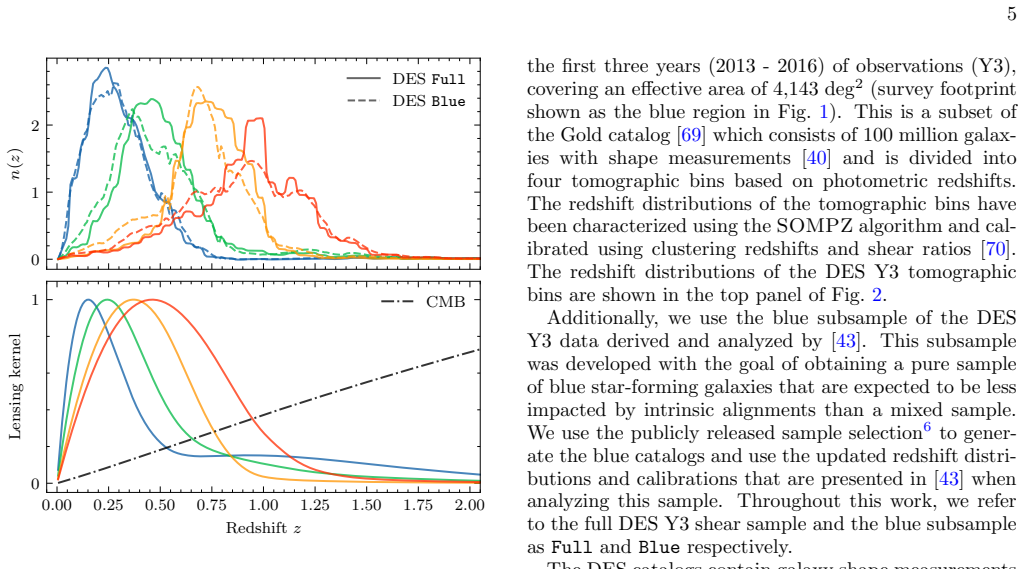
We present measurements of the cross-correlation between CMB lensing and cosmic shear over ~1,300 deg2 of the sky using the SPT-3G D1 CMB lensing maps and the Dark Energy Survey Year 3 (DES Y3) shear catalogs. For the first time, we measure this cross-correlation at high significance (~14σ) when using a polarization-only CMB lensing reconstruction that is expected to be robust against biases induced by extragalactic foregrounds. We test a variety of other CMB lensing estimators that include temperature information and exhibit different tradeoffs between foreground biases and noise, as well as a shear sample that consists of blue, star-forming galaxies and has been shown to be less impacted b
What carries the argument
Polarization-only CMB lensing reconstruction crossed with the DES Y3 galaxy shear catalog to form the cross-power spectrum; this estimator uses only E and B polarization modes to map the lensing potential and thereby sidesteps temperature foreground contamination.
If this is right
- The cross-correlation supplies an independent S8 constraint that matches both Planck and DES shear-only values.
- It returns a constraint on the intrinsic alignment amplitude of the DES sample that is competitive with shear-only analyses.
- Combining the cross-correlation with Planck data produces a lower limit on the strength of baryonic feedback.
- Multiple CMB lensing estimators display distinct tradeoffs between foreground bias and noise levels.
- A blue, star-forming galaxy shear sample reduces the impact of intrinsic alignments relative to the full sample.
Where Pith is reading between the lines
- The polarization-only approach could be applied to other overlapping CMB and optical surveys to reduce foreground-related systematics in lensing cross-checks.
- Prioritizing blue galaxy samples in future shear analyses may lower the modeling burden from intrinsic alignments.
- The observed consistency between probes suggests that cross-correlations can help isolate the contribution of specific astrophysical effects such as feedback.
- Testing the same cross-correlation on independent sky patches would provide a direct check on the stability of the 14 sigma detection.
Load-bearing premise
The analysis assumes a flat LambdaCDM cosmology and that the modeled uncertainties in intrinsic alignments, baryonic feedback, and nuisance parameters fully capture the relevant systematics.
What would settle it
A future measurement of the same cross-correlation using improved foreground modeling that yields an S8 value in significant tension with 0.833 would indicate that unaccounted biases remain in the polarization-only result.
Figures





read the original abstract
Measurements of the weak lensing of galaxies and of the cosmic microwave background (CMB) provide direct probes of the cosmic matter density field, but the two observables are sensitive to different spatial scales, redshift ranges, and survey systematics. Their cross-correlation thus enables consistency checks of the theoretical model and of potential systematics in either dataset. We present measurements of the cross-correlation between CMB lensing and cosmic shear over $\sim$1,300 deg$^2$ of the sky using the SPT-3G D1 CMB lensing maps and the Dark Energy Survey Year 3 (DES Y3) shear catalogs. For the first time, we measure this cross-correlation at high significance ($\sim 14\sigma$) when using a polarization-only CMB lensing reconstruction that is expected to be robust against biases induced by extragalactic foregrounds. We test a variety of other CMB lensing estimators that include temperature information and exhibit different tradeoffs between foreground biases and noise, as well as a shear sample that consists of blue, star-forming galaxies and has been shown to be less impacted by galaxy intrinsic alignments. Assuming $\Lambda$CDM and marginalizing over uncertainties in intrinsic alignments, baryonic feedback, and various nuisance parameters, we obtain a constraint on the amplitude of matter clustering $S_8 \equiv \sigma_8 \sqrt{\Omega_m / 0.3} = 0.833^{+0.047}_{-0.061}$, consistent with both the primary CMB results from Planck and shear-only results from DES Y3. By combining our measurement with Planck, we find mild constraints on the astrophysical processes that impact the cross-correlation. We obtain a constraint on the intrinsic alignment amplitude of the DES sample that is competitive with that from shear-only analyses, and we find a lower limit on the strength of baryonic feedback.
Editorial analysis
A structured set of objections, weighed in public.
Referee Report
Summary. The manuscript reports a cross-correlation measurement between SPT-3G D1 CMB lensing (using a polarization-only reconstruction) and DES Y3 galaxy shear catalogs over ~1300 deg². It claims a ~14σ detection significance, derives the constraint S_8 = 0.833^{+0.047}_{-0.061} under ΛCDM after marginalizing over intrinsic alignments, baryonic feedback, and nuisance parameters, and finds consistency with Planck primary CMB results and DES Y3 shear-only results. The analysis also combines the cross-correlation with Planck data to obtain a competitive constraint on the DES intrinsic alignment amplitude and a lower limit on the strength of baryonic feedback, while testing alternative CMB lensing estimators (including those with temperature information) and a blue-galaxy shear sample.
Significance. If the central measurement and modeling hold, this work supplies a valuable consistency test between two independent weak-lensing probes that are sensitive to different redshifts and scales. The polarization-only CMB lensing map is a clear strength because it is expected to be robust against extragalactic foreground biases; the explicit comparison of multiple estimators and the use of a blue-galaxy sample (less affected by intrinsic alignments) further strengthen the robustness claims. The derived S_8 constraint is competitive, and the joint analysis with Planck yields astrophysical constraints on intrinsic alignments and baryonic feedback that are not available from either dataset alone.
minor comments (4)
- [Abstract] Abstract: the reported detection significance (~14σ) is given without stating whether it is computed from the signal-to-noise ratio of the binned cross-power spectrum, from a χ² test against the null hypothesis, or from another estimator; adding this detail would clarify the claim.
- [Methods / Modeling section] The text refers to “various nuisance parameters” that are marginalized over, but does not list them explicitly in one place (e.g., multiplicative bias, photo-z shifts, shear calibration); a compact table or paragraph summarizing all marginalized parameters and their priors would improve readability.
- [Results figures] Figure captions for the cross-power spectrum plots should state the exact multipole binning, the covariance estimation method (jackknife, simulations, or analytic), and whether the plotted errors include the full covariance or only diagonal terms.
- [Shear sample section] The blue-galaxy sample is stated to be “less impacted by galaxy intrinsic alignments,” but the quantitative reduction in the IA amplitude relative to the full sample is not shown; a short comparison plot or table would support this statement.
Simulated Author's Rebuttal
We thank the referee for their positive assessment of our manuscript, accurate summary of the results, and recommendation for minor revision. We appreciate the recognition of the robustness provided by the polarization-only CMB lensing reconstruction and the value of the consistency test between probes.
Circularity Check
No significant circularity; direct data-driven measurement
full rationale
The paper reports a cross-correlation measurement between two independent observational datasets (SPT-3G polarization-only CMB lensing maps and DES Y3 galaxy shear catalogs) over ~1300 deg², achieving ~14σ significance. The S8 constraint is obtained by fitting the measured correlation function under ΛCDM while marginalizing over IA, baryonic feedback, and nuisance parameters. No load-bearing step reduces by construction to a fitted input, self-citation chain, or ansatz smuggled from prior work; the central result is externally falsifiable against Planck and DES Y3 shear-only analyses. The derivation chain is self-contained against external benchmarks.
Axiom & Free-Parameter Ledger
free parameters (2)
- S8
- intrinsic alignment amplitude
axioms (1)
- domain assumption ΛCDM background cosmology
Reference graph
Works this paper leans on
-
[1]
The number of data points in each bin is 24
and relative to thePlanckprediction (χ 2 pl) for each tomographic bin. The number of data points in each bin is 24. The totalχ 2 relative to thePlanckmodel is 96.6 with 96 degrees of freedom, while the totalχ 2 relative to the best fit is 94.2 with 93.0 degrees of freedom (accounting for the effective number of fit parameters). The gray vertical lines ind...
-
[2]
Intrinsic alignments Due to tidal forces, galaxies are not randomly oriented, but tend to align with the large-scale tidal field, leading to an additional contribution to the shear power spec- trum. Intrinsic alignments are one of the main sources of systematic uncertainty in the modeling of shear data and many methods have been developed to model their c...
-
[3]
We account for this uncertainty by marginalizing over the phenomenological logT AGN parameter inHMCode
Baryonic feedback Baryonic feedback is a major source of theoretical un- certainty in the nonlinear matter power spectrum on small scales (k≳1hMpc −1) [95]. We account for this uncertainty by marginalizing over the phenomenological logT AGN parameter inHMCode. This parameterization was calibrated to reproduce the matter power spectrum observed in theBaham...
-
[4]
While more flexible models of feedback have been developed [e.g., 97], the level of small-scale noise in our measurement does not warrant the use of more complicated models
forz <1 andk <20hMpc −1. While more flexible models of feedback have been developed [e.g., 97], the level of small-scale noise in our measurement does not warrant the use of more complicated models
-
[5]
Shear measurement uncertainties As in the official DES Y3 analysis [77], we marginalize over uncertainties in the shear calibration and the red- shift distributions of the source galaxies. Uncertainties in the redshift distributions are parameterized through a shift ∆zi of their means: ni(z)→n i(z−∆z i).(11) Residual uncertainties in the shear calibration...
-
[6]
Non-Gaussian covariance terms We model the total covariance of the cross-spectra as the sum of the Gaussian covariance computed usingNa- 10 κγ1 κγ2 κγ3 κγ4 κγ1 κγ2 κγ3 κγ4 Gaussian (iNKA) iNKA + SSC + cNG −100 −10−1 −10−2 0 10−2 10−1 100 correlation Cij /√CiiCjj FIG. 5. Normalized data covariance matrix for theFull×Pol cross-correlation. The upper half of...
-
[7]
We sample all parameters over the same ranges used in the DES Y3 analysis with a few small changes
Priors We list all of the fiducial parameter values and priors used in our parameter inference in Table II. We sample all parameters over the same ranges used in the DES Y3 analysis with a few small changes. We use broad uniform priors for the cosmological parameters Ωm, Ωb,h,A s, and ns. We assume a single massive neutrino species with a fixed mass ofm ν...
-
[8]
Likelihood We assume a Gaussian likelihoodLfor the joint dis- tribution of the cross-spectrum bandpowers: −2 lnL+K≡ χ2 = (d−m(θ)) T C−1(d−m(θ)),(15) whereKis an arbitrary constant,dis the data vector consisting of the measured cross-spectra,mis the model computed at given values of the parametersθ, and C is the covariance matrix of the data. The posterior...
-
[9]
true” cross-spectra are calculated from the noiseless full-skyAgoralensing maps. We also note that the “true
Scale cuts For our fiducial analysis, we attempt to fit all scales present in the measured data vectors (30≤ℓ≤3500). To test the robustness of our results, we also test the effect of scale cuts designed to remove sensitivity to all spatial modes withk > k max. To convert ak max cut to a correspondingℓ max cut, we use a method similar to that developed by ...
2000
-
[10]
11 we compare the con- straints obtained when cross-correlating the four GMV variants of the CMB lensing maps with the full DES Y3 sample
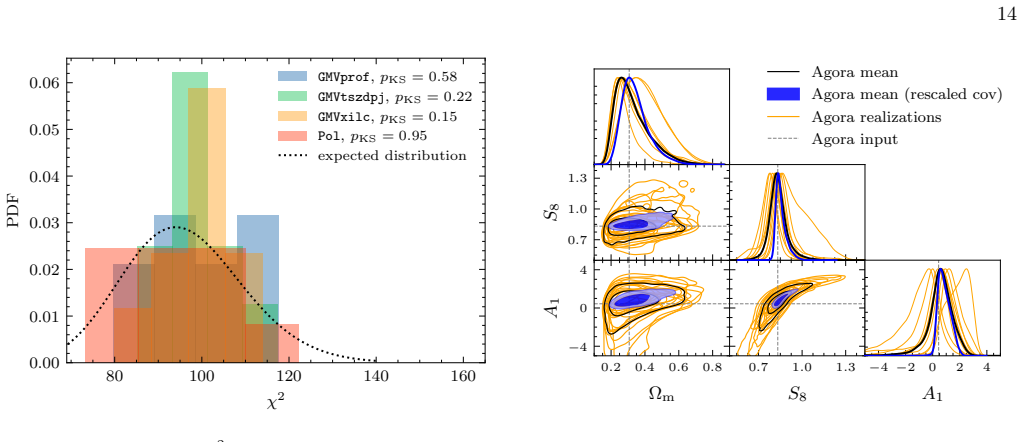
CMB lensing foregrounds In the second panel of Fig. 11 we compare the con- straints obtained when cross-correlating the four GMV variants of the CMB lensing maps with the full DES Y3 sample. Generally, we see good agreement between all of the data combinations and the fiducial polarization-only result, except for the one that uses the rawGMVmap which is c...
-
[11]
Scale cuts A potential concern about this analysis is that we at- tempt to use all scales to extract cosmological constraints while using relatively simplistic models for IA and bary- onic feedback. Since the measuredκγcross-correlation on its own is unable to constrain the parameters related to these effects, we conclude that there is not enough sen- sit...
-
[12]
tailored IA
Intrinsic alignments Under the assumption of NLA (which is expected to be a reasonable approximation on the quasi-linear scales our measurement is mostly sensitive to), we find that our results are robust against IA modeling choices. In the bottom panel of Fig. 11 we show how varying the IA priors for theFull×PolandBlue×Polanalyses affects the resultingS ...
2020
-
[13]
Weak gravitational lensing
Bartelmann, M., & Schneider, P. Weak gravitational lensing. 2001, Phys. Rep., 340, 291, doi:10.1016/ S0370-1573(00)00082-X
2001
-
[14]
Kilbinger, M. Cosmology with cosmic shear observa- tions: a review. 2015, Reports on Progress in Physics, 78, 086901, doi:10.1088/0034-4885/78/8/086901
-
[16]
Dark Energy Survey and Kilo-Degree Survey Collabo- ration, Abbott, T. M. C., Aguena, M., et al. DES Y3 + KiDS-1000: Consistent cosmology combining cosmic shear surveys. 2023, The Open Journal of Astrophysics, 6, 36, doi:10.21105/astro.2305.17173
-
[17]
H., St¨ olzner, B., Asgari, M., et al
Wright, A. H., St¨ olzner, B., Asgari, M., et al. KiDS- Legacy: Cosmological constraints from cosmic shear with the complete Kilo-Degree Survey. 2025, A&A, 703, A158, doi:10.1051/0004-6361/202554908
-
[18]
Hyper Suprime-Cam Year 3 results: Cosmology from cosmic shear power spectra
Dalal, R., Li, X., Nicola, A., et al. Hyper Suprime-Cam Year 3 results: Cosmology from cosmic shear power spectra. 2023, Phys. Rev. D, 108, 123519, doi:10.1103/ PhysRevD.108.123519
2023
-
[19]
Anbajagane, D., Chang, C., Drlica-Wagner, A., et al. The DECADE cosmic shear project IV: cosmological constraints from 107 million galaxies across 5,400 deg 2 of the sky. 2025, The Open Journal of Astrophysics, 8, 46161, doi:10.33232/001c.146161
-
[20]
CMB lensing from Planck PR4 maps
Carron, J., Mirmelstein, M., & Lewis, A. CMB lensing from Planck PR4 maps. 2022, J. Cosmology Astropart. Phys., 2022, 039, doi:10.1088/1475-7516/2022/09/ 039
-
[21]
Madhavacheril, M. S., Qu, F. J., Sherwin, B. D., et al. The Atacama Cosmology Telescope: DR6 Gravitational Lensing Map and Cosmological Parameters. 2024, ApJ, 962, 113, doi:10.3847/1538-4357/acff5f
-
[22]
A 2500 deg 2 CMB Lensing Map from Combined South Pole Tele- scope and Planck Data
Omori, Y., Chown, R., Simard, G., et al. A 2500 deg 2 CMB Lensing Map from Combined South Pole Tele- scope and Planck Data. 2017, ApJ, 849, 124, doi:10. 3847/1538-4357/aa8d1d
2017
-
[23]
Wu, W. L. K., Mocanu, L. M., Ade, P. A. R., et al. 21 −2 0 2 106 ℓCκγB ℓ χ2/Nd = 16.7 / 24 Full×Pol bin 1 χ2/Nd = 41.4 / 24 Full×Pol bin 2 χ2/Nd = 20.1 / 24 Full×Pol bin 3 χ2/Nd = 19.2 / 24 Full×Pol bin 4 102 103 ℓ −2 0 2 106 ℓCκγB ℓ χ2/Nd = 20.4 / 24 Blue×Pol bin 1 102 103 ℓ χ2/Nd = 34.9 / 24 Blue×Pol bin 2 102 103 ℓ χ2/Nd = 24.5 / 24 Blue×Pol bin 3 102 ...
-
[25]
Qu, F. J., Ge, F., Wu, W. L. K., et al. Unified and Consistent Structure Growth Measurements from Joint ACT, SPT, and Planck CMB Lensing. 2026, Phys. Rev. Lett., 136, 021001, doi:10.1103/k5yr-3h6d
-
[26]
Di Valentino, E., Said, J. L., Riess, A., et al. The Cos- moVerse White Paper: Addressing observational ten- sions in cosmology with systematics and fundamental physics. 2025, Physics of the Dark Universe, 49, 101965, doi:10.1016/j.dark.2025.101965
-
[27]
Status of the S 8 tension: A 2026 review of probe discrepancies
Pantos, I., & Perivolaropoulos, L. Status of the S 8 tension: A 2026 review of probe discrepancies. 2026, Physics of the Dark Universe, 52, 102286, doi:10.1016/ j.dark.2026.102286
arXiv 2026
-
[28]
A non-linear solution to the S8 tension? 2022, MNRAS, 516, 5355, doi:10.1093/ mnras/stac2429
Amon, A., & Efstathiou, G. A non-linear solution to the S8 tension? 2022, MNRAS, 516, 5355, doi:10.1093/ mnras/stac2429
2022
-
[29]
A non-linear solution to the S 8 tension - II
Preston, C., Amon, A., & Efstathiou, G. A non-linear solution to the S 8 tension - II. Analysis of DES Year 3 cosmic shear. 2023, MNRAS, 525, 5554, doi:10.1093/ mnras/stad2573
2023
-
[30]
E., Zennaro, M., Contreras, S., Chen, A., & Hern´ andez-Monteagudo, C
Aric` o, G., Angulo, R. E., Zennaro, M., Contreras, S., Chen, A., & Hern´ andez-Monteagudo, C. DES Y3 cos- mic shear down to small scales: Constraints on cosmol- ogy and baryons. 2023, A&A, 678, A109, doi:10.1051/ 0004-6361/202346539
2023
-
[31]
DeRose, J., & Chen, S.-F. The Lensing Counter Narra- tive: An Effective Description of Small-Scale Clustering in Weak Lensing Power Spectra. 2025, arXiv e-prints, arXiv:2510.18981, doi:10.48550/arXiv.2510.18981
-
[32]
Analysis of DESI×DES using the Lagrangian effective theory of LSS
Chen, S., DeRose, J., Zhou, R., et al. Analysis of DESI×DES using the Lagrangian effective theory of LSS. 2024, Phys. Rev. D, 110, 103518, doi:10.1103/ PhysRevD.110.103518
2024
-
[33]
Late-time suppression of structure growth as a solution for the S8 tension
Terasawa, R., Takada, M., Kurita, T., & Sugiyama, S. Late-time suppression of structure growth as a solution for the S8 tension. 2025, Phys. Rev. D, 112, 083556, doi:10.1103/k7gb-8dp7
-
[34]
Sabogal, M. A., Silva, E., Nunes, R. C., Kumar, S., Di Valentino, E., & Giar` e, W. Quantifying the S8 tension and evidence for interacting dark energy from redshift- space distortion measurements. 2024, Phys. Rev. D, 110, 123508, doi:10.1103/PhysRevD.110.123508
-
[36]
K., Hloˇ zek, R., Lagu¨ e, A., Ivanov, M
Rogers, K. K., Hloˇ zek, R., Lagu¨ e, A., Ivanov, M. M., Philcox, O. H. E., Cabass, G., Akitsu, K., & Marsh, D. J. E. Ultra-light axions and the S 8 tension: joint constraints from the cosmic microwave background and galaxy clustering. 2023, J. Cosmology Astropart. Phys., 2023, 023, doi:10.1088/1475-7516/2023/06/023
-
[37]
He, A., Ivanov, M. M., An, R., & Gluscevic, V. S 8 Ten- sion in the Context of Dark Matter-Baryon Scattering. 2023, ApJ, 954, L8, doi:10.3847/2041-8213/acdb63
-
[38]
Going beyondS 8: fast infer- ence of the matter power spectrum from weak-lensing surveys
Doux, C., & Karwal, T. Going beyondS 8: fast infer- ence of the matter power spectrum from weak-lensing surveys. 2026, The Open Journal of Astrophysics, 9, 55045, doi:10.33232/001c.155045
-
[39]
Troxel, M. A., & Ishak, M. The intrinsic alignment of galaxies and its impact on weak gravitational lensing in an era of precision cosmology. 2015, Phys. Rep., 558, 1, doi:10.1016/j.physrep.2014.11.001
-
[40]
N., Pyne, S., Legnani, E., & Ferreira, T
Lamman, C., Tsaprazi, E., Shi, J., ˇSarˇ cevi´ c, N. N., Pyne, S., Legnani, E., & Ferreira, T. The IA Guide: A Breakdown of Intrinsic Alignment Formalisms. 2024, 22 0.2 0.4 Ωm 7.5 8.0 log TAGN −4 0 4 α1 −2 0 2 A1 0.9 1.0 ns 0.6 0.8 h 0.04 0.06 Ωb 0.6 0.8 1.0 S8 1 2 3 4 109As 1 2 3 4 109As 0.6 0.8 1.0 S8 0.04 0.06 Ωb 0.6 0.7 0.8 h 0.9 1.0 ns −2 0 2 A1 −4 0...
arXiv 2024
-
[41]
Chisari, N. E. A rising tide: intrinsic alignments since the turn of the millennium. 2025, A&A Rev., 33, 5, doi:10.1007/s00159-025-00161-8
-
[42]
Osborne, S. J., Hanson, D., & Dor´ e, O. Extragalactic foreground contamination in temperature-based CMB lens reconstruction. 2014, J. Cosmology Astropart. Phys., 2014, 024, doi:10.1088/1475-7516/2014/03/ 024
-
[43]
van Engelen, A., Bhattacharya, S., Sehgal, N., Holder, G. P., Zahn, O., & Nagai, D. CMB Lensing Power Spec- trum Biases from Galaxies and Clusters Using High- angular Resolution Temperature Maps. 2014, ApJ, 786, 13, doi:10.1088/0004-637X/786/1/13
-
[45]
Marques, G. A., Liu, J., Huffenberger, K. M., & Colin Hill, J. Cross-correlation between Subaru Hyper Suprime-Cam Galaxy Weak Lensing and Planck Cos- mic Microwave Background Lensing. 2020, ApJ, 904, 182, doi:10.3847/1538-4357/abc003
-
[46]
C., Alonso, D., Harnois-D´ eraps, J., et al
Robertson, N. C., Alonso, D., Harnois-D´ eraps, J., et al. Strong detection of the CMB lensing and galaxy weak lensing cross-correlation from ACT-DR4, Planck Legacy, and KiDS-1000. 2021, A&A, 649, A146, doi:10. 1051/0004-6361/202039975
2021
-
[47]
Cosmol- ogy from cross-correlation of ACT-DR4 CMB lensing and DES-Y3 cosmic shear
Shaikh, S., Harrison, I., van Engelen, A., et al. Cosmol- ogy from cross-correlation of ACT-DR4 CMB lensing and DES-Y3 cosmic shear. 2024, MNRAS, 528, 2112, doi:10.1093/mnras/stad3987
-
[48]
Chang, C., Omori, Y., Baxter, E. J., et al. Joint analysis of Dark Energy Survey Year 3 data and CMB lensing from SPT and Planck. II. Cross-correlation measure- ments and cosmological constraints. 2023, Phys. Rev. D, 107, 023530, doi:10.1103/PhysRevD.107.023530
-
[49]
Constraining baryonic feedback and 23 cosmology from DES Y3 and Planck PR4 6×2pt data
Xu, J., Eifler, T., Krause, E., Miranda, V., Salcido, J., & McCarthy, I. Constraining baryonic feedback and 23 cosmology from DES Y3 and Planck PR4 6×2pt data. I. ΛCDM models. 2025, arXiv e-prints, arXiv:2510.25596, doi:10.48550/arXiv.2510.25596
-
[50]
Omori, Y., Baxter, E. J., Chang, C., et al. Joint analysis of Dark Energy Survey Year 3 data and CMB lensing from SPT and Planck. I. Construction of CMB lensing maps and modeling choices. 2023, Phys. Rev. D, 107, 023529, doi:10.1103/PhysRevD.107.023529
-
[51]
Abbott, T. M. C., Aguena, M., Alarcon, A., et al. Joint analysis of Dark Energy Survey Year 3 data and CMB lensing from SPT and Planck. III. Combined cosmo- logical constraints. 2023, Phys. Rev. D, 107, 023531, doi:10.1103/PhysRevD.107.023531
-
[52]
Gatti, M., Sheldon, E., Amon, A., et al. Dark energy survey year 3 results: weak lensing shape catalogue. 2021, MNRAS, 504, 4312, doi:10.1093/mnras/stab918
-
[53]
D., Ade, P., Anthony, A., et al
Kermish, Z. D., Ade, P., Anthony, A., et al. The POLARBEAR experiment. 2012, in Society of Photo- Optical Instrumentation Engineers (SPIE) Conference Series, Vol. 8452, Millimeter, Submillimeter, and Far- Infrared Detectors and Instrumentation for Astronomy VI, ed. W. S. Holland & J. Zmuidzinas, 84521C, doi:10. 1117/12.926354
2012
-
[54]
AGORA: Multicomponent simulation for cross-survey science
Omori, Y. AGORA: Multicomponent simulation for cross-survey science. 2024, MNRAS, 530, 5030, doi:10. 1093/mnras/stae1031
2024
-
[55]
Dark Energy Survey Year 3: Blue shear
McCullough, J., Amon, A., Legnani, E., et al. Dark Energy Survey Year 3: Blue shear. 2026, Phys. Rev. D, 113, 103509, doi:10.1103/wmp3-qc3p
-
[56]
2020, title Planck 2018 results
Planck Collaboration, Aghanim, N., Akrami, Y., et al. Planck 2018 results. VI. Cosmological parameters. 2020, A&A, 641, A6, doi:10.1051/0004-6361/201833910
-
[57]
Sobrin, J. A., Anderson, A. J., Bender, A. N., et al. The Design and Integrated Performance of SPT-3G. 2022, ApJS, 258, 42, doi:10.3847/1538-4365/ac374f
-
[58]
, archivePrefix = "arXiv", eprint =
Carlstrom, J. E., Ade, P. A. R., Aird, K. A., et al. The 10 Meter South Pole Telescope. 2011, PASP, 123, 568, doi:10.1086/659879
-
[59]
Camphuis, E., Quan, W., Balkenhol, L., et al. SPT-3G D1: CMB temperature and polarization power spectra and cosmology from 2019 and 2020 observations of the SPT-3G main field. 2026, Phys. Rev. D, 113, 083504, doi:10.1103/7wt3-9v2y
-
[60]
SPT-3G D1: Maps of the millimeter-wave sky from 2019 and 2020 observations of the SPT-3G Main field
Quan, W., Camphuis, E., Daley, C., et al. SPT-3G D1: Maps of the millimeter-wave sky from 2019 and 2020 observations of the SPT-3G Main field. 2026, arXiv e-prints, arXiv:2603.20163.https://arxiv.org/abs/ 2603.20163
arXiv 2019
-
[61]
Mass Reconstruction with Cosmic Microwave Background Polarization
Hu, W., & Okamoto, T. Mass Reconstruction with Cosmic Microwave Background Polarization. 2002, ApJ, 574, 566, doi:10.1086/341110
-
[62]
M., & Seljak, U
Hirata, C. M., & Seljak, U. Reconstruction of lens- ing from the cosmic microwave background polariza- tion. 2003, Phys. Rev. D, 68, 083002, doi:10.1103/ PhysRevD.68.083002
2003
-
[64]
Maximum a posteriori CMB lensing reconstruction
Carron, J., & Lewis, A. Maximum a posteriori CMB lensing reconstruction. 2017, Phys. Rev. D, 96, 063510, doi:10.1103/PhysRevD.96.063510
-
[66]
Selecting samples of galaxies with fewer Fingers-of-God
Baleato Lizancos, A., Seljak, U., Karamanis, M., Bonici, M., & Ferraro, S. Selecting samples of galaxies with fewer Fingers-of-God. 2025, J. Cosmology Astropart. Phys., 2025, 014, doi:10.1088/1475-7516/2025/07/ 014
-
[67]
Smith, K. M., Cooray, A., Das, S., Dor´ e, O., Hanson, D., Hirata, C., Kaplinghat, M., Keating, B., Loverde, M., Miller, N., Rocha, G., Shimon, M., & Zahn, O. Gravitational Lensing. 2009, in American Institute of Physics Conference Series, Vol. 1141, CMB Polariza- tion Workshop: Theory and Foregrounds: CMBPol Mission Concept Study, ed. S. Dodelson, D. Bau...
-
[68]
C., M¨ unchmeyer, M., & Terrana, A
Deutsch, A.-S., Johnson, M. C., M¨ unchmeyer, M., & Terrana, A. Polarized Sunyaev Zel’dovich tomogra- phy. 2018, J. Cosmology Astropart. Phys., 2018, 034, doi:10.1088/1475-7516/2018/04/034
-
[69]
Polarization of the Cosmic In- frared Background Fluctuations
Feng, C., & Holder, G. Polarization of the Cosmic In- frared Background Fluctuations. 2020, ApJ, 897, 140, doi:10.3847/1538-4357/ab9013
-
[70]
Cosmic microwave back- ground lensing reconstruction on the full sky
Okamoto, T., & Hu, W. Cosmic microwave back- ground lensing reconstruction on the full sky. 2003, Phys. Rev. D, 67, 083002, doi:10.1103/PhysRevD.67. 083002
-
[71]
S., Ali-Ha¨ ımoud, Y., Carron, J., Lewis, A., & Madhavacheril, M
Maniyar, A. S., Ali-Ha¨ ımoud, Y., Carron, J., Lewis, A., & Madhavacheril, M. S. Quadratic estimators for CMB weak lensing. 2021, Phys. Rev. D, 103, 083524, doi:10.1103/PhysRevD.103.083524
-
[72]
Namikawa, T., Hanson, D., & Takahashi, R. Bias- hardened CMB lensing. 2013, MNRAS, 431, 609, doi:10.1093/mnras/stt195
-
[73]
Lower bias, lower noise CMB lensing with foreground-hardened estima- tors
Sailer, N., Schaan, E., & Ferraro, S. Lower bias, lower noise CMB lensing with foreground-hardened estima- tors. 2020, Phys. Rev. D, 102, 063517, doi:10.1103/ PhysRevD.102.063517
2020
-
[74]
Madhavacheril, M. S., & Hill, J. C. Mitigating fore- ground biases in CMB lensing reconstruction using cleaned gradi ents. 2018, Phys. Rev. D, 98, 023534, doi:10.1103/PhysRevD.98.023534
-
[75]
A Cross-internal Lin- ear Combination Approach to Probe the Secondary CMB Anisotropies: Kinematic Sunyaev-Zel’dovich Ef- fect and CMB Lensing
Raghunathan, S., & Omori, Y. A Cross-internal Lin- ear Combination Approach to Probe the Secondary CMB Anisotropies: Kinematic Sunyaev-Zel’dovich Ef- fect and CMB Lensing. 2023, ApJ, 954, 83, doi:10. 3847/1538-4357/ace0c6
2023
-
[76]
Nakato, Y., Wu, W. L. K., Oliveira, A. C. S., Omori, Y., & Maniyar, A. S. Foreground mitigation for CMB lens- ing with the global minimum variance quadratic esti- mator. 2026, J. Cosmology Astropart. Phys., 2026, 031, doi:10.1088/1475-7516/2026/03/031
-
[77]
The Dark Energy Survey Collaboration. The Dark En- ergy Survey. 2005, arXiv e-prints, astro, doi:10.48550/ arXiv.astro-ph/0510346
Pith/arXiv arXiv 2005
-
[78]
Abbott, T. M. C., Abdalla, F. B., Allam, S., et al. The Dark Energy Survey: Data Release 1. 2018, ApJS, 239, 18, doi:10.3847/1538-4365/aae9f0
-
[79]
Abbott, T. M. C., Adam´ ow, M., Aguena, M., et al. The Dark Energy Survey Data Release 2. 2021, ApJS, 255, 20, doi:10.3847/1538-4365/ac00b3
-
[80]
T., Honscheid, K., et al
Flaugher, B., Diehl, H. T., Honscheid, K., et al. The Dark Energy Camera. 2015, AJ, 150, 150, doi:10.1088/ 24 0004-6256/150/5/150
2015
-
[81]
Dark Energy Survey Year 3 Results: Photometric Data Set for Cosmology
Sevilla-Noarbe, I., Bechtol, K., Carrasco Kind, M., et al. Dark Energy Survey Year 3 Results: Photometric Data Set for Cosmology. 2021, ApJS, 254, 24, doi:10.3847/ 1538-4365/abeb66
2021
-
[82]
Myles, J., Alarcon, A., Amon, A., et al. Dark En- ergy Survey Year 3 results: redshift calibration of the weak lensing source galaxies. 2021, MNRAS, 505, 4249, doi:10.1093/mnras/stab1515
-
[83]
Sheldon, E. S., & Huff, E. M. Practical Weak-lensing Shear Measurement with Metacalibration. 2017, ApJ, 841, 24, doi:10.3847/1538-4357/aa704b
-
[84]
Metacalibration: Direct Self-Calibration of Biases in Shear Measurement
Huff, E., & Mandelbaum, R. Metacalibration: Direct Self-Calibration of Biases in Shear Measurement. 2017, arXiv e-prints, arXiv:1702.02600, doi:10.48550/arXiv. 1702.02600
work page internal anchor Pith review Pith/arXiv arXiv doi:10.48550/arxiv 2017
-
[85]
Amon, A., Gruen, D., Troxel, M. A., et al. Dark Energy Survey Year 3 results: Cosmology from cosmic shear and robustness to data calibration. 2022, Phys. Rev. D, 105, 023514, doi:10.1103/PhysRevD.105.023514
-
[86]
2016, MNRAS, 457, 4340, doi: 10.1093/mnras/stw248
Klypin, A., Yepes, G., Gottl¨ ober, S., Prada, F., & Heß, S. MultiDark simulations: the story of dark matter halo concentrations and density profiles. 2016, MNRAS, 457, 4340, doi:10.1093/mnras/stw248
discussion (0)
Sign in with ORCID, Apple, or X to comment. Anyone can read and Pith papers without signing in.