REVIEW 3 major objections 4 minor 37 references
Dual Adversarial Inference for Text-to-Image Synthesis
T0 review · 3 major / 4 minor · reviewed 2026-08-14 · deepseek-v4-flash
Pith's one-line read By adding dual adversarial inference, text-to-image synthesis learns a content code and a style code that are disentangled, making the style channel meaningful and improving image quality.
desk verdict A useful fix for the ignored-noise problem in text-to-image GANs, but the style/disentanglement claim rests mostly on qualitative evidence; deserves a careful referee. read the letter →
The pith
A machine-rendered reading of the paper's core claim, the machinery that carries it, and where it could break.
The reading
What carries the argument
The load-bearing object is dual adversarial inference over the factorized posterior $q(z,c|x)=q(z|x)q(c|x)$, implemented by an encoder $G_{z,c}(x)=(\hat z,\hat c)$ and two discriminators $D_{x,z}$ and $D_{x,c}$ that match the empirical joint distributions to the model joint distributions for $(x,z)$ and $(x,c)$. Matching these joint distributions transfers data variation into the latent codes, and the independence factorization is what is supposed to keep style and content from bleeding into each other. A third discriminator $D_{x,x'}$ enforces cycle consistency by comparing $x$ with the reconstruction $G_x(\hat z,\hat c)$, and the matching-aware text loss $V_{t2i}$ keeps the content code tied to the text embedding $\phi_t$. The later switch of the content prior to a Bernoulli distribution is motivated by independent component analysis, where non-Gaussianity is needed to separate additive sources.
What would settle it
On a dataset with independently labeled style attributes (position, size, count) and fixed content attributes, train the model and then test whether a linear classifier trained on $\hat z$ predicts the style labels while $\hat c$ predicts content labels, and vice versa; any cross-prediction above chance would show the independence factorization failed.
Extended reading notes
Core claim
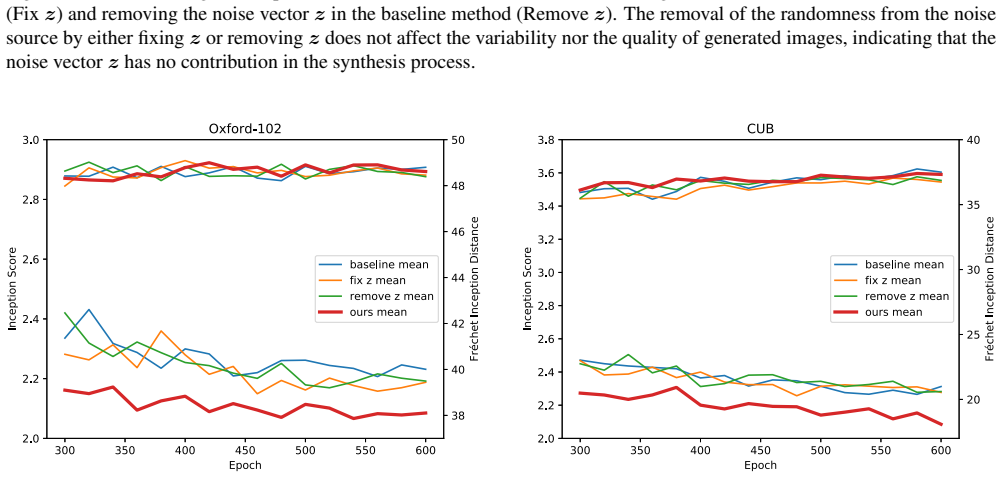
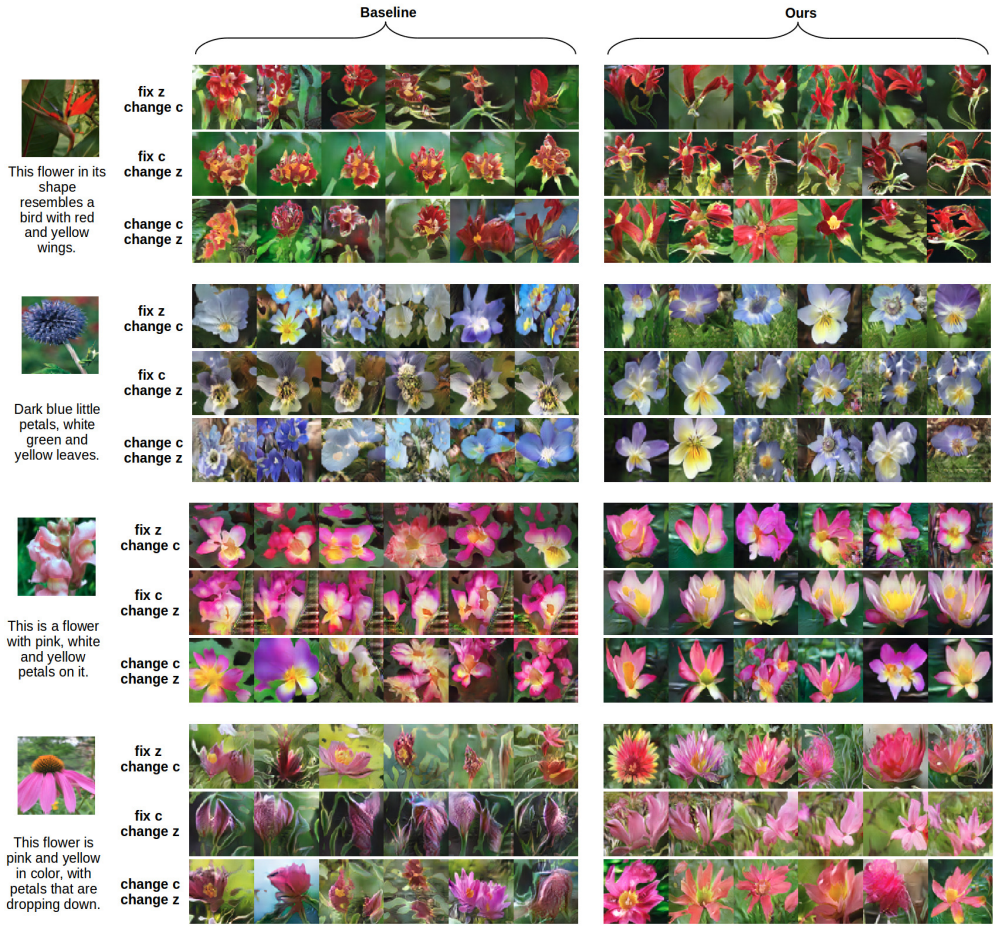
The paper's central claim is that a text-to-image generator should be driven by two genuinely independent latent variables—content $c$, carrying what the text says, and style $z$, carrying everything else in the image—and that this separation can be learned without style labels by adding a dual adversarial inference mechanism. An encoder produces $\hat z$ and $\hat c$ from a real image, and two discriminators match the empirical joint distributions $q(x,z)$ and $q(x,c)$ to the generator's model distributions, while a cycle-consistency discriminator forces the inferred pair to reconstruct the original image. The authors report that in standard baselines the noise $z$ is dead—fixing or removing it leaves generation unchanged—whereas in their model $z$ becomes a meaningful control, and the inferred codes can be swapped between images to transfer style while preserving content. On Oxford-102, CUB, and COCO at $64\times64$, the method improves FID over the baseline ($40.02\to37.94$, $20.60\to18.41$, $29.13\to27.07$) with comparable inception scores. Because the datasets have no labeled style attributes, the style-content separation is verified through t-SNE clustering, interpolations, and style-transfer examples rather than a quantitative disentanglement metric.
Load-bearing premise
The result rests on the assumption that content and style are independent given an image, a factorization the method imposes rather than measures; if real image variation does not factor that way, the two codes could stay correlated and the style-control examples would not be representative.
Editorial extensions
If this is right
- Because $z$ now carries style, sampling a new $z$ while holding $c$ fixed yields visibly different locations, sizes, poses, or counts instead of near-identical images, giving text-to-image models a controllable diversity axis.
- The inference network enables image-driven style transfer: infer $\hat c$ from one image and $\hat z$ from another, and the generator produces a hybrid that keeps the first image's content and the second's style.
- The reported FID improvements on three benchmarks imply the added inference and cycle losses help fidelity without sacrificing text-image alignment, since visual-semantic similarity stays comparable to the baseline.
- The finding that baseline $z$ is idle suggests previously reported diversity in these models comes mainly from randomness in the conditioned text embedding, not from the image-noise channel.
- Ablations show the full objective needs all three terms: removing the text-matching loss hurts most, dropping cycle consistency hurts slightly, and replacing adversarial cycle loss with $\ell^2$ reconstruction badly degrades output.
Reading between the lines
- A direct test of the core assumption would measure mutual information or classifier accuracy between $\hat z$ and $\hat c$ on a dataset with known style labels; the paper itself notes such labels are absent, so the separation claim currently rests on qualitative examples.
- If the separation holds robustly, it gives a path to user-controllable generation: a user could drag attributes such as object position, size, or count without any annotated supervision, since the style code is learned from images rather than text.
- The independence factorization is a strong prior; with Gaussian latents, adversarial joint matching alone may satisfy marginals without true independence, which likely explains why the authors found a Bernoulli content prior helpful and suggests identifiable disentanglement theory is doing real work.
- Because the content source can be an image as well as a text description, the same mechanism points toward general disentangled image-to-image translation, a direction the paper flags.
Signed reviews
Editorial analysis
A structured set of objections, weighed in public.
Referee Report
Summary. This paper proposes a text-to-image synthesis method that augments a conditional GAN (HDGAN) with a dual adversarial inference module. Two latent variables are introduced: content c, intended to capture information explicitly described in the text, and style z, intended to capture remaining image factors such as location, size, quantity, pose, and background. The model trains encoders that infer both variables from an image, two joint-pair discriminators for (x,z) and (x,c), and a cycle-consistency loss. The authors report improved FID over their HDGAN baseline on Oxford-102, CUB, and COCO at 64x64 resolution, and they present qualitative interpolations and style-transfer examples that appear to show disentanglement. A toy MNIST-CB experiment is used as a proof-of-concept.
Significance. If the disentanglement claim holds, the paper addresses a recognized weakness of standard text-to-image GANs, where the noise vector often degenerates and does not capture meaningful, controllable variation. The paper is careful to report means over three independent runs, provides an ablation study, and includes a toy proof-of-concept. However, the central claim of unsupervised content/style disentanglement on natural images is supported almost entirely by qualitative evidence; Section 4.5 explicitly concedes that no suitable quantitative metric is available. As a result, the significance is currently limited until the disentanglement claim is validated more rigorously.
major comments (3)
- [Section 4.5, Figures 5–7, 12–18] The central claim that inferred style z encodes location, size, quantity, pose, and background is substantiated only by selected interpolation and style-transfer panels. Section 4.5 explicitly states that the dataset does not contain any labeled style attribute and that existing disentanglement metrics are unsuitable, so no quantitative evaluation of disentanglement is provided on Oxford-102, CUB, or COCO. I would request either (a) a quantitative evaluation using the synthetic style sources described in Section 6.8.3, where known attributes are engineered and the inferred z can be tested for systematic variation, (b) a user study, or (c) a clear and prominent softening of the disentanglement claim to 'qualitative evidence only'.
- [Table 2 and Section 4.6] The note in Table 2 states that removing Vdual 'eventually turns into the baseline.' This means the reported FID improvement from adding Vdual is not attributable specifically to disentanglement; it could result from the additional encoder, the extra discriminators, or the cycle-consistency loss, all of which are introduced simultaneously. An ablation that removes the disentanglement constraint while keeping the same amount of inference machinery (e.g., a single latent variable, or no independence factorization) is needed to isolate whether the quality gain is actually due to learning separate content and style representations.
- [Section 3.2, Eq. (5)] The factorization q(z,c|x)=q(z|x)q(c|x) is an architectural assumption. Matching the joint distributions q(x,z)=p(x,z) and q(x,c)=p(x,c) separately does not, by itself, force z and c to be independent in the posterior or to exclusively encode style and content. The appeal to ICA in Section 4.5 is heuristic. The paper should either provide an identifiability argument or state clearly that the method only 'encourages' disentanglement and that the separation is an empirical, observed property rather than a guaranteed one.
minor comments (4)
- [Section 1, Contributions] The claim 'by incorporating inference we improve on the state-of-the-art in image quality' is stronger than the reported results support: Inception scores in Table 1 are identical to the baseline for Oxford-102 and CUB, and only FID improves, with modest differences. Suggest rewording to 'improves over the HDGAN baseline on FID at 64x64 resolution.'
- [Table 1] The row labeled 'HDGAN mean*' appears to be the authors' reimplementation, not the numbers from the original HDGAN paper. Please clarify that this is a reimplementation and explain any differences in evaluation protocol that might explain why the original paper's FID values are absent.
- [Section 4.5] The admission that style inference is 'not always consistent and faithful' with Gaussian priors and that a Bernoulli prior is needed for better disentanglement raises the question of how the prior was selected. Please discuss whether the choice of prior is principled or a hyperparameter, and whether the result is sensitive to this choice.
- [Figure 1] The caption of Figure 1 does not clearly describe what the rows and columns of the style-transfer grid represent; the main text refers to it but the figure is not self-contained. Please clarify in the caption and label the axes.
Circularity Check
No significant circularity: FID/IS comparisons are external, and the dual-adversarial objectives are independent of the claimed style/content separation.
full rationale
The paper's derivation chain is not circular. The image-quality claim (IS 2.90/3.58/8.94 and FID 37.94/18.41/27.07 on Oxford-102, CUB, and COCO) is benchmarked against the external HDGAN baseline and real data statistics; inception score and FID are independent of the paper's fitted values. The disentanglement mechanism (Vdual, Eq. 5, plus Vcycle, Eq. 6, added to Vt2i, Eq. 3) is an architectural objective rather than a relabeling of the evaluation. The MNIST-CB experiment provides an externally labeled style axis (font and background color) showing that the inference mechanism can separate known style from content, so the mechanism is not merely self-confirming on natural images. Real-image style claims are validated only qualitatively, and Section 4.5 explicitly concedes that no labeled style attribute exists and that existing disentanglement metrics are unsuitable; however, that is a validation gap and underdetermination rather than a reduction-by-construction. The factorization q(z,c|x)=q(z|x)q(c|x) is stated as an explicit assumption, not as a definitional equivalence between the learned z and the paper's definition of style. No load-bearing self-citation was found: the cited works (BiGAN/ALI, CycleGAN, StackGAN, HDGAN, ALICE, etc.) are prior external work by other authors, not unverified self-citations. Therefore the central claims retain independent empirical content.
Assumptions & free parameters
free parameters (3)
- lambda_KL =
4
- latent_dim =
1024
- content_prior_shape =
Gaussian or Bernoulli
assumptions (3)
- ad hoc to paper Independence of inferred z and c: q(z,c|x) = q(z|x)q(c|x)
- domain assumption The text embedding p(c|phi_t) captures all content; all other image factors are style
- standard math Joint-distribution matching implies posterior matching in adversarial inference
Cite this review
Pith. "Pith review of Dual Adversarial Inference for Text-to-Image Synthesis." pith.science (2026). https://pith.science/paper/IUTP3Q5Y
@misc{pith2026190805324,
  author       = {Pith},
  title        = {Pith review of: Dual Adversarial Inference for Text-to-Image Synthesis},
  year         = {2026},
  howpublished = {\url{https://pith.science/paper/IUTP3Q5Y}},
  note         = {Machine review of arXiv:1908.05324}
}
read the original abstract
Synthesizing images from a given text description involves engaging two types of information: the content, which includes information explicitly described in the text (e.g., color, composition, etc.), and the style, which is usually not well described in the text (e.g., location, quantity, size, etc.). However, in previous works, it is typically treated as a process of generating images only from the content, i.e., without considering learning meaningful style representations. In this paper, we aim to learn two variables that are disentangled in the latent space, representing content and style respectively. We achieve this by augmenting current text-to-image synthesis frameworks with a dual adversarial inference mechanism. Through extensive experiments, we show that our model learns, in an unsupervised manner, style representations corresponding to certain meaningful information present in the image that are not well described in the text. The new framework also improves the quality of synthesized images when evaluated on Oxford-102, CUB and COCO datasets.
Figures


Figures from the paper (15 more)





Reference graph
Works this paper leans on
-
[1]
Augmented cyclegan: Learning many-to-many mappings from unpaired data
Amjad Almahairi, Sai Rajeswar, Alessandro Sordoni, Philip Bachman, and Aaron Courville. Augmented cyclegan: Learning many-to-many mappings from unpaired data. In ICML, 2018. 5
work page 2018
-
[2]
Adversarial learning of semantic relevance in text to image synthesis
Miriam Cha, Youngjune L Gown, and HT Kung. Adversarial learning of semantic relevance in text to image synthesis. In AAAI, 2019. 2
work page 2019
-
[3]
Xi Chen, Yan Duan, Rein Houthooft, John Schulman, Ilya Sutskever, and Pieter Abbeel. Infogan: Interpretable rep- resentation learning by information maximizing generative adversarial nets. In NIPS, 2016. 3
work page 2016
-
[4]
Independent component analysis, a new con- cept? Signal processing, 36(3):287–314, 1994
Pierre Comon. Independent component analysis, a new con- cept? Signal processing, 36(3):287–314, 1994. 8
work page 1994
-
[5]
Tac-gan-text conditioned auxiliary classifier generative ad- versarial network
Ayushman Dash, John Cristian Borges Gamboa, Sheraz Ahmed, Marcus Liwicki, and Muhammad Zeshan Afzal. Tac-gan-text conditioned auxiliary classifier generative ad- versarial network. In arXiv preprint arXiv:1703.06412 ,
-
[6]
Ad- versarial feature learning
Jeff Donahue, Philipp Kr ¨ahenb¨uhl, and Trevor Darrell. Ad- versarial feature learning. In ICLR, 2017. 3, 4, 5
work page 2017
-
[7]
Adversarially learned inference
Vincent Dumoulin, Ishmael Belghazi, Ben Poole, Olivier Mastropietro, Alex Lamb, Martin Arjovsky, and Aaron Courville. Adversarially learned inference. In ICLR, 2017. 3, 4, 5
work page 2017
-
[8]
Image-to-image translation for cross-domain disentan- glement
Abel Gonzalez-Garcia, Joost van de Weijer, and Yoshua Ben- gio. Image-to-image translation for cross-domain disentan- glement. In NIPS, 2018. 5
work page 2018
Show all 37 references
-
[9]
Generative adversarial nets
Ian Goodfellow, Jean Pouget-Abadie, Mehdi Mirza, Bing Xu, David Warde-Farley, Sherjil Ozair, Aaron Courville, and Yoshua Bengio. Generative adversarial nets. In NIPS, 2014. 1
2014
-
[10]
Gans trained by a two time-scale update rule converge to a local nash equilib- rium
Martin Heusel, Hubert Ramsauer, Thomas Unterthiner, Bernhard Nessler, and Sepp Hochreiter. Gans trained by a two time-scale update rule converge to a local nash equilib- rium. In NIPS, 2017. 6, 12
2017
-
[11]
beta-vae: Learning basic visual con- cepts with a constrained variational framework
Irina Higgins, Loic Matthey, Arka Pal, Christopher Burgess, Xavier Glorot, Matthew Botvinick, Shakir Mohamed, and Alexander Lerchner. beta-vae: Learning basic visual con- cepts with a constrained variational framework. In ICLR,
-
[12]
Inferring semantic layout for hierarchical text- to-image synthesis
Seunghoon Hong, Dingdong Yang, Jongwook Choi, and Honglak Lee. Inferring semantic layout for hierarchical text- to-image synthesis. In CVPR, 2018. 2
2018
-
[13]
Variational autoencoders and nonlinear ica: A unifying framework
Ilyes Khemakhem, Diederik P Kingma, and Aapo Hyv¨arinen. Variational autoencoders and nonlinear ica: A unifying framework. 2019. 8
2019
-
[14]
Learning to discover cross-domain relations with generative adversarial networks
Taeksoo Kim, Moonsu Cha, Hyunsoo Kim, Jung Kwon Lee, and Jiwon Kim. Learning to discover cross-domain relations with generative adversarial networks. In ICML, 2017. 5
2017
-
[15]
Adam: A method for stochastic optimization
Diederik P Kingma and Jimmy Ba. Adam: A method for stochastic optimization. In ICLR, 2015. 12
2015
-
[16]
Auto-encoding varia- tional bayes
Diederik P Kingma and Max Welling. Auto-encoding varia- tional bayes. In ICLR, 2014. 5
2014
-
[17]
Autoencoding beyond pixels using a learned similarity metric
Anders Boesen Lindbo Larsen, Søren Kaae Sønderby, Hugo Larochelle, and Ole Winther. Autoencoding beyond pixels using a learned similarity metric. In ICML, 2016. 5
2016
-
[18]
Diverse image-to-image translation via disentangled representations
Hsin-Ying Lee, Hung-Yu Tseng, Jia-Bin Huang, Maneesh Singh, and Ming-Hsuan Yang. Diverse image-to-image translation via disentangled representations. In ECCV, 2018. 2
2018
-
[19]
Alice: To- wards understanding adversarial learning for joint distribu- tion matching
Chunyuan Li, Hao Liu, Changyou Chen, Yuchen Pu, Liqun Chen, Ricardo Henao, and Lawrence Carin. Alice: To- wards understanding adversarial learning for joint distribu- tion matching. In NIPS, 2017. 3, 5, 8
2017
-
[20]
Microsoft coco: Common objects in context
Tsung-Yi Lin, Michael Maire, Serge Belongie, James Hays, Pietro Perona, Deva Ramanan, Piotr Doll´ar, and C Lawrence Zitnick. Microsoft coco: Common objects in context. In ECCV, 2014. 2, 12
2014
-
[21]
Are gans created equal? a large-scale study
Mario Lucic, Karol Kurach, Marcin Michalski, Sylvain Gelly, and Olivier Bousquet. Are gans created equal? a large-scale study. In NIPS, 2018. 6
2018
-
[22]
Conditional generative adversarial nets
Mehdi Mirza and Simon Osindero. Conditional generative adversarial nets. In arXiv preprint arXiv:1411.1784, 2014. 1
2014 arXiv
-
[23]
Automated flower classification over a large number of classes
Maria-Elena Nilsback and Andrew Zisserman. Automated flower classification over a large number of classes. In ICVGIP, 2008. 2, 12
2008
-
[24]
Mirrorgan: Learning text-to-image generation by redescrip- tion
Tingting Qiao, Jing Zhang, Duanqing Xu, and Dacheng Tao. Mirrorgan: Learning text-to-image generation by redescrip- tion. In CVPR, 2019. 2, 4
2019
-
[25]
Learning deep representations of fine-grained visual descrip- tions
Scott Reed, Zeynep Akata, Honglak Lee, and Bernt Schiele. Learning deep representations of fine-grained visual descrip- tions. In CVPR, 2016. 12
2016
-
[26]
Generative ad- versarial text to image synthesis
Scott Reed, Zeynep Akata, Xinchen Yan, Lajanugen Lo- geswaran, Bernt Schiele, and Honglak Lee. Generative ad- versarial text to image synthesis. In ICML, 2016. 1, 2, 3, 4, 6, 8, 12
2016
-
[27]
Learning what and where to draw
Scott E Reed, Zeynep Akata, Santosh Mohan, Samuel Tenka, Bernt Schiele, and Honglak Lee. Learning what and where to draw. In NIPS, 2016. 2, 6
2016
-
[28]
Improved techniques for training gans
Tim Salimans, Ian Goodfellow, Wojciech Zaremba, Vicki Cheung, Alec Radford, and Xi Chen. Improved techniques for training gans. In NIPS, 2016. 6, 12
2016
-
[29]
Caltech-ucsd birds 200
Peter Welinder, Steve Branson, Takeshi Mita, Catherine Wah, Florian Schroff, Serge Belongie, and Pietro Perona. Caltech-ucsd birds 200. 2010. 2, 12
2010
-
[30]
Attngan: Fine- grained text to image generation with attentional generative adversarial networks
Tao Xu, Pengchuan Zhang, Qiuyuan Huang, Han Zhang, Zhe Gan, Xiaolei Huang, and Xiaodong He. Attngan: Fine- grained text to image generation with attentional generative adversarial networks. In CVPR, 2018. 2, 4
2018
-
[31]
Dualgan: Unsupervised dual learning for image-to-image translation
Zili Yi, Hao (Richard) Zhang, Ping Tan, and Minglun Gong. Dualgan: Unsupervised dual learning for image-to-image translation. In ICCV, 2017. 5
2017
-
[32]
Stackgan: Text to photo-realistic image synthesis with stacked genera- tive adversarial networks
Han Zhang, Tao Xu, Hongsheng Li, Shaoting Zhang, Xiaolei Huang, Xiaogang Wang, and Dimitris Metaxas. Stackgan: Text to photo-realistic image synthesis with stacked genera- tive adversarial networks. In ICCV, 2017. 1, 2, 4, 5, 6, 8, 12
2017
-
[33]
Stack- gan++: Realistic image synthesis with stacked generative adversarial networks
Han Zhang, Tao Xu, Hongsheng Li, Shaoting Zhang, Xiao- gang Wang, Xiaolei Huang, and Dimitris Metaxas. Stack- gan++: Realistic image synthesis with stacked generative adversarial networks. In arXiv preprint arXiv:1710.10916 ,
-
[34]
Separating style and content for generalized style transfer
Yexun Zhang, Ya Zhang, and Wenbin Cai. Separating style and content for generalized style transfer. In CVPR, 2018. 8
2018
-
[35]
Photographic text-to-image synthesis with a hierarchically-nested adver- sarial network
Zizhao Zhang, Yuanpu Xie, and Lin Yang. Photographic text-to-image synthesis with a hierarchically-nested adver- sarial network. In CVPR, 2018. 2, 4, 5, 6, 8, 12
2018
-
[36]
Unpaired image-to-image translation using cycle- consistent adversarial networkss
Jun-Yan Zhu, Taesung Park, Phillip Isola, and Alexei A Efros. Unpaired image-to-image translation using cycle- consistent adversarial networkss. In ICCV, 2017. 5
2017
-
[37]
Supplementary Material 6.1. Problem The current state-of-the-art methods for text-to-image synthesis normally have two sources of randomness: one for the text embedding variability, and the other (noise z given a normal distribution) capturing image variability. Our empirical ...
Reviewed August 14, 2026 · model on record in the stance chip above.
Discussion (0). Continue with ORCID to comment.