REVIEW 3 major objections 6 minor 111 references
Minute-cadence Observations of the LAMOST Fields with the TMTS: VI. Absolute Physical Parameters of Contact Binaries
T0 review · 3 major / 6 minor · reviewed 2026-08-11 · deepseek-v4-flash
Pith's one-line read The paper reports absolute masses, radii, and luminosities for ten W UMa contact binaries by fitting minute-cadence light curves and radial velocities together, and identifies two systems as likely newly formed contact binaries.
desk verdict Solid, standard contact-binary parameter paper whose published RV phases don't match its own ephemerides; fix that before trusting the masses. read the letter →
The pith
A machine-rendered reading of the paper's core claim, the machinery that carries it, and where it could break.
The reading
What carries the argument
The load-bearing machinery is the Wilson–Devinney (W-D) Roche-geometry model, which solves the phase-folded minute-cadence light curve and the measured radial velocities simultaneously. Its adjustable parameters include the orbital semimajor axis $a$, systemic velocity $V_\gamma$, inclination $i$, mass ratio $q=M_2/M_1$, secondary temperature $T_2$, primary luminosity $L_1$, and common surface potential $\Omega_1=\Omega_2$; the fill-out factor is $f=(\Omega-\Omega_{\rm in})/(\Omega_{\rm out}-\Omega_{\rm in})$. The evolutionary interpretation is carried by the empirical angular momentum–total mass relation $J_{\rm orb}=1.24\times10^{52}M_T^{3/5}P^{1/3}q(1+q)^{-2}$, which places J0132 and J0913 close to the detached/contact boundary, and by ZAMS/TAMS tracks from a binary stellar evolution code used to classify component evolutionary states.
What would settle it
Take new medium- or high-resolution spectra for these ten targets at orbital phases covering both velocity extrema; if the resulting semi-amplitudes or systemic velocities differ from the W-D solutions by more than the formal errors, the absolute parameters are biased. A single such re-measurement for J0132, with only a handful of RVs, would already test the claimed mass ratio.
Extended reading notes
Core claim
On the paper's own terms, the discovery is that simultaneous modeling of the ten systems' high-cadence light curves and their first measured radial velocities fixes the absolute physical parameters of each binary: component masses, radii, luminosities, mass ratio, inclination, fill-out factor, and separation. All ten are W-type contact binaries with shallow or medium fill-out, and a single dark spot accounts for the observed O'Connell effect. The O-C diagrams show long-term period growth or shrinkage in nine systems and periodic residuals in three that are attributed to possible third bodies or magnetic cycles. The evolutionary states split the sample: eight systems have a main-sequence primary and an evolved secondary, whereas J0132 has both components on the main sequence and J0913 has both above the terminal-age main sequence; from their low fill-out factors and position in the orbital angular momentum–total mass plane, the paper concludes that J0132 and J0913 are probably newly formed contact binaries that recently evolved from detached systems.
Load-bearing premise
The results stand or fall on the assumption that the sparse radial-velocity measurements—as few as three epochs, often near one quadrature—pin down the full velocity orbits and hence the component masses.
Editorial extensions
If this is right
- If the fitted parameters are correct, these ten systems can be added to the small set of contact binaries whose absolute masses, radii, and luminosities rest on both photometry and spectroscopy, providing anchors for statistical studies of W-type binaries.
- The measured mass ratios for the four previously studied targets agree with earlier photometric-only solutions, so the simultaneous method can be extended to other targets in the same survey sample.
- For J0047, J0638, and J1402, the computed mass-transfer timescale is only 1–4% of the thermal timescale, so their decreasing periods are more plausibly driven by angular momentum loss than by conservative mass transfer.
- If J0132, J1300, and J1402 host third bodies, J0132's companion would be substellar at about $0.066\,M_\odot$, while J1300 and J1402 would have M-dwarf companions; magnetic activity remains a viable alternative, especially for J1402.
- The two candidate newly formed contact binaries, J0132 and J0913, should show the relationship between angular momentum loss and initial contact in their future period evolution.
Reading between the lines
- A natural extension is to apply the same simultaneous-fitting approach to other systems in the minute-cadence sample that currently lack radial velocities; a small set of such calibrators could train a machine-learning surrogate for the model and produce a large catalog of absolute parameters.
- The number of radial-velocity epochs per system is very small—sometimes only three—so the quoted internal uncertainties should be treated as lower bounds; adding more spectra at previously unsampled orbital phases is the direct way to test whether the mass ratios are stable.
- If J0132 and J0913 are indeed newly formed contact binaries, their light-curve asymmetries and spot configurations might change on year timescales, and their orbital periods might show correlated changes; tracking these systems over the next several years could distinguish spot activity from genuine period evolution.
Signed reviews
Editorial analysis
A structured set of objections, weighed in public.
Referee Report
Summary. This paper analyzes ten W UMa-type contact binaries selected from the TMTS catalog and LAMOST medium-resolution spectra. Using simultaneous Wilson-Devinney fits to TMTS light curves and LAMOST radial velocities, the authors derive orbital parameters, mass ratios, inclinations, fill-out factors, and absolute masses, radii, and luminosities. They model the O'Connell effect with a dark spot, analyze O-C diagrams to obtain period-change rates and possible third-body/Applegate variations for three systems, measure H-alpha emission to identify active systems, and discuss the evolutionary states of the components. Four previously studied targets provide a literature cross-check for the mass ratios.
Significance. If the absolute parameters are reliable, this is a useful addition to the growing sample of contact binaries with spectroscopically determined masses and radii, and it provides the first such measurements for six of the ten systems. The paper deserves credit for using public survey data, providing machine-readable tables, and explicitly acknowledging degeneracies in the spot and third-body/Applegate interpretations. The consistency of the mass ratios with previous studies for J0132, J0305, J1300, and J1402 is a genuine sanity check. However, the central claim depends on radial-velocity phase bookkeeping and on sparse RV sampling, and the O-C analysis uses optimistic error assignments; these issues must be resolved before the absolute parameters can be used as ground truth.
major comments (3)
- [Table 3 vs Table 5; §4.1] The orbital phases in Table 3 are not reproducible from the corrected ephemerides listed in Table 5, which §4.1 states were used to convert BJD to phase. For example, J0132 at BJD 2458450.02562 with T0 = 2458080.255492 and P = 0.400938 gives (2458450.02562 − 2458080.255492)/0.400938 ≈ 922.26 cycles, i.e., phase ≈ 0.26, not the listed 0.30095; the second J0132 epoch differs by about 0.013 cycles from its listed value. For J0305, BJD 2458410.17413 with T0 = 2454085.459429 and P = 0.246983 gives phase ≈ 0.17, not the listed 0.21550. The offsets are not a constant phase shift, so they cannot be absorbed by redefining phase zero. Because the W-D simultaneous fit uses RV phases to determine K1, K2, and Vgamma, and hence q, a, and the absolute masses in Table 7, the authors must either correct Table 3 or explicitly document which ephemeris and which time columns were actually entered into the fit; otherwise the central parameter table is not reproducible and the quoted internal uncertainties understate the error.
- [Table 1 and Table 3; §4.1] Several targets have very sparse radial-velocity coverage, and the paper does not quantify the resulting systematic error. Table 1 lists only three LAMOST MR exposures for J1300, J1402, and J2236, and the excerpted rows for J0047 contain three RV epochs all between phases 0.71 and 0.83 (Table 3). With no velocities near the opposite quadrature, K1, K2, and Vgamma are not independently pinned down; because the masses scale roughly as (K1+K2)^3/sin^3 i, small phase errors propagate directly into Table 7 and into the evolutionary statements in Section 5.3. Please show the complete RV table, state the number of usable epochs per target, and test robustness, for example by dropping one epoch per target or by fitting with the photometric mass ratio held fixed.
- [Figure 3 caption; Table 5; §5.2] The treatment of timing uncertainties is not conservative enough to support the quoted precision. The Figure 3 caption states that errors not given in Table 4 are set to 0.001 d, yet many literature minima come from heterogeneous surveys with unknown systematics; this choice dominates the least-squares weighting and yields formal errors such as 7.00 ± 0.01 × 10^-8 d/yr for J0305 in Table 5. These period-change rates feed into the mass-transfer rates in Table 5, the timescale comparison in Table 8, and the third-body/Applegate discussion in Section 5.2. Please re-fit the O-C diagrams with realistic per-point errors or survey-by-survey weighting, and report the resulting range of dp/dt.
minor comments (6)
- [§2.2] The paragraph labeled (iii) for J1300 contains several sentences about J0913 that appear to belong to a separate target description; please move them to the correct system.
- [§2.2(iv)] The text reports a periodic modulation of 10.14 ± 1.13 days for J1402, but Table 6 lists P3 = 17.9 ± 0.5 yr; please check the units and reconcile with the cited literature.
- [§5.1] For J0132 and J0305, the paper inverts the mass ratio before comparing with previous studies and then suggests that the temperature labels may be swapped; this ambiguity should be stated explicitly in a table note, because swapping T1 and T2 would change the W-type classification and the evolutionary interpretation.
- [Throughout] There are several typographical errors that should be corrected in a final pass: 'Chaina' in §2.1, 'exposrue' in Table 1, 'Normarlized flux' in Figure 7, 'photospere' in §4.1, and 'binaires' in §5.2.
- [Equation (2)] The typesetting of Equation (2) is garbled, especially the Irwin formula in the second line; please provide a cleanly formatted version with all defined symbols.
- [Table 1] The columns NLRS and NMRS are labeled 'exposure times' but the entries are integers that appear to be exposure counts; please rename these columns or clarify the units.
Circularity Check
No significant circularity: absolute physical parameters derive from independent simultaneous W-D fits to TMTS light curves and LAMOST RVs, not from redefined inputs.
full rationale
The paper's central quantitative claims—masses, radii, luminosities, and evolutionary states—are produced by simultaneous Wilson-Devinney fits to TMTS light curves and LAMOST medium-resolution radial velocities (Section 4.1), with T1 fixed from LAMOST/Gaia and periods taken from external ephemerides. The derived M1, M2, R1, R2 are not defined in terms of these inputs by construction; they are constrained by independent RV semi-amplitudes and light-curve morphology. Self-citations to the TMTS-V catalog (Guo et al. 2024) enter only for target selection and initial periods, not as load-bearing evidence for the fitted parameters. The third-body masses and mass-transfer rates are standard applications of Irwin (1952), Equation 3, and Equation 4 to the separately fitted O-C and W-D quantities; they inherit uncertainties but are not circular. The apparent inconsistency between Table 3 phases and Table 5 ephemerides is a serious internal data-quality concern that would bias the W-D inputs, but it is a correctness risk, not a circularity: the fit still reduces to independent data rather than to its own outputs.
Assumptions & free parameters
free parameters (11)
- Secondary effective temperature T2 (per target) =
4610 to 6165 K, Table 7
- Mass ratio q = M2/M1 (per target) =
1.07 to 5.47, Table 7
- Orbital inclination i (per target) =
61.5 to 87.6 deg, Table 7
- Dimensionless surface potential Omega1=Omega2 =
3.83 to 9.75, Table 7
- Primary monochromatic luminosity L1 (L-band) =
0.210 to 0.567 of total, Table 7
- Systemic radial velocity Vgamma =
-38.7 to 38.4 km/s, Table 7
- Spot longitude (per target) =
35 to 310 deg, Table 7
- Spot angular radius (per target) =
9.3 to 24.2 deg, Table 7
- Spot temperature factor (per target) =
0.66 to 0.80, Table 7
- O-C quadratic period change dp/dt (per target) =
-38.03e-8 to 41.79e-8 d/yr, Table 5
- O-C cyclic parameters A, e, omega, P3, T3 for J0132/J1300/J1402 =
A 0.00134-0.00628 d; P3 12.1-17.9 yr, Table 6
assumptions (9)
- domain assumption Orbital eccentricity fixed to e=0 for all targets
- domain assumption Gravity darkening g1,2=0.32 and bolometric albedo A1,2=0.5
- domain assumption Primary temperature T1 fixed to LAMOST/Gaia values
- ad hoc to paper Spot latitude fixed at 90 degrees
- standard math Limb-darkening coefficients from van Hamme (1993) square-root law
- domain assumption Conservative mass transfer formula dP/P = -3 dM1 (1/M1 - 1/M2)
- domain assumption Inactive template spectra from Huang et al. (2018) are suitable for spectral subtraction
- domain assumption ZAMS/TAMS lines from BSE (Hurley et al. 2002)
- domain assumption J-M boundary line from Eker et al. (2006) separates detached and overcontact binaries
invented entities (4)
-
Third body around J0132 (possible brown dwarf)
independent evidence
-
Third body around J1300 (M dwarf)
independent evidence
-
Third body around J1402 (M5.5 dwarf)
independent evidence
-
Dark starspots (one per target)
Cite this review
Pith. "Pith review of Minute-cadence Observations of the LAMOST Fields with the TMTS: VI. Absolute Physical Parameters of Contact Binaries." pith.science (2026). https://pith.science/paper/IW6OHNRU
@misc{pith2026241211545,
  author       = {Pith},
  title        = {Pith review of: Minute-cadence Observations of the LAMOST Fields with the TMTS: VI. Absolute Physical Parameters of Contact Binaries},
  year         = {2026},
  howpublished = {\url{https://pith.science/paper/IW6OHNRU}},
  note         = {Machine review of arXiv:2412.11545}
}
abstract
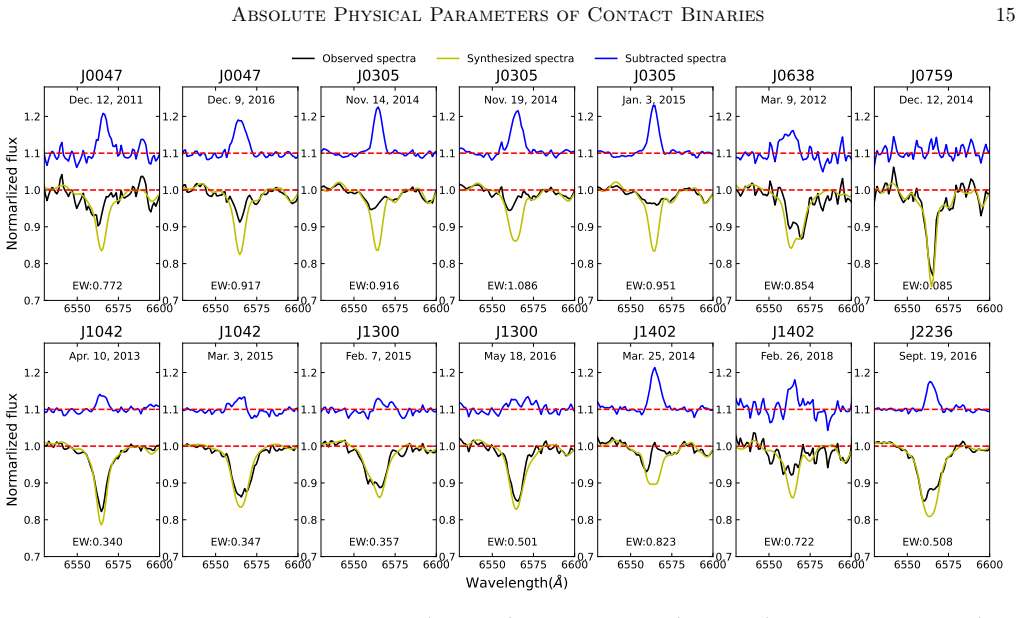
With the development of wide-field surveys, a large amount of data on short-period W UMa contact binaries have been obtained. Continuous and uninterrupted light curves as well as high-resolution spectroscopic data are crucial in determining the absolute physical parameters. Targets with both TMTS light curves and LAMOST medium-resolution spectra were selected. The absolute physical parameters were inferred with the W-D code for ten systems, all of them are W-type shallow or medium contact binaries. The O'Connell effect observed in the light curves can be explained by adding a spot on the primary or secondary component in the models. According to O-C analysis, the orbital periods exhibit a long-term increasing or decreasing trend, amongst which J0132, J1300, and J1402 show periodic variations that may be attributed to the presence of a third body or magnetic activity cycles. Spectral subtraction analysis revealed that the equivalent width of H$\alpha$ indicates strong magnetic activity in J0047, J0305, J0638, and J1402. Among the 10 selected binary systems, except for J0132 and J0913, the more massive components are found to be main-sequence stars while the less massive components have evolved off the main sequence. In J0132, both components are in the main sequence, whereas both components of J0913 lie above the terminal-age main sequence. Based on the relationship between orbital angular momentum and total mass for these two systems, as well as their low fill-out factors, it is possible that these two systems are newly formed contact binaries, having recently evolved from the detached configuration.
Figures


Figures from the paper (6 more)




Reference graph
Works this paper leans on
-
[1]
2024, NewA, 112, 102270, doi: 10.1016/j.newast.2024.102270
Adalalı, S., & Soydugan, E. 2024, NewA, 112, 102270, doi: 10.1016/j.newast.2024.102270
arXiv 2024
-
[2]
2000, AJ, 119, 1901, doi: 10.1086/301321
Akerlof, C., Amrose, S., Balsano, R., et al. 2000, AJ, 119, 1901, doi: 10.1086/301321
doi:10.1086/301321 2000
-
[3]
Alton, K. B., & Stępień, K. 2021, AcA, 71, 123, doi: 10.32023/0001-5237/71.2.4
-
[4]
2015, PASP, 127, 742, doi: 10.1086/682388
Lapasset, E. 2015, PASP, 127, 742, doi: 10.1086/682388
-
[5]
Applegate, J. H. 1992, ApJ, 385, 621, doi: 10.1086/170967
doi:10.1086/170967 1992
-
[6]
Barden, S. C. 1985, ApJ, 295, 162, doi: 10.1086/163361
doi:10.1086/163361 1985
-
[7]
Baron, E., & Hauschildt, P. H. 2007, A&A, 468, 255, doi: 10.1051/0004-6361:20066755
-
[8]
Bellm, E. C., Kulkarni, S. R., Graham, M. J., et al. 2019, PASP, 131, 018002, doi: 10.1088/1538-3873/aaecbe
Show all 111 references
-
[9]
Berdyugina, S. V. 2005, Living Reviews in Solar Physics, 2, 8, doi: 10.12942/lrsp-2005-8
2005 doi
-
[10]
1970, Vistas in Astronomy, 12, 217, doi: 10.1016/0083-6656(70)90041-3
Binnendijk, L. 1970, Vistas in Astronomy, 12, 217, doi: 10.1016/0083-6656(70)90041-3
1970 doi
-
[11]
2003, Information Bulletin on Variable Stars, 5403, 1
Blattler, E., & Diethelm, R. 2003, Information Bulletin on Variable Stars, 5403, 1
2003
-
[12]
E., & Papageorgiou, A
Christopoulou, P. E., & Papageorgiou, A. 2013, AJ, 146, 157, doi: 10.1088/0004-6256/146/6/157
2013 doi
-
[13]
T., Jayasinghe, T., Stanek, K
Christy, C. T., Jayasinghe, T., Stanek, K. Z., et al. 2023, MNRAS, 519, 5271, doi: 10.1093/mnras/stac3801
2023 doi
-
[14]
Cox, A. N. 2000, Allen’s astrophysical quantities
2000
-
[15]
2012, Research in Astronomy and Astrophysics, 12, 1197, doi: 10.1088/1674-4527/12/9/003
Cui, X.-Q., Zhao, Y.-H., Chu, Y.-Q., et al. 2012, Research in Astronomy and Astrophysics, 12, 1197, doi: 10.1088/1674-4527/12/9/003
2012 doi
-
[16]
Deb, S., & Singh, H. P. 2011, MNRAS, 412, 1787, doi: 10.1111/j.1365-2966.2010.18016.x
2011
-
[17]
2011, Information Bulletin on Variable Stars, 5965, 1
Demircan, Y., Gurol, B., Gokay, G., et al. 2011, Information Bulletin on Variable Stars, 5965, 1
2011
-
[18]
2005, Information Bulletin on Variable Stars, 5653, 1 —
Diethelm, R. 2005, Information Bulletin on Variable Stars, 5653, 1 —. 2006, Information Bulletin on Variable Stars, 5713, 1 —. 2007, Information Bulletin on Variable Stars, 5781, 1 —. 2009a, Information Bulletin on Variable Stars, 5871, 1 —. 2009b, Information Bulletin on Vari...
2005
-
[19]
2023, MNRAS, 525, 4596, doi: 10.1093/mnras/stad2565
Ding, X., Ji, K., Li, X., et al. 2023, MNRAS, 525, 4596, doi: 10.1093/mnras/stad2565
2023 doi
-
[20]
2021, PASJ, 73, 786, doi: 10.1093/pasj/psab042
Ding, X., Ji, K.-F., & Li, X.-Z. 2021, PASJ, 73, 786, doi: 10.1093/pasj/psab042
2021 doi
-
[21]
Dvorak, S. W. 2005, Information Bulletin on Variable Stars, 5603, 1
2005
-
[22]
1999, Turkish Journal of Physics, 23, 357
Eker, Z. 1999, Turkish Journal of Physics, 23, 357
1999
-
[23]
2006, MNRAS, 373, 1483, doi: 10.1111/j.1365-2966.2006.11073.x
Eker, Z., Demircan, O., Bilir, S., & Karataş, Y. 2006, MNRAS, 373, 1483, doi: 10.1111/j.1365-2966.2006.11073.x
2006
-
[24]
Flannery, B. P. 1976, ApJ, 205, 217, doi: 10.1086/154266 Gaia Collaboration, Prusti, T., de Bruijne, J. H. J., et al. 2016, A&A, 595, A1, doi: 10.1051/0004-6361/201629272 Gaia Collaboration, Brown, A. G. A., Vallenari, A., et al. 2018, A&A, 616, A1, doi: 10.1051/0004-6361/201833051
1976 doi
-
[25]
1973, Veroeffentlichungen der Sternwarte Sonneberg, 7, 607 Górski, K
Gessner, H., & Meinunger, I. 1973, Veroeffentlichungen der Sternwarte Sonneberg, 7, 607 Górski, K. M., Hivon, E., Banday, A. J., et al. 2005, ApJ, 622, 759, doi: 10.1086/427976
1973 doi
-
[26]
F., Li, K., Hu, S
Guo, D. F., Li, K., Hu, S. M., & Chen, X. 2018, PASP, 130, 064201, doi: 10.1088/1538-3873/aaba50
2018 doi
-
[27]
2024, MNRAS, 528, 6997, doi: 10.1093/mnras/stae404
Guo, F., Lin, J., Wang, X., et al. 2024, MNRAS, 528, 6997, doi: 10.1093/mnras/stae404
2024 doi
-
[28]
2020, Research in Astronomy and Astrophysics, 20, 179, doi: 10.1088/1674-4527/20/11/179
Guo, Y.-N., Li, K., Xia, Q.-Q., et al. 2020, Research in Astronomy and Astrophysics, 20, 179, doi: 10.1088/1674-4527/20/11/179
2020 doi
-
[29]
Hauschildt, P. H. 1993, JQSRT, 50, 301, doi: 10.1016/0022-4073(93)90080-2
1993 doi
-
[30]
H., & Baron, E
Hauschildt, P. H., & Baron, E. 2006, A&A, 451, 273, doi: 10.1051/0004-6361:20053846
2006 doi
-
[31]
N., Tonry, J
Heinze, A. N., Tonry, J. L., Denneau, L., et al. 2018, AJ, 156, 241, doi: 10.3847/1538-3881/aae47f
2018 doi
-
[32]
I., Harrison, T
Hoffman, D. I., Harrison, T. E., & McNamara, B. J. 2009, AJ, 138, 466, doi: 10.1088/0004-6256/138/2/466
2009 doi
-
[33]
1966, Astronomische Nachrichten, 289, 139, doi: 10.1002/asna.19662890306 Honková, K., Juryšek, J., Lehký, M., et al
Hoffmeister, C. 1966, Astronomische Nachrichten, 289, 139, doi: 10.1002/asna.19662890306 Honková, K., Juryšek, J., Lehký, M., et al. 2014, Open European Journal on Variable Stars, 165, 1
1966 doi
-
[34]
2015, Open European Journal on Variable Stars, 168, 1, doi: 10.48550/arXiv.1606.00369 Hoňková, K., Juryšek, J., Lehký, M., et al
Honkova, K., Jurysek, J., Lehky, M., et al. 2015, Open European Journal on Variable Stars, 168, 1, doi: 10.48550/arXiv.1606.00369 Hoňková, K., Juryšek, J., Lehký, M., et al. 2013, Open European Journal on Variable Stars, 160, 1
-
[35]
Hrivnak, B. J. 1988, ApJ, 335, 319, doi: 10.1086/166930 —. 1989, ApJ, 340, 458, doi: 10.1086/167408
1988 doi
-
[36]
W., Chen, B
Huang, Y., Liu, X. W., Chen, B. Q., et al. 2018, AJ, 156, 90, doi: 10.3847/1538-3881/aacda5
2018 doi
-
[37]
2005, Information Bulletin on Variable Stars, 5643, 1 —
Hubscher, J. 2005, Information Bulletin on Variable Stars, 5643, 1 —. 2014, Information Bulletin on Variable Stars, 6118, 1 —. 2017, Information Bulletin on Variable Stars, 6196, 1, doi: 10.22444/IBVS.6196 Absolute Physical Parameters of Contact Binaries 21
2005 doi
-
[38]
Hubscher, J., Braune, W., & Lehmann, P. B. 2013, Information Bulletin on Variable Stars, 6048, 1
2013
-
[39]
Hubscher, J., & Lehmann, P. B. 2012, Information Bulletin on Variable Stars, 6026, 1
2012
-
[40]
B., & Walter, F
Hubscher, J., Lehmann, P. B., & Walter, F. 2012, Information Bulletin on Variable Stars, 6010, 1
2012
-
[41]
2011, Information Bulletin on Variable Stars, 5959, 1
Hubscher, J., & Monninger, G. 2011, Information Bulletin on Variable Stars, 5959, 1
2011
-
[42]
2005, Information Bulletin on Variable Stars, 5657, 1 —
Hubscher, J., Paschke, A., & Walter, F. 2005, Information Bulletin on Variable Stars, 5657, 1 —. 2006, Information Bulletin on Variable Stars, 5731, 1
2005
-
[43]
2008, Information Bulletin on Variable Stars, 5830, 1
Hubscher, J., Steinbach, H.-M., & Walter, F. 2008, Information Bulletin on Variable Stars, 5830, 1
2008
-
[44]
R., Tout, C
Hurley, J. R., Tout, C. A., & Pols, O. R. 2002, MNRAS, 329, 897, doi: 10.1046/j.1365-8711.2002.05038.x
2002
-
[45]
Irwin, J. B. 1952, ApJ, 116, 211, doi: 10.1086/145604 Juryšek, J., Hoňková, K., Šmelcer, L., et al. 2017, Open European Journal on Variable Stars, 179, 1
1952 doi
-
[46]
P., Popov, V
Kjurkchieva, D. P., Popov, V. A., Eneva, Y., & Petrov, N. I. 2019, Research in Astronomy and Astrophysics, 19, 014, doi: 10.1088/1674-4527/19/1/14
2019 doi
-
[47]
P., Popov, V
Kjurkchieva, D. P., Popov, V. A., Lyubenova Vasileva, D., & Petrov, N. I. 2018, Research in Astronomy and Astrophysics, 18, 046, doi: 10.1088/1674-4527/18/4/46
2018 doi
-
[48]
K., & van Woerden, H
Kwee, K. K., & van Woerden, H. 1956, BAN, 12, 327
1956
-
[49]
2017, Information Bulletin on Variable Stars, 6230, 1, doi: 10.22444/IBVS.6230
Lampens, P., Van Cauteren, P., Ayiomamitis, A., et al. 2017, Information Bulletin on Variable Stars, 6230, 1, doi: 10.22444/IBVS.6230
2017 doi
-
[50]
F., & Rodonò, M
Lanza, A. F., & Rodonò, M. 1999, A&A, 349, 887 —. 2002, Astronomische Nachrichten, 323, 424, doi: 10.1002/1521-3994(200208)323:3/4<424:: AID-ASNA424>3.0.CO;2-1 Latković, O., Čeki, A., & Lazarević, S. 2021, ApJS, 254, 10, doi: 10.3847/1538-4365/abeb23
1999 doi
-
[51]
W., & Park, J.-H
Lee, J. W., & Park, J.-H. 2018, PASP, 130, 034201, doi: 10.1088/1538-3873/aaa390 Lehký, M., Hoňková, K., Šmelcer, L., et al. 2021, Open European Journal on Variable Stars, 211, 1, doi: 10.5817/OEJV2021-0211
2018 doi
-
[52]
2007, Information Bulletin on Variable Stars, 5784, 1
Lewandowski, M., Niedzielski, A., & Maciejewski, G. 2007, Information Bulletin on Variable Stars, 5784, 1
2007
-
[53]
2018, NewA, 59, 60, doi: 10.1016/j.newast.2017.09.004
Li, K. 2018, NewA, 59, 60, doi: 10.1016/j.newast.2017.09.004
2018 doi
-
[54]
2022, AJ, 164, 202, doi: 10.3847/1538-3881/ac8ff2
Li, K., Gao, X., Liu, X.-Y., et al. 2022, AJ, 164, 202, doi: 10.3847/1538-3881/ac8ff2
2022 doi
-
[55]
M., Guo, D
Li, K., Hu, S. M., Guo, D. F., et al. 2015, AJ, 149, 120, doi: 10.1088/0004-6256/149/4/120
2015 doi
-
[56]
2021a, ApJ, 922, 122, doi: 10.3847/1538-4357/ac242f —
Li, K., Xia, Q.-Q., Kim, C.-H., et al. 2021a, ApJ, 922, 122, doi: 10.3847/1538-4357/ac242f —. 2021b, AJ, 162, 13, doi: 10.3847/1538-3881/abfc53
-
[57]
2024a, MNRAS, 527, 3982, doi: 10.1093/mnras/stad3251
Li, L.-Z., Li, K., Gao, X., et al. 2024a, MNRAS, 527, 3982, doi: 10.1093/mnras/stad3251
-
[58]
2024b, ApJS, 271, 32, doi: 10.3847/1538-4365/ad226a
Li, X.-Z., Zhu, Q.-F., Ding, X., et al. 2024b, ApJS, 271, 32, doi: 10.3847/1538-4365/ad226a
-
[59]
2022, MNRAS, 509, 2362, doi: 10.1093/mnras/stab2812 —
Lin, J., Wang, X., Mo, J., et al. 2022, MNRAS, 509, 2362, doi: 10.1093/mnras/stab2812 —. 2023a, MNRAS, 523, 2172, doi: 10.1093/mnras/stad994
2022 doi
-
[60]
2023b, Nature Astronomy, 7, 223, doi: 10.1038/s41550-022-01783-z
Lin, J., Wu, C., Wang, X., et al. 2023b, Nature Astronomy, 7, 223, doi: 10.1038/s41550-022-01783-z
-
[61]
2024, Nature Astronomy, 8, 491, doi: 10.1038/s41550-023-02188-2
Lin, J., Wu, C., Xiong, H., et al. 2024, Nature Astronomy, 8, 491, doi: 10.1038/s41550-023-02188-2
2024 doi
-
[62]
R., Vera-Ciro, C., Murray, C
Lindner, R. R., Vera-Ciro, C., Murray, C. E., et al. 2015, AJ, 149, 138, doi: 10.1088/0004-6256/149/4/138
2015 doi
-
[63]
2019, Research in Astronomy and Astrophysics, 19, 075, doi: 10.1088/1674-4527/19/5/75
Liu, N., Fu, J.-N., Zong, W., et al. 2019, Research in Astronomy and Astrophysics, 19, 075, doi: 10.1088/1674-4527/19/5/75
2019 doi
-
[64]
P., Qian, S
Liu, N. P., Qian, S. B., Liao, W. P., Huang, Y., & Yuan, Z. L. 2023a, AJ, 165, 259, doi: 10.3847/1538-3881/acd04e
-
[65]
1991, Ap&SS, 183, 237
Liu, X., & Tan, H. 1991, Ap&SS, 183, 237
1991
-
[66]
2023b, MNRAS, 519, 5760, doi: 10.1093/mnras/stad026
Liu, X.-Y., Li, K., Michel, R., et al. 2023b, MNRAS, 519, 5760, doi: 10.1093/mnras/stad026
-
[67]
Loeb, A., & Gaudi, B. S. 2003, ApJL, 588, L117, doi: 10.1086/375551
2003 doi
-
[68]
J., & Rush, B
Lu, W., Hrivnak, B. J., & Rush, B. W. 2007, AJ, 133, 255, doi: 10.1086/509604
2007 doi
-
[69]
Lucy, L. B. 1967, ZA, 65, 89 —. 1968a, ApJ, 153, 877, doi: 10.1086/149712 —. 1968b, ApJ, 151, 1123, doi: 10.1086/149510 —. 1976, ApJ, 205, 208, doi: 10.1086/154265
1967 doi
- [70]
-
[71]
L., Zhao, Y.-H., Zhao, G., et al
Luo, A. L., Zhao, Y.-H., Zhao, G., et al. 2015, Research in Astronomy and Astrophysics, 15, 1095, doi: 10.1088/1674-4527/15/8/002
2015 doi
-
[72]
M., Prince, T
Marsh, F. M., Prince, T. A., Mahabal, A. A., et al. 2017, MNRAS, 465, 4678, doi: 10.1093/mnras/stw2110
2017 doi
-
[73]
J., Laher, R
Masci, F. J., Laher, R. R., Rusholme, B., et al. 2019, PASP, 131, 018003, doi: 10.1088/1538-3873/aae8ac
2019 doi
-
[74]
Nelson, R. H. 2007, Information Bulletin on Variable Stars, 5760, 1 —. 2008, Information Bulletin on Variable Stars, 5820, 1 —. 2009a, Information Bulletin on Variable Stars, 5875, 1 —. 2009b, Information Bulletin on Variable Stars, 5875, 1 —. 2013, Information Bulletin on Var...
2007
-
[75]
2018, Information Bulletin on Variable Stars, 6244, 1, doi: 10.22444/IBVS.6244
Pagel, L. 2018, Information Bulletin on Variable Stars, 6244, 1, doi: 10.22444/IBVS.6244
2018 doi
- [76]
-
[77]
Panchal, A., & Joshi, Y. C. 2021, AJ, 161, 221, doi: 10.3847/1538-3881/abea0c
2021 doi
-
[78]
E., et al
Papageorgiou, A., Christopoulou, P.-E., Ferreira Lopes, C. E., et al. 2023, AJ, 165, 80, doi: 10.3847/1538-3881/aca65a
2023 doi
-
[79]
V., Evans, A., Banerjee, D
Pavlenko, Y. V., Evans, A., Banerjee, D. P. K., et al. 2018, A&A, 615, A120, doi: 10.1051/0004-6361/201832717
2018 doi
-
[80]
2017, AJ, 154, 260, doi: 10.3847/1538-3881/aa9438
Pi, Q.-f., Zhang, L.-y., Bi, S.-l., et al. 2017, AJ, 154, 260, doi: 10.3847/1538-3881/aa9438
2017 doi
- [81]
-
[82]
L., Skillen, I., Collier Cameron, A., et al
Pollacco, D. L., Skillen, I., Collier Cameron, A., et al. 2006, PASP, 118, 1407, doi: 10.1086/508556 Prša, A. 2018, Modeling and Analysis of Eclipsing Binary Stars; The theory and design principles of PHOEBE, doi: 10.1088/978-0-7503-1287-5
2006 doi
-
[83]
2001, MNRAS, 328, 914, doi: 10.1046/j.1365-8711.2001.04921.x
Qian, S. 2001, MNRAS, 328, 914, doi: 10.1046/j.1365-8711.2001.04921.x
2001
-
[84]
2017, Research in Astronomy and Astrophysics, 17, 087, doi: 10.1088/1674-4527/17/8/87
Qian, S.-B., He, J.-J., Zhang, J., et al. 2017, Research in Astronomy and Astrophysics, 17, 087, doi: 10.1088/1674-4527/17/8/87
2017 doi
-
[85]
R., Latham, D
Ricker, G. R., Latham, D. W., Vanderspek, R. K., et al. 2010, in American Astronomical Society Meeting
2010
-
[86]
A., & Eggleton, P
Robertson, J. A., & Eggleton, P. P. 1977, MNRAS, 179, 359, doi: 10.1093/mnras/179.3.359 Ruciński, S. M. 1969, AcA, 19, 245
1977 doi
-
[87]
M., Lu, W., & Mochnacki, S
Rucinski, S. M., Lu, W., & Mochnacki, S. W. 2000, AJ, 120, 1133, doi: 10.1086/301458
2000 doi
-
[88]
J., Prieto, J
Shappee, B. J., Prieto, J. L., Grupe, D., et al. 2014, ApJ, 788, 48, doi: 10.1088/0004-637X/788/1/48
2014 doi
-
[89]
G., Oelkers, R
Stassun, K. G., Oelkers, R. J., Pepper, J., et al. 2018, AJ, 156, 102, doi: 10.3847/1538-3881/aad050
2018 doi
- [90]
-
[91]
2020a, ApJS, 247, 50, doi: 10.3847/1538-4365/ab7894 —
Sun, W., Chen, X., Deng, L., & de Grijs, R. 2020a, ApJS, 247, 50, doi: 10.3847/1538-4365/ab7894 —. 2020b, ApJS, 247, 50, doi: 10.3847/1538-4365/ab7894 van Hamme, W. 1993, AJ, 106, 2096, doi: 10.1086/116788 Van Hamme, W., & Wilson, R. E. 2007, ApJ, 661, 1129, doi: 10.1086/51787...
1993 doi
-
[92]
2023, Research in Astronomy and Astrophysics, 23, 055009, doi: 10.1088/1674-4527/acc154
Vijaya, A., & Sriram, K. 2023, Research in Astronomy and Astrophysics, 23, 055009, doi: 10.1088/1674-4527/acc154
2023 doi
-
[93]
L., Henden, A
Watson, C. L., Henden, A. A., & Price, A. 2006, Society for Astronomical Sciences Annual Symposium, 25, 47
2006
-
[94]
A., Weisenburger, K
West, A. A., Weisenburger, K. L., Irwin, J., et al. 2015, ApJ, 812, 3, doi: 10.1088/0004-637X/812/1/3
2015 doi
-
[95]
A., Morgan, D
West, A. A., Morgan, D. P., Bochanski, J. J., et al. 2011, AJ, 141, 97, doi: 10.1088/0004-6256/141/3/97
2011 doi
-
[96]
Wilson, R. E. 1979, ApJ, 234, 1054, doi: 10.1086/157588 —. 1990, ApJ, 356, 613, doi: 10.1086/168867
1979 doi
-
[97]
E., & Devinney, E
Wilson, R. E., & Devinney, E. J. 1971, ApJ, 166, 605, doi: 10.1086/150986
1971 doi
-
[98]
E., & Van Hamme, W
Wilson, R. E., & Van Hamme, W. 2014, ApJ, 780, 151, doi: 10.1088/0004-637X/780/2/151
2014 doi
-
[99]
E., Van Hamme, W., & Terrell, D
Wilson, R. E., Van Hamme, W., & Terrell, D. 2010, ApJ, 723, 1469, doi: 10.1088/0004-637X/723/2/1469
2010 doi
-
[100]
2024, MNRAS, 529, 3113, doi: 10.1093/mnras/stae590
Wu, J.-F., Zhu, L.-Y., Matekov, A., et al. 2024, MNRAS, 529, 3113, doi: 10.1093/mnras/stae590
2024 doi
-
[101]
2024, ApJS, 270, 20, doi: 10.3847/1538-4365/ad0ceb
Xiong, J., Ding, X., Li, J., et al. 2024, ApJS, 270, 20, doi: 10.3847/1538-4365/ad0ceb
2024 doi
-
[102]
Yakut, K., & Eggleton, P. P. 2005, ApJ, 629, 1055, doi: 10.1086/431300
2005 doi
-
[103]
2023, MNRAS, 522, 3076, doi: 10.1093/mnras/stad1141
Yang, Y., Michel, R., Yuan, H., Wang, S., & Tamayo, F. 2023, MNRAS, 522, 3076, doi: 10.1093/mnras/stad1141
2023 doi
-
[104]
2011, Research in Astronomy and Astrophysics, 11, 181, doi: 10.1088/1674-4527/11/2/006
Yang, Y.-G. 2011, Research in Astronomy and Astrophysics, 11, 181, doi: 10.1088/1674-4527/11/2/006
2011 doi
-
[105]
2013, AJ, 146, 35, doi: 10.1088/0004-6256/146/2/35 Yıldız, M
Soonthornthum, B. 2013, AJ, 146, 35, doi: 10.1088/0004-6256/146/2/35 Yıldız, M. 2014, MNRAS, 437, 185, doi: 10.1093/mnras/stt1874
2013 doi
-
[106]
2013, MNRAS, 430, 2029, doi: 10.1093/mnras/stt028
Yildiz, M., & Doğan, T. 2013, MNRAS, 430, 2029, doi: 10.1093/mnras/stt028
2013 doi
-
[107]
2020a, ApJS, 246, 9, doi: 10.3847/1538-4365/ab55ef
Zhang, B., Liu, C., & Deng, L.-C. 2020a, ApJS, 246, 9, doi: 10.3847/1538-4365/ab55ef
-
[108]
2021, ApJS, 256, 14, doi: 10.3847/1538-4365/ac0834
Zhang, B., Li, J., Yang, F., et al. 2021, ApJS, 256, 14, doi: 10.3847/1538-4365/ac0834
2021 doi
-
[109]
2020b, PASP, 132, 125001, doi: 10.1088/1538-3873/abbea2
Zhang, J.-C., Wang, X.-F., Mo, J., et al. 2020b, PASP, 132, 125001, doi: 10.1088/1538-3873/abbea2
-
[110]
2012, Research in Astronomy and Astrophysics, 12, 723, doi: 10.1088/1674-4527/12/7/002
Zhao, G., Zhao, Y.-H., Chu, Y.-Q., Jing, Y.-P., & Deng, L.-C. 2012, Research in Astronomy and Astrophysics, 12, 723, doi: 10.1088/1674-4527/12/7/002
2012 doi
-
[111]
2007, ApJ, 670, 1326, doi: 10.1086/521389
Zucker, S., Mazeh, T., & Alexander, T. 2007, ApJ, 670, 1326, doi: 10.1086/521389
2007 doi
Reviewed August 11, 2026 · model on record in the stance chip above.
Discussion (0). Continue with ORCID to comment.