Important Bit Prefix M-ary Quadrature Amplitude Modulation for Semantic Communications
Pith reviewed 2026-05-18 23:01 UTC · model grok-4.3
The pith
Important-bit-prefixed MQAM lowers error rates on semantically key symbols compared to standard MQAM.
A machine-rendered reading of the paper's core claim, the machinery that carries it, and where it could break.
Core claim
Prefixing important bits in the MQAM constellation produces a measurable reduction in important symbol error rate, which in turn improves semantic fidelity when text semantics are measured by topic-model extraction.
What carries the argument
The IBP-MQAM constellation that places important bits in higher-reliability positions within each symbol.
If this is right
- Semantic communication systems can allocate protection to bits according to their extracted topic weight rather than treating all bits equally.
- The same prefixing idea can be applied to higher-order MQAM constellations without changing the basic derivation of ISER and USER.
- Topic-model-based importance labels provide a practical way to generate the bit-priority map needed by the modulator.
Where Pith is reading between the lines
- The scheme may be combined with semantic encoders that already output per-bit importance scores, removing the need for a separate LDA step.
- Dynamic adjustment of which bits are prefixed could be tested by feeding real-time content statistics into the modulator.
- Extension to non-text modalities would require an analogous importance metric that can be mapped onto bit positions.
Load-bearing premise
Important bits can be identified reliably in advance so that prefixing them yields a net semantic gain rather than adding offsetting errors.
What would settle it
A test in which bit importance labels are randomly permuted or withheld, after which the semantic performance advantage of IBP-MQAM over MQAM disappears.
Figures


read the original abstract
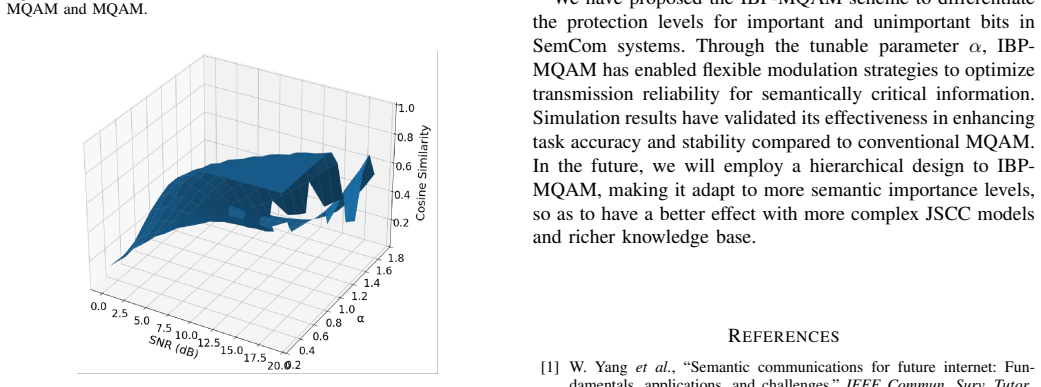
M-ary Quadrature Amplitude Modulation (MQAM) is a commonly used channel modulation technology in wireless communication systems. To achieve dedicated channel modulation for semantic communication (SemCom), we propose an Important-Bit-Prefixed MQAM (IBP-MQAM) scheme and derive its approximate expression of important symbol error rate (ISER) and unimportant symbol error rate (USER). By extracting and quantifying text semantics using Latent Dirichlet Allocation (LDA), we verify that IBP-MQAM achieves improved performance over MQAM in SemCom scenarios and further analyze the effects of key system parameters.
Editorial analysis
A structured set of objections, weighed in public.
Referee Report
Summary. The manuscript proposes an Important-Bit-Prefixed M-ary Quadrature Amplitude Modulation (IBP-MQAM) scheme for semantic communications. Approximate expressions for important symbol error rate (ISER) and unimportant symbol error rate (USER) are derived. Using Latent Dirichlet Allocation (LDA) to extract and quantify text semantics, the authors verify that IBP-MQAM achieves improved performance over MQAM in SemCom scenarios and analyze the effects of key system parameters.
Significance. Should the central claims be substantiated, this contribution would be significant for advancing modulation techniques specifically designed for semantic communications. By prefixing important bits in the MQAM constellation, the scheme aims to protect semantically critical information, potentially leading to better semantic recovery at the receiver. The LDA-based verification offers a quantitative framework for evaluating semantic performance, which is a strength if the connection to error rates is clearly established. This could inspire further research in error-resilient semantic transmission.
major comments (2)
- The abstract states that approximate expressions are derived and performance is verified using LDA, yet the manuscript does not detail the equations or provide error-bar details and data-exclusion rules, making it difficult to fully assess the mathematical support for the claims.
- The link between the derived ISER/USER and the LDA-measured semantic improvement is not explicitly shown. The paper needs to demonstrate how bit-level errors from the modulation affect the LDA posterior or coherence metric to confirm that lower ISER leads to measurable semantic benefits, particularly if the important bits do not disproportionately influence dominant topics.
minor comments (2)
- Notation for important and unimportant bits could be clarified in the system model section to avoid ambiguity.
- Figure captions should include more details on the simulation parameters used for performance comparison.
Simulated Author's Rebuttal
We thank the referee for the constructive feedback on our manuscript. We have carefully reviewed the major comments and provide point-by-point responses below. We believe addressing these points will improve the clarity and rigor of the work.
read point-by-point responses
-
Referee: The abstract states that approximate expressions are derived and performance is verified using LDA, yet the manuscript does not detail the equations or provide error-bar details and data-exclusion rules, making it difficult to fully assess the mathematical support for the claims.
Authors: We appreciate this observation. The approximate expressions for ISER and USER are derived in Section III (equations (8)-(15)), building on the IBP-MQAM constellation mapping and symbol error probability approximations. To address the concern, we will expand the derivation with additional intermediate steps for better traceability, include error bars in all simulation figures (e.g., Figures 5-8), and add a dedicated paragraph in Section IV detailing the LDA data preprocessing, including stop-word removal, term frequency thresholds, and document exclusion rules based on minimum length and coherence contribution. revision: yes
-
Referee: The link between the derived ISER/USER and the LDA-measured semantic improvement is not explicitly shown. The paper needs to demonstrate how bit-level errors from the modulation affect the LDA posterior or coherence metric to confirm that lower ISER leads to measurable semantic benefits, particularly if the important bits do not disproportionately influence dominant topics.
Authors: This is a fair critique regarding explicit causality. Our current evaluation in Section IV shows that reduced ISER correlates with higher semantic similarity and topic coherence under LDA, but we acknowledge the need for a more direct demonstration. In the revision, we will add a new subsection with analysis (including a supporting figure) that perturbs bits according to ISER/USER rates and tracks resulting changes in LDA topic posteriors and coherence scores. We will also clarify our bit-importance assignment, which prioritizes bits carrying high semantic weight based on LDA topic probabilities, to address whether they disproportionately affect dominant topics. revision: yes
Circularity Check
Standard derivations of ISER/USER with independent LDA verification
full rationale
The paper derives approximate ISER and USER expressions for the proposed IBP-MQAM scheme using conventional modulation error-rate analysis, which does not reduce to parameters fitted from the target semantic metric. LDA-based semantic extraction and quantification is applied as an external verification step on text data and is not constructed from or equivalent to the modulation error expressions. No self-definitional, fitted-input, or self-citation load-bearing reductions appear in the derivation chain; the performance claim rests on the independent LDA comparison rather than tautological redefinition of inputs.
Axiom & Free-Parameter Ledger
Lean theorems connected to this paper
-
IndisputableMonolith/Foundation/AbsoluteFloorClosure.leanreality_from_one_distinction unclear?
unclearRelation between the paper passage and the cited Recognition theorem.
We propose the Importance-Biased Prefixed M-ary Quadrature Amplitude Modulation (IBP-MQAM) ... map the prefix bits ... to the standard QPSK constellation Cp ... scaling factor α ∈ [0,1] ... derive analytical expressions for SER, important SER (ISER), and unimportant SER (USER)
-
IndisputableMonolith/Cost/FunctionalEquation.leanwashburn_uniqueness_aczel unclear?
unclearRelation between the paper passage and the cited Recognition theorem.
By extracting and quantifying text semantics using Latent Dirichlet Allocation (LDA), we verify that IBP-MQAM achieves improved performance over MQAM
What do these tags mean?
- matches
- The paper's claim is directly supported by a theorem in the formal canon.
- supports
- The theorem supports part of the paper's argument, but the paper may add assumptions or extra steps.
- extends
- The paper goes beyond the formal theorem; the theorem is a base layer rather than the whole result.
- uses
- The paper appears to rely on the theorem as machinery.
- contradicts
- The paper's claim conflicts with a theorem or certificate in the canon.
- unclear
- Pith found a possible connection, but the passage is too broad, indirect, or ambiguous to say the theorem truly supports the claim.
Forward citations
Cited by 1 Pith paper
-
Secure Intellicise Wireless Network: Agentic AI for Coverless Semantic Steganography Communication
Agentic AI enables coverless semantic steganography without private keys or cover images, delivering higher capacity and security than prior schemes in semantic communication.
Reference graph
Works this paper leans on
-
[1]
Semantic communications for future internet: Fun- damentals, applications, and challenges,
W. Yang et al. , “Semantic communications for future internet: Fun- damentals, applications, and challenges,” IEEE Commun. Surv. Tutor. , vol. 25, no. 1, pp. 213–250, 2023
work page 2023
-
[2]
A survey of secure semantic communications,
R. Meng et al., “A survey of secure semantic communications,” Journal of Network and Computer Applications , vol. 239, p. 104181, 2025
work page 2025
-
[3]
D. Fan et al. , “Generative diffusion models for wireless net- works: Fundamental, architecture, and state-of-the-art,” arXiv preprint arXiv:2507.16733, 2025
-
[4]
Joint source-channel coding for channel-adaptive digital semantic communications,
J. Park et al., “Joint source-channel coding for channel-adaptive digital semantic communications,” IEEE Trans. Cogn. Commun. Netw., vol. 11, no. 1, pp. 75–89, 2025
work page 2025
-
[5]
Adaptive modulation and retransmission scheme for semantic communication systems,
H. Gao et al. , “Adaptive modulation and retransmission scheme for semantic communication systems,” IEEE Trans. Cogn. Commun. Netw., vol. 10, no. 1, pp. 150–163, 2024
work page 2024
-
[6]
Universal joint source-channel coding for modulation- agnostic semantic communication,
Y . Huh et al. , “Universal joint source-channel coding for modulation- agnostic semantic communication,” IEEE J. Sel. Areas Commun. , vol. 43, no. 7, pp. 2560–2574, 2025
work page 2025
-
[7]
Ofdm-based digital semantic communication with impor- tance awareness,
C. Liu et al., “Ofdm-based digital semantic communication with impor- tance awareness,”IEEE Trans. Commun., vol. 72, no. 10, pp. 6301–6315, 2024
work page 2024
-
[8]
Stochastic geometry based semantic performance analysis for text semantic communication,
H. Zhu et al., “Stochastic geometry based semantic performance analysis for text semantic communication,”IEEE Trans. Commun., pp. 1–1, 2025
work page 2025
-
[9]
Wireless semantic communication based on probability distribution: An initial work,
Q. Luo et al., “Wireless semantic communication based on probability distribution: An initial work,” in 2025 IEEE Wireless Communications and Networking Conference (WCNC) , 2025, pp. 1–6
work page 2025
-
[10]
Semantic-oriented modulation for wireless communi- cation,
Y . Wang et al. , “Semantic-oriented modulation for wireless communi- cation,” IEEE Internet of Things Journal , vol. 12, no. 14, pp. 28 259– 28 273, 2025
work page 2025
-
[11]
Newsweeder: Learning to filter netnews,
K. Lang, “Newsweeder: Learning to filter netnews,” in Machine Learn- ing Proceedings 1995, A. Prieditis and S. Russell, Eds. San Francisco (CA): Morgan Kaufmann, 1995, pp. 331–339
work page 1995
-
[12]
Bangladesh news articles from multiple newspapers,
S. Hasan et al., “Bangladesh news articles from multiple newspapers,”
-
[13]
Available: https://www.kaggle.com/ds/7709271
[Online]. Available: https://www.kaggle.com/ds/7709271
-
[14]
Ofdm network optimization using a qpsk based on a wind-driven genetic algorithm,
Y . Sun et al. , “Ofdm network optimization using a qpsk based on a wind-driven genetic algorithm,” Sensors, vol. 22, no. 16, 2022
work page 2022
-
[15]
Bit error probability of mqam in the presence of phase noise,
H. Jafari et al., “Bit error probability of mqam in the presence of phase noise,” IEEE Trans. Veh. Technol. , vol. 69, no. 12, pp. 14 918–14 931, 2020
work page 2020
-
[16]
A comparison of semantic similarity methods for maximum human interpretability,
P. Sitikhu et al. , “A comparison of semantic similarity methods for maximum human interpretability,” in 2019 Artificial Intelligence for Transforming Business and Society (AITB) , vol. 1, 2019, pp. 1–4
work page 2019
discussion (0)
Sign in with ORCID, Apple, or X to comment. Anyone can read and Pith papers without signing in.