REVIEW 2 major objections 2 minor 1 cited by
Dual-Scale Antenna Deployment for Pinching Antenna Systems
T0 review · 2 major / 2 minor · reviewed 2026-05-21 · grok-4.3
Pith's one-line read Dual-scale deployment of pinching antennas yields nearly twofold energy efficiency gains over MIMO systems.
desk verdict The dual-scale deployment framework for pinching antennas is a clear extension of prior single-scale work, with the main value in the combined coarse/fine protocols and the derived EE expressions, though the reported gains rest on an untested power model. read the letter →
The pith
A machine-rendered reading of the paper's core claim, the machinery that carries it, and where it could break.
The reading
What carries the argument
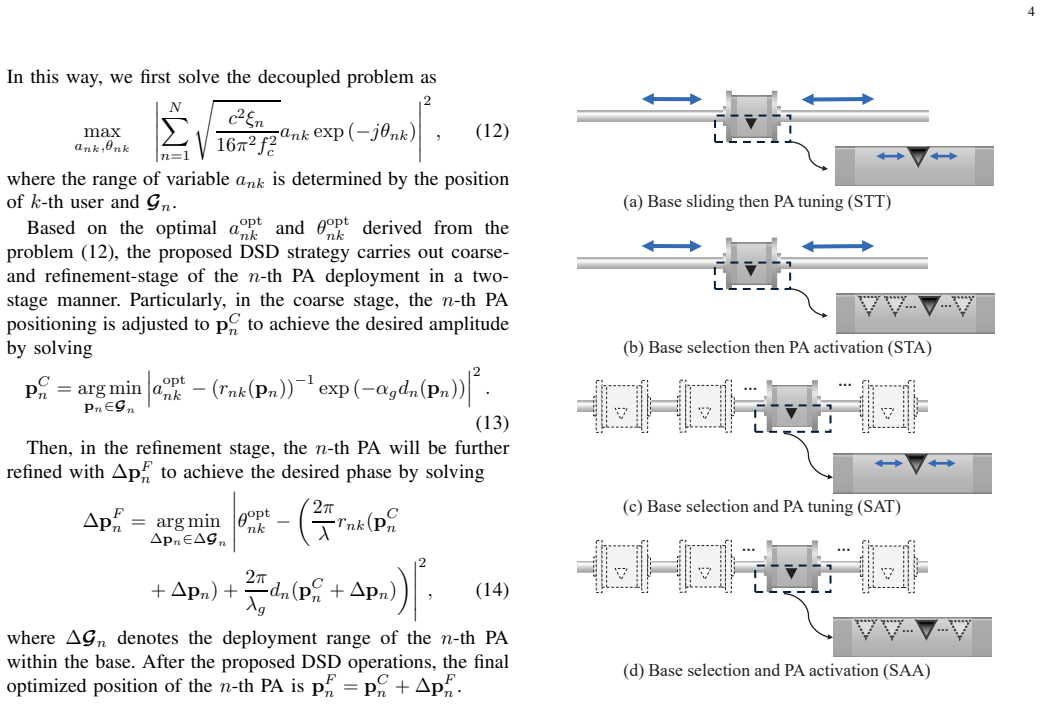
The dual-scale deployment (DSD) framework, which performs coarse-scale transfers of the pinching antenna over large waveguide distances together with fine-scale high-precision adjustments inside small regions.
What would settle it
A direct measurement of energy efficiency in a hardware prototype that implements the proposed dual-scale pinching antenna adjustments, compared against cell-free and MIMO baselines under the same user locations and power constraints.
Extended reading notes
Core claim
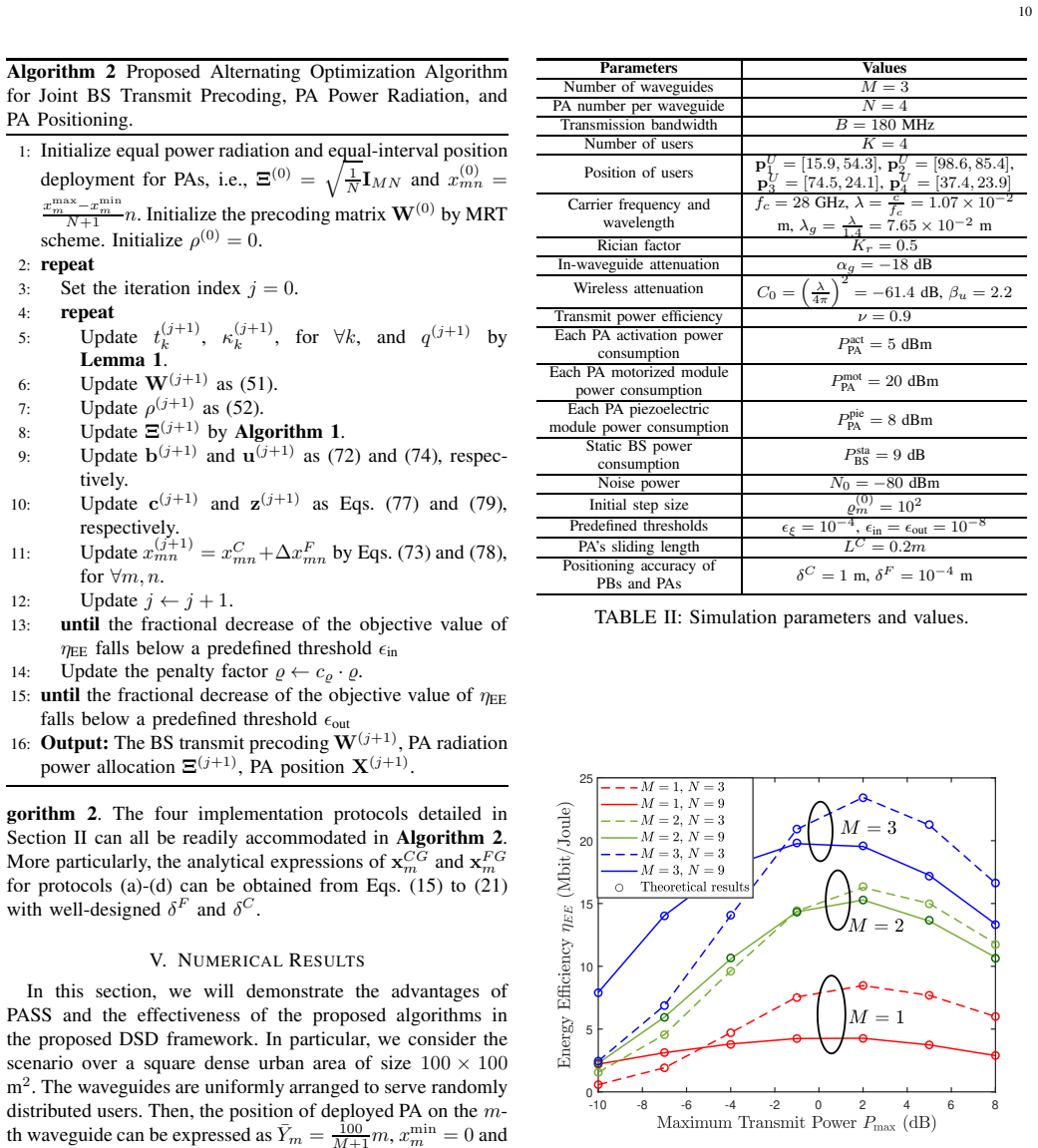
The dual-scale deployment framework optimizes pinching antenna positions simultaneously at the coarse waveguide scale and the fine local scale, jointly with precoding and power allocation, to maximize energy efficiency; this produces theoretical expressions and simulation results showing roughly 70 percent higher efficiency than cell-free architectures and nearly twofold gains relative to MIMO systems.
Load-bearing premise
The practical power consumption model and the derived theoretical energy efficiency expressions accurately reflect real hardware behavior, and the penalty-based alternating optimization algorithm reliably reaches high-quality solutions for the non-convex joint problem.
Editorial extensions
If this is right
- The framework delivers about 70 percent higher energy efficiency than conventional cell-free architectures.
- It achieves nearly twofold energy efficiency improvement compared with standard MIMO systems.
- The penalty-based alternating optimization algorithm converges while solving the joint precoding, power, and deployment problem at low complexity.
- Theoretical energy efficiency expressions match simulated performance for the optimized dual-scale placements.
Reading between the lines
- The same coarse-plus-fine positioning idea could transfer to other movable or fluid antenna systems where mechanical adjustment is feasible.
- Real deployments may need to add models for waveguide attenuation or control overhead that the current power consumption expressions omit.
- The efficiency gains suggest fewer total antennas or lower overall network power draw could suffice to serve the same users.
- Extending the optimization to account for user mobility or imperfect channel knowledge would test whether the reported gains remain stable.
Editorial analysis
A structured set of objections, weighed in public.
Referee Report
Summary. The manuscript proposes a dual-scale deployment (DSD) framework for pinching antenna systems (PASS) that combines coarse-scale waveguide-level PA transfer with fine-scale high-precision adjustment. It establishes a practical power consumption model, derives closed-form theoretical energy-efficiency (EE) expressions, formulates a non-convex joint optimization problem over transmit precoding, PA radiation power, and dual-scale deployment variables, and solves the problem with a penalty-based alternating optimization (AO) algorithm. Simulations are used to verify the accuracy of the theoretical EE expressions, demonstrate algorithm convergence, and report performance gains of approximately 70% higher EE relative to conventional cell-free architectures and nearly twofold improvement over MIMO systems.
Significance. If the practical power consumption model correctly captures all relevant hardware terms (including any deployment-related overhead) and the penalty-based AO algorithm reliably reaches high-quality solutions, the DSD framework would constitute a meaningful advance for energy-efficient operation of PASS. The headline quantitative claims are load-bearing for the paper’s contribution; their credibility therefore depends directly on the fidelity of the power model and the optimization procedure.
major comments (2)
- [Power consumption model section] The practical power consumption model (introduced prior to the EE expressions) appears to omit or under-represent terms such as waveguide propagation losses and the additional power required for mechanical coarse-scale adjustments. Because the theoretical EE expressions are derived directly from this model, any under-accounting of these costs would systematically inflate the reported gains (70% over cell-free, twofold over MIMO). A concrete sensitivity analysis or explicit inclusion of these terms is needed to support the central performance claims.
- [Algorithm and simulation results] The penalty-based AO algorithm is claimed to solve the non-convex joint optimization problem with low complexity and to converge reliably. However, the manuscript provides limited evidence (e.g., no comparison against global optimization benchmarks or exhaustive search on small instances) that the obtained solutions are near-optimal rather than locally good. This directly affects the validity of the simulated EE improvements.
minor comments (2)
- [System model] Notation for the coarse-scale and fine-scale variables should be introduced with a clear table or diagram early in the paper to avoid ambiguity when they appear in the optimization problem.
- [Introduction / Framework description] The abstract states that four protocols are provided under the DSD framework, yet the main text does not explicitly enumerate or compare them; a short dedicated subsection would improve readability.
Simulated Author's Rebuttal
We thank the referee for the detailed and constructive feedback on our manuscript. We address each major comment below and outline the revisions we intend to implement to strengthen the paper.
read point-by-point responses
-
Referee: [Power consumption model section] The practical power consumption model (introduced prior to the EE expressions) appears to omit or under-represent terms such as waveguide propagation losses and the additional power required for mechanical coarse-scale adjustments. Because the theoretical EE expressions are derived directly from this model, any under-accounting of these costs would systematically inflate the reported gains (70% over cell-free, twofold over MIMO). A concrete sensitivity analysis or explicit inclusion of these terms is needed to support the central performance claims.
Authors: We appreciate the referee pointing out potential omissions in the power consumption model. Our model was intended to capture the dominant power terms relevant to PASS, including radiation and circuit powers. However, we acknowledge that explicit modeling of waveguide propagation losses and mechanical power for coarse-scale PA adjustments was not included. In the revised manuscript, we will update the power consumption model to incorporate these terms and include a sensitivity analysis to evaluate their effect on the reported energy efficiency improvements. This will help validate the robustness of our performance claims. revision: yes
-
Referee: [Algorithm and simulation results] The penalty-based AO algorithm is claimed to solve the non-convex joint optimization problem with low complexity and to converge reliably. However, the manuscript provides limited evidence (e.g., no comparison against global optimization benchmarks or exhaustive search on small instances) that the obtained solutions are near-optimal rather than locally good. This directly affects the validity of the simulated EE improvements.
Authors: We agree that additional evidence for the solution quality of the penalty-based AO algorithm would enhance the paper. The algorithm employs penalty functions to manage the non-convex constraints and has demonstrated reliable convergence in our simulations. To address this concern, we will include comparisons with exhaustive search methods on small-scale problem instances in the revised version. For larger systems, we will discuss the practical limitations of global optimization approaches and why the AO method provides a good trade-off between performance and complexity. revision: partial
Circularity Check
No significant circularity in derivation chain
full rationale
The paper proposes a dual-scale deployment framework, establishes a practical power consumption model as an input assumption, derives energy-efficiency expressions directly from that model, formulates an optimization problem, and solves it via a penalty-based alternating optimization algorithm. Simulation results then compare performance against baselines under the same model. This constitutes standard modeling and optimization workflow rather than any reduction of predictions to fitted values or self-referential definitions by construction. No self-citations, uniqueness theorems, or ansatzes smuggled via prior work are indicated in the abstract or description. The derivation remains self-contained against external benchmarks.
Assumptions & free parameters
Cite this review
Pith. "Pith review of Dual-Scale Antenna Deployment for Pinching Antenna Systems." pith.science (2026). https://pith.science/paper/IY2FIAWA
@misc{pith2026251027185,
  author       = {Pith},
  title        = {Pith review of: Dual-Scale Antenna Deployment for Pinching Antenna Systems},
  year         = {2026},
  howpublished = {\url{https://pith.science/paper/IY2FIAWA}},
  note         = {Machine review of arXiv:2510.27185}
}
abstract
A dual-scale deployment (DSD) framework is proposed for pinching antenna systems (PASS), under which four protocols are provided. 1) For the coarse-scale deployment, the pinching antenna (PA) is transferred over a large-scale range at the waveguide level. 2) For the fine-scale deployment, the PA is adjusted with high precision within a small-scale region. By simultaneously optimizing both scales, the proposed DSD framework can unleash the full potential of PA deployment, while maintaining low computational complexity. Based on this framework, we establish a practical power consumption model and derive theoretical energy efficiency expressions for PASS. Then, an energy-efficiency maximization problem is formulated to jointly optimize the transmit precoding, PA radiation power, and dual-scale PA deployment. To solve this non-convex, highly coupled problem, a low-complexity penalty-based alternating optimization algorithm is proposed. Simulation results validate the accuracy of theoretical results and the convergence of the proposed algorithm. It is demonstrated that the proposed DSD framework is highly effective for PASS, delivering about $70\%$ higher energy efficiency than the conventional cell-free architecture and nearly a \emph{twofold} improvement relative to MIMO systems.
Figures

Figures from the paper (5 more)


Lean theorems connected to this paper
-
IndisputableMonolith/Cost/FunctionalEquation.leanwashburn_uniqueness_aczel unclear?
unclearRelation between the paper passage and the cited Recognition theorem.
We propose a realistic PASS power consumption model... ηEE = B·∑ Rk / Pall ... penalty-based alternating optimization algorithm
-
IndisputableMonolith/Foundation/AlexanderDuality.leanalexander_duality_circle_linking unclear?
unclearRelation between the paper passage and the cited Recognition theorem.
DSD framework... four protocols (STT, STA, SAT, SAA)... coarse/fine grid search
What do these tags mean?
- matches
- The paper's claim is directly supported by a theorem in the formal canon.
- supports
- The theorem supports part of the paper's argument, but the paper may add assumptions or extra steps.
- extends
- The paper goes beyond the formal theorem; the theorem is a base layer rather than the whole result.
- uses
- The paper appears to rely on the theorem as machinery.
- contradicts
- The paper's claim conflicts with a theorem or certificate in the canon.
- unclear
- Pith found a possible connection, but the passage is too broad, indirect, or ambiguous to say the theorem truly supports the claim.
Forward citations
Cited by 1 Pith paper
-
C-PASS: Center-Fed Pinching Antenna System
Center-fed pinching antenna systems achieve twice the degrees of freedom and an extra O(P_T ln^4 N/N^2) multiplexing gain over a co-located end-fed baseline.
Reference graph
Works this paper leans on
-
[1]
ITU-R. Framework and Overall Objectives of the Future Development of IMT for 2030 and Beyond, Recommendation ITU-R M.2160-0, Nov. 2023. [Online]. Available: https://www.itu.int/rec /R-REC-M.2160- 0-202311-I/en
-
[2]
Reconfigurable intelligent surfaces for energy efficiency in wireless communication,
C. Huang, A. Zappone, G. C. Alexandropoulos, M. Debbah an d C. Y uen, “Reconfigurable intelligent surfaces for energy efficiency in wireless communication,” IEEE Trans. Wireless Commun. , vol. 18, no. 8, pp. 4157-4170, Aug. 2019
work page 2019
-
[3]
Intelligent reflecting surface enha nced wireless network via joint active and passive beamforming,
Q. Wu, and R. Zhang, “Intelligent reflecting surface enha nced wireless network via joint active and passive beamforming,” IEEE Trans. Wireless Commun., vol. 18, no. 11, pp. 5394-5409, Nov. 2019
work page 2019
-
[4]
K. -K. Wong, A. Shojaeifard, K. -F. Tong and Y . Zhang, “Flu id antenna systems,” IEEE Trans. Wireless Commun., vol. 20, no. 3, pp. 1950-1962, Mar. 2021
work page 1950
-
[5]
Fluid Antenna Systems Enabling 6G:Principles, Appl ications, and Research Directions
T. Wu, K. Zhi, J. Y ao, X. Lai, J. Zheng, H. Niu, M. Elkashlan , K. - K Wong, C. -B. Chae, Z. Ding, G. K. Karagiannidis, M. Debbah, C . Y uen, “Fluid Antenna Systems Enabling 6G:Principles, Appl ications, and Research Directions”, arXiv preprint arXiv:2412.03839 , 2024
-
[6]
A tutorial on movable antennas for wireles s net- works,
L. Zhu et al., “A tutorial on movable antennas for wireles s net- works,” IEEE Commun. Surv. Tutor . , early access, Feb. 2025, doi: 10.1109/COMST.2025.3546373
-
[7]
Pinching-antenna systems: Architecture designs, opportunities, and outlook,
Y . Liu, Z. Wang, X. Mu, C. Ouyang, X. Xu and Z. Ding, “Pinching-antenna systems: Architecture designs, opport unities, and outlook,” IEEE Commun. Mag. , early access, 2025. doi: 10.1109/MCOM.001.2500037
-
[8]
Flexible-anten na systems: A pinching-antenna perspective,
Z. Ding, R. Schober and H. Vincent Poor, “Flexible-anten na systems: A pinching-antenna perspective,” IEEE Trans. Wireless Commun. , early access, 2025. doi: 10.1109/TCOMM.2025.3555866
Show all 30 references
-
[9]
Pinching -antenna systems (PASS): A tutorial
Y . Liu, H. Jiang, X. Xu, Z. Wang, J. Guo, C. Ouyang, X. Mu, Z. Ding, A. Nallanathan, G. K. Karagiannidis, R. Schober, “Pinching -antenna systems (PASS): A tutorial”, arXiv preprint arXiv:2508.07572 , 2025
2025
-
[10]
Pinching-antenn a systems with LoS blockages,
K. Wang, C. Ouyang, Y . Liu and Z. Ding, “Pinching-antenn a systems with LoS blockages,” IEEE Wireless Commun. Lett. , early access, 2025, doi: 10.1109/LWC.2025.3614451
2025 doi
-
[11]
Physical layer securit y for pinching- antenna systems (PASS),
M. Sun, C. Ouyang, S. Wu, Y . Liu, “Physical layer securit y for pinching- antenna systems (PASS),” IEEE Trans. Wireless Commun. , early access, 2025
2025
-
[12]
Pinching-antenna syst ems for physical layer security,
K. Wang, Z. Ding, N. Al-Dhahir, “Pinching-antenna syst ems for physical layer security,” IEEE Wireless Commun. Lett. , early access, 2025, doi: 10.1109/LWC.2025.3624885
2025 doi
-
[13]
Pinching antenna - using a dielectric waveguide as an anten na,
A. Fukuda, H. Y amamoto, H. Okazaki, Y . Suzuki, and K. Kaw ai, “Pinching antenna - using a dielectric waveguide as an anten na,” NTT DOCOMO Technical J. , vol. 23, no. 3, pp. 5-12, Jan. 2022
2022
-
[14]
Modeling and b eamform- ing optimization for pinching-antenna systems
Z. Wang, C. Ouyang, X. Mu, Y . Liu, Z. Ding, “Modeling and b eamform- ing optimization for pinching-antenna systems”, IEEE Trans. Commun. , early access, 2025, doi: 10.1109/TCOMM.2025.3621049
2025 doi
-
[15]
Exploiting pinching- antenna systems in multicast communications,
S. Shan, C. Ouyang, Y . Li, Y . Liu, “Exploiting pinching- antenna systems in multicast communications,” IEEE Trans. Commun. , early access, 2025
2025
-
[16]
Dynamic placement of pinching antennas for multicast MU-MISO downlinks,
J. -C. Chen, P . -C. Wu and K. -K. Wong, “Dynamic placement of pinching antennas for multicast MU-MISO downlinks,” IEEE Open J. Commun. Soc. , vol. 6, pp. 5611-5625, Jun. 2025
2025
-
[17]
Joint ra diation power, antenna position, and beamforming optimization for pinching- antenna systems with motion power consumption,
Y . Xu, D. Xu, X. Y u, S. Song, Z. Ding, R. Schober, “Joint ra diation power, antenna position, and beamforming optimization for pinching- antenna systems with motion power consumption,” arXiv preprint arXiv:2507.02348, 2025
2025
-
[18]
Pinching- antenna systems (PASS): Power radiation model and optimal beamform ing design,
X. Xu, X. Mu, Z. Wang, Y . Liu, A. Nallanathan, “Pinching- antenna systems (PASS): Power radiation model and optimal beamform ing design,” arXiv preprint arXiv:2505.00218 , 2025
2025
-
[19]
On the perf ormance analysis of pinching-antenna-enabled SWIPT systems,
B. Zhang, H. Zhang, K. Y ang, Y . Zhao, K. Wang, “On the perf ormance analysis of pinching-antenna-enabled SWIPT systems,” arXiv preprint arXiv:2509.03836, 2025
2025
-
[20]
D. K. Cheng, Field and wave electromagnetics , Addison-Wesley, 1989
1989
-
[21]
KG, Miniature Precision Positioning Stages
Physik Instrumente (PI) GmbH & Co. KG, Miniature Precision Positioning Stages. PI Catalog, 2015. Available: https://www.pi- usa.us/fileadmin/user_upload/pi_us/files/catalogs/PI_ Precision_Miniature _Translation_Stages.pdf
2015
-
[22]
NR: The new 5G radio access technology,
S. Parkvall, E. Dahlman, A. Furuskar and M. Frenne, “NR: The new 5G radio access technology,” IEEE Commun. Stand. Mag. , vol. 1, no. 4, pp. 24-30, Dec. 2017
2017
-
[23]
Cell-free massive MIMO versus small cells,
H. Q. Ngo, A. Ashikhmin, H. Y ang, E. G. Larsson and T. L. Ma rzetta, “Cell-free massive MIMO versus small cells,” IEEE Trans. Wireless Commun., vol. 16, no. 3, pp. 1834-1850, Mar. 2017
2017
-
[24]
Absil, R
P .-A. Absil, R. Mahony, and R. Sepulchre, Optimization Algorithms on Matrix Manifolds. Princeton, NJ, USA: Princeton Univ. Press, 2009
2009
-
[25]
Line search a lgorithms for locally Lipschitz functions on Riemannian manifolds,
S. Hosseini, W. Huang, and R. Y ousefpour, “Line search a lgorithms for locally Lipschitz functions on Riemannian manifolds,” SIAM J. Optimization, vol. 28, no. 1, pp. 596-619, 2018
2018
-
[26]
Penalty dual decomposition method f or non- smooth nonconvex optimization—Part I: Algorithms and conv ergence analysis,
Q. Shi and M. Hong, “Penalty dual decomposition method f or non- smooth nonconvex optimization—Part I: Algorithms and conv ergence analysis,” IEEE Trans. Signal Process. , vol. 68, pp. 4108-4122, Jun. 2020
2020
-
[27]
Multipl e RISs assisted cell-free networks with two-timescale CSI: P erformance analysis and system design,
X. Gan, C. Zhong, C. Huang, Z. Y ang and Z. Zhang, “Multipl e RISs assisted cell-free networks with two-timescale CSI: P erformance analysis and system design,” IEEE Trans. Commun. , vol. 70, no. 11, pp. 7696-7710, Nov. 2022
2022
-
[28]
Fractional programming for communic ation systems—Part I: Power control and beamforming,
K. Shen and W. Y u, “Fractional programming for communic ation systems—Part I: Power control and beamforming,” IEEE Trans. Signal Process., vol. 66, no. 10, pp. 2616-2630, May 2018
2018
-
[29]
An iterative ly weighted MMSE approach to distributed sum-utility maximization for a MIMO interfering broadcast channel,
Q. Shi, M. Razaviyayn, Z. -Q. Luo and C. He, “An iterative ly weighted MMSE approach to distributed sum-utility maximization for a MIMO interfering broadcast channel,” IEEE Trans. Signal Process. , vol. 59, no. 9, pp. 4331-4340, Sept. 2011
2011
-
[30]
On nonlinear fractional programming,
W. Dinkelbach, “On nonlinear fractional programming, ” Manage. Sci. , vol. 133, no. 7, pp. 492-498, Mar. 1967
1967
Reviewed May 21, 2026 · model on record in the stance chip above.
Discussion (0). Continue with ORCID to comment.