When One Adapter Speaks for Many: Discovering Low-Rank Redundancy in Continual Fine-Tuning
Pith reviewed 2026-06-29 05:01 UTC · model grok-4.3
The pith
Task-specific LoRA adapters in continual learning exhibit substantial low-rank redundancy through overlapping subspaces.
A machine-rendered reading of the paper's core claim, the machinery that carries it, and where it could break.
Core claim
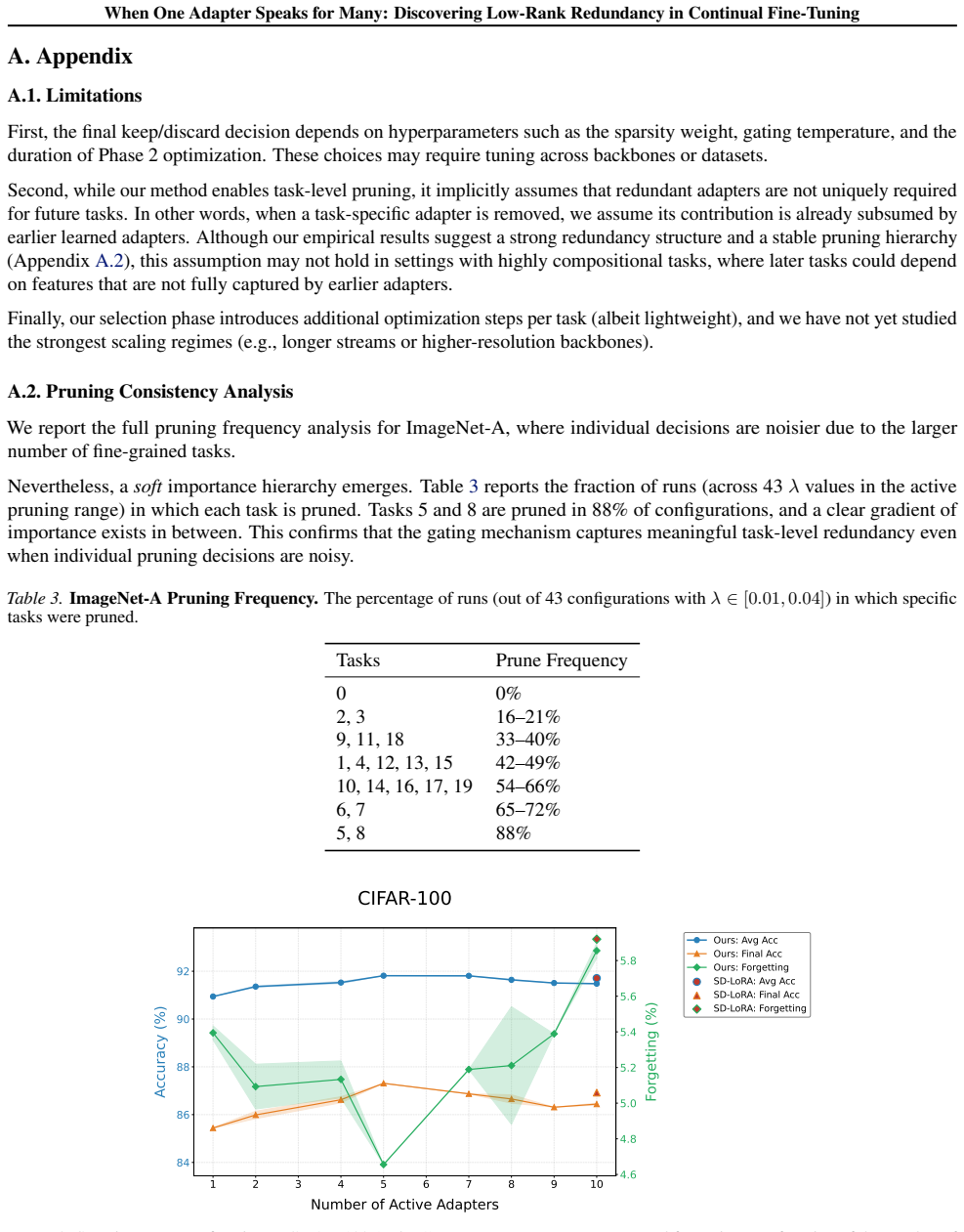
Task-specific LoRA adapters in continual learning exhibit significant low-rank redundancy: the subspaces spanned by adapters trained on different tasks substantially overlap, and in many cases earlier adapters can faithfully represent later tasks. LiteLoRA deploys a plug-and-play gating mechanism that learns at train time whether to recruit a new adapter or reuse existing low-rank representations, reducing the number of active adapters by 20-70 percent while matching or exceeding state-of-the-art performance.
What carries the argument
A gating mechanism that learns at train time whether to recruit a new adapter or reuse existing low-rank representations.
If this is right
- The number of active adapters can be reduced by 20-70 percent without performance loss on standard CL benchmarks.
- Selective reuse of existing adapters achieves stability without sacrificing plasticity.
- Low-rank redundancy is pervasive across the evaluated continual learning settings.
- A single earlier adapter can stand in for multiple later tasks when subspace overlap is high.
Where Pith is reading between the lines
- The same redundancy pattern could appear in other parameter-efficient fine-tuning techniques beyond LoRA.
- Deploying models across long task sequences would require less memory if reuse decisions generalize.
- The gating approach might be tested on non-standard benchmarks to check whether redundancy holds outside common vision and language tasks.
Load-bearing premise
The observed subspace overlap between adapters permits faithful representation of later tasks by earlier adapters without measurable degradation.
What would settle it
An experiment that measures task performance when forcing reuse of an earlier adapter versus training a dedicated new adapter on the same task; a consistent accuracy drop under reuse would falsify the redundancy claim.
Figures

read the original abstract
Low-Rank Adaptation (LoRA) has become the standard tool for parameter-efficient fine-tuning of large pretrained models. When applied sequentially across tasks in Continual Learning (CL), the standard assumption is that each new task requires a dedicated low-rank adapter. In this work, we challenge this assumption empirically and structurally. We show that task-specific LoRA adapters in CL exhibit significant low-rank redundancy: the subspaces spanned by adapters trained on different tasks substantially overlap, and in many cases earlier adapters can faithfully represent later tasks. Building on this observation, we propose LiteLoRA, a plug-and-play gating mechanism that learns at train time whether to recruit a new adapter or reuse existing low-rank representations. Our method reduces the number of active adapters by 20-70% while matching or exceeding state-of-the-art performance on standard CL benchmarks, revealing that structural redundancy is pervasive and that selective learning is sufficient to achieve stability without sacrificing plasticity.
Editorial analysis
A structured set of objections, weighed in public.
Referee Report
Summary. The paper claims that LoRA adapters trained sequentially on different tasks in continual learning exhibit substantial low-rank subspace overlap, such that earlier adapters can often faithfully represent later tasks. It introduces LiteLoRA, a train-time gating mechanism that decides whether to allocate a new adapter or reuse an existing one, achieving 20-70% reduction in active adapters while matching or exceeding SOTA performance on standard CL benchmarks.
Significance. If the central empirical claim holds, the work demonstrates that structural redundancy is pervasive in continual LoRA fine-tuning and that selective reuse via gating can preserve stability-plasticity balance with far fewer parameters. This could influence the design of parameter-efficient CL methods by shifting from per-task allocation to redundancy-aware selection, particularly for long task sequences.
major comments (2)
- [Abstract; experimental evaluation (presumably §4)] The core claim that subspace overlap permits faithful representation of later tasks by earlier adapters (without measurable degradation) is load-bearing for both the redundancy discovery and the LiteLoRA gating decision, yet the manuscript provides no explicit ablation that substitutes an earlier adapter into a later task and reports the resulting accuracy or forgetting relative to a dedicated adapter. Subspace metrics alone do not entail equivalent performance on the new loss surface.
- [Method description (presumably §3)] The gating mechanism is trained at train time to decide reuse vs. allocation, but the manuscript does not clarify how the training objective for the gate avoids circularity with the redundancy hypothesis or whether the reported reductions in active adapters are accompanied by controls for equivalent total parameter count and training budget.
minor comments (2)
- Clarify the precise definition and computation of 'faithful representation' (e.g., via accuracy delta, principal angles, or cosine similarity thresholds) and include error bars or multiple runs for all reported percentages.
- The abstract states reductions of '20-70%' without specifying the range of task counts or datasets; a table summarizing per-benchmark adapter counts and final accuracies would improve readability.
Simulated Author's Rebuttal
We thank the referee for the detailed and constructive report. The two major comments raise important points about empirical validation and methodological clarity. We address each below and indicate where revisions will be made.
read point-by-point responses
-
Referee: [Abstract; experimental evaluation (presumably §4)] The core claim that subspace overlap permits faithful representation of later tasks by earlier adapters (without measurable degradation) is load-bearing for both the redundancy discovery and the LiteLoRA gating decision, yet the manuscript provides no explicit ablation that substitutes an earlier adapter into a later task and reports the resulting accuracy or forgetting relative to a dedicated adapter. Subspace metrics alone do not entail equivalent performance on the new loss surface.
Authors: We agree that an explicit substitution ablation would provide more direct evidence for the claim that earlier adapters can faithfully represent later tasks. The current manuscript demonstrates substantial subspace overlap via metrics such as principal angles and shows that LiteLoRA achieves comparable or superior accuracy and lower forgetting than per-task baselines. However, these results are indirect. We will add a new ablation in the revised version that freezes earlier adapters and evaluates them directly on subsequent tasks, reporting per-task accuracy and average forgetting relative to dedicated adapters. revision: yes
-
Referee: [Method description (presumably §3)] The gating mechanism is trained at train time to decide reuse vs. allocation, but the manuscript does not clarify how the training objective for the gate avoids circularity with the redundancy hypothesis or whether the reported reductions in active adapters are accompanied by controls for equivalent total parameter count and training budget.
Authors: The gate is optimized jointly with the adapters using a composite loss consisting of the standard task loss plus a sparsity-inducing regularizer on the gate outputs; the redundancy hypothesis is validated only after training by analyzing the learned subspaces, so the gate does not presuppose overlap. All reported results control for total parameter count by matching the effective rank budget across methods (e.g., by varying the number of adapters while keeping per-adapter rank fixed) and use identical training schedules and data orders. We will expand the method section with an explicit statement of the gate objective and add a supplementary table confirming matched parameter and compute budgets. revision: partial
Circularity Check
Empirical measurements and trainable gating show no reduction to fitted inputs or self-citations
full rationale
The paper's core claims rest on direct empirical measurements of subspace overlap across task-specific LoRA adapters and on a gating mechanism that is trained end-to-end at train time. Performance numbers are obtained by running the trained LiteLoRA system on standard CL benchmarks; they are not algebraically entailed by any fitted parameter or prior self-result. No load-bearing step matches any of the enumerated circularity patterns: there is no self-definitional loop, no fitted input relabeled as prediction, and no uniqueness theorem or ansatz imported solely via self-citation. The derivation chain is therefore self-contained against external benchmarks.
Axiom & Free-Parameter Ledger
Reference graph
Works this paper leans on
-
[1]
An Image is Worth 16x16 Words: Transformers for Image Recognition at Scale , url =
Dosovitskiy, Alexey and Beyer, Lucas and Kolesnikov, Alexander and Weissenborn, Dirk and Zhai, Xiaohua and Unterthiner, Thomas and Dehghani, Mostafa and Minderer, Matthias and Heigold, Georg and Gelly, Sylvain and Uszkoreit, Jakob and Houlsby, Neil , bibsource =. An Image is Worth 16x16 Words: Transformers for Image Recognition at Scale , url =. 9th Inter...
-
[2]
Psychology of Learning and Motivation , author =
Catastrophic Interference in Connectionist Networks:. Psychology of Learning and Motivation , author =
-
[3]
Categorical Reparameterization with Gumbel-Softmax
Categorical reparameterization with gumbel-softmax , author=. arXiv preprint arXiv:1611.01144 , year=
work page internal anchor Pith review Pith/arXiv arXiv
-
[4]
2017 , eprint=
Adam: A Method for Stochastic Optimization , author=. 2017 , eprint=
2017
-
[5]
Learning Multiple Layers of Features from Tiny Images , author =
-
[6]
2019 , eprint=
Decoupled Weight Decay Regularization , author=. 2019 , eprint=
2019
-
[7]
Proceedings of the 30th International Conference on Machine Learning , pages =
On the importance of initialization and momentum in deep learning , author =. Proceedings of the 30th International Conference on Machine Learning , pages =. 2013 , editor =
2013
-
[8]
The 2023 Conference on Empirical Methods in Natural Language Processing , year=
Orthogonal Subspace Learning for Language Model Continual Learning , author=. The 2023 Conference on Empirical Methods in Natural Language Processing , year=
2023
-
[9]
2025 , url=
Yichen Wu and Hongming Piao and Long-Kai Huang and Renzhen Wang and Wanhua Li and Hanspeter Pfister and Deyu Meng and Kede Ma and Ying Wei , booktitle=. 2025 , url=
2025
-
[10]
2021 , eprint=
LoRA: Low-Rank Adaptation of Large Language Models , author=. 2021 , eprint=
2021
-
[11]
CVPR , year=
Natural Adversarial Examples , author=. CVPR , year=
-
[12]
Proceedings of the Computer Vision and Pattern Recognition Conference (CVPR) , month =
He, Jiangpeng and Duan, Zhihao and Zhu, Fengqing , title =. Proceedings of the Computer Vision and Pattern Recognition Conference (CVPR) , month =. 2025 , pages =
2025
-
[13]
Lori: Reducing cross- task interference in multi-task low-rank adaptation,
LoRI: Reducing Cross-Task Interference in Multi-Task Low-Rank Adaptation , author=. arXiv preprint arXiv:2504.07448 , year=
-
[14]
Proceedings of the IEEE/CVF Conference on Computer Vision and Pattern Recognition (CVPR) , month =
Zhu, Hao and Zhang, Yifei and Dong, Junhao and Koniusz, Piotr , title =. Proceedings of the IEEE/CVF Conference on Computer Vision and Pattern Recognition (CVPR) , month =. 2025 , pages =
2025
-
[15]
Estimating or Propagating Gradients Through Stochastic Neurons for Conditional Computation
Yoshua Bengio and Nicholas L. Estimating or Propagating Gradients Through Stochastic Neurons for Conditional Computation , journal =. 2013 , url =. 1308.3432 , timestamp =
work page internal anchor Pith review Pith/arXiv arXiv 2013
-
[16]
Rusu and Razvan Pascanu , keywords =
Raia Hadsell and Dushyant Rao and Andrei A. Rusu and Razvan Pascanu , keywords =. Embracing Change: Continual Learning in Deep Neural Networks , journal =. 2020 , issn =. doi:https://doi.org/10.1016/j.tics.2020.09.004 , url =
-
[17]
Scaling Learning Algorithms Towards
Bengio, Yoshua and LeCun, Yann , booktitle =. Scaling Learning Algorithms Towards
-
[18]
Proceedings of the IEEE/CVF Conference on Computer Vision and Pattern Recognition (CVPR) , month =
Liang, Yan-Shuo and Li, Wu-Jun , title =. Proceedings of the IEEE/CVF Conference on Computer Vision and Pattern Recognition (CVPR) , month =. 2024 , pages =
2024
-
[19]
NeurIPS 2024 Datasets and Benchmarks Track , year=
TRACE: A Comprehensive Benchmark for Continual Learning in Large Language Models , author=. NeurIPS 2024 Datasets and Benchmarks Track , year=
2024
-
[20]
Llama 2: Open Foundation and Fine-Tuned Chat Models
Llama 2: Open Foundation and Fine-Tuned Chat Models , author=. arXiv preprint arXiv:2307.09288 , year=
work page internal anchor Pith review Pith/arXiv arXiv
-
[21]
ICCV , year=
The Many Faces of Robustness: A Critical Analysis of Out-of-Distribution Generalization , author=. ICCV , year=
-
[22]
ImageNet: A large-scale hierarchical image database , year=
Deng, Jia and Dong, Wei and Socher, Richard and Li, Li-Jia and Kai Li and Li Fei-Fei , booktitle=. ImageNet: A large-scale hierarchical image database , year=
discussion (0)
Sign in with ORCID, Apple, or X to comment. Anyone can read and Pith papers without signing in.