Toward Controllable Catalyst Inverse Design via Large-Scale Autoregressive Pretraining
Pith reviewed 2026-06-27 01:46 UTC · model grok-4.3
The pith
A GPT-style model pretrained on 133 million catalyst structures generates new catalysts that match specified adsorbate types, compositions, and binding energies.
A machine-rendered reading of the paper's core claim, the machinery that carries it, and where it could break.
Core claim
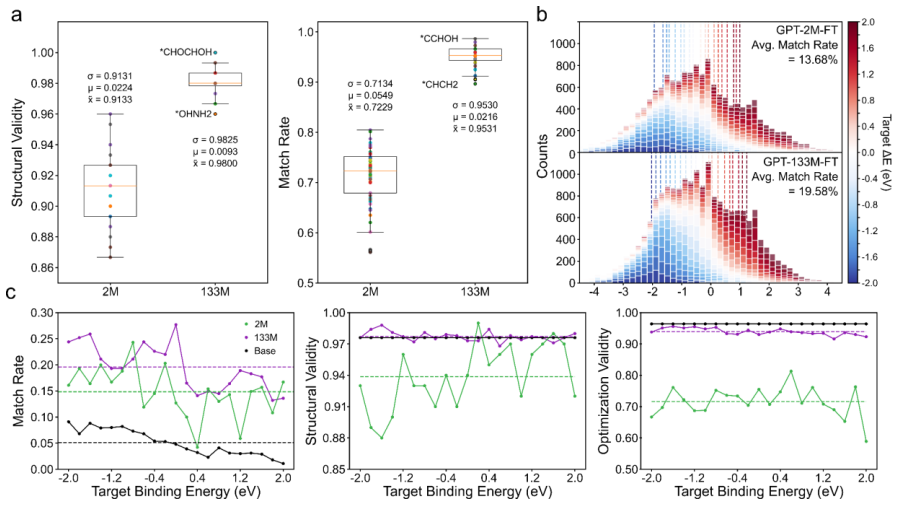
After pretraining on 133 million structures and fine-tuning on approximately 460,000 optimized examples, the conditional generative model attains 98 percent structural validity and 95 percent optimization validity. It reaches a 93 percent joint match rate for adsorbate type and composition, and for binding-energy conditioning it achieves an approximately 20 percent match rate (four times the baseline rate) while the generated distributions move systematically toward the target values.
What carries the argument
Generative Pretrained Transformer architecture equipped with a numerical embedding layer that injects both categorical labels and continuous scalar values such as binding energy into the autoregressive token sequence.
If this is right
- Generated catalyst structures remain structurally valid at 98 percent and optimization-valid at 95 percent.
- Categorical conditioning produces a 93 percent joint match rate for adsorbate type and composition.
- Binding-energy conditioning raises the target match rate fourfold and shifts the output distribution toward the requested values.
- Screening efficiency for reaction-targeted catalysts improves 1.5- to 4-fold without additional fine-tuning.
Where Pith is reading between the lines
- The same numerical-embedding approach could be tested on other continuous targets such as formation energy or selectivity if labeled data become available.
- Whether the generated candidates retain their predicted binding energies after explicit DFT relaxation on a fresh test set would directly test practical utility.
- Analogous large-scale autoregressive pretraining might be applied to inverse design tasks in other domains that combine discrete composition choices with continuous property targets.
Load-bearing premise
Conditioning via the numerical embedding layer causes the generated structures to exhibit computed binding energies close enough to the target that they are useful for real catalyst screening.
What would settle it
A held-out evaluation in which the fraction of generated structures whose binding energy lies inside a narrow window around the conditioning value stays near the 5 percent baseline level instead of rising to 20 percent.
Figures

read the original abstract
Inverse design of heterogeneous catalysts remains challenging because catalyst surfaces exhibit substantial structural complexity with coupled surface-adsorbate interactions across a vast chemical space that is difficult to explore efficiently through conventional screening alone. Although machine learning-based high-throughput screening has accelerated catalyst discovery, its efficiency inevitably declines as the search space grows, motivating the development of generative models that can directly construct catalysts with target properties. Here, we present a conditional catalyst generative model based on the Generative Pretrained Transformer architecture with a numerical embedding layer that enables the generation of catalyst structures conditioned on both categorical and continuous properties within a single autoregressive framework. The model was pretrained on 133 million catalyst structures and subsequently fine-tuned on approximately 460,000 optimized structures with associated categorical properties and binding energies for conditional generation. The resulting model achieved 98% structural validity, 95% optimization validity, and high categorical condition fidelity, with a 93 % joint match rate for adsorbate type and composition. For binding energy conditioning, the match rate of approximately 20% represents a four-fold improvement over the baseline training distribution, and the generated distributions shift systematically toward the target values, enabling a 1.5 to 4-fold improvement in screening efficiency for reaction-targeted catalyst discovery without additional fine-tuning. These results show that large-scale autoregressive pre-training, combined with explicit property conditioning, provides a practical route toward controllable catalyst generation and accelerated catalysts discovery.
Editorial analysis
A structured set of objections, weighed in public.
Referee Report
Summary. The paper presents a conditional generative model based on the Generative Pretrained Transformer (GPT) architecture augmented with a numerical embedding layer. It enables autoregressive generation of heterogeneous catalyst structures conditioned on both categorical properties (e.g., adsorbate type and composition) and continuous properties (binding energies). The model is pretrained on 133 million catalyst structures and fine-tuned on approximately 460,000 optimized structures. Reported results include 98% structural validity, 95% optimization validity, 93% joint match rate for categorical conditions, and for binding-energy conditioning a ~20% match rate (four-fold improvement over the training-distribution baseline) with systematic distribution shifts that yield 1.5- to 4-fold gains in screening efficiency for reaction-targeted discovery without additional fine-tuning.
Significance. If the conditioning results are shown to be robust under clearly defined metrics, this work would constitute a meaningful step toward controllable inverse design in catalysis. The combination of large-scale autoregressive pretraining (133 million structures) with explicit numerical embedding for continuous properties is a strength that could generalize beyond the reported fine-tuning set and reduce reliance on exhaustive screening. The approach addresses a genuine bottleneck in exploring coupled surface-adsorbate chemical space.
major comments (2)
- [Abstract] Abstract: The binding-energy match rate of approximately 20% (four-fold improvement) is presented as evidence of effective continuous conditioning, yet no tolerance threshold (absolute or relative), binning protocol, or statistical test for the match is defined. This definition is load-bearing for the central claim that the numerical embedding enables controllable generation on continuous properties.
- [Abstract] Abstract: The 1.5- to 4-fold improvement in screening efficiency is stated without a quantitative definition (e.g., enrichment factor, number of samples required to recover a target-property structure, or comparison protocol against the unconditional baseline). This metric is central to the practical utility asserted for reaction-targeted catalyst discovery.
minor comments (1)
- [Abstract] The abstract reports 'high categorical condition fidelity' alongside the 93% joint match rate; a breakdown by individual categorical variables or a results table would clarify the per-property performance.
Simulated Author's Rebuttal
We thank the referee for the constructive comments on our manuscript. We address each major comment below and agree that clarifications are required to strengthen the presentation of the results.
read point-by-point responses
-
Referee: [Abstract] Abstract: The binding-energy match rate of approximately 20% (four-fold improvement) is presented as evidence of effective continuous conditioning, yet no tolerance threshold (absolute or relative), binning protocol, or statistical test for the match is defined. This definition is load-bearing for the central claim that the numerical embedding enables controllable generation on continuous properties.
Authors: We agree that the match-rate definition must be stated explicitly. The ~20% figure is the fraction of generated structures whose DFT-evaluated binding energy lies within ±0.2 eV of the conditioning target (a tolerance chosen to reflect typical chemical accuracy in catalysis); the four-fold improvement is the ratio of this fraction to the corresponding fraction obtained by sampling the unconditional training distribution. We will revise the abstract to include this tolerance and will add a cross-reference to the Methods section for the exact binning and statistical protocol. revision: yes
-
Referee: [Abstract] Abstract: The 1.5- to 4-fold improvement in screening efficiency is stated without a quantitative definition (e.g., enrichment factor, number of samples required to recover a target-property structure, or comparison protocol against the unconditional baseline). This metric is central to the practical utility asserted for reaction-targeted catalyst discovery.
Authors: We concur that a precise definition is needed. The reported 1.5- to 4-fold gains are enrichment factors: the ratio of the success rate (fraction of structures whose binding energy falls inside the target interval) when sampling from the conditioned model versus sampling from the unconditional training distribution, evaluated across a range of target binding energies. We will update the abstract to state this definition explicitly and will expand the comparison protocol in the Results and Methods sections of the revision. revision: yes
Circularity Check
No significant circularity in empirical performance claims
full rationale
The paper reports empirical metrics (validity rates, categorical match rates, binding-energy match rates vs. training-distribution baseline, and screening-efficiency gains) from a pretrained autoregressive model with numerical embeddings, fine-tuned on ~460k structures. These are measured on generated outputs against external baselines rather than being defined by or reducing to fitted parameters inside the claim. No self-definitional equations, fitted-input predictions, or load-bearing self-citation chains appear in the derivation chain.
Axiom & Free-Parameter Ledger
Reference graph
Works this paper leans on
-
[1]
Identification of cathode materials for lithium batteries guided by first -principles calculations
(1) Ceder, G.; Chiang, Y .-M.; Sadoway, D.; Aydinol, M.; Jang, Y .-I.; Huang, B. Identification of cathode materials for lithium batteries guided by first -principles calculations. Nature 1998, 392 (6677), 694–696. (2) Tran, K.; Ulissi, Z. W. Active learning across intermetallics to guide discovery of electrocatalysts for CO2 reduction and H2 evolution. N...
1998
-
[2]
F.; Bonde, J.; Chorkendorff, I.; Nørskov, J
(6) Greeley, J.; Jaramillo, T. F.; Bonde, J.; Chorkendorff, I.; Nørskov, J. K. Computational high- throughput screening of electrocatalytic materials for hydrogen evolution. Nat. Mater. 2006, 5 (11), 909–913. (7) Ong, S. P. Accelerating materials science with high-throughput computations and machine learning. Comp. Mater. Sci. 2019, 161, 143–150. (8) Back...
arXiv 2006
-
[3]
(14) Yang, S.; Cho, K.; Merchant, A.; Abbeel, P.; Schuurmans, D.; Mordatch, I.; Cubuk, E. D. Scalable diffusion for materials generation. arXiv preprint arXiv:2311.09235
-
[4]
H.; Aspuru-Guzik, A.; Jung, Y
(15) Kim, S.; Noh, J.; Gu, G. H.; Aspuru-Guzik, A.; Jung, Y . Generative adversarial networks for crystal structure prediction. ACS Cent. Sci. 2020, 6 (8), 1412–1420. (16) Luo, X.; Wang, Z.; Wang, Q.; Shao, X.; Lv, J.; Wang, L.; Wang, Y .; Ma, Y . CrystalFlow: a flow-based generative model for crystalline materials. Nat. Commun. 2025, 16 (1),
2020
-
[5]
A generative model for inorganic materials design
(17) Zeni, C.; Pinsler, R.; Zügner, D.; Fowler, A.; Horton, M.; Fu, X.; Wang, Z.; Shysheya, A.; Crabbé, J.; Ueda, S. A generative model for inorganic materials design. Nature 2025, 639 (8055), 624–632. (18) Ou, P. Heterogeneous catalyst design by generative models. Journal of Materials Informatics 2025, 5 (4), N/A–N/A. (19) Mok, D. H.; Back, S. Generative...
2025
-
[6]
Open catalyst 2020 (OC20) dataset and community challenges
(22) Chanussot, L.; Das, A.; Goyal, S.; Lavril, T.; Shuaibi, M.; Riviere, M.; Tran, K.; Heras - Domingo, J.; Ho, C.; Hu, W. Open catalyst 2020 (OC20) dataset and community challenges. ACS Catal. 2021, 11 (10), 6059–6072. (23) Wood, B. M.; Dzamba, M.; Fu, X.; Gao, M.; Shuaibi, M.; Barroso -Luque, L.; Abdelmaqsoud, K.; Gharakhanyan, V .; Kitchin, J. R.; Lev...
arXiv 2020
-
[7]
(24) Ong, S. P.; Richards, W. D.; Jain, A.; Hautier, G.; Kocher, M.; Cholia, S.; Gunter, D.; Chevrier, V . L.; Persson, K. A.; Ceder, G. Python Materials Genomics (pymatgen): A robust, open-source python library for materials analysis. Comp. Mater. Sci. 2013, 68, 314–319. (25) Kim, M.; Kim, N.; Kim, H.; Ahn, S. CatFlow: Co-generation of Slab-Adsorbate Sys...
Pith/arXiv arXiv 2013
-
[8]
Generative Inverse Design of Crystal Structures via Diffusion Models with Transformers
(26) Takahara, I.; Shibata, K.; Mizoguchi, T. Generative Inverse Design of Crystal Structures via Diffusion Models with Transformers. arXiv preprint arXiv:2406.09263
-
[9]
K.; Bligaard, T.; Logadottir, A.; Kitchin, J
(27) Nørskov, J. K.; Bligaard, T.; Logadottir, A.; Kitchin, J. R.; Chen, J. G.; Pandelov, S.; Stimming, U. Trends in the exchange current for hydrogen evolution. Journal of The Electrochemical Society 2005, 152 (3), J23–J26. (28) Nørskov, J. K.; Rossmeisl, J.; Logadottir, A.; Lindqvist, L.; Kitchin, J. R.; Bligaard, T.; Jonsson, H. Origin of the overpoten...
arXiv 2005
-
[10]
Equiformerv2: Improved equivariant transformer for scaling to higher-degree representations
(31) Liao, Y .-L.; Wood, B.; Das, A.; Smidt, T. Equiformerv2: Improved equivariant transformer for scaling to higher-degree representations. arXiv preprint arXiv:2306.12059
-
[11]
(32) Flam -Shepherd, D.; Aspuru -Guzik, A. Language models can generate molecules, materials, and protein binding sites directly in three dimensions as xyz, cif, and pdb files. arXiv preprint arXiv:2305.05708
-
[12]
Denoising diffusion probabilistic models
(33) Ho, J.; Jain, A.; Abbeel, P. Denoising diffusion probabilistic models. Adv. Neural Inf. Process. Syst. 2020, 33, 6840–6851. (34) Kresse, G.; Furthmüller, J. Efficiency of ab-initio total energy calculations for metals and semiconductors using a plane-wave basis set. Comp. Mater. Sci. 1996, 6 (1), 15–50. (35) Kresse, G.; Hafner, J. Ab initio molecular...
2020
-
[13]
B.; Nørskov, J
(37) Hammer, B.; Hansen, L. B.; Nørskov, J. K. Improved adsorption energetics within density- functional theory using revised Perdew -Burke-Ernzerhof functionals. Phys. Rev. B 1999, 59 (11),
1999
-
[14]
J.; Pack, J
(38) Monkhorst, H. J.; Pack, J. D. Special points for Brillouin -zone integrations. Phys. Rev. B 1976, 13 (12),
1976
discussion (0)
Sign in with ORCID, Apple, or X to comment. Anyone can read and Pith papers without signing in.