REVIEW 4 major objections 5 minor 1 cited by
MJ-VIDEO: Fine-Grained Benchmarking and Rewarding Video Preferences in Video Generation
T0 review · 4 major / 5 minor · reviewed 2026-08-09 · deepseek-v4-flash
Pith's one-line read MJ-VIDEO claims a mixture-of-experts reward model yields 17.58% better overall and 15.87% better fine-grained video preference judgments than existing judges.
desk verdict Solid benchmark-plus-reward-model package with real external checks, but missing annotator agreement and the strongest concurrent baseline. read the letter →
The pith
A machine-rendered reading of the paper's core claim, the machinery that carries it, and where it could break.
The reading
What carries the argument
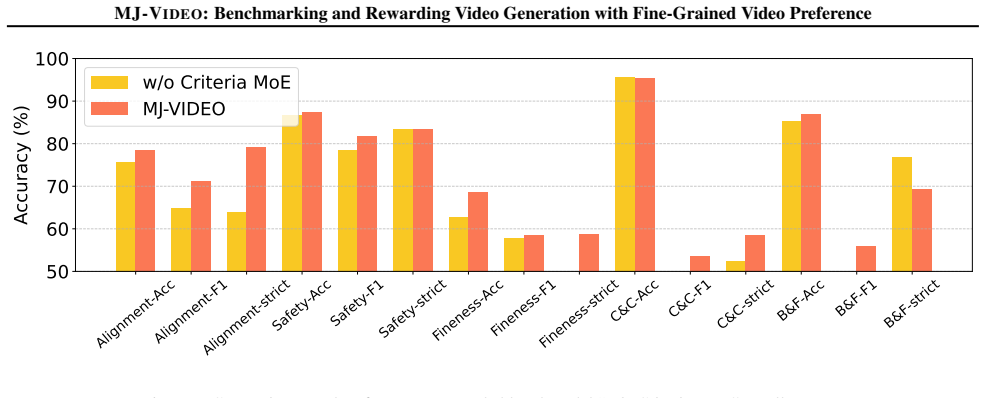
The load-bearing mechanism is the two stacked mixture-of-experts layers on top of a 2B video-language backbone. This is a mixture-of-experts design: specialized scoring heads with a router that decides which experts matter for the current text-video pair. The Aspect MoE produces routing weights $AR = \operatorname{softmax}(g(h))$ over five aspects; the Criteria MoE produces 28 criterion scores $C[U_i] = \operatorname{softmax}(g'(h)[U_i]) \odot f(h)[U_i]$; and the overall score is the aspect-weighted sum $OS = \sum_i (\sum_{t \in U_i} C[t]) AR[i]$. This lets the same model specialize and reweight preferences per input instead of applying a fixed rubric.
What would settle it
An independent re-annotation study would settle it: take 200 randomly chosen MJ-BENCH-VIDEO pairs, give the same 28-criteria rubric to fresh annotators, and compare their aspect and overall preferences with the released labels. If per-criterion agreement is poor or the released preferences cannot be reproduced, the benchmark's ground truth would not support the paper's conclusions; if agreement is high, the label-noise objection loses its force.
Extended reading notes
Core claim
The paper's central claim is that decomposing video preference into five aspects and 28 criteria, and training a reward model to weigh those criteria dynamically, produces judgments closer to human preference than a single scalar judge. On its own benchmark, MJ-VIDEO reports accuracy across the five aspects of 78.41/87.50/68.60/95.36/86.92 and 68.75% strict overall preference accuracy, outperforming prior reward models including VideoScore. It also reports that fine-tuning a text-to-video diffusion model with MJ-VIDEO as the reward improves human-evaluated alignment from 68.80 to 79.20 on its reported scale. The architecture is the reason given: a gating network selects relevant aspects, a second gating layer weights the 28 criteria, and the overall score is a weighted combination, so the judge can emphasize safety for cartoons or coherence for sports rather than averaging everything together.
Load-bearing premise
The paper's results stand on the assumption that the human labels behind MJ-BENCH-VIDEO, 72 judgments per pair organized into 28 criteria, are accurate and consistent enough to serve as ground truth, and the paper reports no inter-annotator agreement; if annotators disagree or share systematic biases, both the reported judge accuracy and the reward model's training signal inherit that noise.
Editorial extensions
If this is right
- If preference is genuinely decomposable into the five aspects, reward-model evaluation becomes interpretable: a low overall score can be traced to a specific criterion such as object disappearance or political sensitivity rather than an opaque number.
- MJ-BENCH-VIDEO gives subsequent work a common test bed, so future judges can be compared aspect-by-aspect and criterion-by-criterion, and the 28-criteria rubric can be reused or extended.
- Using MJ-VIDEO as a reward in preference tuning should make text-to-video models align more closely to instructions, including counts, attributes, and scene details, because the fine-grained signal rewards each aspect separately.
- The aspect-routing weights potentially let a practitioner emphasize safety or coherence for a particular deployment, since the overall score is an explicit weighted sum rather than an end-to-end black box.
Reading between the lines
- Beyond the paper, the same two-tier mixture-of-experts recipe could transfer to other generative modalities, such as judging image or audio generations against multi-criteria rubrics, because the mechanism only assumes a backbone that embeds the input and a set of criteria with human labels.
- Beyond the paper, a testable extension is to probe routing stability: feed the same video pair with systematically altered prompts that emphasize different aspects and check whether the aspect-routing weights shift in the expected direction, which would tell whether the router is learning preferences rather than surface correlations.
- Beyond the paper, the benchmark's filtering rules, which drop pairs with no aspect disagreement and very low scores, mean the reported accuracy measures relative judgment on decidable pairs; accuracy may not transfer to near-tie or uniformly poor pairs without re-measuring.
- Beyond the paper, the reported gains come with the model trained and evaluated on splits of the same annotation pool, so a stronger external check would be scoring newly collected, never-annotated preference pairs from a different generation pipeline.
Editorial analysis
A structured set of objections, weighed in public.
Referee Report
Summary. MJ-VIDEO introduces a large-scale video preference benchmark, MJ-BENCH-VIDEO, with 5,421 text-video preference pairs annotated along five aspects (Alignment, Safety, Fineness, Coherence & Consistency, Bias & Fairness) and 28 fine-grained criteria, and a 2B mixture-of-experts (MoE) reward model built on InternVL2 with two stacked MoE layers for aspect routing and criteria scoring. The model is trained in three stages with criteria regression, aspect ranking, and overall preference ranking losses. Experiments report that MJ-VIDEO outperforms existing LVLM judges and VideoScore on the benchmark (17.58% overall and 15.87% fine-grained strict accuracy gains), and that using it as a reward model in a VADER-style RLAIF pipeline improves VideoCrafter2 alignment on VBench and human evaluation.
Significance. The dataset and model are potentially valuable contributions: the benchmark is substantially larger and more fine-grained than existing video preference resources, and the MoE design with aspect routing is a sensible way to handle multi-dimensional preferences. The paper also ships a clear held-out split, external evaluations on Safesora-test and GenAI-Bench, an ablation of the two MoE components, and a preference-tuning application. However, the central claim of general superiority over prior reward models rests on a benchmark that was filtered and annotated by the same group, with no inter-annotator agreement reported and no confidence intervals on the headline gains. The much smaller improvement on GenAI-Bench (1.65%) than on MJ-BENCH-VIDEO (17.58%) underscores that the claimed advantage may be partly in-distribution.
major comments (4)
- [§2.2.3, Table 1] The absence of inter-annotator agreement (e.g., Cohen's kappa or Krippendorff's alpha) for the 72 labels per pair is a load-bearing gap because these annotations serve simultaneously as training targets and evaluation ground truth; without a reliability measure, the reported 17.58% and 15.87% gains could reflect the model fitting annotator noise rather than learning a generalizable preference function.
- [§2.2.2, Table 2] The filtering rules—discarding pairs where one video scores below 5 in all five aspects and removing pairs with identical aspect scores—systematically remove ambiguous and tied cases, which likely inflates accuracy on the same-distribution test set; the paper should report results on an unfiltered validation set or an independently annotated sample, and should provide confidence intervals or paired significance tests for the improvements over VideoScore and InternVL2-26B.
- [§4.3, Table 2] VisionReward (Xu et al., 2024) is discussed in Related Work as a concurrent fine-grained reward model but is not benchmarked in Table 2; since it is the closest concurrent method, its omission prevents the reader from assessing the claimed state-of-the-art status.
- [§4.4, Table 3] The human evaluation results (e.g., quality 69.90 vs. 64.50 and alignment 79.20 vs. 74.80) are reported without the number of annotators, annotation instructions, agreement statistics, or statistical significance tests; moreover, the VBench Overall Consistency score for MJ-VIDEO (28.19) is slightly lower than VideoScore (28.38), so the claim of improvement should be qualified with per-dimension significance testing.
minor comments (5)
- [Appendix F.1] The loss weight ratios (0.3:1:1 and 0.3:0.3:1) are introduced without sensitivity analysis; please state whether the main conclusions are stable to these choices.
- [§2.2.1, Table 4] Table 4 lists 10,000 pairs from Safesora and 15,505 prompts from I2V, while Section 2.2.1 describes 20,000 videos and 10,000 prompts from the existing dataset; please reconcile these counts and clarify the pair-to-video relationship.
- [§4.5, Figure 4] Figure 4(b) reports an average improvement of 5.45% across three datasets without a per-dataset breakdown; please provide the underlying numbers for each dataset.
- [Throughout] The model name is inconsistently typeset as 'MJ-V IDEO' in the abstract and elsewhere; please normalize the spacing.
- [§4.6] The phrase 'two case study' should read 'two case studies', and the claimed 'ethereal bird' detail in Figure 5 is not evident from the text description; please make the figure annotations self-explanatory.
Circularity Check
No significant circularity: the central preference-accuracy claims are held-out supervised evaluations, with external checks on GenAI-Bench, Safesora-test, VBench, and human evaluation.
full rationale
The paper's main claim is that MJ-VIDEO outperforms existing video reward models on overall and fine-grained preference judgment. This is supported by a standard 4:1 train/test split of MJ-BENCH-VIDEO, where the test annotations come from the same human annotation campaign but are not used in training. Training a predictor on one subset and measuring accuracy on a disjoint subset is supervised generalization, not circular reasoning. The additional datasets GenAI-Bench and Safesora-test provide external held-out preference pairs, and the downstream alignment experiment is evaluated with VBench and human evaluation, both independent of the model's training labels. The only notable self-citation is the adaptation of the five-aspect rubric from MJ-Bench (Chen et al., 2024c), but that citation supplies a taxonomy and prompting style, not the numerical outcomes; the benchmark's labels are newly collected human annotations. The data-filtering rules in Section 2.2.2 and the absence of reported inter-annotator agreement in Section 2.2.3 are legitimate concerns about benchmark validity and potential inflation of in-distribution accuracy, but they do not make any prediction equivalent to an input by construction. Equations (1)-(5) define the model's training objectives and scoring rules; evaluation compares the resulting preferences against held-out human labels, so no equation reduces the reported result to its training target. No circular step can be exhibited, and the external evaluations provide independent support for the central claims.
Assumptions & free parameters
free parameters (5)
- Five-aspect taxonomy
- Number of fine-grained criteria =
28
- Filtering threshold =
5/10
- Loss weight ratios =
0.3:1:1 (stage II), 0.3:0.3:1 (stage III)
- Train/test split ratio =
4:1
assumptions (5)
- domain assumption Human preference labels in MJ-BENCH-VIDEO are accurate and consistent enough to serve as ground truth.
- domain assumption The five aspects and 28 criteria are a valid and roughly complete decomposition of video preference for text-to-video generation.
- domain assumption The filtering step does not introduce selection bias that systematically favors the trained reward model.
- domain assumption The 1,085 test pairs are representative of real text-to-video preference distributions.
- domain assumption InternVL2-2B's video representations contain enough information to support fine-grained criteria scoring.
Cite this review
Pith. "Pith review of MJ-VIDEO: Fine-Grained Benchmarking and Rewarding Video Preferences in Video Generation." pith.science (2026). https://pith.science/paper/J2Y5CHCJ
@misc{pith2026250201719,
  author       = {Pith},
  title        = {Pith review of: MJ-VIDEO: Fine-Grained Benchmarking and Rewarding Video Preferences in Video Generation},
  year         = {2026},
  howpublished = {\url{https://pith.science/paper/J2Y5CHCJ}},
  note         = {Machine review of arXiv:2502.01719}
}
read the original abstract
Recent advancements in video generation have significantly improved the ability to synthesize videos from text instructions. However, existing models still struggle with key challenges such as instruction misalignment, content hallucination, safety concerns, and bias. Addressing these limitations, we introduce MJ-BENCH-VIDEO, a large-scale video preference benchmark designed to evaluate video generation across five critical aspects: Alignment, Safety, Fineness, Coherence & Consistency, and Bias & Fairness. This benchmark incorporates 28 fine-grained criteria to provide a comprehensive evaluation of video preference. Building upon this dataset, we propose MJ-VIDEO, a Mixture-of-Experts (MoE)-based video reward model designed to deliver fine-grained reward. MJ-VIDEO can dynamically select relevant experts to accurately judge the preference based on the input text-video pair. This architecture enables more precise and adaptable preference judgments. Through extensive benchmarking on MJ-BENCH-VIDEO, we analyze the limitations of existing video reward models and demonstrate the superior performance of MJ-VIDEO in video preference assessment, achieving 17.58% and 15.87% improvements in overall and fine-grained preference judgments, respectively. Additionally, introducing MJ-VIDEO for preference tuning in video generation enhances the alignment performance. All our code, data, and models are available at https://aiming-lab.github.io/MJ-VIDEO.github.io/.
Figures


Figures from the paper (6 more)




Forward citations
Cited by 1 Pith paper
-
VGIF-Score: Interpretable and Diagnostic Evaluation of Spatio-Temporal Instruction Following in Video Generation
VGIF-Score decomposes video prompts into dependency graphs and uses a VLM to diagnose which instruction constraints models satisfy, revealing strong failures on causal and late-prompt constraints.
Reference graph
Works this paper leans on
-
[4]
Chen, Z., Du, Y ., Wen, Z., Zhou, Y ., Cui, C., Weng, Z., Tu, H., Wang, C., Tong, Z., Huang, Q., et al. Mj- bench: Is your multimodal reward model really a good judge for text-to-image generation? arXiv preprint arXiv:2407.04842, 2024c. Chen, Z., Pinto, F., Pan, M., and Li, B. Safewatch: An efficient safety-policy following video guardrail model with tran...
-
[5]
Chu, Z., Zhang, L., Sun, Y ., Xue, S., Wang, Z., Qin, Z., and Ren, K
URL https://arxiv.org/ abs/2202.04053. Chu, Z., Zhang, L., Sun, Y ., Xue, S., Wang, Z., Qin, Z., and Ren, K. Sora detector: A unified hallucination detection for large text-to-video models,
-
[6]
Cui, C., Zhang, A., Zhou, Y ., Chen, Z., Deng, G., Yao, H., and Chua, T.-S
URL https:// arxiv.org/abs/2405.04180. Cui, C., Zhang, A., Zhou, Y ., Chen, Z., Deng, G., Yao, H., and Chua, T.-S. Fine-grained verifiers: Preference modeling as next-token prediction in vision-language alignment. arXiv preprint arXiv:2410.14148,
-
[7]
Escontrela, A., Adeniji, A., Yan, W., Jain, A., Peng, X
URL https://arxiv.org/abs/ 2406.14477. Escontrela, A., Adeniji, A., Yan, W., Jain, A., Peng, X. B., Goldberg, K., Lee, Y ., Hafner, D., and Abbeel, P. Video prediction models as rewards for reinforcement learning. Advances in Neural Information Processing Systems , 36,
-
[8]
D., Ni, Y ., Lyu, B., Narsupalli, Y ., Fan, R., Lyu, Z., Lin, Y ., and Chen, W
He, X., Jiang, D., Zhang, G., Ku, M., Soni, A., Siu, S., Chen, H., Chandra, A., Jiang, Z., Arulraj, A., Wang, K., Do, Q. D., Ni, Y ., Lyu, B., Narsupalli, Y ., Fan, R., Lyu, Z., Lin, Y ., and Chen, W. Videoscore: Building automatic metrics to simulate fine-grained human feed- back for video generation. ArXiv, abs/2406.15252, 2024a. URL https://arxiv.org/a...
-
[10]
Diffusion reward: Learning rewards via conditional video diffusion, 2024a
Huang, T., Jiang, G., Ze, Y ., and Xu, H. Diffusion reward: Learning rewards via conditional video diffusion, 2024a. URL https://arxiv.org/abs/2312.14134. 9 MJ-V IDEO : Benchmarking and Rewarding Video Generation with Fine-Grained Video Preference Huang, Z., He, Y ., Yu, J., Zhang, F., Si, C., Jiang, Y ., Zhang, Y ., Wu, T., Jin, Q., Chanpaisit, N., Wang,...
-
[11]
Nan, K., Xie, R., Zhou, P., Fan, T., Yang, Z., Chen, Z., Li, X., Yang, J., and Tai, Y
URL https://arxiv.org/ abs/2403.16407. Nan, K., Xie, R., Zhou, P., Fan, T., Yang, Z., Chen, Z., Li, X., Yang, J., and Tai, Y . Openvid-1m: A large-scale high-quality dataset for text-to-video generation. arXiv preprint arXiv:2407.02371,
-
[12]
Prabhudesai, M., Mendonca, R., Qin, Z., Fragkiadaki, K., and Pathak, D
URL https://arxiv.org/abs/2303.08774. Prabhudesai, M., Mendonca, R., Qin, Z., Fragkiadaki, K., and Pathak, D. Video diffusion alignment via reward gradients. Prabhudesai, M., Mendonca, R., Qin, Z., Fragkiadaki, K., and Pathak, D. Video diffusion alignment via reward gradients. arXiv preprint arXiv:2407.08737, 2024a. Prabhudesai, M., Mendonca, R., Qin, Z.,...
Show all 26 references
-
[15]
Tan, Z., Yang, X., Qin, L., and Li, H
URL https: //arxiv.org/abs/2209.14792. Tan, Z., Yang, X., Qin, L., and Li, H. Vidgen-1m: A large- scale dataset for text-to-video generation. arXiv preprint arXiv:2408.02629,
-
[16]
Team, G., Anil, R., Borgeaud, S., Alayrac, J.-B., Yu, J., Soricut, R., Schalkwyk, J., Dai, A
URL https://arxiv.org/ abs/2405.09818. Team, G., Anil, R., Borgeaud, S., Alayrac, J.-B., Yu, J., Soricut, R., Schalkwyk, J., Dai, A. M., Hauth, A., Millican, K., and et al., D. S. Gemini: A family of highly capable multimodal models,
-
[17]
Unterthiner, T., van Steenkiste, S., Kurach, K., Marinier, R., Michalski, M., and Gelly, S
URL https: //arxiv.org/abs/2312.11805. Unterthiner, T., van Steenkiste, S., Kurach, K., Marinier, R., Michalski, M., and Gelly, S. Towards accurate generative models of video: A new metric & challenges,
-
[19]
T., Arora, S., Mazeika, M., Hendrycks, D., Lin, Z., Cheng, Y ., Koyejo, S., Song, D., and Li, B
Wang, B., Chen, W., Pei, H., Xie, C., Kang, M., Zhang, C., Xu, C., Xiong, Z., Dutta, R., Schaeffer, R., Truong, S. T., Arora, S., Mazeika, M., Hendrycks, D., Lin, Z., Cheng, Y ., Koyejo, S., Song, D., and Li, B. Decodingtrust: A comprehensive assessment of trustworthiness in g...
-
[20]
Wang, W., Chen, Z., Chen, X., Wu, J., Zhu, X., Zeng, G., Luo, P., Lu, T., Zhou, J., Qiao, Y ., and Dai, J
URL https://openreview.net/forum? id=pYNl76onJL. Wang, W., Chen, Z., Chen, X., Wu, J., Zhu, X., Zeng, G., Luo, P., Lu, T., Zhou, J., Qiao, Y ., and Dai, J. Visionllm: Large language model is also an open-ended decoder for vision-centric tasks, 2023b. URL https://arxiv. org/abs...
-
[21]
Xu, H., Ghosh, G., Huang, P.-Y ., Okhonko, D., Agha- janyan, A., Metze, F., Zettlemoyer, L., and Feichten- hofer, C
URL https://arxiv.org/abs/ 2408.12528. Xu, H., Ghosh, G., Huang, P.-Y ., Okhonko, D., Agha- janyan, A., Metze, F., Zettlemoyer, L., and Feichten- hofer, C. Videoclip: Contrastive pre-training for zero- shot video-text understanding,
-
[22]
Xu, J., Huang, Y ., Cheng, J., Yang, Y ., Xu, J., Wang, Y ., Duan, W., Yang, S., Jin, Q., Li, S., et al
URL https: //arxiv.org/abs/2109.14084. Xu, J., Huang, Y ., Cheng, J., Yang, Y ., Xu, J., Wang, Y ., Duan, W., Yang, S., Jin, Q., Li, S., et al. Visionre- ward: Fine-grained multi-dimensional human preference learning for image and video generation. arXiv preprint arXiv:2412.21059,
-
[23]
Yuan, H., Zhang, S., Wang, X., Wei, Y ., Feng, T., Pan, Y ., Zhang, Y ., Liu, Z., Albanie, S., and Ni, D
URL https://arxiv.org/abs/2106.02638. Yuan, H., Zhang, S., Wang, X., Wei, Y ., Feng, T., Pan, Y ., Zhang, Y ., Liu, Z., Albanie, S., and Ni, D. Instructvideo: Instructing video diffusion models with human feedback. Dec 2023a. Yuan, H., Zhang, S., Wang, X., Wei, Y ., Feng, T., ...
-
[24]
Grape: Generalizing robot policy via preference alignment
Zhang, Z., Zheng, K., Chen, Z., Jang, J., Li, Y ., Wang, C., Ding, M., Fox, D., and Yao, H. Grape: Generalizing robot policy via preference alignment. arXiv preprint arXiv:2411.19309,
-
[25]
Zhou, Y ., Fan, Z., Cheng, D., Yang, S., Chen, Z., Cui, C., Wang, X., Li, Y ., Zhang, L., and Yao, H
URL https: //arxiv.org/abs/2202.09368. Zhou, Y ., Fan, Z., Cheng, D., Yang, S., Chen, Z., Cui, C., Wang, X., Li, Y ., Zhang, L., and Yao, H. Calibrated self-rewarding vision language models. arXiv preprint arXiv:2405.14622,
-
[26]
M., Stiennon, N., Wu, J., Brown, T
Ziegler, D. M., Stiennon, N., Wu, J., Brown, T. B., Radford, A., Amodei, D., Christiano, P., and Irving, G. Fine-tuning language models from human preferences. arXiv preprint arXiv:1909.08593,
1909 arXiv
-
[2017]
Singer, U., Polyak, A., Hayes, T., Yin, X., An, J., Zhang, S., Hu, Q., Yang, H., Ashual, O., Gafni, O., Parikh, D., Gupta, S., and Taigman, Y
URL https://arxiv.org/abs/1701.06538. Singer, U., Polyak, A., Hayes, T., Yin, X., An, J., Zhang, S., Hu, Q., Yang, H., Ashual, O., Gafni, O., Parikh, D., Gupta, S., and Taigman, Y . Make-a-video: Text-to-video generation without text-video data,
-
[2019]
Wallace, B., Dang, M., Rafailov, R., Zhou, L., Lou, A., Purushwalkam, S., Ermon, S., Xiong, C., Joty, S., and Naik, N
URL https://arxiv.org/abs/1812.01717. Wallace, B., Dang, M., Rafailov, R., Zhou, L., Lou, A., Purushwalkam, S., Ermon, S., Xiong, C., Joty, S., and Naik, N. Diffusion model alignment using direct pref- erence optimization. In Proceedings of the IEEE/CVF Conference on Computer ...
-
[2020]
Shazeer, N., Mirhoseini, A., Maziarz, K., Davis, A., Le, Q., Hinton, G., and Dean, J
URL https://arxiv.org/abs/ 2004.06704. Shazeer, N., Mirhoseini, A., Maziarz, K., Davis, A., Le, Q., Hinton, G., and Dean, J. Outrageously large neural net- works: The sparsely-gated mixture-of-experts layer,
2004 arXiv
-
[2021]
Black, K., Janner, M., Du, Y ., Kostrikov, I., and Levine, S
URL https://arxiv.org/abs/2108.10447. Black, K., Janner, M., Du, Y ., Kostrikov, I., and Levine, S. Training diffusion models with reinforcement learn- ing,
-
[2022]
org/abs/2205.15868
URL https://arxiv. org/abs/2205.15868. Hong, W., Wang, W., Ding, M., Yu, W., Lv, Q., Wang, Y ., Cheng, Y ., Huang, S., Ji, J., Xue, Z., et al. Cogvlm2: Vi- sual language models for image and video understanding. arXiv preprint arXiv:2408.16500,
-
[2023]
Cai, W., Jiang, J., Wang, F., Tang, J., Kim, S., and Huang, J
URL https://arxiv.org/abs/ 2311.15127. Cai, W., Jiang, J., Wang, F., Tang, J., Kim, S., and Huang, J. A survey on mixture of experts,
-
[2024]
Chen, D., Chen, R., Zhang, S., Liu, Y ., Wang, Y ., Zhou, H., Zhang, Q., Zhou, P., Wan, Y ., and Sun, L
URL https: //arxiv.org/abs/2407.06204. Chen, D., Chen, R., Zhang, S., Liu, Y ., Wang, Y ., Zhou, H., Zhang, Q., Zhou, P., Wan, Y ., and Sun, L. Mllm-as-a- judge: Assessing multimodal llm-as-a-judge with vision- language benchmark. arXiv preprint arXiv:2402.04788, 2024a. Chen, ...
Reviewed August 9, 2026 · model on record in the stance chip above.
Discussion (0). Continue with ORCID to comment.