Photo-assisted shot noise probes multiple charge carriers in quantum Hall edges
Pith reviewed 2026-05-23 02:20 UTC · model grok-4.3
The pith
Photo-assisted shot noise distinguishes multiple tunneling charges at quantum point contacts even when one amplitude is much smaller.
A machine-rendered reading of the paper's core claim, the machinery that carries it, and where it could break.
Core claim
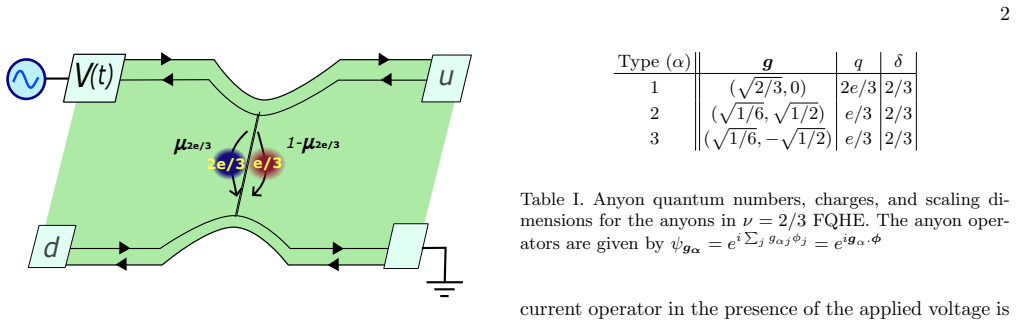
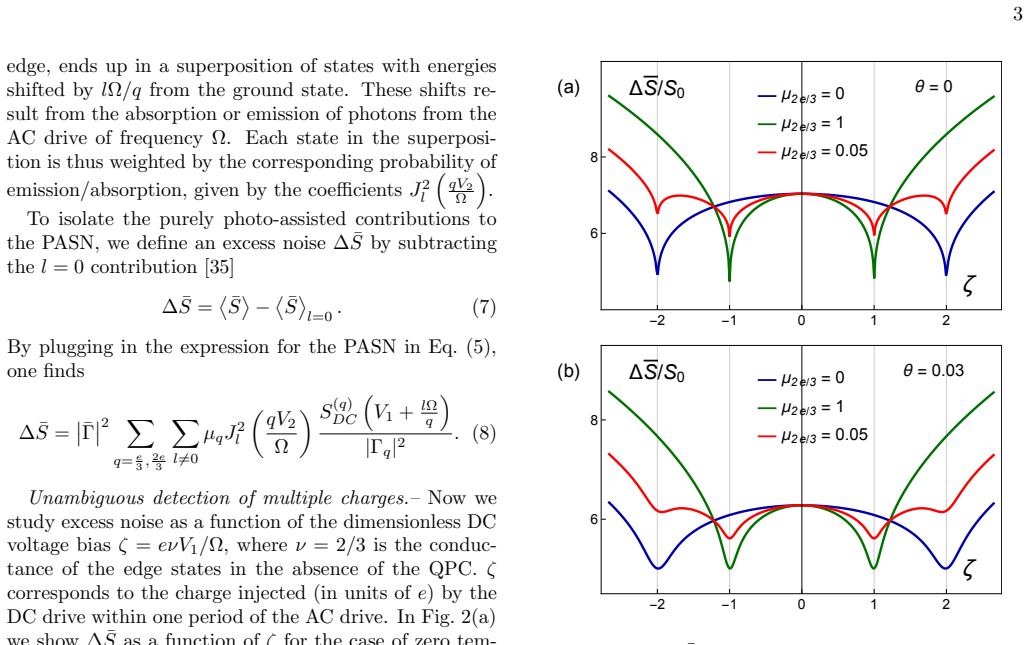
In hierarchical fractional quantum Hall states multiple charge types tunnel concurrently at a quantum point contact; photo-assisted shot noise induced by periodic AC bias produces distinct frequency-dependent signatures that identify each tunneling charge separately. For the ν = 2/3 state these signatures remain detectable even when one tunneling amplitude is significantly smaller than the other, and the predicted features persist under typical laboratory values of temperature and frequency. The same formalism applies to general Abelian systems with multiple edge modes.
What carries the argument
Photo-assisted shot noise generated by periodic AC voltage, evaluated with a scattering formalism that accounts for multiple edge modes and charge species.
If this is right
- PASN yields clearer separation of charge signals than DC shot noise when several charges tunnel together at one contact.
- Different tunneling charges remain identifiable at ν = 2/3 even with strongly unequal tunneling amplitudes.
- The same signatures are expected to appear in other hierarchical fractional quantum Hall states.
- The method supplies a practical route to confirm the presence of multiple anyonic charges under realistic lab conditions.
Where Pith is reading between the lines
- PASN could serve as a diagnostic for edge reconstructions or mode mixing in states where DC noise alone is inconclusive.
- The approach may be extended to probe charge fractionalization in interferometry setups that combine AC bias with anyon braiding.
- If the formalism is adapted, similar frequency signatures might appear in non-Abelian candidate states.
Load-bearing premise
The frequency-dependent features calculated for photo-assisted shot noise remain visible at the temperatures and driving frequencies reached in current experiments.
What would settle it
A measurement at a quantum point contact in a ν = 2/3 sample that shows no distinct AC-frequency peaks or dips matching the expected charge values would falsify the claim that PASN can separate the different tunneling charges.
Figures

read the original abstract
Fractional charges in the fractional quantum Hall effect were first observed via DC shot noise measurements of anyons tunneling at a quantum point contact (QPC). However, in scenarios with simultaneous tunneling of different types of charges at the QPC, the connection between DC shot noise and tunneling charge is less transparent. Photo-assisted shot noise (PASN), induced by periodic AC voltage, offers a promising alternative. Here, we investigate PASN in the hierarchical states of the fractional quantum Hall effect, where different types of charges are expected to tunnel concurrently at QPCs. In the particular case of the fractional quantum Hall state $\nu = 2/3$, our analysis demonstrates that PASN can be employed as a robust tool to detect different tunneling charges, even when the tunneling amplitude of one type is significantly smaller compared to the other. We show that the features predicted by our calculations are still visible for typical values of temperature and frequency achieved in state-of-the-art experiments. Our general formalism can be used to compute PASN for general Abelian quantum Hall systems with multiple edge modes and charge types.
Editorial analysis
A structured set of objections, weighed in public.
Referee Report
Summary. The manuscript develops a theoretical framework using the scattering approach and Keldysh formalism to compute photo-assisted shot noise (PASN) for Abelian fractional quantum Hall edge states with multiple co-propagating modes and charge types. For the hierarchical state at filling factor ν=2/3, explicit calculations demonstrate that PASN spectra exhibit distinct features allowing identification of different tunneling charges (e.g., e/3 and e) even when one tunneling amplitude is much smaller than the other; these features remain visible at typical experimental temperatures and AC frequencies. A general formalism is provided that applies to arbitrary Abelian QH systems.
Significance. If the calculations hold, the result is significant for mesoscopic physics because it supplies a concrete, experimentally accessible method to resolve multiple anyonic charges at QPCs where conventional DC shot noise becomes ambiguous. The explicit calculations for ν=2/3 together with the general Abelian formalism constitute a clear strength, enabling direct comparison with state-of-the-art experiments and guiding future device design.
minor comments (2)
- [Abstract] The abstract states that features remain visible for 'typical values of temperature and frequency' but does not quote the specific numerical ranges (e.g., T=10–50 mK, ω/2π=1–10 GHz) used in the plots; adding these values would strengthen the experimental relevance claim without altering the central result.
- [§3] Notation for the two tunneling amplitudes (denoted Γ1 and Γ2 in §3) is introduced without an explicit statement of their ratio range explored in the ν=2/3 numerics; a short sentence clarifying the ratio interval (e.g., 0.01–0.1) would improve readability.
Simulated Author's Rebuttal
We thank the referee for their careful reading of the manuscript, the accurate summary of our results, and the positive recommendation to accept. We appreciate the recognition that the explicit calculations for ν=2/3 together with the general Abelian formalism provide a concrete, experimentally accessible method to resolve multiple anyonic charges.
Circularity Check
No significant circularity; derivation self-contained via explicit Abelian formalism
full rationale
The manuscript derives PASN expressions for hierarchical Abelian states using standard scattering theory and noise formulas applied to multiple edge modes and charge types. The ν=2/3 case is obtained by direct substitution into these general expressions rather than by fitting or redefinition. No step reduces a claimed prediction to an input parameter by construction, nor does any load-bearing premise rest solely on self-citation. The visibility of features at experimental T and ω follows from the same analytic forms without additional ansatz smuggling. The derivation chain is therefore independent of the target result.
Axiom & Free-Parameter Ledger
axioms (1)
- domain assumption Abelian quantum Hall theory with multiple edge modes applies to hierarchical states such as ν=2/3
Reference graph
Works this paper leans on
-
[1]
R. B. Laughlin, Anomalous quantum hall effect: An in- compressible quantum fluid with fractionally charged ex- citations, Phys. Rev. Lett. 50, 1395 (1983)
work page 1983
-
[2]
D. C. Tsui, Nobel lecture: Interplay of disorder and in- teraction in two-dimensional electron gas in intense mag- netic fields, Rev. Mod. Phys. 71, 891 (1999)
work page 1999
-
[3]
J. M. Leinaas and J. Myrheim, On the theory of identical particles, Il Nuovo Cimento B (1971-1996) 37, 1 (1977)
work page 1971
-
[4]
Wilczek, Quantum mechanics of fractional-spin parti- cles, Phys
F. Wilczek, Quantum mechanics of fractional-spin parti- cles, Phys. Rev. Lett. 49, 957 (1982)
work page 1982
-
[5]
C. de C. Chamon, D. E. Freed, S. A. Kivelson, S. L. Sondhi, and X. G. Wen, Two point-contact interferom- 5 eter for quantum hall systems, Phys. Rev. B 55, 2331 (1997)
work page 1997
-
[6]
I. Safi, P. Devillard, and T. Martin, Partition noise and statistics in the fractional quantum hall effect, Phys. Rev. Lett. 86, 4628 (2001)
work page 2001
-
[7]
T. Martin, Course 5 noise in mesoscopic physics, Nanophysics: Coherence and Transport, ´Ecole d’ ´Et´ e De Physique Des Houches Session LXXXI , 283 (2005)
work page 2005
-
[8]
B. Rosenow, I. P. Levkivskyi, and B. I. Halperin, Current correlations from a mesoscopic anyon collider, Phys. Rev. Lett. 116, 156802 (2016)
work page 2016
-
[9]
H. Bartolomei, M. Kumar, R. Bisognin, A. Marguerite, J. Berroir, E. Bocquillon, B. Pla¸ cais, A. Cavanna, Q. Dong, U. Gennser, Y. Jin, and G. F` eve, Fractional statistics in anyon collisions, Science 368, 173 (2020)
work page 2020
-
[10]
J. Nakamura, S. Liang, G. C. Gardner, and M. J. Manfra, Direct observation of anyonic braiding statistics, Nature Physics 16, 931 (2020)
work page 2020
-
[11]
D. E. Feldman and B. I. Halperin, Fractional charge and fractional statistics in the quantum hall effects, Reports on Progress in Physics 84, 076501 (2021)
work page 2021
-
[12]
M. Carrega, L. Chirolli, S. Heun, and L. Sorba, Anyons in quantum hall interferometry, Nature Reviews Physics 3, 698 (2021)
work page 2021
- [13]
- [14]
-
[15]
J. M. Lee, C. Hong, A. Tomer, N. Schiller, V. Umansky, M. Heiblum, Y. Oreg, and H. S. Sim, Partitioning of diluted anyons reveals their braiding statistics, Nature 617, 277 (2023)
work page 2023
-
[16]
J. Nakamura, S. Liang, G. C. Gardner, and M. J. Man- fra, Fabry-p´ erot interferometry at theν = 2/5 fractional quantum hall state, Phys. Rev. X 13, 041012 (2023)
work page 2023
-
[17]
K. Iyer, F. Ronetti, B. Gr´ emaud, T. Martin, J. Rech, and T. Jonckheere, Finite width of anyons changes their braiding signature, Phys. Rev. Lett. 132, 216601 (2024)
work page 2024
-
[18]
M. Thamm and B. Rosenow, Effect of the soliton width on nonequilibrium exchange phases of anyons, Phys. Rev. Lett. 132, 156501 (2024)
work page 2024
- [19]
-
[20]
Anyon braiding and telegraph noise in a graphene interferometer
T. Werkmeister, J. R. Ehrets, M. E. Wesson, D. H. Na- jafabadi, K. Watanabe, T. Taniguchi, B. I. Halperin, A. Yacoby, and P. Kim, Anyon braiding and tele- graph noise in a graphene interferometer (2024), arXiv:2403.18983 [cond-mat.mes-hall]
work page internal anchor Pith review Pith/arXiv arXiv 2024
-
[21]
C. L. Kane and M. P. A. Fisher, Nonequilibrium noise and fractional charge in the quantum hall effect, Phys. Rev. Lett. 72, 724 (1994)
work page 1994
-
[22]
L. Saminadayar, D. C. Glattli, Y. Jin, and B. Eti- enne, Observation of the e/3 fractionally charged laugh- lin quasiparticle, Phys. Rev. Lett. 79, 2526 (1997)
work page 1997
-
[23]
R. de Picciotto, M. Heiblum, V. Umansky, G. Bunin, and D. Mahalu, Direct observation of a fractional charge, Nature 389, 162 (1997)
work page 1997
-
[24]
M. Reznikov, R. d. Picciotto, T. Griffiths, M. Heiblum, and V. Umansky, Observation of quasiparticles with one- fifth of an electron’s charge, Nature 399, 238 (1999)
work page 1999
-
[25]
C. Bena and I. Safi, Emission and absorption noise in the fractional quantum hall effect, Phys. Rev. B 76, 125317 (2007)
work page 2007
-
[27]
B. Roussel, P. Degiovanni, and I. Safi, Perturbative fluc- tuation dissipation relation for nonequilibrium finite- frequency noise in quantum circuits, Phys. Rev. B 93, 045102 (2016)
work page 2016
-
[28]
D. Ferraro, A. Braggio, N. Magnoli, and M. Sassetti, Finite-frequency noise for edge states at a filling factor ν = 2/5, Physica Scripta 2012, 014025 (2012)
work page 2012
-
[29]
R. Bisognin, H. Bartolomei, M. Kumar, I. Safi, J. Berroir, E. Bocquillon, B. Pla¸ cais, A. Cavanna, U. Gennser, Y. Jin, and G. F` eve, Microwave photons emitted by frac- tionally charged quasiparticles, Nature Communications 10, 10.1038/s41467-019-09758-x (2019)
-
[30]
A. Cr´ epieux, P. Devillard, and T. Martin, Photoassisted current and shot noise in the fractional quantum hall effect, Phys. Rev. B 69, 205302 (2004)
work page 2004
-
[31]
C. d. C. Chamon, D. E. Freed, and X. G. Wen, Tunneling and quantum noise in one-dimensional luttinger liquids, Phys. Rev. B 51, 2363 (1995)
work page 1995
-
[32]
X.-G. Wen, Edge transport properties of the fractional quantum hall states and weak-impurity scattering of a one-dimensional charge-density wave, Phys. Rev. B 44, 5708 (1991)
work page 1991
-
[33]
I. Safi and E. V. Sukhorukov, Determination of tunnel- ing charge via current measurements, Europhysics Let- ters 91, 67008 (2010)
work page 2010
-
[34]
I. Safi, Driven strongly correlated quantum circuits and hall edge states: Unified photoassisted noise and revisited minimal excitations, Phys. Rev. B 106, 205130 (2022)
work page 2022
- [35]
-
[36]
X. Wen, Chiral luttinger liquid and the edge excitations in the fractional quantum hall states, Physical Review B 41, 12838 (1990)
work page 1990
-
[37]
X. G. Wen, Electrodynamical properties of gapless edge excitations in the fractional quantum hall states, Phys. Rev. Lett. 64, 2206 (1990)
work page 1990
-
[38]
B. I. Halperin, Statistics of quasiparticles and the hierar- chy of fractional quantized hall states, Phys. Rev. Lett. 52, 1583 (1984)
work page 1984
-
[39]
J. K. Jain, Composite-fermion approach for the fractional quantum hall effect, Phys. Rev. Lett. 63, 199 (1989)
work page 1989
-
[40]
X. Wen, Topological orders and edge excitations in frac- tional quantum hall states, Advances in Physics 44, 405 (1995)
work page 1995
-
[41]
O. Shtanko, K. Snizhko, and V. Cheianov, Nonequilib- rium noise in transport across a tunneling contact be- tween ν = 2 3 fractional quantum hall edges, Phys. Rev. B 89, 125104 (2014)
work page 2014
-
[42]
D. Ferraro, A. Braggio, N. Magnoli, and M. Sassetti, Charge tunneling in fractional edge channels, Physical 6 Review B 82, 085323 (2010)
work page 2010
-
[43]
A. Bid, N. Ofek, M. Heiblum, V. Umansky, and D. Ma- halu, Shot noise and charge at the 2 /3 composite frac- tional quantum hall state, Phys. Rev. Lett. 103, 236802 (2009)
work page 2009
-
[44]
D. Ferraro, A. Braggio, M. Merlo, N. Magnoli, and M. Sassetti, Relevance of multiple quasiparticle tunneling between edge states at ν = p/(2np + 1), Physical Review Letters 101, 166805 (2008)
work page 2008
-
[45]
Y. C. Chung, M. Heiblum, and V. Umansky, Scattering of Bunched Fractionally Charged Quasiparticles, Physical Review Letters 91, 216804 (2003)
work page 2003
- [46]
- [47]
-
[48]
N. Schiller, T. Alkalay, C. Hong, V. Umansky, M. Heiblum, Y. Oreg, and K. Snizhko, Scaling tunnelling noise in the fractional quantum hall effect tells about renormalization and breakdown of chiral luttinger liquid (2024), arXiv:2403.17097 [cond-mat.mes-hall]
-
[49]
P. Glidic, O. Maillet, C. Piquard, A. Aassime, A. Ca- vanna, Y. Jin, U. Gennser, A. Anthore, and F. Pierre, Quasiparticle andreev scattering in the ν = 1 /3 frac- tional quantum hall regime, Nature Communications 14, 10.1038/s41467-023-36080-4 (2023)
-
[50]
C. L. Kane and M. P. A. Fisher, Shot noise and the trans- mission of dilute laughlin quasiparticles, Phys. Rev. B67, 045307 (2003)
work page 2003
-
[51]
K. Iyer, T. Martin, J. Rech, and T. Jonckheere, Quasi- particle andreev reflection in the laughlin fractions of the fractional quantum hall effect, Phys. Rev. B 108, 155404 (2023)
work page 2023
-
[52]
M. Carrega, D. Ferraro, A. Braggio, N. Magnoli, and M. Sassetti, Spectral noise for edge states at the fill- ing factor ν = 5 /2, New Journal of Physics 14, 023017 (2012)
work page 2012
-
[53]
D. Ferraro, M. Carrega, A. Braggio, and M. Sas- setti, Multiple quasiparticle hall spectroscopy investi- gated with a resonant detector, New Journal of Physics 16, 043018 (2014)
work page 2014
- [54]
-
[55]
L.-H. Reydellet, P. Roche, D. C. Glattli, B. Etienne, and Y. Jin, Quantum partition noise of photon-created electron-hole pairs, Phys. Rev. Lett. 90, 176803 (2003)
work page 2003
-
[56]
R. J. Schoelkopf, A. A. Kozhevnikov, D. E. Prober, and M. J. Rooks, Observation of “photon-assisted” shot noise in a phase-coherent conductor, Phys. Rev. Lett. 80, 2437 (1998)
work page 1998
-
[57]
G. B. Lesovik, T. Martin, and J. Torr` es, Josephson frequency singularity in the noise of normal-metal– superconductor junctions, Phys. Rev. B60, 11935 (1999)
work page 1999
-
[58]
A. A. Kozhevnikov, R. J. Schoelkopf, and D. E. Prober, Observation of photon-assisted noise in a diffusive nor- mal metal–superconductor junction, Phys. Rev. Lett. 84, 3398 (2000)
work page 2000
-
[60]
We set ℏ = 1 in the rest of the paper
-
[61]
C. L. Kane, M. P. A. Fisher, and J. Polchinski, Random- ness at the edge: Theory of quantum hall transport at filling ν=2/3, Phys. Rev. Lett. 72, 4129 (1994)
work page 1994
-
[62]
J. Rech, D. Ferraro, T. Jonckheere, L. Vannucci, M. Sas- setti, and T. Martin, Minimal excitations in the frac- tional quantum hall regime, Phys. Rev. Lett.118, 076801 (2017)
work page 2017
-
[63]
F. Ronetti, B. Bertin-Johannet, A. Popoff, J. Rech, T. Jonckheere, B. Gr´ emaud, L. Raymond, and T. Martin, Levitons in correlated nano-scale systems, Chaos: An In- terdisciplinary Journal of Nonlinear Science 34, 042103 (2024)
work page 2024
-
[64]
P. K. Tien and J. P. Gordon, Multiphoton process ob- served in the interaction of microwave fields with the tunneling between superconductor films, Phys. Rev.129, 647 (1963)
work page 1963
-
[65]
A. Veillon, C. Piquard, P. Glidic, Y. Sato, A. Aas- sime, A. Cavanna, Y. Jin, U. Gennser, A. Anthore, and F. Pierre, Observation of the scaling dimension of frac- tional quantum hall anyons, Nature 10.1038/s41586-024- 07727-z (2024)
-
[66]
E. Papa and A. H. MacDonald, Interactions suppress quasiparticle tunneling at hall bar constrictions, Phys. Rev. Lett. 93, 126801 (2004)
work page 2004
-
[67]
A. Braggio, D. Ferraro, M. Carrega, N. Magnoli, and M. Sassetti, Environmental induced renormalization ef- fects in quantum hall edge states due to 1/f noise and dissipation, New Journal of Physics 14, 093032 (2012)
work page 2012
- [68]
-
[69]
J. Keeling, I. Klich, and L. S. Levitov, Minimal excitation states of electrons in one-dimensional wires, Phys. Rev. Lett. 97, 116403 (2006)
work page 2006
-
[70]
T. Jonckheere, J. Rech, B. Gr´ emaud, and T. Martin, Anyonic statistics revealed by the hong-ou-mandel dip for fractional excitations, Phys. Rev. Lett. 130, 186203 (2023)
work page 2023
- [71]
-
[72]
M. Carrega, D. Ferraro, A. Braggio, N. Magnoli, and M. Sassetti, Anomalous charge tunneling in fractional quantum hall edge states at a filling factorν = 5/2, Phys. Rev. Lett. 107, 146404 (2011)
work page 2011
-
[73]
I. S. Gradshteyn and I. Ryzhik, Table of integrals, se- ries, and products , eighth ed., edited by D. Zwillinger and V. Moll (Academic Press, Boston, 2014). END MA TTER General Abelian FQHE edge states.– A general Abelian FQHE edge is described by the Hamiltonian H0 =PN j=1 vj 4π (∂xϕj)2, where ϕj denote the bosonic modes on the edge, vj > 0 denote the pr...
work page 2014
discussion (0)
Sign in with ORCID, Apple, or X to comment. Anyone can read and Pith papers without signing in.