Polarization Formalism for Photon-Gravitational Wave Mixing Around Magnetars
Pith reviewed 2026-06-27 08:56 UTC · model grok-4.3
The pith
The stochastic gravitational wave background from magnetar electromagnetic emission via the Gertsenshtein effect is negligible.
A machine-rendered reading of the paper's core claim, the machinery that carries it, and where it could break.
Core claim
By solving the evolution equations of the associated Stokes parameters for the Gertsenshtein conversion process, the paper derives a lower bound on the stochastic gravitational wave background produced by magnetar electromagnetic emission and an upper bound from the requirement that incoming gravitational waves do not overproduce the observed X-ray flux; these bounds establish that the generated gravitational waves produce a negligible stochastic background.
What carries the argument
The evolution equations of the Stokes parameters tracking polarization changes during photon-gravitational wave mixing in strong magnetic fields.
If this is right
- The contribution of magnetar emissions to the high-frequency stochastic gravitational wave background is negligible.
- Magnetar X-ray observations can place upper limits on the amplitude of background gravitational waves at frequencies inaccessible to standard detectors.
- Analytical results for the mixing process are restricted to geometries where the adiabatic approximation remains valid.
Where Pith is reading between the lines
- Realistic magnetar magnetospheres may require numerical integration of the Stokes equations outside the two chosen geometries.
- The same polarization formalism could be applied to other compact objects with strong magnetic fields to check for similar conversion effects.
Load-bearing premise
The adiabatic approximation holds in the two specific geometries chosen for the analytical derivations.
What would settle it
A measurement of the high-frequency stochastic gravitational wave background exceeding the derived lower bound, or an observed magnetar X-ray flux that cannot be explained without significant gravitational wave conversion, would falsify the negligibility result.
Figures


read the original abstract
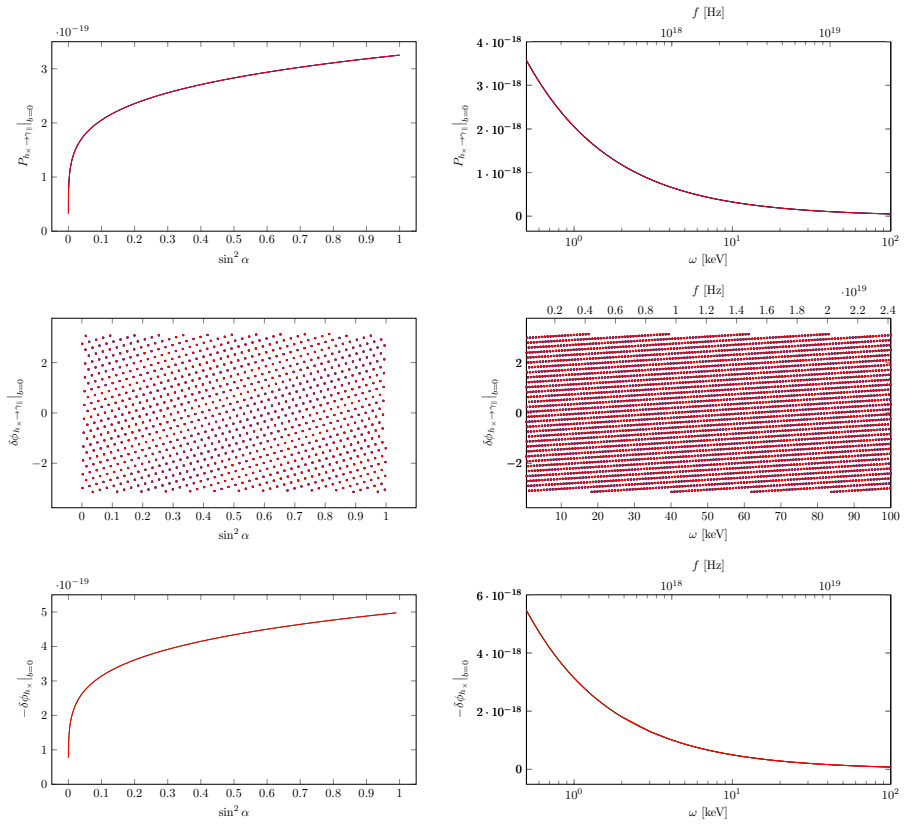
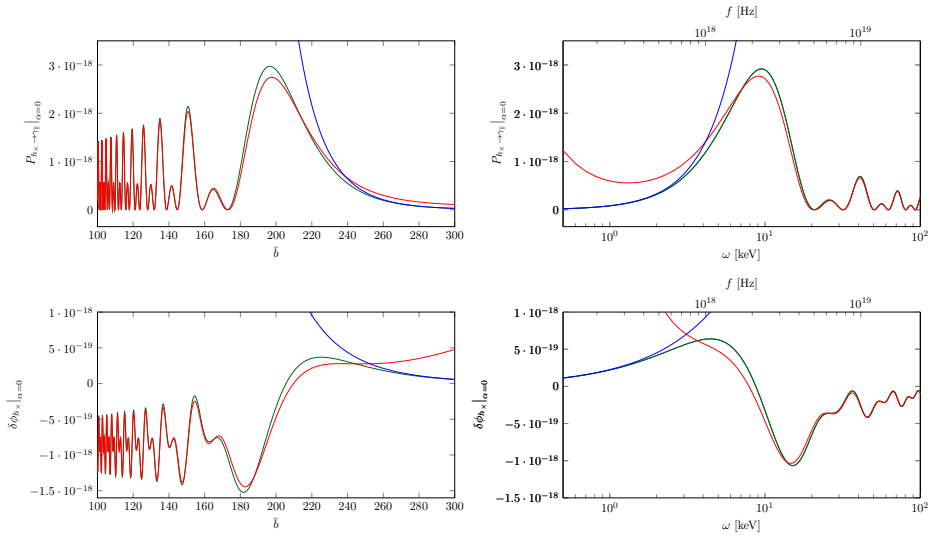
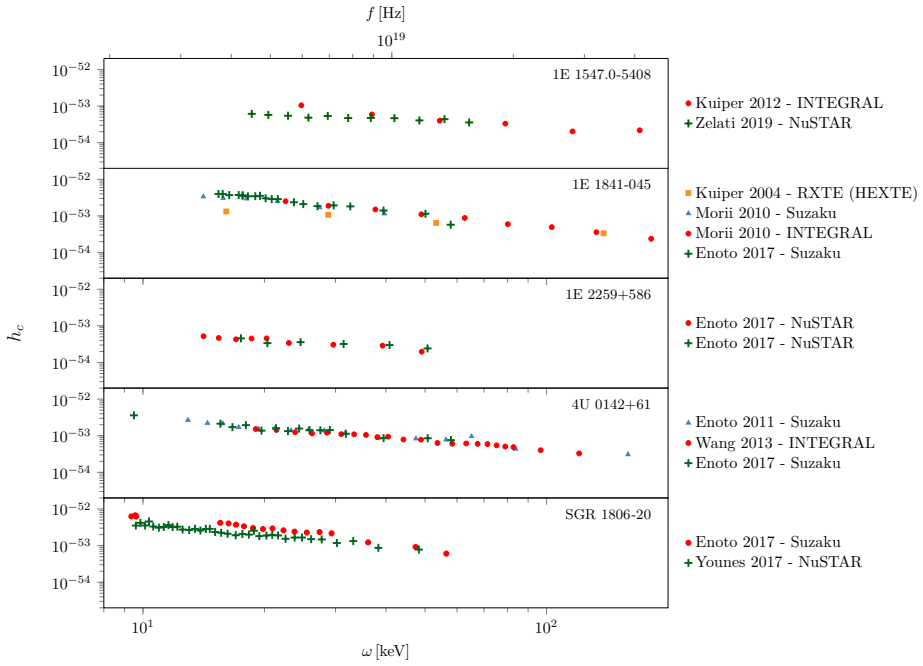
The Gertsenshtein effect can be used to probe the stochastic gravitational wave background at high frequencies, well above the range of standard cosmological sources. In this paper, we revisit the conversion between electromagnetic and gravitational waves in the magnetosphere of magnetars by solving the evolution equations of the associated Stokes parameters. In the process, we point out that the adiabatic approximation usually taken in the literature is not generally justified in the context of the Gertsenshtein effect. To derive analytical results, we focus our attention on two specific geometries where the adiabatic approximation is valid. From these, we derive a lower bound on the stochastic gravitational wave background from the conversion of magnetar electromagnetic emission into gravitational waves, and an upper bound by requiring that the conversion of background gravitational waves into electromagnetic radiation does not exceed the observed magnetar flux in the X-ray band. Our results demonstrate that gravitational waves generated through the Gertsenshtein conversion of magnetar electromagnetic emission produce a negligible stochastic background, as anticipated.
Editorial analysis
A structured set of objections, weighed in public.
Referee Report
Summary. The paper develops a polarization formalism for photon-gravitational wave mixing in magnetar magnetospheres by solving the evolution equations for the associated Stokes parameters. It notes that the adiabatic approximation is not generally valid and restricts analytical derivations to two specific geometries where the approximation holds. From these, it obtains a lower bound on the stochastic gravitational wave background produced by conversion of magnetar electromagnetic emission into gravitational waves, and an upper bound by requiring that the reverse conversion does not exceed observed X-ray fluxes. The central conclusion is that gravitational waves generated via this mechanism produce a negligible stochastic background.
Significance. If the bounds prove robust, the work supplies a concrete constraint on high-frequency stochastic gravitational wave backgrounds from an astrophysical source, reinforcing the expectation that Gertsenshtein conversion in magnetars is subdominant. The systematic use of Stokes-parameter evolution equations offers a clear framework for tracking polarization, which is a methodological strength.
major comments (1)
- [Sections deriving the analytical bounds in the two geometries] The lower and upper bounds on the stochastic GW background rest exclusively on analytical results derived in two geometries where the adiabatic approximation is valid. Although the manuscript correctly states that the approximation does not hold in general, no quantitative metric (e.g., volume fraction of the magnetosphere satisfying the adiabatic condition or distribution of field-line curvatures) is supplied to establish that these geometries dominate typical magnetar magnetospheres. If non-adiabatic regions contribute appreciably to the integrated conversion probability, both bounds could shift by orders of magnitude, directly affecting the negligibility claim.
Simulated Author's Rebuttal
We thank the referee for their careful reading of the manuscript and for identifying a point that merits clarification. We address the major comment below and indicate where revisions will be made.
read point-by-point responses
-
Referee: [Sections deriving the analytical bounds in the two geometries] The lower and upper bounds on the stochastic GW background rest exclusively on analytical results derived in two geometries where the adiabatic approximation is valid. Although the manuscript correctly states that the approximation does not hold in general, no quantitative metric (e.g., volume fraction of the magnetosphere satisfying the adiabatic condition or distribution of field-line curvatures) is supplied to establish that these geometries dominate typical magnetar magnetospheres. If non-adiabatic regions contribute appreciably to the integrated conversion probability, both bounds could shift by orders of magnitude, directly affecting the negligibility claim.
Authors: We agree that an explicit quantitative metric, such as a volume fraction or curvature distribution, is not provided in the current text. The two geometries were selected precisely because they permit analytic solution of the Stokes-parameter equations under the adiabatic condition and yield the highest conversion probabilities; in non-adiabatic regimes the rapid variation of the propagation eigenstates produces rapid oscillations in the Stokes parameters whose time-averaged conversion probability is suppressed by the large phase mismatch. Consequently the net integrated conversion probability is dominated by the adiabatic patches, and the bounds derived there remain the most constraining. We will add a short paragraph in the revised manuscript that makes this averaging argument explicit and supplies a rough order-of-magnitude estimate of the adiabatic volume fraction based on standard magnetar dipole-field models. This addition does not change the conclusion that the resulting stochastic background is negligible. revision: partial
Circularity Check
No significant circularity; bounds derived from external X-ray data and specific adiabatic geometries
full rationale
The paper solves the Stokes parameter evolution equations for photon-gravitational wave mixing and derives analytical lower/upper bounds on the stochastic GW background only in two geometries where the adiabatic approximation holds, while correctly noting the approximation's limited validity. The upper bound is set by requiring that GW-to-EM conversion does not exceed observed magnetar X-ray fluxes (external benchmark), and the lower bound follows from EM-to-GW conversion in those geometries. No equations reduce predictions to fitted parameters by construction, no load-bearing self-citations appear, and no ansatz or uniqueness theorem is smuggled in via prior author work. The derivation remains self-contained against external observations.
Axiom & Free-Parameter Ledger
axioms (1)
- domain assumption Adiabatic approximation is valid in the two specific geometries selected for analytical results
Reference graph
Works this paper leans on
-
[1]
Observation of Gravitational Waves from a Binary Black Hole Merger
LIGO Scientific, Virgo Collaboration, B. P. Abbott et al.,“Observation of Gravitational Waves from a Binary Black Hole Merger”, Phys. Rev. Lett.116, 061102 (2016), arXiv:1602.03837 [gr-qc]
Pith/arXiv arXiv 2016
-
[2]
GW170817: Observation of Gravitational Waves from a Binary Neutron Star Inspiral
LIGO Scientific, Virgo Collaboration, B. P. Abbott et al.,“GW170817: Observation of Gravitational Waves from a Binary Neutron Star Inspiral”, Phys. Rev. Lett.119, 161101 (2017),arXiv:1710.05832 [gr-qc]
Pith/arXiv arXiv 2017
-
[3]
J. L. Cook & L. Sorbo,“Particle production during inflation and gravitational waves de- tectable by ground-based interferometers”, Phys. Rev. D85, 023534 (2012), arXiv:1109.0022 [astro-ph.CO], [Erratum: Phys.Rev.D 86, 069901 (2012)]
Pith/arXiv arXiv 2012
-
[4]
Probing inflation models with gravitational waves
V. Domcke,“Probing inflation models with gravitational waves”, in“51st Rencontres de Moriond on Cosmology”
-
[5]
Primordial gravitational waves, precisely: The role of thermodynamics in the Standard Model
K. Saikawa & S. Shirai,“Primordial gravitational waves, precisely: The role of thermodynamics in the Standard Model”, JCAP05, 035 (2018),arXiv:1803.01038 [hep-ph]
Pith/arXiv arXiv 2018
-
[6]
Stochastic gravitational waves from postinflationary structure formation
B. Eggemeier, J. C. Niemeyer, K. Jedamzik & R. Easther,“Stochastic gravitational waves from postinflationary structure formation”, Phys. Rev. D107, 043503 (2023), arXiv:2212.00425 [astro-ph.CO]
arXiv 2023
-
[7]
Relic gravitational waves produced after preheating
S. Y. Khlebnikov & I. I. Tkachev,“Relic gravitational waves produced after preheating”, Phys. Rev. D56, 653 (1997),hep-ph/9701423
Pith/arXiv arXiv 1997
-
[8]
Gravitational Wave Production At The End Of Inflation
R. Easther, J. T. Giblin, Jr. & E. A. Lim,“Gravitational Wave Production At The End Of Inflation”, Phys. Rev. Lett.99, 221301 (2007),astro-ph/0612294
Pith/arXiv arXiv 2007
-
[9]
Gravitational wave production from preheating: parameter dependence
D. G. Figueroa & F. Torrenti,“Gravitational wave production from preheating: parameter dependence”, JCAP10, 057 (2017),arXiv:1707.04533 [astro-ph.CO]
Pith/arXiv arXiv 2017
-
[10]
Gravitational wave background from Standard Model physics: Quali- tative features
J. Ghiglieri & M. Laine,“Gravitational wave background from Standard Model physics: Quali- tative features”, JCAP07, 022 (2015),arXiv:1504.02569 [hep-ph]
Pith/arXiv arXiv 2015
-
[11]
Gravitational Waves as a Big Bang Thermome- ter
A. Ringwald, J. Sch¨ utte-Engel & C. Tamarit,“Gravitational Waves as a Big Bang Thermome- ter”, JCAP03, 054 (2021),arXiv:2011.04731 [hep-ph]
arXiv 2021
-
[12]
Gravitational wave background from Stan- dard Model physics: Complete leading order
J. Ghiglieri, G. Jackson, M. Laine & Y. Zhu,“Gravitational wave background from Stan- dard Model physics: Complete leading order”, JHEP2007, 092 (2020), arXiv:2004.11392 [hep-ph]
arXiv 2020
-
[13]
Cosmic Separation of Phases
E. Witten,“Cosmic Separation of Phases”, Phys. Rev. D30, 272 (1984)
1984
-
[14]
Gravitational radiation from cosmological phase transitions
C. J. Hogan,“Gravitational radiation from cosmological phase transitions”, Mon. Not. Roy. As- tron. Soc.218, 629 (1986). 30
1986
-
[15]
Can we observe the QCD phase transition-generated gravitational waves through pulsar timing arrays?
A. Brandenburg, E. Clarke, Y. He & T. Kahniashvili,“Can we observe the QCD phase transition-generated gravitational waves through pulsar timing arrays?”, Phys. Rev. D104, 043513 (2021),arXiv:2102.12428 [astro-ph.CO]
arXiv 2021
-
[16]
Probing Beyond the Standard Model with Gravitational Waves from Phase Transi- tions
C. Caprini,“Probing Beyond the Standard Model with Gravitational Waves from Phase Transi- tions”, HiHEP1, 22 (2025),arXiv:2602.02861 [astro-ph.CO]
arXiv 2025
-
[17]
Stochastic gravitational wave background from smoothed cosmic string loops
J. J. Blanco-Pillado & K. D. Olum,“Stochastic gravitational wave background from smoothed cosmic string loops”, Phys. Rev. D96, 104046 (2017),arXiv:1709.02693 [astro-ph.CO]
Pith/arXiv arXiv 2017
-
[18]
Probing the gravitational wave background from cosmic strings with LISA
P. Auclair et al.,“Probing the gravitational wave background from cosmic strings with LISA”, JCAP04, 034 (2020),arXiv:1909.00819 [astro-ph.CO]
arXiv 2020
-
[19]
Ultrahigh frequency primordial gravitational waves beyond the kHz: The case of cosmic strings
G. Servant & P. Simakachorn,“Ultrahigh frequency primordial gravitational waves beyond the kHz: The case of cosmic strings”, Phys. Rev. D109, 103538 (2024), arXiv:2312.09281 [hep-ph]
arXiv 2024
-
[20]
Exploring properties of high-density matter through remnants of neutron-star mergers
A. Bauswein, N. Stergioulas & H.-T. Janka,“Exploring properties of high-density matter through remnants of neutron-star mergers”, Eur. Phys. J. A52, 56 (2016), arXiv:1508.05493 [astro-ph.HE]
Pith/arXiv arXiv 2016
-
[21]
Gravitational waves from coalescing black hole MACHO binaries
T. Nakamura, M. Sasaki, T. Tanaka & K. S. Thorne,“Gravitational waves from coalescing black hole MACHO binaries”, Astrophys. J. Lett.487, L139 (1997),astro-ph/9708060
Pith/arXiv arXiv 1997
-
[22]
Primordial Black Hole Scenario for the Gravitational-Wave Event GW150914
M. Sasaki, T. Suyama, T. Tanaka & S. Yokoyama,“Primordial Black Hole Scenario for the Gravitational-Wave Event GW150914”, Phys. Rev. Lett.117, 061101 (2016), arXiv:1603.08338 [astro-ph.CO], [Erratum: Phys.Rev.Lett. 121, 059901 (2018)]
Pith/arXiv arXiv 2016
-
[23]
S. Wang, T. Terada & K. Kohri,“Prospective constraints on the primordial black hole abundance from the stochastic gravitational-wave backgrounds produced by coalescing events and curvature perturbations”, Phys. Rev. D99, 103531 (2019), arXiv:1903.05924 [astro-ph.CO] , [Erratum: Phys.Rev.D 101, 069901 (2020)]
arXiv 2019
-
[24]
Compact stars made of fermionic dark matter
G. Narain, J. Schaffner-Bielich & I. N. Mishustin,“Compact stars made of fermionic dark matter”, Phys. Rev. D74, 063003 (2006),astro-ph/0605724
Pith/arXiv arXiv 2006
-
[25]
Hunting for Dark Particles with Gravitational Waves
G. F. Giudice, M. McCullough & A. Urbano,“Hunting for Dark Particles with Gravitational Waves”, JCAP10, 001 (2016),arXiv:1605.01209 [hep-ph]
Pith/arXiv arXiv 2016
-
[26]
S. Krippendorf, F. Muia & F. Quevedo,“Moduli Stars”, JHEP1808, 070 (2018), arXiv:1806.04690 [hep-th]
Pith/arXiv arXiv 2018
-
[27]
Discovering the QCD Axion with Black Holes and Gravitational Waves
A. Arvanitaki, M. Baryakhtar & X. Huang,“Discovering the QCD Axion with Black Holes and Gravitational Waves”, Phys. Rev. D91, 084011 (2015),arXiv:1411.2263 [hep-ph]
Pith/arXiv arXiv 2015
-
[28]
Gravitational waves from superradiant cloud level transition
S.-T. Peng & J. Zhang,“Gravitational waves from superradiant cloud level transition”, Phys. Rev. D113, 064038 (2026),arXiv:2504.00728 [gr-qc]. 31
Pith/arXiv arXiv 2026
-
[29]
Cosmological backgrounds of gravitational waves
C. Caprini & D. G. Figueroa,“Cosmological backgrounds of gravitational waves”, Classi- cal and Quantum Gravity35, 163001 (2018)
2018
-
[30]
Challenges and opportunities of gravitational-wave searches at MHz to GHz frequencies
N. Aggarwal et al.,“Challenges and opportunities of gravitational-wave searches at MHz to GHz frequencies”, Living Rev. Rel.24, 4 (2021),arXiv:2011.12414 [gr-qc]
arXiv 2021
-
[31]
Stochastic Gravitational- Wave Backgrounds: Current Detection Efforts and Future Prospects
A. I. Renzini, B. Goncharov, A. C. Jenkins & P. M. Meyers,“Stochastic Gravitational- Wave Backgrounds: Current Detection Efforts and Future Prospects”, Galaxies10, 34 (2022), arXiv:2202.00178 [gr-qc]
arXiv 2022
-
[32]
Gravitational wave scattering on magnetic fields
V. Domcke, C. Garcia-Cely & S. M. Lee,“Gravitational wave scattering on magnetic fields”, JCAP11, 016 (2025),arXiv:2507.16609 [gr-qc]
arXiv 2025
-
[33]
S. A. Olausen & V. M. Kaspi,“The McGill Magnetar Catalog”, Astrophys. J. Suppl.212, 6 (2014),arXiv:1309.4167 [astro-ph.HE]
Pith/arXiv arXiv 2014
-
[34]
V. M. Kaspi & A. Beloborodov,“Magnetars”, Ann. Rev. Astron. Astrophys.55, 261 (2017), arXiv:1703.00068 [astro-ph.HE]
Pith/arXiv arXiv 2017
-
[35]
The First Day in the Life of a Magnetar: Evolution of the Inclination Angle, Magnetic Dipole Moment, and Braking Index of Millisecond Magnetars during Gamma-Ray Burst Afterglows
S. S ¸a¸ smaz Mu¸ s, S.C ¸ıkınto˘ glu, U. Ayg¨ un, I. C. Anda¸ c & K. Y. Ek¸ si,“The First Day in the Life of a Magnetar: Evolution of the Inclination Angle, Magnetic Dipole Moment, and Braking Index of Millisecond Magnetars during Gamma-Ray Burst Afterglows”, The Astrophysical Journal 886, 5 (2019),https://api.semanticscholar.org/CorpusID:119309172
2019
-
[36]
Consequences of Dirac’s theory of positrons
W. Heisenberg & H. Euler,“Consequences of Dirac’s theory of positrons”, Z. Phys.98, 714 (1936),physics/0605038
Pith/arXiv arXiv 1936
-
[37]
Resonant conversion of gravitational waves in neutron star magnetospheres
J. I. McDonald & S. A. R. Ellis,“Resonant conversion of gravitational waves in neutron star magnetospheres”, Phys. Rev. D110, 103003 (2024),arXiv:2406.18634 [hep-ph]
arXiv 2024
-
[38]
Mixing of the Photon with Low Mass Particles
G. Raffelt & L. Stodolsky,“Mixing of the Photon with Low Mass Particles”, Phys. Rev. D37, 1237 (1988)
1988
-
[39]
Probing axions with radiation from magnetic stars
D. Lai & J. Heyl,“Probing axions with radiation from magnetic stars”, Phys. Rev. D74, 123003 (2006),https://link.aps.org/doi/10.1103/PhysRevD.74.123003
-
[40]
Photon-dark photon conversions in extreme background electromag- netic fields
J.-F. Fortin & K. Sinha,“Photon-dark photon conversions in extreme background electromag- netic fields”, JCAP11, 020 (2019),arXiv:1904.08968 [hep-ph]
arXiv 2019
-
[41]
A. Y. Potekhin, D. Lai, G. Chabrier & W. C. G. Ho,“Electromagnetic polarization in partially ionized plasmas with strong magnetic fields and neutron star atmosphere models”, Astrophys. J. 612, 1034 (2004),astro-ph/0405383
Pith/arXiv arXiv 2004
-
[42]
Graviton-photon conversion in stochastic magnetic fields
W. Chiba, R. Jinno & K. Nomura,“Graviton-photon conversion in stochastic magnetic fields”, Phys. Rev. D112, 083539 (2025),arXiv:2505.10926 [gr-qc]
arXiv 2025
-
[43]
D. Ejlli & V. R. Thandlam,“Graviton-photon mixing”, Phys. Rev. D99, 044022 (2019), arXiv:1807.00171 [gr-qc]. 32
Pith/arXiv arXiv 2019
-
[44]
High-Frequency Gravitational Wave Constraints from Graviton-Photon Conversion in the M87 Galaxy
A. Gupta, P. Majumdar, S. Roy & P. Sarkar,“High-Frequency Gravitational Wave Constraints from Graviton-Photon Conversion in the M87 Galaxy”,arXiv:2604.01290 [hep-ph]
-
[45]
Limits on High-Frequency Gravitational Waves in Planetary Magnetospheres
T. Liu, J. Ren & C. Zhang,“Limits on High-Frequency Gravitational Waves in Planetary Magnetospheres”, Phys. Rev. Lett.132, 131402 (2024),arXiv:2305.01832 [hep-ph]
arXiv 2024
-
[46]
High Frequency Gravitational Wave bounds from galactic neutron stars
V. Dandoy, T. Bert´ olez-Mart´ ınez & F. Costa,“High Frequency Gravitational Wave bounds from galactic neutron stars”, JCAP12, 023 (2024),arXiv:2402.14092 [gr-qc]
arXiv 2024
-
[47]
Polarization formalism for ALP-induced X-ray emission from magnetars
J.-F. Fortin & K. Sinha,“Polarization formalism for ALP-induced X-ray emission from magnetars”, JCAP08, 042 (2023),arXiv:2303.17641 [astro-ph.HE]
arXiv 2023
-
[48]
X-ray Signatures of Axion Conversion in Magnetic White Dwarf Stars
C. Dessert, A. J. Long & B. R. Safdi,“X-ray Signatures of Axion Conversion in Magnetic White Dwarf Stars”, Phys. Rev. Lett.123, 061104 (2019),arXiv:1903.05088 [hep-ph]
arXiv 2019
-
[49]
X-Ray Polarization Signals from Magnetars with Axion-Like- Particles
J.-F. Fortin & K. Sinha,“X-Ray Polarization Signals from Magnetars with Axion-Like- Particles”, JHEP1901, 163 (2019),arXiv:1807.10773 [hep-ph]
Pith/arXiv arXiv 2019
-
[50]
Probing high frequency gravitational waves with pulsars
A. Ito, K. Kohri & K. Nakayama,“Probing high frequency gravitational waves with pulsars”, Phys. Rev. D109, 063026 (2024),arXiv:2305.13984 [gr-qc]
arXiv 2024
-
[51]
Fitting Pulsar Wind Tori. II. Error Analysis and Applications
C.-Y. Ng & R. Romani,“Fitting Pulsar Wind Tori. II. Error Analysis and Applications”, The Astrophysical Journal673, 411 (2008)
2008
-
[52]
Shimmering gravitons in the gamma-ray sky
S. Ramazanov, R. Samanta, G. Trenkler & F. Urban,“Shimmering gravitons in the gamma-ray sky”, Publisher: IOP Publishing,https://doi.org/10.1088/1475-7516/2023/06/019
-
[53]
Magnetars and axion-like particles: probes with the hard X-ray spectrum
J.-F. Fortin, H.-K. Guo, S. P. Harris, E. Sheridan & K. Sinha,“Magnetars and axion-like particles: probes with the hard X-ray spectrum”, JCAP06, 036 (2021), arXiv:2101.05302 [hep-ph]
arXiv 2021
-
[54]
Gravitational wave experiments and early universe cosmology
M. Maggiore,“Gravitational wave experiments and early universe cosmology”, Phys. Rept. 331, 283 (2000),gr-qc/9909001
Pith/arXiv arXiv 2000
-
[55]
Asymptotic Expansions of Integrals
N. Bleistein & R. Handelsman,“Asymptotic Expansions of Integrals”, Dover Publications (1986)
1986
-
[56]
The discovery of a new hard X- ray source in the Norma region by INTEGRAL: IGR J16293-4603
L. Kuiper, P. G. Jonker, M. A. P. Torres, A. Rest & S. Keek,“The discovery of a new hard X- ray source in the Norma region by INTEGRAL: IGR J16293-4603”, The Astronomer’s Telegram 1774, 1 (2008)
2008
-
[57]
Kuiper, W
L. Kuiper, W. Hermsen, P. den Hartog & J. Urama,“TEMPORAL AND SPECTRAL EVO- LUTION IN X- AND γ-RAYS OF MAGNETAR 1E 1547.0–5408 SINCE ITS 2008 OCTOBER OUTBURST: THE DISCOVERY OF A TRANSIENT HARD PULSED COMPONENT AFTER ITS 2009 JANUARY OUTBURST”, The Astrophysical Journal748, 133 (2012)
2008
-
[58]
The long-term enhanced brightness of the magnetar 1E 1547.0–5408
F. Coti Zelati, A. Borghese, N. Rea, D. Vigan` o, T. Enoto, P. Esposito, J. A. Pons, S. Cam- pana & G. L. Israel,“The long-term enhanced brightness of the magnetar 1E 1547.0–5408”, Astronomy & amp; Astrophysics633, A31 (2020). 33
2020
-
[59]
Discovery of hard non-thermal pulsed X-ray emis- sion from the anomalous X-ray pulsar 1E 1841–045
L. Kuiper, W. Hermsen & M. Mendez,“Discovery of hard non-thermal pulsed X-ray emis- sion from the anomalous X-ray pulsar 1E 1841–045”, Astrophys. J.613, 1173 (2004), astro-ph/0404582
Pith/arXiv arXiv 2004
-
[60]
Suzaku Observation of the Anomalous X-Ray Pulsar 1E 1841– 045
M. Morii, S. Kitamoto, N. Shibazaki, N. Kawai, M. Arimoto, M. Ueno, T. Kohmura, Y. Terada, S. Yamauchi & H. Takahashi,“Suzaku Observation of the Anomalous X-Ray Pulsar 1E 1841– 045”, Publications- Astronomical Society of Japan62, 1249 (2010)
2010
-
[61]
T. Enoto, S. Shibata, T. Kitaguchi, Y. Suwa, T. Uchide, H. Nishioka, S. Kisaka, T. Nakano, H. Murakami & K. Makishima,“Magnetar Broadband X-ray Spectra Correlated with Magnetic Fields: Suzaku Archive of SGRs and AXPs Combined with NuSTAR, Swift, and RXTE”, Astrophys. J. Suppl.231, 8 (2017),arXiv:1704.07018 [astro-ph.HE]
Pith/arXiv arXiv 2017
-
[62]
Soft and Hard X-Ray Emissions from the Anomalous X-Ray Pulsar 4U 0142+61 Observed with Suzaku
T. Enoto, K. Makishima, K. Nakazawa, M. Kokubun, M. Kawaharada, J. Kotoku & N. Shibazaki,“Soft and Hard X-Ray Emissions from the Anomalous X-Ray Pulsar 4U 0142+61 Observed with Suzaku”, Publications of the Astronomical Society of Japan63, 387 (2011), https://doi.org/10.1093/pasj/63.2.387
-
[63]
Hard X-ray emission cutoff in the anomalous X-ray pulsar 4U 0142+61 detected by INTEGRAL
W. Wang, H. Tong & Y. Guo,“Hard X-ray emission cutoff in the anomalous X-ray pulsar 4U 0142+61 detected by INTEGRAL”, Research in Astronomy and Astrophysics14, 673 (2013), https://api.semanticscholar.org/CorpusID:119125586
2013
-
[64]
The Sleeping Monster: NuSTAR Observations of SGR 1806–20, 11 Years After the Giant Flare
G. Younes, M. Baring, C. Kouveliotou, A. Harding, S. Donovan, E. G¨ o˘ g¨ u¸ s, V. Kaspi & J. Granot,“The Sleeping Monster: NuSTAR Observations of SGR 1806–20, 11 Years After the Giant Flare”, The Astrophysical Journal851, 17 (2017)
2017
-
[65]
A downward revision to the distance of the 1806-20 cluster and associated magnetar from Gemini Near-Infrared Spec- troscopy
J. L. Bibby, P. A. Crowther, J. P. Furness & J. S. Clark,“A downward revision to the distance of the 1806-20 cluster and associated magnetar from Gemini Near-Infrared Spec- troscopy”, Monthly Notices of the Royal Astronomical Society: Letters386, 23 (2008), https://api.semanticscholar.org/CorpusID:14466990. 34
2008
discussion (0)
Sign in with ORCID, Apple, or X to comment. Anyone can read and Pith papers without signing in.