Probing Singlet Vector-Like Top Quarks in the Hadronic tZ Channel at the HL-LHC using Machine and Deep Learning Architectures
Pith reviewed 2026-06-28 09:03 UTC · model grok-4.3
The pith
XGBoost and graph neural networks exclude vector-like singlet top partners with g* as low as 0.16 at 2σ in the hadronic tZ channel at HL-LHC.
A machine-rendered reading of the paper's core claim, the machinery that carries it, and where it could break.
Core claim
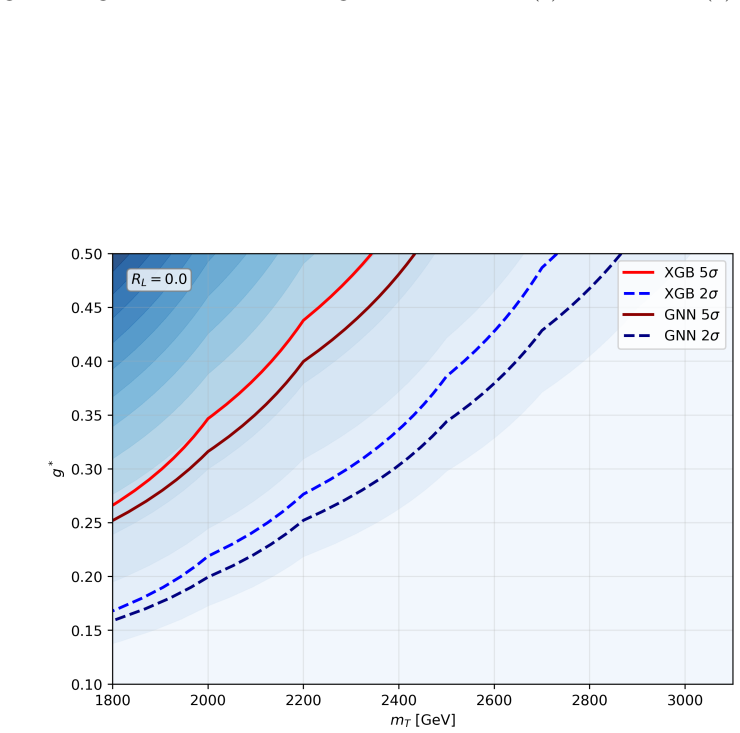
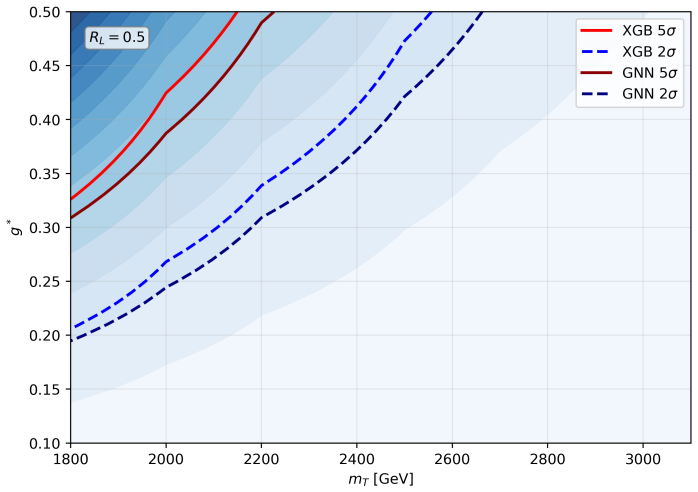
For R_L = 0 the analysis finds that 2σ exclusion is possible for g* in the interval [0.17, 0.49] with XGBoost and [0.16, 0.43] with the GNN across m_T from 1.8 to 2.7 TeV, while 5σ discovery reaches g* in [0.27, 0.44] and [0.26, 0.40] for m_T from 1.8 to 2.2 TeV; the corresponding intervals for R_L = 0.5 are shifted to slightly higher couplings but remain comparable in mass reach, with the GNN yielding marginally stronger and smoother limits in both cases.
What carries the argument
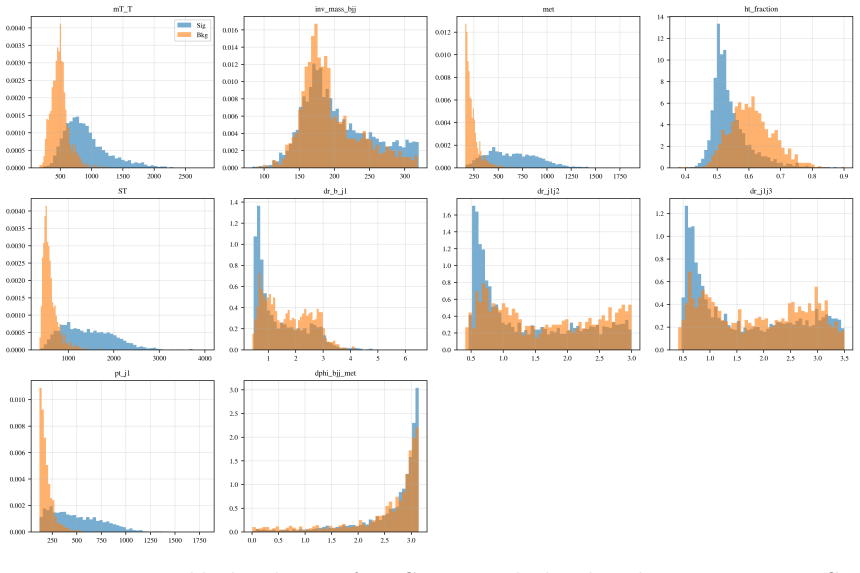
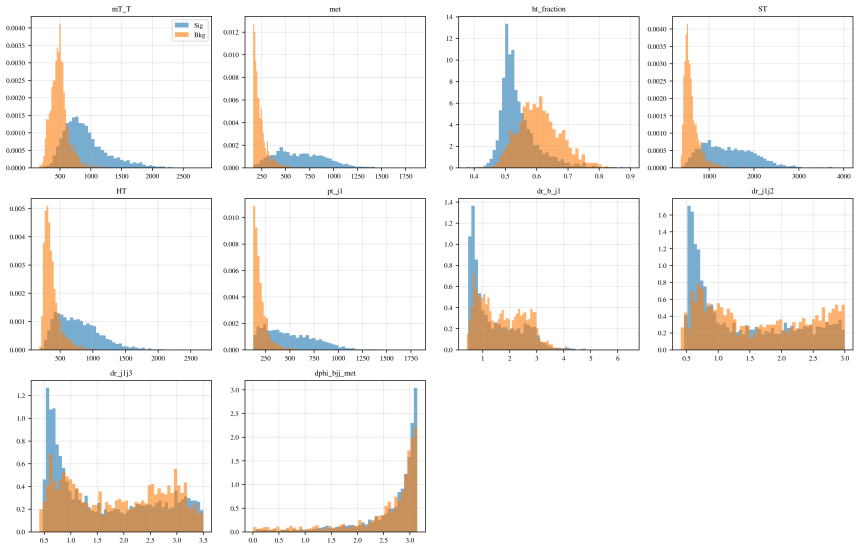
Extreme Gradient Boosting and Graph Neural Network classifiers trained on jet-level kinematic features after hadronic pre-selection (N_j ≥ 3, N_b ≥ 1, N_ℓ = 0) and optimized kinematic cuts in the tZ channel.
If this is right
- For R_L = 0, 2σ exclusion of g* down to 0.16–0.17 is possible up to m_T = 2.7 TeV.
- 5σ discovery is achievable for g* above 0.26–0.27 for m_T between 1.8 and 2.2 TeV.
- The GNN produces slightly stronger limits than XGBoost across the scanned parameter space.
- For R_L = 0.5 the 2σ exclusion window moves to g* ∈ [0.20, 0.48] up to m_T = 2.5 TeV.
- All reaches incorporate a 20% background systematic uncertainty via the Asimov significance formula.
Where Pith is reading between the lines
- Similar jet-level ML classifiers could be applied to other vector-like quark decay modes to improve overall search sensitivity.
- The modest advantage of the GNN over XGBoost suggests that graph representations of jet correlations may become standard for fully hadronic final states.
- Validation of the simulated background modeling against early HL-LHC data would be required before the projected reaches can be treated as reliable.
- Combining the hadronic tZ channel with leptonic or multi-lepton channels could further extend the mass and coupling coverage.
Load-bearing premise
Monte Carlo generators and detector simulation correctly reproduce the kinematic distributions and rates of the dominant backgrounds, and the trained classifiers will perform similarly on real collision data.
What would settle it
A statistically significant mismatch between predicted and observed yields in a signal-depleted control region or after applying the ML working point to actual HL-LHC collision data would invalidate the quoted exclusion and discovery reaches.
Figures
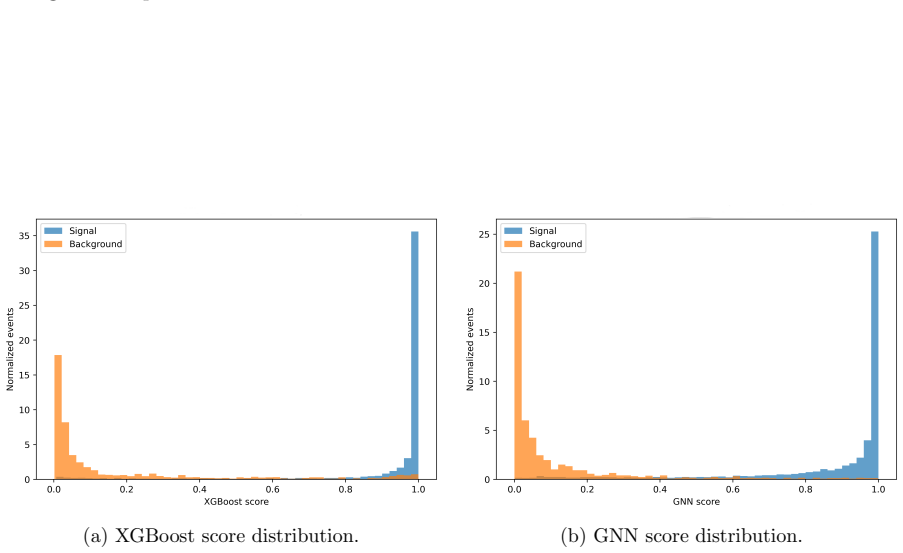
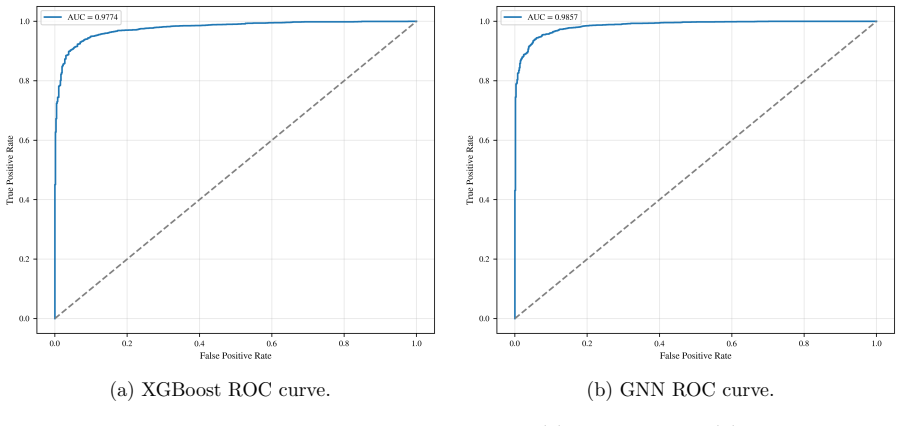
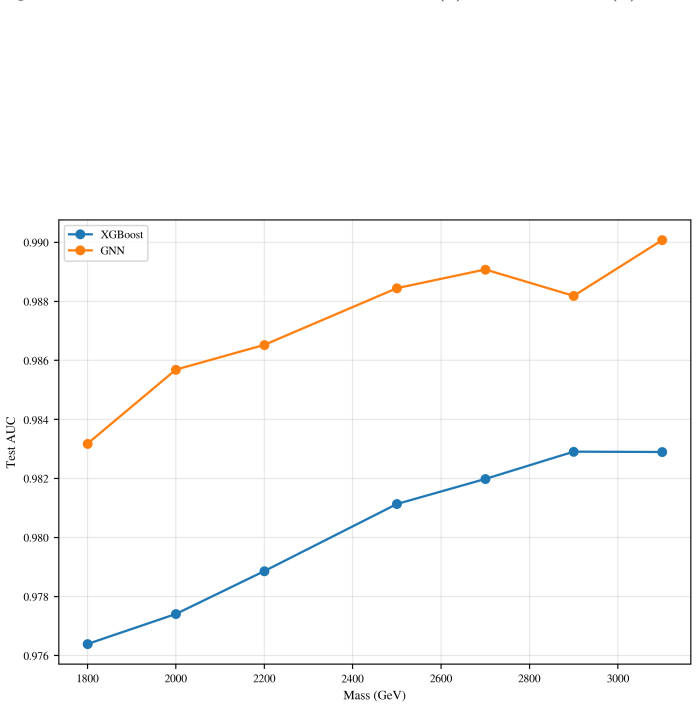
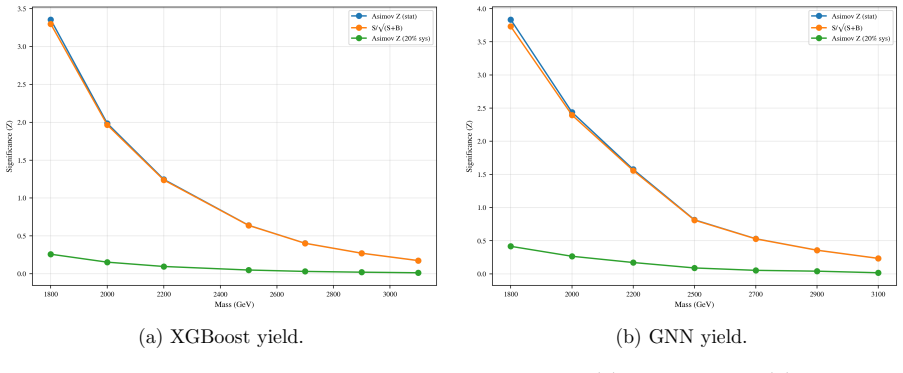
read the original abstract
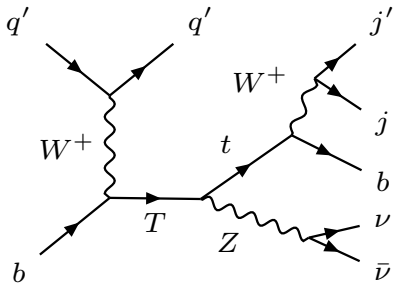
In this work, we study the single production of a vector-like singlet top partner \( T \) at the 14 TeV HL-LHC in the channel \( pp \to T j \) with \( T \to t Z \), \( t \to b W \to b j j \), and \( Z \to \nu \bar{\nu} \). Signal and background samples are generated with MadGraph5\_aMC@NLO v3.5.11, showered with Pythia 8, and passed through Delphes. The dominant backgrounds are \( t \bar{t} \), \( t Z j \), \( ZZ j j \), and \( W Z j j \) (including charge conjugates). A hadronic pre-selection (\( N_j \geq 3 \), \( N_b \geq 1 \), \( N_\ell = 0 \)) is imposed as trigger, followed by optimized kinematic cuts. We perform multivariate classification with Extreme Gradient Boosting (XGBoost) and a Graph Neural Network (GNN) based on jet-level features. Sensitivities at 3000 fb\(^{-1}\) are quoted using the Asimov significance, \( S / \sqrt{S + B} \), and an Asimov variant with a 20\% background systematic. The model parameters \( g^* \) and \( R_L \) are defined in Sec.~2, and a single global working point is used to avoid per-mass tuning bias. In the \( (g^*, m_T) \) scan, we present 2\(\sigma\) exclusion and 5\(\sigma\) discovery contours for \( R_L = 0 \) and \( R_L = 0.5 \). For \( R_L = 0 \), 2\(\sigma\) exclusion corresponds to \( g^* \in [0.17, 0.49] \) (\( 0.16, 0.43 \)) over \( m_T \in [1.8, 2.7] \) TeV, while 5\(\sigma\) discovery corresponds to \( g^* \in [0.27, 0.44] \) (\( 0.26, 0.40 \)) over \( m_T \in [1.8, 2.2] \) TeV for XGBoost and GNN respectively. For \( R_L = 0.5 \), the 2\(\sigma\) reach is \( g^* \in [0.21, 0.48] \) (\( 0.20, 0.43 \)) over \( m_T \in [1.8, 2.5] \) TeV, and the 5\(\sigma\) reach is \( g^* \in [0.33, 0.43] \) (\( 0.31, 0.49 \)) over \( m_T \in [1.8, 2.2] \) TeV, with the GNN yielding slightly stronger and smoother limits across the scan.
Editorial analysis
A structured set of objections, weighed in public.
Referee Report
Summary. The paper studies single production of a singlet vector-like top partner T in the pp → Tj, T → tZ (hadronic) channel at the 14 TeV HL-LHC with 3000 fb⁻¹. Samples are generated with MadGraph5_aMC@NLO + Pythia 8 + Delphes; after hadronic pre-selection (Nj ≥ 3, Nb ≥ 1, Nℓ = 0) and kinematic cuts, XGBoost and a jet-based GNN are used for classification against tt̄, tZj, ZZjj, and WZjj backgrounds. Sensitivities are reported via the Asimov significance S/√(S+B) (with and without 20% background systematic) as 2σ exclusion and 5σ discovery contours in the (g*, m_T) plane for RL = 0 and RL = 0.5, with explicit numerical ranges given for each classifier.
Significance. If the Monte Carlo modeling of the fully hadronic final state is reliable, the work supplies concrete, up-to-date HL-LHC projections that incorporate modern jet-level classifiers (including a GNN) and a single global working point to reduce tuning bias. The explicit tabulation of g* intervals for both exclusion and discovery is a useful benchmark for experimental planning. The central results, however, rest entirely on the unvalidated simulation chain.
major comments (2)
- [multivariate classification section] The manuscript supplies no information on training/validation splits, hyperparameter optimization, or cross-validation procedure for the XGBoost and GNN classifiers (multivariate classification section). Because the quoted 2σ and 5σ reaches are obtained directly from the classifier output distributions via the Asimov formula, these details are required to assess whether the reported performance is robust or overfit.
- [simulation and background modeling section] No control-region closure tests, generator-variation studies, or data-driven background estimates are described for the dominant backgrounds (tt̄, tZj, ZZjj, WZjj) in the presence of MET (simulation and background modeling section). All sensitivity contours in the (g*, m_T) plane are derived exclusively from these simulated samples; any mismodeling in jet energy scale, b-tagging, or MET tails would directly shift the Asimov significances.
minor comments (1)
- [Abstract] The abstract states that kinematic cuts are 'optimized' but neither the optimization criterion nor the numerical cut values are given; these should be listed explicitly in the main text.
Simulated Author's Rebuttal
We thank the referee for the careful review and constructive comments. We address each major comment below and indicate the revisions planned for the manuscript.
read point-by-point responses
-
Referee: [multivariate classification section] The manuscript supplies no information on training/validation splits, hyperparameter optimization, or cross-validation procedure for the XGBoost and GNN classifiers (multivariate classification section). Because the quoted 2σ and 5σ reaches are obtained directly from the classifier output distributions via the Asimov formula, these details are required to assess whether the reported performance is robust or overfit.
Authors: We agree that these methodological details are essential to evaluate robustness and potential overfitting. In the revised manuscript we will expand the multivariate classification section to specify the training/validation/test split (70/15/15), the hyperparameter optimization procedure (grid search combined with 5-fold cross-validation), and the cross-validation strategy used for both XGBoost and the GNN. These additions will allow readers to assess the reliability of the Asimov significances derived from the classifier outputs. revision: yes
-
Referee: [simulation and background modeling section] No control-region closure tests, generator-variation studies, or data-driven background estimates are described for the dominant backgrounds (tt̄, tZj, ZZjj, WZjj) in the presence of MET (simulation and background modeling section). All sensitivity contours in the (g*, m_T) plane are derived exclusively from these simulated samples; any mismodeling in jet energy scale, b-tagging, or MET tails would directly shift the Asimov significances.
Authors: This is a prospective HL-LHC projection study performed entirely with Monte Carlo samples, so data-driven background estimates and control-region closure tests with real data are not possible. In revision we will augment the simulation section with additional details on generator settings, a qualitative discussion of jet-energy-scale and b-tagging uncertainties, and an explicit statement of how the already-included 20% background systematic is intended to cover potential mismodeling. Generator-variation studies will be added where computationally feasible. revision: partial
- Data-driven background estimates and control-region closure tests cannot be performed in the absence of actual HL-LHC collision data.
Circularity Check
No significant circularity in sensitivity projections
full rationale
The paper generates signal and background samples using external MC generators (MadGraph5_aMC@NLO, Pythia 8, Delphes), applies fixed pre-selections and kinematic cuts, trains XGBoost/GNN classifiers on jet-level features, and computes Asimov significances directly from the simulated yields to obtain the (g*, m_T) contours. No parameters are fitted to the target reaches, no self-citations justify uniqueness or ansatze, and no step reduces by construction to its own inputs. The derivation is self-contained forward simulation; the load-bearing assumptions concern MC fidelity rather than internal circularity.
Axiom & Free-Parameter Ledger
axioms (1)
- domain assumption Monte Carlo event generators and Delphes detector simulation accurately model signal and background kinematics and rates in the hadronic final state.
invented entities (1)
-
Singlet vector-like top partner T
no independent evidence
Reference graph
Works this paper leans on
-
[1]
J.A. Aguilar-Saavedra, R. Benbrik, S. Heinemeyer, and M. Perez-Victoria. Handbook of vectorlike quarks: Mixing and single production.Phys. Rev. D, 88:094010, 2013. doi: 10.1103/PhysRevD.88.094010
-
[2]
J. Alwall, R. Frederix, S. Frixione, V. Hirschi, F. Maltoni, O. Mattelaer, H.-S. Shao, T. Stelzer, P. Torrielli, and M. Zaro. The automated computation of tree-level and next-to- leading order differential cross sections, and their matching to parton shower simulations. JHEP, 07:079, 2014. doi: 10.1007/JHEP07(2014)079
-
[3]
Apollinari, I
G. Apollinari, I. Bejar Alonso, O. Bruning, M. Lamont, and L. Rossi. High-luminosity large hadron collider (hl-lhc): Preliminary design report. Technical Report CERN-2015- 005, CERN, 2015
2015
-
[4]
Cohen, Emanuel Katz, and Ann E
Nima Arkani-Hamed, Andrew G. Cohen, Emanuel Katz, and Ann E. Nelson. The littlest higgs.JHEP, 07:034, 2002. doi: 10.1088/1126-6708/2002/07/034
-
[5]
A. Buckley, J. Ferrando, S. Lloyd, K. Nordstrom, B. Page, M. Rufenacht, M. Schonherr, and G. Watt. Lhapdf6: parton density access in the lhc precision era.Eur. Phys. J. C, 75: 132, 2015. doi: 10.1140/epjc/s10052-015-3318-8
-
[6]
G. Cacciapaglia, A. Deandrea, L. Panizzi, N. Gaur, D. Harada, and Y. Okada. Heavy vector-like top partners at the lhc and flavour constraints.JHEP, 03:070, 2012. doi: 10.1007/JHEP03(2012)070
-
[7]
G. Cacciapaglia, A. Deandrea, N. Gaur, D. Harada, Y. Okada, and L. Panizzi. The lhc potential of vector-like quark doublets.JHEP, 11:055, 2018. doi: 10.1007/JHEP11(2018) 055
-
[8]
G. Cacciapaglia, A. Deandrea, L. Panizzi, et al. A global view on vector-like quarks: K- factors and phenomenology.Phys. Lett. B, 793:206–211, 2019. doi: 10.1016/j.physletb. 2019.04.040. 15
-
[9]
XGBoost: A Scalable Tree Boosting System
T. Chen and C. Guestrin. Xgboost: A scalable tree boosting system.Proc. KDD, 2016. doi: 10.1145/2939672.2939785
-
[10]
ATLAS Collaboration. Search for single production of vector-like t quarks decaying into ht or zt inppcollisions at √s= 13 tev with the atlas detector.JHEP, 08:153, 2023. doi: 10.1007/JHEP08(2023)153
-
[11]
CMS Collaboration. Search for single production of a vector-like t quark decaying to a top quark and a z boson in the final state with jets and missing transverse momentum at√s= 13 tev.JHEP, 05:093, 2022. doi: 10.1007/JHEP05(2022)093
-
[12]
Search for production of a single vector-like quark decaying to th or tz in the all-hadronic final state inppcollisions at √s= 13 tev.Phys
CMS Collaboration. Search for production of a single vector-like quark decaying to th or tz in the all-hadronic final state inppcollisions at √s= 13 tev.Phys. Rev. D, 110:072012,
-
[13]
doi: 10.1103/PhysRevD.110.072012
-
[14]
Asymptotic formulae for likelihood-based tests of new physics
G. Cowan, K. Cranmer, E. Gross, and O. Vitells. Asymptotic formulae for likelihood-based tests of new physics.Eur. Phys. J. C, 71:1554, 2011. doi: 10.1140/epjc/s10052-011-1554-0
work page internal anchor Pith review doi:10.1140/epjc/s10052-011-1554-0 2011
-
[15]
M. Czakon, P. Fiedler, and A. Mitov. Total top-quark pair-production cross section at hadron colliders througho( alpha4 s).Phys. Rev. Lett., 110:252004, 2013. doi: 10.1103/PhysRevLett.110.252004
-
[16]
J. de Favereau, C. Delaere, P. Demin, A. Giammanco, V. Lemaitre, A. Mertens, and M. Selvaggi. Delphes 3: A modular framework for fast simulation of a generic collider experiment.JHEP, 02:057, 2014. doi: 10.1007/JHEP02(2014)057
work page internal anchor Pith review doi:10.1007/jhep02(2014)057 2014
-
[17]
Search for the singlet vector-like top quark int→tzchannel withz→ν¯νat the 14 tev lhc.Nucl
Haitao Li, Jinjin Chao, and Guoqing Zhang. Search for the singlet vector-like top quark int→tzchannel withz→ν¯νat the 14 tev lhc.Nucl. Phys. B, 994:116310, 2023. doi: 10.1016/j.nuclphysb.2023.116310
-
[18]
Giuliano Panico and Andrea Wulzer.The Composite Nambu-Goldstone Higgs, volume 913 ofLecture Notes in Physics. Springer, 2016. doi: 10.1007/978-3-319-22617-0
-
[19]
A large mass hierarchy from a small extra dimension
Lisa Randall and Raman Sundrum. A large mass hierarchy from a small extra dimension. Phys. Rev. Lett., 83:3370–3373, 1999. doi: 10.1103/PhysRevLett.83.3370
work page internal anchor Pith review doi:10.1103/physrevlett.83.3370 1999
-
[20]
J. Shlomi, P. Battaglia, and J.-R. Vlimant. Graph neural networks in particle physics. Mach. Learn. Sci. Technol., 2:021001, 2021. doi: 10.1088/2632-2153/abbf9a
-
[21]
T. Sjostrand, S. Ask, J.R. Christiansen, R. Corke, N. Desai, P. Ilten, S. Mrenna, S. Prestel, C.O. Rasmussen, and P.Z. Skands. An introduction to pythia 8.2.Comput. Phys. Commun., 191:159–177, 2015. doi: 10.1016/j.cpc.2015.01.024. 16
discussion (0)
Sign in with ORCID, Apple, or X to comment. Anyone can read and Pith papers without signing in.