REVIEW 2 major objections 5 minor 1 cited by
Multiphase gas in Circumgalactic cloud complexes: Insights from kiloparsec-scale Magnetohydrodynamic Turbulence Simulations
T0 review · 2 major / 5 minor · reviewed 2026-08-04 · deepseek-v4-flash
Pith's one-line read Cold gas survives in the circumgalactic medium only where cooling beats turbulent mixing.
desk verdict Important sub-sampling warning and clean high-res MHD results, but the central t_cool/t_mix scaling is shakier than the abstract claims — Table 1 shows the parameter is not actually held fixed across the Tmix series. read the letter →
The pith
A machine-rendered reading of the paper's core claim, the machinery that carries it, and where it could break.
The reading
What carries the argument
The operating object is the dimensionless ratio t_cool/t_mix, where t_cool is the isobaric cooling time and t_mix = l_int / v_l is the turbulent mixing time at the integral scale; for multiphase gas, t_mix carries a √χ factor for the hot/cold density contrast. The paper varies box size (0.125–8 kpc) under two scalings — constant energy injection rate (so t_mix ∝ l^{2/3}, mimicking a turbulent cascade) and constant t_mix — to isolate this ratio's role. The identity that carries the argument is scale-invariance: runs with matched t_cool/t_mix reproduce each other's cold gas mass fraction and lifetime, making the ratio a transferable control parameter between local patch simulations and cosmolo
What would settle it
If observations find cold gas below 10^4 K persisting for ≳100 Myr in low-density, highly turbulent CGM gas with t_cool/t_mix ≳ 10 (n ≈ 3×10^-4 cm^-3), or if a simulation run without the global compensating heating term fails to reproduce the 20–50% cold fractions at matched t_cool/t_mix, the central claim would be falsified.
Extended reading notes
Core claim
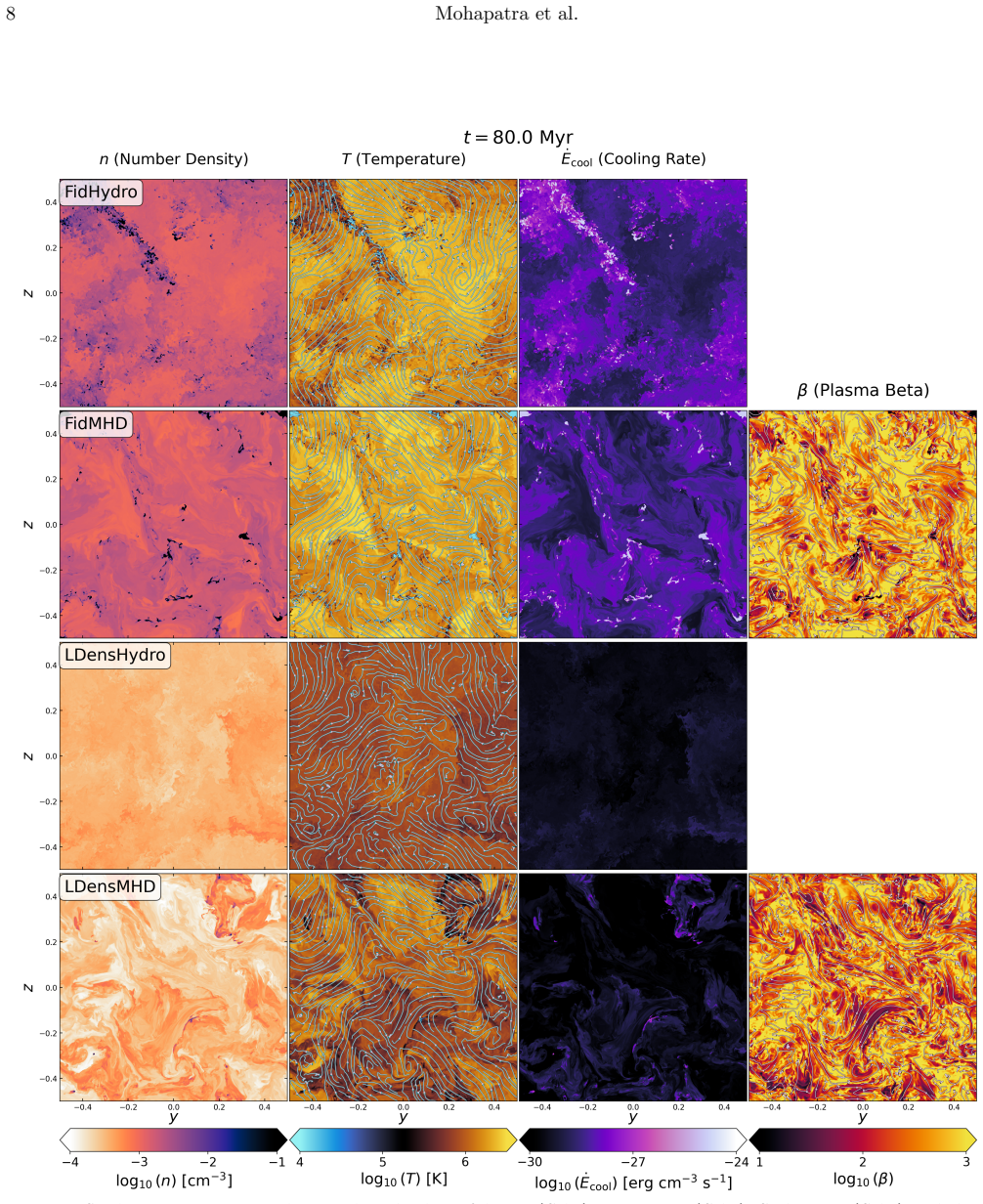
The central claim is that t_cool/t_mix — the ratio of isobaric cooling time to turbulent mixing time at the integral scale — is the control parameter for multiphase gas in the circumgalactic medium, not the box size or turbulent heating rate. Simulations with matched t_cool/t_mix show comparable cold gas mass fractions and lifetimes even when the box size differs by a factor of 64, whereas holding the energy injection rate fixed shortens t_mix in smaller boxes and erases the cold phase. Low-density gas (3×10^-4 cm^-3) has t_cool/t_mix ≥ 1 at all temperatures and cannot sustain gas below 10^4 K, while denser gas (3×10^-3 cm^-3) reaches a multiphase steady state with 20–50% of mass cold occupy
Load-bearing premise
The simulations maintain global thermal balance with an artificial heating term (eq. 2b) that returns all net cooling and turbulent work as heat; the simulated cold-gas fractions, including the up-to-50% steady state, depend on that heating being as responsive as assumed.
Editorial extensions
If this is right
- Cold gas at ≲10 kpc scales in the CGM is expected to live in relatively dense, quiescent cloud complexes; large-scale turbulent cascade tends to destroy it.
- Low-density CGM gas (n ≈ 3×10^-4 cm^-3) is largely single-phase: any cold gas that forms evaporates within a few mixing times.
- Cosmological and meso-scale simulations cannot be compared by simple volume sub-sampling; they should be compared at matched t_cool/t_mix.
- Dense CGM environments can sustain a steady multiphase state with ~20–50% cold mass fraction (hydro vs MHD), ~1% volume fraction, and area covering fractions near 80%.
- Magnetic fields suppress mixing and fragmentation, extending cold gas lifetime and producing filamentary cold structures.
Reading between the lines
- If t_cool/t_mix is a universal control parameter, cold-gas survival could be estimated directly from observed density, temperature, and velocity dispersion, without running simulations.
- The quantitative cold-gas fractions (20–50%) likely depend on the paper's responsive compensating heating term; a less responsive heating prescription could shift the budget even if the t_cool/t_mix scaling holds.
- The flat density power spectra imply multiphase gas adds density fluctuations down to AU scales, predicting enhanced FRB scattering that current FRB observations can test.
- The ICM-like runs suggest matching t_cool/t_mix at the integral scale already absorbs the density-contrast correction via smaller cloud sizes; a testable extension is that cold gas mass fraction is roughly independent of χ at matched t_cool/t_mix.
Editorial analysis
A structured set of objections, weighed in public.
Referee Report
Summary. The paper presents a suite of 0.125–8 kpc magnetohydrodynamic and hydrodynamic turbulence simulations of CGM-like gas, with parameters motivated by quasar absorption-line observations. The simulations resolve the minimum cooling length by at least 30 cells for gas above ~10^4 K. The central claim is that the ratio t_cool/t_mix, rather than box size or turbulent heating rate, controls cold gas survival: low-density runs (n=3e-4 cm^-3) cannot sustain cold gas below 10^4 K, while higher-density Fiducial runs (n=3e-3 cm^-3) reach a multiphase steady state with cold mass fractions up to ~50% in MHD and ~20% in hydro. By varying box size under two scalings—fixed energy injection rate (Dedt) and fixed mixing time (Tmix)—the authors argue that matched t_cool/t_mix yields comparable cold fractions across scales, implying that small-scale cold gas arises in dense, quiescent CGM regions rather than in uniformly turbulent cascades. The paper also examines magnetic field geometry, compressive vs. solenoidal forcing, volume- vs. mass-weighted heating, and ICM-like density contrasts.
Significance. If the central scaling claim holds, the paper provides a useful organizing principle for connecting pc-scale cloud simulations, kpc-scale turbulent box simulations, and cosmological CGM simulations. The simulations are well-resolved in the sense that c_s t_cool is resolved by at least 30 cells, and the use of an open-source GPU-capable code (AthenaK) is a strength. The comparisons to observed non-thermal line broadening and the predicted flat density power spectra in multiphase gas are interesting and potentially relevant for FRB scattering and absorption-line diagnostics. However, the central claim that t_cool/t_mix is a robust control parameter is currently under-supported by the presented data, because the reported t_cool/t_mix values are initial inputs rather than measured simulation quantities, and because the matched runs in Table 1 do not actually show comparable cold fractions in the MHD case. The compensatory heating prescription also directly shapes the quoted steady-state cold fractions and needs more scrutiny. The paper's significance would be substantially strengthened by reporting measured mixing times and by quantifying the sensitivity of the cold fraction to the hea
major comments (2)
- [§4, Table 1, Fig. 8] The key scaling claim—simulations with similar t_cool/t_mix exhibit comparable cold gas mass fractions—is not convincingly supported by Table 1. Column 5 lists t_cool/t_mix as an 'initial ratio' (see table note), not a measured steady-state quantity. The actual velocity dispersion deviates from the assumed target; for example, 0.125TmixHydroLR has σ_v=1.4 km/s while the stated target in §2.5.2 for a 0.125 kpc box with Tmix scaling would be ~2.5 km/s. More importantly, the MHD matched runs fail: FidMHDLR has t_cool/t_mix=2.7 and M_cold/Mtot=0.42, while 8TmixMHDLR has t_cool/t_mix=2.9 and M_cold/Mtot=0.18. These are similar control parameters but cold fractions differ by more than a factor of two. The 0.125Tmix runs also have t_cool/t_mix=1.9–2.2 and cold fractions 0.30–0.40, spanning a factor ~1.6 in the control parameter. Since each configuration is a single realization without ensemble
- [§2.2, Eq. (2b); §5.2, Fig. 13] The compensatory heating term Q(t) is an artificial thermostat that offsets all net cooling and turbulent work to maintain global thermal balance. With the default mass-weighted heating (α_heat=1), Q is preferentially deposited in denser gas, and as cold gas condenses the net cooling rate rises, which increases Q and pumps heat back into the hot phase. This feedback loop directly regulates the steady-state cold gas mass fraction. The paper's headline result of up to 50% cold mass in the Fiducial MHD run therefore rests on this prescription. The sensitivity run with volume-weighted heating (QvwHydroLR, α_heat=0) already shows a material difference: M_cold/Mtot=0.33 versus 0.20 for FidHydroLR (Table 1 and Fig. 13). The authors should quantify how much of the steady-state cold fraction is controlled by the thermostat rather than by the t_cool/t_mix balance, justify the α_heat=1 choice physi
minor comments (5)
- [§2.3] The text says 'second-order Runge–Kutta (RK3)' but RK3 is third-order. Please correct the order or the acronym.
- [Fig. 5 caption] The caption mentions 'green solid lines in the upper panels' representing initial density perturbations, but the figure as rendered appears to show only colored time-series lines. Please check the color/legend and update the caption or figure.
- [Table 1] The column header says t_cool/t_mix, but the note says this is the initial ratio. To avoid confusion, either rename the column to 'initial t_cool/t_mix' or provide a second column with measured steady-state values.
- [§2.5.2] The description of the two box-size scalings is clear, but Eq. (5a) fixes t_mix as an input while the realized t_mix depends on the actual velocity dispersion. Please clarify in the text that the Tmix labels denote target conditions, and that the realized values must be measured.
- [References] The two Afruni et al. 2023a,b entries appear to have identical author lists and page numbers (A680, A112). If they are the same paper, merge them; if different, correct the bibliographic details.
Circularity Check
The Tmix 'confirmation' of the t_cool/t_mix scaling is partly a consistency check with the runs' construction (eq. 5a fixes t_mix, hence t_cool/t_mix at fixed density), and the matched MHD runs actually disagree (FidMHDLR t_cool/t_mix=2.7 -> Mcold=0.42 vs 8TmixMHDLR 2.9 -> 0.18); independent LDens/Fiducial and ICM content keeps the central claim from being fully circular.
-
self definitional
[Abstract; §2.5.2 (eq. 5a); §4; §7; Table 1 note]
"we explore different box sizes (0.125â8 kpc) and identify a key scaling relation: simulations with similar t_cool/t_mix exhibit comparable cold gas mass fractions and lifetimes. ... In the second approach, we fix the mixing time t_mix across all box sizes ... t_mix = t_mix,fid (5a) ... Since the density is unchanged, t_cool remains constant. ... Tmix simulations with matched turbulent mixing times (t_mix) yield consistent cold gas fractions across scales, confirming t_cool/t_mix as a robust control parameter for the multiphase CGM."
The runs offered as the key test of the scaling relation are constructed to embody it: eq. 5a fixes t_mix across box sizes, and with density unchanged t_cool is constant, so the input t_cool/t_mix is equal by construction. The comparable cold fractions in Fig. 8/Table 1 are therefore a consistency check of the design, presented in §7 as 'confirming t_cool/t_mix as a robust control parameter.' Table 1 column 5 records only the input ('initial ratio of cooling to mixing time at the driving scale'), not a measured steady-state ratio, and realized velocities deviate from the eq. 5b targets (0.125TmixHydroLR sigma_v=1.4 vs 2.5 km/s), so the 'key scaling relation' partly restates design intent. Where independently checkable the relation fails: FidMHDLR (t_cool/t_mix=2.7) has Mcold=0.42 while 8Tm
full rationale
The central claim that t_cool/t_mix controls cold-gas survival has genuine independent content. The LDens-vs-Fiducial contrast is a clean emergent test: input t_cool/t_mix of 27â35 (LDens) versus 2.5â3.2 (Fiducial) yields cold fractions of ~0 versus 0.20â0.50, and this is a measured, externally meaningful difference. The ICM suite varies the density contrast chi with t_cool/t_mix matched and produces genuinely different outcomes (cold gas survives when t_cool/t_mix is matched; it evaporates when t_cool/t_multimix is matched), which could have falsified the framework. The Dedt runs likewise make a falsifiable prediction (small stirred boxes cannot retain cold gas) that the simulations realize. The partially circular element is the Tmix 'confirmation': those runs equalize t_cool/t_mix as an input (eq. 5a), so the similar cold fractions constitute a consistency check, and the summary's wording ('confirming t_cool/t_mix as a robust control parameter') converts the design criterion into a result. This is compounded by Table 1 labeling column 5 as an initial (input) ratio rather than a realized steady-state quantity, and by the MHD matched pair contradicting the scaling (2.7 -> 0.42 versus 2.9 -> 0.18). The box-size conclusion also leans on the adopted Kolmogorov input scaling (eq. 4b: t_mix ~ l_box^(2/3)), so the 'cold gas lives in quiescent regions' inference is in part a propagation of that assumption. Self-citations (Banerjee & Sharma 2014; Mohapatra et al. 2023) motivate the control parameter, but they are not the only support: Gronke et al. (2022) is independent, and the paper's own LDens/Fiducial and ICM runs provide internal evidence. The global thermostat (eq. 2b) shapes the quantitative 20â50% fractions, but this is an openly stated modeling choice that the paper itself probes with an alpha_heat=0 run (QvwHydroLR, §5.2), so it is a caveat, not circularity. Overall: one self-reinforcing consistency check presented as confirmation, with the central claim retaining independent content; score 4.
Assumptions & free parameters
free parameters (6)
- Turbulent driving velocity calibration v_driv ≈ 20 km/s (Fiducial) =
~20 km/s (motivated by Chen et al. 2023 non-thermal broadening)
- Metallicity Z = 0.3 Z_sun =
0.3 Zsun
- Initial density perturbation amplitude σ_rho/⟨ρ⟩ ≈ 0.6 (k=1–3) =
~0.6
- Mass-weighted heating fraction α_heat = 1 (default) =
1 (vs 0 in one run)
- Temperature floor 10^3.2 K =
10^3.2 K
- Initial magnetic field plasma beta β=100 with k^-1/3 spectrum =
β=100
assumptions (5)
- ad hoc to paper Compensatory heating term Q maintains global thermal balance (eq. 2b), offsetting all net cooling and turbulent work.
- domain assumption t_cool/t_mix at the integral scale is the control parameter for cold-gas survival.
- domain assumption A periodic box with stochastic spectral forcing represents a CGM patch; no gradients, gravity, or galactic potential.
- domain assumption Photoionization equilibrium and fixed 0.3 Z_sun throughout the box.
- domain assumption Kolmogorov scaling (u ∝ ℓ^{1/3}, t_mix ∝ ℓ^{2/3}) applies to MHD turbulence when designing the Dedt scaling.
Cite this review
Pith. "Pith review of Multiphase gas in Circumgalactic cloud complexes: Insights from kiloparsec-scale Magnetohydrodynamic Turbulence Simulations." pith.science (2026). https://pith.science/paper/JE4PJZGT
@misc{pith2026251100229,
  author       = {Pith},
  title        = {Pith review of: Multiphase gas in Circumgalactic cloud complexes: Insights from kiloparsec-scale Magnetohydrodynamic Turbulence Simulations},
  year         = {2026},
  howpublished = {\url{https://pith.science/paper/JE4PJZGT}},
  note         = {Machine review of arXiv:2511.00229}
}
abstract
The circumgalactic medium (CGM) is the diffuse gas surrounding a galaxy's halo, and it plays a vital role in the galactic baryon cycle. However, its mass distribution across the virial phase and the cooler, denser atomic phase, remains uncertain. To investigate this, we perform high-resolution magnetohydrodynamic simulations of 0.125--8 kpc-scale representative patches of the CGM, with parameters informed by quasar absorption line observations. Our simulations resolve the cooling length (the minimum across all temperatures of $c_s t_{\rm cool}$, where $c_s$ is the sound speed and $t_{\rm cool}$ is the cooling time in isobaric conditions), allowing us to track the evolution of cold gas more accurately. We find that low-density CGM gas ($3\times10^{-4}$ cm$^{-3}$) cannot sustain cold gas below $10^4$ K for long, due to a large value of the ratio between the cooling to mixing time ($t_{\rm cool}/t_{\rm mix}$). In contrast, higher-density environments ($3\times10^{-3}~{\rm cm}^{-3}$) reach a turbulent multiphase steady state, with up to $50\%$ of the mass in the cold phase, occupying only about $1\%$ of the volume. To connect with large-volume cosmological simulations and small ${\rm pc}$-scale idealized simulations, we explore different box sizes (0.125--8 kpc) and identify a key scaling relation: simulations with similar $t_{\rm cool}/t_{\rm mix}$ exhibit comparable cold gas mass fractions and lifetimes. Importantly, we find that simply sub-sampling (reducing box-size) a small region from a large-volume simulation while maintaining a constant turbulent energy density injection rate from larger to smaller scales artificially shortens $t_\mathrm{mix}$, leading to inaccurate predictions for cold gas survival. This means that cold gas at small $\lesssim 10$ kpc scales arises in relatively dense, quiescent regions of the CGM rather than the turbulent ones undergoing cascade from large scales.
Figures


Figures from the paper (9 more)


Forward citations
Cited by 1 Pith paper
-
CRexit observed: probing cosmic ray transport in the circumgalactic medium with absorption line spectra
Efficient cosmic-ray transport in CR-pressure-dominated CGM simulations produces stronger cool-gas absorption (MgII, SiII) and covering fractions matching star-forming galaxies, while slow transport underproduces them.
Reference graph
Works this paper leans on
-
[1]
Abruzzo M. W., Fielding D. B., Bryan G. L., 2024, @doi [ ] 10.3847/1538-4357/ad1e51 , https://ui.adsabs.harvard.edu/abs/2024ApJ...966..181A 966, 181
-
[3]
Afruni A., et al., 2023b, @doi [ ] 10.1051/0004-6361/202347867 , https://ui.adsabs.harvard.edu/abs/2023A&A...680A.112A 680, A112
-
[4]
Armillotta L., Fraternali F., Marinacci F., 2016, @doi [ ] 10.1093/mnras/stw1930 , https://ui.adsabs.harvard.edu/\#abs/2016MNRAS.462.4157A 462, 4157
-
[5]
Astropy Collaboration et al., 2018, @doi [ ] 10.3847/1538-3881/aabc4f , https://ui.adsabs.harvard.edu/abs/2018AJ....156..123A 156, 123
-
[6]
Banerjee N., Sharma P., 2014, @doi [ ] 10.1093/mnras/stu1179 , https://ui.adsabs.harvard.edu/\#abs/2014MNRAS.443..687B 443, 687
-
[7]
Beattie J. R., Federrath C., Kriel N., Mocz P., Seta A., 2023, @doi [ ] 10.1093/mnras/stad1863 , https://ui.adsabs.harvard.edu/abs/2023MNRAS.524.3201B 524, 3201
-
[8]
Magnetized compressible turbulence with a fluctuation dynamo and Reynolds numbers over a million
Beattie J. R., Federrath C., Klessen R. S., Cielo S., Bhattacharjee A., 2024, @doi [arXiv e-prints] 10.48550/arXiv.2405.16626 , https://ui.adsabs.harvard.edu/abs/2024arXiv240516626B p. arXiv:2405.16626
work page Pith review arXiv doi:10.48550/arxiv.2405.16626 2024
-
[9]
Berlok T., Pfrommer C., 2019, @doi [ ] 10.1093/mnras/stz2347 , https://ui.adsabs.harvard.edu/abs/2019MNRAS.489.3368B 489, 3368
Show all 101 references
-
[10]
S., Sharma P., Dutta A., Nath B
Bisht M. S., Sharma P., Dutta A., Nath B. B., 2025, @doi [ ] 10.1093/mnras/staf1319 , https://ui.adsabs.harvard.edu/abs/2025MNRAS.tmp.1273B
2025 doi
-
[11]
B \"o ckmann K., et al., 2023, @doi [ ] 10.1051/0004-6361/202346777 , https://ui.adsabs.harvard.edu/abs/2023A&A...678A..56B 678, A56
2023 doi
-
[12]
Borthakur S., et al., 2015, @doi [ ] 10.1088/0004-637X/813/1/46 , https://ui.adsabs.harvard.edu/abs/2015ApJ...813...46B 813, 46
2015 doi
-
[13]
Brandenburg A., Ntormousi E., 2023, @doi [ ] 10.1146/annurev-astro-071221-052807 , https://ui.adsabs.harvard.edu/abs/2023ARA&A..61..561B 61, 561
2023 doi
-
[14]
Br \"u ggen M., Scannapieco E., Grete P., 2023, @doi [ ] 10.3847/1538-4357/acd63e , https://ui.adsabs.harvard.edu/abs/2023ApJ...951..113B 951, 113
2023 doi
-
[15]
J., Scannapieco E., 2018, @doi [ ] 10.3847/1538-4357/aad8bd , https://ui.adsabs.harvard.edu/abs/2018ApJ...864..114B 864, 114
Buie II E., Gray W. J., Scannapieco E., 2018, @doi [ ] 10.3847/1538-4357/aad8bd , https://ui.adsabs.harvard.edu/abs/2018ApJ...864..114B 864, 114
2018 doi
-
[16]
J., Scannapieco E., Safarzadeh M., 2020, @doi [ ] 10.3847/1538-4357/ab9535 , https://ui.adsabs.harvard.edu/abs/2020ApJ...896..136B 896, 136
Buie Edward I., Gray W. J., Scannapieco E., Safarzadeh M., 2020, @doi [ ] 10.3847/1538-4357/ab9535 , https://ui.adsabs.harvard.edu/abs/2020ApJ...896..136B 896, 136
2020 doi
-
[17]
S., Fielding D
Butsky I. S., Fielding D. B., Hayward C. C., Hummels C. B., Quinn T. R., Werk J. K., 2020, @doi [ ] 10.3847/1538-4357/abbad2 , https://ui.adsabs.harvard.edu/abs/2020ApJ...903...77B 903, 77
2020 doi
-
[18]
Chen H.-W., et al., 2020, @doi [ ] 10.1093/mnras/staa1773 , https://ui.adsabs.harvard.edu/abs/2020MNRAS.497..498C 497, 498
2020 doi
-
[19]
Chen H.-W., et al., 2023, @doi [ ] 10.3847/2041-8213/acf85b , https://ui.adsabs.harvard.edu/abs/2023ApJ...955L..25C 955, L25
2023 doi
-
[20]
C., et al., 2024, @doi [ ] 10.3847/1538-4357/ad1406 , https://ui.adsabs.harvard.edu/abs/2024ApJ...962...98C 962, 98
Chen M. C., et al., 2024, @doi [ ] 10.3847/1538-4357/ad1406 , https://ui.adsabs.harvard.edu/abs/2024ApJ...962...98C 962, 98
2024 doi
-
[21]
C., et al., 2025, @doi [ ] 10.3847/2041-8213/ad9bac , https://ui.adsabs.harvard.edu/abs/2025ApJ...978L..18C 978, L18
Chen M. C., et al., 2025, @doi [ ] 10.3847/2041-8213/ad9bac , https://ui.adsabs.harvard.edu/abs/2025ApJ...978L..18C 978, L18
2025 doi
-
[22]
O'Reilly
Collette A., 2013, Python and HDF5. O'Reilly
2013
-
[23]
J., et al., 2021, @doi [ ] 10.1093/mnras/stab2869 , https://ui.adsabs.harvard.edu/abs/2021MNRAS.508.4359C 508, 4359
Cooper T. J., et al., 2021, @doi [ ] 10.1093/mnras/stab2869 , https://ui.adsabs.harvard.edu/abs/2021MNRAS.508.4359C 508, 4359
2021 doi
-
[24]
K., Gronke M., 2024, @doi [ ] 10.1093/mnras/stad3125 , https://ui.adsabs.harvard.edu/abs/2024MNRAS.527..991D 527, 991
Das H. K., Gronke M., 2024, @doi [ ] 10.1093/mnras/stad3125 , https://ui.adsabs.harvard.edu/abs/2024MNRAS.527..991D 527, 991
2024 doi
-
[25]
Das S., Mathur S., Gupta A., Krongold Y., 2021, @doi [ ] 10.3847/1538-4357/ac0e8e , https://ui.adsabs.harvard.edu/abs/2021ApJ...918...83D 918, 83
2021 doi
-
[26]
Das S., Chiang Y.-K., Mathur S., 2023, @doi [ ] 10.3847/1538-4357/acd764 , https://ui.adsabs.harvard.edu/abs/2023ApJ...951..125D 951, 125
2023 doi
-
[27]
S., Sharma P., Ghosh R., Roy M., Nath B
Dutta A., Bisht M. S., Sharma P., Ghosh R., Roy M., Nath B. B., 2024, @doi [ ] 10.1093/mnras/stae977 , https://ui.adsabs.harvard.edu/abs/2024MNRAS.531.5117D 531, 5117
2024 doi
-
[28]
arXiv:2506.08545
Dutta A., Sharma P., Gronke M., 2025, @doi [arXiv e-prints] 10.48550/arXiv.2506.08545 , https://ui.adsabs.harvard.edu/abs/2025arXiv250608545D p. arXiv:2506.08545
2025 doi
-
[29]
B., 1988, Computers and Fluids, https://ui.adsabs.harvard.edu/\#abs/1988CF.....16..257E 16, 257
Eswaran V., Pope S. B., 1988, Computers and Fluids, https://ui.adsabs.harvard.edu/\#abs/1988CF.....16..257E 16, 257
1988
-
[30]
F., 2017, @doi [ ] 10.3847/1538-4357/835/1/52 , https://ui.adsabs.harvard.edu/abs/2017ApJ...835...52F 835, 52
Faerman Y., Sternberg A., McKee C. F., 2017, @doi [ ] 10.3847/1538-4357/835/1/52 , https://ui.adsabs.harvard.edu/abs/2017ApJ...835...52F 835, 52
2017 doi
-
[31]
F., 2020, @doi [ ] 10.3847/1538-4357/ab7ffc , https://ui.adsabs.harvard.edu/abs/2020ApJ...893...82F 893, 82
Faerman Y., Sternberg A., McKee C. F., 2020, @doi [ ] 10.3847/1538-4357/ab7ffc , https://ui.adsabs.harvard.edu/abs/2020ApJ...893...82F 893, 82
2020 doi
-
[32]
P., 2023, @doi [ ] 10.1146/annurev-astro-052920-125203 , https://ui.adsabs.harvard.edu/abs/2023ARA&A..61..131F 61, 131
Faucher-Gigu \`e re C.-A., Oh S. P., 2023, @doi [ ] 10.1146/annurev-astro-052920-125203 , https://ui.adsabs.harvard.edu/abs/2023ARA&A..61..131F 61, 131
2023 doi
-
[33]
S., Schmidt W., Mac Low M
Federrath C., Roman-Duval J., Klessen R. S., Schmidt W., Mac Low M. M., 2010, @doi [ ] 10.1051/0004-6361/200912437 , https://ui.adsabs.harvard.edu/\#abs/2010A&A...512A..81F 512, A81
2010 doi
-
[34]
B., Ostriker E
Fielding D. B., Ostriker E. C., Bryan G. L., Jermyn A. S., 2020, @doi [ ] 10.3847/2041-8213/ab8d2c , https://ui.adsabs.harvard.edu/abs/2020ApJ...894L..24F 894, L24
2020 doi
-
[35]
B., Ripperda B., Philippov A
Fielding D. B., Ripperda B., Philippov A. A., 2023, @doi [ ] 10.3847/2041-8213/accf1f , https://ui.adsabs.harvard.edu/abs/2023ApJ...949L...5F 949, L5
2023 doi
-
[36]
Ganguly S., et al., 2023, Frontiers in Astronomy and Space Sciences, 10
2023
-
[37]
S., Liu A., Walker S
Gatuzz E., Mohapatra R., Federrath C., Sanders J. S., Liu A., Walker S. A., Pinto C., 2023, @doi [ ] 10.1093/mnras/stad2039 , https://ui.adsabs.harvard.edu/abs/2023MNRAS.524.2945G 524, 2945
2023 doi
- [38]
-
[39]
W., Beckwith K., 2021, @doi [ ] 10.3847/1538-4357/abdd22 , https://ui.adsabs.harvard.edu/abs/2021ApJ...909..148G 909, 148
Grete P., O'Shea B. W., Beckwith K., 2021, @doi [ ] 10.3847/1538-4357/abdd22 , https://ui.adsabs.harvard.edu/abs/2021ApJ...909..148G 909, 148
2021 doi
-
[40]
W., Glines F
Grete P., O'Shea B. W., Glines F. W., Prasad D., Wibking B. D., Fournier M., Br \"u ggen M., Voit G. M., 2025, @doi [ ] 10.3847/1538-4357/adde45 , https://ui.adsabs.harvard.edu/abs/2025ApJ...988..155G 988, 155
2025 doi
-
[41]
P., 2018, @doi [ ] 10.1093/mnrasl/sly131 , https://ui.adsabs.harvard.edu/\#abs/2018MNRAS.480L.111G 480, L111
Gronke M., Oh S. P., 2018, @doi [ ] 10.1093/mnrasl/sly131 , https://ui.adsabs.harvard.edu/\#abs/2018MNRAS.480L.111G 480, L111
2018 doi
-
[42]
P., Ji S., Norman C., 2022, @doi [ ] 10.1093/mnras/stab3351 , https://ui.adsabs.harvard.edu/abs/2022MNRAS.511..859G 511, 859
Gronke M., Oh S. P., Ji S., Norman C., 2022, @doi [ ] 10.1093/mnras/stab3351 , https://ui.adsabs.harvard.edu/abs/2022MNRAS.511..859G 511, 859
2022 doi
-
[43]
Ha T., Li Y., Xu S., Kounkel M., Li H., 2021, @doi [ ] 10.3847/2041-8213/abd8c9 , https://ui.adsabs.harvard.edu/abs/2021ApJ...907L..40H 907, L40
2021 doi
-
[44]
Ha T., Li Y., Kounkel M., Xu S., Li H., Zheng Y., 2022, @doi [ ] 10.3847/1538-4357/ac76bf , https://ui.adsabs.harvard.edu/abs/2022ApJ...934....7H 934, 7
2022 doi
-
[45]
Haardt F., Madau P., 2012, @doi [ ] 10.1088/0004-637X/746/2/125 , https://ui.adsabs.harvard.edu/abs/2012ApJ...746..125H 746, 125
2012 doi
-
[46]
Hafen Z., et al., 2020, @doi [ ] 10.1093/mnras/staa902 , https://ui.adsabs.harvard.edu/abs/2020MNRAS.494.3581H 494, 3581
2020 doi
-
[47]
R., et al., 2020, Array programming with NumPy ( @eprint arXiv 2006.10256 ), @doi 10.1038/s41586-020-2649-2 , https://doi.org/10.1038/s41586-020-2649-2
Harris C. R., et al., 2020, Array programming with NumPy ( @eprint arXiv 2006.10256 ), @doi 10.1038/s41586-020-2649-2 , https://doi.org/10.1038/s41586-020-2649-2
2020 arXiv
-
[48]
Heesen V., et al., 2023, @doi [ ] 10.1051/0004-6361/202346008 , https://ui.adsabs.harvard.edu/abs/2023A&A...670L..23H 670, L23
2023 doi
-
[49]
B., Rubin K
Hummels C. B., Rubin K. H. R., Schneider E. E., Fielding D. B., 2024, @doi [ ] 10.3847/1538-4357/ad5965 , https://ui.adsabs.harvard.edu/abs/2024ApJ...972..148H 972, 148
2024 doi
-
[50]
D., 2007, @doi [Computing in Science Engineering] 10.1109/MCSE.2007.55 , 9, 90
Hunter J. D., 2007, @doi [Computing in Science Engineering] 10.1109/MCSE.2007.55 , 9, 90
2007 doi
-
[51]
L., Gr nnow A., McClure-Griffiths N
Jung S. L., Gr nnow A., McClure-Griffiths N. M., 2023, @doi [ ] 10.1093/mnras/stad1236 , https://ui.adsabs.harvard.edu/abs/2023MNRAS.522.4161J 522, 4161
2023 doi
-
[52]
Kanjilal V., Dutta A., Sharma P., 2021, @doi [ ] 10.1093/mnras/staa3610 , https://ui.adsabs.harvard.edu/abs/2021MNRAS.501.1143K 501, 1143
2021 doi
-
[53]
P., Mandelker N., 2025, @doi [ ] 10.1093/mnras/staf706 , https://ui.adsabs.harvard.edu/abs/2025MNRAS.539.3669K 539, 3669
Kaul I., Tan B., Oh S. P., Mandelker N., 2025, @doi [ ] 10.1093/mnras/staf706 , https://ui.adsabs.harvard.edu/abs/2025MNRAS.539.3669K 539, 3669
2025 doi
-
[54]
N., 1941, Akademiia Nauk SSSR Doklady, https://ui.adsabs.harvard.edu/\#abs/1941DoSSR..32...16K 32, 16
Kolmogorov A. N., 1941, Akademiia Nauk SSSR Doklady, https://ui.adsabs.harvard.edu/\#abs/1941DoSSR..32...16K 32, 16
1941
-
[55]
B., Scannapieco E., 2023, @doi [ ] 10.3847/1538-4357/acf4fc , https://ui.adsabs.harvard.edu/abs/2023ApJ...956...54K 956, 54
Koplitz B., II E. B., Scannapieco E., 2023, @doi [ ] 10.3847/1538-4357/acf4fc , https://ui.adsabs.harvard.edu/abs/2023ApJ...956...54K 956, 54
2023 doi
-
[56]
Lara-DI A., Mathur S., Krongold Y., Das S., Gupta A., 2023, @doi [ ] 10.3847/1538-4357/acbf40 , https://ui.adsabs.harvard.edu/abs/2023ApJ...946...55L 946, 55
2023 doi
-
[57]
C., Wakker B
Lehner N., Howk J. C., Wakker B. P., 2015, @doi [ ] 10.1088/0004-637X/804/2/79 , https://ui.adsabs.harvard.edu/abs/2015ApJ...804...79L 804, 79
2015 doi
-
[58]
N., Stone J
Lemaster M. N., Stone J. M., 2009, @doi [ ] 10.1088/0004-637X/691/2/1092 , https://ui.adsabs.harvard.edu/abs/2009ApJ...691.1092L 691, 1092
2009 doi
-
[59]
Li Y., et al., 2020, @doi [ ] 10.3847/2041-8213/ab65c7 , https://ui.adsabs.harvard.edu/abs/2020ApJ...889L...1L 889, L1
2020 doi
-
[60]
Li Y., Luo R., Fossati M., Sun M., J \'a chym P., 2023, @doi [ ] 10.1093/mnras/stad874 , https://ui.adsabs.harvard.edu/abs/2023MNRAS.521.4785L 521, 4785
2023 doi
-
[61]
C., 2020, @doi [ ] 10.1093/mnras/staa812 , https://ui.adsabs.harvard.edu/abs/2020MNRAS.494.2641M 494, 2641
Mandelker N., Nagai D., Aung H., Dekel A., Birnboim Y., van den Bosch F. C., 2020, @doi [ ] 10.1093/mnras/staa812 , https://ui.adsabs.harvard.edu/abs/2020MNRAS.494.2641M 494, 2641
2020 doi
-
[62]
X., 2025, @doi [arXiv e-prints] 10.48550/arXiv.2504.19562 , https://ui.adsabs.harvard.edu/abs/2025arXiv250419562M p
Mas-Ribas L., McQuinn M., Prochaska J. X., 2025, @doi [arXiv e-prints] 10.48550/arXiv.2504.19562 , https://ui.adsabs.harvard.edu/abs/2025arXiv250419562M p. arXiv:2504.19562
2025 doi
-
[63]
Mohapatra R., Federrath C., Sharma P., 2020, @doi [ ] 10.1093/mnras/staa711 , https://ui.adsabs.harvard.edu/abs/2020MNRAS.493.5838M 493, 5838
2020 doi
-
[64]
Mohapatra R., Jetti M., Sharma P., Federrath C., 2022a, @doi [ ] 10.1093/mnras/stab3429 , https://ui.adsabs.harvard.edu/abs/2022MNRAS.510.2327M 510, 2327
-
[65]
Mohapatra R., Jetti M., Sharma P., Federrath C., 2022b, @doi [ ] 10.1093/mnras/stab3603 , https://ui.adsabs.harvard.edu/abs/2022MNRAS.510.3778M 510, 3778
-
[66]
Mohapatra R., Sharma P., Federrath C., Quataert E., 2023, @doi [ ] 10.1093/mnras/stad2574 , https://ui.adsabs.harvard.edu/abs/2023MNRAS.525.3831M 525, 3831
2023 doi
-
[67]
Nelson D., et al., 2020, @doi [ ] 10.1093/mnras/staa2419 , https://ui.adsabs.harvard.edu/abs/2020MNRAS.498.2391N 498, 2391
2020 doi
-
[68]
K., Chen M
Ocker S. K., Chen M. C., Oh S. P., Sharma P., 2025, @doi [ ] 10.3847/1538-4357/ade0bc , https://ui.adsabs.harvard.edu/abs/2025ApJ...988...69O 988, 69
2025 doi
-
[69]
http://learningsys.org/nips17/assets/papers/paper_16.pdf
Okuta R., Unno Y., Nishino D., Hido S., Loomis C., 2017, in Proceedings of Workshop on Machine Learning Systems (LearningSys) in The Thirty-first Annual Conference on Neural Information Processing Systems (NIPS). http://learningsys.org/nips17/assets/papers/paper_16.pdf
2017
-
[70]
S., et al., 2019, @doi [ ] 10.3847/1538-4357/ab0654 , https://ui.adsabs.harvard.edu/abs/2019ApJ...873..129P 873, 129
Peeples M. S., et al., 2019, @doi [ ] 10.3847/1538-4357/ab0654 , https://ui.adsabs.harvard.edu/abs/2019ApJ...873..129P 873, 129
2019 doi
-
[71]
Qu Z., et al., 2022, @doi [ ] 10.1093/mnras/stac2528 , https://ui.adsabs.harvard.edu/abs/2022MNRAS.516.4882Q 516, 4882
2022 doi
-
[72]
Qu Z., et al., 2023, @doi [ ] 10.1093/mnras/stad1886 , https://ui.adsabs.harvard.edu/abs/2023MNRAS.524..512Q 524, 512
2023 doi
-
[73]
Ramesh R., Nelson D., 2024, @doi [ ] 10.1093/mnras/stae237 , https://ui.adsabs.harvard.edu/abs/2024MNRAS.528.3320R 528, 3320
2024 doi
-
[74]
Ravi V., 2019, @doi [ ] 10.3847/1538-4357/aafb30 , https://ui.adsabs.harvard.edu/abs/2019ApJ...872...88R 872, 88
2019 doi
-
[75]
P., Katz H
Rey M. P., Katz H. B., Cameron A. J., Devriendt J., Slyz A., 2024, @doi [ ] 10.1093/mnras/stae388 , https://ui.adsabs.harvard.edu/abs/2024MNRAS.528.5412R 528, 5412
2024 doi
-
[76]
S., Hummels C., Ponnada S
Roy M., Su K.-Y., Tonnesen S., Lu Y. S., Hummels C., Ponnada S. B., 2025, @doi [arXiv e-prints] 10.48550/arXiv.2510.21699 , https://ui.adsabs.harvard.edu/abs/2025arXiv251021699R p. arXiv:2510.21699
2025 doi
-
[77]
C., Steidel C
Rudie G. C., Steidel C. C., Pettini M., Trainor R. F., Strom A. L., Hummels C. B., Reddy N. A., Shapley A. E., 2019, @doi [ ] 10.3847/1538-4357/ab4255 , https://ui.adsabs.harvard.edu/abs/2019ApJ...885...61R 885, 61
2019 doi
-
[78]
Scannapieco E., Br \"u ggen M., 2015, @doi [ ] 10.1088/0004-637X/805/2/158 , https://ui.adsabs.harvard.edu/abs/2015ApJ...805..158S 805, 158
2015 doi
-
[79]
C., 2006, Computers & Fluids, 35, 353
Schmidt W., Hillebrandt W., Niemeyer J. C., 2006, Computers & Fluids, 35, 353
2006
-
[80]
J., Quataert E., 2010, @doi [ ] 10.1088/0004-637X/720/1/652 , https://ui.adsabs.harvard.edu/\#abs/2010ApJ...720..652S 720, 652
Sharma P., Parrish I. J., Quataert E., 2010, @doi [ ] 10.1088/0004-637X/720/1/652 , https://ui.adsabs.harvard.edu/\#abs/2010ApJ...720..652S 720, 652
2010 doi
-
[81]
arXiv:2509.03802
Sharma P., Kumar A., Datta D., Babul A., Das R., Aditya K., 2025, @doi [arXiv e-prints] 10.48550/arXiv.2509.03802 , https://ui.adsabs.harvard.edu/abs/2025arXiv250903802S p. arXiv:2509.03802
2025 doi
-
[82]
B., Silk J., 2018, @doi [ ] 10.1093/mnras/sty1276 , https://ui.adsabs.harvard.edu/abs/2018MNRAS.478.2909S 478, 2909
Singh P., Majumdar S., Nath B. B., Silk J., 2018, @doi [ ] 10.1093/mnras/sty1276 , https://ui.adsabs.harvard.edu/abs/2018MNRAS.478.2909S 478, 2909
2018 doi
-
[83]
T., Faerman Y., Stern J., Nagai D., 2024, @doi [ ] 10.1093/mnras/stae1695 , https://ui.adsabs.harvard.edu/abs/2024MNRAS.532.3222S 532, 3222
Singh P., Lau E. T., Faerman Y., Stern J., Nagai D., 2024, @doi [ ] 10.1093/mnras/stae1695 , https://ui.adsabs.harvard.edu/abs/2024MNRAS.532.3222S 532, 3222
2024 doi
-
[84]
M., Tomida K., White C
Stone J. M., Tomida K., White C. J., Felker K. G., 2020, @doi [ ] 10.3847/1538-4365/ab929b , https://ui.adsabs.harvard.edu/abs/2020ApJS..249....4S 249, 4
2020 doi
- [85]
-
[86]
P., Gronke M., 2021, @doi [ ] 10.1093/mnras/stab053 , https://ui.adsabs.harvard.edu/abs/2021MNRAS.502.3179T 502, 3179
Tan B., Oh S. P., Gronke M., 2021, @doi [ ] 10.1093/mnras/stab053 , https://ui.adsabs.harvard.edu/abs/2021MNRAS.502.3179T 502, 3179
2021 doi
-
[87]
Trott C., et al., 2021, @doi [Computing in Science and Engineering] 10.1109/MCSE.2021.3098509 , https://ui.adsabs.harvard.edu/abs/2021CSE....23e..10T 23, 10
2021
-
[88]
Tumlinson J., et al., 2013, @doi [ ] 10.1088/0004-637X/777/1/59 , https://ui.adsabs.harvard.edu/abs/2013ApJ...777...59T 777, 59
2013 doi
-
[89]
S., Werk J
Tumlinson J., Peeples M. S., Werk J. K., 2017, @doi [Annual Review of Astronomy and Astrophysics] 10.1146/annurev-astro-091916-055240 , https://ui.adsabs.harvard.edu/\#abs/2017ARA&A..55..389T 55, 389
2017 doi
-
[90]
Virtanen P., et al., 2020, @doi [Nature Methods] 10.1038/s41592-019-0686-2 , 17, 261
2020 doi
-
[91]
M., 2018, @doi [ ] 10.3847/1538-4357/aae8e2 , https://ui.adsabs.harvard.edu/abs/2018ApJ...868..102V 868, 102
Voit G. M., 2018, @doi [ ] 10.3847/1538-4357/aae8e2 , https://ui.adsabs.harvard.edu/abs/2018ApJ...868..102V 868, 102
2018 doi
-
[92]
M., 2019, @doi [ ] 10.3847/1538-4357/ab2bfd , https://ui.adsabs.harvard.edu/abs/2019ApJ...880..139V 880, 139
Voit G. M., 2019, @doi [ ] 10.3847/1538-4357/ab2bfd , https://ui.adsabs.harvard.edu/abs/2019ApJ...880..139V 880, 139
2019 doi
-
[93]
P., Jiang Y.-F., Kaul I., 2025, @doi [arXiv e-prints] 10.48550/arXiv.2507.00136 , https://ui.adsabs.harvard.edu/abs/2025arXiv250700136W p
Wang C., Oh S. P., Jiang Y.-F., Kaul I., 2025, @doi [arXiv e-prints] 10.48550/arXiv.2507.00136 , https://ui.adsabs.harvard.edu/abs/2025arXiv250700136W p. arXiv:2507.00136
-
[94]
Weber M., Thomas T., Pfrommer C., Pakmor R., 2025, @doi [ ] 10.1051/0004-6361/202553954 , https://ui.adsabs.harvard.edu/abs/2025A&A...698A.125W 698, A125
2025 doi
-
[95]
K., et al., 2014, @doi [ ] 10.1088/0004-637X/792/1/8 , https://ui.adsabs.harvard.edu/abs/2014ApJ...792....8W 792, 8
Werk J. K., et al., 2014, @doi [ ] 10.1088/0004-637X/792/1/8 , https://ui.adsabs.harvard.edu/abs/2014ApJ...792....8W 792, 8
2014 doi
-
[96]
D., Voit G
Wibking B. D., Voit G. M., O'Shea B. W., 2025, @doi [ ] 10.1093/mnras/staf092 , https://ui.adsabs.harvard.edu/abs/2025MNRAS.537..739W 537, 739
2025 doi
-
[97]
Xrism Collaboration et al., 2025, @doi [ ] 10.3847/2041-8213/add2f6 , https://ui.adsabs.harvard.edu/abs/2025ApJ...985L..20X 985, L20
2025 doi
-
[98]
S., Chen H.-W., Johnson S
Zahedy F. S., Chen H.-W., Johnson S. D., Pierce R. M., Rauch M., Huang Y.-H., Weiner B. J., Gauthier J.-R., 2019, @doi [ ] 10.1093/mnras/sty3482 , https://ui.adsabs.harvard.edu/abs/2019MNRAS.484.2257Z 484, 2257
2019 doi
-
[99]
S., et al., 2021, @doi [ ] 10.1093/mnras/stab1661 , https://ui.adsabs.harvard.edu/abs/2021MNRAS.506..877Z 506, 877
Zahedy F. S., et al., 2021, @doi [ ] 10.1093/mnras/stab1661 , https://ui.adsabs.harvard.edu/abs/2021MNRAS.506..877Z 506, 877
2021 doi
-
[100]
Zhang Y., et al., 2024, @doi [ ] 10.1051/0004-6361/202449412 , https://ui.adsabs.harvard.edu/abs/2024A&A...690A.267Z 690, A267
2024 doi
-
[101]
Zhao X., Bai X.-N., 2023, @doi [ ] 10.1093/mnras/stad3011 , https://ui.adsabs.harvard.edu/abs/2023MNRAS.526.4245Z 526, 4245
2023 doi
-
[102]
van der Velden E., 2020, @doi [The Journal of Open Source Software] 10.21105/joss.02004 , https://ui.adsabs.harvard.edu/abs/2020JOSS....5.2004V 5, 2004
2020 doi
Reviewed August 4, 2026 · model on record in the stance chip above.
Discussion (0). Continue with ORCID to comment.