REVIEW 6 major objections 4 minor 48 references
Production coding agents are session-structured loops of LLM and tool calls, making the KV cache highly reusable inside a turn but fragile at turn boundaries, model switches, and compaction.
Reviewed by Pith at T0; open to challenge. T0 means a machine referee read the full paper against a public rubric. the ladder, T0–T4 →
T0 review · deepseek-v4-flash
2026-08-04 01:16 UTC pith:JFJD7BZV
load-bearing objection Large, honestly presented production trace study of coding agents; the numbers are useful, but the cache-lifecycle claims rest on client telemetry the paper itself admits it cannot validate from the server side. the 6 major comments →
Agentic Coding in the Wild: Characterizing GitHub Copilot Traces at Production Scale
The pith
A machine-rendered reading of the paper's core claim, the machinery that carries it, and where it could break.
Core claim
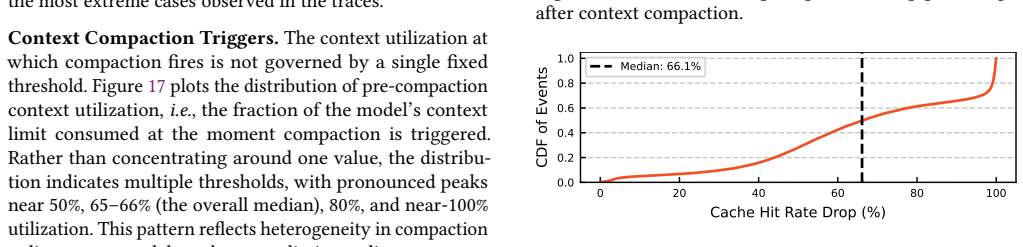
The central claim is that the unit of work in coding-agent serving is the session-structured turn, not the individual LLM request. Within a turn the prompt grows monotonically as history and tool outputs accumulate, so each successive call reuses the previous prefix; average KV-cache hit rates reach ~90%, with a predictable ramp from 45% on the first call to 92–94% by the third. At turn boundaries, inter-turn idle triggers time-based eviction, dropping the average to 55%; model switching (in ~6.4% of sessions, usually reactive to errors or rate limits) leaves only 8%. Context compaction rewrites the prompt so aggressively (median 72.8% token drop, 66.1% hit-rate drop) that it cold-starts the
What carries the argument
The central object is the user turn: one user prompt plus the agent's full autonomous response chain of LLM calls and tool executions. The paper's key mechanism is the KV-cache lifecycle over these turns. Because each LLM call in a turn extends a shared prompt prefix, prefix caching reuses almost all cached key-value tensors within a turn; because turn boundaries insert minutes of user idle time, time-based eviction, model switches, and context compaction invalidate that prefix. The turn boundary, a clearly identifiable event in the telemetry, is the load-bearing structural marker that the paper uses to separate short, reclaimable idle periods from long, reclaimable ones, and it is also the
Load-bearing premise
The headline cache-lifecycle numbers come from client-reported 'cached prompt tokens', not from measuring the server's actual KV-cache state; if those counts overstate real cache reuse, the 90/55/8% rates and the systems conclusions built on them would shift.
What would settle it
Compare client-reported cached-prompt-token counts with server-side KV-cache hit/miss logs on a sample of the same sessions. If the measured intra-turn hit rate is not near 90%, the turn-boundary drop is not near 55%, or caches are not actually evicted in the 2–10 minute idle window, the central lifecycle claim is unsupported.
If this is right
- KV-cache management becomes a session-level scheduling concern: within a turn the cache should stay pinned to GPU memory, while at turn boundaries it should become a candidate for offloading to DRAM or disk based on predicted idle duration.
- Capacity planning and admission control must model autonomous agent chains, since 87% of LLM calls are agent-initiated and user-request arrivals alone do not predict load.
- Model pinning and proactive cache staging on the target model can avoid the near-total cache cold-start (8% hit rate) observed after model switches.
- Context compaction should be treated as a first-class cache event; incremental, prefix-preserving compaction could cut the observed 66% median cache-hit-rate drop.
- Uniform eviction and retention policies are suboptimal across a 50x range of per-turn token consumption; tiered, archetype-aware SLOs would reduce tail cost for the heaviest users without wasting memory on light users.
Where Pith is reading between the lines
- The paper does not run this experiment, but its 2–10 minute eviction cliff implies a cheap test: a keep-alive prefill just before the retention deadline could preserve cache for sessions the predictor says will return, converting eviction into a controlled decision.
- The paper measures that failed builds inject 7–8x more prompt tokens at the median; a natural extension is to test whether streaming or summarizing tool output before it enters the prompt reduces context growth and cache pressure without changing agent behavior.
- Because the traces come from one product over one week, the generality of the 1:1 coupling and the 90/55/8% lifecycle is best tested by applying the same turn-level analysis to traces from other coding agents or later time windows.
Editorial analysis
A structured set of objections, weighed in public.
Referee Report
Summary. This paper presents a large-scale workload characterization of GitHub Copilot's coding agent using one week of anonymized telemetry from June 2026 (13.5M sessions, 3.2M users, 760.5M LLM calls). The authors document a tightly coupled LLM-tool execution loop, high agent autonomy, heavy-tailed session/turn distributions, session-structured KV-cache reuse, context compaction events, tool failure amplification, user archetypes, and resource idle-time patterns. They also design a lightweight idle-time predictor at turn boundaries and report that it captures 86–90% of total idle time. The stated contributions are empirical: a production-scale description of agentic coding and systems implications for KV-cache management, scheduling, and container reclamation.
Significance. If the quantitative findings hold, this is a valuable and timely dataset for the systems community. The scale is unprecedented for coding-agent traces, and the paper makes concrete, falsifiable claims about turn-boundary cache degradation, model-switch invalidation, compaction cost, and bimodal idle times. The paper also ships a reproducible prediction experiment with a held-out evaluation (subject to the data-window issue noted below). The main risk is that the headline cache-lifecycle numbers are derived from client-reported cached-token counts without server-side validation, which the paper itself acknowledges in Section 11. The systems implications are plausible but conditional on that measurement. With validation or appropriately softened claims, this would be an influential reference point for agent-native serving systems.
major comments (6)
- [§3.1, §5.2, Table 4, Fig. 10, §11] The central cache-lifecycle claims (90% intra-turn, 55% turn-boundary, 8% after model switch, 66.1% median drop after compaction) are computed from client-reported cached-token counts in telemetry, but the paper never states the exact definition of 'cache hit rate' or validates the field against server-side KV-cache state. Section 11 explicitly notes 'No server-side view.' If the client counts cacheable-but-missed prefixes, or aggregates multiple candidate prefix matches, all subsequent systems implications shift. Please either provide server-side validation for a subset of sessions, or re-label these as client-reported prefix reuse and remove the eviction-policy and serving-system language from the key findings.
- [§5.3, Fig. 15] The sharp drop in cache hit rate between 2 and 10 minutes of idle time is attributed to 'a time-based KV cache eviction policy at the serving system.' This is an inference from client-side telemetry; no server-side eviction events are observed. The same pattern could be produced by client-side timeout accounting, dynamic prompt content, tokenizer changes, or user behavior. The paper should label this as a hypothesis or validate with server logs; as written, the causal claim overstates the evidence.
- [§3.1 vs §9.2] Section 3.1 states the dataset covers one week in June 2026, but Section 9.2 says the idle-time predictor is trained on 150K sessions from 'a one-week window' and evaluated on 50K sessions from 'the following week.' These statements are inconsistent unless the dataset actually spans two weeks. Because the 86–90% captured-idle-time claim depends on a genuine temporal holdout, the authors must clarify the data window or rerun the evaluation with a holdout within the available week.
- [§9.1, Table 8 vs Fig. 32a] The idle-time statistics are internally inconsistent. Table 8 reports intra-turn P50 container idle = 5.8s and KV-cache idle = 1.2s, while Figure 32a shows overall medians of 6.8s and 5.0s. Since the text says more than 90% of idle intervals are intra-turn, the combined median should be dominated by the intra-turn values. Additionally, cross-turn KV-cache idle median (172s) is an order of magnitude smaller than the reported user idle median (1,512s), despite cross-turn idle being defined to include the user wait between turns. Please reconcile the definitions and ensure the reported numbers describe the same populations.
- [§3.1, Table 3] The sampling methodology is under-specified. The paper says 'sampled subset' but gives no sampling rate, method, or inclusion criteria, and notes the traces are US-only (three timezones). With such skewed and heavy-tailed distributions, small selection biases can change percentages such as 87% agent-initiated, 7.8% compaction, or archetype shares. Please provide sampling details, discuss selection bias, and state which numbers are computed on the full population versus the sampled subset, since Section 3.1 says aggregate metrics are computed 'except when computing aggregate metrics.'
- [§9.2, Fig. 33b] The metric 'Captured idle time' is central to the predictor claim (86–90%) but is never formally defined. Please specify exactly how it is computed (e.g., dwell time in sessions whose predicted survival crosses a threshold before actual idle ends, divided by total idle time), the operating-point selection rule, and how the result relates to the reported ROC-AUC and F1. Without this definition, the gap between decaying accuracy and stable captured idle time cannot be interpreted.
minor comments (4)
- [Abstract vs Table 3] The abstract says '95T tokens', but Table 3 reports 44.9T prompt tokens and 39.3B completion tokens, which totals roughly 45T. Please correct the headline token count.
- [§4.2] The text says 'the median turn triggers 3 LLM calls and 3 tool invocations, consuming 160.2K prompt tokens and 265 completion tokens,' which conflicts with Table 4 and Figure 4e (median per-turn LLM calls 4.5, prompt tokens 227.6K, completion tokens 1.9K). Please reconcile.
- [§1] Typo: 'reclaimation' should be 'reclamation' in the Introduction.
- [§9.2] The conditional survival formula S(t|idle>t0)=S(t)/S(t0) requires S(t0)>0; the paper should state how boundary cases are handled in practice.
Circularity Check
No significant circularity: the paper's findings are direct telemetry measurements, and the learned idle-time predictor is evaluated on held-out data.
full rationale
This is a workload characterization paper, not a derivation. The central quantitative claims (KV cache hit rates by call position, turn-boundary degradation, model-switch invalidation, compaction impact) are computed from telemetry fields such as 'cached prompt tokens' and timestamps, as described in Sections 3.1, 5.2, and 6. These are measurements, not quantities fitted to a conclusion. The one predictive component, the idle-time predictor, is trained on 150K sessions and evaluated on 50K sessions from a separate week (Section 9.2), with ROC-AUC and captured-idle metrics reported against baselines; 'captured idle time' is a held-out evaluation metric, not a restatement of a training objective or of a fitted constant. The paper's own limitation statement, 'No server-side view' (Section 11), identifies a validity concern about whether client-reported cached tokens reflect server-side KV-cache state, but this is a measurement-threat critique, not circularity: it does not show that any conclusion is equivalent by construction to its input. Self-citations appear (e.g., Refs. [8], [32], [31], [30]) but none is load-bearing for the headline findings; the workload statistics stand on the trace data, and related-work comparisons cite external benchmarks and prior characterizations. No step reduces an output to an input by definition, no fitted parameter is renamed as a prediction, and no uniqueness or ansatz is imported from prior work. Therefore the circularity score is 0.
Axiom & Free-Parameter Ledger
free parameters (2)
- LightGBM quantile-regressor hyperparameters =
12 quantile targets; 400 trees per model
- Idle-time prediction operating points =
30s to 30m evaluation windows; 60s binary threshold
axioms (4)
- domain assumption Telemetry metadata (timestamps, token counts, success/failure flags) is accurate and complete for sampled sessions.
- domain assumption Client-reported 'cached prompt tokens' correspond to actual server-side KV-cache hits.
- domain assumption Sampled US-only traces from one week generalize to the broader coding-agent population.
- domain assumption The telemetry session/turn/step segmentation matches user-intent boundaries.
read the original abstract
AI coding agents like GitHub Copilot, Claude Code, and Codex interleave multi-step LLM inference with tool execution, creating a workload different from chatbots. We present the first production-scale characterization of this workload using sampled GitHub Copilot traces from June 2026, comprising 3.2M users, 13M sessions, 761M LLM calls, and 95T tokens. Our analysis reveals distinctive workload properties with important systems implications. For example, agentic coding sessions consist of sparse user-initiated turns, each unfolding into an autonomous agent loop of LLM calls almost always coupled with tool execution. This structure yields KV cache hit rates averaging 90% within a turn, but falling to 55\% across turn boundaries and drastically invalidated after events like model switches or context compaction. Diverse workflows and user behaviors are observed with variable and long-tailed token consumption, time span, and tool calls. We highlight the difference between quick agentic turnaround times and the minutes-long user idle periods at turn boundaries, and design a lightweight idle-time predictor that captures 86-90\% of total idle time, enabling proactive decisions for efficient resource orchestration. These findings challenge assumptions underlying current LLM-serving systems and provide an empirical foundation for agent-native infrastructure.
Figures




Reference graph
Works this paper leans on
-
[1]
Amazon. 2025. AWS Lambda.https://aws.amazon.com/lambda/
2025
-
[2]
Amazon Web Services. 2025. Elastic Kubernetes Service (EKS).https: //aws.amazon.com/eks/
2025
-
[3]
Anthropic. 2025. Claude Code.https://docs.anthropic.com/en/docs/ claude-code
2025
-
[4]
Anthropic. 2026. Anthropic Economic Index report: Cadences.https: //www.anthropic.com/research/economic-index-june-2026-report
2026
-
[5]
Anthropic. 2026. Prompt Caching.https://platform.claude.com/docs/ en/build-with-claude/prompt-caching. Claude Platform Documenta- tion. Accessed: 2026-07-09
2026
-
[6]
Arena Team. 2026. Agent Arena: Causal Evaluation of Agents in the Real World.https://arena.ai/blog/agent-arena-methodology. Arena Blog
2026
-
[7]
Samriddhi Biswas, Sagar Goel, Ranjita Mohan, Samarth Khare, Ran- jita Ramjee, and Mohit Bansal. 2026. Sutradhara: Orchestrator- Engine Co-Design for Tool-Based Agentic Inference.arXiv preprint arXiv:2601.12967(2026)
Pith/arXiv arXiv 2026
-
[8]
Gohar Irfan Chaudhry, Esha Choukse, Haoran Qiu, Íñigo Goiri, Ro- drigo Fonseca, Adam Belay, and Ricardo Bianchini. 2026. Murakkab: Resource-efficient agentic workflow orchestration in cloud platforms. InProceedings of the 20th USENIX Symposium on Operating Systems Design and Implementation (OSDI)
2026
-
[9]
Jiazhan Feng, Shijue Huang, Xingwei Qu, Ge Zhang, Yujia Qin, Bao- quan Zhong, Chengquan Jiang, Jinxin Chi, and Wanjun Zhong. 2025. ReTool: Reinforcement learning for strategic tool use in LLMs.arXiv preprint arXiv:2504.11536(2025)
Pith/arXiv arXiv 2025
-
[10]
GitHub. 2025. GitHub Copilot.https://github.com/features/copilot
2025
-
[11]
GitHub Copilot. 2026. GitHub Copilot CLI Context Management and Compaction.https://docs.github.com/en/copilot/concepts/agents/ copilot-cli/context-management. GitHub Docs. Accessed: 2026-07-09
2026
-
[12]
Dongxin Guo, Jikun Wu, and Siu Ming Yiu. 2026. SAGA: Workflow- Atomic Scheduling for AI Agent Inference on GPU Clusters.arXiv preprint arXiv:2605.00528(2026)
Pith/arXiv arXiv 2026
-
[13]
Qinghao Hu, Peng Sun, Shengen Yan, Yonggang Wen, and Tianwei Zhang. 2021. Characterization and Prediction of Deep Learning Work- loads in Large-Scale GPU Datacenters. InProceedings of the Interna- tional Conference for High Performance Computing, Networking, Storage and Analysis (SC)
2021
-
[14]
Naman Jain, Alex Gu, Wen-Ding Li, Fanjia Yan, Tianjun Zhang, Sida Wang, Armando Solar-Lezama, Koushik Sen, and Ion Stoica. 2025. LiveCodeBench: Holistic and contamination free evaluation of large language models for code. InInternational Conference on Learning Representations, Vol. 2025. 58791–58831
2025
-
[15]
Myeongjae Jeon, Shivaram Venkataraman, Amar Phanishayee, Junjie Qian, Wencong Xiao, and Fan Yang. 2019. Analysis of Large-Scale Multi-Tenant GPU Clusters for DNN Training Workloads. InProceed- ings of the 2019 USENIX Annual Technical Conference (ATC)
2019
-
[16]
Carlos E Jimenez, John Yang, Alexander Wettig, Shunyu Yao, Kexin Pei, Ofir Press, and Karthik Narasimhan. 2024. SWE-bench: Can Language Models Resolve Real-World GitHub Issues?arXiv preprint arXiv:2310.06770(2024)
Pith/arXiv arXiv 2024
-
[17]
Guolin Ke, Qi Meng, Thomas Finley, Taifeng Wang, Wei Chen, Wei- dong Ma, Qiwei Ye, and Tie-Yan Liu. 2017. LightGBM: A highly effi- cient gradient boosting decision tree.Advances in neural information processing systems30 (2017)
2017
-
[18]
Woosuk Kwon, Zhuohan Li, Siyuan Zhuang, Ying Sheng, Lianmin Zheng, Cody Hao Yu, Joseph E Gonzalez, Hao Zhang, and Ion Stoica
-
[19]
Hanchen Li, Azalia Mirhoseini, and Ion Stoica. 2025. Efficient Agentic LLM Inference with KV Cache Retention.arXiv preprint arXiv:2511.02230(2025)
Pith/arXiv arXiv 2025
-
[20]
Chaofan Lin, Zhenhua Han, Chengruidong Zhang, Yuqing Yang, Fan Liu, Chen Chen, and Lili Qiu. 2024. Parrot: Efficient Serving of LLM- based Applications with Semantic Variable.Proceedings of the 18th USENIX Symposium on Operating Systems Design and Implementation (OSDI)(2024)
2024
-
[21]
Banruo Liu, Wei-Yu Lin, Minghao Fang, Yihan Jiang, and Fan Lai. 2026. Compass: SLO-aware Query Planner for Compound AI Serving at Scale. arXiv:2504.16397 [cs.DB]https://arxiv.org/abs/2504.16397
Pith/arXiv arXiv 2026
-
[22]
Yuhan Liu, Yihua Cheng, Jiayi Yao, Yuwei An, Xiaokun Chen, Shaot- ing Feng, Yuyang Huang, Samuel Shen, Rui Zhang, Kuntai Du, et al
-
[23]
Michael Luo, Xiaoxiang Shi, Colin Cai, Tianjun Zhang, Justin Wong, Yichuan Wang, Chi Wang, Yanping Huang, Zhifeng Chen, Joseph E Gonzalez, et al. 2025. Autellix: An efficient serving engine for LLM agents as general programs.arXiv preprint arXiv:2502.13965(2025)
Pith/arXiv arXiv 2025
-
[24]
Prateek Majgaonkar et al. 2025. Understanding Code Agent Behaviour: An Empirical Study.arXiv preprint arXiv:2511.00197(2025)
arXiv 2025
-
[25]
Microsoft. 2025. Azure Kubernetes Service (AKS).https://azure. microsoft.com/en-us/services/kubernetes-service/
2025
-
[26]
Microsoft. 2025. Serverless on Azure.https://azure.microsoft.com/en- us/solutions/serverless. 19 Banruo Liu, Haoran Qiu, Íñigo Goiri, Rodrigo Fonseca, Ricardo Bianchini, and Esha Choukse
2025
-
[27]
Microsoft. 2026. Microsoft 365 Copilot AI for Enterprise Productivity. https://www.microsoft.com/en-us/microsoft-365-copilot/enterprise
2026
-
[28]
OpenAI. 2025. Codex.https://openai.com/index/codex/
2025
-
[29]
OpenAI. 2025. Introducing Deep Research.https://openai.com/index/ introducing-deep-research/
2025
-
[30]
Pratyush Patel, Esha Choukse, Chaojie Zhang, Íñigo Goiri, Brijesh Warrier, Nithish Mahalingam, and Ricardo Bianchini. 2024. Charac- terizing Power Management Opportunities for LLMs in the Cloud. In Proceedings of the 29th ACM International Conference on Architectural Support for Programming Languages and Operating Systems, Volume 3 (La Jolla, CA, USA)(ASP...
arXiv 2024
-
[31]
Haoran Qiu, Anish Biswas, Zihan Zhao, Jayashree Mohan, Alind Khare, Esha Choukse, Íñigo Goiri, Zeyu Zhang, Haiying Shen, Chetan Bansal, Ramachandran Ramjee, and Rodrigo Fonseca. 2025. ModServe: Modality- and Stage-Aware Resource Disaggregation for Scalable Mul- timodal Model Serving. InProceedings of the 2025 ACM Symposium on Cloud Computing (SoCC 2025)(V...
2025
-
[32]
Yeonju Ro, Haoran Qiu, Íñigo Goiri, Rodrigo Fonseca, Ricardo Bian- chini, Aditya Akella, Zhangyang Wang, Mattan Erez, and Esha Choukse. 2025. Sherlock: Reliable and Efficient Agentic Workflow Execution.arXiv preprint arXiv:2511.00330(2025)
arXiv 2025
-
[33]
Mohammad Shahrad, Rodrigo Fonseca, Íñigo Goiri, Gohar Chaudhry, Paul Batum, Jason Cooke, Eduardo Laureano, Colby Tresness, Mark Russinovich, and Ricardo Bianchini. 2020. Serverless in the Wild: Characterizing and Optimizing the Serverless Workload at a Large Cloud Provider. InProceedings of the 2020 USENIX Annual Technical Conference (ATC)
2020
-
[34]
Jovan Stojkovic, Chaojie Zhang, Íñigo Goiri, Josep Torrellas, and Esha Choukse. 2025. DynamoLLM: Designing LLM inference clusters for performance and energy efficiency. In2025 IEEE International Sym- posium on High Performance Computer Architecture (HPCA). IEEE, 1348–1362
2025
-
[35]
Xingyao Wang et al. 2024. OpenHands: An Open Platform for AI Soft- ware Developers as Generalist Agents.arXiv preprint arXiv:2407.16741 (2024)
Pith/arXiv arXiv 2024
-
[36]
Yawen Wang, Kapil Arya, Marios Kogias, Manohar Vanga, Aditya Bhandari, Neeraja J Yadwadkar, Siddhartha Sen, Sameh Elnikety, Chris- tos Kozyrakis, and Ricardo Bianchini. 2021. SmartHarvest: Harvesting idle CPUs safely and efficiently in the cloud. InProceedings of the Sixteenth European Conference on Computer Systems. 1–16
2021
-
[37]
Yechen Xu, Xinhao Kong, Tingjun Chen, and Danyang Zhuo. 2024. Conveyor: Efficient tool-aware LLM serving with tool partial execu- tion.arXiv preprint arXiv:2406.00059(2024)
Pith/arXiv arXiv 2024
-
[38]
John Yang, Carlos E Jimenez, Alexander Wettig, Kilian Liber, Karthik Narasimhan, and Ofir Press. 2024. SWE-agent: Agent-Computer In- terfaces Enable Automated Software Engineering.arXiv preprint arXiv:2405.15793(2024)
Pith/arXiv arXiv 2024
-
[39]
Shunyu Yao, Jeffrey Zhao, Dian Yu, Nan Du, Izhak Shafran, Karthik Narasimhan, and Yuan Cao. 2023. ReAct: Synergizing Reasoning and Acting in Language Models.arXiv preprint arXiv:2210.03629(2023)
Pith/arXiv arXiv 2023
-
[40]
Gyeong-In Yu, Joo Seong Jeong, Geon-Woo Kim, Soojeong Kim, and Byung-Gon Chun. 2022. Orca: A Distributed Serving System for Transformer-Based Generative Models. InProceedings of the 16th USENIX Symposium on Operating Systems Design and Implementa- tion (OSDI)
2022
-
[41]
Shan Yu, Junyi Shu, Yuanjiang Ni, Kun Qian, Xue Li, Yang Wang, Jinyuan Zhang, Ziyi Xu, Shuo Yang, Lingjun Zhu, et al. 2026. Pythia: Exploiting Workflow Predictability for Efficient Agent-Native LLM Serving.arXiv preprint arXiv:2604.25899(2026)
Pith/arXiv arXiv 2026
-
[42]
Yichao Yuan, Ankita Nayak, Souvik Kundu, and Nishil Talati. 2026. Agentic AI Workload Characteristics.arXiv preprint arXiv:2605.26297 (2026)
Pith/arXiv arXiv 2026
-
[43]
Wei Zhang, Zhiyu Wu, Yi Mu, Rui Ning, Banruo Liu, Nikhil Sarda, Myungjin Lee, and Fan Lai. 2025. JITServe: SLO-aware LLM Serving with Imprecise Request Information. arXiv:2504.20068 [cs.DC]https: //arxiv.org/abs/2504.20068
arXiv 2025
-
[44]
Lianmin Zheng, Liangsheng Yin, Zhiqiang Xie, Chuyue Sun, Jeff Huang, Cody Hao Yu, Shi Cao, Christos Kober, Liang Shi, Ziniu Wu, et al. 2024. SGLang: Efficient Execution of Structured Language Model Programs.arXiv preprint arXiv:2312.07104(2024)
Pith/arXiv arXiv 2024
-
[45]
Yuxiang Zheng, Dayuan Fu, Xiangkun Hu, Xiaojie Cai, Lyumanshan Ye, Pengrui Lu, and Pengfei Liu. 2025. DeepResearcher: Scaling deep research via reinforcement learning in real-world environments. In Proceedings of the 2025 Conference on Empirical Methods in Natural Language Processing. 414–431
2025
-
[46]
Kan Zhu, Mathew Jacob, Chenxi Ma, Yi Pan, Stephanie Wang, Arvind Krishnamurthy, and Baris Kasikci. 2026. TraceLab: Characterizing Coding Agent Workloads for LLM Serving. arXiv:2606.30560 [cs.LG] https://arxiv.org/abs/2606.30560 20
Pith/arXiv arXiv 2026
-
[2023]
InProceedings of the 29th Symposium on Operating Systems Principles (SOSP)
vLLM: Efficient Memory Management for Large Language Model Serving with PagedAttention. InProceedings of the 29th Symposium on Operating Systems Principles (SOSP)
-
[2025]
LMCache: An efficient KV cache layer for enterprise-scale LLM inference.arXiv preprint arXiv:2510.09665(2025)
arXiv 2025
discussion (0)
Sign in with ORCID, Apple, or X to comment. Anyone can read and Pith papers without signing in.