REVIEW 3 major objections 5 minor 73 references
DiffusionTrend: A Minimalist Approach to Virtual Fashion Try-On
T0 review · 3 major / 5 minor · reviewed 2026-08-11 · deepseek-v4-flash
Pith's one-line read Virtual fashion try-on can be done without retraining a diffusion model, by inverting both images into latents and blending them at two carefully chosen denoising timesteps.
desk verdict A genuinely training-free try-on pipeline that mostly works on simple poses; the headline claim is plausible but the timestep selection is tuned on the test set. read the letter →
The pith
A machine-rendered reading of the paper's core claim, the machinery that carries it, and where it could break.
The reading
What carries the argument
The load-bearing object is the pair of DDIM-inversion latent trajectories $\{z^{*m}_t\}$ and $\{z^{*g}_t\}$ for the model and garment images. They are combined twice: garment infusion at $t_1$ via $z^*_{t_1} = z^m_{t_1}\cdot(1-M_g) + z^{*g}_{t_1}\cdot M_g$, and background restoration at $t_2$ via $z^*_{t_2} = z^m_{t_2}\cdot(1-M_{bg}) + z^{*m}_{t_2}\cdot M_{bg}$, where $M_{bg}$ is the complement of the union of the model's and garment's masks. The workhorse making this work is the pretrained diffusion model's 'inherent repair capability'—the denoising steps after the splices smooth the latent discontinuities without any fine-tuning. A CIEDE2000-based adaptive termination rule decides when to stop sampling to avoid color drift.
What would settle it
Run the pipeline with the authors' reported masks, timesteps, and prompts on a simple front-facing example from the DressCode test set where a trained baseline succeeds, using a garment whose color or pattern strongly contrasts with the model's background; a visible seam, color halo, or distorted face at the garment boundary in the output would show that the repair assumption fails even in the simple-pose regime the paper claims.
Extended reading notes
Core claim
The central discovery is that DDIM-inverted latents of a pretrained latent diffusion model are rich enough to act as a transfer medium for garments. At an early denoising step ($t_1=40$ of 50), the paper replaces the model latent inside the garment mask with the garment's inverted latent, so the garment's texture and pattern are progressively generated into the model's structure; at a later step ($t_2=15$), it replaces the background outside the union of the two garment masks with the model's own inverted latent, preserving identity and scene. The pretrained SDXL model's denoising then blends the two sources across the remaining steps, so the result is one continuous image rather than a cut-and-paste composite. The paper demonstrates this with a minimal pipeline: a lightweight CNN predicts garment masks from image and text features, and a perspective transform aligns the garment to the model's bounding box.
Load-bearing premise
The method works only if the pretrained diffusion model's denoising process spontaneously smooths over the abrupt latent edits, so the final image looks like one continuous photograph rather than a paste job with visible seams, color shifts, or distorted faces.
Editorial extensions
If this is right
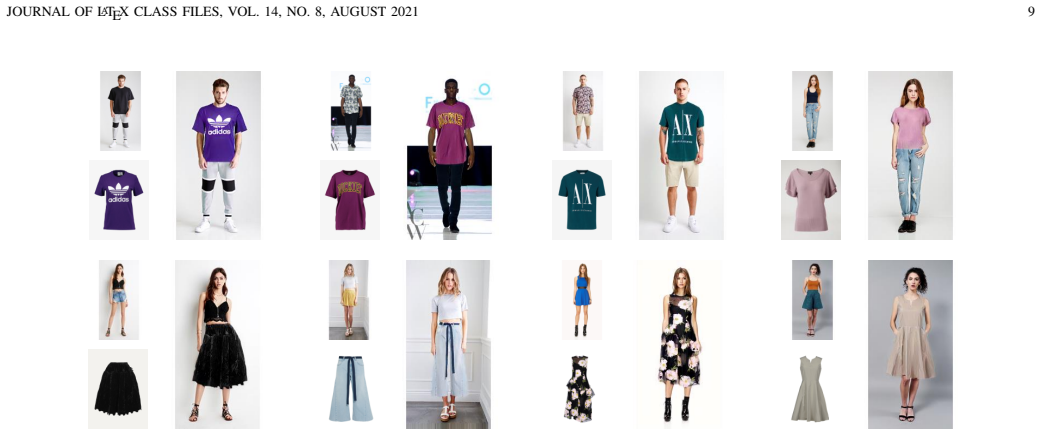
- Training-free try-on is feasible for simple, frontal poses: the authors show that with no diffusion-model training and no auxiliary inputs, the generated images are visually on par with trained baselines in qualitative comparisons.
- The pipeline removes the need for densepose, segmentation maps, keypoints, and clothes-agnostic representations—the only learned component is a small CNN for garment masks.
- Quality should improve automatically as better pretrained diffusion models and inversion methods appear, since the method relies on their latent priors and repair behavior.
- The same two-splice latent procedure transfers across datasets: model images from SHHQ-1.0 combined with garments from DressCode and VITON-HD remain coherent.
Reading between the lines
- If the latent-repair assumption holds broadly, the same two-timestep blending recipe could be adapted to other object-swap or local-editing tasks that currently require fine-tuning or inpainting models.
- The method's weakness on complex poses and occluded body parts likely comes from the perspective-transform alignment rather than the latent blending itself; replacing that alignment with a lightweight learned warp inside the latent space could extend the method while keeping most of its training-free character.
- The paper's suboptimal LPIPS/SSIM/FID numbers may understate its performance for the intended use case (quick purchase-decision preview), where users care about pattern fidelity and natural blending more than exact pixel match to the original model image.
Editorial analysis
A structured set of objections, weighed in public.
Referee Report
Summary. DiffusionTrend proposes a training-free virtual fashion try-on method built on Stable Diffusion XL and DDIM inversion. A lightweight CNN predicts garment masks; the garment image is perspective-transformed and aligned with the model image; its inverted latent is hard-infused into the model's latent at a timestep t1 (Eq. 8); later, the model's own latent is restored outside the union mask at timestep t2 (Eq. 11); an adaptive stopping rule based on CIEDE2000 terminates sampling. The paper reports experiments on VITON-HD and DressCode, finding that the method lags behind SOTA on most quantitative metrics, and argues that qualitative results on simple poses show a visually compelling try-on experience.
Significance. If substantiated, the paper would provide a useful training-free baseline for virtual try-on, avoiding expensive diffusion-model fine-tuning and complex user inputs such as densepose, keypoints, and segmentation maps. The lightweight mask network (2 GFLOPs vs 372 for SAM) and the honest reporting of suboptimal metrics are strengths, as are the systematic ablations of the two infusion timesteps. However, the central claim depends critically on two scalar hyperparameters that appear to be selected using the evaluation test sets, and the qualitative evidence is a small set of selected images. The exploratory value is real, but the evidence as presented does not yet establish a robust, generally applicable training-free try-on recipe.
major comments (3)
- [§IV-A, §IV-C, Table IV] The two load-bearing hyperparameters t1=40 and t2=15 are selected by sweeping on the benchmark test sets. §IV-C explicitly justifies t2=15 over the better-FID t2=25 by visual inspection of test images ('the waist's metallic embellishments are lost' at t2=25), and no validation split or separate development set is described anywhere in §IV. Since Eqs. (8) and (11) are sensitive to these timesteps—Fig. 5 and Fig. 8 show seams, color shifts, and loss of detail when t1 or t2 is off by 5–10 steps—the reported metrics are partially fitted to the evaluation benchmark rather than independent predictions. To support the claim of a generally feasible training-free recipe, the authors should either introduce a proper validation split for hyperparameter selection and report test-set numbers obtained with the fixed validation-selected values, or demonstrate that the same (t1, t2) transfers across datasets, garment categories, and at least one other diffusion checkpoint.
- [§III-C, Eq. (11), Fig. 8] The coherence of the final image rests on the assumption, stated in §III-C, that the pre-trained SDXL has an 'inherent repair capability' that seamlessly integrates the hard latent replacements of Eqs. (8) and (11). This is an empirical property, not a derived one, and the paper's own ablations show the operating window is narrow. Yet the manuscript provides no quantitative evaluation of boundary artifacts or failure rate; the qualitative evidence consists of selected examples in Figs. 6 and 7. The paper should quantify the repair behavior on a random subset of the test data, for example by measuring boundary fidelity or counting visible seam artifacts, and should compare the method against a naive latent-pasting baseline to demonstrate that the self-repair assumption is actually load-bearing.
- [§IV-B, Table II] The quantitative results show DiffusionTrend generally underperforming the strongest baselines on both benchmarks (e.g., on VITON-HD, LPIPS 0.0918 vs 0.0530 for DCI-VTON and FID 10.433 vs 6.290 for IDM-VTON; on DressCode, LPIPS 0.0720 vs 0.0388 for StableVITON). The paper acknowledges this and argues that 'traditional try-on dataset evaluations are insufficient' and that 'qualitative experiments will further demonstrate our superiority,' but no user study or systematic qualitative protocol is provided. To support the claim of a 'visually compelling try-on experience,' the revision should include either a perceptual user study on a representative sample or a larger, pre-specified qualitative evaluation with defined inclusion criteria and separate failure-case analysis.
minor comments (5)
- [§IV-C, t1 ablation] The sentence 'incorporating clothing information too early tends to lower the LPIPS, SSIM, and FID scores' does not match Table IV, where decreasing t1 from 50 to 25 improves LPIPS (0.0791 to 0.0691) and SSIM (0.9142 to 0.9187) while only FID worsens (9.89 to 10.19); please clarify the intended trade-off direction.
- [§III-B] The phrase 'for models adorned in addresses' appears to be a typo; if it means 'adorned with accessories' or 'dressed in multiple layers,' please correct the wording.
- [References] References [21] and [56] are the same paper (Zhang, Han, Zhang, Lan, Huang, 'Limb-aware virtual try-on network with progressive clothing warping'); one should be removed or renumbered.
- [§III-C, Eq. (8)] State explicitly whether M_g is resized and transformed by the same perspective transformation as the garment image before being used in Eq. (8), since the latent grid must be aligned with z_m for the hard replacement to be physically meaningful.
- [§IV-A, Implementation Details] The number of clusters K=5 is fixed without an ablation or sensitivity analysis; given that K-means directly affects the upper/lower garment masks used in Eqs. (7) and (10), the paper should at least report how the final try-on quality varies with K.
Circularity Check
The two critical timesteps (t1=40, t2=15) are selected on the benchmark test sets themselves, so the reported training-free try-on metrics are partly fitted rather than independent predictions.
-
fitted input called prediction
[Section IV-A Implementation Details; Section IV-C Ablation Study, Table IV]
"Garment latent infusion occurs at time step t1 = 40, and background restoration at t2 = 15. ... Although the quantitative results in Table IV show that the FID and KID scores are higher at t2 = 25 and 20, it can be observed from the second row of Fig. 8 that, performing background restoration too early can negatively impact the generation of garment details."
The two scalar hyperparameters that define the method are selected by sweeping the benchmark test set: Table IV scans t1 from 25 to 50 and t2 from 0 to 25, and Fig. 8 uses visual inspection of test images to choose t2=15 even though t2=25 has better FID/KID. The same test sets then produce the headline numbers in Table II. No validation split or cross-dataset transfer of (t1,t2) is reported, so the final evaluation is not an independent test of a fixed training-free recipe; the timesteps are fitted to the evaluation benchmark, and the reported metrics partly inherit that fit.
full rationale
The pipeline is an empirical construction rather than a derivation: Eq. (8) and Eq. (11) define a latent replacement schedule, and the claim that SDXL 'repairs' the seam between infused garment latent and restored background is an empirical assumption, not a consequence of the diffusion equations. That is not circular. The mask CNN is trained on training splits and evaluated on test splits, which is standard supervised practice. The self-citation to EasyInv [67] is a robustness demonstration and is not load-bearing for the central claim. The one substantive circularity is the selection of the two critical timesteps: Table IV sweeps t1 and t2 on the benchmark test set, and Fig. 8 selects t2=15 by inspecting test images even though t2=25 gives better FID/KID; these same test sets are then used for the headline Table II numbers. No validation split is described, so the reported metrics are partly fitted to the evaluation benchmark. The paper itself concedes that 'quantitative experiments serve only as a reference, while qualitative experiments will further demonstrate our superiority,' which further reduces the evidentiary weight of the fitted numbers. Overall, the method is not circular by construction, but the reported benchmark performance is partially selected rather than predicted.
Assumptions & free parameters
free parameters (6)
- t1 (garment latent infusion timestep) =
40
- t2 (background restoration timestep) =
15
- K (K-means clusters) =
5
- Adaptive termination activation threshold =
after step 45
- Prompts =
'clothes' and 'model wearing clothes'
- Perspective transformation scaling factors =
not specified
assumptions (4)
- standard math DDIM inversion (Eq. 3) approximately reverses the sampling ODE, so inverted latents preserve the source image content.
- domain assumption The pre-trained SDXL model's denoising process can repair discontinuities created by latent blending and produce a coherent try-on image.
- domain assumption K-means clustering on masked CNN features reliably separates upper and lower garments.
- domain assumption An empty prompt during inversion preserves the model's identity and background in the reconstruction.
Cite this review
Pith. "Pith review of DiffusionTrend: A Minimalist Approach to Virtual Fashion Try-On." pith.science (2026). https://pith.science/paper/JIDUSLF2
@misc{pith2026241214465,
  author       = {Pith},
  title        = {Pith review of: DiffusionTrend: A Minimalist Approach to Virtual Fashion Try-On},
  year         = {2026},
  howpublished = {\url{https://pith.science/paper/JIDUSLF2}},
  note         = {Machine review of arXiv:2412.14465}
}
read the original abstract
We introduce DiffusionTrend for virtual fashion try-on, which forgoes the need for retraining diffusion models. Using advanced diffusion models, DiffusionTrend harnesses latent information rich in prior information to capture the nuances of garment details. Throughout the diffusion denoising process, these details are seamlessly integrated into the model image generation, expertly directed by a precise garment mask crafted by a lightweight and compact CNN. Although our DiffusionTrend model initially demonstrates suboptimal metric performance, our exploratory approach offers some important advantages: (1) It circumvents resource-intensive retraining of diffusion models on large datasets. (2) It eliminates the necessity for various complex and user-unfriendly model inputs. (3) It delivers a visually compelling try-on experience, underscoring the potential of training-free diffusion model. This initial foray into the application of untrained diffusion models in virtual try-on technology potentially paves the way for further exploration and refinement in this industrially and academically valuable field.
Figures


Figures from the paper (9 more)




Reference graph
Works this paper leans on
-
[1]
Image- based virtual try-on: A survey,
D. Song, X. Zhang, J. Zhou, W. Nie, R. Tong, and A.-A. Liu, “Image- based virtual try-on: A survey,”arXiv preprint arXiv:2311.04811, 2023
arXiv 2023
-
[2]
Deep learning in virtual try-on: A comprehensive survey,
T. Islam, A. Miron, X. Liu, and Y . Li, “Deep learning in virtual try-on: A comprehensive survey,”IEEE Access, 2024
work page 2024
-
[3]
Tryondiffusion: A tale of two unets,
L. Zhu, D. Yang, T. Zhu, F. Reda, W. Chan, C. Saharia, M. Norouzi, and I. Kemelmacher-Shlizerman, “Tryondiffusion: A tale of two unets,” inProc. IEEE Conf. Comput. Vis. Pattern Recognit. (CVPR), 2023, pp. 4606–4615
work page 2023
-
[4]
Taming the power of diffusion models for high-quality virtual try-on with appearance flow,
J. Gou, S. Sun, J. Zhang, J. Si, C. Qian, and L. Zhang, “Taming the power of diffusion models for high-quality virtual try-on with appearance flow,” inACM Int. Conf. Multimedia, 2023, pp. 7599–7607
work page 2023
-
[5]
Ladi-vton: latent diffusion textual-inversion enhanced virtual try-on,
D. Morelli, A. Baldrati, G. Cartella, M. Cornia, M. Bertini, and R. Cuc- chiara, “Ladi-vton: latent diffusion textual-inversion enhanced virtual try-on,” inACM Int. Conf. Multimedia, 2023, pp. 8580–8589
work page 2023
-
[6]
Warpdiffusion: Efficient diffusion model for high-fidelity virtual try-on,
X. Li, M. Kampffmeyer, X. Dong, Z. Xie, F. Zhu, H. Dong, X. Liang et al., “Warpdiffusion: Efficient diffusion model for high-fidelity virtual try-on,”arXiv preprint arXiv:2312.03667, 2023
arXiv 2023
-
[7]
Ootdiffusion: Outfitting fusion based latent diffusion for controllable virtual try-on,
Y . Xu, T. Gu, W. Chen, and C. Chen, “Ootdiffusion: Outfitting fusion based latent diffusion for controllable virtual try-on,”arXiv preprint arXiv:2403.01779, 2024
arXiv 2024
-
[8]
Stableviton: Learning semantic correspondence with latent diffusion model for virtual try-on,
J. Kim, G. Gu, M. Park, S. Park, and J. Choo, “Stableviton: Learning semantic correspondence with latent diffusion model for virtual try-on,” arXiv preprint arXiv:2312.01725, 2023
arXiv 2023
Show all 73 references
-
[9]
Improving diffusion models for virtual try-on,
Y . Choi, S. Kwak, K. Lee, H. Choi, and J. Shin, “Improving diffusion models for virtual try-on,”arXiv preprint arXiv:2403.05139, 2024
2024 arXiv
-
[10]
Wear-any-way: Manipulable virtual try-on via sparse correspondence alignment,
M. Chen, X. Chen, Z. Zhai, C. Ju, X. Hong, J. Lan, and S. Xiao, “Wear-any-way: Manipulable virtual try-on via sparse correspondence alignment,”arXiv preprint arXiv:2403.12965, 2024
2024 arXiv
-
[11]
Viton-hd: High-resolution virtual try-on via misalignment-aware normalization,
S. Choi, S. Park, M. Lee, and J. Choo, “Viton-hd: High-resolution virtual try-on via misalignment-aware normalization,” inProc. IEEE Conf. Comput. Vis. Pattern Recognit. (CVPR), 2021, pp. 14 131–14 140
2021
-
[12]
High-resolution virtual try- on with misalignment and occlusion-handled conditions,
S. Lee, G. Gu, S. Park, S. Choi, and J. Choo, “High-resolution virtual try- on with misalignment and occlusion-handled conditions,” inEur . Conf. Comput. Vis., 2022, pp. 204–219
2022
-
[13]
Parser-free virtual try-on via distilling appearance flows,
Y . Ge, Y . Song, R. Zhang, C. Ge, W. Liu, and P. Luo, “Parser-free virtual try-on via distilling appearance flows,” inProc. IEEE Conf. Comput. Vis. Pattern Recognit. (CVPR), 2021, pp. 8485–8493
2021
-
[14]
Gp-vton: Towards general purpose virtual try-on via collaborative local-flow global-parsing learning,
Z. Xie, Z. Huang, X. Dong, F. Zhao, H. Dong, X. Zhang, F. Zhu, and X. Liang, “Gp-vton: Towards general purpose virtual try-on via collaborative local-flow global-parsing learning,” inProc. IEEE Conf. Comput. Vis. Pattern Recognit. (CVPR), 2023, pp. 23 550–23 559
2023
-
[15]
Pg-vton: A novel image-based virtual try-on method via progressive inference paradigm,
N. Fang, L. Qiu, S. Zhang, Z. Wang, and K. Hu, “Pg-vton: A novel image-based virtual try-on method via progressive inference paradigm,” IEEE Trans. Multimedia, 2024
2024
-
[16]
Povnet: Image-based virtual try- on through accurate warping and residual,
K. Li, J. Zhang, and D. Forsyth, “Povnet: Image-based virtual try- on through accurate warping and residual,”IEEE Trans. Pattern Anal. Mach. Intell., vol. 45, no. 10, pp. 12 222–12 235, 2023
2023
-
[17]
Generative adversarial nets,
I. Goodfellow, J. Pouget-Abadie, M. Mirza, B. Xu, D. Warde-Farley, S. Ozair, A. Courville, and Y . Bengio, “Generative adversarial nets,” Proc. Adv. Neural Inform. Process. Syst., vol. 27, 2014
2014
-
[18]
A two-stage personalized virtual try-on framework with shape control and texture guidance,
S. Zhang, M. Ni, S. Chen, L. Wang, W. Ding, and Y . Liu, “A two-stage personalized virtual try-on framework with shape control and texture guidance,”IEEE Trans. Multimedia, 2024
2024
-
[19]
Template-free try-on image synthesis via semantic-guided optimization,
C.-L. Chou, C.-Y . Chen, C.-W. Hsieh, H.-H. Shuai, J. Liu, and W.- H. Cheng, “Template-free try-on image synthesis via semantic-guided optimization,”IEEE Trans. Neural Netw. Learn. Syst., vol. 33, no. 9, pp. 4584–4597, 2021
2021
-
[20]
Virtual try-on network with attribute transformation and local rendering,
J. Xu, Y . Pu, R. Nie, D. Xu, Z. Zhao, and W. Qian, “Virtual try-on network with attribute transformation and local rendering,”IEEE Trans. Multimedia, vol. 23, pp. 2222–2234, 2021
2021
-
[21]
Limb- aware virtual try-on network with progressive clothing warping,
S. Zhang, X. Han, W. Zhang, X. Lan, H. Yao, and Q. Huang, “Limb- aware virtual try-on network with progressive clothing warping,”IEEE Trans. Multimedia, vol. 26, pp. 1731–1746, 2023. JOURNAL OF LATEX CLASS FILES, VOL. 14, NO. 8, AUGUST 2021 14
2023
-
[22]
Spg-vton: Semantic prediction guidance for multi-pose virtual try-on,
B. Hu, P. Liu, Z. Zheng, and M. Ren, “Spg-vton: Semantic prediction guidance for multi-pose virtual try-on,”IEEE Trans. Multimedia, vol. 24, pp. 1233–1246, 2022
2022
-
[23]
Single stage virtual try- on via deformable attention flows,
S. Bai, H. Zhou, Z. Li, C. Zhou, and H. Yang, “Single stage virtual try- on via deformable attention flows,” inEur . Conf. Comput. Vis., 2022, pp. 409–425
2022
-
[24]
Clothflow: A flow-based model for clothed person generation,
X. Han, X. Hu, W. Huang, and M. R. Scott, “Clothflow: A flow-based model for clothed person generation,” inProc. IEEE/CVF Int. Conf. Comput. Vis. (ICCV), 2019, pp. 10 471–10 480
2019
-
[25]
Virtual try-on with garment self-occlusion conditions,
Z. Xing, Y . Wu, S. Liu, S. Di, and H. Ma, “Virtual try-on with garment self-occlusion conditions,”IEEE Trans. Multimedia, vol. 25, pp. 7323– 7336, 2022
2022
-
[26]
Fashion customization: Image generation based on editing clue,
D. Song, J.-H. Zeng, M. Liu, X.-Y . Li, and A.-A. Liu, “Fashion customization: Image generation based on editing clue,”IEEE Trans. Circuits Syst. Video Technol., 2023
2023
-
[27]
View synthesis by appearance flow,
T. Zhou, S. Tulsiani, W. Sun, J. Malik, and A. A. Efros, “View synthesis by appearance flow,” inEur . Conf. Comput. Vis., 2016, pp. 286–301
2016
-
[28]
Vton- scfa: A virtual try-on network based on the semantic constraints and flow alignment,
C. Du, F. Yu, M. Jiang, A. Hua, X. Wei, T. Peng, and X. Hu, “Vton- scfa: A virtual try-on network based on the semantic constraints and flow alignment,”IEEE Trans. Multimedia, vol. 25, pp. 777–791, 2022
2022
-
[29]
Vton-mp: Multi-pose virtual try-on via appearance flow and feature filtering,
F. Yu, A. Hua, C. Du, M. Jiang, X. Wei, T. Peng, L. Xu, and X. Hu, “Vton-mp: Multi-pose virtual try-on via appearance flow and feature filtering,”IEEE Trans. Consum. Electron., 2023
2023
-
[30]
Towards photo-realistic virtual try-on by adaptively generating-preserving image content,
H. Yang, R. Zhang, X. Guo, W. Liu, W. Zuo, and P. Luo, “Towards photo-realistic virtual try-on by adaptively generating-preserving image content,” inProc. IEEE Conf. Comput. Vis. Pattern Recognit. (CVPR), 2020, pp. 7850–7859
2020
-
[31]
Do not mask what you do not need to mask: a parser-free virtual try-on,
T. Issenhuth, J. Mary, and C. Calauzenes, “Do not mask what you do not need to mask: a parser-free virtual try-on,” inEur . Conf. Comput. Vis., 2020, pp. 619–635
2020
-
[32]
Spatial-aware texture transformer for high-fidelity garment transfer,
T. Liu, J. Zhang, X. Nie, Y . Wei, S. Wei, Y . Zhao, and J. Feng, “Spatial-aware texture transformer for high-fidelity garment transfer,” IEEE Trans. Image Process., vol. 30, pp. 7499–7510, 2021
2021
-
[33]
Unpaired person image generation with semantic parsing transformation,
S. Song, W. Zhang, J. Liu, Z. Guo, and T. Mei, “Unpaired person image generation with semantic parsing transformation,”IEEE Trans. Pattern Anal. Mach. Intell., vol. 43, no. 11, pp. 4161–4176, 2020
2020
-
[34]
Denoising diffusion probabilistic models,
J. Ho, A. Jain, and P. Abbeel, “Denoising diffusion probabilistic models,” Proc. Adv. Neural Inform. Process. Syst., vol. 33, pp. 6840–6851, 2020
2020
-
[35]
Dress code: high-resolution multi-category virtual try-on,
D. Morelli, M. Fincato, M. Cornia, F. Landi, F. Cesari, and R. Cucchiara, “Dress code: high-resolution multi-category virtual try-on,” inProc. IEEE Conf. Comput. Vis. Pattern Recognit. (CVPR), 2022
2022
-
[36]
Densepose: Dense human pose estimation in the wild,
R. A. G ¨uler, N. Neverova, and I. Kokkinos, “Densepose: Dense human pose estimation in the wild,” inProc. IEEE Conf. Comput. Vis. Pattern Recognit. (CVPR), 2018, pp. 7297–7306
2018
-
[37]
Look into person: Self-supervised structure-sensitive learning and a new benchmark for human parsing,
K. Gong, X. Liang, D. Zhang, X. Shen, and L. Lin, “Look into person: Self-supervised structure-sensitive learning and a new benchmark for human parsing,” inProc. IEEE Conf. Comput. Vis. Pattern Recognit. (CVPR), 2017, pp. 932–940
2017
-
[38]
Viton: An image- based virtual try-on network,
X. Han, Z. Wu, Z. Wu, R. Yu, and L. S. Davis, “Viton: An image- based virtual try-on network,” inProc. IEEE Conf. Comput. Vis. Pattern Recognit. (CVPR), 2018, pp. 7543–7552
2018
-
[39]
Realtime multi-person 2d pose estimation using part affinity fields,
Z. Cao, T. Simon, S.-E. Wei, and Y . Sheikh, “Realtime multi-person 2d pose estimation using part affinity fields,” inProc. IEEE Conf. Comput. Vis. Pattern Recognit. (CVPR), 2017, pp. 7291–7299
2017
-
[40]
Denoising diffusion implicit models,
J. Song, C. Meng, and S. Ermon, “Denoising diffusion implicit models,” arXiv preprint arXiv:2010.02502, 2020
2010 arXiv
-
[41]
Instructpix2pix: Learning to follow image editing instructions,
T. Brooks, A. Holynski, and A. A. Efros, “Instructpix2pix: Learning to follow image editing instructions,” inProc. IEEE Conf. Comput. Vis. Pattern Recognit. (CVPR), 2023, pp. 18 392–18 402
2023
-
[42]
Imagic: Text-based real image editing with diffusion models,
B. Kawar, S. Zada, O. Lang, O. Tov, H. Chang, T. Dekel, I. Mosseri, and M. Irani, “Imagic: Text-based real image editing with diffusion models,” inProc. IEEE Conf. Comput. Vis. Pattern Recognit. (CVPR), 2023, pp. 6007–6017
2023
-
[43]
Dccf: Deep comprehensible color filter learning framework for high-resolution image harmonization,
B. Xue, S. Ran, Q. Chen, R. Jia, B. Zhao, and X. Tang, “Dccf: Deep comprehensible color filter learning framework for high-resolution image harmonization,” inEur . Conf. Comput. Vis., 2022, pp. 300–316
2022
-
[44]
Paint by example: Exemplar-based image editing with diffusion models,
B. Yang, S. Gu, B. Zhang, T. Zhang, X. Chen, X. Sun, D. Chen, and F. Wen, “Paint by example: Exemplar-based image editing with diffusion models,” inProc. IEEE Conf. Comput. Vis. Pattern Recognit. (CVPR), 2023, pp. 18 381–18 391
2023
-
[45]
Dreambooth: Fine tuning text-to-image diffusion models for subject- driven generation,
N. Ruiz, Y . Li, V . Jampani, Y . Pritch, M. Rubinstein, and K. Aberman, “Dreambooth: Fine tuning text-to-image diffusion models for subject- driven generation,” inProc. IEEE Conf. Comput. Vis. Pattern Recognit. (CVPR), 2023, pp. 22 500–22 510
2023
-
[46]
An image is worth one word: Person- alizing text-to-image generation using textual inversion,
R. Gal, Y . Alaluf, Y . Atzmon, O. Patashnik, A. H. Bermano, G. Chechik, and D. Cohen-Or, “An image is worth one word: Person- alizing text-to-image generation using textual inversion,”arXiv preprint arXiv:2208.01618, 2022
2022 arXiv
-
[47]
Multi- concept customization of text-to-image diffusion,
N. Kumari, B. Zhang, R. Zhang, E. Shechtman, and J.-Y . Zhu, “Multi- concept customization of text-to-image diffusion,” inProc. IEEE Conf. Comput. Vis. Pattern Recognit. (CVPR), 2023, pp. 1931–1941
2023
-
[48]
Prompt-to-prompt image editing with cross attention control,
A. Hertz, R. Mokady, J. Tenenbaum, K. Aberman, Y . Pritch, and D. Cohen-Or, “Prompt-to-prompt image editing with cross attention control,”arXiv preprint arXiv:2208.01626, 2022
2022 arXiv
-
[49]
Masactrl: Tuning-free mutual self-attention control for consistent image synthesis and editing,
M. Cao, X. Wang, Z. Qi, Y . Shan, X. Qie, and Y . Zheng, “Masactrl: Tuning-free mutual self-attention control for consistent image synthesis and editing,” inProc. IEEE/CVF Int. Conf. Comput. Vis. (ICCV), 2023, pp. 22 560–22 570
2023
-
[50]
Neural ordinary differential equations,
R. T. Chen, Y . Rubanova, J. Bettencourt, and D. K. Duvenaud, “Neural ordinary differential equations,”Proc. Adv. Neural Inform. Process. Syst., vol. 31, 2018
2018
-
[51]
Segment anything,
A. Kirillov, E. Mintun, N. Ravi, H. Mao, C. Rolland, L. Gustafson, T. Xiao, S. Whitehead, A. C. Berg, W.-Y . Loet al., “Segment anything,” inProc. IEEE/CVF Int. Conf. Comput. Vis. (ICCV), 2023, pp. 4015– 4026
2023
-
[52]
Mask r-cnn,
K. He, G. Gkioxari, P. Doll ´ar, and R. Girshick, “Mask r-cnn,” inProc. IEEE/CVF Int. Conf. Comput. Vis. (ICCV), 2017, pp. 2961–2969
2017
-
[53]
Learning transferable visual models from natural language supervision,
A. Radford, J. W. Kim, C. Hallacy, A. Ramesh, G. Goh, S. Agarwal, G. Sastry, A. Askell, P. Mishkin, J. Clarket al., “Learning transferable visual models from natural language supervision,” inInt. Conf. Mach. Learn., 2021, pp. 8748–8763
2021
-
[54]
Snakes: Active contour models,
M. Kass, A. Witkin, and D. Terzopoulos, “Snakes: Active contour models,”Int. J. Comput. Vis. (IJCV), vol. 1, no. 4, pp. 321–331, 1988
1988
-
[55]
Shape-guided clothing warping for virtual try-on,
X. Han, S. Zheng, Z. Li, C. Wang, X. Sun, and Q. Meng, “Shape-guided clothing warping for virtual try-on,” inACM Int. Conf. Multimedia, 2024, pp. 2593–2602
2024
-
[56]
Limb- aware virtual try-on network with progressive clothing warping,
S. Zhang, X. Han, W. Zhang, X. Lan, H. Yao, and Q. Huang, “Limb- aware virtual try-on network with progressive clothing warping,”IEEE Trans. Multimedia, vol. 26, pp. 1731–1746, 2023
2023
-
[57]
Freeinit: Bridging initial- ization gap in video diffusion models,
T. Wu, C. Si, Y . Jiang, Z. Huang, and Z. Liu, “Freeinit: Bridging initial- ization gap in video diffusion models,”arXiv preprint arXiv:2312.07537, 2023
2023 arXiv
-
[58]
The ciede2000 color-difference formula: Implementation notes, supplementary test data, and mathemat- ical observations,
G. Sharma, W. Wu, and E. N. Dalal, “The ciede2000 color-difference formula: Implementation notes, supplementary test data, and mathemat- ical observations,”Color Research and Application, vol. 30, no. 1, pp. 21–30, 2005
2005
-
[59]
Stylegan-human: A data-centric odyssey of human generation,
J. Fu, S. Li, Y . Jiang, K.-Y . Lin, C. Qian, C. C. Loy, W. Wu, and Z. Liu, “Stylegan-human: A data-centric odyssey of human generation,” inEur . Conf. Comput. Vis.Springer, 2022, pp. 1–19
2022
-
[60]
The unreasonable effectiveness of deep features as a perceptual metric,
R. Zhang, P. Isola, A. A. Efros, E. Shechtman, and O. Wang, “The unreasonable effectiveness of deep features as a perceptual metric,” in Proc. IEEE Conf. Comput. Vis. Pattern Recognit. (CVPR), 2018, pp. 586–595
2018
-
[61]
Image quality assessment: from error visibility to structural similarity,
Z. Wang, A. C. Bovik, H. R. Sheikh, and E. P. Simoncelli, “Image quality assessment: from error visibility to structural similarity,”IEEE Trans. Image Process., vol. 13, no. 4, pp. 600–612, 2004
2004
-
[62]
Gans trained by a two time-scale update rule converge to a local nash equilibrium,
M. Heusel, H. Ramsauer, T. Unterthiner, B. Nessler, and S. Hochreiter, “Gans trained by a two time-scale update rule converge to a local nash equilibrium,”Proc. Adv. Neural Inform. Process. Syst., vol. 30, 2017
2017
-
[63]
Demysti- fying mmd gans,
M. Bi ´nkowski, D. J. Sutherland, M. Arbel, and A. Gretton, “Demysti- fying mmd gans,”arXiv preprint arXiv:1801.01401, 2018
2018 arXiv
-
[64]
Adam: A method for stochastic optimization,
D. P. Kingma and J. Ba, “Adam: A method for stochastic optimization,” arXiv preprint arXiv:1412.6980, 2014
2014 arXiv
-
[65]
Sdxl: Improving latent diffusion models for high-resolution image synthesis,
D. Podell, Z. English, K. Lacey, A. Blattmann, T. Dockhorn, J. M ¨uller, J. Penna, and R. Rombach, “Sdxl: Improving latent diffusion models for high-resolution image synthesis,”arXiv preprint arXiv:2307.01952, 2023
2023 arXiv
-
[66]
Viton: An image- based virtual try-on network,
X. Han, Z. Wu, Z. Wu, R. Yu, and L. S. Davis, “Viton: An image- based virtual try-on network,” inProc. IEEE Conf. Comput. Vis. Pattern Recognit. (CVPR), 2018
2018
-
[67]
Easyinv: Toward fast and better ddim inversion,
Z. Zhang, M. Lin, S. Yan, and R. Ji, “Easyinv: Toward fast and better ddim inversion,”arXiv preprint arXiv:2408.05159, 2024
2024 arXiv
-
[68]
Null- text inversion for editing real images using guided diffusion models,
R. Mokady, A. Hertz, K. Aberman, Y . Pritch, and D. Cohen-Or, “Null- text inversion for editing real images using guided diffusion models,” inProc. IEEE Conf. Comput. Vis. Pattern Recognit. (CVPR), 2023, pp. 6038–6047
2023
-
[69]
Renoise: Real image inversion through iterative noising,
D. Garibi, O. Patashnik, A. V oynov, H. Averbuch-Elor, and D. Cohen- Or, “Renoise: Real image inversion through iterative noising,”arXiv preprint arXiv:2403.14602, 2024
2024 arXiv
-
[70]
Effective real image editing with accelerated iterative diffusion inversion,
Z. Pan, R. Gherardi, X. Xie, and S. Huang, “Effective real image editing with accelerated iterative diffusion inversion,” inProc. IEEE/CVF Int. Conf. Comput. Vis. (ICCV), 2023, pp. 15 912–15 921. JOURNAL OF LATEX CLASS FILES, VOL. 14, NO. 8, AUGUST 2021 15
2023
-
[71]
Q-diffusion: Quantizing diffusion models,
X. Li, Y . Liu, L. Lian, H. Yang, Z. Dong, D. Kang, S. Zhang, and K. Keutzer, “Q-diffusion: Quantizing diffusion models,” inProc. IEEE/CVF Int. Conf. Comput. Vis. (ICCV), 2023, pp. 17 535–17 545
2023
-
[72]
Post-training quanti- zation on diffusion models,
Y . Shang, Z. Yuan, B. Xie, B. Wu, and Y . Yan, “Post-training quanti- zation on diffusion models,” inProc. IEEE Conf. Comput. Vis. Pattern Recognit. (CVPR), 2023, pp. 1972–1981
2023
-
[73]
Ld-pruner: Efficient pruning of latent diffusion models using task-agnostic insights,
T. Castells, H.-K. Song, B.-K. Kim, and S. Choi, “Ld-pruner: Efficient pruning of latent diffusion models using task-agnostic insights,” inProc. IEEE Conf. Comput. Vis. Pattern Recognit. (CVPR), 2024, pp. 821–830. Wengyi Zhancompleted her undergraduate studies and obtained the...
2014
Reviewed August 11, 2026 · model on record in the stance chip above.
Discussion (0). Continue with ORCID to comment.