Secondary drift-driven instabilities in the presence of a parallel-propagating electromagnetic ion cyclotron wave and cold multi-component ions
Pith reviewed 2026-06-27 07:52 UTC · model grok-4.3
The pith
Polarization drifts from EMIC waves drive lower-hybrid instabilities that heat cold ions and electrons even at low wave amplitudes.
A machine-rendered reading of the paper's core claim, the machinery that carries it, and where it could break.
Core claim
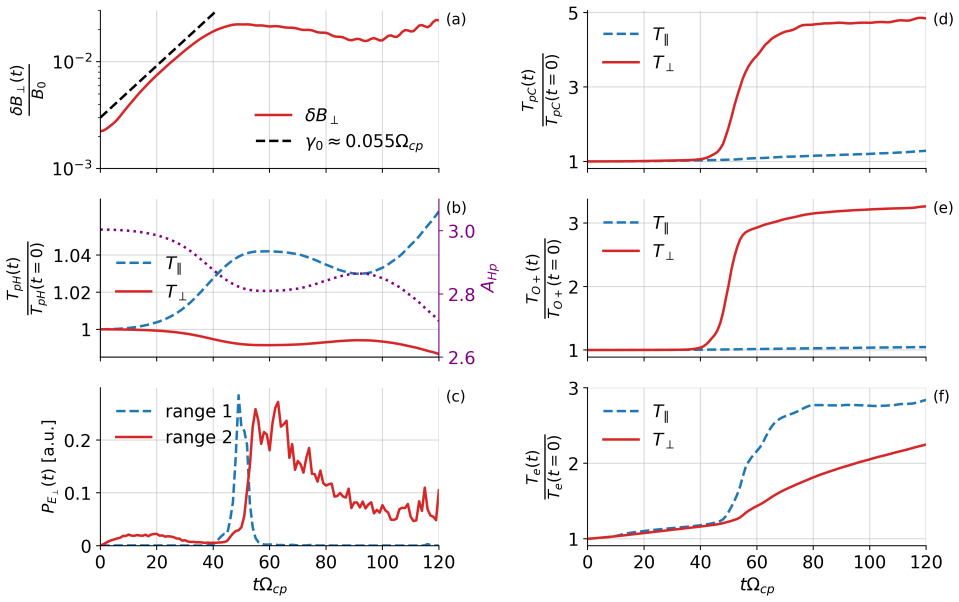
The electric field of a parallel-propagating EMIC wave drives inter-species perpendicular polarization drifts that excite lower-hybrid secondary instabilities including the modified two-stream and ion-ion cross-field modes. These secondary waves persist even at low EMIC amplitudes provided the cold ion population remains sufficiently cold, and the kinetic simulation shows they produce anisotropic heating of cold protons and singly-charged oxygen ions primarily perpendicular to the ambient field and of electrons in both parallel and perpendicular directions.
What carries the argument
Inter-species perpendicular polarization drifts induced by the EMIC wave electric field, which excite the modified two-stream and ion-ion cross-field instabilities in cold multi-component plasma.
If this is right
- Secondary instabilities persist and heat cold protons and O+ ions perpendicular to the magnetic field at low EMIC amplitudes.
- Electrons receive heating in both parallel and perpendicular directions from the same modes.
- The process alters the evolution of both the EMIC wave and the cold plasma in multi-component magnetospheric conditions.
- The instabilities remain active as long as the cold population does not heat enough to quench the drifts.
Where Pith is reading between the lines
- This heating channel could contribute to observed temperature anisotropies in cold plasma populations during geomagnetic activity without requiring strong EMIC waves.
- Models that assume cold ions remain at fixed low temperatures may underestimate energy transfer rates when EMIC waves are present.
- Similar drift-driven instabilities might operate for other wave frequencies or ion species compositions not examined here.
Load-bearing premise
The cold ion population stays sufficiently cold throughout the interaction so polarization drifts keep driving the secondary instabilities at low EMIC amplitudes.
What would settle it
A kinetic simulation or spacecraft observation in which cold ions heat rapidly enough to suppress the secondary instabilities even when the initial cold population is below 100 eV and the EMIC amplitude is low.
Figures






read the original abstract
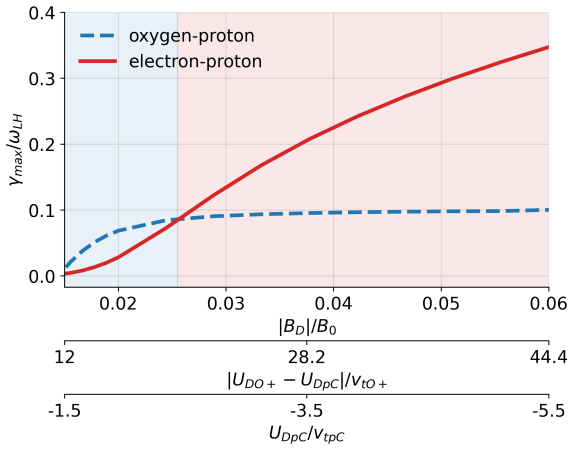
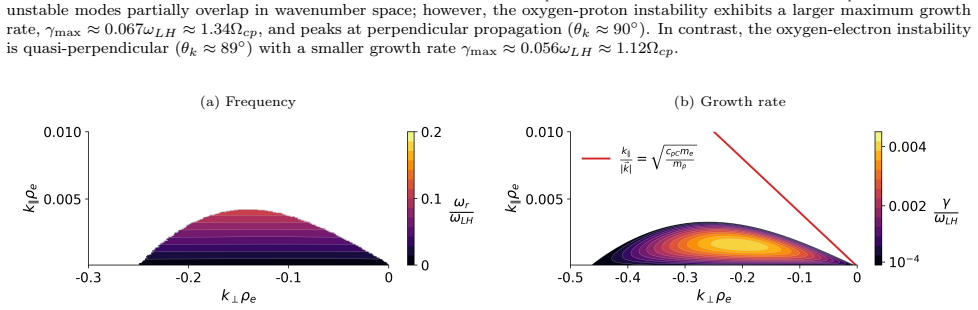
Electromagnetic ion cyclotron (EMIC) waves are commonly observed in Earth's inner magnetosphere, particularly during geomagnetic storms driven by anisotropic ring-current protons. While their role in radiation belt scattering of hot ions is well established, their interaction with the cold (less than 100 eV) plasma remains less understood. This is partly due to limited magnetospheric cold ion observations, as spacecraft charging can prevent cold ions from reaching onboard instruments. It is well-known that the electric field of a parallel-propagating EMIC wave can drive inter-species perpendicular polarization drifts that excite lower-hybrid secondary instabilities. In multi-component plasmas, these include the modified two-stream and the ion-ion cross-field instabilities. In this paper, we study the impact of such secondary instabilities on the parallel-propagating EMIC wave and multi-component plasma via a fully kinetic particle-in-cell simulation and linear theory. We find that the secondary waves persist even at low EMIC amplitudes, provided the cold population remains sufficiently cold. The kinetic simulation demonstrates that these secondary modes produce anisotropic heating of cold protons and singly-charged oxygen ions, primarily in the direction perpendicular to the ambient magnetic field and of electrons in both parallel and perpendicular directions.
Editorial analysis
A structured set of objections, weighed in public.
Referee Report
Summary. The manuscript examines interactions between parallel-propagating EMIC waves and cold multi-component ions using fully kinetic PIC simulations and linear theory. It claims that secondary lower-hybrid instabilities (modified two-stream and ion-ion cross-field) persist even at low EMIC amplitudes provided the cold ions (T < 100 eV) remain sufficiently cold, and that these modes produce anisotropic heating of cold protons and O+ ions (primarily perpendicular) and electrons (parallel and perpendicular).
Significance. If the results hold, the work addresses a gap in understanding EMIC wave effects on cold plasma populations in the inner magnetosphere, where direct observations are limited by spacecraft charging. The use of independent PIC evolution combined with linear theory provides a concrete test of polarization-drift-driven secondary instabilities.
major comments (2)
- [Abstract; simulation results section] Abstract and simulation results section: The headline claim that secondary waves 'persist even at low EMIC amplitudes, provided the cold population remains sufficiently cold' is load-bearing, yet the same simulations are reported to produce perpendicular heating of the cold protons and O+ ions. No explicit check is shown that the temperature rise remains below the threshold at which polarization-drift velocity falls below the linear-theory instability criterion on the growth timescale.
- [Linear theory comparison section] Linear theory comparison section: The persistence result at low amplitudes is conditioned on the cold ions staying 'sufficiently cold,' but the manuscript does not report the time evolution of the cold-ion temperature relative to the derived threshold or quantify how close the simulated heating comes to violating the assumption.
minor comments (2)
- [Abstract] The abstract states 'less than 100 eV' for the cold population but does not specify the exact initial temperature distribution used in the PIC runs or the precise criterion for 'sufficiently cold' in the linear analysis.
- [Figure captions] Figure captions and text should clarify whether the reported heating rates are averaged over the full simulation domain or extracted from specific spatial regions where secondary waves are active.
Simulated Author's Rebuttal
We thank the referee for their careful reading of the manuscript and for highlighting these points regarding the persistence claim. We address each major comment below.
read point-by-point responses
-
Referee: [Abstract; simulation results section] Abstract and simulation results section: The headline claim that secondary waves 'persist even at low EMIC amplitudes, provided the cold population remains sufficiently cold' is load-bearing, yet the same simulations are reported to produce perpendicular heating of the cold protons and O+ ions. No explicit check is shown that the temperature rise remains below the threshold at which polarization-drift velocity falls below the linear-theory instability criterion on the growth timescale.
Authors: We agree that an explicit verification of the cold-ion temperatures relative to the linear-theory threshold would strengthen the manuscript. In the revised version we will add a panel (or dedicated subsection) showing the time evolution of the perpendicular temperatures of the cold H+ and O+ populations together with the corresponding threshold values computed from the polarization-drift criterion. This will demonstrate that the observed heating remains below the threshold on the growth timescale of the secondary modes. revision: yes
-
Referee: [Linear theory comparison section] Linear theory comparison section: The persistence result at low amplitudes is conditioned on the cold ions staying 'sufficiently cold,' but the manuscript does not report the time evolution of the cold-ion temperature relative to the derived threshold or quantify how close the simulated heating comes to violating the assumption.
Authors: We concur that the linear-theory comparison section would benefit from this quantitative check. We will revise the section to include the time-dependent comparison of simulated cold-ion temperatures against the derived threshold and will report the margin by which the assumption holds throughout the interval of secondary-wave activity. revision: yes
Circularity Check
No circularity: results from independent kinetic simulation
full rationale
The paper reports outcomes from fully kinetic PIC simulations and linear theory comparisons. The central claim (persistence of secondary lower-hybrid modes at low EMIC amplitude when cold ions remain sufficiently cold) is demonstrated by direct numerical evolution of particle trajectories, not by fitting parameters to the target quantities or by any self-referential definition. No equations, ansatzes, or uniqueness theorems are shown to reduce the reported heating or instability persistence to the inputs by construction. The temperature condition is an explicit modeling assumption whose validity is checked against the simulation, not presupposed in a way that forces the result.
Axiom & Free-Parameter Ledger
axioms (2)
- standard math Maxwell's equations and the Lorentz force law govern the evolution of fields and particles
- domain assumption The background magnetic field is uniform and the EMIC wave propagates exactly parallel to it
Reference graph
Works this paper leans on
-
[1]
S. P. Gary, M. D. Montgomery, W. C. Feldman, and D. W. Forslund. Proton temperature anisotropy instabilities in the solar wind.Journal of Geophysical Research, 81(7):1241–1246, 1976
1976
-
[2]
S. P. Gary.Theory of Space Plasma Microinstabilities. Cambridge University Press, 1993
1993
-
[3]
G. V. Khazanov, S. Boardsen, E. N. Krivorutsky, M. J. Engebretson, D. Sibeck, S. Chen, and A. Breneman. Lower hybrid frequency range waves generated by ion polarization drift due to electromagnetic ion cyclotron waves: Analysis of an event observed by the Van Allen Probe B.Journal of Geophysical Research: Space Physics, 122(1):449–463, 2017
2017
-
[4]
E. H. Kim, K. H. Kim, J. R. Johnson, P. A. Damiano, S. Shiraiwa, Y. Lin, and W. Martin. Prediction of the Wave Normal Angle of Proton-Band EMIC Waves Near Geosynchronous Orbit.Journal of Geophysical Research: Space Physics, 130(12):e2025JA034612, 2025
2025
-
[5]
R. B. Horne and R. M. Thorne. Wave heating of He+ by electromagnetic ion cyclotron waves in the magnetosphere: Heating near the H+–He+ bi-ion resonance frequency.Journal of Geophysical Research: Space Physics, 102(A6):11457–11471, 1997
1997
-
[6]
X. Yu, Z. Yuan, D. Wang, H. Li, S. Huang, Z. Wang, Q. Zheng, M. Zhou, C. A. Kletzing, and J. R. Wygant. In situ observations of EMIC waves in O+ band by the Van Allen Probe A.Geophysical Research Letters, 42(5):1312–1317, 2015
2015
-
[7]
M. F. Bashir and R. Ilie. The First Observation of N+ Electromagnetic Ion Cyclotron Waves.Journal of Geophysical Research: Space Physics, 126(3):e2020JA028716, 2021
2021
-
[8]
C. F. Kennel and H. E. Petschek. Limit on stably trapped particle fluxes.Journal of Geophysical Research (1896-1977), 71(1):1–28, 1966
1977
-
[9]
J. M. Cornwall, F. V. Coroniti, and R. M. Thorne. Turbulent loss of ring current protons.Journal of Geophysical Research (1896-1977), 75(25):4699–4709, 1970
1977
-
[10]
M. E. Usanova, A. Drozdov, K. Orlova, I. R. Mann, Y. Shprits, M. T. Robertson, D. L. Turner, D. K. Milling, A. Kale, D. N. Baker, S. A. Thaller, G. D. Reeves, H. E. Spence, C. Kletzing, and J. Wygant. Effect of EMIC waves on relativistic and ultrarelativistic electron populations: Ground-based and Van Allen Probes observations.Geophysical Research Letters...
2014
-
[11]
Summers and R
D. Summers and R. M. Thorne. Relativistic electron pitch-angle scattering by electromagnetic ion cyclotron waves during geomagnetic storms.Journal of Geophysical Research: Space Physics, 108(A4), 2003
2003
-
[12]
Cuperman
S. Cuperman. Electromagnetic kinetic instabilities in multicomponent space plasmas: Theoretical predic- tions and computer simulation experiments.Reviews of Geophysics, 19(2):307–343, 1981. 16
1981
-
[13]
S. P. Gary, M. B. Moldwin, M. F. Thomsen, D. Winske, and D. J. McComas. Hot proton anisotropies and cool proton temperatures in the outer magnetosphere.Journal of Geophysical Research: Space Physics, 99 (A12):23603–23615, 1994
1994
-
[14]
G. L. Delzanno, J. E. Borovsky, M. G. Henderson, P. A. Resendiz Lira, V. Roytershteyn, and D. T. Welling. The impact of cold electrons and cold ions in magnetospheric physics.Journal of Atmospheric and Solar-Terrestrial Physics, 220:105599, 2021
2021
-
[15]
C. A. Maldonado, P. A. Resendiz Lira, G. L. Delzanno, B. A. Larsen, D. B. Reisenfeld, and V. Coffey. A review of instrument techniques to measure magnetospheric cold electrons and ions.Frontiers in Astronomy and Space Sciences, 9, 2023
2023
-
[16]
Omidi, R
N. Omidi, R. M. Thorne, and J. Bortnik. Nonlinear evolution of EMIC waves in a uniform magnetic field:
-
[17]
Hybrid simulations.Journal of Geophysical Research: Space Physics, 115(A12), 2010
2010
-
[18]
phase bunching
B. H. Mauk. Electromagnetic wave energization of heavy ions by the electric “phase bunching" process. Geophysical Research Letters, 9(10):1163–1166, 1982
1982
-
[19]
Berchem and R
J. Berchem and R. Gendrin. Nonresonant interaction of heavy ions with electromagnetic ion cyclotron waves.Journal of Geophysical Research: Space Physics, 90(A11):10945–10960, 1985
1985
-
[20]
Bortnik, R
J. Bortnik, R. M. Thorne, and N. Omidi. Nonlinear evolution of EMIC waves in a uniform magnetic field:
-
[21]
Test-particle scattering.Journal of Geophysical Research: Space Physics, 115(A12), 2010
2010
-
[22]
Omura, M
Y. Omura, M. Ashour-Abdalla, R. Gendrin, and K. Quest. Heating of thermal helium in the equatorial magnetosphere: A simulation study.Journal of Geophysical Research: Space Physics, 90(A9):8281–8292, 1985
1985
-
[23]
S. Qian, M. K. Hudson, and I. Roth. Particle simulation of ion heating in the ring current.Journal of Geophysical Research: Space Physics, 95(A2):1001–1013, 1990
1990
-
[24]
J. W. Kwon, K. H. Kim, H. Jin, K. Min, S. Y. Lee, and E. Lee. Energization of cold protons and helium ions by EMIC waves in the inner magnetosphere: Hybrid simulations.Journal of Geophysical Research: Space Physics, 128(5):e2022JA031240, 2023
2023
-
[25]
K. H. Kim, C. W. Jun, J. W. Kwon, J. Lee, K. Shiokawa, Y. Miyoshi, E. H. Kim, K. Min, J. Seough, K. Asamura, I. Shinohara, A. Matsuoka, S. Yokota, Y. Kasahara, S. Kasahara, T. Hori, K. Keika, A. Ku- mamoto, and F. Tsuchiya. Observation and Numerical Simulation of Cold Ions Energized by EMIC Waves. Journal of Geophysical Research: Space Physics, 129(5):e20...
2024
-
[26]
S. Gu, M. Cowee, X. Fu, L. Chen, X. Liu, and V. Jordanova. The role of cold oxygen ions in the emic wave growth.Journal of Geophysical Research: Space Physics, 130(6):e2024JA033661, 2025
2025
-
[27]
D. T. Young, S. Perraut, A. Roux, C. de Villedary, R. Gendrin, A. Korth, G. Kremser, and D. Jones. Wave-particle interactions nearΩHe+ observed on GEOS 1 and 2 1. Propagation of ion cyclotron waves in He+ rich plasma.Journal of Geophysical Research: Space Physics, 86(A8):6755–6772, 1981
1981
-
[28]
A. Roux, S. Perraut, J. L. Rauch, C. de Villedary, G. Kremser, A. Korth, and D. T. Young. Wave-particle interactions nearΩHe + observed on board GEOS 1 and 2: 2. Generation of ion cyclotron waves and heating of He+ ions.Journal of Geophysical Research: Space Physics, 87(A10):8174–8190, 1982
1982
-
[29]
B. J. Anderson and S. A. Fuselier. Response of thermal ions to electromagnetic ion cyclotron waves.Journal of Geophysical Research: Space Physics, 99(A10):19413–19425, 1994
1994
-
[30]
A. A. Abid, Q. Lu, X. L. Gao, B. M. Alotaibi, S. Ali, M. N. S. Qureshi, Y. Al-Hadeethi, and S. Wang. Energization of cold ions by electromagnetic ion cyclotron waves: Magnetospheric multiscale (MMS) ob- servations.Physics of Plasmas, 28(7), 2021
2021
-
[31]
G. V. Khazanov, E. N. Krivorutsky, T. E. Moore, M. W. Liemohn, and J. L. Horwitz. Lower hybrid oscillations in multicomponent space plasmas subjected to ion cyclotron waves.Journal of Geophysical Research: Space Physics, 102(A1):175–184, 1997. 17
1997
-
[32]
V. L. Sizonenko and K. N. Stepanov. Plasma instability in the electric field of an ion-cyclotron wave. Nuclear Fusion, 7(2-3):131, 1967
1967
-
[33]
G. V. Khazanov, T. E. Moore, E. N. Krivorutsky, J. L. Horwitz, and M. W. Liemohn. Lower hybrid turbulence and ponderomotive force effects in space plasmas subjected to large-amplitude low-frequency waves.Geophysical Research Letters, 23(8):797–800, 1996
1996
-
[34]
S. P. Gary, R. L. Tokar, and D. Winske. Ion/ion and electron/ion cross-field instabilities near the lower hybrid frequency.Journal of Geophysical Research: Space Physics, 92(A9):10029–10038, 1987
1987
-
[35]
Papadopoulos, R
K. Papadopoulos, R. C. Davidson, J. M. Dawson, I. Haber, D. A. Hammer, N. A. Krall, and R. Shanny. Heating of Counterstreaming Ion Beams in an External Magnetic Field.The Physics of Fluids, 14(4): 849–857, 04 1971
1971
-
[36]
D. D. Barbosa. Generation of lower-hybrid noise by superthermal cross-field ion currents.The Physics of Fluids, 29(3):888–890, 03 1986
1986
-
[37]
E. Ott, J. B. McBride, J. H. Orens, and J. P. Boris. Turbulent Heating in Computer Simulations of the Modified Plasma Two-Stream Instability.Phys. Rev. Lett., 28:88–91, 1972
1972
-
[38]
N. A. Krall and P. C. Liewer. Low-Frequency Instabilities in Magnetic Pulses.Phys. Rev. A, 4:2094–2103, 1971
2094
-
[39]
J. B. McBride, E. Ott, J. P. Boris, and J. H. Orens. Theory and Simulation of Turbulent Heating by the Modified Two-Stream Instability.The Physics of Fluids, 15(12):2367–2383, 1972
1972
-
[40]
Janhunen, A
S. Janhunen, A. Smolyakov, D. Sydorenko, M. Jimenez, I. Kaganovich, and Y. Raitses. Evolution of the electron cyclotron drift instability in two-dimensions.Physics of Plasmas, 25(8):082308, 08 2018
2018
-
[41]
G. V. Khazanov, M. W. Liemohn, E. N. Krivorutsky, and J. L. Horwitz. A model for lower hybrid wave excitation compared with observations by Viking.Geophysical Research Letters, 24(19):2399–2402, 1997
1997
-
[42]
High- frequency waves in the cusp/cleft regions.Journal of Geophysical Research: Space Physics, 95(A5):5957– 5971, 1990
R Pottelette, M Malingre, N Dubouloz, B Aparicio, R Lundin, G Holmgren, and G Marklund. High- frequency waves in the cusp/cleft regions.Journal of Geophysical Research: Space Physics, 95(A5):5957– 5971, 1990
1990
-
[43]
Z. Y. Liu, Q. G. Zong, S. Wang, X. Z. Zhou, and C. Yue. Direct observations of cross-scale energy transfer driven by multiple-ion interactions in space plasmas.Nature Communications, 16:11516, 2025
2025
-
[44]
Saito, Y
S. Saito, Y. Nariyuki, and T. Umeda. Nonlinear damping of a finite amplitude whistler wave due to modified two stream instability.Physics of Plasmas, 22(7), 2015
2015
-
[45]
K. V. Gamayunov, E. N. Krivorutsky, A. A. Veryaev, and G. V. Khazanov. Saturation of Alfvén oscillations in the ring current region due to generation of lower hybrid waves.Planetary and Space Science, 40(4): 477–479, 1992
1992
-
[46]
Singh, G
N. Singh, G. Khazanov, and A. Mukhter. Electrostatic wave generation and transverse ion acceleration by Alfvénic wave components of broadband extremely low frequency turbulence.Journal of Geophysical Research: Space Physics, 112(A6), 2007
2007
-
[47]
Khazanov and N
I. Khazanov and N. Singh. Ion and electron accelerations by large-scale shear Alfvén waves via cross-field instabilities.Geophysical Research Letters, 34(20), 2007
2007
-
[48]
Roytershteyn and G
V. Roytershteyn and G. L. Delzanno. Nonlinear coupling of whistler waves to oblique electrostatic turbu- lence enabled by cold plasma.Physics of Plasmas, 28(4):042903, 2021
2021
-
[49]
Roytershteyn, G
V. Roytershteyn, G. L. Delzanno, and J. Holmes. Oblique Instability of Quasi-Parallel Whistler Waves in the Presence of Cold and Warm Electron Populations.Frontiers in Astronomy and Space Sciences, 11, 2024. 18
2024
-
[50]
Issan, V
O. Issan, V. Roytershteyn, G. L. Delzanno, and S. Janhunen. Understanding cold electron impact on parallel-propagating whistler chorus waves via moment-based quasilinear theory.Physics of Plasmas, 33 (3):032110, 2026
2026
-
[51]
O. Buneman. Instability of electrons drifting through ions across a magnetic field.Journal of Nuclear Energy. Part C, Plasma Physics, Accelerators, Thermonuclear Research, 4(2):111, 1962
1962
-
[52]
A. I. Akhiezer, I. A. Akhiezer, R. V. Polovin, A. G. Sitenko, and K.N. Stepanov. Plasma electrodynamics. Volume 1-Linear theory.Oxford Pergamon Press International Series on Natural Philosophy, 1, 1975
1975
-
[53]
B. D. Fried and S. D. Conte.The Plasma Dispersion Function; the Hilbert Transform of the Gaussian. Academic Press, 1961
1961
-
[54]
Hunana, A
P. Hunana, A. Tenerani, G. P. Zank, M. L. Goldstein, G. M. Webb, E. Khomenko, M. Collados, P. S. Cally, L. Adhikari, and M. Velli. An introductory guide to fluid models with anisotropic temperatures. Part 2. Kinetic theory, Padé approximants and Landau fluid closures.Journal of Plasma Physics, 85(6):205850603, 2019
2019
-
[55]
K. J. Bowers, B. J. Albright, L. Yin, B. Bergen, and T. J. T. Kwan. Ultrahigh performance three- dimensional electromagnetic relativistic kinetic plasma simulation.Physics of Plasmas, 15(5):055703, 2008
2008
-
[56]
de Soria-Santacruz and M
M. de Soria-Santacruz and M. Martinez-Sanchez. Electromagnetic ion cyclotron waves for radiation belt remediation applications.IEEE Transactions on Plasma Science, 41(12):3329–3337, 2013
2013
-
[57]
Porkolab
M. Porkolab. Invited paper: Parametric instabilities in the tokamak edge plasma in the ion cyclotron heating regimes.Fusion Engineering and Design, 12(1):93–103, 1990
1990
-
[58]
Gomberoff, G
L. Gomberoff, G. Gnavi, and F. T. Gratton. Parametric decays of electromagnetic ion cyclotron waves in a H+-He+-O+ magnetospheric like plasma.Journal of Geophysical Research: Space Physics, 100(A9): 17221–17229, 1995. 19
1995
discussion (0)
Sign in with ORCID, Apple, or X to comment. Anyone can read and Pith papers without signing in.