REVIEW 4 major objections 4 minor 86 references
NavMorph: A Self-Evolving World Model for Vision-and-Language Navigation in Continuous Environments
T0 review · 4 major / 4 minor · reviewed 2026-08-06 · deepseek-v4-flash
Pith's one-line read NavMorph claims that a self-evolving latent world model with a scene-context memory raises VLN-CE success and path efficiency, reporting monocular R2R-CE unseen SR of 47.91 versus 43.77 for the base agent.
desk verdict A solid world-model-plus-memory contribution to VLN-CE; the headline tables mix an online-adapting model with static baselines, but the core result survives even under the fair static comparison. read the letter →
The pith
A machine-rendered reading of the paper's core claim, the machinery that carries it, and where it could break.
The reading
What carries the argument
The central object is a latent dynamics world model of the RSSM family, customized for waypoint navigation: a deterministic recurrent state $h_t$, a stochastic state $s_t$, a visual encoder/decoder pair $e_\phi/d_\theta$, and a shared CEM-enhanced recurrence $f$. The named component is Contextual Evolution Memory (CEM), a bank of $N_m=1000$ scene-contextual vectors with top-$K$ cosine retrieval and exponential forward updates ($\alpha=\beta=0.7$ in the monocular setting). The Foresight Action Planner uses these states to predict $T_p=2$ future latent states, decodes them into visual embeddings rather than pixels, and guides the policy by weighting candidate waypoints closer to the imagined trajectory. The full model is trained with a variational lower bound on the data log-likelihood plus an imitation-learning term, with NDTW-regularized reconstruction and action prediction losses enforcing temporal consistency between predicted and actual trajectories.
What would settle it
Run the released model on R2R-CE Val Unseen with CEM forward updates disabled during testing but all weights identical. The paper reports this variant at 45.08 SR; an independent run that shows no drop from 47.91 would falsify the claim that online memory accumulation contributes. Conversely, resetting CEM before every episode and seeing no loss in SR would falsify the claim that cross-episode memory reuse matters.
Extended reading notes
Core claim
The paper's central claim is that a world model with online self-evolution is a better backbone for VLN-CE than the static policies used by most baselines. NavMorph treats navigation as latent-state inference: an encoder turns RGB-D observations into visual embeddings, a recurrent model maintains a deterministic history, and a stochastic state captures uncertainty; the predictive network then rolls the latent state forward $T_p$ steps to imagine future embeddings and actions, and the navigation policy scores candidate waypoints by their proximity to the imagined path. The Contextual Evolution Memory augments the recurrent state by retrieving its top-$K$ scene features by cosine similarity and blending them with an enhancement factor, and during both training and testing the retrieved entries are updated by a forward move $v_k \leftarrow (1-\beta)v_k + \beta h_t$, so the model accumulates scene context without backpropagation at test time. The paper reports consistent gains over both monocular and panoramic baselines, and its ablations attribute part of the gain to the world-model losses (visual reconstruction, action prediction, posterior-prior matching) and part to the online self-evolution.
Load-bearing premise
The headline comparisons allow the Contextual Evolution Memory to store and reuse scene features from the test episodes during online evaluation, while most baseline numbers in the main tables come from static models; if test-time learning is not permitted, the paper's no-self-evolution variant is the fair comparison and the reported margins shrink.
Editorial extensions
If this is right
- The same learned weights can keep improving in a new building during an episode, because CEM accumulates scene context without needing ground-truth actions.
- Because memory updates are forward passes rather than gradient steps, online adaptation adds little time: average per-instruction cost is 21.22s versus 20.53s for the base model, while the LSTM-based gradient test-time adaptation variant takes 44.56s.
- Foresight is computed in latent space and used to re-rank candidate waypoints, so NavMorph can be layered on existing monocular and panoramic waypoint agents rather than replacing the waypoint predictor.
- The ablation gap (47.91 vs 45.08 SR without self-evolution) quantifies the online-memory contribution, while the world-model losses alone still exceed the base model (45.08 vs 43.77).
Reading between the lines
- If an evaluation protocol resets or freezes CEM at episode boundaries, the headline margins over static baselines would not hold; the comparable numbers would be the paper's no-self-evolution variant.
- Because CEM stores scene-contextual vectors with top-K retrieval, ablating memory content by clustering seen scenes could test whether the gains come from recognizing scene identity rather than from generic visual priors.
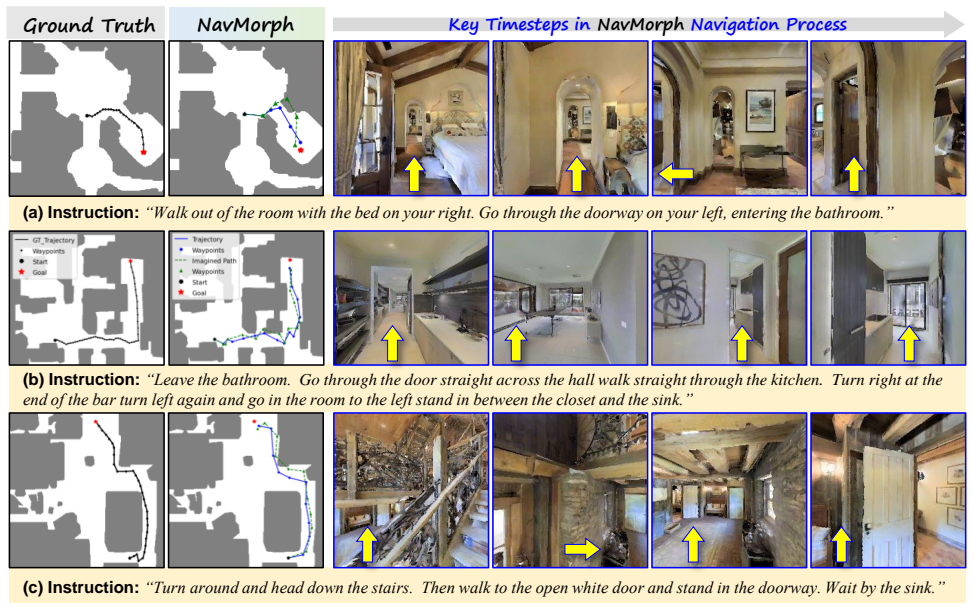
- The paper shows imagined paths sometimes cut through obstacles; adding a collision penalty to the world-model losses could convert foresight gains into larger SPL improvements.
- The same latent-dynamics-plus-memory recipe could transfer to other embodied tasks with low-level actions, such as object navigation or point-goal navigation, where online adaptation matters.
Editorial analysis
A structured set of objections, weighed in public.
Referee Report
Summary. The paper proposes NavMorph, a world-model framework for Vision-and-Language Navigation in Continuous Environments (VLN-CE). NavMorph combines an RSSM-style latent dynamics model (World-aware Navigator) with a Foresight Action Planner that predicts future visual embeddings and actions in latent space, and a Contextual Evolution Memory (CEM) that stores and iteratively updates scene-contextual features. Training maximizes a variational lower bound with reconstruction, action-prediction, and KL terms, together with an imitation objective and an NDTW-based regularization. The method is evaluated on R2R-CE and RxR-CE in both monocular and panoramic settings, reporting gains over VLN-3DFF, ETPNav, and HNR, with ablations over loss components, CEM design, memory size, predictive steps, and test-time-adaptation baselines.
Significance. If the reported results are reliable, NavMorph is a meaningful advance for VLN-CE: it demonstrates that a latent world model with foresight planning can be integrated into existing monocular and panoramic navigation policies and improve success and path efficiency. The paper has several strengths: the ablation study is fairly complete, the supplement includes variance estimates for the TTA comparison, the discussion is candid about the online memory mechanism, and the authors promise code release. In particular, Supplementary Table 8 shows that the world model without online evolution still improves SR from 43.77 to 46.87 on R2R-CE Val Unseen, so the core architectural contribution appears credible. The main unresolved issue is the evaluation protocol for cross-episode CEM updates, which affects how the headline SOTA comparisons should be interpreted.
major comments (4)
- [§3.4, §4.1, Tables 1–2] The main SOTA comparisons are asymmetric because NavMorph updates CEM across test episodes during online evaluation (Eq. (3), §3.4, batch size 1 in §4.1), while most baselines in Tables 1–2 are static models. The paper's own Supplementary Table 8 shows that the online-updated variant reaches SR 47.91 while the no-online-evolution variant 'NavMorph w/o SE*' reaches 46.87 and the base model reaches 43.77; thus the headline 4.14-point gain over VLN-3DFF* is a blend of ~3.1 points of architectural improvement and ~1.0 point of cross-episode test-time memory accumulation. The authors should clearly state the protocol in the main tables, identify which baselines were also run with online adaptation, and report the static variant as the primary point of comparison if the benchmark is intended to measure static generalization.
- [Table 1, DREAMW rows] The DREAMW rows contain impossible numbers: OSR cannot be lower than SR, yet the table reports OSR 49 and SR 59 on Val Unseen, OSR 59 and SR 66 on Val Seen, and OSR 49 and SR 57 on Test Unseen. This indicates that the baseline table was not carefully verified against the original publication, and it undercuts confidence in the surrounding comparisons. The authors should correct these entries and re-verify all other baseline numbers in Tables 1, 2, 6, and 7.
- [§3.3, Eq. (6), Tables 1–2] NDTW is used both as a training regularization term (Eq. (6), applied to the reconstruction and action-prediction losses) and as an evaluation metric reported in NDTW and SDTW. Consequently, the reported NDTW/SDTW gains are partially driven by optimizing the evaluation criterion itself, and these metrics should not be presented as neutral evidence of better path fidelity. The paper should state this overlap explicitly and ideally provide an ablation that removes the NDTW regularization term to quantify its effect on the reported metrics.
- [Tables 1–2 and Supplementary Table 10] The main SOTA tables do not report variance or the number of seeds for NavMorph or the baselines, even though the gains over ETPNav and HNR are often small (1–3 percentage points). Supplementary Table 10 reports mean ± standard deviation only for the TTA comparison; the same rigor should be applied to the headline results before the paper can claim consistent improvements over state-of-the-art methods.
minor comments (4)
- [§4.3 and Table 3] The two no-evolution variants 'NavMorph w/o SE' (Table 3, SR 45.08) and 'NavMorph w/o SE*' (Supplementary Table 8, SR 46.87) should be defined in the main text and clearly distinguished, since they differ by 1.8 SR points and the discussion refers to both.
- [Eq. (5) and Supplementary Eq. (13)] The notation in the future prediction terms is inconsistent: Eq. (5) writes p(x_{T+j}|h_T,s_T) without hats and without explicit sampling over future latent states, while the supplementary derivation in Eq. (13) places the latent transition terms inside the log-likelihood and then drops them; the derivation should be rewritten so that the ELBO steps are formally clean.
- [§3.1] The task description says the agent predicts actions by selecting a candidate sub-goal point, but the action is later defined as a delta-position Δposition_t; these two notions should be reconciled.
- [§4.3 and Table 4 note] There are several typographical errors, including 'memroy' in §4.3, 'Supplymentary' in §4.3, 'agnet' in Table 4, and ' )is' in the supplementary evaluation-metrics section; a careful proofread is needed.
Circularity Check
No significant circularity; the variational world-model derivation is self-contained and the NDTW-in-loss / test-time CEM updates are disclosed mechanisms rather than circular reductions.
full rationale
The paper's derivation chain is self-contained. The world model loss LW (Eq. 5) is derived from a standard variational lower bound in the supplementary (Eqs. 7-16), with no target result fed back as an input. The NDTW term in Eq. 6 appears both in the training loss and in the reported NDTW/SDTW metrics, but the training loss compares predicted sequences against ground-truth sequences from training episodes; the evaluation metrics are computed on held-out episodes, so there is no by-construction equivalence. The Contextual Evolution Memory (CEM) is updated online during testing via Eq. (3), which the paper explicitly discloses in Section 4.3 as 'accumulates scene-specific information from test environments,' and it validates the effect of this mechanism with the w/o SE and w/o SE* ablations (SR 43.77 base, 46.87 w/o SE*, 47.91 full on R2R-CE Val Unseen). This is a test-time adaptation protocol, not a circular derivation. The only minor self-citation is the reliance on the authors' own FSTTA [19] to justify the online VLN evaluation setting (batch size 1, Section 4.1) and the fairness of cross-episode memory accumulation; FSTTA is a published ICML paper and the paper provides an internal static-model comparison, so this citation is not load-bearing for the method's core architecture. The impossible DREAMW row in Table 1 (OSR 49 < SR 59) is a data-integrity concern, not circularity. Overall, no prediction or derivation reduces to its own inputs by construction.
Assumptions & free parameters
free parameters (5)
- Memory size N_m =
1000
- Top-K retrieval K =
16 (monocular), 10 (panoramic)
- Update factors alpha, beta =
0.7 (monocular), 0.9 (panoramic)
- Predictive steps T_p =
2
- KL weight gamma =
1e-3
assumptions (5)
- standard math Variational lower bound via Jensen's inequality justifies the world-model loss (Supplementary Section 6).
- domain assumption Latent dynamics factorize as in Eq. (7): x_t and a_t are conditionally independent given (h_t, s_t), and future predictions depend only on h_T, s_T in Eq. (5).
- domain assumption Teacher-action supervision (DAgger-style interactive demonstrator) is available for the imitation loss L_IL.
- ad hoc to paper NDTW is a suitable, differentiable training objective (Eq. 6) and its implementation matches the evaluation NDTW.
- domain assumption Online test-time adaptation with batch size 1 and cross-episodic memory is a valid evaluation protocol.
invented entities (1)
-
Contextual Evolution Memory (CEM)
Cite this review
Pith. "Pith review of NavMorph: A Self-Evolving World Model for Vision-and-Language Navigation in Continuous Environments." pith.science (2026). https://pith.science/paper/JNMJEG35
@misc{pith2026250623468,
  author       = {Pith},
  title        = {Pith review of: NavMorph: A Self-Evolving World Model for Vision-and-Language Navigation in Continuous Environments},
  year         = {2026},
  howpublished = {\url{https://pith.science/paper/JNMJEG35}},
  note         = {Machine review of arXiv:2506.23468}
}
read the original abstract
Vision-and-Language Navigation in Continuous Environments (VLN-CE) requires agents to execute sequential navigation actions in complex environments guided by natural language instructions. Current approaches often struggle with generalizing to novel environments and adapting to ongoing changes during navigation. Inspired by human cognition, we present NavMorph, a self-evolving world model framework that enhances environmental understanding and decision-making in VLN-CE tasks. NavMorph employs compact latent representations to model environmental dynamics, equipping agents with foresight for adaptive planning and policy refinement. By integrating a novel Contextual Evolution Memory, NavMorph leverages scene-contextual information to support effective navigation while maintaining online adaptability. Extensive experiments demonstrate that our method achieves notable performance improvements on popular VLN-CE benchmarks. Code is available at https://github.com/Feliciaxyao/NavMorph.
Figures


Figures from the paper (2 more)

Reference graph
Works this paper leans on
-
[1]
Bevbert: Topo-metric map pre-training for language-guided navigation
Dong An, Yuankai Qi, Yangguang Li, Yan Huang, Liang Wang, Tieniu Tan, and Jing Shao. Bevbert: Topo-metric map pre-training for language-guided navigation. arXiv preprint arXiv:2212.04385, 2022. 2, 4
arXiv 2022
-
[2]
1st place so- lutions for rxr-habitat vision-and-language navigation com- petition
Dong An, Zun Wang, Yangguang Li, Yi Wang, Yicong Hong, Yan Huang, Liang Wang, and Jing Shao. 1st place so- lutions for rxr-habitat vision-and-language navigation com- petition. arXiv preprint arXiv:2206.11610, 2022. 7, 5
arXiv 2022
-
[3]
Etpnav: Evolving topo- logical planning for vision-language navigation in continu- ous environments
Dong An, Hanqing Wang, Wenguan Wang, Zun Wang, Yan Huang, Keji He, and Liang Wang. Etpnav: Evolving topo- logical planning for vision-language navigation in continu- ous environments. IEEE TPAMI, 2024. 2, 4, 6, 7, 3, 5
2024
-
[4]
On evaluation of embodied navigation agents
Peter Anderson, Angel Chang, Devendra Singh Chaplot, Alexey Dosovitskiy, Saurabh Gupta, Vladlen Koltun, Jana Kosecka, Jitendra Malik, Roozbeh Mottaghi, Manolis Savva, et al. On evaluation of embodied navigation agents. arXiv preprint arXiv:1807.06757, 2018. 6, 2
arXiv 2018
-
[5]
Vision-and-language navigation: Interpreting visually-grounded navigation instructions in real environments
Peter Anderson, Qi Wu, Damien Teney, Jake Bruce, Mark Johnson, Niko S ¨underhauf, Ian Reid, Stephen Gould, and Anton Van Den Hengel. Vision-and-language navigation: Interpreting visually-grounded navigation instructions in real environments. In CVPR, pages 3674–3683, 2018. 1, 2, 6, 7, 3, 4, 5
2018
-
[6]
Sim- to-real transfer for vision-and-language navigation
Peter Anderson, Ayush Shrivastava, Joanne Truong, Arjun Majumdar, Devi Parikh, Dhruv Batra, and Stefan Lee. Sim- to-real transfer for vision-and-language navigation. InCoRL, pages 671–681, 2021. 2
2021
-
[7]
Robot-assisted navigation for visually impaired through adaptive impedance and path planning
Pietro Balatti, Idil Ozdamar, Doganay Sirintuna, Luca For- tini, Mattia Leonori, Juan M Gandarias, and Arash Ajoudani. Robot-assisted navigation for visually impaired through adaptive impedance and path planning. In ICRA, pages 2310–2316, 2024. 1
2024
-
[8]
The robotslang benchmark: Dialog-guided robot localization and navigation
Shurjo Banerjee, Jesse Thomason, and Jason Corso. The robotslang benchmark: Dialog-guided robot localization and navigation. In CoRL, pages 1384–1393, 2021. 2
2021
Show all 86 references
-
[9]
Navigation world models
Amir Bar, Gaoyue Zhou, Danny Tran, Trevor Darrell, and Yann LeCun. Navigation world models. ArXiv, 2024. 1, 2, 5
2024
-
[10]
Matterport3d: Learning from rgb-d data in indoor environments
Angel Chang, Angela Dai, Thomas Funkhouser, Maciej Halber, Matthias Niessner, Manolis Savva, Shuran Song, Andy Zeng, and Yinda Zhang. Matterport3d: Learning from rgb-d data in indoor environments. arXiv preprint arXiv:1709.06158, 2017. 3
2017 arXiv
-
[11]
Reinforced structured state-evolution for vision-language navigation
Jinyu Chen, Chen Gao, Erli Meng, Qiong Zhang, and Si Liu. Reinforced structured state-evolution for vision-language navigation. In CVPR, pages 15429–15438, 2022. 4
2022
-
[12]
Affordances-oriented planning using foundation models for continuous vision-language naviga- tion
Jiaqi Chen, Bingqian Lin, Xinmin Liu, Xiaodan Liang, and Kwan-Yee K Wong. Affordances-oriented planning using foundation models for continuous vision-language naviga- tion. arXiv preprint arXiv:2407.05890, 2024. 7, 5
2024 arXiv
-
[13]
Topological planning with transformers for vision-and-language navigation
Kevin Chen, Junshen Chen, Jo Chuang, Marynel V’azquez, and Silvio Savarese. Topological planning with transformers for vision-and-language navigation. In CVPR, pages 11271– 11281, 2020. 4
2020
-
[14]
Li, Mingkui Tan, and Chuang Gan
Peihao Chen, Dongyu Ji, Kun-Li Channing Lin, Run- hao Zeng, Thomas H. Li, Mingkui Tan, and Chuang Gan. Weakly-supervised multi-granularity map learning for vision-and-language navigation. In NeurIPS, pages 38149– 38161, 2022. 7, 4, 5
2022
-
[15]
A2 nav: Action-aware zero-shot robot navigation by exploit- ing vision-and-language ability of foundation models
Peihao Chen, Xinyu Sun, Hongyan Zhi, Runhao Zeng, Thomas H Li, Gaowen Liu, Mingkui Tan, and Chuang Gan. A2 nav: Action-aware zero-shot robot navigation by exploit- ing vision-and-language ability of foundation models. arXiv preprint arXiv:2308.07997, 2023. 7, 5
2023 arXiv
-
[16]
Think global, act local: Dual-scale graph transformer for vision-and-language navi- gation
Shizhe Chen, Pierre-Louis Guhur, Makarand Tapaswi, Cordelia Schmid, and Ivan Laptev. Think global, act local: Dual-scale graph transformer for vision-and-language navi- gation. In CVPR, pages 16537–16547, 2022. 3, 4
2022
-
[17]
Unitedvln: Generalizable gaussian splatting for contin- uous vision-language navigation
Guangzhao Dai, Jian Zhao, Yuantao Chen, Yusen Qin, Hao Zhao, Guosen Xie, Yazhou Yao, Xiangbo Shu, and Xuelong Li. Unitedvln: Generalizable gaussian splatting for contin- uous vision-language navigation. ArXiv, abs/2411.16053,
-
[18]
An image is worth 16x16 words: Transformers for image recognition at scale
Alexey Dosovitskiy. An image is worth 16x16 words: Transformers for image recognition at scale. arXiv preprint arXiv:2010.11929, 2020. 3
2010 arXiv
-
[19]
Fast-slow test- time adaptation for online vision-and-language navigation
Junyu Gao, Xuan Yao, and Changsheng Xu. Fast-slow test- time adaptation for online vision-and-language navigation. In ICML, pages 14902–14919, 2024. 1, 6, 7, 8, 4, 5
2024
-
[20]
Cross-modal map learning for vision and language navigation
Georgios Georgakis, Karl Schmeckpeper, Karan Wanchoo, Soham Dan, Eleni Miltsakaki, Dan Roth, and Kostas Dani- ilidis. Cross-modal map learning for vision and language navigation. In CVPR, pages 15439–15449, 2022. 7, 3, 4, 5
2022
-
[21]
Note: Robust continual test- time adaptation against temporal correlation
Taesik Gong, Jongheon Jeong, Taewon Kim, Yewon Kim, Jinwoo Shin, and Sung-Ju Lee. Note: Robust continual test- time adaptation against temporal correlation. In NeurIPS, pages 27253–27266, 2022. 6
2022
-
[22]
Recurrent world models facilitate policy evolution
David Ha and J ¨urgen Schmidhuber. Recurrent world models facilitate policy evolution. In NeurIPS, 2018. 2
2018
-
[23]
Learning latent dynamics for planning from pixels
Danijar Hafner, Timothy Lillicrap, Ian Fischer, Ruben Ville- gas, David Ha, Honglak Lee, and James Davidson. Learning latent dynamics for planning from pixels. In ICML, pages 2555–2565, 2019. 2, 3
2019
-
[24]
Dream to control: Learning behaviors by la- tent imagination
Danijar Hafner, Timothy Lillicrap, Jimmy Ba, and Moham- mad Norouzi. Dream to control: Learning behaviors by la- tent imagination. In ICLR, 2020. 2
2020
-
[25]
Mastering diverse domains through world models
Danijar Hafner, Jurgis Pasukonis, Jimmy Ba, and Timothy Lillicrap. Mastering diverse domains through world models. arXiv preprint arXiv:2301.04104, 2023. 2
2023 arXiv
-
[26]
Reasoning with language model is planning with world model
Shibo Hao, Yi Gu, Haodi Ma, Joshua Jiahua Hong, Zhen Wang, Daisy Zhe Wang, and Zhiting Hu. Reasoning with language model is planning with world model. arXiv preprint arXiv:2305.14992, 2023. 1
2023 arXiv
-
[27]
Deep residual learning for image recognition
Kaiming He, Xiangyu Zhang, Shaoqing Ren, and Jian Sun. Deep residual learning for image recognition. In CVPR, pages 770–778, 2016. 3
2016
-
[28]
Frequency-enhanced data augmentation for vision-and-language navigation
Keji He, Chenyang Si, Zhihe Lu, Yan Huang, Liang Wang, and Xinchao Wang. Frequency-enhanced data augmentation for vision-and-language navigation. In NeurIPS, 2024. 2
2024
-
[29]
Bridg- ing the gap between learning in discrete and continuous en- vironments for vision-and-language navigation
Yicong Hong, Zun Wang, Qi Wu, and Stephen Gould. Bridg- ing the gap between learning in discrete and continuous en- vironments for vision-and-language navigation. In CVPR, pages 15418–15428, 2022. 2, 3, 6, 7, 4, 5
2022
-
[30]
Learning navigational visual representations with semantic map super- vision
Yicong Hong, Yang Zhou, Ruiyi Zhang, Franck Dernon- court, Trung Bui, Stephen Gould, and Hao Tan. Learning navigational visual representations with semantic map super- vision. In Proceedings of the IEEE/CVF international con- ference on computer vision, pages 3032–3044, 2023. 4
2023
-
[31]
Learning navigational visual representations with semantic map super- vision
Yicong Hong, Yang Zhou, Ruiyi Zhang, Franck Dernon- court, Trung Bui, Stephen Gould, and Hao Tan. Learning navigational visual representations with semantic map super- vision. In ICCV, pages 3055–3067, 2023. 2
2023
-
[32]
Model-based imitation learning for urban driving
Anthony Hu, Gianluca Corrado, Nicolas Griffiths, Zachary Murez, Corina Gurau, Hudson Yeo, Alex Kendall, Roberto Cipolla, and Jamie Shotton. Model-based imitation learning for urban driving. In NeurIPS, pages 20703–20716, 2022. 2
2022
-
[33]
General evaluation for instruction con- ditioned navigation using dynamic time warping
Gabriel Ilharco, Vihan Jain, Alexander Ku, Eugene Ie, and Jason Baldridge. General evaluation for instruction con- ditioned navigation using dynamic time warping. arXiv preprint arXiv:1907.05446, 2019. 5, 6, 2
1907 arXiv
-
[34]
Semantically-aware spatio-temporal rea- soning agent for vision-and-language navigation in continu- ous environments
Muhammad Zubair Irshad, Niluthpol Chowdhury Mithun, Zachary Seymour, Han-Pang Chiu, Supun Samarasekera, and Rakesh Kumar. Semantically-aware spatio-temporal rea- soning agent for vision-and-language navigation in continu- ous environments. In ICPR, pages 4065–4071, 2021. 4
2021
-
[35]
Semantically-aware spatio-temporal rea- soning agent for vision-and-language navigation in continu- ous environments
Muhammad Zubair Irshad, Niluthpol Chowdhury Mithun, Zachary Seymour, Han-Pang Chiu, Supun Samarasekera, and Rakesh Kumar. Semantically-aware spatio-temporal rea- soning agent for vision-and-language navigation in continu- ous environments. In ICPR, pages 4065–4071, 2022. 2
2022
-
[36]
Sur les fonctions convexes et les in ´egalit´es entre les valeurs moyennes
Johan Ludwig William Valdemar Jensen. Sur les fonctions convexes et les in ´egalit´es entre les valeurs moyennes. Acta mathematica, 30(1):175–193, 1906. 1
1906
-
[37]
A new path: Scaling vision- and-language navigation with synthetic instructions and im- itation learning
Aishwarya Kamath, Peter Anderson, Su Wang, Jing Yu Koh, Alexander Ku, Austin Waters, Yinfei Yang, Jason Baldridge, and Zarana Parekh. A new path: Scaling vision- and-language navigation with synthetic instructions and im- itation learning. In CVPR, pages 10813–10823, 2023. 2
2023
-
[38]
Enhancing blind visitor’s autonomy in a science museum using an autonomous navigation robot
Seita Kayukawa, Daisuke Sato, Masayuki Murata, Tatsuya Ishihara, Hironobu Takagi, Shigeo Morishima, and Chieko Asakawa. Enhancing blind visitor’s autonomy in a science museum using an autonomous navigation robot. In Proceed- ings of the 2023 CHI Conference on Human Factors in ...
2023
-
[39]
Pathdreamer: A world model for indoor navigation
Jing Yu Koh, Honglak Lee, Yinfei Yang, Jason Baldridge, and Peter Anderson. Pathdreamer: A world model for indoor navigation. In ICCV, pages 14738–14748, 2021. 1, 2, 4, 5
2021
-
[40]
Sim-2-sim transfer for vision- and-language navigation in continuous environments
Jacob Krantz and Stefan Lee. Sim-2-sim transfer for vision- and-language navigation in continuous environments. In ECCV, pages 588–603, 2022. 2, 6, 7, 4
2022
-
[41]
Beyond the nav-graph: Vision-and- language navigation in continuous environments
Jacob Krantz, Erik Wijmans, Arjun Majumdar, Dhruv Ba- tra, and Stefan Lee. Beyond the nav-graph: Vision-and- language navigation in continuous environments. In ECCV, pages 104–120, 2020. 2, 3, 6
2020
-
[42]
Waypoint models for instruction- guided navigation in continuous environments
Jacob Krantz, Aaron Gokaslan, Dhruv Batra, Stefan Lee, and Oleksandr Maksymets. Waypoint models for instruction- guided navigation in continuous environments. In ICCV, pages 15162–15171, 2021. 2, 3
2021
-
[43]
Room-across-room: Multilingual vision- and-language navigation with dense spatiotemporal ground- ing
Alexander Ku, Peter Anderson, Roma Patel, Eugene Ie, and Jason Baldridge. Room-across-room: Multilingual vision- and-language navigation with dense spatiotemporal ground- ing. In EMNLP, pages 4392–4412, 2020. 6, 3
2020
-
[44]
Memory- maze: Scenario driven benchmark and visual language nav- igation model for guiding blind people
Masaki Kuribayashi, Kohei Uehara, Allan Wang, Daisuke Sato, Simon Chu, and Shigeo Morishima. Memory- maze: Scenario driven benchmark and visual language nav- igation model for guiding blind people. arXiv preprint arXiv:2405.07060, 2024. 1
2024
-
[45]
A path towards autonomous machine intelli- gence version 0.9
Yann LeCun. A path towards autonomous machine intelli- gence version 0.9. 2, 2022-06-27. Open Review, 62(1):1–62,
2022
-
[46]
Improving vision-and-language navigation by generating future-view image semantics
Jialu Li and Mohit Bansal. Improving vision-and-language navigation by generating future-view image semantics. In CVPR, pages 10803–10812, 2023. 5
2023
-
[47]
Panogen: Text-conditioned panoramic environment generation for vision-and-language navigation
Jialu Li and Mohit Bansal. Panogen: Text-conditioned panoramic environment generation for vision-and-language navigation. In NeurIPS, 2024. 2
2024
-
[48]
Vida: Homeostatic visual domain adapter for continual test time adaptation
Jiaming Liu, Senqiao Yang, Peidong Jia, Ming Lu, Yandong Guo, Wei Xue, and Shanghang Zhang. Vida: Homeostatic visual domain adapter for continual test time adaptation. In ICLR, 2024. 6
2024
-
[49]
Roberta: A robustly optimized bert pretraining approach
Yinhan Liu. Roberta: A robustly optimized bert pretraining approach. arXiv preprint arXiv:1907.11692, 364, 2019. 3
1907 arXiv
-
[50]
Decoupled weight decay regularization
Ilya Loshchilov and Frank Hutter. Decoupled weight decay regularization. In ICLR, 2017. 6
2017
-
[51]
Openeqa: Embodied question answering in the era of foun- dation models
Arjun Majumdar, Anurag Ajay, Xiaohan Zhang, Pranav Putta, Sriram Yenamandra, Mikael Henaff, Sneha Silwal, Paul Mcvay, Oleksandr Maksymets, Sergio Arnaud, et al. Openeqa: Embodied question answering in the era of foun- dation models. In CVPR, pages 16488–16498, 2024. 1
2024
-
[52]
Driveworld: 4d pre-trained scene understanding via world models for autonomous driving
Chen Min, Dawei Zhao, Liang Xiao, Jian Zhao, Xinli Xu, Zheng Zhu, Lei Jin, Jianshu Li, Yulan Guo, Junliang Xing, et al. Driveworld: 4d pre-trained scene understanding via world models for autonomous driving. In CVPR, pages 15522–15533, 2024. 2
2024
-
[53]
Embodiedgpt: Vision-language pre-training via embodied chain of thought
Yao Mu, Qinglong Zhang, Mengkang Hu, Wenhai Wang, Mingyu Ding, Jun Jin, Bin Wang, Jifeng Dai, Yu Qiao, and Ping Luo. Embodiedgpt: Vision-language pre-training via embodied chain of thought. In NeurIPS, 2024. 1
2024
-
[54]
Towards stable test-time adaptation in dynamic wild world
Shuaicheng Niu, Jiaxiang Wu, Yifan Zhang, Zhiquan Wen, Yaofo Chen, Peilin Zhao, and Mingkui Tan. Towards stable test-time adaptation in dynamic wild world. In ICLR, 2023. 6
2023
-
[55]
Dreamingv2: Re- inforcement learning with discrete world models without re- construction
Masashi Okada and Tadahiro Taniguchi. Dreamingv2: Re- inforcement learning with discrete world models without re- construction. In IROS, pages 985–991, 2022. 2
2022
-
[56]
Agronav: Autonomous navigation framework for agricul- tural robots and vehicles using semantic segmentation and semantic line detection
Shivam K Panda, Yongkyu Lee, and M Khalid Jawed. Agronav: Autonomous navigation framework for agricul- tural robots and vehicles using semantic segmentation and semantic line detection. In CVPR, pages 6272–6281, 2023. 1
2023
-
[57]
Visual language navi- gation: A survey and open challenges
Sang-Min Park and Young-Gab Kim. Visual language navi- gation: A survey and open challenges. Artificial Intelligence Review, 56(1):365–427, 2023. 1
2023
-
[58]
Pytorch: An imperative style, high-performance deep learning library
Adam Paszke, Sam Gross, Francisco Massa, Adam Lerer, James Bradbury, Gregory Chanan, Trevor Killeen, Zeming Lin, Natalia Gimelshein, Luca Antiga, et al. Pytorch: An imperative style, high-performance deep learning library. In NeurIPS, 2019. 6
2019
-
[59]
Recore: Regularized contrastive represen- tation learning of world model
Rudra PK Poudel, Harit Pandya, Stephan Liwicki, and Roberto Cipolla. Recore: Regularized contrastive represen- tation learning of world model. In CVPR, pages 22904– 22913, 2024. 2
2024
-
[60]
Reverie: Remote embodied visual referring expres- sion in real indoor environments
Yuankai Qi, Qi Wu, Peter Anderson, Xin Wang, William Yang Wang, Chunhua Shen, and Anton van den Hengel. Reverie: Remote embodied visual referring expres- sion in real indoor environments. In CVPR, pages 9982– 9991, 2020. 2
2020
-
[61]
Hop+: History-enhanced and order- aware pre-training for vision-and-language navigation.IEEE TPAMI, 45(7):8524–8537, 2023
Yanyuan Qiao, Yuankai Qi, Yicong Hong, Zheng Yu, Peng Wang, and Qi Wu. Hop+: History-enhanced and order- aware pre-training for vision-and-language navigation.IEEE TPAMI, 45(7):8524–8537, 2023. 2
2023
-
[62]
Sonia Raychaudhuri, Saim Wani, Shivansh Patel, Unnat Jain, and Angel X. Chang. Language-aligned waypoint (law) su- pervision for vision-and-language navigation in continuous environments. In EMNLP, pages 4018–4028, 2021. 7, 4, 5
2021
-
[63]
A re- duction of imitation learning and structured prediction to no- regret online learning
St ´ephane Ross, Geoffrey Gordon, and Drew Bagnell. A re- duction of imitation learning and structured prediction to no- regret online learning. In AISTATS, pages 627–635, 2011. 6
2011
-
[64]
Habitat: A plat- form for embodied ai research
Manolis Savva, Abhishek Kadian, Oleksandr Maksymets, Yili Zhao, Erik Wijmans, Bhavana Jain, Julian Straub, Jia Liu, Vladlen Koltun, Jitendra Malik, et al. Habitat: A plat- form for embodied ai research. In ICCV, pages 9339–9347,
-
[65]
Lxmert: Learning cross- modality encoder representations from transformers
Hao Tan and Mohit Bansal. Lxmert: Learning cross- modality encoder representations from transformers. arXiv preprint arXiv:1908.07490, 2019. 3
1908 arXiv
-
[66]
A framework towards ambient assisted living en- hanced by service robots
Petros Toupas, Georgios Tsamis, Andreas Kargakos, Dim- itrios Giakoumis, Konstantinos V otis, and Dimitrios Tzo- varas. A framework towards ambient assisted living en- hanced by service robots. In Proceedings of the 16th In- ternational Conference on PErvasive Technologies Rel...
2023
-
[67]
Using interoper- ability between mobile robot and knx technology for occu- pancy monitoring in smart home care
Jan Vanus, Radim Hercik, and Petr Bilik. Using interoper- ability between mobile robot and knx technology for occu- pancy monitoring in smart home care. Sensors, 23(21):8953,
-
[68]
Tent: Fully test-time adaptation by entropy minimization
Dequan Wang, Evan Shelhamer, Shaoteng Liu, Bruno Ol- shausen, and Trevor Darrell. Tent: Fully test-time adaptation by entropy minimization. In ICLR, 2021. 6
2021
-
[69]
Dreamwalker: Mental planning for continuous vision-language navigation
Hanqing Wang, Wei Liang, Luc Van Gool, and Wenguan Wang. Dreamwalker: Mental planning for continuous vision-language navigation. In ICCV, pages 10873–10883,
-
[70]
Embodiedscan: A holistic multi- modal 3d perception suite towards embodied ai
Tai Wang, Xiaohan Mao, Chenming Zhu, Runsen Xu, Ruiyuan Lyu, Peisen Li, Xiao Chen, Wenwei Zhang, Kai Chen, Tianfan Xue, et al. Embodiedscan: A holistic multi- modal 3d perception suite towards embodied ai. In CVPR, pages 19757–19767, 2024. 1
2024
-
[71]
Graph-based environment representation for vision-and- language navigation in continuous environments
Ting Wang, Zongkai Wu, Feiyu Yao, and Donglin Wang. Graph-based environment representation for vision-and- language navigation in continuous environments. InICASSP, pages 8331–8335, 2024. 4
2024
-
[72]
Driving into the future: Multiview visual forecasting and planning with world model for au- tonomous driving
Yuqi Wang, Jiawei He, Lue Fan, Hongxin Li, Yuntao Chen, and Zhaoxiang Zhang. Driving into the future: Multiview visual forecasting and planning with world model for au- tonomous driving. In CVPR, pages 14749–14759, 2024. 2
2024
-
[73]
Scaling data generation in vision-and-language navigation
Zun Wang, Jialu Li, Yicong Hong, Yi Wang, Qi Wu, Mohit Bansal, Stephen Gould, Hao Tan, and Yu Qiao. Scaling data generation in vision-and-language navigation. In Proceed- ings of the IEEE/CVF international conference on computer vision, pages 12009–12020, 2023. 4
2023
-
[74]
Gridmm: Grid memory map for vision-and- language navigation
Zihan Wang, Xiangyang Li, Jiahao Yang, Yeqi Liu, and Shuqiang Jiang. Gridmm: Grid memory map for vision-and- language navigation. In ICCV, pages 15625–15636, 2023. 7, 3, 4
2023
-
[75]
Sim-to-real transfer via 3d feature fields for vision- and-language navigation
Zihan Wang, Xiangyang Li, Jiahao Yang, and Shuqiang Jiang. Sim-to-real transfer via 3d feature fields for vision- and-language navigation. In CoRL, 2024. 2, 6, 7, 3, 4, 5
2024
-
[76]
Lookahead exploration with neural radiance representation for continuous vision- language navigation
Zihan Wang, Xiangyang Li, Jiahao Yang, Yeqi Liu, Junjie Hu, Ming Jiang, and Shuqiang Jiang. Lookahead exploration with neural radiance representation for continuous vision- language navigation. In CVPR, pages 13753–13762, 2024. 6, 7, 4, 5
2024
-
[77]
Daydreamer: World models for physical robot learning
Philipp Wu, Alejandro Escontrela, Danijar Hafner, Pieter Abbeel, and Ken Goldberg. Daydreamer: World models for physical robot learning. In CoRL, pages 2226–2240, 2023. 2
2023
-
[78]
Vision-language navigation: a survey and tax- onomy
Wansen Wu, Tao Chang, Xinmeng Li, Quanjun Yin, and Yue Hu. Vision-language navigation: a survey and tax- onomy. Neural Computing and Applications , 36(7):3291– 3316, 2024. 1
2024
-
[79]
Holodeck: Language guided gen- eration of 3d embodied ai environments
Yue Yang, Fan-Yun Sun, Luca Weihs, Eli VanderBilt, Alvaro Herrasti, Winson Han, Jiajun Wu, Nick Haber, Ranjay Kr- ishna, Lingjie Liu, et al. Holodeck: Language guided gen- eration of 3d embodied ai environments. In CVPR, pages 16227–16237, 2024. 1
2024
-
[80]
Navid: Video-based vlm plans the next step for vision-and-language navigation
Jiazhao Zhang, Kunyu Wang, Rongtao Xu, Gengze Zhou, Yicong Hong, Xiaomeng Fang, Qi Wu, Zhizheng Zhang, and Wang He. Navid: Video-based vlm plans the next step for vision-and-language navigation. In RSS, 2024. 2, 7, 4, 5
2024
-
[81]
Storm: Efficient stochastic transformer based world models for reinforcement learning
Weipu Zhang, Gang Wang, Jian Sun, Yetian Yuan, and Gao Huang. Storm: Efficient stochastic transformer based world models for reinforcement learning. In NeurIPS, 2024. 2 NavM rph: A Self-Evolving World Model for Vision-and-Language Navigation in Continuous Environments Suppleme...
2024
-
[82]
There- fore, we need to infer the latent variables s1:T
Lower Bound Derivation Following the predictive network described in § 3 of our main paper, the joint probability distribution for our pro- posed world model can be factorized as: p(h1:T , s1:T , x1:T +Tp a1:T +Tp ) = TY t=1 p(ht, st|ht−1, st−1, at−1)p(xt, at|ht, st) TpY j=1 p...
-
[83]
• NE (Navigation Error) measures the average distance (in meter) between the agent’s final position in the pre- dicted trajectory and the target in the ground truth
Evaluation Metrics for VLN-CE agents We follow previous approaches [4, 5, 33] and adopt the stan- dard metrics for evaluating VLN-CE agents: • TL (Trajectory length) measures the average length of the predicted navigation trajectories. • NE (Navigation Error) measures the aver...
-
[84]
In conventional panoramic VLN-CE frameworks [3, 74], the agent perceives its sur- roundings through multi-view RGB-D panoramas captured at 30-degree intervals at each timestep t
Implementation Details The Baseline Framework. In conventional panoramic VLN-CE frameworks [3, 74], the agent perceives its sur- roundings through multi-view RGB-D panoramas captured at 30-degree intervals at each timestep t. These panoramic observations are processed by a tra...
-
[85]
Walk out of the room with the bed on your right. Go through the doorway on your left, entering the bathroom
Complementary Experiments 9.1. Full Results In our main paper, we provide representative comparison results on the R2R-CE [5, 41] and RxR-CE [41, 43] bench- marks due to space constraints. Here, we present the com- plete results across the ‘validation seen’, ‘validation un- se...
-
[86]
Since our world model encodes high-level features instead of raw images, direct visualization of latent states remains non-trivial
Qualitative Analysis To evaluate the predictive performance of NavMorph, we conduct qualitative analysis by comparing trajectories gen- erated through our Foresight Action Planner with executed paths and ground truth sequences. Since our world model encodes high-level features...
Reviewed August 6, 2026 · model on record in the stance chip above.
Discussion (0). Continue with ORCID to comment.