REVIEW 4 major objections 5 minor 34 references
An Elaborate Search for Coherent Pulsations from Intermittent-AMXPs
T0 review · 4 major / 5 minor · reviewed 2026-08-09 · deepseek-v4-flash
Pith's one-line read A maximum-likelihood re-analysis of RXTE data finds coherent pulsations persisting beyond standard pulse-detection intervals, and yields an orbital period of 8.764 hours for SAX J1748.9-2021.
desk verdict Solid archival candidate list from the Z1^2 scan, but the ML-based smooth-transition and orbital-period claims need null-hypothesis validation before they can be taken as established. read the letter →
The pith
A machine-rendered reading of the paper's core claim, the machinery that carries it, and where it could break.
The reading
What carries the argument
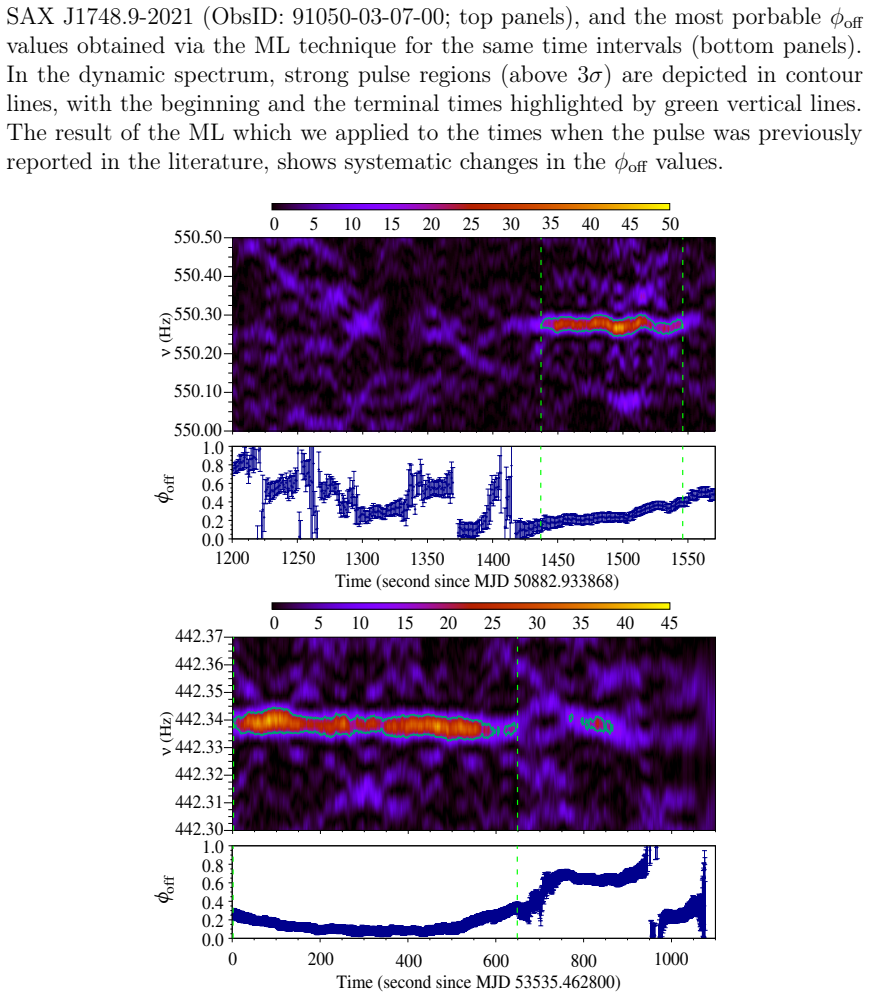
The engine of the analysis is a maximum-likelihood phase-offset estimator: a pulse profile obtained from a $Z_1^2$-detected segment is smoothed and normalized into a probability density over spin phase, and for each 25-second time bin the likelihood of a phase offset is computed from all photon phases, with the resulting offset distribution fitted by a Gaussian to give the most probable phase and its uncertainty. Tracking this offset over time reveals systematic phase drift caused by binary orbital motion even when the $Z_1^2$ power remains below the detection threshold. The $Z_1^2$ scan itself, with 25-second bins shifted by 1 second, supplies both the candidate pulse intervals and the template profiles that make the ML tracking possible.
What would settle it
Apply the same ML phase-tracking procedure to an RXTE/PCA observation of a source with no known pulsations and a similar count rate: if the phase-offset tracks show systematic, orbit-like wanderings comparable to those reported here, the detections could be noise artifacts. For the orbital period, an independent timing solution of SAX J1748.9-2021 from the 2015 XMM-Newton outburst that disagrees with $8.764 \pm 0.001$ hours would refute the updated period.
Extended reading notes
Core claim
The central discovery is that maximum-likelihood phase tracking, using a normalized pulse profile from a $Z_1^2$-detected segment as a probability density function, recovers coherent pulsations in time intervals where the $Z_1^2$ statistic alone gives no significant detection. For all three intermittent AMXPs, the ML-derived pulse-on durations are systematically longer than the $Z_1^2$-derived ones, and for SAX J1748.9-2021 the ML phase offsets trace a clean sinusoidal pattern across two datasets spanning intervals with no visible $Z_1^2$ power. The authors take these longer durations and coherent phase drifts as evidence that the transitions between pulse-on and pulse-off stages are smooth and can be continuous, with the pulse amplitude fading to undetectable levels rather than switching off sharply. Combining the turn-over points of the two phase-offset sinusoids with the literature cycle count yields an updated orbital period of $8.764 \pm 0.001$ hours for SAX J1748.9-2021.
Load-bearing premise
The pulse profile built from a $Z_1^2$-detected segment is assumed to remain a valid probability density for ML phase estimation in time intervals where $Z_1^2$ gives no significant detection; if the profile, spin frequency, or cycle count is slightly wrong, or if noise produces spurious phase offsets, the inferred smooth transitions and the orbital period are not supported.
Editorial extensions
If this is right
- Pulse-on intervals for these systems are longer than previously reported, so the standard sharp on/off picture underestimates the time a source spends pulsing.
- The maximum-likelihood phase-tracking method can be applied to other X-ray timing archives to recover weak pulsations that power-based searches miss.
- SAX J1748.9-2021's orbital period is refined to $8.764 \pm 0.001$ hours, a fractional improvement over the literature value used for the cycle count.
- Phase offsets that drift coherently in time can serve as a pulsation diagnostic even when $Z_1^2$ power is below threshold, making ML tracking a complement to power-spectrum searches.
- The transition between pulse-on and pulse-off stages is smooth and event-dependent rather than a universal sharp switch, so the underlying accretion geometry must vary.
Reading between the lines
- If smooth transitions are real, then the duty cycle of an intermittent AMXP is not an intrinsic source property but depends on detector sensitivity: a more sensitive instrument would catch pulses the current searches classify as off.
- The same template-based phase tracking could be applied to archival RXTE data of other LMXBs without known pulsations, using any tentative detection as a template to search for coherent phase drift.
- The correlation between transition type (sharp, smooth, continuous-weak) and X-ray luminosity or spectral state could be tested using the long-term light curves; the paper does not perform that correlation.
- If the orbital period is independently constrained by future outbursts, the ML phase-tracking technique may provide a way to measure period derivatives or apsidal motion for this source.
Editorial analysis
A structured set of objections, weighed in public.
Referee Report
Summary. The paper reports a systematic search for coherent X-ray pulsations from three intermittent accreting millisecond X-ray pulsars (Aql X-1, HETE J1900.1-2455, SAX J1748.9-2021) using all available RXTE/PCA data. A Z_1^2 scan over 25 s intervals with 1 s shifts is used to identify pulse candidates, followed by an RMS smoothness cut and Monte Carlo estimates of chance probabilities. For selected candidates, a maximum likelihood (ML) method is applied to track pulse phase offsets, using the Z_1^2-derived pulse profile as a probability density. The authors claim that the ML phase tracking reveals coherent pulsation persisting beyond the Z_1^2-detected intervals, implying smooth pulse-on/off transitions, and they use the phase-offset evolution in two RXTE observations of SAX J1748.9-2021 to derive an orbital period of 8.764 ± 0.001 hours.
Significance. If fully validated, the paper would provide useful new pulse detections for three intermittent-AMXPs and an interesting constraint on the transition mechanism between pulse-on and pulse-off states. The Z_1^2 search is systematic, covers 16 years of data, and includes Monte Carlo false-alarm estimates for the pulse candidates, which is a strength. However, the additional claims — the smooth transition inferred from ML phase offsets and the revised orbital period of SAX J1748.9-2021 — rest on ML phase estimates in intervals where Z_1^2 gives no significant detection, and no null-hypothesis validation is provided for those phase tracks. As presented, these claims are not yet quantitatively supported, which limits the significance of the paper in its current form.
major comments (4)
- [§2.3, Eq. (5); §3, Figs. 7-9] The ML phase-offset estimates are not accompanied by any likelihood-ratio test, false-alarm probability, or noise simulation. Equation (5) yields a best-fit phase offset for any photon realization, so a smoothly evolving or even turnover-containing phase curve can arise from noise or from a fixed frequency error. The paper's central claims — that ML phase offsets persist beyond the Z_1^2 intervals, that transitions are smooth, and that the phase pattern in Fig. 9 reflects orbital motion — depend on interpreting a smooth phase track as coherent pulsation. A concrete test would be to apply the identical ML procedure to simulated non-pulsed data with the same count rates and show that the inferred phase offsets do not produce similarly smooth, turnover-containing curves, or to compute a detection significance for phase coherence against the null hypothesis of constant phase.
- [§3, Fig. 9 and the orbital-period derivation] The orbital period of 8.764 ± 0.001 h is derived from two local maxima of the modified phase-offset curves, with the integer cycle count between them taken from the literature period of 8.85 h. The two parabolic segments in the bottom panels of Fig. 9 are fit over only ~0.035-day intervals, and a constant spin-frequency error produces exactly a quadratic phase residual over such a short span. The quoted ±0.001 h precision does not include the uncertainty in the assumed cycle count, and the derived value differs from the 8.85 h literature value by about 0.5 h, which is not addressed. The paper needs to demonstrate that the phase model is consistent across the full data span with the cycle count resolved, and that the derived period is not an artifact of local quadratic fits to a frequency-mismatch residual.
- [§2.3, Eq. (5)] The pulse profile used to construct the probability density in Eq. (5) is obtained from a Z_1^2-detected interval and is assumed to remain valid as the probability density for ML phase estimation in neighboring and non-detected intervals. This is an unvalidated assumption. If the profile, spin frequency, or cycle count is slightly wrong, or if the profile evolves between outbursts, the ML phase offsets will be biased, and the inferred smooth transitions and the orbital period will not be supported. The authors should test the robustness of the ML phase estimator with injected signals using the actual pulse profile, including cases with small frequency and profile mismatches.
- [§3, smooth-transition inference] The claim that ML pulse-on durations are 'slightly longer' than Z_1^2 durations and hence that transitions are smooth is based on a qualitative comparison of the extent of systematic phase evolution in a few examples (Figs. 7 and 8). No criterion is given for what constitutes a systematic phase change, no uncertainties are reported for the ML pulse-on durations, and the number of cases is small. The paper's conclusion that 'the transition between pulse-on and pulse-off stages are smooth' is load-bearing and requires a quantitative definition of pulse-on duration in the ML phase track, along with a statistical comparison to the Z_1^2 durations. Without this, the smooth-transition claim is not established.
minor comments (5)
- [§2.3, Eq. (5)] The quantity 'Prob(ϕoff)' in Eq. (5) is a likelihood, not a probability; it should be called the likelihood function or the joint likelihood, and the normalization should be clarified.
- [§2.2, Table 2] The 'chance probability' values in Table 2 are quoted as single-trial probabilities, while the simulations described later in §3 give global false-alarm rates; the relation between these two quantities should be stated explicitly.
- [§3, Fig. 9] There are typographical inconsistencies in the figure labels and text: '6035-02-03-00' for the ObsID, 'M method' instead of 'ML method', and 'Diving the time gap' instead of 'Dividing the time gap'.
- [§3] The sentence 'we performed the ML scan ~50 days around them' is inconsistent with the time ranges shown in Figs. 7-9, which cover hours rather than days; the scanned time window should be stated precisely.
- [§1, Table 1] In Table 1, the column header 'Burst oscillation frequency' is used for the spin frequency of the sources; this is potentially misleading because burst oscillations and coherent pulsations are distinct phenomena, and the notation should be corrected.
Circularity Check
No circular reduction: ML phase offsets are data-dependent and the orbital period is a standard ephemeris refinement; the main gap is statistical validation, not circularity.
full rationale
The derivation chain is not circular. The Z1^2 scan is an independent periodicity test, and the ML step uses the Z1^2-derived pulse profile only as a fixed template; Eq. (5) then yields phase offsets from the actual photon arrival times, so the offsets are data-dependent and not equal to the template by construction. The 'pulse-on duration via ML' and the smooth-transition claim rest on interpreting the time evolution of these offsets, not on the profile itself. The orbital period for SAX J1748.9-2021 is obtained from the time separation of two phase-curve turn-overs divided by an integer cycle count adopted from the literature period, which is a standard ephemeris-refinement step rather than a renaming of the input. No load-bearing result is justified by a self-citation; the cited Güngör et al. (2017) appears only as a physical interpretation of smooth transitions. The main weakness is statistical rather than circular: the ML phase estimator returns a best-fit phase for any data, and the paper reports no false-alarm probability or noise-only simulations for the phase track, so the smooth-transition and 8.764 h claims are less secure than presented. That is a calibration/validation gap, not a circular reduction.
Assumptions & free parameters
free parameters (4)
- Common Z1^2 power threshold =
25.0
- RMS pulse-profile smoothness limit =
1e-2
- ML phase step and profile bin width =
1e-4
- Frequency search ranges and step =
550.0-550.5, 336.0-338.0, 441.0-443.0 Hz with 1e-4 Hz step
assumptions (4)
- ad hoc to paper The pulse profile derived from a Z1^2-detected interval remains valid as the probability density for ML phase estimation in neighboring and non-detected intervals.
- domain assumption Spin frequency is constant over each scanned interval and orbital motion is sufficiently covered by scanning a narrow frequency range around the literature value.
- domain assumption The ML phase-offset probability distribution is Gaussian, so FWHM gives a valid uncertainty.
- domain assumption The literature orbital period is accurate enough to give an unambiguous integer cycle count between two phase maxima.
Cite this review
Pith. "Pith review of An Elaborate Search for Coherent Pulsations from Intermittent-AMXPs." pith.science (2026). https://pith.science/paper/JSKXLIFI
@misc{pith2026250203947,
  author       = {Pith},
  title        = {Pith review of: An Elaborate Search for Coherent Pulsations from Intermittent-AMXPs},
  year         = {2026},
  howpublished = {\url{https://pith.science/paper/JSKXLIFI}},
  note         = {Machine review of arXiv:2502.03947}
}
abstract
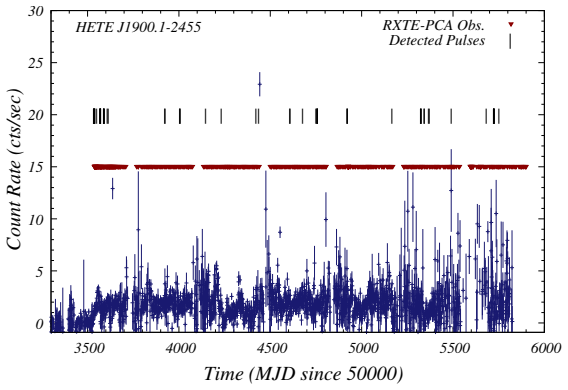
We present a detailed systematic pulse search for three Intermittent-Accreting Millisecond X-ray Pulsars (Intermittent-AMXPs), HETE J1900.1-2455, SAX J1748.9-2021 & Aql X-1, via Z$_1^2$ and maximum likelihood (ML) techniques by using 16 years data of Rossi X-ray Timing Explorer/Proportional Counter Array (RXTE/PCA) in the energy range of 3.0 - 13.0 keV. We first performed a pulse scan using the Z$_1^2$ technique in millisecond sensitivities for every 25 s time interval with 1 s shifts to cover all data set around the detected frequencies given in the literature. We tracked the Z$_1^2$ power over time and flagged the time intervals exceeding defined threshold levels for each source as \textit{pulse candidates}. The detected pulse list throughout our scan has new discoveries while covering the pulsed regions presented in the literature. For a deeper search, using the pulses obtained from the Z$_1^2$ method as a probability density function as an input parameter, we re-scanned the time intervals centered on the detected pulse via ML. The detected pulse-on duration via ML is slightly longer than the one via Z$_1^2$ method. This phenomenon allows us to argue for the existence of the smooth transition between pulse-on and pulse-off stages. For SAX J1748.9-2021, we also obtained orbital period by using the systematic pulse arrival phase patterns throughput of ML to be 8.76 hours.
Figures


Figures from the paper (6 more)




Reference graph
Works this paper leans on
-
[1]
Alpar, M.A., Cheng, A.F., Ruderman, M.A., Shaham, J., 1982. A new class of radio pulsars. Nature 300, 728–730. doi:10.1038/300728a0
doi:10.1038/300728a0 1982
-
[2]
Is GX5 - 1 a millisecond pulsar? Nature 316, 239–241
Alpar, M.A., Shaham, J., 1985. Is GX5 - 1 a millisecond pulsar? Nature 316, 239–241. doi:10.1038/316239a0
doi:10.1038/316239a0 1985
-
[3]
Altamirano, D., Casella, P., Patruno, A., Wijnands, R., van der Klis, M., 2008. In- termittent Millisecond X-Ray Pulsations from the Neutron Star X-Ray Transient SAX J1748.9-2021 in the Globular Cluster NGC 6440. ApJ 674, L45. doi:10.1086/528983, arXiv:0708.1316
work page Pith review arXiv 2008
-
[4]
Search for Intermittent X-ray Pulsations from Neutron Stars in Low Mass X-ray Binaries
Bahar, Y.E., Chakraborty, M., Göˇ güş, E., 2021. SearchforintermittentX-raypulsations from neutron stars in low-mass X-ray binaries. Publ. Astron. Soc. Australia 38, e011. doi:10.1017/pasa.2021.6, arXiv:2102.03132
work page Pith review arXiv 2021
-
[5]
Effect of an Electron Scattering Cloud on X-Ray Oscillations Produced by Beaming
Brainerd, J., Lamb, F.K., 1987. Effect of an Electron Scattering Cloud on X-Ray Oscillations Produced by Beaming. ApJ 317, L33. doi:10.1086/184908
-
[6]
20 Search for pulsed γ-ray emission from radio pulsars in the COS-B data
Buccheri, R., Bennett, K., Bignami, G.F., Bloemen, J.B.G.M., Boriakoff, V., Car- aveo, P.A., Hermsen, W., Kanbach, G., Manchester, R.N., Masnou, J.L., Mayer- Hasselwander, H.A., Özel, M.E., Paul, J.A., Sacco, B., Scarsi, L., Strong, A.W., 1983. 20 Search for pulsed γ-ray emission from radio pulsars in the COS-B data. A&A 128, 245–251
work page 1983
-
[7]
On Low Mass X-ray Binaries and Millisecond Pulsar
Burderi, L., DiSalvo, T., 2013. OnlowmassX-raybinariesandmillisecondpulsar. Mem. Soc. Astron. Italiana 84, 117. doi:10.48550/arXiv.1310.1283, arXiv:1310.1283
work page Pith review arXiv doi:10.48550/arxiv.1310.1283 2013
-
[8]
Discovery of Coherent Millisecond X-Ray Pulsations in Aquila X-1
Casella, P., Altamirano, D., Patruno, A., Wijnands, R., van der Klis, M., 2008. Discovery of Coherent Millisecond X-Ray Pulsations in Aquila X-1. ApJ 674, L41. doi:10.1086/528982, arXiv:0708.1110
arXiv 2008
Show all 34 references
-
[9]
Accreting Binaries; Nature, formation, and evolution
Chaty, S., 2022. Accreting Binaries; Nature, formation, and evolution. doi:10.1088/ 2514-3433/ac595f
2022
-
[10]
Discovery of a 19-hour period in Aquila X-1
Chevalier, C., Ilovaisky, S.A., 1991. Discovery of a 19-hour period in Aquila X-1. A&A 251, L11
1991
-
[11]
Magnetic Screening in Accreting Neutron Stars
Cumming, A., Zweibel, E., Bildsten, L., 2001. Magnetic Screening in Accreting Neutron Stars. ApJ 557, 958–966. doi:10.1086/321658, arXiv:astro-ph/0102178
2001 arXiv
-
[12]
A catalogue of low-mass X-ray binaries in the Galaxy: from the INTEGRAL to the Gaia era
Fortin, F., Kalsi, A., García, F., Chaty, S., 2024. A catalogue of low-mass X-ray binaries in the Galaxy: from the INTEGRAL to the Gaia era. arXiv e-prints , arXiv:2401.11931arXiv:2401.11931
2024 arXiv
-
[13]
Ther- monuclear (Type I) X-Ray Bursts Observed by the Rossi X-Ray Timing Explorer
Galloway, D.K., Muno, M.P., Hartman, J.M., Psaltis, D., Chakrabarty, D., 2008. Ther- monuclear (Type I) X-Ray Bursts Observed by the Rossi X-Ray Timing Explorer. ApJS 179, 360–422. doi:10.1086/592044, arXiv:astro-ph/0608259
2008 arXiv
-
[14]
Discovery of 442 Hz Pulsations from an X-Ray Source in the Globular Cluster NGC 6440
Gavriil, F.P., Strohmayer, T.E., Swank, J.H., Markwardt, C.B., 2007. Discovery of 442 Hz Pulsations from an X-Ray Source in the Globular Cluster NGC 6440. ApJ 669, L29–L32. doi:10.1086/523758, arXiv:0708.0829
2007 arXiv
-
[15]
Is the Lack of Pulsations in Low-Mass X- Ray Binaries due to Comptonizing Coronae? ApJ 659, 580–584
Göˇ güş, E., Alpar, M.A., Gilfanov, M., 2007. Is the Lack of Pulsations in Low-Mass X- Ray Binaries due to Comptonizing Coronae? ApJ 659, 580–584. doi:10.1086/512028, arXiv:astro-ph/0612680
2007 arXiv
-
[16]
Partial Accretion in the Propeller Stage of Low-mass X-Ray Binary Aql X-1
Güngör, C., Ekşi, K.Y., Göğüş, E., Güver, T., 2017. Partial Accretion in the Propeller Stage of Low-mass X-Ray Binary Aql X-1. ApJ 848, 13. doi: 10.3847/1538-4357/ aa8b76, arXiv:1709.02378
2017 arXiv
-
[17]
A new X-ray outburst in the globular cluster NGC 6440: SAX J1748.9-2021
in ’t Zand, J.J.M., Verbunt, F., Strohmayer, T.E., Bazzano, A., Cocchi, M., Heise, J., van Kerkwijk, M.H., Muller, J.M., Natalucci, L., Smith, M.J.S., Ubertini, P., 1999. A new X-ray outburst in the globular cluster NGC 6440: SAX J1748.9-2021. A&A 345, 100–108. doi:10.48550/ar...
-
[18]
The distances to galactic low-mass x-ray binaries: consequences for black hole luminosities and kicks
Jonker, P.G., Nelemans, G., 2004. The distances to galactic low-mass x-ray binaries: consequences for black hole luminosities and kicks. Monthly Notices of the Royal As- tronomical Society 354, 355–366
2004
-
[19]
Discovery of the Mil- lisecond X-Ray Pulsar HETE J1900.1-2455
Kaaret, P., Morgan, E.H., Vanderspek, R., Tomsick, J.A., 2006. Discovery of the Mil- lisecond X-Ray Pulsar HETE J1900.1-2455. ApJ 638, 963–967. doi:10.1086/498886, arXiv:astro-ph/0510483. 21
2006 arXiv
-
[20]
Discovery of x-ray bursts from aquila x-1
Koyama, K., Inoue, H., Makishima, K., Matsuoka, M., Murakami, T., Oda, M., Os- gawara, Y., Ohashi, T., Shibazaki, N., Tanaka, Y., et al., 1981. Discovery of x-ray bursts from aquila x-1. The Astrophysical Journal 247, L27–L29
1981
-
[21]
Accretion to magnetized stars through the Rayleigh-Taylor instability: global 3D simulations
Kulkarni, A.K., Romanova, M.M., 2008. Accretion to magnetized stars through the Rayleigh-Taylor instability: global 3D simulations. MNRAS 386, 673–687. doi: 10. 1111/j.1365-2966.2008.13094.x, arXiv:0802.1759
2008
-
[22]
TemporaleffectsofelectronscatteringontheoscillationsofanX-ray source
Kylafis, N.D., 1988. TemporaleffectsofelectronscatteringontheoscillationsofanX-ray source. Advances in Space Research 8, 455–458. doi:10.1016/0273-1177(88)90442-5
1988 doi
-
[23]
A Model for the Waveform Behavior of Accreting Mil- lisecond X-Ray Pulsars: Nearly Aligned Magnetic Fields and Moving Emission Regions
Lamb, F.K., Boutloukos, S., Van Wassenhove, S., Chamberlain, R.T., Lo, K.H., Clare, A., Yu, W., Miller, M.C., 2009a. A Model for the Waveform Behavior of Accreting Mil- lisecond X-Ray Pulsars: Nearly Aligned Magnetic Fields and Moving Emission Regions. ApJ 706, 417–435. doi:10...
-
[24]
Origin of Intermittent Accretion-Powered X-ray Oscillations in Neutron Stars with Millisecond Spin Periods
Lamb, F.K., Boutloukos, S., Van Wassenhove, S., Chamberlain, R.T., Lo, K.H., Miller, M.C., 2009b. Origin of Intermittent Accretion-Powered X-ray Oscillations in Neutron Stars with Millisecond Spin Periods. ApJ 705, L36–L39. doi:10.1088/0004-637X/705/ 1/L36, arXiv:0809.4016
-
[25]
X-ray and Radio Timing of the Pulsar in 3C 58
Livingstone, M.A., Ransom, S.M., Camilo, F., Kaspi, V.M., Lyne, A.G., Kramer, M., Stairs, I.H., 2009. X-ray and Radio Timing of the Pulsar in 3C 58. ApJ 706, 1163–1173. doi:10.1088/0004-637X/706/2/1163, arXiv:0901.2119
2009 arXiv
-
[26]
The donor of Aquila X-1 revealed by high-angular resolution near-infrared spectroscopy
Mata Sánchez, D., Muñoz-Darias, T., Casares, J., Jiménez-Ibarra, F., 2016. The donor of Aquila X-1 revealed by high-angular resolution near-infrared spectroscopy. Monthly Notices of the Royal Astronomical Society: Letters 464, L41–L45. URL:https://doi. org/10.1093/mnrasl/slw17...
2016 doi
-
[27]
Gravitational Light Bending near Neutron Stars
Meszaros, P., Riffert, H., 1988. Gravitational Light Bending near Neutron Stars. II. Accreting Pulsar Spectra as a Function of Phase. ApJ 327, 712. doi:10.1086/166227
1988 doi
-
[28]
The low galactic latitude metal-rich globular cluster NGC 6440
Ortolani, S., Barbuy, B., Bica, E., 1994. The low galactic latitude metal-rich globular cluster NGC 6440. A&AS 108, 653–659
1994
-
[29]
Phase-Coherent Timing of the Accreting Millisecond Pulsar SAX J1748.9-
Patruno, A., Altamirano, D., Hessels, J.W.T., Casella, P., Wijnands, R., van der Klis, M., 2009. Phase-Coherent Timing of the Accreting Millisecond Pulsar SAX J1748.9-
2009
-
[30]
UnstableDiskAccretiononto Magnetized Stars: First Global Three-dimensional Magnetohydrodynamic Simulations
Romanova, M.M., Kulkarni, A.K., Lovelace, R.V.E., 2008. UnstableDiskAccretiononto Magnetized Stars: First Global Three-dimensional Magnetohydrodynamic Simulations. ApJ 673, L171. doi:10.1086/527298, arXiv:0711.0418
2008 arXiv
-
[31]
Timing of the accreting millisecond pulsar SAX J1748.9-2021 during its 2015 outburst
Sanna, A., Burderi, L., Riggio, A., Pintore, F., Di Salvo, T., Gambino, A.F., Iaria, R., Matranga, M., Scarano, F., 2016. Timing of the accreting millisecond pulsar SAX J1748.9-2021 during its 2015 outburst. MNRAS 459, 1340–1349. doi:10.1093/mnras/ stw740, arXiv:1603.08757. 22
2016 arXiv
-
[32]
On the X-Ray Variability of Magnetar 1RXS J170849.0-400910
Scholz, P., Archibald, R.F., Kaspi, V.M., Ng, C.Y., Beardmore, A.P., Gehrels, N., Kennea, J.A., 2014. On the X-Ray Variability of Magnetar 1RXS J170849.0-400910. ApJ 783, 99. doi:10.1088/0004-637X/783/2/99, arXiv:1401.5000
2014 arXiv
-
[33]
Possible new X-ray burst source detected by HETE
Vanderspek, R., Morgan, E., Crew, G., Graziani, C., Suzuki, M., 2005. Possible new X-ray burst source detected by HETE. The Astronomer’s Telegram 516, 1. 23
2005
-
[2021]
doi:10.1088/0004-637X/690/2/1856, arXiv:0801.1031
ApJ 690, 1856–1865. doi:10.1088/0004-637X/690/2/1856, arXiv:0801.1031
Reviewed August 9, 2026 · model on record in the stance chip above.
Discussion (0). Continue with ORCID to comment.