Gauged Flavour for Asymmetric Dark Matter
Pith reviewed 2026-05-21 00:59 UTC · model grok-4.3
The pith
A gauged SO(3) flavour symmetry links the origins of Standard Model fermion mass hierarchies and asymmetric dark matter via leptogenesis and sphalerons.
A machine-rendered reading of the paper's core claim, the machinery that carries it, and where it could break.
Core claim
A gauged SO(3) flavour symmetry acting simultaneously on visible and dark sectors has its spontaneous breaking generate Standard Model fermion mass hierarchies while right-handed neutrino decays produce a lepton asymmetry that is converted by electroweak and flavour sphalerons into correlated baryon and dark matter asymmetries, with dark matter appearing as baryon-like states of a confining SU(3).
What carries the argument
Gauged SO(3) flavour symmetry whose spontaneous breaking sets fermion masses and whose associated sphalerons redistribute lepton asymmetry into dark matter asymmetry, together with a confining SU(3) that forms dark matter bound states.
If this is right
- Visible and dark matter mass scales are linked by the shared flavour symmetry and confining dynamics.
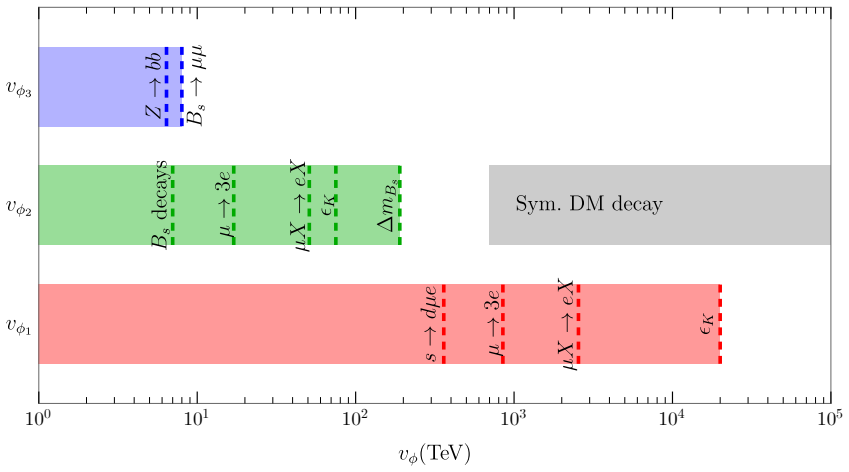
- K meson oscillations constrain the highest flavour-breaking scale while B_s observables constrain the intermediate scale.
- The lowest scale may bring some mirror fermions within reach of future colliders and is already tested by flavour-violating B_s decays and electroweak precision data.
- Flavour interactions must be sufficiently strong to ensure rapid decay of any symmetric dark matter component.
Where Pith is reading between the lines
- Flavour violation searches could indirectly limit the parameter space of dark matter production mechanisms.
- The same symmetry structure might be used to address neutrino mass generation in a unified way.
- Similar gauged flavour models could be constructed for other dark sector gauge groups.
Load-bearing premise
Anomaly cancellation requires mirror fermions that produce a seesaw-like suppression so that different flavour-breaking scales can be probed by separate observables without violating existing data.
What would settle it
Absence of the predicted deviations in K or B_s meson oscillations at the highest and intermediate scales, or non-observation of mirror fermions and flavour-violating B_s decays at the lowest scale.
Figures

read the original abstract
We propose a framework that links the origin of the Standard Model flavour hierarchies to the generation of asymmetric dark matter via leptogenesis. The key new ingredient is a gauged $SO(3)$ flavour symmetry acting on both the visible and dark sectors, whose spontaneous breaking generates fermion mass hierarchies. Right-handed neutrino decays produce a primordial lepton asymmetry, which is redistributed into baryon and dark matter asymmetries by electroweak and flavour sphalerons respectively. Dark matter arises as baryon-like bound states of a confining $SU(3)$, providing a natural rationale for the similar mass scales of visible and dark matter. We analyze flavour, collider, electroweak, and cosmological constraints. Anomaly cancellation requires the presence of mirror fermions, inducing a seesaw-like suppression of new physics effects in the lighter generations, such that different observables are sensitive to different flavour-breaking scales. Meson oscillations provide the dominant constraints, with $K$ and $B_s$ observables constraining the highest and intermediate scales, while the lowest scale may place some mirror fermions potentially within reach of future collider searches and is currently probed by flavour violating $B_s$ decays and electroweak observables. Flavour interactions are also bounded from below by the requirement of a sufficiently fast decay of the symmetric dark matter component, leading to a tightly constrained and predictive scenario testable through several complementary probes.
Editorial analysis
A structured set of objections, weighed in public.
Referee Report
Summary. The manuscript proposes a framework linking Standard Model flavour hierarchies to asymmetric dark matter via leptogenesis. A gauged SO(3) flavour symmetry acts on both visible and dark sectors; its spontaneous breaking generates fermion masses. Right-handed neutrino decays produce a lepton asymmetry redistributed by electroweak and flavour sphalerons into baryon and dark-matter asymmetries. Dark matter consists of baryon-like bound states of a confining SU(3). Anomaly cancellation requires mirror fermions that induce seesaw-like suppression, allowing different observables to probe different flavour-breaking scales. The authors analyze constraints from flavour physics, colliders, electroweak precision tests, and cosmology, claiming that flavour interactions are bounded from below by the need for rapid symmetric DM decay before BBN, resulting in a tightly constrained, predictive scenario.
Significance. If the scale choices prove consistent, the work provides a concrete link between the flavour problem and the origin of asymmetric dark matter, naturally explaining the comparable visible and dark matter densities. The framework yields testable predictions across meson oscillations, flavour-violating decays, electroweak observables, and collider searches for mirror fermions. The use of gauged flavour symmetry and sphaleron redistribution offers a falsifiable alternative to unrelated mechanisms for baryogenesis and dark matter.
major comments (1)
- [Abstract and constraints analysis] The central claim that the three flavour-breaking scales can be chosen to simultaneously (i) reproduce the observed fermion mass hierarchies, (ii) permit flavour sphalerons to redistribute the lepton asymmetry into the dark sector, and (iii) satisfy the cosmological lower bound from symmetric DM decay before BBN while respecting upper bounds from K and B_s meson mixing is load-bearing. The abstract states that meson oscillations provide the dominant constraints with K and B_s observables constraining the highest and intermediate scales, yet no explicit demonstration is given that a viable window exists once the seesaw suppression from mirror fermions and the requirement of sufficiently strong flavour interactions for DM decay are imposed together.
minor comments (2)
- [Abstract] The abstract refers to 'mirror fermions' and their seesaw-like suppression without a brief parenthetical explanation of how anomaly cancellation is achieved; adding one sentence would aid readers unfamiliar with the construction.
- [Constraints discussion] Notation for the three distinct flavour-breaking scales is introduced but not consistently labeled (e.g., as v1, v2, v3 or similar) when discussing which scale controls which observable; a short table or explicit mapping would improve clarity.
Simulated Author's Rebuttal
We thank the referee for their careful reading and constructive comments on our manuscript. We address the major comment below and have revised the manuscript to provide the requested explicit demonstration of the viable parameter space.
read point-by-point responses
-
Referee: [Abstract and constraints analysis] The central claim that the three flavour-breaking scales can be chosen to simultaneously (i) reproduce the observed fermion mass hierarchies, (ii) permit flavour sphalerons to redistribute the lepton asymmetry into the dark sector, and (iii) satisfy the cosmological lower bound from symmetric DM decay before BBN while respecting upper bounds from K and B_s meson mixing is load-bearing. The abstract states that meson oscillations provide the dominant constraints with K and B_s observables constraining the highest and intermediate scales, yet no explicit demonstration is given that a viable window exists once the seesaw suppression from mirror fermions and the requirement of sufficiently strong flavour interactions for DM decay are imposed together.
Authors: We thank the referee for highlighting this important point. While the original manuscript discusses the individual constraints from meson mixing, electroweak precision, colliders, and cosmology, and notes that the seesaw suppression from mirror fermions allows different observables to probe different scales, we agree that an explicit combined demonstration of a viable window strengthens the central claim. In the revised manuscript we have added a new subsection that performs a joint analysis: we scan over the three flavour-breaking scales, incorporating the seesaw factors for lighter generations, the conditions for flavour sphalerons to redistribute the asymmetry, the lower bound on flavour interaction strength from symmetric DM decay before BBN, and the upper bounds from K and B_s mixing. This scan confirms the existence of a non-empty parameter region satisfying all requirements simultaneously. We have also updated the abstract to reference this explicit check. revision: yes
Circularity Check
No significant circularity; derivation chain is self-contained
full rationale
The paper constructs a model with gauged SO(3) flavour symmetry whose spontaneous breaking generates fermion mass hierarchies and enables asymmetry redistribution via sphalerons and leptogenesis, with DM as SU(3) bound states. These steps follow directly from the stated gauge structure, anomaly cancellation requiring mirror fermions, and standard sphaleron dynamics without any quoted reduction of a prediction to a fitted input or self-citation chain. Meson-mixing constraints and the lower bound on flavour interactions from symmetric DM decay are presented as external bounds rather than inputs that force the central results by construction. The framework therefore remains independent of its own outputs.
Axiom & Free-Parameter Ledger
free parameters (1)
- flavour breaking scales
axioms (2)
- domain assumption Anomaly cancellation requires mirror fermions with seesaw-like suppression in lighter generations.
- domain assumption Flavour sphalerons redistribute the lepton asymmetry into dark matter asymmetry.
invented entities (3)
-
Gauged SO(3) flavour symmetry acting on dark sector
no independent evidence
-
Confining SU(3) for dark matter bound states
no independent evidence
-
Mirror fermions
no independent evidence
Lean theorems connected to this paper
-
IndisputableMonolith/Cost/FunctionalEquation.leanwashburn_uniqueness_aczel unclear?
unclearRelation between the paper passage and the cited Recognition theorem.
gauged SO(3) flavour symmetry acting on both the visible and dark sectors, whose spontaneous breaking generates fermion mass hierarchies... mirror fermions, inducing a seesaw-like suppression
-
IndisputableMonolith/Foundation/DimensionForcing.leanalexander_duality_circle_linking unclear?
unclearRelation between the paper passage and the cited Recognition theorem.
flavour sphalerons... redistribute... lepton asymmetry... DM arises as baryon-like bound states of a confining SU(3)
What do these tags mean?
- matches
- The paper's claim is directly supported by a theorem in the formal canon.
- supports
- The theorem supports part of the paper's argument, but the paper may add assumptions or extra steps.
- extends
- The paper goes beyond the formal theorem; the theorem is a base layer rather than the whole result.
- uses
- The paper appears to rely on the theorem as machinery.
- contradicts
- The paper's claim conflicts with a theorem or certificate in the canon.
- unclear
- Pith found a possible connection, but the passage is too broad, indirect, or ambiguous to say the theorem truly supports the claim.
Reference graph
Works this paper leans on
-
[1]
Minkowski,µ→eγat a Rate of One Out of10 9 Muon Decays?,Phys
P. Minkowski,µ→eγat a Rate of One Out of10 9 Muon Decays?,Phys. Lett. B67(1977) 421–428
work page 1977
-
[2]
R. N. Mohapatra and G. Senjanovic,Neutrino Mass and Spontaneous Parity Nonconservation,Phys. Rev. Lett.44(1980) 912
work page 1980
-
[3]
Yanagida,Horizontal gauge symmetry and masses of neutrinos,Conf
T. Yanagida,Horizontal gauge symmetry and masses of neutrinos,Conf. Proc. C7902131 (1979) 95–99
work page 1979
-
[4]
Complex Spinors and Unified Theories
M. Gell-Mann, P. Ramond, and R. Slansky,Complex Spinors and Unified Theories,Conf. Proc. C790927(1979) 315–321, [arXiv:1306.4669]
work page internal anchor Pith review Pith/arXiv arXiv 1979
-
[5]
M. Fukugita and T. Yanagida,Baryogenesis Without Grand Unification,Phys. Lett. B174 (1986) 45–47
work page 1986
-
[6]
S. Nussinov,TECHNOCOSMOLOGY: COULD A TECHNIBARYON EXCESS PROVIDE A ’NATURAL’ MISSING MASS CANDIDATE?,Phys. Lett. B165(1985) 55–58
work page 1985
-
[7]
S. M. Barr, R. S. Chivukula, and E. Farhi,Electroweak Fermion Number Violation and the Production of Stable Particles in the Early Universe,Phys. Lett. B241(1990) 387–391
work page 1990
-
[8]
S. M. Barr,Baryogenesis, sphalerons and the cogeneration of dark matter,Phys. Rev. D44 (1991) 3062–3066
work page 1991
-
[9]
D. B. Kaplan,A Single explanation for both the baryon and dark matter densities,Phys. Rev. Lett.68(1992) 741–743
work page 1992
-
[10]
On Relating the Genesis of Cosmic Baryons and Dark Matter
H. Davoudiasl and R. N. Mohapatra,On Relating the Genesis of Cosmic Baryons and Dark Matter,New J. Phys.14(2012) 095011, [arXiv:1203.1247]
work page internal anchor Pith review Pith/arXiv arXiv 2012
-
[11]
Review of asymmetric dark matter
K. Petraki and R. R. Volkas,Review of asymmetric dark matter,Int. J. Mod. Phys. A28 (2013) 1330028, [arXiv:1305.4939]
work page internal anchor Pith review Pith/arXiv arXiv 2013
-
[12]
K. M. Zurek,Asymmetric Dark Matter: Theories, Signatures, and Constraints,Phys. Rept. 537(2014) 91–121, [arXiv:1308.0338]. 19
work page internal anchor Pith review Pith/arXiv arXiv 2014
-
[13]
P.-H. Gu, U. Sarkar, and X. Zhang,Visible and Dark Matter Genesis and Cosmic Positron/Electron Excesses,Phys. Rev. D80(2009) 076003, [arXiv:0906.3103]
work page internal anchor Pith review Pith/arXiv arXiv 2009
-
[14]
Common Origin of Visible and Dark Universe
P.-H. Gu and U. Sarkar,Common Origin of Visible and Dark Universe,Phys. Rev. D81 (2010) 033001, [arXiv:0909.5463]
work page internal anchor Pith review Pith/arXiv arXiv 2010
-
[15]
Leptogenesis as a Common Origin for Matter and Dark Matter
H. An, S.-L. Chen, R. N. Mohapatra, and Y. Zhang,Leptogenesis as a Common Origin for Matter and Dark Matter,JHEP03(2010) 124, [arXiv:0911.4463]
work page internal anchor Pith review Pith/arXiv arXiv 2010
-
[16]
E. J. Chun,Leptogenesis origin of Dirac gaugino dark matter,Phys. Rev. D83(2011) 053004, [arXiv:1009.0983]
work page internal anchor Pith review Pith/arXiv arXiv 2011
-
[17]
Aidnogenesis via Leptogenesis and Dark Sphalerons
M. Blennow, B. Dasgupta, E. Fernandez-Martinez, and N. Rius,Aidnogenesis via Leptogenesis and Dark Sphalerons,JHEP03(2011) 014, [arXiv:1009.3159]
work page internal anchor Pith review Pith/arXiv arXiv 2011
-
[18]
Asymmetric Dark Matter from Leptogenesis
A. Falkowski, J. T. Ruderman, and T. Volansky,Asymmetric Dark Matter from Leptogenesis, JHEP05(2011) 106, [arXiv:1101.4936]
work page internal anchor Pith review Pith/arXiv arXiv 2011
-
[19]
Dark matter assisted Dirac leptogenesis and neutrino mass
N. Narendra, N. Sahoo, and N. Sahu,Dark matter assisted Dirac leptogenesis and neutrino mass,Nucl. Phys. B936(2018) 76–90, [arXiv:1712.02960]
work page internal anchor Pith review Pith/arXiv arXiv 2018
-
[20]
N. Narendra, S. Patra, N. Sahu, and S. Shil,Baryogenesis via Leptogenesis from Asymmetric Dark Matter and radiatively generated Neutrino mass,Phys. Rev. D98(2018), no. 9 095016, [arXiv:1805.04860]
-
[21]
N. Narendra, S. Patra, N. Sahu, and S. Shil,Baryogenesis via Leptogenesis from Asymmetric Dark Matter Using Higher Dimension Operator,Springer Proc. Phys.234(2019) 335–340
work page 2019
- [22]
-
[23]
S. Mahapatra, P. K. Paul, N. Sahu, and P. Shukla,Asymmetric long-lived dark matter and leptogenesis from the type-III seesaw framework,Phys. Rev. D111(2025), no. 1 015043, [arXiv:2305.11138]
- [24]
-
[25]
H. Takahashi and J. Wada,Asymmetric Dark Matter from Low-Scale Spontaneous Leptogenesis,arXiv:2601.01849
- [26]
-
[27]
A three-site gauge model for flavor hierarchies and flavor anomalies
M. Bordone, C. Cornella, J. Fuentes-Martin, and G. Isidori,A three-site gauge model for flavor hierarchies and flavor anomalies,Phys. Lett. B779(2018) 317–323, [arXiv:1712.01368]
work page internal anchor Pith review Pith/arXiv arXiv 2018
-
[28]
M. Fernández Navarro and S. F. King,Tri-hypercharge: a separate gauged weak hypercharge for each fermion family as the origin of flavour,JHEP08(2023) 020, [arXiv:2305.07690]
-
[29]
B. Capdevila, A. Crivellin, J. M. Lizana, and S. Pokorski,SU(2)L deconstruction and flavour (non)-universality,JHEP08(2024) 031, [arXiv:2401.00848]. 20
-
[30]
J. Fuentes-Martín and J. M. Lizana,Deconstructing flavor anomalously,JHEP07(2024) 117, [arXiv:2402.09507]
- [31]
- [32]
-
[33]
J. Davighi and G. Isidori,A Composite Theory of Higgs and Flavour,arXiv:2512.19650
-
[34]
D. B. Kaplan,Flavor at SSC energies: A New mechanism for dynamically generated fermion masses,Nucl. Phys. B365(1991) 259–278
work page 1991
-
[35]
Neutrino masses and mixings in non-factorizable geometry
Y. Grossman and M. Neubert,Neutrino masses and mixings in nonfactorizable geometry, Phys. Lett. B474(2000) 361–371, [hep-ph/9912408]
work page internal anchor Pith review Pith/arXiv arXiv 2000
-
[36]
Bulk Fields and Supersymmetry in a Slice of AdS
T. Gherghetta and A. Pomarol,Bulk fields and supersymmetry in a slice of AdS,Nucl. Phys. B586(2000) 141–162, [hep-ph/0003129]
work page internal anchor Pith review Pith/arXiv arXiv 2000
-
[37]
Z. G. Berezhiani and R. Rattazzi,Inverse hierarchy approach to fermion masses,Nucl. Phys. B407(1993) 249–270, [hep-ph/9212245]
work page internal anchor Pith review Pith/arXiv arXiv 1993
-
[38]
Fermion masses and mixings in a flavour symmetric GUT
R. Barbieri, G. R. Dvali, and A. Strumia,Fermion masses and mixings in a flavor symmetric GUT,Nucl. Phys. B435(1995) 102–114, [hep-ph/9407239]
work page internal anchor Pith review Pith/arXiv arXiv 1995
-
[39]
Flavor hierarchies from dynamical scales
G. Panico and A. Pomarol,Flavor hierarchies from dynamical scales,JHEP07(2016) 097, [arXiv:1603.06609]
work page internal anchor Pith review Pith/arXiv arXiv 2016
-
[40]
J. Fuentes-Martin, G. Isidori, J. M. Lizana, N. Selimovic, and B. A. Stefanek,Flavor hierarchies, flavor anomalies, and Higgs mass from a warped extra dimension,Phys. Lett. B 834(2022) 137382, [arXiv:2203.01952]
-
[41]
C. D. Froggatt and H. B. Nielsen,Hierarchy of Quark Masses, Cabibbo Angles and CP Violation,Nucl. Phys. B147(1979) 277–298
work page 1979
-
[42]
S. F. King and G. G. Ross,Fermion masses and mixing angles from SU (3) family symmetry and unification,Phys. Lett. B574(2003) 239–252, [hep-ph/0307190]
work page internal anchor Pith review Pith/arXiv arXiv 2003
-
[43]
R. T. D’Agnolo and D. M. Straub,Gauged flavour symmetry for the light generations,JHEP 05(2012) 034, [arXiv:1202.4759]
work page internal anchor Pith review Pith/arXiv arXiv 2012
-
[44]
A. Greljo and A. E. Thomsen,Rising through the ranks: flavor hierarchies from a gauged SU(2) symmetry,Eur. Phys. J. C84(2024), no. 2 213, [arXiv:2309.11547]
- [45]
-
[46]
Low Scale Flavor Gauge Symmetries
B. Grinstein, M. Redi, and G. Villadoro,Low Scale Flavor Gauge Symmetries,JHEP11 (2010) 067, [arXiv:1009.2049]
work page internal anchor Pith review Pith/arXiv arXiv 2010
-
[47]
R. Alonso, E. Fernandez Martinez, M. B. Gavela, B. Grinstein, L. Merlo, and P. Quilez, Gauged Lepton Flavour,JHEP12(2016) 119, [arXiv:1609.05902]
work page internal anchor Pith review Pith/arXiv arXiv 2016
-
[48]
S. Antusch, A. Greljo, B. A. Stefanek, and A. E. Thomsen,U(2) Is Right for Leptons and Left for Quarks,Phys. Rev. Lett.132(2024), no. 15 151802, [arXiv:2311.09288]. 21
- [49]
-
[50]
On The Potential of Minimal Flavour Violation
R. Alonso, M. B. Gavela, L. Merlo, and S. Rigolin,On the scalar potential of minimal flavour violation,JHEP07(2011) 012, [arXiv:1103.2915]
work page internal anchor Pith review Pith/arXiv arXiv 2011
- [51]
-
[52]
J. Fuentes-Martín, P. Ruiz-Femenía, A. Vicente, and J. Virto,DsixTools 2.0: the effective field theory toolkit,The European Physical Journal C81(2021)
work page 2021
-
[53]
Model-independent constraints on Delta F=2 operators and the scale of New Physics
“Flavor Constraints on new physics.”https://agenda.infn.it/event/14377/ contributions/24434/attachments/17481/19830/silvestriniLaThuile.pdf. La Thuile 2018. [54]UTfitCollaboration, M. Bona et al.,Model-independent constraints on∆F= 2operators and the scale of new physics,JHEP03(2008) 049, [arXiv:0707.0636]
work page internal anchor Pith review Pith/arXiv arXiv 2018
-
[54]
Weak Decays Beyond Leading Logarithms
G. Buchalla, A. J. Buras, and M. E. Lautenbacher,Weak Decays beyond Leading Logarithms, Rev. Mod. Phys.68(1996) 1125–1144, [hep-ph/9512380]. [56]LHCbCollaboration, R. Aaij et al.,Precise determination of theB 0 s–B 0 s oscillation frequency,Nature Phys.18(2022), no. 1 1–5, [arXiv:2104.04421]
work page internal anchor Pith review Pith/arXiv arXiv 1996
-
[55]
L. Di Luzio, M. Kirk, A. Lenz, and T. Rauh,∆Ms theory precision confronts flavour anomalies,JHEP12(2019) 009, [arXiv:1909.11087]
-
[56]
Detailed calculation of lepton flavor violating muon-electron conversion rate for various nuclei
R. Kitano, M. Koike, and Y. Okada,Detailed calculation of lepton flavor violating muon electron conversion rate for various nuclei,Phys. Rev. D66(2002) 096002, [hep-ph/0203110]. [Erratum: Phys.Rev.D 76, 059902 (2007)]. [59]SINDRUM IICollaboration, W. H. Bertl et al.,A Search for muon to electron conversion in muonic gold,Eur. Phys. J. C47(2006) 337–346. [...
work page internal anchor Pith review Pith/arXiv arXiv 2002
-
[57]
V. Bresó-Pla, A. Falkowski, and M. González-Alonso,AF B in the SMEFT: precision Z physics at the LHC,JHEP08(2021) 021, [arXiv:2103.12074]. [65]ATLASCollaboration, G. Aad et al.,Climbing to the Top of the ATLAS 13 TeV data,Phys. Rept.1116(2025) 127–183, [arXiv:2404.10674]. 22
-
[58]
F. Cornet-Gomez, V. Miralles, M. Miralles López, M. Moreno Llácer, and M. Vos,Future collider constraints on top-quark operators,JHEP10(2025) 156, [arXiv:2503.11518]
- [59]
-
[60]
Electroweak symmetry breaking after LEP1 and LEP2
R. Barbieri, A. Pomarol, R. Rattazzi, and A. Strumia,Electroweak symmetry breaking after LEP-1 and LEP-2,Nucl. Phys. B703(2004) 127–146, [hep-ph/0405040]
work page internal anchor Pith review Pith/arXiv arXiv 2004
-
[61]
E. Bagnaschi, J. Ellis, M. Madigan, K. Mimasu, V. Sanz, and T. You,SMEFT analysis of mW,JHEP08(2022) 308, [arXiv:2204.05260]
- [62]
-
[63]
L. Allwicher, C. Cornella, G. Isidori, and B. A. Stefanek,New physics in the third generation. A comprehensive SMEFT analysis and future prospects,JHEP03(2024) 049, [arXiv:2311.00020]. [72]Mu3eCollaboration, G. Hesketh, S. Hughes, A.-K. Perrevoort, and N. Rompotis,The Mu3e Experiment, inSnowmass 2021, 4, 2022.arXiv:2204.00001
-
[64]
The Sphaleron Rate in the Minimal Standard Model
M. D’Onofrio, K. Rummukainen, and A. Tranberg,Sphaleron Rate in the Minimal Standard Model,Phys. Rev. Lett.113(2014), no. 14 141602, [arXiv:1404.3565]
work page internal anchor Pith review Pith/arXiv arXiv 2014
-
[65]
J. A. Harvey and M. S. Turner,Cosmological Baryon and Lepton Number in the Presence of Electroweak Fermion Number Violation,Phys. Rev. D42(1990) 3344–3349. [75]PlanckCollaboration, N. Aghanim et al.,Planck 2018 results. VI. Cosmological parameters, Astron. Astrophys.641(2020) A6, [arXiv:1807.06209]. [Erratum: Astron.Astrophys. 652, C4 (2021)]
work page internal anchor Pith review Pith/arXiv arXiv 1990
-
[66]
Big-Bang Nucleosynthesis and Hadronic Decay of Long-Lived Massive Particles
M. Kawasaki, K. Kohri, and T. Moroi,Big-Bang nucleosynthesis and hadronic decay of long-lived massive particles,Phys. Rev. D71(2005) 083502, [astro-ph/0408426]
work page internal anchor Pith review Pith/arXiv arXiv 2005
-
[67]
Dark Matter Self-interactions and Small Scale Structure
S. Tulin and H.-B. Yu,Dark Matter Self-interactions and Small Scale Structure,Phys. Rept. 730(2018) 1–57, [arXiv:1705.02358]
work page internal anchor Pith review Pith/arXiv arXiv 2018
-
[68]
Adhikari et al.,Astrophysical tests of dark matter self-interactions,Rev
S. Adhikari et al.,Astrophysical tests of dark matter self-interactions,Rev. Mod. Phys.97 (2025), no. 4 045004, [arXiv:2207.10638]
-
[69]
J. de Blas et al.,Physics Briefing Book: Input for the 2026 update of the European Strategy for Particle Physics,arXiv:2511.03883. [80]BNLCollaboration, D. Ambrose et al.,New limit on muon and electron lepton number violation from K0(L) —>mu+- e-+ decay,Phys. Rev. Lett.81(1998) 5734–5737, [hep-ex/9811038]
-
[70]
Low-energy signatures of the $\mathrm{PS}^3$ model: from $B$-physics anomalies to LFV
M. Bordone, C. Cornella, J. Fuentes-Martín, and G. Isidori,Low-energy signatures of thePS3 model: fromB-physics anomalies to LFV,JHEP10(2018) 148, [arXiv:1805.09328]. [82]LHCbCollaboration, R. Aaij et al.,Search for the lepton-flavour-violating decays B0 s →τ ±µ∓ andB 0 →τ ±µ∓,Phys. Rev. Lett.123(2019), no. 21 211801, [arXiv:1905.06614]. 23 [83]Belle, Bel...
work page internal anchor Pith review Pith/arXiv arXiv 2018
-
[71]
Lepton Flavor Violation in the Standard Model with general Dimension-Six Operators
A. Crivellin, S. Najjari, and J. Rosiek,Lepton Flavor Violation in the Standard Model with general Dimension-Six Operators,JHEP04(2014) 167, [arXiv:1312.0634]. [85]HFLAVCollaboration, Y. S. Amhis et al.,Averages of b-hadron, c-hadron, andτ-lepton properties as of 2018,Eur. Phys. J. C81(2021), no. 3 226, [arXiv:1909.12524]. [86]SINDRUMCollaboration, U. Bel...
work page internal anchor Pith review Pith/arXiv arXiv 2014
-
[72]
G. Isidori, Z. Polonsky, and A. Tinari,Semi-inclusive b→sℓ¯ℓtransitions at high q2,Phys. Rev. D108(2023), no. 9 093008, [arXiv:2305.03076]. [88]Particle Data GroupCollaboration, S. Navas et al.,Review of particle physics,Phys. Rev. D110(2024), no. 3 030001
-
[73]
M. Czaja and M. Misiak,Current Status of the Standard Model Prediction for the Bs → µ+µ− Branching Ratio,Symmetry16(2024), no. 7 917, [arXiv:2407.03810]. 24
discussion (0)
Sign in with ORCID, Apple, or X to comment. Anyone can read and Pith papers without signing in.