Enhancing the Instantaneous Bandwidth of Rydberg Microwave Sensors: A Proposed Scheme
Pith reviewed 2026-06-25 19:43 UTC · model grok-4.3
The pith
An auxiliary microwave field boosts Rydberg sensor instantaneous bandwidth to 44.6 MHz while holding sensitivity at 225.7 nV cm^{-1} Hz^{-1/2}.
A machine-rendered reading of the paper's core claim, the machinery that carries it, and where it could break.
Core claim
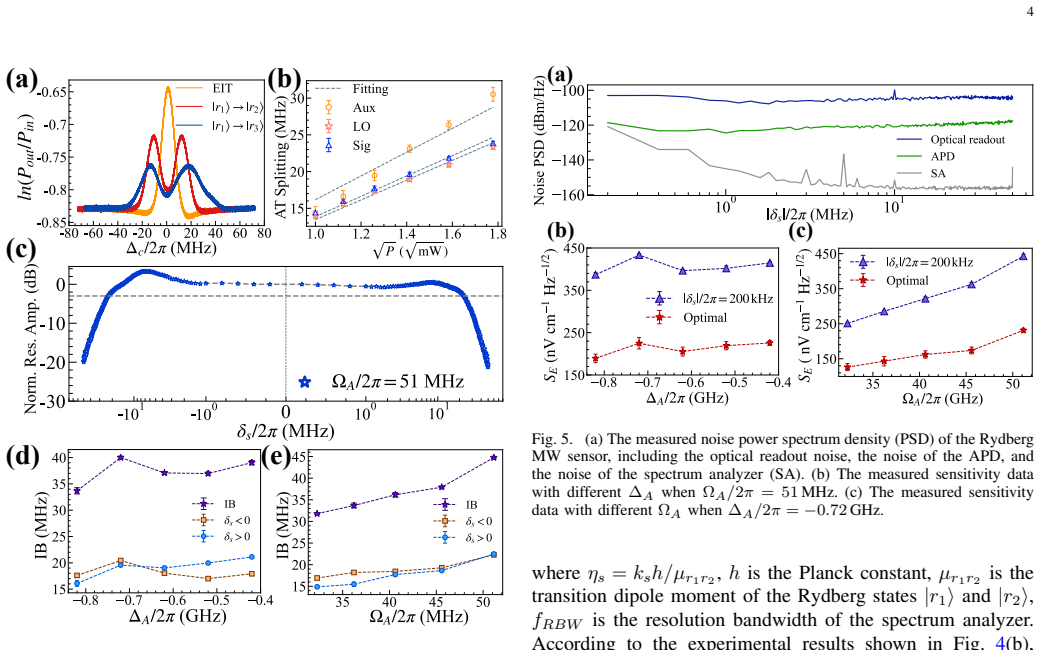
By introducing an auxiliary microwave field, Rydberg microwave sensors overcome the sensitivity-bandwidth trade-off and reach an instantaneous bandwidth of 44.6 MHz (±22.3 MHz) while achieving a sensitivity of 225.7 nV cm^{-1} Hz^{-1/2}.
What carries the argument
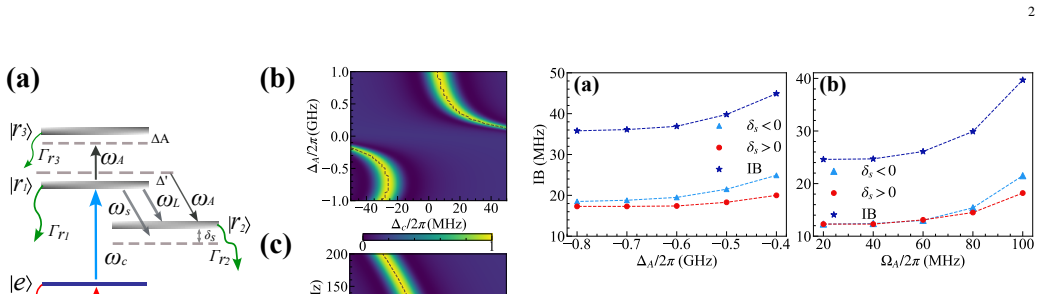
An auxiliary microwave field that broadens the atomic response bandwidth through controlled interaction.
If this is right
- The scheme simultaneously optimizes instantaneous bandwidth and sensitivity.
- Rydberg microwave sensors become more suitable for radar and communications.
- The experimental demonstration shows the bandwidth increase occurs without sensitivity loss.
- A new pathway exists for practical deployment of these sensors.
Where Pith is reading between the lines
- The method could support higher data-rate signals in communication systems without hardware changes.
- Similar auxiliary-field control might extend to other atomic or molecular sensing platforms.
- Further tuning of the auxiliary field strength could test whether bandwidth can increase beyond 44.6 MHz at the same sensitivity.
Load-bearing premise
The auxiliary microwave field broadens the atomic response bandwidth through a controlled interaction that does not introduce additional noise sources or require experimental conditions that would prevent practical deployment.
What would settle it
A direct measurement in which sensitivity falls below 225.7 nV cm^{-1} Hz^{-1/2} when the auxiliary field produces 44.6 MHz bandwidth would falsify the central claim.
Figures
read the original abstract
Rydberg atoms have emerged as a highly promising platform for microwave electric field sensing. Their practical deployment as next-generation sensors is fundamentally limited by the inherent trade-off between sensitivity and instantaneous bandwidth: enhancing instantaneous bandwidth while preserving high sensitivity remains a long-standing challenge in the field. Here we propose and experimentally demonstrate a novel scheme to overcome this limitation by introducing an auxiliary microwave field. This approach achieves a significant enhancement in instantaneous bandwidth while maintaining a high level sensitivity. Our experimental results demonstrate that an instantaneous bandwidth of 44.6$\,$MHz ($\pm$22.3$\,$MHz) is realized while achieving a sensitivity of 225.7$\,$nV$\,$cm$^{-1}\,$Hz$^{-1/2}$. This work provides a new pathway to simultaneously optimize the instantaneous bandwidth and sensitivity of Rydberg microwave sensors, facilitating their practical applications in radar and communications.
Editorial analysis
A structured set of objections, weighed in public.
Referee Report
Summary. The manuscript proposes and experimentally demonstrates a scheme to overcome the sensitivity-bandwidth trade-off in Rydberg-atom microwave electric-field sensors by applying an auxiliary microwave field. The central experimental result is an instantaneous bandwidth of 44.6 MHz (±22.3 MHz) achieved together with a sensitivity of 225.7 nV cm^{-1} Hz^{-1/2}.
Significance. If the auxiliary-field interaction truly broadens the response without introducing additional noise or decoherence, the result would constitute a meaningful advance for Rydberg sensors, directly addressing a long-standing limitation for radar and communications applications.
major comments (1)
- [Results section] The claim that the auxiliary microwave field broadens the instantaneous bandwidth while preserving the quoted sensitivity without added noise is load-bearing. The manuscript does not report a direct comparison of the noise spectral density, coherence time, or AC-Stark-shift measurements performed with and without the auxiliary field (Results section), leaving open the possibility that the reported sensitivity is shifted rather than truly maintained.
minor comments (1)
- [Abstract] The abstract contains the typographical phrasing 'high level sensitivity'; this should be corrected to 'high sensitivity'.
Simulated Author's Rebuttal
We thank the referee for their thoughtful review and for highlighting an important point regarding the presentation of our experimental results. We address the major comment below and commit to strengthening the manuscript accordingly.
read point-by-point responses
-
Referee: [Results section] The claim that the auxiliary microwave field broadens the instantaneous bandwidth while preserving the quoted sensitivity without added noise is load-bearing. The manuscript does not report a direct comparison of the noise spectral density, coherence time, or AC-Stark-shift measurements performed with and without the auxiliary field (Results section), leaving open the possibility that the reported sensitivity is shifted rather than truly maintained.
Authors: We agree that the absence of explicit side-by-side comparisons of noise spectral density, coherence time, and AC-Stark shifts (with versus without the auxiliary field) leaves the claim open to the interpretation raised by the referee. The quoted sensitivity of 225.7 nV cm^{-1} Hz^{-1/2} was measured under the operating condition that includes the auxiliary field, which is the relevant configuration for the reported 44.6 MHz bandwidth. Nevertheless, the manuscript would be strengthened by the addition of these comparative data. We will therefore include new measurements of noise spectral density, coherence time, and AC-Stark shifts performed both with and without the auxiliary field in a revised Results section (and, if appropriate, in an expanded Methods section) to demonstrate that the auxiliary field does not introduce measurable additional noise or decoherence. revision: yes
Circularity Check
No circularity: experimental demonstration of auxiliary-field scheme
full rationale
The paper presents a proposed scheme and reports measured experimental values (44.6 MHz bandwidth at 225.7 nV cm^{-1} Hz^{-1/2} sensitivity) rather than any first-principles derivation or prediction that reduces to fitted inputs or self-citations. No load-bearing equations, ansatzes, or uniqueness theorems are invoked that collapse to the reported results by construction. The central claim rests on laboratory data, which is externally falsifiable and independent of the paper's own modeling.
Axiom & Free-Parameter Ledger
Reference graph
Works this paper leans on
-
[1]
Role of radar in microwaves,
M. Skolnik, “Role of radar in microwaves,”IEEE Trans. Microwave Theory Tech., vol. 50, no. 3, pp. 625–632, 2002. 5
2002
-
[2]
Microwave photonic radars,
S. Pan and Y . Zhang, “Microwave photonic radars,”J. Lightwave Technol., vol. 38, no. 19, pp. 5450–5484, 2020
2020
-
[3]
Microwave communications-an historical perspective,
H. Sobol, “Microwave communications-an historical perspective,”IEEE Trans. Microwave Theory Tech., vol. 32, no. 9, pp. 1170–1181, 1984
1984
-
[4]
Digital microwave receiver technology,
J. B. Tsui and J. P. Stephens, “Digital microwave receiver technology,” IEEE Trans. Microwave Theory Tech., vol. 50, no. 3, pp. 699–705, 2002
2002
-
[5]
Quantum information with Rydberg atoms,
M. Saffman, T. G. Walker, and K. Mølmer, “Quantum information with Rydberg atoms,”Rev. Mod. Phys., vol. 82, no. 3, pp. 2313–2363, 2010
2010
-
[6]
Atom based RF electric field sensing,
H. Fan, S. Kumar, J. Sedlacek, H. K ¨ubler, S. Karimkashi, and J. P. Shaffer, “Atom based RF electric field sensing,”J. Phys. B:At., Mol. Opt. Phys., vol. 48, no. 20, p. 202001, 2015
2015
-
[7]
Quantum sensing of microwave electric fields based on Rydberg atoms,
J. Yuan, W. Yang, M. Jing, H. Zhang, Y . Jiao, W. Li, L. Zhang, L. Xiao, and S. Jia, “Quantum sensing of microwave electric fields based on Rydberg atoms,”Rep. Prog. Phys., 2023
2023
-
[8]
Rydberg states of alkali atoms in atomic vapour as SI-traceable field probes and communications receivers,
N. Schlossberger, N. Prajapati, S. Berweger, A. P. Rotunno, A. B. Artusio-Glimpse, M. T. Simons, A. A. Sheikh, E. B. Norrgard, S. P. Eckel, and C. L. Holloway, “Rydberg states of alkali atoms in atomic vapour as SI-traceable field probes and communications receivers,”Nat. Rev. Phys., pp. 1–15, 2024
2024
-
[9]
Broadband Rydberg atom-based electric-field probe for SI-traceable, self-calibrated measurements,
C. L. Holloway, J. A. Gordon, S. Jefferts, A. Schwarzkopf, D. A. Anderson, S. A. Miller, N. Thaicharoen, and G. Raithel, “Broadband Rydberg atom-based electric-field probe for SI-traceable, self-calibrated measurements,”IEEE Trans. Antennas Propag., vol. 62, no. 12, pp. 6169–6182, 2014
2014
-
[10]
Atom-based RF electric field metrology: from self-calibrated measurements to subwavelength and near-field imaging,
C. L. Holloway, M. T. Simons, J. A. Gordon, P. F. Wilson, C. M. Cooke, D. A. Anderson, and G. Raithel, “Atom-based RF electric field metrology: from self-calibrated measurements to subwavelength and near-field imaging,”IEEE Trans. Electromagn. Compat., vol. 59, no. 2, pp. 717–728, 2017
2017
-
[11]
Electric field metrology for SI traceability: Systematic measurement uncertainties in electromagnetically induced transparency in atomic vapor,
C. L. Holloway, M. T. Simons, J. A. Gordon, A. Dienstfrey, D. A. Anderson, and G. Raithel, “Electric field metrology for SI traceability: Systematic measurement uncertainties in electromagnetically induced transparency in atomic vapor,”J. Appl. Phys., vol. 121, no. 23, 2017
2017
-
[12]
Atom-based vector microwave electrometry using rubidium Rydberg atoms in a vapor cell,
J. Sedlacek, A. Schwettmann, H. K ¨ubler, and J. Shaffer, “Atom-based vector microwave electrometry using rubidium Rydberg atoms in a vapor cell,”Phys. Rev. Lett., vol. 111, no. 6, p. 063001, 2013
2013
-
[13]
Two-photon microwave transitions and strong-field effects in a room-temperature Rydberg-atom gas,
D. Anderson, A. Schwarzkopf, S. Miller, N. Thaicharoen, G. Raithel, J. Gordon, and C. Holloway, “Two-photon microwave transitions and strong-field effects in a room-temperature Rydberg-atom gas,”Phys. Rev. A, vol. 90, no. 4, p. 043419, 2014
2014
-
[14]
Radio-frequency- modulated Rydberg states in a vapor cell,
S. A. Miller, D. A. Anderson, and G. Raithel, “Radio-frequency- modulated Rydberg states in a vapor cell,”New J. Phys., vol. 18, no. 5, p. 053017, 2016
2016
-
[15]
Optical measurements of strong microwave fields with Rydberg atoms in a vapor cell,
D. A. Anderson, S. A. Miller, G. Raithel, J. Gordon, M. Butler, and C. Holloway, “Optical measurements of strong microwave fields with Rydberg atoms in a vapor cell,”Phys. Rev. Appl., vol. 5, no. 3, p. 034003, 2016
2016
-
[16]
Closed- loop quantum interferometry for phase-resolved Rydberg-atom field sensing,
S. Berweger, A. B. Artusio-Glimpse, A. P. Rotunno, N. Prajapati, J. D. Christesen, K. R. Moore, M. T. Simons, and C. L. Holloway, “Closed- loop quantum interferometry for phase-resolved Rydberg-atom field sensing,”Phys. Rev. Appl., vol. 20, no. 5, p. 054009, 2023
2023
-
[17]
Polarization-insensitive microwave electrometry using Rydberg atoms,
M. Cloutman, M. Chilcott, A. Elliott, J. S. Otto, A. B. Deb, and N. Kjærgaard, “Polarization-insensitive microwave electrometry using Rydberg atoms,”Phys. Rev. Appl., vol. 21, no. 4, p. 044025, 2024
2024
-
[18]
Atomic superheterodyne receiver based on microwave-dressed Rydberg spectroscopy,
M. Jing, Y . Hu, J. Ma, H. Zhang, L. Zhang, L. Xiao, and S. Jia, “Atomic superheterodyne receiver based on microwave-dressed Rydberg spectroscopy,”Nat. Phys., vol. 16, no. 9, pp. 911–915, 2020
2020
-
[19]
Rydberg atoms for radio- frequency communications and sensing: Atomic receivers for pulsed RF field and phase detection,
D. A. Anderson, R. E. Sapiro, and G. Raithel, “Rydberg atoms for radio- frequency communications and sensing: Atomic receivers for pulsed RF field and phase detection,”IEEE Aerosp. Electron. Syst. Mag., vol. 35, no. 4, pp. 48–56, 2020
2020
-
[20]
Assessment of Rydberg atoms for wideband electric field sensing,
D. H. Meyer, Z. A. Castillo, K. C. Cox, and P. D. Kunz, “Assessment of Rydberg atoms for wideband electric field sensing,”J. Phys. B:At., Mol. Opt. Phys., vol. 53, no. 3, p. 034001, 2020
2020
-
[21]
Waveguide-coupled Rydberg spectrum analyzer from 0 to 20 GHz,
D. H. Meyer, P. D. Kunz, and K. C. Cox, “Waveguide-coupled Rydberg spectrum analyzer from 0 to 20 GHz,”Phys. Rev. Appl., vol. 15, no. 1, p. 014053, 2021
2021
-
[22]
Enhancement of electromagnetically induced transparency based Rydberg-atom electrometry through pop- ulation repumping,
N. Prajapati, A. K. Robinson, S. Berweger, M. T. Simons, A. B. Artusio- Glimpse, and C. L. Holloway, “Enhancement of electromagnetically induced transparency based Rydberg-atom electrometry through pop- ulation repumping,”Appl. Phys. Lett., vol. 119, no. 21, 2021
2021
-
[23]
Rydberg microwave-frequency-comb spectrometer,
L.-H. Zhang, Z.-K. Liu, B. Liu, Z.-Y . Zhang, G.-C. Guo, D.-S. Ding, and B.-S. Shi, “Rydberg microwave-frequency-comb spectrometer,”Phys. Rev. Appl., vol. 18, no. 1, p. 014033, 2022
2022
-
[24]
Continuous- frequency microwave heterodyne detection in an atomic vapor cell,
X.-H. Liu, K.-Y . Liao, Z.-X. Zhang, H.-T. Tu, W. Bian, Z.-Q. Li, S.- Y . Zheng, H.-H. Li, W. Huang, H. Yan, and S.-L. Zhu, “Continuous- frequency microwave heterodyne detection in an atomic vapor cell,” Phys. Rev. Appl., vol. 18, no. 5, p. 054003, 2022
2022
-
[25]
Continuous broadband microwave electric field measurement in Rydberg atoms based on the DC stark effect,
K. Ouyang, Y . Shi, M. Lei, and M. Shi, “Continuous broadband microwave electric field measurement in Rydberg atoms based on the DC stark effect,”Appl. Phys. Lett., vol. 123, no. 26, 2023
2023
-
[26]
Improvement of response bandwidth and sensitivity of Rydberg receiver using multi-channel excitations,
J. Hu, Y . Jiao, Y . He, H. Zhang, L. Zhang, J. Zhao, and S. Jia, “Improvement of response bandwidth and sensitivity of Rydberg receiver using multi-channel excitations,”EPJ QUANTUM TECHNOL, vol. 10, no. 1, p. 51, 2023
2023
-
[27]
Approaching the standard quantum limit of a Rydberg-atom microwave electrometer,
H.-T. Tu, K.-Y . Liao, H.-L. Wang, Y .-F. Zhu, S.-Y . Qiu, H. Jiang, W. Huang, W. Bian, H. Yan, and S.-L. Zhu, “Approaching the standard quantum limit of a Rydberg-atom microwave electrometer,”Sci. Adv., vol. 10, no. 51, p. eads0683, 2024
2024
-
[28]
Rydberg-atom- based electrometry using a self-heterodyne frequency-comb readout and preparation scheme,
K. Dixon, K. Nickerson, D. W. Booth, and J. P. Shaffer, “Rydberg-atom- based electrometry using a self-heterodyne frequency-comb readout and preparation scheme,”Phys. Rev. Appl., vol. 19, no. 3, p. 034078, 2023
2023
-
[29]
Increased instantaneous bandwidth of Rydberg atom electrometry with an optical frequency comb probe,
A. B. Artusio-Glimpse, D. A. Long, S. M. Bresler, N. Prajapati, D. Shylla, A. P. Rotunno, M. T. Simons, S. Berweger, N. Schlossberger, T. W. LeBrun, and C. L. Holloway, “Increased instantaneous bandwidth of Rydberg atom electrometry with an optical frequency comb probe,” arXiv preprint arXiv:2402.17942, 2024
arXiv 2024
-
[30]
Highly sensitive microwave electrometry with enhanced instantaneous bandwidth,
B. Yang, Y . Yan, X. Li, L. Xiao, X. Li, L. Chen, J. Deng, and H. Cheng, “Highly sensitive microwave electrometry with enhanced instantaneous bandwidth,”Phys. Rev. Appl., vol. 21, no. 3, p. L031003, 2024
2024
-
[31]
On the generators of quantum dynamical semigroups,
G. Lindblad, “On the generators of quantum dynamical semigroups,” Communications in mathematical physics, vol. 48, no. 2, pp. 119–130, 1976
1976
-
[32]
C. N. Cohen-Tannoudji,The Autler-Townes Effect Revisited. New York, NY: Springer New York, 1996, pp. 109–123. [Online]. Available: https://doi.org/10.1007/978-1-4612-2378-8 11
-
[33]
R. W. Boyd,Nonlinear Optics, 4th ed. San Diego, CA: Academic Press, 2020
2020
-
[34]
Nonlinear absorption and density-dependent dephasing in Rydberg electromagnetically-induced-transparency media,
M. G ¨arttner and J. Evers, “Nonlinear absorption and density-dependent dephasing in Rydberg electromagnetically-induced-transparency media,” Phys. Rev. A, vol. 88, p. 033417, Sep 2013
2013
-
[35]
High-frequency approximation for periodically driven quantum systems from a Floquet-space perspective,
A. Eckardt and E. Anisimovas, “High-frequency approximation for periodically driven quantum systems from a Floquet-space perspective,” New Journal of Physics, vol. 17, no. 9, p. 093039, sep 2015
2015
-
[36]
Floquet perturbation theory: formalism and application to low-frequency limit,
M. Rodriguez-Vega, M. Lentz, and B. Seradjeh, “Floquet perturbation theory: formalism and application to low-frequency limit,”New Journal of Physics, vol. 20, no. 9, p. 093022, sep 2018
2018
-
[37]
The Floquet Engineer’s Handbook,
M. S. Rudner and N. H. Lindner, “The Floquet Engineer’s Handbook,” 2020
2020
-
[38]
Response analysis of four-level heterodyne rydberg atom receiver,
Y . Tang, S. Wang, S. Ren, C. Yang, H. Zhou, and C. Lu, “Response analysis of four-level heterodyne rydberg atom receiver,”IEEE Trans- actions on Antennas and Propagation, vol. 74, no. 4, pp. 3266–3281, 2026
2026
discussion (0)
Sign in with ORCID, Apple, or X to comment. Anyone can read and Pith papers without signing in.