REVIEW 3 major objections 3 minor 41 references
Failure-Informed Image Self-Augmentation for Multimodal Large Language Model Self-Improvement
T0 review · 3 major / 3 minor · reviewed 2026-08-05 · deepseek-v4-flash
Pith's one-line read FISA claims that generating image augmentations from a model's own failures—complicating the image in text first, then rendering it—improves MLLM visual question answering on six benchmarks more than generic caption-based augmentation at th
desk verdict FISA is a sensible new angle on MLLM self-augmentation—image-side, failure-informed complication—and the paper deserves a serious referee, but the key fidelity filter is nearly a no-op for multiple-choice questions and the headline gains are small single-run numbers without error bars. read the letter →
The pith
A machine-rendered reading of the paper's core claim, the machinery that carries it, and where it could break.
The reading
What carries the argument
The carrying mechanism is the answer-preserving complication prompt plus the dual-fidelity gate. The model is forced to separate answer-critical facts, which must survive, from visual difficulty, which may be added; a text-to-image model renders the modified caption into a new image. The acceptance rule S_u ∧ S_vt ∧ S_vi keeps only samples that expose a real failure while remaining answerable: S_u requires the model's greedy prediction to be wrong, S_vt requires the correct answer to be recoverable from the modified caption, and S_vi requires at least one correct answer among N stochastic rollouts on the generated image.
What would settle it
Take a set of images that pass the S_vi filter and destroy or remove their answer-critical content (or replace each with a random frame from the same dataset), then rerun the filtering with the same N=16 stochastic rollouts. If most of these now-wrong images still pass because four-option guessing gives at least one correct answer with probability about 99%, the filter is not detecting answer preservation.
Extended reading notes
Core claim
The central claim is that image-side self-augmentation should be driven by the model's own failures, not by generic transforms or arbitrary captions. FISA uses a three-stage text template—original caption, a reasoning step about how to increase visual difficulty, and a modified caption that explicitly preserves answer-critical information—then generates the modified image from that caption. Each candidate is kept only if the model answers the original question incorrectly on the modified image (utility), the correct answer is recoverable from the modified caption alone (text-level fidelity), and at least one of N stochastic responses to the modified image is correct (image-level fidelity). W
Load-bearing premise
The framework relies on the assumption that a generated image preserves the answer-critical information whenever the model can answer the original question correctly in at least one of N sampled attempts; on multiple-choice benchmarks, random guessing alone can meet that condition, so the image-level filter may admit many semantically distorted images.
Editorial extensions
If this is right
- Image-side self-augmentation and text-side self-augmentation are orthogonal: adding FISA on top of a Self-Instruct-augmented seed set improves results in most reported settings.
- With a fixed augmentation budget, failure-oriented complications yield more training value than generic caption-guided image generation.
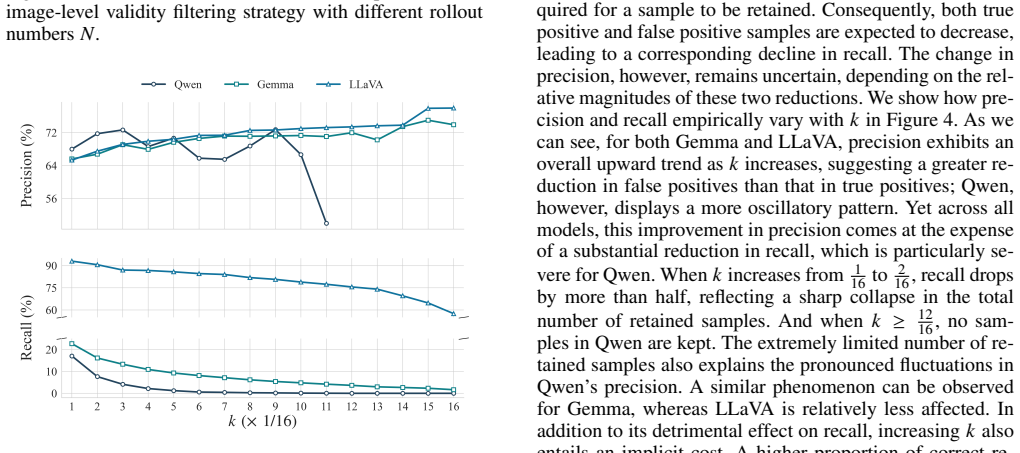
- The rollout-based image fidelity filter retains answer-preserving samples more reliably than CLIPScore or a self-judging baseline in this setting, although its retained-sample precision is around 65%.
- Improvements transfer to out-of-distribution benchmarks, including AI2D, MME, MMStar, and MMBench, not only to the seed distributions.
- Generated complications cluster into four recurring strategies—decoy insertion, feature obscuration, salience rebalancing, and misleading disguise—with decoy insertion and feature obscuration together accounting for nearly 70% of cases.
Reading between the lines
- Because S_vi passes whenever at least one of 16 stochastic guesses on a multiple-choice item is right, chance alone can satisfy the image-fidelity condition; the reported ~65% precision implies roughly a third of retained images are false positives, so part of the training gain may come from added visual diversity rather than from true answer preservation.
- Ground-truth answers drive S_u, S_vt, and S_vi, so the pipeline is not annotation-free; a fully self-supervised variant would need utility and fidelity signals not keyed to known answers.
- The Cap2Aug baseline does not control for visual difficulty, so a cleaner test of the 'failure-informed' hypothesis would compare FISA against generic complications independently rated as equally hard.
- The four complication modes suggest concrete, controllable augmentation operators—decoy insertion, feature obscuration, salience rebalancing, misleading disguise—that could be used to stress-test specific MLLM skills such as counting, recognition, and relative-magnitude judgment.
Editorial analysis
A structured set of objections, weighed in public.
Referee Report
Summary. The paper proposes FISA, a framework for multimodal large language model (MLLM) self-improvement. Starting from a seed dataset, FISA uses the model itself to write a modified caption that complicates the image while supposedly preserving answer-critical information, then synthesizes the new image with a text-to-image model. Candidates are filtered through a utility check (the model fails on the new image), a text-level fidelity check (the answer is recoverable from the caption), and an image-level fidelity check (at least one of N stochastic model responses on the new image is correct). The retained samples are combined with the seed data and used for fine-tuning together with self-explanations. The paper reports experiments on three MLLMs and six VQA benchmarks, claiming consistent improvements over the seed-data baseline and over a caption-based augmentation baseline, compatibility with textual self-augmentation, and effectiveness of the proposed filters.
Significance. The failure-informed image complication idea is a genuinely useful and novel direction: it targets the model's actual weaknesses rather than applying generic perturbations, and it could reduce reliance on new annotated image data if the fidelity guarantee held. The paper is also commendable for including ablations of the complication strategy, the filtering strategy, and the hyperparameters, and for evaluating on both in-distribution and out-of-distribution benchmarks. However, the central load-bearing claim—that the generated images are answer-preserving—is not supported by the current filtering criterion, and the empirical-consistency claim rests on single runs with small differences. If the filter is strengthened and the statistics made solid, the contribution would be valuable; in its present form, the mechanism that produces the reported gains is not convincingly identified.
major comments (3)
- [Eq. (3) / Implementation details] The image-level fidelity filter S_vi with k=1/N and N=16 passes a sample if any of 16 stochastic responses matches the ground truth. For the 4-option multiple-choice items that dominate SEEDBench, AI2D, MME, MMStar, and MMBench, random guessing alone yields 1−(3/4)^16 ≈ 99% pass probability, so S_vi cannot distinguish answer-preserving from answer-distorting images. Figure 2 confirms the weakness: retained-sample precision is about 65%, meaning roughly one third of kept samples are false positives. Since the central claim attributes gains to answer-preserving complications, the mechanism is not established. Please tighten the criterion (e.g., require a large majority of correct rollouts or use a separate image-question consistency check) and report precision separately for open-ended and multiple-choice items.
- [Table 1] The claimed 'consistent improvement' rests on single training runs without error bars or significance tests. Several cells move in the wrong direction (Qwen3-VL-2B Vanilla+FISA on MME: 76.24 vs 77.25; LLaVA Vanilla+FISA on SEEDBench: 63.10 vs 63.90; Gemma3-4B Vanilla+SI+FISA on MMBench: 79.95 vs 80.32), and most gains are below 1 point. Without repeated seeds or paired tests, the average improvements are within plausible noise. Please provide standard deviations across at least three seeds and significance tests for the headline comparisons.
- [Eqs. (1)-(2) and final training] The 'no external supervision' framing is overstated. The utility filter S_u (Eq. 1), the text-level fidelity filter S_vt (Eq. 2), the image-level filter S_vi (Eq. 3), and the final training instances all require the ground-truth answer a_g. The method therefore relies on seed labels for selection and supervision; only the image generation is unlabeled. This should be stated plainly so that the contribution is not described as fully self-supervised.
minor comments (3)
- [Notation] The text refers to R_u, R_vt, R_vi (Appendix A and the implementation-details paragraph) while Eqs. (1)-(3) define S_u, S_vt, S_vi. Please unify the notation.
- [Tables] The model name is inconsistently typed as 'LLaV A1.5-7B' and 'LLaV A'; use 'LLaVA-1.5-7B' consistently.
- [Equation (3)] The notation ∑_{a_i∈A_vi} I(a_i=a_g) is slightly confusing because it counts correct responses. Consider writing C = |{i : a_i = a_g}| and S_vi = I(C ≥ kN), which is clearer.
Circularity Check
No significant circularity: FISA's performance claims are evaluated on external benchmarks and no prediction reduces by construction to its inputs.
full rationale
The central claim—that FISA improves MLLM performance on A-OKVQA, SEEDBench, AI2D, MME, MMStar, and MMBench—is an empirical result measured on external, fixed benchmarks. The pipeline (failure-oriented complication, utility/fidelity filtering, self-explanations) uses the model's own generations and predictions as selection signals, but no parameter is fitted to the evaluation target and no benchmark score is used as an input to the method. The fidelity filter S_vi (Eq. 3) is self-referential in that the model judges its own generated images, and the paper explicitly admits 'this criterion is imperfect' in the Utility and Fidelity Filtering section; Figure 2 shows retained-sample precision around 65%. This is a validity concern about the filter's precision, not a definitional reduction: S_vi does not define the final benchmark accuracy, and the final evaluation is independent. The framework also uses ground-truth answers from the seed dataset in S_u, S_vt, and the training labels, which tempers the 'without external supervision' framing but is standard supervised training on seed labels, not circular. No load-bearing self-citations or imported uniqueness theorems appear. The derivation chain is self-contained against external benchmarks; therefore the circularity score is 0.
Assumptions & free parameters
free parameters (2)
- N (rollouts for S_vi) =
16 for main results (varied 4-64 in study)
- k (activation threshold in Eq. 3) =
1/N = 1/16
assumptions (4)
- domain assumption Ground-truth answer a_g is available for every seed sample and used for utility and fidelity checks
- domain assumption The text-to-image model Z-Image-Turbo can render the modified caption C_m into an image that preserves the answer-critical details
- ad hoc to paper At least one correct answer among N stochastic responses implies the modified image preserves answer-critical information
- domain assumption If the model can answer the question from the modified caption C_m alone, then C_m preserves the answer-critical information
Cite this review
Pith. "Pith review of Failure-Informed Image Self-Augmentation for Multimodal Large Language Model Self-Improvement." pith.science (2026). https://pith.science/paper/JYY5WVNF
@misc{pith2026260803733,
  author       = {Pith},
  title        = {Pith review of: Failure-Informed Image Self-Augmentation for Multimodal Large Language Model Self-Improvement},
  year         = {2026},
  howpublished = {\url{https://pith.science/paper/JYY5WVNF}},
  note         = {Machine review of arXiv:2608.03733}
}
read the original abstract
Multimodal large language models (MLLMs) have achieved remarkable performance across vision-language tasks, but their progress depends heavily on large-scale, high-quality multimodal data that are costly to annotate. Self-augmentation offers a promising alternative by enabling models to expand their own training data without external supervision. However, existing MLLM self-augmentation methods are largely text-centric, while image augmentation remains underexplored and typically relies on generic or handcrafted transformations that are weakly aligned with the model's actual incapability. We propose Failure-informed Image Self-Augmentation (\textbf{FISA}), a framework for MLLM self-improvement that constructs augmented images from the model's own failure cases. Our method generates visually challenging yet answer-preserving image complications, verifies their utility through self-examination, and applies dual fidelity filtering to avoid semantic distortion. Experiments on visual question answering benchmarks show that the proposed method consistently improves performance across both in-distribution and out-of-distribution settings. Further experiments validate the compatibility of FISA with existing textual self-augmentation approaches, the superior data efficiency of the synthesized samples over generic image augmentation baselines, and the practical effectiveness of the proposed filtering strategy.
Figures


Figures from the paper (6 more)


Reference graph
Works this paper leans on
-
[1]
arXiv preprint arXiv:2511.21631 , year=
Qwen3-vl technical report , author=. arXiv preprint arXiv:2511.21631 , year=
-
[2]
arXiv preprint arXiv:2412.08905 , year=
Phi-4 technical report , author=. arXiv preprint arXiv:2412.08905 , year=
-
[3]
arXiv preprint arXiv:2507.01006 , year=
Glm-4.5 v and glm-4.1 v-thinking: Towards versatile multimodal reasoning with scalable reinforcement learning , author=. arXiv preprint arXiv:2507.01006 , year=
-
[4]
arXiv preprint arXiv:2405.16640 , year=
A survey of multimodal large language model from a data-centric perspective , author=. arXiv preprint arXiv:2405.16640 , year=
-
[5]
Pablo Villalobos and Anson Ho and Jaime Sevilla and Tamay Besiroglu and Lennart Heim and Marius Hobbhahn , title =
-
[6]
Yucheng Shi and Quanzheng Li and Jin Sun and Xiang Li and Ninghao Liu , title =
-
[7]
Zhen Tan and Dawei Li and Song Wang and Alimohammad Beigi and Bohan Jiang and Amrita Bhattacharjee and Mansooreh Karami and Jundong Li and Lu Cheng and Huan Liu , title =
-
[8]
Smith and Daniel Khashabi and Hannaneh Hajishirzi , title =
Yizhong Wang and Yeganeh Kordi and Swaroop Mishra and Alisa Liu and Noah A. Smith and Daniel Khashabi and Hannaneh Hajishirzi , title =
Show all 41 references
-
[9]
Xian Li and Ping Yu and Chunting Zhou and Timo Schick and Omer Levy and Luke Zettlemoyer and Jason Weston and Mike Lewis , title =
-
[10]
NeurIPS , volume=
First SFT, Second RL, Third UPT: Continual Improving Multi-Modal LLM Reasoning via Unsupervised Post-Training , author=. NeurIPS , volume=
-
[11]
Henry Hengyuan Zhao and Pan Zhou and Mike Zheng Shou , title =
-
[12]
Letian Zhang and Quan Cui and Bingchen Zhao and Cheng Yang , title =
-
[13]
Zou and Kai
Yihe Deng and Pan Lu and Fan Yin and Ziniu Hu and Sheng Shen and Quanquan Gu and James Y. Zou and Kai. Enhancing Large Vision Language Models with Self-Training on Image Comprehension , booktitle =
-
[14]
NeurIPS , volume=
Sherlock: Self-correcting reasoning in vision-language models , author=. NeurIPS , volume=
-
[15]
arXiv preprint arXiv:2604.20705 , year=
SSL-R1: Self-Supervised Visual Reinforcement Post-Training for Multimodal Large Language Models , author=. arXiv preprint arXiv:2604.20705 , year=
-
[16]
arXiv preprint arXiv:2510.14958 , year=
Mathcanvas: Intrinsic visual chain-of-thought for multimodal mathematical reasoning , author=. arXiv preprint arXiv:2510.14958 , year=
-
[17]
Linger Deng and Linghao Zhu and Yuliang Liu and Yu Wang and Qunyi Xie and Jingjing Wu and Gang Zhang and Yingying Zhu and Xiang Bai , title =
-
[18]
CVPR , pages=
Differences That Matter: Auditing Models for Capability Gap Discovery and Rectification , author=. CVPR , pages=
-
[19]
CVPR , pages=
Effective training data synthesis for improving mllm chart understanding , author=. CVPR , pages=
-
[20]
arXiv preprint arXiv:2602.03300 , year=
R1-SyntheticVL: Is Synthetic Data from Generative Models Ready for Multimodal Large Language Model? , author=. arXiv preprint arXiv:2602.03300 , year=
-
[21]
NeurIPS , year =
Yiyang Zhou and Zhiyuan Fan and Dongjie Cheng and Sihan Yang and Zhaorun Chen and Chenhang Cui and Xiyao Wang and Yun Li and Linjun Zhang and Huaxiu Yao , title =. NeurIPS , year =
-
[22]
arXiv preprint arXiv:2509.25787 , year=
Self-Evolving Vision-Language Models for Image Quality Assessment via Voting and Ranking , author=. arXiv preprint arXiv:2509.25787 , year=
-
[23]
Kanzhi Cheng and Yantao Li and Fangzhi Xu and Jianbing Zhang and Hao Zhou and Yang Liu , title =
-
[24]
arXiv preprint arXiv:2411.15594 , year=
A Survey on LLM-as-a-Judge , author=. arXiv preprint arXiv:2411.15594 , year=
-
[25]
Ziwei Ji and Tiezheng Yu and Yan Xu and Nayeon Lee and Etsuko Ishii and Pascale Fung , title =
-
[26]
Le and Ed H
Xuezhi Wang and Jason Wei and Dale Schuurmans and Quoc V. Le and Ed H. Chi and Sharan Narang and Aakanksha Chowdhery and Denny Zhou , title =
-
[27]
Pattern Recognit
Mingle Xu and Sook Yoon and Alvaro Fuentes and Dong Sun Park , title =. Pattern Recognit. , volume =
-
[28]
Jack Hessel and Ari Holtzman and Maxwell Forbes and Ronan Le Bras and Yejin Choi , title =
-
[29]
Zhaorui Yang and Tianyu Pang and Haozhe Feng and Han Wang and Wei Chen and Minfeng Zhu and Qian Liu , title =
-
[30]
arXiv preprint arXiv:2307.16125 , year=
Seed-bench: Benchmarking multimodal llms with generative comprehension , author=. arXiv preprint arXiv:2307.16125 , year=
-
[31]
Dustin Schwenk and Apoorv Khandelwal and Christopher Clark and Kenneth Marino and Roozbeh Mottaghi , title =
-
[32]
Aniruddha Kembhavi and Mike Salvato and Eric Kolve and Min Joon Seo and Hannaneh Hajishirzi and Ali Farhadi , title =
-
[33]
NeurIPS , volume=
Mme: A comprehensive evaluation benchmark for multimodal large language models , author=. NeurIPS , volume=
-
[34]
NeurIPS , year =
Lin Chen and Jinsong Li and Xiaoyi Dong and Pan Zhang and Yuhang Zang and Zehui Chen and Haodong Duan and Jiaqi Wang and Yu Qiao and Dahua Lin and Feng Zhao , title =. NeurIPS , year =
-
[35]
Yuan Liu and Haodong Duan and Yuanhan Zhang and Bo Li and Songyang Zhang and Wangbo Zhao and Yike Yuan and Jiaqi Wang and Conghui He and Ziwei Liu and Kai Chen and Dahua Lin , title =
-
[36]
Gemma 3 , url=
Gemma Team , year=. Gemma 3 , url=
-
[37]
Haotian Liu and Chunyuan Li and Yuheng Li and Yong Jae Lee , title =
-
[38]
Woosuk Kwon and Zhuohan Li and Siyuan Zhuang and Ying Sheng and Lianmin Zheng and Cody Hao Yu and Joseph Gonzalez and Hao Zhang and Ion Stoica , title =
-
[39]
Aniket Roy and Anshul Shah and Ketul Shah and Anirban Roy and Rama Chellappa , title =
-
[40]
arXiv preprint arXiv:2601.03267 , year=
Openai gpt-5 system card , author=. arXiv preprint arXiv:2601.03267 , year=
-
[41]
arXiv preprint arXiv:2511.22699 , year=
Z-image: An efficient image generation foundation model with single-stream diffusion transformer , author=. arXiv preprint arXiv:2511.22699 , year=
Reviewed August 5, 2026 · model on record in the stance chip above.
Discussion (0). Sign in to comment.