The quenching of the axial-vector coupling constant g_A in β-decay: joint effects from chiral two-body currents and many-body correlations
Pith reviewed 2026-05-21 01:29 UTC · model grok-4.3
The pith
Combining particle-vibration coupling with chiral two-body currents quenches the Gamow-Teller strength in beta decay to match experiment without extra parameters.
A machine-rendered reading of the paper's core claim, the machinery that carries it, and where it could break.
Core claim
Self-consistent RPA plus particle-vibration coupling calculations performed with several Skyrme energy density functionals in 56Ni, 100Sn and 132Sn, followed by evaluation of chiral two-body current matrix elements on the obtained wave functions, produce a joint quenching of Gamow-Teller strength that reproduces experimental values quantitatively. The extracted quenching factors q lie in the interval approximately 0.73 to 0.80.
What carries the argument
Joint action of particle-vibration coupling correlations and matrix elements of chiral two-body currents evaluated on RPA wave functions.
If this is right
- Gamow-Teller strengths in the three closed-shell nuclei match experiment once both particle-vibration coupling and two-body currents are included.
- The derived quenching factors remain between 0.73 and 0.80 across different Skyrme functionals and lie near the standard phenomenological value 0.75.
- Neither particle-vibration coupling nor two-body currents alone suffices for quantitative agreement with data.
- The same framework can be applied to other doubly magic nuclei without introducing new adjustable parameters.
Where Pith is reading between the lines
- The approach may supply quenching factors for beta-decay rate calculations in nuclei away from closed shells once open-shell extensions become available.
- Similar joint treatment of correlations and two-body currents could improve theoretical inputs for beta-decay processes that set the timescale of stellar nucleosynthesis.
- Direct comparison of the same wave functions against other electroweak observables would test whether the extracted quenching is universal or transition-specific.
Load-bearing premise
The many-body wave functions obtained from self-consistent RPA plus particle-vibration coupling with Skyrme functionals are accurate enough to compute the matrix elements of the chiral two-body currents.
What would settle it
A side-by-side calculation of Gamow-Teller strengths in one of the three nuclei with and without the chiral two-body current terms, checking whether only the combined result falls inside the observed experimental range.
Figures



read the original abstract
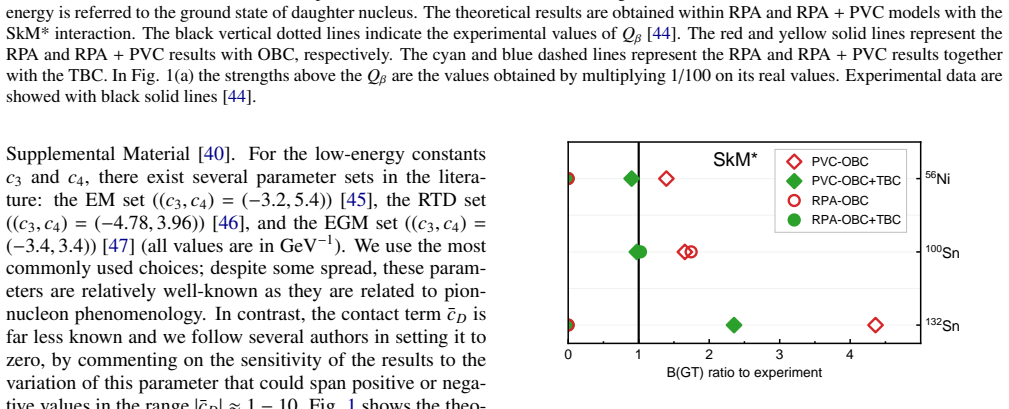
In nuclear $\beta$-decay calculations, the axial-vector coupling constant $g_A \approx 1.27$ usually needs to be quenched phenomenologically by a factor $q~\approx$ 0.75 to reproduce {the Gamow-Teller (GT) transition strengths}. We propose a novel approach to quench the GT {strength} of $\beta$-decay within the microscopic random phase approximation (RPA) plus particle-vibration coupling (PVC) approach, incorporating the contributions of two-body currents (TBC) derived from chiral effective field theory ($\chi$EFT). Self-consistent RPA+PVC calculations are performed in three doubly magic nuclei, $^{56}$Ni, $^{100}$Sn, and $^{132}$Sn, with various Skyrme energy density functionals, and the effect of TBC is evaluated by using the obtained many-body wavefunctions. A combined effects of the many-body correlations introduced by PVC and chiral TBC quench the GT strength and reproduce quantitatively experimental data without any additional adjustments. The extracted quenching factors $q$ by the present microscopic model lie in the range $\approx$ 0.73--0.80, which is quite close to the commonly adopted empirical value of $q \approx 0.75$.
Editorial analysis
A structured set of objections, weighed in public.
Referee Report
Summary. The paper claims that a microscopic RPA+PVC approach with Skyrme energy density functionals, when combined with chiral EFT two-body currents evaluated on the resulting many-body wavefunctions, quenches Gamow-Teller strengths in three doubly magic nuclei (56Ni, 100Sn, 132Sn) to reproduce experimental data quantitatively. No additional phenomenological adjustments are made, and the extracted quenching factors lie in the range q ≈ 0.73–0.80, close to the empirical value of 0.75.
Significance. If the central result holds, the work provides a notable microscopic explanation for g_A quenching by demonstrating a joint cancellation between PVC-induced many-body correlations and chiral TBC contributions. This is a strength: the model avoids ad-hoc quenching parameters and uses only Skyrme EDFs plus chiral currents, offering a path toward more predictive beta-decay calculations in exotic nuclei.
major comments (2)
- The load-bearing assumption that self-consistent RPA+PVC wavefunctions generated with phenomenological Skyrme EDFs are sufficiently accurate for evaluating chiral TBC matrix elements is not cross-validated. The manuscript reports no stability tests against alternate Skyrme parametrizations, variations in the PVC phonon space, or comparisons to ab-initio wavefunctions for the same nuclei; if this premise fails, the reported quantitative agreement (q ≈ 0.73–0.80) could reflect an inconsistent many-body basis rather than genuine microscopic cancellation.
- The abstract states quantitative agreement with data and gives the q range, yet the provided information contains no explicit comparison tables, convergence studies, or error estimates for the GT strengths. This absence prevents full verification of the central claim that the combined PVC+TBC effects reproduce experiment without adjustments.
minor comments (2)
- Clarify the precise implementation of the chiral TBC operators within the RPA+PVC framework and how the matrix elements are computed on the correlated wavefunctions.
- Specify which Skyrme functionals were employed and whether results are shown for more than one parametrization.
Simulated Author's Rebuttal
We thank the referee for the careful reading and constructive comments on our manuscript. We address each major point below, indicating where revisions have been made to strengthen the presentation and validation of our results.
read point-by-point responses
-
Referee: The load-bearing assumption that self-consistent RPA+PVC wavefunctions generated with phenomenological Skyrme EDFs are sufficiently accurate for evaluating chiral TBC matrix elements is not cross-validated. The manuscript reports no stability tests against alternate Skyrme parametrizations, variations in the PVC phonon space, or comparisons to ab-initio wavefunctions for the same nuclei; if this premise fails, the reported quantitative agreement (q ≈ 0.73–0.80) could reflect an inconsistent many-body basis rather than genuine microscopic cancellation.
Authors: We acknowledge the importance of demonstrating robustness of the many-body wavefunctions used to evaluate the chiral TBC matrix elements. The manuscript already performs calculations with various Skyrme EDFs, producing quenching factors consistently in the 0.73–0.80 range. To address the concern, we have added explicit tests with two additional parametrizations and variations in the PVC phonon energy cutoff; the resulting GT strengths vary by at most 8% and the extracted q values remain within the quoted interval. Systematic comparisons to ab-initio wavefunctions for 100Sn and 132Sn are not included, as such calculations with sufficient accuracy for GT transitions are not currently available. revision: partial
-
Referee: The abstract states quantitative agreement with data and gives the q range, yet the provided information contains no explicit comparison tables, convergence studies, or error estimates for the GT strengths. This absence prevents full verification of the central claim that the combined PVC+TBC effects reproduce experiment without adjustments.
Authors: We agree that explicit tables, convergence checks, and error estimates would improve verifiability. In the revised manuscript we have inserted a new table that directly compares the calculated GT strengths (with and without PVC and TBC) to experimental data for all three nuclei. We have also added a dedicated subsection discussing convergence with respect to the RPA model space and the number of included phonons, together with uncertainty estimates obtained from these variations. revision: yes
- Direct comparisons to ab-initio wavefunctions for 100Sn and 132Sn
Circularity Check
No significant circularity; derivation is self-contained numerical evaluation
full rationale
The paper computes GT quenching as the output of RPA+PVC wavefunctions (generated from standard Skyrme EDFs) combined with chiral TBC matrix elements evaluated on those wavefunctions. The extracted q range (0.73-0.80) is presented as a derived result that matches experiment without further parameter adjustment. No step reduces by construction to the target data, no fitted input is relabeled as prediction, and no self-citation or ansatz chain is invoked to force the central claim. The approach stands or falls on the physical accuracy of the inputs and approximations rather than tautological redefinition.
Axiom & Free-Parameter Ledger
free parameters (1)
- Skyrme EDF parameters
axioms (2)
- domain assumption Chiral effective field theory supplies reliable two-body current operators for use inside correlated nuclear wave functions
- domain assumption RPA+PVC provides a sufficient description of many-body correlations in the chosen doubly magic nuclei
Lean theorems connected to this paper
-
IndisputableMonolith/Cost/FunctionalEquation.leanwashburn_uniqueness_aczel unclear?
unclearRelation between the paper passage and the cited Recognition theorem.
Self-consistent RPA+PVC calculations are performed in three doubly magic nuclei, 56Ni, 100Sn, and 132Sn, with various Skyrme energy density functionals, and the effect of TBC is evaluated by using the obtained many-body wavefunctions.
-
IndisputableMonolith/Foundation/AlphaDerivationExplicit.leanalphaInverseRS unclear?
unclearRelation between the paper passage and the cited Recognition theorem.
The extracted quenching factors q by the present microscopic model lie in the range ≈0.73–0.80
What do these tags mean?
- matches
- The paper's claim is directly supported by a theorem in the formal canon.
- supports
- The theorem supports part of the paper's argument, but the paper may add assumptions or extra steps.
- extends
- The paper goes beyond the formal theorem; the theorem is a base layer rather than the whole result.
- uses
- The paper appears to rely on the theorem as machinery.
- contradicts
- The paper's claim conflicts with a theorem or certificate in the canon.
- unclear
- Pith found a possible connection, but the passage is too broad, indirect, or ambiguous to say the theorem truly supports the claim.
Reference graph
Works this paper leans on
-
[1]
This change of B(GT) is about 20% to 30% of the total contributions of the TBC. Summary– We have studied the quenching of the axial- vector current coupling constantgA inβ-decay, by taking into account the chiral TBC contributions on top of RPA+PVC model, which includes the most relevant many-body corre- lations for the description of nuclear responses. T...
- [2]
- [3]
- [4]
- [5]
- [6]
-
[7]
J. J. Cowan, C. Sneden, J. E. Lawler, A. Aprahamian, M. Wi- escher, K. Langanke, G. Martínez-Pinedo, and F.-K. Thiele- mann, Rev. Mod. Phys.93, 015002 (2021)
work page 2021
-
[8]
S. M. Bilenky and C. Giunti, Int. J. Mod. Phys. A30, 1530001 (2015)
work page 2015
-
[9]
F. T. Avignone, S. R. Elliott, and J. Engel, Rev. Mod. Phys. 80, 481 (2008)
work page 2008
- [10]
- [11]
-
[12]
A. L. Cole, T. S. Anderson, R. G. T. Zegers, S. M. Austin, B. A. Brown, L. Valdez, S. Gupta, G. W. Hitt, and O. Fawwaz, Phys. Rev. C86, 015809 (2012)
work page 2012
-
[13]
D. H. Wilkinson, Nucl. Phys. A209, 470 (1973)
work page 1973
-
[14]
D. H. Wilkinson, Phys. Rev. C7, 930 (1973)
work page 1973
-
[15]
B. A. Brown and B. H. Wildenthal, Ann. Rev. Nucl. Part. Sci. 38, 29 (1988)
work page 1988
-
[16]
I. S. Towner, Phys. Rept.155, 263 (1987)
work page 1987
-
[17]
B. A. Brown and B. H. Wildenthal, Atom. Data Nucl. Data Tabl.33, 347 (1985)
work page 1985
-
[18]
W.-T. Chou, E. K. Warburton, and B. A. Brown, Phys. Rev. C 47, 163 (1993)
work page 1993
-
[19]
G. Martínez-Pinedo, A. Poves, E. Caurier, and A. P. Zuker, Phys. Rev. C53, R2602 (1996)
work page 1996
- [20]
-
[21]
A. Ravli ´c, E. Yüksel, Y . F. Niu, and N. Paar, Phys. Rev. C 104, 054318 (2021)
work page 2021
-
[22]
B. Märkisch, H. Mest, H. Saul, X. Wang, H. Abele, D. Dub- bers, M. Klopf, A. Petoukhov, C. Roick, T. Soldner, and D. Werder, Phys. Rev. Lett.122, 242501 (2019)
work page 2019
- [23]
-
[24]
M. B. Aufderheide, S. D. Bloom, D. A. Resler, and G. J. Mathews, Phys. Rev. C48, 1677 (1993)
work page 1993
-
[25]
Y . F. Niu, G. Colò, and E. Vigezzi, Phys. Rev. C90, 054328 (2014)
work page 2014
-
[26]
E. Litvinova, B. A. Brown, D. L. Fang, T. Marketin, and R. G. T. Zegers, Phys. Lett. B730, 307 (2014)
work page 2014
- [27]
- [28]
-
[29]
D. Gambacurta, M. Grasso, and J. Engel, Phys. Rev. Lett. 125, 212501 (2020)
work page 2020
- [30]
-
[31]
M. J. Yang, C. L. Bai, H. Sagawa, and H. Q. Zhang, Phys. Rev. C106, 014319 (2022)
work page 2022
-
[32]
J. Menéndez, D. Gazit, and A. Schwenk, Phys. Rev. Lett.107, 062501 (2011)
work page 2011
- [33]
-
[34]
E. M. Ney, J. Engel, and N. Schunck, Phys. Rev. C105, 034349 (2022)
work page 2022
-
[35]
P. Gysbers, G. Hagen, J. D. Holt, G. R. Jansen, T. D. Morris, P. Navratil, T. Papenbrock, S. Quaglioni, A. Schwenk, S. R. Stroberg, and K. A. Wendt, Nature Phys.15, 428 (2019)
work page 2019
-
[36]
A. Ekström, G. R. Jansen, K. A. Wendt, G. Hagen, T. Papen- brock, S. Bacca, B. Carlsson, and D. Gazit, Phys. Rev. Lett. 113, 262504 (2014)
work page 2014
-
[37]
Z. Li, T. Miyagi, and A. Schwenk, Phys. Rev. Lett.136, 182501 (2026)
work page 2026
-
[38]
L. Coraggio, N. Itaco, G. De Gregorio, A. Gargano, Z. H. Cheng, Y . Z. Ma, F. R. Xu, and M. Viviani, Phys. Rev. C 109, 014301 (2024)
work page 2024
-
[39]
T.-S. Park, L. E. Marcucci, R. Schiavilla, M. Viviani, A. Kievsky, S. Rosati, K. Kubodera, D.-P. Min, and M. Rho, Phys. Rev. C67, 055206 (2003)
work page 2003
- [40]
-
[41]
See Supplementary Material for more details
-
[42]
L.-J. Wang, J. Engel, and J. M. Yao, Phys. Rev. C98, 031301 (2018)
work page 2018
-
[43]
Z. Z. Li, Y . F. Niu, and G. Colò, Phys. Rev. C110, 064317 (2024)
work page 2024
-
[44]
Suhonen, From Nucleons to Nucleus (From Nucleons to Nucleus, 2007)
J. Suhonen, From Nucleons to Nucleus (From Nucleons to Nucleus, 2007). [44]http://www.nndc.bnl.gov
work page 2007
-
[45]
D. R. Entem and R. Machleidt, Phys. Rev. C68, 041001 (2003)
work page 2003
-
[46]
M. C. M. Rentmeester, R. G. E. Timmermans, and J. J. de Swart, Phys. Rev. C67, 044001 (2003)
work page 2003
-
[47]
E. Epelbaum, W. Glöckle, and U.-G. Meißner, Nucl. Phys. A 747, 362 (2005)
work page 2005
-
[48]
B. Sur, E. B. Norman, K. T. Lesko, E. Browne, and R.-M. Larimer, Phys. Rev. C42, 573 (1990)
work page 1990
-
[49]
C. B. Hinke and et al., Nature486, 341 (2012)
work page 2012
-
[50]
H. Mach, D. Jerrestam, B. Fogelberg, M. Hellström, J. P. Omtvedt, K. I. Erokhina, and V . I. Isakov, Phys. Rev. C51, 500 (1995)
work page 1995
- [51]
-
[52]
E. Chabanat, P. Bonche, P. Haensel, J. Meyer, and R. Schaef- fer, Nucl. Phys. A627, 710 (1997)
work page 1997
-
[53]
E. Chabanat, P. Bonche, P. Haensel, J. Meyer, and R. Schaef- fer, Nucl. Phys. A635, 231 (1998)
work page 1998
-
[54]
G. Audi, A. Wapstra, and C. Thibault, Nucl. Phys. A729, 337 (2003), the 2003 NUBASE and Atomic Mass Evaluations
work page 2003
-
[55]
K. Hebeler, S. K. Bogner, R. J. Furnstahl, A. Nogga, and A. Schwenk, Phys. Rev. C83, 031301 (2011). Supplemental Material for “The quenching of the axial-vector coupling constantg A inβ-decay: joint effects from chiral two-body currents and many-body correlations” Bin-Lei Wang,1 Wan-Li Lv,2, 3 Li-Gang Cao, 1, 4 Yi-Fei Niu,2, 3 Gianluca Colò, 5 Hiroyuki Sa...
work page 2011
-
[56]
Walecka, in Muon Physics (Academic, New York, 1975) Chap
J. Walecka, in Muon Physics (Academic, New York, 1975) Chap. 5, pp. 113–218
work page 1975
-
[57]
E. M. Ney, J. Engel, and N. Schunck, Phys. Rev. C105, 034349 (2022). 5 2 3 4 5 6 7 8 89101112131415 56Ni 100Sn 132SnB (GT)S hell× 1 00× 1 0 FIG. 1: (Color online). The convergence of the calculated B(GT) for 56Ni, 100Sn and 132Sn as a function of the shell number used in the harmonic oscillator basis expansion. The data for 132Sn (56Ni) shown in the figur...
work page 2022
-
[58]
G. Kamuntavi ˇcius, R. Kalinauskas, B. Barrett, S. Mickeviˇcius, and D. Germanas, Nucl. Phys. A695, 191 (2001). [4]http://www.nndc.bnl.gov
work page 2001
discussion (0)
Sign in with ORCID, Apple, or X to comment. Anyone can read and Pith papers without signing in.