REVIEW 3 major objections 3 minor 1 cited by
Rao-Blackwellized Score Matching on Manifolds
T0 review · 3 major / 3 minor · reviewed 2026-08-02 · deepseek-v4-flash
Pith's one-line read Ambient Gaussian denoising score matching on manifold-supported data, after conditioning on the nearest-point projection, estimates the true Riemannian score to first order in noise, with an explicit σ² curvature bias that vanishes on S².
desk verdict Solid canonicality and variance-collapse core, but the headline sigma-squared formula is false as stated: it is missing a third-derivative extrinsic term. read the letter →
The pith
A machine-rendered reading of the paper's core claim, the machinery that carries it, and where it could break.
The reading
What carries the argument
The load-bearing object is rσ(z) = E[ P_{T_z M}(Z−X)/σ² | π(X)=z ], the conditional expectation of the tangent denoising target given the nearest-point projection π(X) onto M. This Rao-Blackwellized target is the unique L²-optimal predictor among estimators depending on X through π(X), and it removes the raw target's irreducible d/σ² variance floor. The expansion is derived by changing to tubular coordinates around M and normal coordinates at z, obtaining a fiber posterior that is a centered Gaussian in tangent displacements times smooth geometric corrections, and applying a manifold Stein identity. The curvature operator ½ W_H − Ric^# — mean-curvature Weingarten minus Ricci endomorphism — c
What would settle it
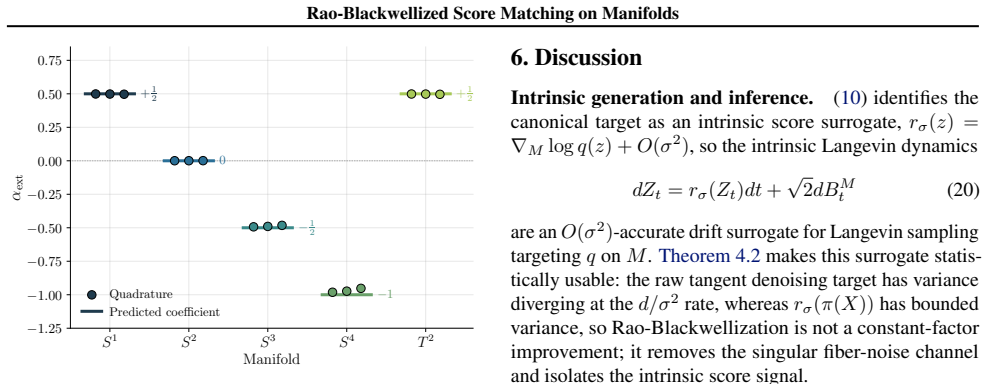
Compute rσ by high-accuracy quadrature on a compact embedded manifold with known intrinsic score, such as the flat torus T² embedded in R³ with a wrapped-Gaussian density, at several small σ, and form the ratio (rσ − ∇_M log q − σ² b_q)/(σ² ∇_M log q). Theorem 5.2 predicts the constant ½ W_H − Ric^# (on T², +½ for the chosen embedding); any measurable σ-dependence at leading order, or any value inconsistent with the Weingarten and Ricci computation, would refute the expansion.
Extended reading notes
Core claim
The paper's central discovery is Theorem 5.2: for a compact C^5 embedded manifold of positive reach, with strictly positive latent density q and isotropic Gaussian corruption, the Rao-Blackwellized tangent target satisfies rσ(z) = ∇_M log q(z) + σ²( b_q(z) + g_ext_M(z) ) + o(σ²), where b_q is the intrinsic Tweedie correction ½∇_M(Δ_M log q + ‖∇_M log q‖²) and g_ext_M = (½ W_H − Ric^#_z) ∇_M log q, with W_H the Weingarten operator in the mean-curvature direction and Ric^# the Ricci endomorphism. The first term recovers the true intrinsic Riemannian score; the second-order correction is the finite-σ bias introduced specifically by ambient Gaussian corruption on curved supports. On spheres the
Load-bearing premise
The load-bearing premise is that the latent distribution sits exactly on a compact C^5 manifold with positive reach and is corrupted by isotropic Gaussian noise; if the data only approximate the manifold or the noise is anisotropic, the d/σ² variance floor and the curvature coefficient ½ W_H − Ric^# need not hold.
Editorial extensions
If this is right
- Provides a population-level answer to what ambient denoising score matching learns on manifold-supported data: the intrinsic Riemannian score, up to an explicit order-σ² curvature bias.
- Rao-Blackwellization is not a constant-factor improvement: it removes the singular d/σ² variance channel, shown to be an irreducible Bayes-risk floor for any estimator using only a fiber-collapsing summary.
- The ambient-versus-intrinsic bias is computable from the Weingarten and Ricci tensors and the learned score, so practitioners can accept, subtract, or avoid it depending on target accuracy.
- On S² the extrinsic bias is exactly zero, so ambient denoising score matching there matches intrinsic methods up to the intrinsic smoothing bias; on S¹, S³, and higher spheres the bias is nonzero and grows with dimension.
- Flat cases reduce exactly to standard d-dimensional Gaussian denoising score matching, pinning down the baseline against which curvature effects must be measured.
Reading between the lines
- If the expansion holds at moderate σ, the same formula suggests a practical debiasing step for ambient score models on product manifolds and rotation groups such as SO(3), where the dimension-dependent coefficient 1 − d/2 would predict systematic shrinkage or amplification of the learned score.
- The S² cancellation is a coincidence of the Einstein identity at dimension two, not a sign that ambient denoising score matching is generally unbiased; using only S² to validate manifold-aware score matching may understate the bias present on other manifolds.
- A natural testable extension is anisotropic Gaussian corruption: replacing the isotropic covariance in the noise model should change both the variance floor to a weighted trace of the covariance and the curvature operator, and the same quadrature approach could verify the modified formula.
- The finite-sample bandwidth rate in the appendix, roughly (σ⁻²N)^(-2/(d+2)), suggests Rao-Blackwellized preprocessing translates directly into improved sample complexity; direct empirical comparison on non-spherical product manifolds would quantify the gain.
Signed reviews
Editorial analysis
A structured set of objections, weighed in public.
Referee Report
Summary. This paper studies ambient Gaussian denoising score matching (DSM) when the latent distribution is supported on a compact smooth submanifold M ⊂ R^D. It defines the Rao-Blackwellized tangent target rσ(z) = E[Tσ | π(X) = z], proves that among estimators depending on the observation only through the nearest-point projection π(X), rσ is the unique L2-optimal predictor, and shows that the raw tangent target Tσ has conditional variance d/σ^2 + O(1) while rσ has bounded variance. The paper proves the leading-order identification rσ(z) = ∇_M log q(z) + O(σ^2) and claims an explicit second-order expansion with an intrinsic Tweedie term and an extrinsic curvature term g_ext = (1/2 W_H − Ric^#) ∇_M log q. It specializes to spheres, observes that the extrinsic term vanishes on S^2, and provides a finite-sample local-averaging rate.
Significance. If the second-order expansion were correct, the paper would give a sharp and useful account of what ambient DSM learns on manifold-supported data, with a computable bias and a theoretical explanation for the benign behavior on S^2. The variance-collapse theorem (Thm 4.2) and the leading-order identification (Eq. 10) are solid and of clear value: the d/σ^2 risk floor is an exact, parameter-free statement, and the flat-case reduction (Prop 5.1) is clean. The paper also makes falsifiable coefficient predictions (Fig. 2), which is a strength. However, the central second-order formula (Thm 5.2) is incomplete: a cubic term in the geometric weight contributes to the σ^2 coefficient through ∇Δ m(0), as a simple graph example shows. Thus the paper's main quantitative claim is not reliable as stated, although the leading-order and variance results appear unaffected.
major comments (3)
- [Appendix F.3, Prop F.6 and Eq. (64)] The proof asserts ∇Δmσ(0)=0 on the grounds that the leading s-dependent term in log Mσ is quadratic. This is false: the O(||s||^3) remainder generally contains a cubic term C(s), and ∇ΔC(0) is a nonzero constant that contributes to rσ(z) at order σ^2 through Lemma F.7. Concretely, take a compact extension of the graph y = x^2 + x^3 at z=0 with uniform q. Then Jgr(s)=1+2s^2+6s^3+... and Fσ(s)=1−2s^2−2s^3 (since W=2), so log Mσ(s)=4s^3+...; hence ∇Δm(0)=24 and the exact posterior mean gives rσ(0)=12σ^2+O(σ^4), whereas Eq. (16) predicts 0. Thus Theorem 5.2 is missing a third-derivative term.
- [Theorem 5.2 / Corollary 5.4] The stated second-order expansion is not correct in general; the missing term involves third derivatives of the embedding and is not captured by W_H or Ric^#. The numerical checks in Figure 2 are on S^d and T^2, which are even/odd symmetric at the evaluation point so the cubic term averages to zero; they therefore do not detect the error. The manuscript should give a corrected expansion with a rigorous remainder and test it on a non-symmetric manifold (e.g., an ellipsoid or the graph example).
- [Section F.3, Lemmas F.4-F.6] The proof strategy expands Jgr and Fσ only to quadratic order and then, in Prop F.6, concludes that the remainder 'contains no term linear in s at order σ^2.' That condition does not imply ∇Δmσ(0)=0. A valid second-order derivation must expand the geometric weight to cubic order and include the σ^2/2 ∇(Δm)(0) term in the Gaussian-moment expansion (Lemma F.7). The algebra needs to be redone; the stated operator (1/2 W_H − Ric^#) is at most part of the correct coefficient.
minor comments (3)
- [Appendix F.3] There are several reference inconsistencies: the proof of Prop F.6 refers to 'Theorem F.4 and Theorem F.5' where these are Lemmas F.4 and F.5, and in the application of Lemma F.7 it is called 'Theorem F.7'. These should be corrected.
- [Section 4.3 and Figure 1] The text states the variance is d/σ^2 + O(1), but Figure 1 displays the second moment E||Tσ||^2. Since E||Tσ||^2 = Var(Tσ) + ||E[Tσ]||^2 and the mean is O(1), the plot is consistent; the caption should clarify which quantity is shown.
- [Remark F.3 / Eq. (59)] The claim for the product of two circles S^1(R1)×S^1(R2) in R^4 that the operator is ½ diag(1/R1^2, 1/R2^2) is stated without derivation. A short verification would improve readability and trust in the frame formula.
Circularity Check
No significant circularity: the main expansion is a self-contained asymptotic derivation with no fitted parameters, self-citation load-bearing steps, or definitional reductions.
full rationale
The paper's central claim, Theorem 5.2, is a population-level asymptotic expansion of rσ(z) = E[PT(π(X))(Z−X)/σ² | π(X)=z] under the explicit corruption model (1). The derivation proceeds through a fiber posterior normal form (Proposition B.2), a Stein identity (Lemma B.3), and a graph-coordinate expansion of the geometric weight (Section F). The target rσ is defined from the true joint law, and the small-σ limit is computed, not assumed. No parameter is fitted to data and then renamed as a prediction; the coefficients bq and g_ext(M) are explicit functions of q and the manifold geometry. The numerical experiments in Figures 2 and 3 are independent verification of the formula, not inputs to it. There are no load-bearing self-citations, no imported uniqueness theorem, and no ansatz smuggled in via citation. The flat-case reduction to ordinary Gaussian DSM is a proved equivalence and a sanity check, not a renaming that carries the curved-case claim. The skeptical objection about the alleged vanishing of ∇∆mσ(0) in Proposition F.6 is a potential mathematical correctness concern, not a circularity: it does not exhibit any equation that reduces to its own inputs by construction. Therefore, under the requested circularity standard, the paper is not circular.
Assumptions & free parameters
assumptions (4)
- domain assumption M⊂R^D is a compact C^5 embedded submanifold with positive reach and q∈C^5(M) strictly positive.
- domain assumption Gaussian corruption X=Z+σξ with isotropic ξ∼N(0,I_D).
- standard math Federer-Gray tube formula and Gauss equation Ric^# = W_H − S for submanifolds.
- standard math Regular conditional expectation given π(X)=z is well-defined and admits a density.
Cite this review
Pith. "Pith review of Rao-Blackwellized Score Matching on Manifolds." pith.science (2026). https://pith.science/paper/K5NPMOM3
@misc{pith2026260525567,
  author       = {Pith},
  title        = {Pith review of: Rao-Blackwellized Score Matching on Manifolds},
  year         = {2026},
  howpublished = {\url{https://pith.science/paper/K5NPMOM3}},
  note         = {Machine review of arXiv:2605.25567}
}
abstract
We study denoising score matching (DSM) when data are drawn from an embedded manifold $M \subset \mathbb{R}^D$. We show that under ambient Gaussian corruption, the target has variance that diverges as the noise scale decreases and correct for it by regressing against the conditional expectation given the nearest point projection on the manifold: the $L^2$-optimal Rao-Blackwellized target. We then compute the small-noise expansion of this target and show that it recovers the true intrinsic Riemannian score to first order, with a second-order bias from a Tweedie term and two geometric terms dependent on how the manifold is embedded in ambient space: a curvature operator acting on the intrinsic score, and an additive drift generated by the spatial variation of the embedding's second fundamental form. On hyperspheres, we derive a simplified formula and show that both geometric terms vanish exactly on $S^2$, offering a theoretical explanation for why ambient DSM performs comparably to intrinsic methods on real Earth science spherical data in prior work.
Figures


Forward citations
Cited by 1 Pith paper
-
Asymptotic Preservation and Uniform Accuracy of Diffusion and Flow-Matching Samplers
DDIM (σ-clock Euler) is the unique layer-exact fixed-step sampler; deterministic residual budgets stay O(1) with no log(1/σ_min), while stochastic path-KL scales as Λ²/N from the Itô term alone.
Reference graph
Works this paper leans on
-
[1992]
URL https://api.semanticscholar. org/CorpusID:53587425. Federer, H. Curvature measures.Transactions of the Amer- 7 Rao-Blackwellized Score Matching on Manifolds ican Mathematical Society, 93(3):418–491, 1959. doi: 10.1090/S0002-9947-1959-0110078-1. Ho, J., Jain, A., and Abbeel, P. Denoising diffusion prob- abilistic models, 2020. URL https://arxiv.org/ ab...
arXiv 1959
-
[2011]
org/CorpusID:23284154
URL https://api.semanticscholar. org/CorpusID:23284154. Fan, J. Design-adaptive nonparametric regression.Journal of the American Statistical Association, 87:998–1004,
Reviewed August 2, 2026 · model on record in the stance chip above.
Discussion (0). Continue with ORCID to comment.