Towards Entanglement-Enhanced Atom Interferometry Using Bow-Tie Cavities
Pith reviewed 2026-06-26 21:10 UTC · model grok-4.3
The pith
A monolithic bow-tie cavity provides homogeneous coupling to strontium atoms for entanglement-enhanced atom interferometry.
A machine-rendered reading of the paper's core claim, the machinery that carries it, and where it could break.
Core claim
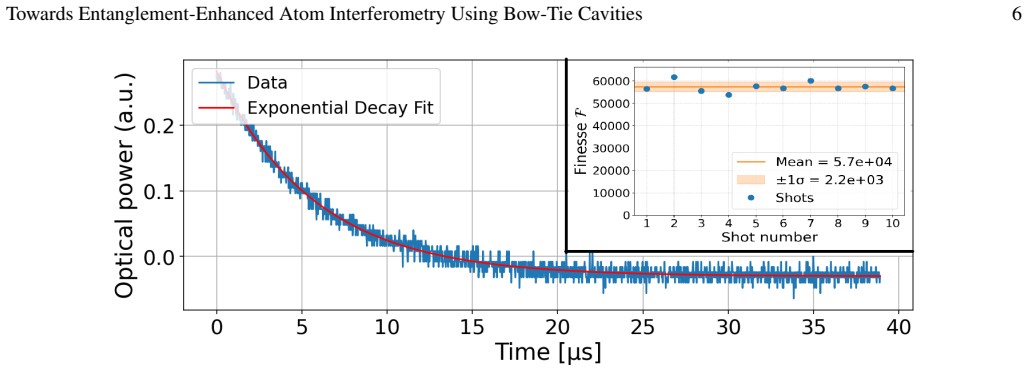
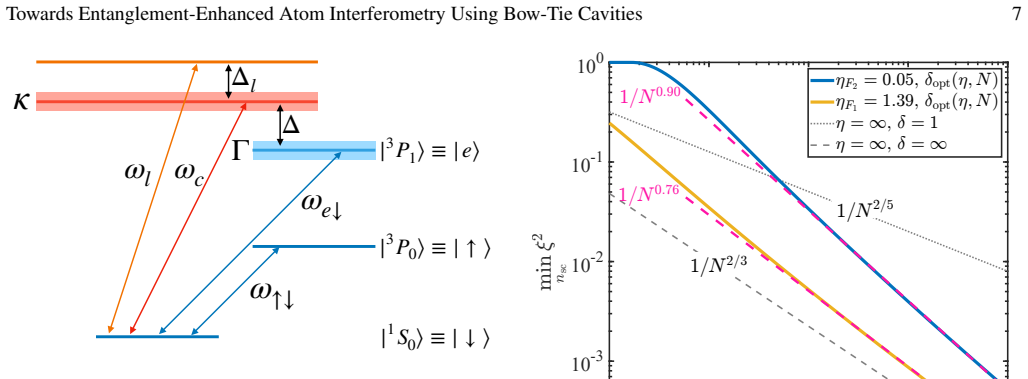
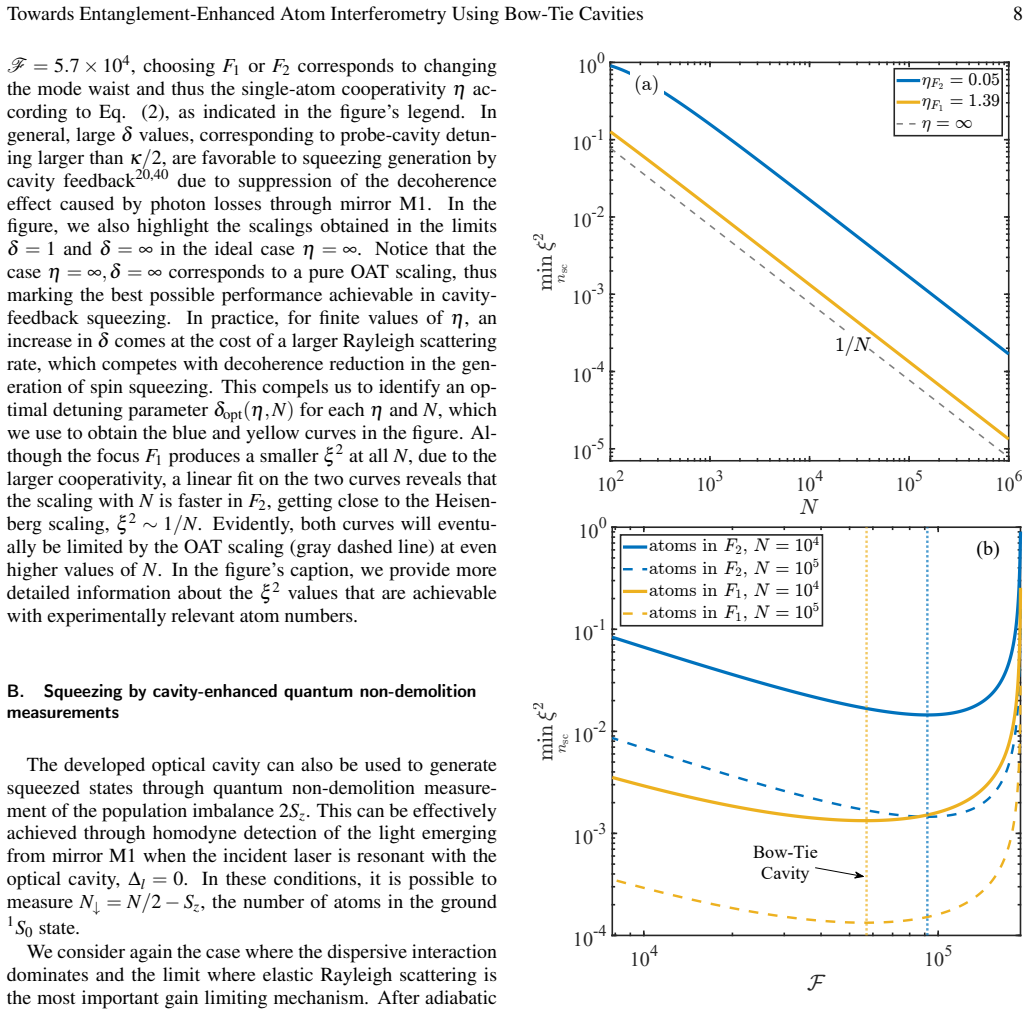
The paper establishes that a monolithic bow-tie cavity operating on the strontium 689 nm transition achieves a finesse of 5.7 times 10 to the 4 with two foci of 164 and 31 micrometers, delivering homogeneous atom-light coupling that enables metrological gains approaching 24 dB through cavity-feedback squeezing and 28 dB through quantum non-demolition measurements for up to 10^5 atoms.
What carries the argument
The traveling-wave bow-tie cavity geometry, which ensures homogeneous atom-light coupling across the ensemble unlike standing-wave resonators.
If this is right
- The cavity supports generation of squeezed states via multiple strategies.
- High mechanical stability and robustness against misalignment are achieved.
- Access to different atom-cavity coupling regimes is provided by the two foci.
- Efficient extraction of atomic information is possible due to sufficient mirror transmission.
Where Pith is reading between the lines
- If the homogeneous coupling holds during free fall, the platform could extend to other atomic species for tests of fundamental physics.
- The design may allow integration with existing atom interferometer setups to surpass current sensitivity limits.
- Further optimization of the cavity parameters could push squeezing levels higher for larger ensembles.
Load-bearing premise
The traveling-wave geometry maintains uniform atom-light coupling throughout the motion of freely falling atoms in the ensemble.
What would settle it
Direct measurement of atom-light coupling strength variation across the ensemble or observed squeezing below the projected 24-28 dB levels for 10^5 atoms would falsify the expected performance.
Figures

read the original abstract
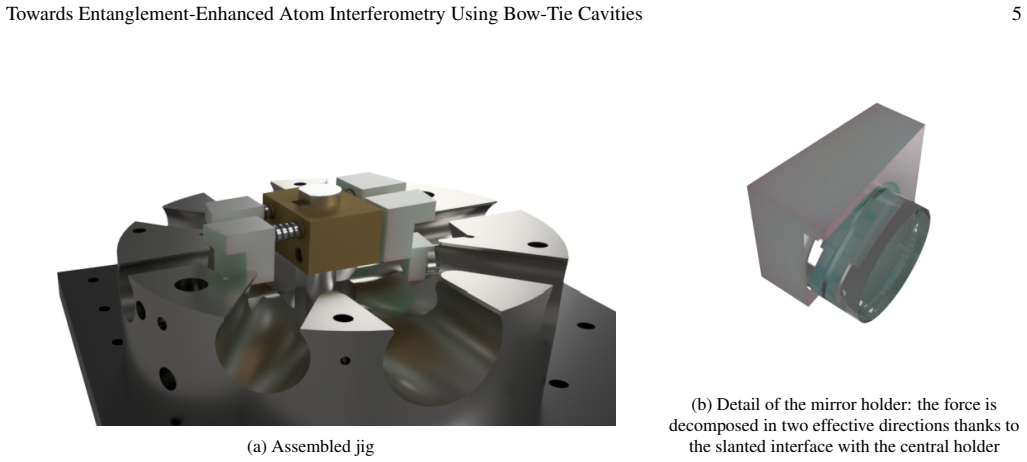
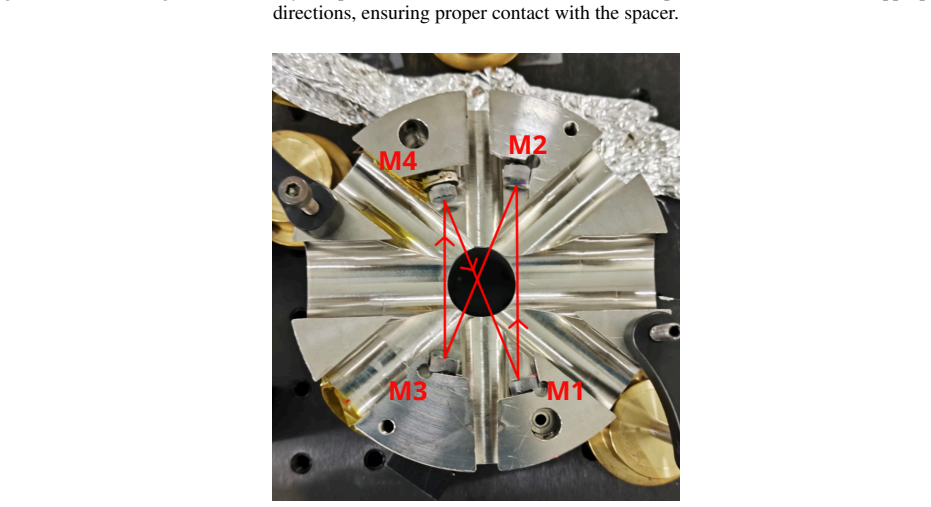
Atom interferometers are among the most sensitive instruments for precision measurements and tests of fundamental physics. Their performance, however, is ultimately limited by quantum projection noise when uncorrelated atomic ensembles are employed. Cavity-assisted generation of entangled states has proven to be a promising route toward quantum-enhanced interferometry beyond the standard quantum limit. In this work, we present the realization and characterization of a monolithic bow-tie cavity developed to achieve a strong collective atom-light coupling with strontium atoms. Unlike conventional standing-wave Fabry-P\'erot resonators, the traveling-wave geometry of the bow-tie cavity provides homogeneous atom-light coupling over the entire atomic ensemble, making it particularly suitable for entanglement-enhanced atom interferometry with freely falling atoms. The monolithic cavity architecture presents several scientifically relevant features such as high mechanical stability, high finesse, robustness against mirror misalignment, optical and atomic access and the option of generating squeezed states through different strategies. The cavity was realized for operation on the strontium $(5s^2) ^1S_0-(5s5p) ^3P_1$ transition at 689 nm and achieves a finesse of $\mathcal{F}=5.7\times 10^4$ while keeping the transmission of a single mirror sufficiently large to allow for efficient atomic information extraction. In this geometry, the cavity supports two foci with waists of 164 $\mu$m and 31 $\mu$m which gives access to different regimes of atom-cavity coupling. For ensembles containing up to $10^5$ atoms, the cavity is expected to enable metrological gains approaching 24 dB of spin squeezing through cavity-feedback squeezing, and 28 dB through quantum non-demolition measurements, demonstrating its potential as a platform for next-generation quantum-enhanced atom interferometers.
Editorial analysis
A structured set of objections, weighed in public.
Referee Report
Summary. The manuscript reports the design, fabrication, and optical characterization of a monolithic bow-tie traveling-wave cavity for the strontium 689 nm transition. It achieves a measured finesse of 5.7×10^4, supports two foci (waists 164 μm and 31 μm), and projects metrological gains of ~24 dB (cavity-feedback squeezing) and ~28 dB (QND) for N≤10^5 atoms on the basis of homogeneous atom-light coupling in the traveling-wave geometry, positioning the device as a platform for entanglement-enhanced atom interferometry with freely falling atoms.
Significance. The monolithic bow-tie architecture provides a stable, high-finesse cavity with good optical and atomic access and the ability to operate in different coupling regimes via the two foci; these are concrete engineering strengths. If the projected squeezing levels are realized, the work would constitute a meaningful step toward quantum-enhanced atom interferometry. The significance is tempered by the fact that the headline gain numbers rest on an unverified uniformity assumption and that no actual squeezing data are presented.
major comments (2)
- [Abstract] Abstract: the projected 24 dB and 28 dB metrological gains presuppose that the single-atom coupling g can be treated as constant across the ensemble. The 31 μm waist gives a mode area ~3×10^3 μm²; for typical 10^5-atom Sr ensembles with rms radii 50–150 μm after release, atoms experience >10% variation in |E(r)|². No calculation of the position-dependent cooperativity, effective squeezing parameter ξ², or inhomogeneous averaging along a free-fall trajectory is supplied, rendering the numerical claims unsupported.
- [Cavity characterization] Cavity characterization section: the reported finesse F=5.7×10^4 is stated without accompanying raw transmission/reflection spectra, linewidth data, or uncertainty analysis. In the absence of these, the claim that the cavity is suitable for the required collective cooperativity cannot be independently assessed.
minor comments (1)
- [Abstract] The abstract states that the traveling-wave geometry 'provides homogeneous atom-light coupling' but does not quantify residual longitudinal variation between the two foci or residual transverse gradients.
Simulated Author's Rebuttal
We thank the referee for their constructive comments and careful reading of the manuscript. We address each major comment below.
read point-by-point responses
-
Referee: [Abstract] Abstract: the projected 24 dB and 28 dB metrological gains presuppose that the single-atom coupling g can be treated as constant across the ensemble. The 31 μm waist gives a mode area ~3×10^3 μm²; for typical 10^5-atom Sr ensembles with rms radii 50–150 μm after release, atoms experience >10% variation in |E(r)|². No calculation of the position-dependent cooperativity, effective squeezing parameter ξ², or inhomogeneous averaging along a free-fall trajectory is supplied, rendering the numerical claims unsupported.
Authors: The referee is correct that the quoted projections require justification of the homogeneity assumption. The manuscript emphasizes the traveling-wave geometry for homogeneity, but the two foci enable different regimes: the 164 μm waist (mode area ~8.5×10^4 μm²) is intended for the large-ensemble homogeneous coupling underlying the 24 dB and 28 dB projections, while the 31 μm waist targets stronger local coupling. For the 164 μm waist, intensity variation remains below ~5% across rms radii up to 100 μm. We will add explicit calculations of the position-dependent cooperativity, effective ξ², and trajectory-averaged squeezing in the revised manuscript (new subsection in Sec. IV or V) and will clarify in the abstract which waist is used for each projection. revision: yes
-
Referee: [Cavity characterization] Cavity characterization section: the reported finesse F=5.7×10^4 is stated without accompanying raw transmission/reflection spectra, linewidth data, or uncertainty analysis. In the absence of these, the claim that the cavity is suitable for the required collective cooperativity cannot be independently assessed.
Authors: We agree that the raw data and uncertainty analysis should be included to allow independent verification. In the revised manuscript we will add the measured transmission and reflection spectra, the cavity linewidth data, and the uncertainty estimate for F=5.7×10^4 (new figure or supplementary material referenced from the cavity characterization section). revision: yes
Circularity Check
No circularity: experimental cavity characterization with forward projections based on measured parameters.
full rationale
The manuscript is an experimental report on the design, fabrication, and characterization of a bow-tie cavity (finesse, waists, transmission). The metrological-gain projections (24 dB, 28 dB) are stated as expectations for N ≤ 10^5 atoms but are not derived from any internal equations that reduce to fitted inputs by construction; they rest on standard cavity-QED formulas applied to the measured cavity parameters. No self-definitional loops, fitted-input predictions, or load-bearing self-citations appear in the provided text. The traveling-wave homogeneity claim is an engineering assertion supported by the geometry description rather than a mathematical identity. The derivation chain is therefore self-contained against external benchmarks.
Axiom & Free-Parameter Ledger
axioms (1)
- domain assumption Standard cavity QED theory applies to predict squeezing levels from measured finesse, waists, and atom number.
Reference graph
Works this paper leans on
-
[1]
Campbell, S. L. and Gear, C. W. The index of general nonlinear D A E S. Numer. M ath. 1995
1995
-
[2]
Slifka, M. K. and Whitton, J. L. Clinical implications of dysregulated cytokine production. J. M ol. M ed. 2000. doi:10.1007/s001090000086
-
[3]
Quasimonotonicity, regularity and duality for nonlinear systems of partial differential equations
Hamburger, C. Quasimonotonicity, regularity and duality for nonlinear systems of partial differential equations. Ann. Mat. Pura. Appl. 1995
1995
-
[4]
Geddes, K. O. and Czapor, S. R. and Labahn, G. Algorithms for C omputer A lgebra. 1992
1992
-
[5]
Software engineering---from auxiliary to key technologies
Broy, M. Software engineering---from auxiliary to key technologies. Software Pioneers. 1992
1992
-
[6]
Conductive P olymers. 1981
1981
-
[7]
Smith, S. E. Neuromuscular blocking drugs in man. Neuromuscular junction. H andbook of experimental pharmacology. 1976
1976
-
[8]
Chung, S. T. and Morris, R. L. Isolation and characterization of plasmid deoxyribonucleic acid from Streptomyces fradiae. 1978
1978
-
[9]
and AghaKouchak, A
Hao, Z. and AghaKouchak, A. and Nakhjiri, N. and Farahmand, A. Global integrated drought monitoring and prediction system (GIDMaPS) data sets. 2014
2014
-
[10]
Babichev, S. A. and Ries, J. and Lvovsky, A. I. Quantum scissors: teleportation of single-mode optical states by means of a nonlocal single photon. 2002
2002
-
[11]
Beneke, M. and Buchalla, G. and Dunietz, I. Mixing induced CP asymmetries in inclusive B decays. Phys. L ett. 1997. arXiv:0707.3168
Pith/arXiv arXiv 1997
-
[12]
deep SIP : deep learning of S upernova I a P arameters
Stahl, B. deep SIP : deep learning of S upernova I a P arameters. 2020. ascl:2006.023
2020
-
[13]
Abbott, T. M. C. and others. Dark Energy Survey Year 1 Results: Constraints on Extended Cosmological Models from Galaxy Clustering and Weak Lensing. Phys. Rev. D. 2019. doi:10.1103/PhysRevD.99.123505. arXiv:1810.02499
-
[14]
Will, C. M. Theory and E xperiment in G ravitational P hysics. 2018. doi:10.1017/9781316338612
-
[15]
Extended Theories of Gravity , journal =
Salvatore Capozziello and Mariafelicia. Extended Theories of Gravity , journal =. 2011 , issn =. doi:https://doi.org/10.1016/j.physrep.2011.09.003 , url =
-
[16]
Cai, Yi-Fu and Capozziello, Salvatore and De Laurentis, Mariafelicia and Saridakis, Emmanuel N , journal=. f (. 2016 , publisher=. doi:10.1088/0034-4885/79/10/106901
-
[17]
Salvi, Leonardo and Poli, Nicola and Vuletic, Vladan and Tino, Guglielmo M. , journal =. Squeezing on. 2018 , month =. doi:10.1103/PhysRevLett.120.033601 , url =
-
[18]
and Bettadpur, Srinivas and Ries, John C
Tapley, Byron D. and Bettadpur, Srinivas and Ries, John C. and Thompson, Paul F. and Watkins, Michael M. , title =. 2004 , doi =. http://science.sciencemag.org/content/305/5683/503.full.pdf , journal =
2004
-
[19]
Floberghagen, Rune and Fehringer, Michael and Lamarre, Daniel and Muzi, Danilo and Frommknecht, Bj \"o rn and Steiger, Christoph and Pi \ n eiro, Juan and da Costa, Andrea. Mission design, operation and exploitation of the gravity field and steady-state ocean circulation explorer mission. Journal of Geodesy. 2011. doi:10.1007/s00190-011-0498-3
-
[20]
A spaceborne gravity gradiometer concept based on cold atom interferometers for measuring
Carraz, Olivier and Siemes, Christian and Massotti, Luca and Haagmans, Roger and Silvestrin, Pierluigi , journal=. A spaceborne gravity gradiometer concept based on cold atom interferometers for measuring. 2014 , publisher=
2014
-
[21]
L\'ev\`eque, T. and Gauguet, A. and Michaud, F. and Pereira Dos Santos, F. and Landragin, A. , journal =. Enhancing the. 2009 , month =. doi:10.1103/PhysRevLett.103.080405 , url =
-
[23]
Schleier-Smith, Monika Helene , title =
-
[24]
2013 , address =
Cheiney, Pierrick , title =. 2013 , address =
2013
-
[25]
Advances in Atomic, Molecular, and Optical Physics , issn =
Chapter 4 - Interaction between Atomic Ensembles and Optical Resonators: Classical Description , editor =. Advances in Atomic, Molecular, and Optical Physics , issn =. 2011 , address =. doi:https://doi.org/10.1016/B978-0-12-385508-4.00004-8 , url =
-
[26]
Tino, Guglielmo M. , title =. doi:10.3254/978-1-61499-448-0-457 , url =
-
[27]
D'Amico, G. and Rosi, G. and Zhan, S. and Cacciapuoti, L. and Fattori, M. and Tino, G. M. , journal =. Canceling the. 2017 , month =. doi:10.1103/PhysRevLett.119.253201 , url =
-
[28]
Hu, Liang and Poli, Nicola and Salvi, Leonardo and Tino, Guglielmo M. , journal =. Atom. 2017 , month =. doi:10.1103/PhysRevLett.119.263601 , url =
-
[29]
2019 , month = Aug, publisher =
Federica Migliaccio and Mirko Reguzzoni and Khulan Batsukh and Guglielmo Maria Tino and Gabriele Rosi and Fiodor Sorrentino and Carla Braitenberg and Tommaso Pivetta and Dora Francesca Barbolla and Simona Zoffoli , title =. 2019 , month = Aug, publisher =. doi:10.1007/s10712-019-09566-4 , url =
-
[30]
Guglielmo M. Tino and Angelo Bassi and Giuseppe Bianco and Kai Bongs and Philippe Bouyer and Luigi Cacciapuoti and Salvatore Capozziello and Xuzong Chen and Maria L. Chiofalo and Andrei Derevianko and Wolfgang Ertmer and Naceur Gaaloul and Patrick Gill and Peter W. Graham and Jason M. Hogan and Luciano Iess and Mark A. Kasevich and Hidetoshi Katori and Ca...
-
[31]
Classical and Quantum Gravity , abstract =
Liang Hu and Enlong Wang and Leonardo Salvi and Jonathan N Tinsley and Guglielmo M Tino and Nicola Poli , title =. Classical and Quantum Gravity , abstract =. doi:10.1088/1361-6382/ab4d18 , url =
-
[32]
Roura, Albert , journal =. Circumventing. 2017 , month =. doi:10.1103/PhysRevLett.118.160401 , url =
-
[33]
R. W. P. Drever and J. L. Hall and F. V. Kowalski and J. Hough and G. M. Ford and A. J. Munley and H. Ward , title =. 1983 , month =. doi:10.1007/bf00702605 , url =
-
[34]
Eric D. Black , title =. 2001 , month =. doi:10.1119/1.1286663 , url =
-
[35]
Sorrentino, F. and Bodart, Q. and Cacciapuoti, L. and Lien, Y.-H. and Prevedelli, M. and Rosi, G. and Salvi, L. and Tino, G. M. , journal =. Sensitivity limits of a. 2014 , month =. doi:10.1103/PhysRevA.89.023607 , url =
-
[36]
Peters, Achim , title =
-
[37]
D. S. Weiss and B. C. Young and S. Chu , title =. 1994 , month =. doi:10.1007/bf01081393 , url =
-
[38]
Daniel A. Steck. Rubidium 87 D L ine D ata. 2019
2019
-
[39]
The influence of transverse motion within an atomic gravimeter , journal =
Anne Louchet-Chauvet and Tristan Farah and Quentin Bodart and Andr. The influence of transverse motion within an atomic gravimeter , journal =. 2011 , month =. doi:10.1088/1367-2630/13/6/065025 , url =
-
[40]
Atom-wave diffraction between the
M\"uller, Holger and Chiow, Sheng-wey and Chu, Steven , journal =. Atom-wave diffraction between the. 2008 , month =. doi:10.1103/PhysRevA.77.023609 , url =
-
[41]
Estey, Brian Vincent , title =
-
[42]
M\"uller, Holger and Chiow, Sheng-wey and Long, Quan and Herrmann, Sven and Chu, Steven , journal =. Atom. 2008 , month =. doi:10.1103/PhysRevLett.100.180405 , url =
-
[43]
Szigeti and Onur Hosten and Simon A
Stuart S. Szigeti and Onur Hosten and Simon A. Haine , journal =. Will quantum-enhanced atom interferometry ever be useful?. 2020 , month=
2020
-
[44]
M. Schioppo and N. Poli and M. Prevedelli and St. Falke and Ch. Lisdat and U. Sterr and G. M. Tino , title =. 2012 , month =. doi:10.1063/1.4756936 , url =
-
[45]
2020 , month =
Joep Assendelft , title =. 2020 , month =
2020
-
[46]
2019 , url =
Nichia , title =. 2019 , url =
2019
-
[47]
2013 , url =
Hamamatsu , title =. 2013 , url =
2013
-
[48]
Salvi, Leonardo , title =
-
[49]
Method for the differential measurement of phase shifts induced by atoms in an optical ring cavity , author =. Phys. Rev. A , volume =. 2021 , month =. doi:10.1103/PhysRevA.103.022609 , url =
-
[50]
Wang, Enlong , title =
-
[51]
2022 , month =
Joep Assendelft , title =. 2022 , month =
2022
-
[52]
Tarallo, Marco Giacinto , title =
-
[53]
Boyd , title =
Martin M. Boyd , title =. 2007 , month =
2007
-
[54]
2021 , month =
Graham Greve , title =. 2021 , month =
2021
-
[55]
Muniz, Juan A. and Young, Dylan J. and Cline, Julia R. K. and Thompson, James K. , journal =. Cavity-. 2021 , month =. doi:10.1103/PhysRevResearch.3.023152 , url =
-
[56]
Tarallo, M. G. and Poli, N. and Schioppo, M. and Sutyrin, D. and Tino, G. M. , volume=. A high-stability semiconductor laser system for a ^. Applied Physics B , publisher=. 2010 , month=. doi:10.1007/s00340-010-4232-2 , number=
-
[57]
Laser-noise-induced heating in far-off resonance optical traps , author =. Phys. Rev. A , volume =. 1997 , month =. doi:10.1103/PhysRevA.56.R1095 , url =
-
[58]
Dynamics of noise-induced heating in atom traps , author =. Phys. Rev. A , volume =. 1998 , month =. doi:10.1103/PhysRevA.58.3914 , url =
-
[59]
Laser cooling by sawtooth-wave adiabatic passage , author =. Phys. Rev. A , volume =. 2018 , month =. doi:10.1103/PhysRevA.98.023404 , url =
-
[60]
Sawtooth-wave adiabatic passage in a magneto-optical trap , author =. Phys. Rev. A , volume =. 2020 , month =. doi:10.1103/PhysRevA.101.053434 , url =
-
[61]
Fast and dense magneto-optical traps for strontium , author =. Phys. Rev. A , volume =. 2019 , month =. doi:10.1103/PhysRevA.99.063421 , url =
-
[62]
Active cancellation of acoustical resonances with an
Ryou, Albert and Simon, Jonathan , volume=. Active cancellation of acoustical resonances with an. Review of Scientific Instruments , publisher=. 2017 , month=. doi:10.1063/1.4973470 , number=
-
[63]
Stroescu, Ion and Hume, David B. and Oberthaler, Markus K. , journal =. Double-well atom trap for fluorescence detection at the. 2015 , month =. doi:10.1103/PhysRevA.91.013412 , url =
-
[64]
Foot, C. J. , publisher =. Atomic. 2004 , address =
2004
-
[65]
Laser C ooling and T rapping
Metcalf, Harold J and Van Der Straten, Peter. Laser C ooling and T rapping
-
[66]
Steck, D. A. Classical and M odern O ptics
-
[67]
Stellmer, Simon , title =
-
[68]
Sansonetti, J. E. and Nave, G. , title =. 2010 , month = sep, publisher =. doi:10.1063/1.3449176 , url =
-
[69]
Ferrari, G. and Cancio, P. and Drullinger, R. and Giusfredi, G. and Poli, N. and Prevedelli, M. and Toninelli, C. and Tino, G. M. , journal =. 2003 , month =. doi:10.1103/PhysRevLett.91.243002 , url =
-
[70]
Accuracy evaluation of an optical lattice clock with bosonic atoms , volume =
Xavier Baillard and Mathilde Fouch\'. Accuracy evaluation of an optical lattice clock with bosonic atoms , volume =. Opt. Lett. , keywords =. 2007 , url =
2007
-
[71]
doi:10.1088/0026-1394/45/5/008 , url =
Gretchen K Campbell and Andrew D Ludlow and Sebastian Blatt and Jan W Thomsen and Michael J Martin and Marcio H G de Miranda and Tanya Zelevinsky and Martin M Boyd and Jun Ye and Scott A Diddams and Thomas P Heavner and Thomas E Parker and Steven R Jefferts , title =. doi:10.1088/0026-1394/45/5/008 , url =
-
[72]
I. Courtillot and A. Quessada-Vial and A. Brusch and D. Kolker and G. D. Rovera and P. Lemonde , title =. 2005 , month = may, publisher =. doi:10.1140/epjd/e2005-00058-0 , url =
-
[73]
Kramida and
A. Kramida and. 2021 , url =
2021
-
[74]
K. J. Ross and B. Sonntag , doi =. High temperature metal atom beam sources , journal =. 1995 , month = sep, publisher =
1995
-
[75]
L.J. Moore and T.J. Murphy and I.L. Barnes and P.J. Paulsen , title =. 1982 , month = jan, publisher =. doi:10.6028/jres.087.001 , url =
-
[76]
John R. de Laeter and John Karl B\". Atomic weights of the elements. 2003 , month = jan, publisher =. doi:10.1351/pac200375060683 , url =
-
[77]
Atomic masses of strontium and ytterbium , author =. Phys. Rev. A , volume =. 2012 , month =. doi:10.1103/PhysRevA.86.050502 , url =
-
[78]
The E lements
Emsley, John. The E lements
-
[79]
Exploring the
Serge Haroche and Jean. Exploring the. 2006 , note =
2006
-
[80]
Ivaylo S. Madjarov and Jacob P. Covey and Adam L. Shaw and Joonhee Choi and Anant Kale and Alexandre Cooper and Hannes Pichler and Vladimir Schkolnik and Jason R. Williams and Manuel Endres , title =. 2020 , month = may, publisher =. doi:10.1038/s41567-020-0903-z , url =
-
[81]
Tobias Bothwell and Dhruv Kedar and Eric Oelker and John M Robinson and Sarah L Bromley and Weston L Tew and Jun Ye and Colin J Kennedy , title =. 2019 , month =. doi:10.1088/1681-7575/ab4089 , url =
discussion (0)
Sign in with ORCID, Apple, or X to comment. Anyone can read and Pith papers without signing in.