REVIEW 4 major objections 4 minor 44 references
Echo-Teddy: Preliminary Design and Development of Large Language Model-based Social Robot for Autistic Students
T0 review · 4 major / 4 minor · reviewed 2026-08-08 · deepseek-v4-flash
Pith's one-line read Echo-Teddy shows a low-cost, cloud-LLM teddy robot is a feasible starting point for autism support.
desk verdict A modest but honest preliminary design report whose concrete prototype documentation is useful, yet whose expert-interview evidence is too thinly reported to verify. read the letter →
The pith
A machine-rendered reading of the paper's core claim, the machinery that carries it, and where it could break.
The reading
What carries the argument
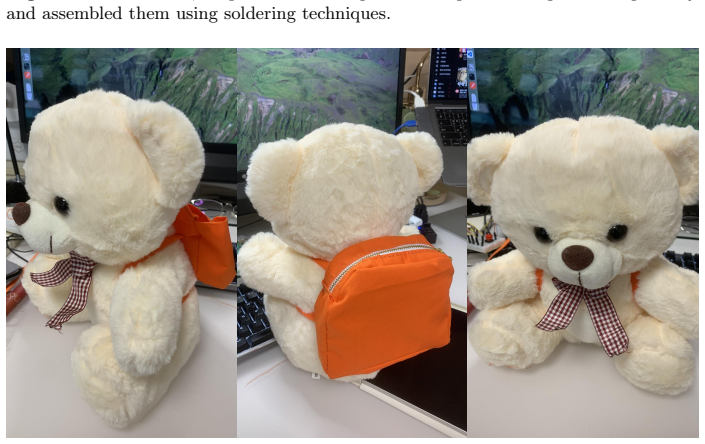
The central machinery is the Echo-Teddy prototype's cloud LLM interaction loop: voice input captured on the Raspberry Pi is transcribed in the cloud, a large language model generates context-aware dialogue, speech synthesis returns audio, and JSON action commands trigger synchronized nonverbal gestures from a servo and dot-matrix face. Two design commitments carry the argument: the soft, non-humanoid teddy exterior, chosen to reduce anxiety and judged by experts as suitable for many students, and the use of cheap, widely available hardware plus cloud APIs, chosen to make the robot feasible for low-budget special-education settings. The paper's iteration process—developer reflection-on-action followed by structured expert interviews—is what turns this prototype into design principles and improvement priorities.
What would settle it
Give autistic students the current Echo-Teddy prototype in a classroom or therapy setting, split sessions between the existing six-to-ten-second cloud delay and a near-real-time local or edge response, and measure engagement, attention, and visible anxiety. If students stay engaged and calm during delayed responses, the paper's leading improvement priority is wrong; if delay reliably breaks engagement, that priority is confirmed. A second check would compare the soft teddy form against a humanoid robot running the same LLM dialogue to test the non-humanoid design principle.
Extended reading notes
Core claim
Echo-Teddy's central discovery is that an agentic-LLM social robot does not need expensive humanoid hardware: a Raspberry Pi 5 with a microphone, speaker, a servo, and a dot-matrix face can hold context-aware conversation when connected to cloud speech and language services. The prototype sends audio to cloud speech-to-text, feeds the text to a large language model, and coordinates synthesized speech with simple gestures such as nodding, while a prompt-management module lets caregivers adjust topics and behavioral prompts. Based on developer reflection and five expert interviews, the paper derives four design-principle themes—potential user, ethical consideration, customization, and usage—and seven improvement themes covering response speed, physical form, interaction goals, nonverbal modeling, target-student range, generalizability, and cost and scalability. The demonstration is therefore not a field-tested therapy result but a validated design direction: the hardware is feasible, and the expert-identified priorities (lower latency, AAC compatibility, expressive nonverbal behavior, peer generalization, customizable forms, open-source distribution) define the next iteration.
Load-bearing premise
The argument's load-bearing premise is that five special-education experts' expectations faithfully predict how autistic students will experience the robot, because no direct interaction data from autistic students using Echo-Teddy are collected in this study.
Editorial extensions
If this is right
- A low-cost cloud-LLM robot is a realistic option for schools with limited equipment budgets, since the prototype uses commodity parts and subscription cloud services rather than specialized robotic hardware.
- Cutting the reported six-to-ten-second response delay becomes the first engineering priority, because experts tie prompt feedback to sustained attention and reduced anxiety in autistic students.
- Adding AAC device input would widen the robot's reach beyond students who use spoken language, making it a tool for a broader spectrum of communication profiles.
- Refocusing the robot as a mediator for peer interaction in inclusive classrooms would test whether skills practiced with the robot generalize to real human-human conversation.
- An open-source DIY distribution model could let schools and families build and customize their own versions, which is the most direct route to the scale the paper targets.
Reading between the lines
- The paper leaves untested whether autistic students themselves tolerate the current cloud latency; a direct behavioral comparison of fast and slow response conditions would show whether the expert-prioritized latency fix is necessary.
- The non-humanoid form is supported by prior findings and expert opinion but not by a within-study comparison; a preference and engagement test across animal forms, textures, and eye designs would isolate which physical features actually drive comfort.
- The paper's reliance on expert proxy judgment suggests a natural next study: log real child-robot conversations and check whether the LLM's responses stay age-appropriate, culturally fitting, and individually calibrated over repeated sessions.
- Should the cloud LLM produce inconsistent or inaccurate emotional reactions, the ethical-safety layer would need more than prompt management—continuous monitoring and fail-safe responses would likely be required.
Editorial analysis
A structured set of objections, weighed in public.
Referee Report
Summary. The paper describes Echo-Teddy, a cost-effective social robot for autistic students that combines a Raspberry Pi 5 base with cloud-based speech processing (AWS Transcribe), LLM dialogue generation (GPT-4o-mini), and Korean TTS (Naver Clova Voice), wrapped in a soft teddy-bear exterior. The authors report two research questions: RQ1 concerns the design principles and initial prototype characteristics, and RQ2 concerns improvements identified via developer reflection-on-action and five semi-structured interviews with special-education experts. The main deliverables are a design-principle table (Table 2) and seven expert-identified improvement themes (Section 4.2), including latency reduction, AAC input support, expressive nonverbal behavior, and peer-interaction scenarios. The study is explicitly preliminary and qualitative in nature.
Significance. If the reported results are treated as a starting point, the paper makes a useful design contribution: the hardware description in Section 3.2 and the component list in Appendix 1 are concrete enough to reproduce or adapt, and Table 2 translates general ethical and customization concerns into specific requirements. The authors deserve credit for honestly reporting the 6–10 s response delay and the need for emotion-output validation. However, the empirical core of the paper is a small qualitative interview study with no analysis protocol and no direct user data, so the significance of the design principles as an evidence-based starting point is currently limited. The paper is better framed as a system-description and preliminary expert-opinion study than as a validated evaluation of an LLM-based social robot.
major comments (4)
- [§4.2] Section 4.2 ('Results of interview with experts') reports seven themes and a list of expert suggestions, but no qualitative analysis procedure is described: there is no coding scheme, no description of the coding process, no inter-rater reliability or alternative trustworthiness check, no representative interview excerpts, and no participant demographics or selection criteria (Section 3.1 only states that five special education experts participated). Because RQ2's entire improvement agenda (latency reduction, AAC input support, expressive nonverbal behavior, peer-interaction scenarios) rests on this analysis, the theme summaries cannot be independently checked; the authors should either report the analysis method with quotes and coding evidence or explicitly reclassify the section as unauditable preliminary impressions.
- [§3.2, Table 1, §4.2] The interview questionnaire was built from the developers' own categories (Affordance, Usability, Instructional Design, Instructional Usefulness; Table 1), and the seven themes in Section 4.2 closely mirror those categories. The manuscript does not explain how the themes emerged independently of the questionnaire structure, what the experts said verbatim, or where experts disagreed. This creates a risk that the reported findings reflect the researchers' presuppositions; the authors should clarify the relation between the questionnaire and the thematic coding and report dissenting or contradictory expert statements.
- [§3.2 vs §4.2] Section 3.2 states that the backend 'ensuring scalability, low-latency processing, and reliable performance in real-time interactions,' but Section 4.2 reports that experts observed a 6–10 s processing delay for cloud STT and TTS, which they considered a major usability problem for autistic students. These statements are in tension; the paper should either temper the low-latency claim, report the measured or observed latency more precisely, or explain why the implementation differs from the design goal.
- [Abstract and §2.1] The abstract states that Echo-Teddy 'leverages advanced LLM capabilities to provide more natural and adaptive interactions' than chatbot-based solutions, but no comparison with chatbot baselines is reported anywhere in the paper; the expert-identified 6–10 s response delay (Section 4.2) even indicates a current usability problem. The claim should be reworded as a design hypothesis or be supported by comparative evidence, since the current phrasing implies an empirical superiority that the study does not establish.
minor comments (4)
- [§1, §3.2, Table 2] The manuscript contains several typos that should be corrected: 'adpt' in the Section 1 introduction, 'Thisstudy' in Section 3.1, 'evaluation were designed' in Section 3.2, and 'paticular topic' in Table 2.
- [§5] The in-text citations do not match the reference list: 'Lee and Park [23]' refers to Maroto-Gómez et al., and 'Choi et al [30]' refers to Santos et al.; these attributions should be corrected or reworded.
- [References] Reference [19] is incomplete: it lacks a publication venue and year, and it is a self-citation that should be checked for relevance and completeness.
- [Abstract and §3.1] The study is described as 'mixed-methods', but the reported evidence consists only of qualitative interviews and developer reflections; either add a quantitative component or describe the design as qualitative.
Circularity Check
No circular derivation: the prototype and expert-interview findings are self-contained, with only one background self-citation that is not load-bearing.
full rationale
This qualitative design paper contains no fitted parameters, predictive equations, or formal derivation chain that could reduce to its own inputs. The design principles in Table 2 are presented as the authors' own design commitments informed by a literature review and by developer reflection, and the improvement priorities in Section 4.2 are explicitly reported from five external special-education expert interviews; they do not reuse the prototype's outputs as evidence for themselves. The single self-citation [19] (Lee et al., generative agent for teacher training) appears in the Introduction only to support the general statement that LLMs are increasingly used in autonomous, adaptive, and decision-making roles, not to justify Echo-Teddy's design principles or evaluation results, so it is not load-bearing. No specific circular step can be quoted from the paper. Although the qualitative analysis is not independently checkable without interview transcripts or a coding scheme, that is a transparency and validity limitation, not a circularity. The central claims therefore rest on external qualitative evidence rather than on a self-referential argument.
Assumptions & free parameters
assumptions (3)
- domain assumption LLM conversation via GPT-4o-mini with a prompt-management layer produces age-appropriate, safe, and socially useful dialogue for autistic students without per-student fine-tuning.
- domain assumption Non-humanoid, soft, fur-covered appearance reduces anxiety and increases engagement for autistic children.
- domain assumption Feedback from five special-education experts generalizes to the needs and classroom realities of the broader autistic student population.
invented entities (1)
-
Echo-Teddy prototype (LLM-agent-based teddy bear robot)
independent evidence
Cite this review
Pith. "Pith review of Echo-Teddy: Preliminary Design and Development of Large Language Model-based Social Robot for Autistic Students." pith.science (2026). https://pith.science/paper/K7XGTPE7
@misc{pith2026250204029,
  author       = {Pith},
  title        = {Pith review of: Echo-Teddy: Preliminary Design and Development of Large Language Model-based Social Robot for Autistic Students},
  year         = {2026},
  howpublished = {\url{https://pith.science/paper/K7XGTPE7}},
  note         = {Machine review of arXiv:2502.04029}
}
read the original abstract
Autistic students often face challenges in social interaction, which can hinder their educational and personal development. This study introduces Echo-Teddy, a Large Language Model (LLM)-based social robot designed to support autistic students in developing social and communication skills. Unlike previous chatbot-based solutions, Echo-Teddy leverages advanced LLM capabilities to provide more natural and adaptive interactions. The research addresses two key questions: (1) What are the design principles and initial prototype characteristics of an effective LLM-based social robot for autistic students? (2) What improvements can be made based on developer reflection-on-action and expert interviews? The study employed a mixed-methods approach, combining prototype development with qualitative analysis of developer reflections and expert interviews. Key design principles identified include customizability, ethical considerations, and age-appropriate interactions. The initial prototype, built on a Raspberry Pi platform, features custom speech components and basic motor functions. Evaluation of the prototype revealed potential improvements in areas such as user interface, educational value, and practical implementation in educational settings. This research contributes to the growing field of AI-assisted special education by demonstrating the potential of LLM-based social robots in supporting autistic students. The findings provide valuable insights for future developments in accessible and effective social support tools for special education.
Figures


Figures from the paper (1 more)

Reference graph
Works this paper leans on
-
[23]
International Journal of Social Robotics pp
Maroto-Gómez, M., Malfaz, M., Castillo, J.C., Castro-González, Á., Salichs, M.Á.: Personalizing activity selection in assistive social robots from explicit and implicit user feedback. International Journal of Social Robotics pp. 1–19 (2024)
work page 2024
-
[30]
Review Journal of Autism and Developmental Disorders pp
Santos, L., Annunziata, S., Geminiani, A., Ivani, A., Giubergia, A., Garofalo, D., Caglio, A., Brazzoli, E., Lipari, R., Carrozza, M.C., et al.: Applications of robotics for autism spectrum disorder: A scoping review. Review Journal of Autism and Developmental Disorders pp. 1–22 (2023)
work page 2023
-
[1]
Interactive Learning Environments32(10), 6159–6172 (2024)
Adeshola, I., Adepoju, A.P.: The opportunities and challenges of chatgpt in edu- cation. Interactive Learning Environments32(10), 6159–6172 (2024)
work page 2024
-
[2]
In: Conference on Robot Learning (2022), https://api.semanticscholar.org/ CorpusID:247939706
Ahn, M., Brohan, A., Brown, N., Chebotar, Y., Cortes, O., David, B., Finn, C., Gopalakrishnan, K., Hausman, K., Herzog, A., Ho, D., Hsu, J., Ibarz, J., Ichter, B., Irpan, A., Jang, E., Ruano, R.M.J., Jeffrey, K., Jesmonth, S., Joshi, N.J., Julian, R.C., Kalashnikov, D., Kuang, Y., Lee, K.H., Levine, S., Lu, Y., Luu, L., Parada, C., Pastor, P., Quiambao, J...
work page 2022
-
[3]
Frontiers in Robotics and AI 6, 107 (2019)
Alcorn, A.M., Ainger, E., Charisi, V., Mantinioti, S., Petrović, S., Schadenberg, B.R., Tavassoli, T., Pellicano, E.: Educators’ views on using humanoid robots with autistic learners in special education settings in england. Frontiers in Robotics and AI 6, 107 (2019)
work page 2019
-
[4]
Bradford, D., Ireland, D., McDonald, J., Tan, T., Hatfield-White, E., Regan, T., Kidd, T., Farr-Wharton, G.: Hear’to help chatbot: Co-development of a chatbot to facilitate participation in tertiary education for students on the autism spectrum and those with related conditions. Final Report. Brisbane, QLD: Cooperative Re- searcher Centre for Living With ...
work page 2020
-
[5]
In: Bekris, K.E., Hauser, K., Herbert, S.L., Yu, J
Brohan, A., Brown, N., Carbajal, J., Chebotar, Y., Dabis, J., Finn, C., Gopalakr- ishnan, K., Hausman, K., Herzog, A., Hsu, J., Ibarz, J., Ichter, B., Irpan, A., Jack- son, T., Jesmonth, S., Joshi, N.J., Julian, R., Kalashnikov, D., Kuang, Y., Leal, I., Lee, K., Levine, S., Lu, Y., Malla, U., Manjunath, D., Mordatch, I., Nachum, O., Parada, C., Peralta, J...
2023
-
[6]
Cano, S., Díaz-Arancibia, J., Arango-López, J., Libreros, J.E., García, M.: De- sign path for a social robot for emotional communication for children with autism spectrum disorder (asd). Sensors23(11), 5291 (2023)
work page 2023
Show all 44 references
-
[7]
Frontiers in Robotics and AI 6, 110 (2019)
Clabaugh, C., Mahajan, K., Jain, S., Pakkar, R., Becerra, D., Shi, Z., Deng, E., Lee, R., Ragusa, G., Matarić, M.: Long-term personalization of an in-home socially assistive robot for children with autism spectrum disorders. Frontiers in Robotics and AI 6, 110 (2019)
2019
-
[8]
International Journal of Social Robotics9, 51–62 (2017)
Conti, D., Nuovo, S.D., Buono, S., Nuovo, A.D.: Robots in education and care of children with developmental disabilities: A study on acceptance by experienced and future professionals. International Journal of Social Robotics9, 51–62 (2017)
2017
-
[9]
In: Com- 18 Lee et al
De Carolis, B., Macchiarulo, N., D’Errico, F., Palestra, G.: Social robots to sup- port gestural development in children with autism spectrum disorder. In: Com- 18 Lee et al. panion Publication of the 2021 International Conference on Multimodal Inter- action. p. 376–380. ICMI ...
2021
-
[10]
Research in Autism Spectrum Disorders 6(1), 249–262 (2012)
Diehl, J.J., 1, L.M.S., Villano, M., Crowell, C.R.: The clinical use of robots for individuals with autism spectrum disorders: a critical review. Research in Autism Spectrum Disorders 6(1), 249–262 (2012)
2012
-
[11]
In: International Conference on Machine Learning (2023),https://api
Driess, D., Xia, F., Sajjadi, M.S.M., Lynch, C., Chowdhery, A., Ichter, B., Wahid, A., Tompson, J., Vuong, Q.H., Yu, T., Huang, W., Chebotar, Y., Sermanet, P., Duckworth, D., Levine, S., Vanhoucke, V., Hausman, K., Toussaint, M., Greff, K., Zeng, A., Mordatch, I., Florence, P....
2023
-
[12]
arXiv preprint arXiv:2303.03378 (2023)
Driess, D., Xia, F., Sajjadi, M.S., Lynch, C., Chowdhery, A., Ichter, B., Wahid, A., Tompson, J., Vuong, Q., Yu, T., et al.: Palm-e: An embodied multimodal language model. arXiv preprint arXiv:2303.03378 (2023)
2023 arXiv
-
[13]
Figure AI: Figure ai (2024),https://www.figure.ai/, accessed: 2024-09-14
2024
-
[14]
Education and Information Technologies pp
Gu, P., Xu, F., Chen, L., Ma, Z., Zhang, M., Zhang, Y.: Technological affordances and applications of chatbots for conversational skill interventions in autism: A scoping review. Education and Information Technologies pp. 1–30 (2024)
2024
-
[15]
Neurodiversity 2, 27546330241245290 (2024)
Halabieh, S., Lai, M.C., Lin, H.Y., Shu, L.: Computer programming a chatbot to improve social-communication skills in autistic children: A feasibility study. Neurodiversity 2, 27546330241245290 (2024)
2024
-
[16]
Working Paper 9, Westfälische Wilhelms-Universität Münster (July 2024)
Kahl, S., Löffler, F., Maciol, M., Ridder, F., Schmitz, M., Spanagel, J., Wienkamp, J., Burgahn, C., Schilling, M.: Enhancing ai tutoring in robotics education: Evalu- ating the effect of retrieval-augmented generation and fine-tuning on large language models. Working Paper 9,...
2024
-
[17]
Intelligent Service Robotics pp
Kim, Y., Kim, D., Choi, J., Park, J., Oh, N., Park, D.: A survey on integration of large language models with intelligent robots. Intelligent Service Robotics pp. 1–17 (2024)
2024
-
[18]
Plos one17(6), e0269800 (2022)
Kouroupa, A., Laws, K.R., Irvine, K., Mengoni, S.E., Baird, A., Sharma, S.: The use of social robots with children and young people on the autism spectrum: A systematic review and meta-analysis. Plos one17(6), e0269800 (2022)
2022
-
[19]
Lee, U., Lee, S., Koh, J., Jeong, Y., Jung, H., Byun, G., Lee, Y., Moon, J., Lim, J., Kim, H.: Generative agent for teacher training: Designing educational problem- solving simulations with large language model-based agents for pre-service teachers
-
[20]
it’s important to think of pepper as a teaching aid or resource external to the classroom
Lemaignan, S., Newbutt, N., Rice, L., Daly, J.: “it’s important to think of pepper as a teaching aid or resource external to the classroom”: A social robot in a school for autistic children. International Journal of Social Robotics6(2), 1083–1104 (2024)
2024
-
[21]
Education Sciences13(4), 410 (2023)
Lo, C.K.: What is the impact of chatgpt on education? a rapid review of the literature. Education Sciences13(4), 410 (2023)
2023
-
[22]
Education and Information Technologies26, 4111–4126 (2021)
Lorenzo, G., Lledó, A., Pérez-Vázquez, E., Lorenzo-Lledó, A.: Action protocol for the use of robotics in students with autism spectrum disoders: A systematic-review. Education and Information Technologies26, 4111–4126 (2021)
2021
-
[24]
International Journal of Social Robotics pp
Pérez-Vázquez, E., Lorenzo, G., Lorenzo-Lledó, A., Lledó, A.: Analysis of the ap- plication of the bee-bot robot for the development of social reciprocity skills in students with autism spectrum disorder. International Journal of Social Robotics pp. 1–26 (2024) Echo-Teddy 19
2024
-
[25]
Rawal, N., Stock-Homburg, R.M.: Facial emotion expressions in human-robot in- teraction: A survey (2022),https://arxiv.org/abs/2103.07169
2022 arXiv
-
[26]
4354–4359 (2010).https://doi.org/10.1109/ROBOT.2010.5509327
Ricks, D.J., Colton, M.B.: Trends and considerations in robot-assisted autism ther- apy pp. 4354–4359 (2010).https://doi.org/10.1109/ROBOT.2010.5509327
2010
-
[27]
In: 2010 IEEE International Conference on Robotics and Automation
Ricks, D.J., Colton, M.B.: Trends and considerations in robot-assisted autism ther- apy. In: 2010 IEEE International Conference on Robotics and Automation. pp. 4354–4359 (2010)
2010
-
[28]
Topics in language disorders24(4), 271–285 (2004)
Rubin, E., Lennon, L.: Challenges in social communication in asperger syndrome and high-functioning autism. Topics in language disorders24(4), 271–285 (2004)
2004
-
[29]
Disability and Rehabilitation: Assistive Technology16(6), 580–602 (2020)
Saleh, M.A., Hanapiah, F.A., Hashim, H.: Robot applications for autism: a compre- hensive review. Disability and Rehabilitation: Assistive Technology16(6), 580–602 (2020)
2020
-
[31]
Annual Review of Biomedical Engineering 14(Volume 14, 2012), 275–294 (2012)
Scassellati, B., Admoni, H., Matarić, M.: Robots for use in autism research. Annual Review of Biomedical Engineering 14(Volume 14, 2012), 275–294 (2012). https://doi.org/https://doi.org/10.1146/ annurev-bioeng-071811-150036, https://www.annualreviews.org/content/ journals/10.1...
2012 doi
-
[32]
arXiv preprint arXiv:2402.06116 (2024)
Shu, P., Zhao, H., Jiang, H., Li, Y., Xu, S., Pan, Y., Wu, Z., Liu, Z., Lu, G., Guan, L., et al.: Llms for coding and robotics education. arXiv preprint arXiv:2402.06116 (2024)
2024 arXiv
-
[33]
Disability and Rehabilitation: Assistive Technology13(6), 527–539 (2018)
So, W.C., Wong, M.K.Y., Lam, C.K.Y., Lam, W.Y., Chui, A.T.F., Lee, T.L., Ng, H.M., Chan, C.H., Fok, D.C.W.: Using a social robot to teach gestural recogni- tion and production in children with autism spectrum disorders. Disability and Rehabilitation: Assistive Technology13(6),...
2018
-
[34]
Syriopoulou-Delli,C.K.,Gkiolnta,E.:Reviewofassistivetechnologyinthetraining ofchildrenwithautismspectrumdisorders.InternationalJournalofDevelopmental Disabilities 68(2), 73–85 (2020)
2020
-
[35]
Journal of Artificial Intelligence and Soft Computing Research6(4), 267–277 (2016)
Tennyson, M.F., Kuester, D.A., Casteel, J., Nikolopoulos, C.: Accessible robots for improving social skills of individuals with autism. Journal of Artificial Intelligence and Soft Computing Research6(4), 267–277 (2016)
2016
-
[36]
Tesla: Tesla optimus gen 2 (2024), https://www.youtube.com/watch?v= cpraXaw7dyc, accessed: 2024-09-14
2024
-
[37]
a systematic review of recent research and critical analysis from the clinical perspective
Vagnetti, R., Di Nuovo, A., Mazza, M., Valenti, M.: Social robots: A promising tool to support people with autism. a systematic review of recent research and critical analysis from the clinical perspective. Review Journal of Autism and De- velopmental Disorders pp. 1–25 (2024)
2024
-
[38]
Journal of autism and developmental disorders45, 1673–1688 (2015)
Van Hees, V., Moyson, T., Roeyers, H.: Higher education experiences of students with autism spectrum disorder: Challenges, benefits and support needs. Journal of autism and developmental disorders45, 1673–1688 (2015)
2015
-
[39]
Vuong, Q., Levine, S., Walke, H.R., Pertsch, K., Singh, A., Doshi, R., Xu, C., Luo, J., Tan, L., Shah, D., Finn, C., Du, M., Kim, M.J., Khazatsky, A., Yang, J.H., Zhao, T.Z., Goldberg, K., Hoque, R., Chen, L.Y., Adebola, S., Sukhatme, G.S., Salhotra, G., Dass, S., Pinto, L., C...
2023
-
[40]
arXiv preprint arXiv:2401.04334 (2024)
Wang, J., Wu, Z., Li, Y., Jiang, H., Shu, P., Shi, E., Hu, H., Ma, C., Liu, Y., Wang, X., et al.: Large language models for robotics: Opportunities, challenges, and perspectives. arXiv preprint arXiv:2401.04334 (2024)
2024 arXiv
-
[41]
Education and Training in Developmental Disabilities pp
Whitby, P.J.S., Mancil, G.R.: Academic achievement profiles of children with high functioning autism and asperger syndrome: A review of the literature. Education and Training in Developmental Disabilities pp. 551–560 (2009)
2009
-
[42]
can i be more so- cial with a chatbot?
Xygkou, A., Siriaraya, P., She, W.J., Covaci, A., Ang, C.S.: “can i be more so- cial with a chatbot?”: Social connectedness through interactions of autistic adults with a conversational virtual human. International Journal of Human–Computer Interaction pp. 1–18 (2024)
2024
-
[43]
arXiv preprint arXiv:2311.07226 (2023)
Zeng, F., Gan, W., Wang, Y., Liu, N., Yu, P.S.: Large language models for robotics: A survey. arXiv preprint arXiv:2311.07226 (2023)
2023
-
[44]
In: Tan, J., Toussaint, M., Darvish, K
Zitkovich,B.,Yu,T.,Xu,S.,Xu,P.,Xiao,T.,Xia,F.,Wu,J.,Wohlhart,P.,Welker, S., Wahid, A., Vuong, Q., Vanhoucke, V., Tran, H., Soricut, R., Singh, A., Singh, J., Sermanet, P., Sanketi, P.R., Salazar, G., Ryoo, M.S., Reymann, K., Rao, K., Pertsch, K., Mordatch, I., Michalewski, H.,...
2023
Reviewed August 8, 2026 · model on record in the stance chip above.
Discussion (0). Continue with ORCID to comment.