REVIEW 1 major objections 61 references
Incorporating wave physical priors into diffusion models: A novel approach to seismic resolution enhancement
T0 review · 1 major / 0 minor · reviewed 2026-06-26 · grok-4.3
Pith's one-line read A diffusion model with the seismic convolution model as a hard constraint generates high-resolution field data without paired labels.
desk verdict The abstract frames a self-supervised diffusion model with a hard seismic convolution constraint for resolution enhancement, but supplies no equations or metrics so the claims cannot be checked. read the letter →
The pith
A machine-rendered reading of the paper's core claim, the machinery that carries it, and where it could break.
The reading
What carries the argument
Seismic convolution model embedded as a hard physical constraint in the diffusion model's training loss and reverse sampling process.
What would settle it
Apply the trained model to field data and check whether the output, when convolved with the wavelet, reproduces the input traces within the noise level; mismatch or new artifacts would falsify the constraint claim.
Extended reading notes
Core claim
By embedding the seismic convolution model as a hard physical constraint in both the training loss function and the reverse sampling process of a diffusion model, and constructing self-supervised targets via progressive filtering of observed field data, high-resolution outputs can be produced that respect wave propagation physics, recover thin layers, suppress noise, preserve continuity, and quantify uncertainty on real 3D post-stack seismic datasets.
Load-bearing premise
The seismic convolution model can be enforced as a hard constraint during training and sampling without introducing artifacts or breaking consistency with the observed field data.
Editorial extensions
If this is right
- Recovers thin layers and subtle structures from limited-bandwidth field data
- Suppresses noise while preserving structural continuity
- Generates spatial confidence maps to flag less reliable resolution-enhanced regions
- Operates on both synthetic tests under noise and real 3D post-stack field volumes
- Avoids distribution mismatch by training directly on observations rather than synthetic pairs
Reading between the lines
- The same hard-constraint pattern could transfer to other wave-equation inverse problems where the forward operator is known but high-resolution labels are unavailable.
- Uncertainty maps could be used to design adaptive acquisition geometries that target low-confidence zones.
- Progressive self-supervised filtering might reduce reliance on large synthetic training corpora across geophysical imaging tasks.
Editorial analysis
A structured set of objections, weighed in public.
Referee Report
Summary. The paper proposes PG-SSDM, a physics-guided self-supervised diffusion model for seismic resolution enhancement. It constructs self-supervised learning targets via progressive filtering of observed field data, embeds the seismic convolution model as a hard physical constraint within both the training loss and the reverse diffusion sampling process, and leverages the probabilistic framework to output spatial uncertainty maps. The approach is evaluated on synthetic data with varying noise levels and on a 3D post-stack field dataset, with reported improvements in thin-layer recovery, noise suppression, structural continuity, and overall interpretability.
Significance. If the hard-constraint embedding of the convolution model can be shown to be consistent with observed data and free of artifacts while outperforming baselines, the work would offer a practical route to applying diffusion models to band-limited geophysical inverse problems without paired high-resolution labels. The self-supervised target construction and built-in uncertainty quantification address two persistent limitations in supervised seismic DL methods and could improve generalization on real acquisitions.
major comments (1)
- The manuscript provides no explicit loss function, sampling algorithm, or mathematical statement of how the seismic convolution operator is imposed as a hard constraint during both training and reverse diffusion. Without this formulation it is impossible to verify whether the constraint is enforced without violating data consistency or introducing artifacts, which is load-bearing for the central claim of physics-guided enhancement.
Simulated Author's Rebuttal
We thank the referee for their constructive feedback and for recognizing the potential of PG-SSDM. We address the single major comment below and will revise the manuscript to supply the requested mathematical details.
read point-by-point responses
-
Referee: The manuscript provides no explicit loss function, sampling algorithm, or mathematical statement of how the seismic convolution operator is imposed as a hard constraint during both training and reverse diffusion. Without this formulation it is impossible to verify whether the constraint is enforced without violating data consistency or introducing artifacts, which is load-bearing for the central claim of physics-guided enhancement.
Authors: We agree that the explicit formulation is required for verification. In the revised manuscript we will add a dedicated subsection presenting (i) the training loss that augments the standard diffusion objective with a hard-constraint term enforcing the seismic convolution model on the predicted clean data, and (ii) the modified reverse sampling algorithm that projects each iterate onto the data-consistent manifold defined by the convolution operator. These equations will make clear that the constraint is applied without relaxing data fidelity or introducing new artifacts. revision: yes
Circularity Check
No significant circularity; derivation relies on external physical model
full rationale
The abstract and context describe a self-supervised diffusion model that incorporates the seismic convolution model as an external hard constraint in the loss and sampling process. No equations, fitted parameters, or self-citations are provided that would reduce any claimed prediction or result to a definition or fit internal to the paper. The approach is presented as building on standard diffusion models plus an independent domain physics model, with no evidence of self-definitional loops, renamed known results, or load-bearing self-citations. This is the common case of a self-contained proposal whose validity must be checked against external benchmarks rather than internal reduction.
Assumptions & free parameters
Cite this review
Pith. "Pith review of Incorporating wave physical priors into diffusion models: A novel approach to seismic resolution enhancement." pith.science (2026). https://pith.science/paper/KA55RSXZ
@misc{pith2026260617808,
  author       = {Pith},
  title        = {Pith review of: Incorporating wave physical priors into diffusion models: A novel approach to seismic resolution enhancement},
  year         = {2026},
  howpublished = {\url{https://pith.science/paper/KA55RSXZ}},
  note         = {Machine review of arXiv:2606.17808}
}
read the original abstract
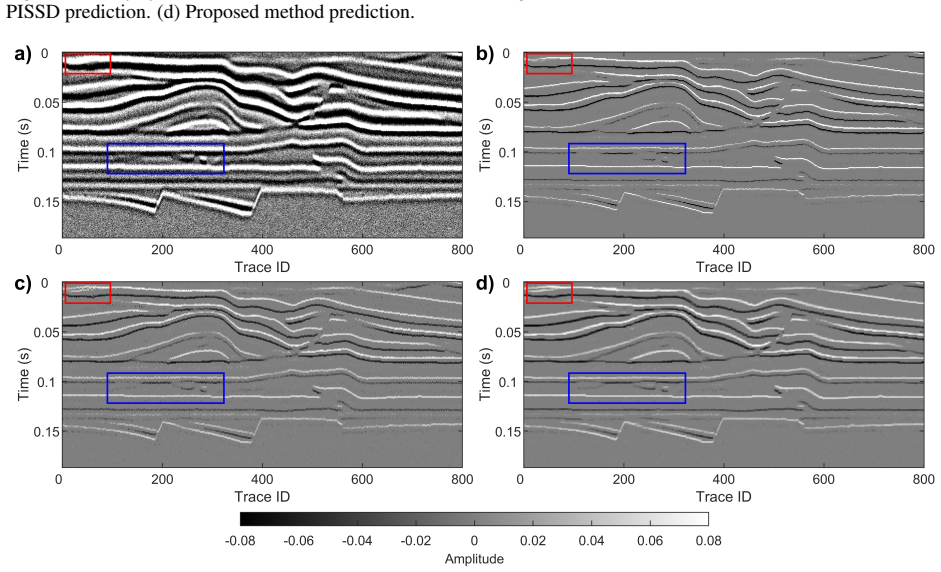
Seismic resolution enhancement remains a critical challenge in exploration geophysics, particularly when processing field data characterized by limited bandwidth, strong noise, and insufficient labeled training samples. Existing deep learning methods typically rely on supervised learning with synthetic training data, leading to distribution mismatch and poor generalization on real seismic acquisitions. To address these limitations, we develop a physics-guided self-supervised diffusion model (PG-SSDM) that learns directly from field observations without requiring paired high-resolution labels. The proposed framework combines three key innovations. First, a self-supervised training strategy constructs learning targets by progressively filtering the observed data itself, eliminating the need for high-resolution ground truth through iterative refinement across multiple stages. Second, seismic convolution model is embedded as a hard physical constraint in both the training loss function and the reverse sampling process, ensuring that generated high-resolution outputs respect fundamental seismic wave propagation physics. Third, the probabilistic nature of diffusion models enables uncertainty quantification, providing spatial confidence maps that identify regions where resolution enhancement may be less reliable. We validate PG-SSDM on synthetic data under various noise conditions and on a 3D post-stack field dataset. Experimental results demonstrate that the proposed method effectively recovers thin layers and subtle structures, suppresses noise, preserves structural continuity, thereby significantly improving the resolution and interpretability of seismic data.
Figures


Figures from the paper (14 more)



Reference graph
Works this paper leans on
-
[1]
Oceans , year=
Design and development of a Giga-bit Ethernet based high speed broadband data acquisition system for an underwater imaging array , author=. Oceans , year=
-
[2]
Geophysical Prospecting , volume=
Principles Of Digital Wiener Filtering , author=. Geophysical Prospecting , volume=. 2006 , doi=
2006
-
[3]
Seg Technical Program Expanded Abstracts , volume=
Least-squares deconvolution of the mixed-phase unknown pulse , author=. Seg Technical Program Expanded Abstracts , volume=
-
[4]
Geophysics , volume=
PREDICTIVE DECONVOLUTION: THEORY AND PRACTICE , author=. Geophysics , volume=. 1969 , doi=
1969
-
[5]
Geophysics , volume=
Improved resolution in Bayesian lithology/fluid inversion from prestack seismic data and well observations: Part 1—Methodology , author=. Geophysics , volume=. 2010 , publisher=
2010
-
[6]
Eage Conference & Exhibition Incorporating Spe Europec , year=
Robust Sparse Deconvolution in the Presence of Outliers , author=. Eage Conference & Exhibition Incorporating Spe Europec , year=
-
[7]
Geophysics , volume=
The use of the conjugate-gradient algorithm in the computation of predictive deconvolution operators , author=. Geophysics , volume=. 1985 , publisher=
1985
-
[8]
Geophysics , volume=
Gabor deconvolution: Estimating reflectivity by nonstationary deconvolution of seismic data , author=. Geophysics , volume=. 2011 , publisher=
2011
Show all 61 references
-
[9]
Progress in Geophysics , volume=
Research on the application to seismic data in Bohai bay based on Gabor deconvolution , author=. Progress in Geophysics , volume=. 2017 , publisher=
2017
-
[10]
Geophysical prospecting , volume=
Factors affecting seismic amplitudes , author=. Geophysical prospecting , volume=. 1975 , publisher=
1975
-
[11]
Geophysics , volume=
A stable and efficient approach of inverse Q filtering , author=. Geophysics , volume=. 2002 , publisher=
2002
-
[12]
Applied Geophysics , volume=
An inverse Q-filter algorithm based on stable wavefield continuation , author=. Applied Geophysics , volume=. 2007 , publisher=
2007
-
[13]
Geophysics , volume=
Inverse Q filtering by Fourier transform , author=. Geophysics , volume=. 1991 , publisher=
1991
-
[14]
Chinese Journal of Geophysics , volume=
The forward Q method for compensating attenuation and frequency dispersion used in the seismic profile of depth domain , author=. Chinese Journal of Geophysics , volume=. 2003 , publisher=
2003
-
[15]
Geophysics , volume=
Inverse Q-filter for seismic resolution enhancement , author=. Geophysics , volume=. 2006 , publisher=
2006
-
[16]
IEEE transactions on acoustics, speech, and signal processing , volume=
Short term spectral analysis, synthesis, and modification by discrete Fourier transform , author=. IEEE transactions on acoustics, speech, and signal processing , volume=. 1977 , publisher=
1977
-
[17]
Chinese Journal of Geophysics , volume=
Enhancing resolution of seismic traces based on the changing wavelet model of the seismogram , author=. Chinese Journal of Geophysics , volume=. 2009 , publisher=
2009
-
[18]
Wavelets: Time-Frequency Methods and Phase Space Proceedings of the International Conference, Marseille, France, December 14--18, 1987 , pages=
Reading and understanding continuous wavelet transforms , author=. Wavelets: Time-Frequency Methods and Phase Space Proceedings of the International Conference, Marseille, France, December 14--18, 1987 , pages=. 1990 , organization=
1987
-
[19]
Geophysics , volume=
The S-transform with windows of arbitrary and varying shape , author=. Geophysics , volume=. 2003 , publisher=
2003
-
[20]
IEEE Transactions on Geoscience and Remote Sensing , volume=
Compact smoothness and relative sparsity algorithm for high-resolution wavelet and reflectivity inversion of seismic data , author=. IEEE Transactions on Geoscience and Remote Sensing , volume=. 2022 , publisher=
2022
-
[21]
Proceedings of the Royal Society of London
The empirical mode decomposition and the Hilbert spectrum for nonlinear and non-stationary time series analysis , author=. Proceedings of the Royal Society of London. Series A: mathematical, physical and engineering sciences , volume=. 1998 , publisher=
1998
-
[22]
Geophysics , volume=
Application of the empirical mode decomposition and Hilbert-Huang transform to seismic reflection data , author=. Geophysics , volume=. 2007 , publisher=
2007
-
[23]
Coal Geology & Exploration , volume=
Challenges and solutions to high-resolution data processing for seismic exploration , author=. Coal Geology & Exploration , volume=. 2023 , doi=
2023
-
[24]
nature , volume=
Deep learning , author=. nature , volume=. 2015 , publisher=
2015
-
[25]
Science , volume=
Deep-learning seismology , author=. Science , volume=. 2022 , publisher=
2022
-
[26]
Reviews of Geophysics , volume=
Deep learning for geophysics: Current and future trends , author=. Reviews of Geophysics , volume=. 2021 , publisher=
2021
-
[27]
The Leading Edge , volume=
Geophysical inversion versus machine learning in inverse problems , author=. The Leading Edge , volume=. 2018 , publisher=
2018
-
[28]
arXiv preprint arXiv:1909.06016 , year=
Enhancement of seismic imaging: An innovative deep learning approach , author=. arXiv preprint arXiv:1909.06016 , year=
1909
-
[29]
Geophysical Journal International , volume=
Geophysics-steered self-supervised learning for deconvolution , author=. Geophysical Journal International , volume=. 2023 , publisher=
2023
-
[30]
IEEE Transactions on Geoscience and Remote Sensing , volume=
Incorporating structural constraint into the machine learning high-resolution seismic reconstruction , author=. IEEE Transactions on Geoscience and Remote Sensing , volume=. 2022 , publisher=
2022
-
[31]
Geophysics , volume=
Optimization-inspired deep learning high-resolution inversion for seismic data , author=. Geophysics , volume=. 2021 , publisher=
2021
-
[32]
Geophysics , volume=
High-resolution acoustic-impedance inversion based on a deep-learning-aided representation model of nonstationary seismic data , author=. Geophysics , volume=. 2024 , publisher=
2024
-
[33]
IEEE Transactions on Geoscience and Remote Sensing , volume=
Deep learning for simultaneous seismic image super-resolution and denoising , author=. IEEE Transactions on Geoscience and Remote Sensing , volume=. 2021 , publisher=
2021
-
[34]
Journal of Petroleum Science and Engineering , volume=
Machine learning-based vertical resolution enhancement considering the seismic attenuation , author=. Journal of Petroleum Science and Engineering , volume=. 2022 , publisher=
2022
-
[35]
Geophysics , volume=
Seismic resolution enhancement using physics-assisted seismic deconvolution network and domain adaptation , author=. Geophysics , volume=. 2025 , publisher=
2025
-
[36]
IEEE Transactions on Geoscience and Remote Sensing , volume=
Deep learning vertical resolution enhancement considering features of seismic data , author=. IEEE Transactions on Geoscience and Remote Sensing , volume=. 2023 , publisher=
2023
-
[37]
Artificial Intelligence in Geosciences , volume=
MLReal: Bridging the gap between training on synthetic data and real data applications in machine learning , author=. Artificial Intelligence in Geosciences , volume=. 2022 , publisher=
2022
-
[38]
IEEE Geoscience and Remote Sensing Letters , volume=
Improving the generalization of deep neural networks in seismic resolution enhancement , author=. IEEE Geoscience and Remote Sensing Letters , volume=. 2022 , publisher=
2022
-
[39]
Advances in neural information processing systems , volume=
Denoising diffusion probabilistic models , author=. Advances in neural information processing systems , volume=
-
[40]
ACM SIGGRAPH 2022 conference proceedings , pages=
Palette: Image-to-image diffusion models , author=. ACM SIGGRAPH 2022 conference proceedings , pages=. 2022 , doi=
2022
-
[41]
ACM Computing Surveys , volume=
Diffusion models: A comprehensive survey of methods and applications , author=. ACM Computing Surveys , volume=. 2023 , publisher=
2023
-
[42]
Advances in neural information processing systems , volume=
Diffusion models beat gans on image synthesis , author=. Advances in neural information processing systems , volume=
-
[43]
IEEE Transactions on Geoscience and Remote Sensing , volume=
Seismic data strong noise attenuation based on diffusion model and principal component analysis , author=. IEEE Transactions on Geoscience and Remote Sensing , volume=. 2024 , publisher=
2024
-
[44]
Third International Meeting for Applied Geoscience & Energy , pages=
Seismic data interpolation based on diffusion model deep learning , author=. Third International Meeting for Applied Geoscience & Energy , pages=. 2023 , organization=
2023
-
[45]
Geophysics , volume=
Generative interpolation via a diffusion probabilistic model , author=. Geophysics , volume=. 2024 , publisher=
2024
-
[46]
IEEE transactions on geoscience and remote sensing , volume=
A prior regularized full waveform inversion using generative diffusion models , author=. IEEE transactions on geoscience and remote sensing , volume=. 2023 , publisher=
2023
-
[47]
Petroleum Science , volume=
SeisResoDiff: Seismic resolution enhancement based on a diffusion model , author=. Petroleum Science , volume=. 2024 , publisher=
2024
-
[48]
Petroleum Science , year=
An EDCC-EMD analysis-based network for DAS VSP data denoising in frequency domain , author=. Petroleum Science , year=
-
[49]
IEEE Transactions on Geoscience and Remote Sensing , year=
Self-supervised seismic resolution enhancement , author=. IEEE Transactions on Geoscience and Remote Sensing , year=
-
[50]
Journal of Geophysical Research: Machine Learning and Computation , volume=
A self-supervised learning framework for seismic low-frequency extrapolation , author=. Journal of Geophysical Research: Machine Learning and Computation , volume=. 2024 , publisher=
2024
-
[51]
IEEE Transactions on Geoscience and Remote Sensing , year=
Structurally-Constrained Unsupervised Deep Learning for Seismic High-Resolution Reconstruction , author=. IEEE Transactions on Geoscience and Remote Sensing , year=
-
[52]
IEEE Geoscience and Remote Sensing Letters , year=
Unsupervised Diffusion Model for Seismic Deconvolution , author=. IEEE Geoscience and Remote Sensing Letters , year=
-
[53]
arXiv preprint arXiv:2503.06488 , year=
Seismic wavefield solutions via physics-guided generative neural operator , author=. arXiv preprint arXiv:2503.06488 , year=
-
[54]
Computers & Geosciences , volume=
Deep diffusion models for seismic processing , author=. Computers & Geosciences , volume=. 2023 , publisher=
2023
-
[55]
Surveys in Geophysics , year=
A generative foundation model for an all-in-one seismic processing framework , author=. Surveys in Geophysics , year=
-
[56]
IEEE Transactions on Geoscience and Remote Sensing , year=
Generative diffusion model for seismic imaging improvement of sparsely acquired data and uncertainty quantification , author=. IEEE Transactions on Geoscience and Remote Sensing , year=
-
[57]
IEEE Transactions on Geoscience and Remote Sensing , year=
Well-and Structure-Constrained Initial Velocity Building for Full-Waveform Inversion via a Generative Diffusion Model , author=. IEEE Transactions on Geoscience and Remote Sensing , year=
-
[58]
Geophysics , volume=
Self-Supervised Diffusion Model for 3D Seismic Data Reconstruction , author=. Geophysics , volume=. 2025 , publisher=
2025
-
[59]
International conference on machine learning , pages=
Improved denoising diffusion probabilistic models , author=. International conference on machine learning , pages=. 2021 , organization=
2021
-
[60]
Journal of Applied Geophysics , volume=
A stable and self-adaptive approach for inverse Q-filter , author=. Journal of Applied Geophysics , volume=. 2015 , publisher=
2015
-
[61]
Geophysical Journal International , volume=
Oriented pre-stack inverse Q filtering for resolution enhancements of seismic data , author=. Geophysical Journal International , volume=. 2020 , publisher=
2020
Reviewed June 26, 2026 · model on record in the stance chip above.
Discussion (0). Continue with ORCID to comment.