Reconstructing the cosmic expansion in f(R, L_(m)) gravity via parametrized Hubble function constraints
Pith reviewed 2026-06-29 15:33 UTC · model grok-4.3
The pith
Three Hubble parametrizations in f(R, L_m) gravity fit cosmic chronometer and supernova data while confirming thermodynamic viability.
A machine-rendered reading of the paper's core claim, the machinery that carries it, and where it could break.
Core claim
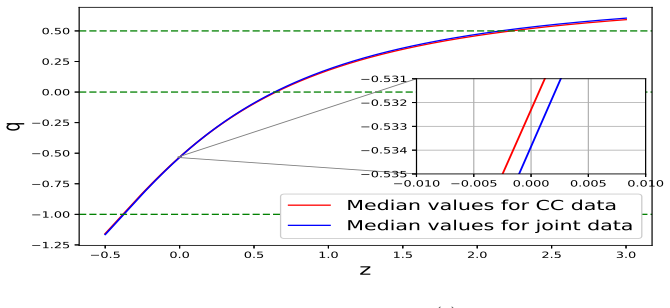
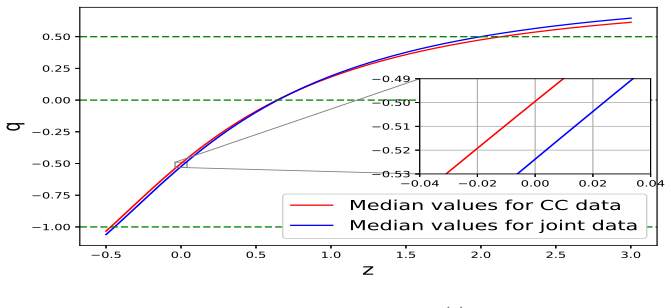
Within f(R, L_m) gravity using the functional form f = R/2 + L_m^λ, three distinct redshift-dependent parametrizations of the Hubble parameter are introduced and constrained via chi-squared minimization on cosmic chronometer and Pantheon data. The resulting models describe a universe whose deceleration parameter changes sign at late times, whose equation-of-state parameter approaches values consistent with acceleration, and whose energy conditions remain satisfied. Temperature and entropy density evolve in a manner that preserves thermodynamic viability, while the computed age of the universe matches late-time astronomical estimates.
What carries the argument
The functional form f(R, L_m) = R/2 + L_m^λ together with three specific H(z) parametrizations that allow direct reconstruction of the expansion history and subsequent derivation of all cosmological quantities from the modified Friedmann equations.
Load-bearing premise
The chosen functional form of f(R, L_m) and the three specific Hubble parametrizations are sufficient to represent the full dynamics of the modified gravity theory without hidden inconsistencies that would invalidate the fits.
What would settle it
A high-redshift Hubble measurement lying outside the 1-sigma bands predicted by all three models after the current CC+Pantheon fits would falsify the reconstruction.
Figures



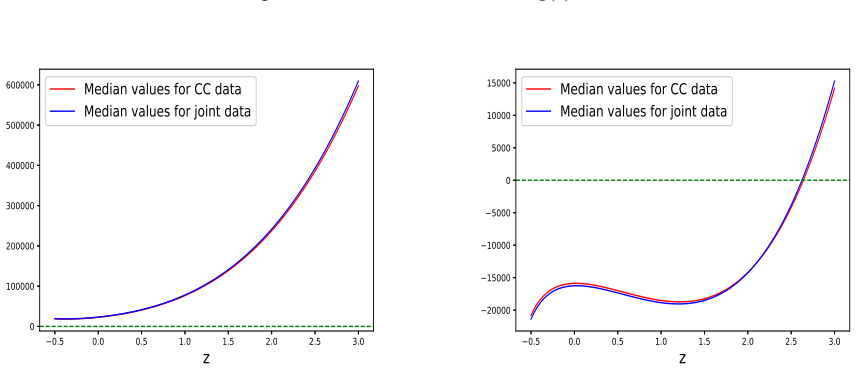


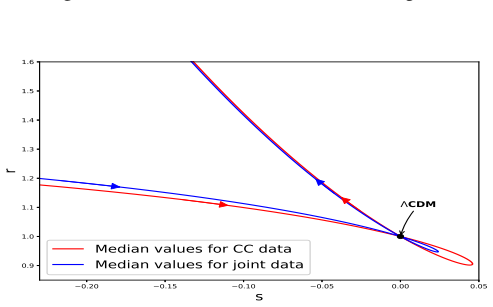


read the original abstract
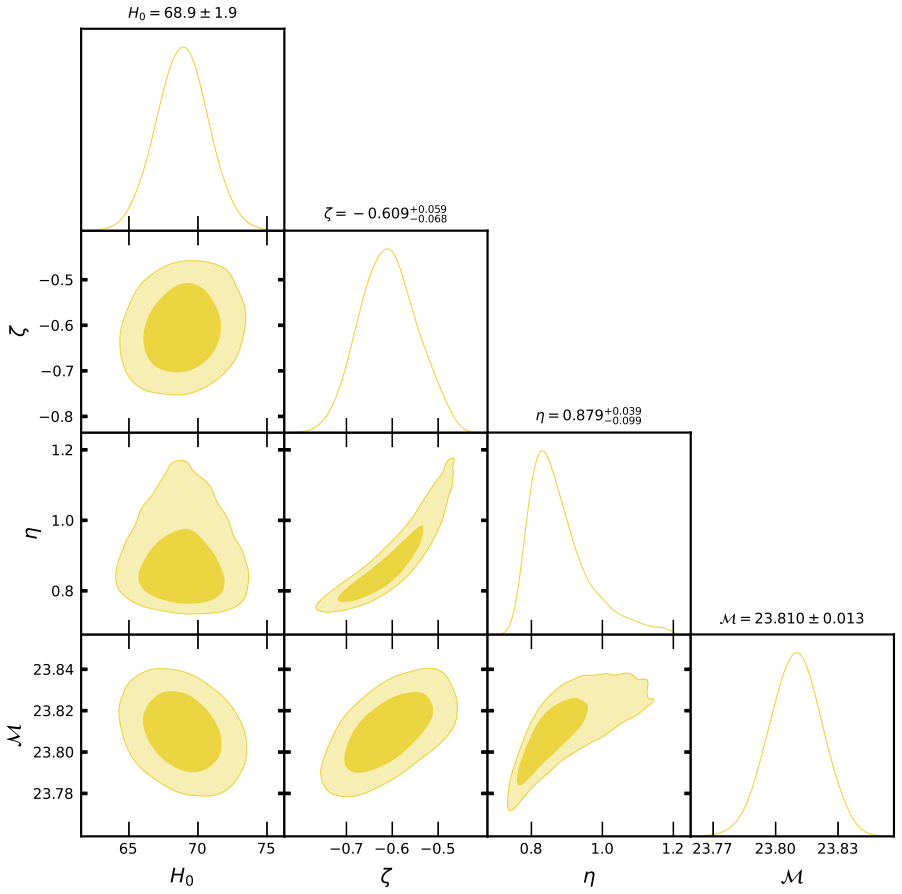
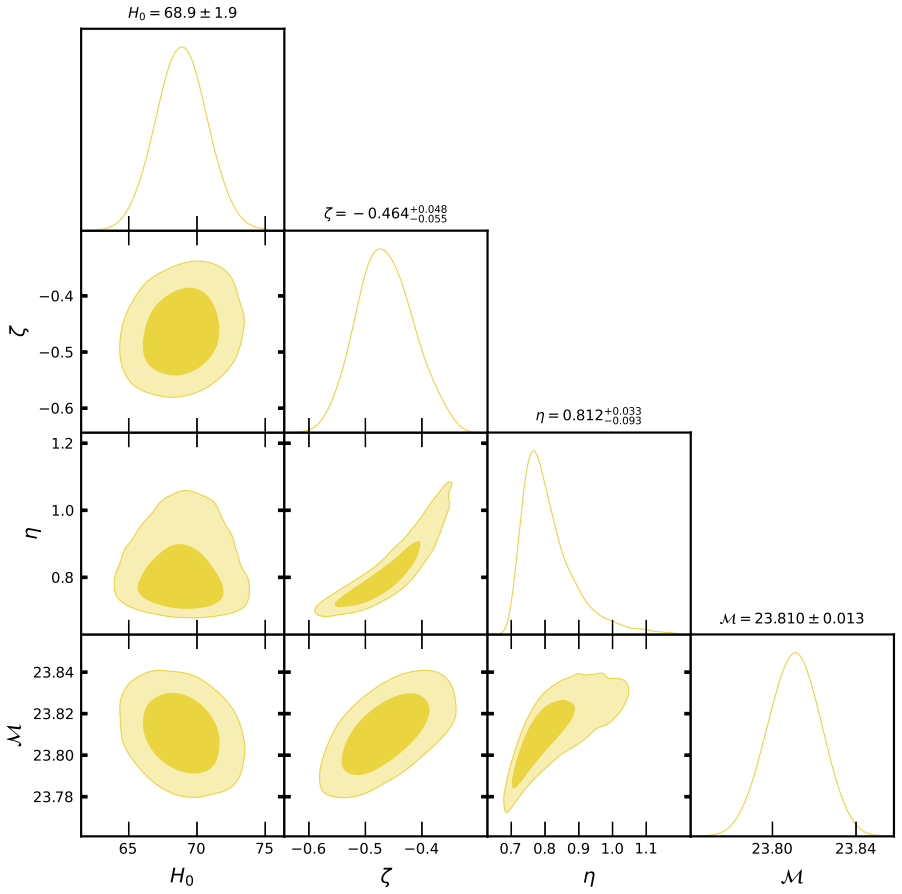
We probe the cosmic expansion scenario within the framework of $f(R, L_{m})$ gravity by employing a well-motivated functional form of $f(R, L_{m}) = \frac{R}{2} + L_{m}^{\lambda}$. Specifically, we introduce three novel cosmological models formulated in terms of the redshift-dependent Hubble parameter $H(z)$, offering deeper insights into the underlying cosmic dynamics. The models are further utilized to investigate the expansion history of the universe and the evolution of several cosmological parameters. By using the Bayesian methods based on the $\chi^{2}$-minimization technique, the median values of the model parameters are determined for the cosmic chronometer (CC) and joint (CC+Pantheon) datasets. A comprehensive study of the deceleration parameter, energy density, pressure and the equation of state parameter is carried out to understand the universe's evolution. Additionally, the validity of the energy conditions and the behavior of the statefinder diagnostic are thoroughly examined. Finally, the thermodynamic viability of the models is confirmed through the evolution of temperature and entropy density, and the estimated age of the universe further exemplifies good agreement with late-time astronomical observations.
Editorial analysis
A structured set of objections, weighed in public.
Referee Report
Summary. The paper examines cosmic expansion within f(R, L_m) gravity using the specific form f(R, L_m) = R/2 + L_m^λ. It introduces three parametrized H(z) models, constrains their parameters via χ² minimization on cosmic chronometer (CC) and joint CC+Pantheon datasets using Bayesian methods, and then derives the deceleration parameter, energy density, pressure, equation-of-state parameter, energy conditions, statefinder diagnostics, temperature and entropy density evolution, and universe age from the best-fit H(z).
Significance. If the central fits are robust and the derived quantities are correctly computed, the work supplies concrete observational bounds on a non-minimally coupled modified-gravity model and shows consistency with late-time data. The provision of explicit H(z) parametrizations and joint-dataset constraints is a concrete contribution, though the predictive power is reduced because most examined quantities follow algebraically from the fitted H(z) rather than constituting independent tests.
major comments (2)
- [Abstract and thermodynamic analysis] Abstract and thermodynamic analysis: the claim that thermodynamic viability is confirmed via the evolution of temperature and entropy density assumes the standard relations T ∝ 1/a and s ∝ a³ (or equivalent) that follow from ∇_μ T^μν = 0. The chosen f(R, L_m) = R/2 + L_m^λ produces a non-zero divergence of the effective stress-energy tensor, implying a modified continuity equation with an extra force term. No correction for this non-conservation appears to be applied to the reported T(z) and s(z) curves, rendering the viability confirmation insecure for the quoted best-fit parameters.
- [Abstract and sections on cosmological parameters] Abstract and sections on cosmological parameters: the reported evolution of the deceleration parameter, equation-of-state parameter, and energy conditions is obtained by direct substitution of the fitted H(z) parameters into the standard expressions. These quantities are therefore algebraic consequences of the data fit rather than independent predictions of the modified-gravity dynamics, weakening the claim that the models successfully describe the underlying cosmic evolution beyond the Hubble fit itself.
minor comments (2)
- [Abstract] The abstract states that median parameter values are determined but provides no explicit error budgets, covariance matrices, or discussion of possible post-hoc selection effects in the three chosen H(z) forms.
- [Model definitions] Notation for the three H(z) parametrizations should be introduced with explicit functional forms and the number of free parameters per model stated clearly before the fitting results are presented.
Simulated Author's Rebuttal
We thank the referee for the careful reading and constructive comments. We address the two major points below.
read point-by-point responses
-
Referee: [Abstract and thermodynamic analysis] Abstract and thermodynamic analysis: the claim that thermodynamic viability is confirmed via the evolution of temperature and entropy density assumes the standard relations T ∝ 1/a and s ∝ a³ (or equivalent) that follow from ∇_μ T^μν = 0. The chosen f(R, L_m) = R/2 + L_m^λ produces a non-zero divergence of the effective stress-energy tensor, implying a modified continuity equation with an extra force term. No correction for this non-conservation appears to be applied to the reported T(z) and s(z) curves, rendering the viability confirmation insecure for the quoted best-fit parameters.
Authors: We agree that the non-minimal coupling implies a non-zero divergence of the effective stress-energy tensor and a modified continuity equation. The reported T(z) and s(z) curves were obtained with the standard relations without explicit correction for the extra force term. We will revise the abstract, the thermodynamic section, and the associated discussion to qualify the analysis as an approximate check and to note this limitation explicitly. revision: yes
-
Referee: [Abstract and sections on cosmological parameters] Abstract and sections on cosmological parameters: the reported evolution of the deceleration parameter, equation-of-state parameter, and energy conditions is obtained by direct substitution of the fitted H(z) parameters into the standard expressions. These quantities are therefore algebraic consequences of the data fit rather than independent predictions of the modified-gravity dynamics, weakening the claim that the models successfully describe the underlying cosmic evolution beyond the Hubble fit itself.
Authors: We acknowledge that the deceleration parameter, EoS parameter, and energy conditions are computed from the best-fit H(z) using the standard (GR) expressions. These quantities therefore test consistency of the fitted expansion history with late-time data rather than constituting independent dynamical predictions derived from the modified field equations. We will revise the abstract and the relevant sections to clarify this distinction and to frame the results as constraints on the parametrized models within the f(R, L_m) framework. revision: yes
Circularity Check
No significant circularity detected
full rationale
The paper parametrizes H(z), fits its parameters to CC and joint CC+Pantheon data via chi-squared minimization, then computes derived quantities (q(z), w(z), energy conditions, T(z), s(z), age) by direct substitution into the standard expressions. This is standard cosmological reconstruction from a fitted expansion history rather than a self-referential derivation. No quoted equations show a fitted input renamed as an independent prediction, no self-citation load-bearing on a uniqueness theorem, and no ansatz smuggled via prior work by the same authors. The thermodynamic analysis uses the usual T and s evolution formulas; any mismatch with the model's non-conservation is a correctness issue, not a circular reduction of the claimed viability to the input fit by construction. The derivation chain remains self-contained against external data.
Axiom & Free-Parameter Ledger
free parameters (2)
- λ
- H(z) model parameters
axioms (2)
- domain assumption FLRW metric describes the background cosmology
- ad hoc to paper f(R, L_m) = R/2 + L_m^λ is the appropriate modified-gravity action
Reference graph
Works this paper leans on
-
[1]
A. G. Riess, A. V . Filippenko, P . Challis, A. Clocchiatti , A. Diercks et al., Observational Evidence from Supernovae for an Accelerating Universe and a Cosmological Constant, Astronomical Journal, 116, 1009- 1038 (1998) https://doi.org/10.1086/300499
work page internal anchor Pith review doi:10.1086/300499 1998
-
[2]
S. Perlmutter, G. Aldering, G. Goldhaber, R. A. Knop, P . N ugent et al., Measurements of Ω and Λ from 42 High-Redshift Supernovae, Astrophysical Journal, 517, 565–586 (1999) https://doi.org/10.1086/307221
work page internal anchor Pith review doi:10.1086/307221 1999
-
[3]
N. Aghanim, Y . Akrami, M. Ashdown, J. Aumont, C. Baccigal upi, et al., Planck 2018 results. VI. Cosmological parameters, Astronomy and Astro physics, 641, A6 (2020) https://doi.org/10.1051/0004-6361/201833910
-
[4]
S. Weinberg, The cosmological constant problem, Review s of Modern Physics, 61, 1 (1989) https://doi.org/10.1103/RevModPhys.61.1
-
[5]
E. Di V alentino, O. Mena, S. Pan, L. Visinelli, W. Y ang, et al., In the realm of the Hubble tension—a review of solutions, Classical and Quantu m Gravity, 38, 153001 (2021) https://doi.org/10.1088/1361-6382/ac086d
-
[6]
S. M. Carroll, The cosmological constant, Living Review s in Relativity, 4, 1-56 (2001) https://doi.org/10.12942/lrr-2001-1
-
[7]
R. Kerner, Cosmology without singularity and nonlinear gravitational Lagrangians, General Relativity and Gravitation, 14, 453–469 (1982) https://doi.org/10.1007/BF00756329
-
[8]
H. A. Buchdahl, Non-linear Lagrangians and cosmologica l theory, Monthly Notices of the Royal Astro- nomical Society, 150, 1-8 (1970) https://doi.org/10.1093/mnras/150.1.1 25
-
[9]
S. Nojiri, S. D. Odintsov, Unified cosmic history in modifi ed gravity: from f (R) theory to Lorentz non-invariant models, Physics Reports, 505, 59-144 (2011) https://doi.org/10.1016/j.physrep.2011.04.001
-
[10]
S. Nojiri, S. D. Odintsov, V . K. Oikonomou, Modified grav ity theories on a nut- shell: Inflation, bounce and late-time evolution, Physics R eports, 692, 1-104 (2017) https://doi.org/10.1016/j.physrep.2017.06.001
work page internal anchor Pith review doi:10.1016/j.physrep.2017.06.001 2017
-
[11]
T. Harko, F. S. N. Lobo, S. Nojiri, S. D. Odintsov, f (R,T ) gravity, Physical Review D,84, 024020 (2011) https://doi.org/10.1103/PhysRevD.84.024020
-
[12]
Yi-Fu Cai, S. Capozziello, M. De Laurentis, E. N. Sarida kis, f (T ) teleparal- lel gravity and cosmology, Reports on Progress in Physics, 79, 106901 (2016) https://doi.org/10.1088/0034-4885/79/10/106901
-
[13]
S. Capozziello, V . F. Cardone, H. Farajollahi, A. Ravan pak, Cosmography in f (T ) gravity, Physical Review D, 84, 043527 (2011) https://doi.org/10.1103/PhysRevD.84.043527
-
[14]
S. Capozziello, R. D’Agostino, O. Luongo, Extended gra vity cosmography, International Journal of Modern Physics D, 28, 1930016 (2019) https://doi.org/10.1142/S0218271819300167
-
[15]
K. Bamba, S. D. Odintsov, L. Sebastiani, S. Zerbini, Fin ite-time future singularities in modified Gauss- Bonnet and f (R,G) gravity and singularity avoidance, The European Physical J ournal C, 67, 295-310 (2010) https://doi.org/10.1140/epjc/s10052-010-1292-8
-
[16]
S. Capozziello, V . De Falco, C. Ferrara, The role of the b oundary term in f (Q,B) symmetric teleparallel gravity,The European Physical Jou rnal C, 83, 915 (2023) https://doi.org/10.1140/epjc/s10052-023-12072-y
-
[17]
A. R. Lalke, G. P . Singh, A. Singh, Late-time accelerati on from ekpyrotic bounce in f (Q,T ) gravity, International Journal of Geometric Methods in Mod ern Physics, 20, 2350131 (2023) https://doi.org/10.1142/S0219887823501311
-
[18]
S. Kotambkar, G. P . Singh, R. Kelkar, B. K. Bishi, Anisot ropic Bianchi type I cosmological models with generalized Chaplygin gas and dynamical gravitational and cosmological constants, Communications in Theoretical Physics, 67, 222 (2017) https://doi.org/10.1088/0253-6102/67/2/222
-
[19]
G. P . Singh, R. V . Deshpande, T. Singh, Viscous cosmolog ical models with particle creation in Brans-Dicke theory, Astrophysics and space sci ence, 282, 489–498 (2002) https://doi.org/10.1023/A:1020963219962
-
[20]
G. K. Goswami, R. Rani, J. K. Singh, A. Pradhan, FLRW cosm ology in Weyl type f (Q) gravity and observational constraints, Journal of High Ene rgy Astrophysics, 43, 105–113 (2024) https://doi.org/10.1016/j.jheap.2024.06.011
-
[21]
K. R. Patle, G. P . Singh, R. Garg, Dynamical constraints on variable vac- uum energy in Brans-Dicke theory, arXiv preprint arXiv:260 1.00419, (2026) https://doi.org/10.48550/arXiv.2601.00419
-
[22]
M. B. V arela, O. Bertolami, Is cosmological data sugges ting a nonminimal cou- pling between matter and gravity?, Physics of the Dark Unive rse, 48, 101861 (2025) https://doi.org/10.1016/j.dark.2025.101861
-
[23]
K. N. Singh, G. R. P . Teruel, S. K. Maurya, T. Chowdhury, F . Rahaman, Conservative worm- holes in generalized K(R,T ) function, Journal of High Energy Astrophysics, 44, 132–145 (2024) https://doi.org/10.1016/j.jheap.2024.09.009 26
-
[24]
A. Singh, G. P . Singh, A. Pradhan, Cosmic dynamics and qu alitative study of Rastall model with spatial curvature, International Journal of Mod ern Physics A, 37, 2250104 (2022) https://doi.org/10.1142/S0217751X22501044
-
[25]
N. Hulke, G. P . Singh, B. K. Bishi, A. Singh, V ariable Cha plygin gas cosmolo- gies in f (R,T ) gravity with particle creation, New Astronomy, 77, 101357 (2020) https://doi.org/10.1016/j.newast.2020.101357
-
[26]
G. P . Singh, R. Garg, A. Singh, A generalized Λ CDM model with parameterized Hubble parameter in particle creation, viscous and f (R) model framework, International Journal of Geometric Metho ds in Modern Physics, 2550111 (2025) https://doi.org/10.1142/S0219887825501117
-
[27]
B. K. Shukla, S. Sahlu, D. Sofuo˘ glu, P . Mishra, A. H. Alf edeel, Multi-components fluid in f (R,T ) gravity with observational constraints, The European Phys ical Journal Plus, 140, 1–14 (2025) https://doi.org/10.1140/epjp/s13360-025-06200-8
-
[28]
T. Harko, F. S. N. Lobo, f (R,Lm) gravity, The European Physical Journal C, 70, 373–379 (2010) https://doi.org/10.1140/epjc/s10052-010-1467-3
-
[29]
V . Faraoni, Cosmology in scalar tensor gravity, Spring er (2004) https://doi.org/10.1007/978-1-4020-1989-0
-
[30]
P . Zhang, Behaviour of f (R) gravity in the solar system, galaxies, and clusters, Physic al Review D, 76, 024007 (2007) https://doi.org/10.1103/PhysRevD.76.024007
-
[31]
General Theory of Relativity: Will it survive the next decade?
O. Bertolami, J. P´ aramos, S. G. Turyshev, General Theory of Relativity: Will it survive the next decade?, in: Lasers, Clocks and Drag-Free Control: Exploration of Re lativistic Gravity in Space, Springer, 27–74 (2008) https://doi.org/10.48550/arXiv.gr-qc/0602016
work page internal anchor Pith review Pith/arXiv arXiv doi:10.48550/arxiv.gr-qc/0602016 2008
-
[32]
F. Rahaman, S. Ray, M. Kalam, M. Sarker, Do Solar system t ests permit higher dimen- sional general relativity?, International Journal of Theo retical Physics, 48, 3124–3138 (2009) https://doi.org/10.1007/s10773-009-0110-2
-
[33]
S. Nojiri, S. D. Odintsov, Gravity assisted dark energy dominance and cosmic acceleration, Physics Letters B, 599, 137–142 (2004) https://doi.org/10.1016/j.physletb.2004.08.045
-
[34]
G. Allemandi, A. Borowiec, M. Francaviglia, S. D. Odint sov, Dark energy dominance and cosmic acceleration in first-order formalism, Physical Review D, 72, 063505 (2005) https://doi.org/10.1103/PhysRevD.72.063505
-
[35]
G. Manna, A. Panda, A. Karmakar, S. Ray, M. R. Islam, f (R,Lx)-gravity in the context of dark energy with power law expansion and energy conditions, Chin ese Physics C, 47, 025101 (2023) https://doi.org/10.1088/1674-1137/ac9fbe
-
[36]
F. S. N. Lobo, T. Harko, Extended f (R,Lm) theories of gravity, THE THIRTEENTH MARCEL GROSS- MANN MEETING, 1164–1166 (2015) https://doi.org/10.48550/arXiv.1211.0426
work page internal anchor Pith review Pith/arXiv arXiv doi:10.48550/arxiv.1211.0426 2015
-
[37]
L. V . Jaybhaye, R. Solanki, S. Mandal, P . K. Sahoo, Cosmo logy in f (R,Lm) gravity, Physics Letters B, 831, 137148 (2022) https://doi.org/10.1016/j.physletb.2022.137148
-
[38]
A. Pradhan, D. C. Maurya, G. K. Goswami, A. Beesham, Mode ling transit dark energy in f (R,Lm) gravity, International Journal of Geometric Methods in Mod ern Physics, 20, 2350105 (2023) https://doi.org/10.1142/S0219887823501050
-
[39]
M. Koussour, N. Myrzakulov, J. Rayimbaev, A. H. A. Alfed eel, H. M. Elkhair, Bouncing behavior in f (R,Lm) gravity: Phantom crossing and energy conditions, Internat ional Journal of Geometric Methods in Modern Physics, 21, 2450184 (2024) https://doi.org/10.1142/S0219887824501846 27
-
[40]
G. Mustafa, F. Javed, S. K. Maurya, M. Govender, A. Salee m, Dynamical stability of new wormhole solutions via cold dark matter and solitonic quantum wave ha los in f (R,Lm) gravity, Physics of the Dark Universe, 45, 101508 (2024) https://doi.org/10.1016/j.dark.2024.101508
-
[41]
S. Myrzakulova, M. Koussour, N. Myrzakulov, Investiga ting the dark energy phenomenon in f (R,Lm) cosmological models with observational constraints, Phys ics of the Dark Universe, 43, 101399 (2024) https://doi.org/10.1016/j.dark.2023.101399
-
[42]
N. S. Kavya, V . V enkatesha, S. Mandal, P . K. Sahoo, Const raining anisotropic cos- mological model in f (R,Lm) Gravity, Physics of the Dark Universe, 38, 101126 (2022) https://doi.org/10.1016/j.dark.2022.101126
-
[43]
Y . K. Devi, S. Narawade, B. Mishra, Constraining parame ters for the accelerat- ing universe in f (R,Lm) gravity, Physics of the Dark Universe, 46, 101640 (2024) https://doi.org/10.1016/j.dark.2024.101640
-
[44]
M. Zeyauddin, A. Dixit, A. Pradhan, Anisotropic dark en ergy models in f (R,Lm)-gravity, International Journal of Geometric Methods in Modern Physi cs, 21, 2450038 (2024) https://doi.org/10.1142/S0219887824500385
-
[45]
D. C. Maurya, Bianchi-I dark energy cosmological model in f (R,Lm)-gravity, In- ternational Journal of Geometric Methods in Modern Physics , 21, 2450072 (2024) https://doi.org/10.1142/S0219887824500725
-
[46]
S. Sahlu, A. H. Alfedeel, A. Abebe, The cosmology of f (R,Lm) gravity: constraining the background and perturbed dynamics, The European Physic al Journal C, 84, 982 (2024) https://doi.org/10.1140/epjc/s10052-024-13307-2
-
[47]
V . K. Bhardwaj, S. Ray, Cosmological model in the framew ork of f (R,Lm) gravity with quadratic equation of state parameter, Physics of the D ark Universe, 101930 (2025) https://doi.org/10.1016/j.dark.2025.101930
-
[48]
L. V . Jaybhaye, S. Mandal, P . K. Sahoo, Constraints on en ergy conditions in f (R,Lm) gravity, International Journal of Geometric Methods in Mod ern Physics, 19, 2250050 (2022) https://doi.org/10.1142/S0219887822500505
-
[49]
A. Shukla, R. Raushan, R. Chaubey, Dynamical Systems An alysis of f (R,Lm) Grav- ity Model, International Journal of Geometric Methods in Mo dern Physics, 2550118 (2025) https://doi.org/10.1142/S021988782550118X
-
[50]
Y . Myrzakulov, O. Donmez, G. D. A. Yildiz, E. Gudekli, S. Muminov et al., Linear redshift parametriza- tion of deceleration parameter in f (R,Lm) gravity, Physics of the Dark Universe, 45, 101545 (2024) https://doi.org/10.1016/j.dark.2024.101545
-
[51]
J. K. Singh, A. Singh, H. Balhara, J. R. L. Santos, The con sequence of higher-order curvature-based constraints on f (R,Lm) gravity, Annals of Physics, 469, 169781 (2024) https://doi.org/10.1016/j.aop.2024.169781
-
[52]
S. Chaudhary, J. Kumar, S. K. Maurya, S. Kiroriwal, A. Az iz, On the existence and stability of traversable wormhole solutions with novel shapefunctions in the framew ork of f (R,Lm) gravity, Communications in Theoretical Physics, 76, 055403 (2024) https://doi.org/10.1088/1572-9494/ad3544
-
[53]
Y . B. Wu, Y . Y . Zhao, Y . Y . Jin, L. L. Lin, J. B. Lu et al., Con straints of energy conditions and DK instability criterion on f (R,Lm) gravity models, Modern Physics Letters A, 29, 1450089 (2014) https://doi.org/10.1142/S0217732314500898 28
-
[54]
N. S. Kavya, V . V enkatesha, G. Mustafa, P . K. Sahoo, S. V . D. Rashmi, Static traversable wormhole solutions in f (R,Lm) gravity, Chinese Journal of Physics, 84, 1–11 (2023) https://doi.org/10.1016/j.cjph.2023.05.002
-
[56]
A. G´ omez-V alent, L. Amendola, H0 from cosmic chronometers and Type Ia supernovae, with Gaussian Processes and the novel Weighted Polynomial Regression met hod, Journal of Cosmology and Astroparti- cle Physics, 04, 051 (2018) https://doi.org/10.1088/1475-7516/2018/04/051
-
[57]
M. Koussour, S. K. J. Pacif, M. Bennai, P . K. Sahoo, A New P arametrization of Hubble Parameter in f (Q) Gravity, Fortschritte der Physik, 71, 2200172 (2023) https://doi.org/10.1002/prop.202200172
-
[58]
J. K. Singh, R. Nagpal, FLRW cosmology with EDSFD parame trization, The European Physical Journal C, 80, 295 (2020) https://doi.org/10.1140/epjc/s10052-020-7827-8
-
[59]
T. Y . He, J. J. Yin, Z. Y . Wang, Z. W. Han, R. J. Y ang, A new pa rametrization of Hubble function and Hubble tension, Journal of Cosmology and Astro particle Physics, 2024, 028 (2024) https://doi.org/10.1088/1475-7516/2024/09/028
-
[60]
N. Roy, S. Goswami, S. Das, Quintessence or phantom: Stu dy of scalar field dark energy models through a general parametrization of the Hubble parameter, Physics of the Dark Universe, 36, 101037 (2022) https://doi.org/10.1016/j.dark.2022.101037
-
[61]
Ryden, Introduction to Cosmology, Addison-Wesley S an Francisco, (2003)
B. Ryden, Introduction to Cosmology, Addison-Wesley S an Francisco, (2003)
2003
-
[62]
T. Harko, F. S. N. Lobo, Generalised curvature-matter c ouplings in modified gravity, Galaxies, 2, 410– 465 (2014) https://doi.org/10.3390/galaxies2030410
-
[63]
T. Harko, F. S. N. Lobo, J. P . Mimoso, D. Pav´ on, Gravitat ional induced particle production through a nonminimal curvature–matter coupling, The Europ ean Physical Journal C, 75, 1–15 (2015) https://doi.org/10.1140/epjc/s10052-015-3620-5
-
[64]
A. Shafieloo, A. G. Kim, E. V . Linder, Model independent t ests of cosmic growth versus expansion, Physical Review D, 87, 023520 (2013) https://doi.org/10.1103/PhysRevD.87.023520
-
[65]
N. Banerjee, S. Das, Acceleration of the universe with a simple trigonometric potential, General Relativ- ity and Gravitation, 37, 1695–1703 (2005) https://doi.org/10.1007/s10714-005-0152-6
-
[66]
J. Cunha, J. A. S. d. Lima, Transition redshift: new kine matic constraints from su- pernovae, Monthly Notices of the Royal Astronomical Societ y, 390, 210–217 (2008) https://doi.org/10.1111/j.1365-2966.2008.13640.x
-
[67]
C. Escamilla-Rivera, A. N´ ajera, Dynamical dark energ y models in the light of gravitational- wave transient catalogues, Journal of Cosmology and Astrop article Physics, 2022, 060 (2022) https://doi.org/10.1088/1475-7516/2022/03/060
-
[68]
N. Myrzakulov, M. Koussour, A. Mussatayeva, Quintesse nce-like features in the late-time cosmolog- ical evolution of f (Q) symmetric teleparallel gravity, Chinese Journal of Physic s, 85, 345–358 (2023) https://doi.org/10.1016/j.cjph.2023.07.003
-
[69]
R. Nagpal, S. K. J. Pacif, F. Atamurotov, R. Pati, Dark se ctor interactions: Prob- ing the Hubble parameter and the sound horizon, Annals of Phy sics, 483, 170249 (2025) https://doi.org/10.1016/j.aop.2025.170249 29
-
[70]
A. K. Y adav, S. R. Bhoyar, M. C. Dhabe, S. H. Shekh, N. Ahma d, Reconstructing f (Q) gravity from parameterization of the Hubble parameter and observationa l constraints, Journal of High Energy Astro- physics, 43, 114–125 (2024) https://doi.org/10.1016/j.jheap.2024.06.012
-
[71]
S. K. J. Pacif, R. Myrzakulov, S. Myrzakul, Reconstruct ion of cosmic history from a simple parametriza- tion of H, International Journal of Geometric Methods in Mod ern Physics, 14, 1750111 (2017) https://doi.org/10.1142/S0219887817501110
-
[72]
D. Foreman-Mackey, D. W. Hogg, D. Lang, J. Goodman, emce e: the MCMC hammer, Publications of the Astronomical Society of the Pacific, 125, 306 (2013) https://doi.org/10.1086/670067
-
[73]
J. Simon, L. V erde, R. Jimenez, Constraints on the redsh ift dependence of the dark energy potential, Physical Review D, 71, 123001 (2005) https://doi.org/10.1103/PhysRevD.71.123001
work page internal anchor Pith review doi:10.1103/physrevd.71.123001 2005
-
[74]
G. S. Sharov, V . O. V asiliev, How predictions of cosmological models depend on Hubble parameter data sets, arXiv preprint arXiv:1807.07323 (2018) https://doi.org/10.26456/mmg/2018-611
work page internal anchor Pith review Pith/arXiv arXiv doi:10.26456/mmg/2018-611 2018
-
[75]
D. Stern, R. Jimenez, L. V erde, M. Kamionkowski, S. A. St anford, Cosmic chronometers: constraining the equation of state of dark energy. I: H(z) measurements, Journal of Cosmology and Astroparticle Physics, 2010, 008 (2010) https://doi.org/10.1088/1475-7516/2010/02/008
-
[76]
M. Moresco, Raising the bar: new constraints on the Hubb le parameter with cosmic chronome- ters at z 2, Monthly Notices of the Royal Astronomical Society: Lette rs, 450, L16–L20 (2015) https://doi.org/10.1093/mnrasl/slv037
work page internal anchor Pith review doi:10.1093/mnrasl/slv037 2015
-
[77]
R. Jimenez, A. Loeb, Constraining cosmological parame ters based on relative galaxy ages, The Astro- physical Journal, 573, 37 (2002) https://doi.org/10.1086/340549
-
[78]
S. Mandal, A. Singh, R. Chaubey, Cosmic evolution of hol ographic dark energy in f (Q,T ) gravity, International Journal of Geometric Methods in Mod ern Physics, 20, 2350084 (2023) https://doi.org/10.1142/S0219887823500846
-
[79]
D. M. Scolnic, D. O. Jones, A. Rest, Y . C. Pan, R. Chornock et al., The complete light- curve sample of spectroscopically confirmed SNe Ia from Pan- STARRS1 and cosmological con- straints from the combined Pantheon sample, The Astrophysi cal Journal, 859, 101 (2018) https://doi.org/10.3847/1538-4357/aab9bb
-
[80]
A. G. Riess, R. P . Kirshner, B. P . Schmidt, S. Jha, P . Chal lis et al., BVRI light curves for 22 type Ia supernovae, The Astronomical Journal, 117, 707 (1999) https://doi.org/10.1086/300738
-
[81]
M. Hicken, W. M. Wood-V asey, S. Blondin, P . Challis, S. J ha et al., Improved dark energy con- straints from 100 new CfA supernova type Ia light curves, The Astrophysical Journal, 700, 1097 (2009) https://doi.org/10.1088/0004-637X/700/2/1097
discussion (0)
Sign in with ORCID, Apple, or X to comment. Anyone can read and Pith papers without signing in.