REVIEW 3 major objections 4 minor 93 references
Optical Levitation of Arrays of Microspheres
T0 review · 3 major / 4 minor · reviewed 2026-08-11 · deepseek-v4-flash
Pith's one-line read This paper shows that one rapidly steered laser beam can trap a defect-free array of 25 microspheres in vacuum, with each sphere independently controllable and all motions measurable at sub-nanometer sensitivity.
desk verdict Solid 25-sphere levitated array demonstration with independent control and sub-nm tracking; the 100-trap scaling claim is the real soft spot, but it is a projection, not the result. read the letter →
The pith
A machine-rendered reading of the paper's core claim, the machinery that carries it, and where it could break.
The reading
What carries the argument
The carrying mechanism is the time-shared pseudo-continuous trap: a two-dimensional acousto-optic deflector illuminated by one 1064 nm beam writes one trap at a time, and an FPGA cycles through the sites; because the cycle rate far exceeds the spheres' 30–100 Hz resonances, the spheres see effectively static traps while each site's position and power can be changed independently. The readout machinery is back-focal-plane interferometry, in which all parallel trapping beams converge to a single spot on a quadrant photodiode, so one detector serves the whole array and the time-sharing itself demultiplexes the signals. For camera imaging, three tracking algorithms are compared, with the eigenframe translation analysis and a trained convolutional neural network providing the best displacement noise floor. Assembly is carried by an offline sorting routine that uses the Hungarian assignment algorithm and collision-checked paths to rearrange spheres into arbitrary defect-free geometries, and a corona-discharge neutralization step reduces sphere charge so Coulomb forces do not overwhelm the optical traps during loading.
What would settle it
Operate an array at the projected ~1.5 kHz cycle rate for 100 traps in vacuum and look at a single sphere's amplitude spectral density with high-bandwidth readout: a resolved peak at the cycling frequency, or an increase in loss or heating as the cycle rate approaches the 30–100 Hz resonances, would show that the pseudo-continuous trap assumption fails.
Extended reading notes
Core claim
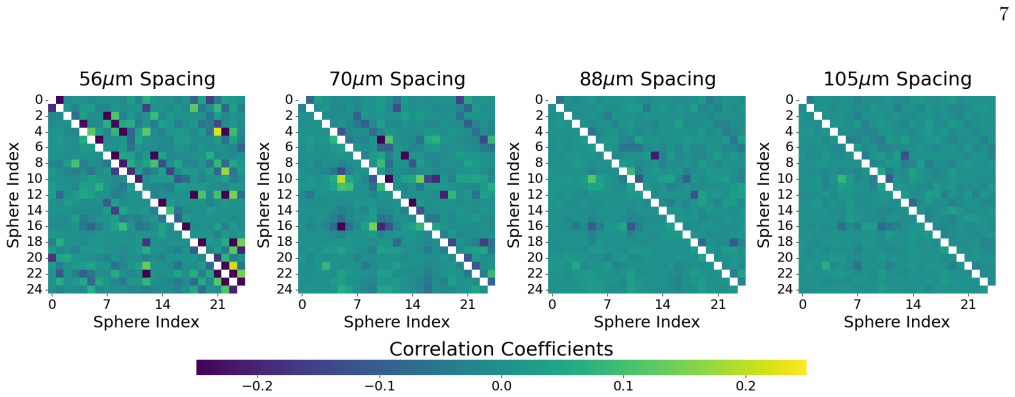
The paper's central claim is that time-shared optical trapping—cycling one laser beam through AOD-defined sites so fast that each site acts as a continuous trap—enables scalable, independent control of levitated microsphere arrays in vacuum. With this method the authors trap, load, sort, and monitor a 5x5 array of 25 silica microspheres (10.8 um diameter) at 57 um spacing, create arbitrary two-dimensional geometries, and rearrange partially filled arrays into dense defect-free grids without losing spheres. During loading the cycle rate is 500 Hz; for 100 traps the projected rate exceeds 1.5 kHz, well above the 30–100 Hz center-of-mass resonances of the gravito-optical traps. All 25 spheres' motions are reconstructed at 1000 frames per second, with eigenframe and neural-network tracking reaching displacement sensitivities below $1\ \mathrm{nm}/\sqrt{\mathrm{Hz}}$, and neighbor correlations are measured as a function of array spacing.
Load-bearing premise
The load-bearing premise is that a briefly and repeatedly illuminated trap is equivalent to a continuously illuminated one: the time-shared cycle rate is far above the 30–100 Hz mechanical resonances, but the paper gives no quantitative stability model for this pseudo-continuous approximation.
Editorial extensions
If this is right
- Up to roughly 10x10 microspheres can be held in vacuum with independent optical potentials at each site, so array size is no longer limited by one beam per particle.
- A single quadrant photodiode can time-multiplex position signals from all spheres, removing the need for one detector and readout chain per particle.
- Camera-based tracking with eigenframe or neural-network analysis gives sub-nanometer displacement sensitivity, providing a practical route to simultaneous closed-loop feedback on many spheres.
- Measured nearest-neighbor correlations can be minimized by operating at spacings above 100 um and by controlling residual charge, so low-crosstalk sensing arrays are realistic.
- Array scaling increases total sensor mass and cross section, which is exactly what rare-interaction searches such as low-mass dark matter detection require.
Reading between the lines
- Beyond the paper: if the pseudo-continuous approximation remains valid at 100 traps, time-sharing could be combined with frequency-comb AOD excitation to reach even larger arrays; the crossover where cycle-rate micromotion limits sensitivity still needs direct measurement.
- Beyond the paper: because the CNN tracker is trained on synthetic images and is fast once trained, it could be adapted for real-time camera-based feedback cooling of every sphere simultaneously, reducing reliance on the QPD.
- Beyond the paper: the pairwise correlations visible at small spacing could be treated as an engineered resource for collective sensing or many-body levitated dynamics, rather than only as crosstalk to suppress.
- Beyond the paper: the near-unity efficiency of the auxiliary-beam transfer suggests deterministic, atom-array-style assembly of microspheres is within reach, which would replace random filling and make large defect-free arrays routine.
Editorial analysis
A structured set of objections, weighed in public.
Referee Report
Summary. The paper reports an experimental platform for optically levitating arrays of silica microspheres in vacuum using a single 1064 nm beam that is time-shared by a two-dimensional acousto-optic deflector. The authors demonstrate arrays of up to 25 microspheres in a 5x5 grid, arbitrary array geometries, independent control of each trap, and a rearrangement algorithm based on the Hungarian method. Simultaneous motion reconstruction of all 25 spheres is performed with camera imaging using three tracking methods, with the CNN and eigenframe methods claimed to reach displacement sensitivities below 1 nm/sqrt(Hz). The paper also demonstrates multiplexed QPD readout for four traps and discusses loading procedures based on corona discharge and auxiliary-beam transfer. The central claims are that the time-sharing approach is scalable to roughly 10x10 arrays and that the camera/QPD techniques enable arrayed levitated sensing.
Significance. If the claims hold, this is a significant experimental advance: it roughly doubles or triples the number of levitated particles that can be simultaneously trapped in vacuum compared to previous work, and it adds independent reconfigurability and simultaneous readout. The 25-sphere array is directly demonstrated, the sorting algorithm is a genuine new tool, and the paper clearly describes both the strengths and the acknowledged limitations of the QPD readout. The main significance of the paper is therefore well supported at the level of the 25-element demonstration. However, the quantitative scaling claim to ~100 traps and the stated 1 nm/sqrt(Hz) sensitivity would need additional support to be considered fully established.
major comments (3)
- [Sec. II A and Sec. III] The abstract claims the techniques are capable of trapping arrays of more than 25 microspheres, but the largest demonstrated array is exactly 25 spheres in Fig. 5. The projection to approximately 10x10 arrays relies on the pseudo-continuous time-sharing approximation, for which the manuscript provides no quantitative stability model. With the quoted 6.2 microsecond dwell time and 100 traps, the cycle rate is about 1.6 kHz, while the instantaneous radial trap frequency during a dwell scales as sqrt(N) times the average radial frequency, giving about 1 kHz for N=100; the needed separation of timescales is therefore marginal in the radial direction. Please add a quantitative analysis (for example a Floquet or Mathieu stability estimate and a heating-rate calculation for the pulsed trap) or revise the scaling claims to what is experimentally demonstrated.
- [Sec. II A] There is an internal inconsistency in the discussion of the cycle-rate limit. One paragraph states that for arrays ≳100 microspheres the cycle-rate will eventually introduce noticeable micromotion and limit the array size, while a later paragraph states that for arrays as large as 100 traps, cycle-rates greater than 1.5 kHz are much larger than the resonant frequency and minimize any driven motion. Both statements cannot be simultaneously true without additional qualification. This should be reconciled, either by giving the quantitative condition under which each statement applies or by explicitly labeling the 10x10 projection as speculative.
- [Sec. II C and Fig. 4] The sub-1 nm/sqrt(Hz) displacement sensitivity is inferred from the high-frequency noise floor of a single amplitude spectral density, without reported error bars and without an explicit description of the pixel-to-nanometer calibration. Because this sensitivity is a central quantitative claim used to motivate the array-sensing applications, please provide the calibration procedure, the conversion factors, and the uncertainty on the sensitivity estimate. In addition, the CNN is validated only on simulated images; the agreement with the eigenframe method near resonance is reassuring, but it does not substitute for a direct validation of the CNN on experimental data with known displacements.
minor comments (4)
- [Sec. II B] The QPD multiplexing demonstration is limited to four traps, and the text itself notes that the readout rise time forces the averaging window to exclude part of each dwell time. Consider labeling this explicitly as a proof-of-principle in the abstract or conclusions, rather than implying that full-array QPD readout has been achieved.
- [Sec. II C] The statement that the CNN and eigenframe methods reach displacement sensitivities below 1 nm/sqrt(Hz) should specify whether this number is the noise floor of the reconstruction algorithm alone or the combined sensitivity of the optical imaging system, and it should state the measurement bandwidth over which the ASD was evaluated.
- [Sec. I] The comparison with prior work cites arrays of up to 9 nanospheres; the distinction between the 10.8-micrometer microspheres used here and the smaller nanospheres used in previous demonstrations is important for mass and sensitivity scaling and could be stated more explicitly for readers outside the levitated-optomechanics niche.
- [Fig. 3] The figure caption and text do not state the dwell time and cycle rate used for the four-trap QPD demonstration; providing these numbers would help the reader connect the multiplexing demonstration to the loading parameters discussed in Sec. II A.
Circularity Check
No circularity: the paper's claims are supported by direct experimental measurements and independent reconstruction methods.
full rationale
The paper is an experimental demonstration rather than a derivation, and I find no step in which a claimed result is assumed by construction, fitted and renamed as a prediction, or justified solely by a load-bearing self-citation. The central experimental claims are (i) trapping and rearranging arrays of up to 25 microspheres in vacuum and (ii) camera-based displacement sensitivity below 1 nm/sqrt(Hz). Both are supported by measured data: the array is directly imaged, and the displacement sensitivity is read from the high-frequency noise floor of the measured amplitude spectral densities, where the sphere motion is suppressed. The CNN is trained on synthetic images, but its result is independently confirmed by the eigenframe method, which does not share that training procedure, so the sensitivity claim does not reduce to the network's own training target. The scalability projection to approximately 10x10 elements rests on a pseudo-continuous time-sharing approximation that is not quantitatively modeled, and the loading and QPD readout sections state their own limitations explicitly; however, an unvalidated assumption or an extrapolation beyond the demonstrated regime is a correctness or engineering risk, not a circularity. No equation in the paper defines a quantity in terms of the quantity it is supposed to predict, and no fitted parameter is relabeled as a prediction. Self-citations appear for experimental setup and context, but the load-bearing validation of the array and sensitivity claims is internal and measured. Therefore the appropriate circularity score is 0.
Assumptions & free parameters
free parameters (1)
- CNN model weights and hyperparameters =
not specified (trained via grid search on simulated images)
assumptions (3)
- domain assumption Time-shared illumination with cycle rate much greater than mechanical resonance forms a stable pseudo-continuous trap.
- domain assumption The high-frequency floor of the amplitude spectral density is dominated by measurement noise, so it can be quoted as displacement sensitivity.
- domain assumption Observed inter-sphere position correlations are attributed to Coulomb forces and optical beam overlap.
Cite this review
Pith. "Pith review of Optical Levitation of Arrays of Microspheres." pith.science (2026). https://pith.science/paper/KCWJFVJQ
@misc{pith2026241207088,
  author       = {Pith},
  title        = {Pith review of: Optical Levitation of Arrays of Microspheres},
  year         = {2026},
  howpublished = {\url{https://pith.science/paper/KCWJFVJQ}},
  note         = {Machine review of arXiv:2412.07088}
}
abstract
Levitated optomechanical systems are rapidly becoming leading tools for precision sensing of forces and accelerations acting on particles in the femtogram to nanogram mass range. These systems enable a high level of control over the sensor's center-of-mass motion, rotational degrees of freedom, and electric charge state. For many sensing applications, extending these techniques to arrays of sensors enables rejection of correlated noise sources and increases sensitivity to interactions that may be too rare or weak to detect with a single particle. Here we present techniques capable of trapping defect free, two-dimensional arrays of more than 25 microspheres in vacuum. These techniques provide independent control of the optical potential for each sphere. Simultaneous imaging of the motion of all spheres in the array is demonstrated using camera-based imaging, with optimized object tracking algorithms reaching a displacement sensitivity below 1 nm/$\surd$Hz. Such arrays of levitated microspheres may find applications ranging from inertial sensing to searches for weakly interacting particles such as dark matter.
Figures


Figures from the paper (3 more)


Reference graph
Works this paper leans on
-
[1]
Liang, S
T. Liang, S. Zhu, P. He, Z. Chen, Y. Wang, C. Li, Z. Fu, X. Gao, X. Chen, N. Li, Q. Zhu, and H. Hu, Yoctonew- ton force detection based on optically levitated oscillator, Fundamental Research 3, 57 (2023)
2023
-
[2]
Deli´ c, M
U. Deli´ c, M. Reisenbauer, K. Dare, D. Grass, V. Vuleti´ c, N. Kiesel, and M. Aspelmeyer, Cooling of a levitated nanoparticle to the motional quantum ground state, Sci- ence 367, 892 (2020)
2020
-
[3]
Magrini, P
L. Magrini, P. Rosenzweig, C. Bach, A. Deutschmann- Olek, S. G. Hofer, S. Hong, N. Kiesel, A. Kugi, and M. Aspelmeyer, Real-time optimal quantum control of mechanical motion at room temperature, Nature 595, 373 (2021)
2021
-
[4]
Tebbenjohanns, M
F. Tebbenjohanns, M. L. Mattana, M. Rossi, M. Frim- mer, and L. Novotny, Quantum control of a nanoparticle optically levitated in cryogenic free space, Nature 595, 378 (2021)
2021
-
[5]
Kamba, R
M. Kamba, R. Shimizu, and K. Aikawa, Optical cold damping of neutral nanoparticles near the ground state in an optical lattice, Opt. Express, OE 30, 26716 (2022)
2022
-
[6]
Ranfagni, K
A. Ranfagni, K. Børkje, F. Marino, and F. Marin, Two- dimensional quantum motion of a levitated nanosphere, Phys. Rev. Res. 4, 033051 (2022)
2022
-
[7]
Piotrowski, D
J. Piotrowski, D. Windey, J. Vijayan, C. Gonzalez- Ballestero, A. de los R ´ ıos Sommer, N. Meyer, R. Quidant, O. Romero-Isart, R. Reimann, and L. Novotny, Simulta- neous ground-state cooling of two mechanical modes of a levitated nanoparticle, Nat. Phys. 19, 1009 (2023)
2023
-
[8]
Romero-Isart, Quantum superposition of massive ob- jects and collapse models, Phys
O. Romero-Isart, Quantum superposition of massive ob- jects and collapse models, Phys. Rev. A 84, 052121 (2011)
2011
Show all 93 references
-
[9]
Arndt and K
M. Arndt and K. Hornberger, Testing the limits of quan- tum mechanical superpositions, Nature Phys 10, 271 (2014)
2014
-
[10]
Romero-Isart, A
O. Romero-Isart, A. C. Pflanzer, F. Blaser, R. Kaltenbaek, N. Kiesel, M. Aspelmeyer, and J. I. Cirac, Large Quantum Superpositions and Interference of Massive Nanometer-Sized Objects, Phys. Rev. Lett. 107, 020405 (2011)
2011
-
[11]
Romero-Isart, A
O. Romero-Isart, A. C. Pflanzer, M. L. Juan, R. Quidant, N. Kiesel, M. Aspelmeyer, and J. I. Cirac, Optically lev- itating dielectrics in the quantum regime: Theory and protocols, Phys. Rev. A 83, 013803 (2011)
2011
-
[12]
Weiss, M
T. Weiss, M. Roda-Llordes, E. Torrontegui, M. As- pelmeyer, and O. Romero-Isart, Large Quantum Delocal- ization of a Levitated Nanoparticle Using Optimal Con- trol: Applications for Force Sensing and Entangling via Weak Forces, Phys. Rev. Lett. 127, 023601 (2021)
2021
-
[13]
D. C. Moore and A. A. Geraci, Searching for new physics using optically levitated sensors, Quantum Sci. Technol. 6, 014008 (2021), arXiv:2008.13197 [quant-ph]
2021 arXiv
-
[14]
Kawasaki, Search for kilogram-scale dark matter with precision displacement sensors, Phys
A. Kawasaki, Search for kilogram-scale dark matter with precision displacement sensors, Phys. Rev. D 99, 023005 (2019)
2019
-
[15]
Carney, K
D. Carney, K. G. Leach, and D. C. Moore, Searches for massive neutrinos with mechanical quantum sen- sors, PRX Quantum 4, 010315 (2023), arXiv:2207.05883 [hep-ex, physics:hep-ph, physics:nucl-ex, physics:physics, physics:quant-ph]
2023 arXiv
-
[16]
Kilian, M
E. Kilian, M. Rademacher, J. M. H. Gosling, J. H. Iaco- poni, F. Alder, M. Toroˇ s, A. Pontin, C. Ghag, S. Bose, T. S. Monteiro, and P. F. Barker, Dark matter searches with levitated sensors, A VS Quantum Science 6, 030503 (2024)
2024
-
[17]
Monteiro, G
F. Monteiro, G. Afek, D. Carney, G. Krnjaic, J. Wang, and D. C. Moore, Search for composite dark matter with optically levitated sensors, Phys. Rev. Lett. 125, 181102 (2020), arXiv: 2007.12067
2020 arXiv
-
[18]
J. Wang, T. Penny, J. Recoaro, B. Siegel, Y.-H. Tseng, and D. C. Moore, Mechanical Detection of Nuclear De- cays, Phys. Rev. Lett. 133, 023602 (2024)
2024
-
[19]
Aggarwal, G
N. Aggarwal, G. P. Winstone, M. Teo, M. Baryakhtar, S. L. Larson, V. Kalogera, and A. A. Geraci, Search- ing for New Physics with a Levitated-Sensor-Based Gravitational-Wave Detector, Phys. Rev. Lett. 128, 111101 (2022)
2022
-
[20]
Manjavacas and F
A. Manjavacas and F. J. G. de Abajo, Vacuum friction in rotating particles, Phys. Rev. Lett. 105, 113601 (2010), arXiv: 1009.4107
2010 arXiv
-
[21]
R. Zhao, A. Manjavacas, F. J. G. de Abajo, and J. B. Pendry, Rotational Quantum Friction, Phys. Rev. Lett. 109, 123604 (2012), arXiv: 1208.4232
2012 arXiv
-
[22]
G. Afek, D. Carney, and D. C. Moore, Coherent Scatter- ing of Low Mass Dark Matter from Optically Trapped Sensors, Phys. Rev. Lett. 128, 101301 (2022)
2022
-
[23]
Carney, A
D. Carney, A. Hook, Z. Liu, J. M. Taylor, and Y. Zhao, Ultralight dark matter detection with mechanical quan- tum sensors, New J. Phys. 23, 023041 (2021)
2021
-
[24]
A. J. Brady, C. Gao, R. Harnik, Z. Liu, Z. Zhang, and Q. Zhuang, Entangled Sensor-Networks for Dark-Matter Searches, PRX Quantum 3, 030333 (2022)
2022
-
[25]
R. Li, S. Lin, L. Zhang, C. Duan, P. Huang, and J. Du, Search for Ultralight Dark Matter with a Frequency Ad- justable Diamagnetic Levitated Sensor, Chinese Phys. Lett. 40, 069502 (2023)
2023
-
[26]
Higgins, S
G. Higgins, S. Kalia, and Z. Liu, Maglev for dark matter: Dark-photon and axion dark matter sensing with levi- tated superconductors, Phys. Rev. D 109, 055024 (2024)
2024
-
[27]
D. W. P. Amaral, D. G. Uitenbroek, T. H. Oosterkamp, and C. D. Tunnell, First Search for Ultralight Dark 9 Matter Using a Magnetically Levitated Particle (2024), arXiv:2409.03814
2024
-
[28]
Yokomizo and Y
K. Yokomizo and Y. Ashida, Non-Hermitian physics of levitated nanoparticle array, Phys. Rev. Res. 5, 033217 (2023)
2023
-
[29]
Rudolph, K
H. Rudolph, K. Hornberger, and B. A. Stickler, En- tangling levitated nanoparticles by coherent scattering, Phys. Rev. A 101, 011804 (2020)
2020
-
[30]
A. K. Chauhan, O. ˇCernot ´ ık, and R. Filip, Tuneable Gaussian entanglement in levitated nanoparticle arrays, npj Quantum Inf 8, 1 (2022)
2022
-
[31]
Anderegg, L
L. Anderegg, L. W. Cheuk, Y. Bao, S. Burchesky, W. Ketterle, K.-K. Ni, and J. M. Doyle, An optical tweezer array of ultracold molecules, Science 365, 1156 (2019)
2019
-
[32]
Scholl, M
P. Scholl, M. Schuler, H. J. Williams, A. A. Eberharter, D. Barredo, K.-N. Schymik, V. Lienhard, L.-P. Henry, T. C. Lang, T. Lahaye, A. M. L¨ auchli, and A. Browaeys, Quantum simulation of 2D antiferromagnets with hun- dreds of Rydberg atoms, Nature 595, 233 (2021)
2021
-
[33]
S. Ma, A. P. Burgers, G. Liu, J. Wilson, B. Zhang, and J. D. Thompson, Universal Gate Operations on Nuclear Spin Qubits in an Optical Tweezer Array of $ˆ{171}\mathrm{Yb}$ Atoms, Phys. Rev. X 12, 021028 (2022)
2022
-
[34]
K. Kim, M. Kim, J. Park, A. Byun, and J. Ahn, Quantum computing dataset of maximum independent set problem on king lattice of over hundred Rydberg atoms, Sci Data 11, 111 (2024)
2024
-
[35]
Bluvstein, S
D. Bluvstein, S. J. Evered, A. A. Geim, S. H. Li, H. Zhou, T. Manovitz, S. Ebadi, M. Cain, M. Kali- nowski, D. Hangleiter, J. P. Bonilla Ataides, N. Maskara, I. Cong, X. Gao, P. Sales Rodriguez, T. Karolyshyn, G. Semeghini, M. J. Gullans, M. Greiner, V. Vuleti´ c, and M. D. Lu...
2024
-
[36]
Pause, L
L. Pause, L. Sturm, M. Mittenb¨ uhler, S. Amann, T. Preuschoff, D. Sch¨ affner, M. Schlosser, and G. Birkl, Supercharged two-dimensional tweezer array with more than 1000 atomic qubits, Optica, OPTICA 11, 222 (2024)
2024
-
[37]
H. J. Manetsch, G. Nomura, E. Bataille, K. H. Leung, X. Lv, and M. Endres, A tweezer array with 6100 highly coherent atomic qubits (2024), arXiv:2403.12021 [quant- ph]
2024 arXiv
-
[38]
S. G. Menon, N. Glachman, M. Pompili, A. Dibos, and H. Bernien, An integrated atom array-nanophotonic chip platform with background-free imaging, Nat Commun 15, 6156 (2024)
2024
-
[39]
Deplano, A
Q. Deplano, A. Pontin, A. Ranfagni, F. Marino, and F. Marin, Coulomb coupling between two nanospheres trapped in a bichromatic optical tweezer (2024), arXiv:2408.02597
2024 arXiv
-
[40]
Arita, E
Y. Arita, E. M. Wright, and K. Dholakia, Optical bind- ing of two cooled micro-gyroscopes levitated in vacuum, Optica, OPTICA 5, 910 (2018)
2018
-
[41]
Rieser, M
J. Rieser, M. A. Ciampini, H. Rudolph, N. Kiesel, K. Hornberger, B. A. Stickler, M. Aspelmeyer, and U. Deli´ c, Tunable light-induced dipole-dipole interaction between optically levitated nanoparticles, Science 377, 987 (2022)
2022
-
[42]
Reisenbauer, H
M. Reisenbauer, H. Rudolph, L. Egyed, K. Hornberger, A. V. Zasedatelev, M. Abuzarli, B. A. Stickler, and U. Deli´ c, Non-Hermitian dynamics and non-reciprocity of optically coupled nanoparticles, Nat. Phys. 20, 1629 (2024)
2024
-
[43]
Vijayan, J
J. Vijayan, J. Piotrowski, C. Gonzalez-Ballestero, K. We- ber, O. Romero-Isart, and L. Novotny, Cavity-mediated long-range interactions in levitated optomechanics, Nat. Phys. 20, 859 (2024)
2024
-
[44]
V. Svak, J. Flajˇ smanov´ a, L. Chv´ atal, M.ˇSiler, A. Jon´ aˇ s, J. Jeˇ zek, S. H. Simpson, P. Zem´ anek, and O. Brzobohat´ y, Stochastic dynamics of optically bound matter levitated in vacuum, Optica, OPTICA 8, 220 (2021)
2021
-
[45]
M. Wu, N. Li, H. Cai, and H. Hu, Coupler enabled tun- able dipole-dipole coupling between optically levitated nanoparticles (2024), arXiv:2408.06256
2024
-
[46]
J. Yan, X. Yu, Z. V. Han, T. Li, and J. Zhang, On- demand assembly of optically levitated nanoparticle ar- rays in vacuum, Photon. Res., PRJ 11, 600 (2023)
2023
-
[47]
Liˇ ska, T
V. Liˇ ska, T. Zem´ ankov´ a, V. Svak, P. J´ akl, J. Jeˇ zek, M. Br´ aneck´ y, S. H. Simpson, P. Zem´ anek, and O. Br- zobohat´ y, Cold damping of levitated optically coupled nanoparticles, Optica, OPTICA 10, 1203 (2023)
2023
-
[48]
Vijayan, Z
J. Vijayan, Z. Zhang, J. Piotrowski, D. Windey, F. van der Laan, M. Frimmer, and L. Novotny, Scalable all-optical cold damping of levitated nanoparticles, Nat. Nanotechnol. 18, 49 (2023)
2023
-
[49]
Arita, G
Y. Arita, G. D. Bruce, E. M. Wright, S. H. Simpson, P. Zem´ anek, and K. Dholakia, All-optical sub-Kelvin sympathetic cooling of a levitated microsphere in vac- uum, Optica, OPTICA 9, 1000 (2022)
2022
-
[50]
T. W. Penny, A. Pontin, and P. F. Barker, Sympathetic cooling and squeezing of two colevitated nanoparticles, Phys. Rev. Res. 5, 013070 (2023)
2023
-
[51]
D. S. Bykov, L. Dania, F. Goschin, and T. E. Northup, 3D sympathetic cooling and detection of levitated nanoparticles, Optica, OPTICA 10, 438 (2023)
2023
-
[52]
Minowa, K
Y. Minowa, K. Kato, S. Ueno, T. W. Penny, A. Pon- tin, M. Ashida, and P. F. Barker, Imaging based feed- back cooling of a levitated nanoparticle, Review of Sci- entific Instruments 93, 075109 (2022), arXiv:2204.05506 [physics, physics:quant-ph]
2022 arXiv
-
[53]
Y. Ren, E. Benedetto, H. Borrill, Y. Savchuk, M. Mes- sage, K. O’Flynn, M. Rashid, and J. Millen, Event-based imaging of levitated microparticles, Appl. Phys. Lett. 121, 113506 (2022)
2022
-
[54]
Y. Ren, B. Siegel, R. Yin, M. Rashid, and J. Millen, Neu- romorphic detection and cooling of microparticle arrays (2024), arXiv:2408.00661
2024 arXiv
-
[55]
B. R. Slezak and B. D’Urso, A microsphere molecule: The interaction of two charged microspheres in a magneto-gravitational trap, Applied Physics Letters114, 244102 (2019)
2019
-
[56]
Sasaki, M
K. Sasaki, M. Koshioka, H. Misawa, N. K. N. Kitamura, and H. M. H. Masuhara, Laser-Scanning Micromanipu- lation and Spatial Patterning of Fine Particles, Jpn. J. Appl. Phys. 30, L907 (1991)
1991
-
[57]
Sasaki, M
K. Sasaki, M. Koshioka, H. Misawa, N. Kitamura, and H. Masuhara, Pattern formation and flow control of fine particles by laser-scanning micromanipulation, Opt. Lett., OL 16, 1463 (1991)
1991
-
[58]
Visscher, G
K. Visscher, G. J. Brakenhoff, and J. J. Krol, Microma- nipulation by ”multiple” optical traps created by a single fast scanning trap integrated with the bilateral confocal scanning laser microscope, Cytometry 14, 105 (1993)
1993
-
[59]
Visscher, S
K. Visscher, S. Gross, and S. Block, Construction of multiple-beam optical traps with nanometer-resolution 10 position sensing, IEEE Journal of Selected Topics in Quantum Electronics 2, 1066 (1996), conference Name: IEEE Journal of Selected Topics in Quantum Electronics
1996
-
[60]
Monteiro, W
F. Monteiro, W. Li, G. Afek, C.-l. Li, M. Mossman, and D. C. Moore, Force and acceleration sensing with opti- cally levitated nanogram masses at microkelvin temper- atures, Physical Review A 101, 053835 (2020)
2020
-
[61]
Gittes and C
F. Gittes and C. F. Schmidt, Interference model for back- focal-plane displacement detection in optical tweezers, Opt. Lett., OL 23, 7 (1998)
1998
-
[62]
Pralle, M
A. Pralle, M. Prummer, E. L. Florin, E. H. Stelzer, and J. K. H¨ orber, Three-dimensional high-resolution particle tracking for optical tweezers by forward scattered light, Microsc Res Tech 44, 378 (1999)
1999
-
[63]
Farr´ e, F
A. Farr´ e, F. Mars` a, and M. Montes-Usategui, Optimized back-focal-plane interferometry directly measures forces of optically trapped particles, Opt. Express, OE 20, 12270 (2012)
2012
-
[64]
Mart ´ ınez and D
I. Mart ´ ınez and D. Petrov, Back-focal-plane position de- tection with extended linear range for photonic force mi- croscopy, Applied optics 51, 5973 (2012)
2012
-
[65]
J. A. Kurvits, M. Jiang, and R. Zia, Comparative analysis of imaging configurations and objectives for Fourier microscopy, J. Opt. Soc. Am. A 32, 2082 (2015), arXiv:1507.04037 [physics]
2015 arXiv
-
[66]
D. Ruh, B. Tr¨ ankle, and A. Rohrbach, Fast parallel in- terferometric 3D tracking of numerous optically trapped particles and their hydrodynamic interaction, Opt. Ex- press, OE 19, 21627 (2011)
2011
-
[67]
Ashkin and J
A. Ashkin and J. M. Dziedzic, Feedback stabilization of optically levitated particles, Appl. Phys. Lett. 30, 202 (1977)
1977
-
[68]
Ashkin and J
A. Ashkin and J. M. Dziedzic, Optical Levitation by Ra- diation Pressure, Appl. Phys. Lett. 19, 283 (1971)
1971
-
[69]
Ashkin and J
A. Ashkin and J. M. Dziedzic, Optical levitation in high vacuum, Appl. Phys. Lett. 28, 333 (1976)
1976
-
[70]
D. C. Moore, A. D. Rider, and G. Gratta, Search for Millicharged Particles Using Optically Levitated Micro- spheres, Physical Review Letters 113, 251801 (2014)
2014
-
[71]
C. P. Blakemore, D. Martin, A. Fieguth, N. Priel, G. Venugopalan, A. Kawasaki, and G. Gratta, Libra- tional feedback cooling, Phys. Rev. A106, 023503 (2022)
2022
-
[72]
G. Afek, F. Monteiro, B. Siegel, J. Wang, S. Dickson, J. Recoaro, M. Watts, and D. C. Moore, Control and measurement of electric dipole moments in levitated op- tomechanics, Physical Review A 104, 053512 (2021)
2021
-
[73]
G. Afek, F. Monteiro, J. Wang, B. Siegel, S. Ghosh, and D. C. Moore, Limits on the abundance of millicharged particles bound to matter, Phys. Rev. D 104, 012004 (2021), arXiv: 2012.08169
2021 arXiv
-
[74]
Monteiro, S
F. Monteiro, S. Ghosh, E. C. van Assendelft, and D. C. Moore, Optical Rotation of Levitated Spheres in High Vacuum, Physical Review A 97, 051802 (2018)
2018
-
[75]
http://www
Purchased from Corpuscular, Inc. http://www. microspheres-nanospheres.com/Microspheres/ Inorganic/Silica/SiO220Plain.htm
-
[76]
L. P. Ghislain and W. W. Webb, Scanning-force micro- scope based on an optical trap, Opt. Lett., OL 18, 1678 (1993)
1993
-
[77]
L. P. Ghislain, N. A. Switz, and W. W. Webb, Mea- surement of small forces using an optical trap, Review of Scientific Instruments 65, 2762 (1994)
1994
-
[78]
A. B. Vasista, D. K. Sharma, and G. P. Kumar, Fourier Plane Optical Microscopy and Spectroscopy, in digital Encyclopedia of Applied Physics, edited by Wiley-VCH Verlag GmbH & Co. KGaA (Wiley-VCH Verlag GmbH & Co. KGaA, Weinheim, Germany, 2019) pp. 1–14
2019
-
[79]
C. W. Lewandowski, T. D. Knowles, Z. B. Etienne, and B. D’Urso, High-Sensitivity Accelerometry with a Feedback-Cooled Magnetically Levitated Microsphere, Phys. Rev. Applied 15, 014050 (2021)
2021
-
[80]
B. M. Lansdorp, S. J. Tabrizi, A. Dittmore, and O. A. Saleh, A high-speed magnetic tweezer beyond 10,000 frames per second, Review of Scientific Instruments 84, 044301 (2013)
2013
-
[81]
J. C. Crocker and D. G. Grier, Methods of Digital Video Microscopy for Colloidal Studies, Journal of Colloid and Interface Science 179, 298 (1996)
1996
-
[82]
D. B. Allan, T. Caswell, N. C. Keim, C. M. van der Wel, and R. W. Verweij, soft-matter/trackpy: v0.6.4 (2024)
2024
-
[83]
Carleo, I
G. Carleo, I. Cirac, K. Cranmer, L. Daudet, M. Schuld, N. Tishby, L. Vogt-Maranto, and L. Zdeborov´ a, Machine learning and the physical sciences, Rev. Mod. Phys. 91, 045002 (2019)
2019
-
[84]
Karagiorgi, G
G. Karagiorgi, G. Kasieczka, S. Kravitz, B. Nachman, and D. Shih, Machine learning in the search for new fun- damental physics, Nat Rev Phys 4, 399 (2022)
2022
-
[85]
Li, Fundamental Tests of Physics with Optically Trapped Microspheres., Ph.D
T. Li, Fundamental Tests of Physics with Optically Trapped Microspheres., Ph.D. thesis, The University of Texas at Austin (2011)
2011
-
[86]
Weisman, C
E. Weisman, C. K. Galla, C. Montoya, E. Alejandro, J. Lim, M. Beck, G. P. Winstone, A. Grinin, W. Eom, and A. A. Geraci, An apparatus for in-vacuum loading of nanoparticles into an optical trap, Review of Scientific Instruments 93, 115115 (2022)
2022
-
[87]
Frimmer, K
M. Frimmer, K. Luszcz, S. Ferreiro, V. Jain, E. Hebe- streit, and L. Novotny, Controlling the net charge on a nanoparticle optically levitated in vacuum, Phys. Rev. A 95, 061801 (2017)
2017
-
[88]
Ricci, M
F. Ricci, M. T. Cuairan, G. P. Conangla, A. W. Schell, and R. Quidant, Accurate Mass Measurement of a Lev- itated Nanomechanical Resonator for Precision Force- Sensing, Nano Lett. 19, 6711 (2019)
2019
-
[89]
H. Kim, W. Lee, H.-g. Lee, H. Jo, Y. Song, and J. Ahn, In situ single-atom array synthesis using dynamic holo- graphic optical tweezers, Nat Commun 7, 13317 (2016)
2016
-
[90]
Endres, H
M. Endres, H. Bernien, A. Keesling, H. Levine, E. R. Anschuetz, A. Krajenbrink, C. Senko, V. Vuletic, M. Greiner, and M. D. Lukin, Atom-by-atom assembly of defect-free one-dimensional cold atom arrays, Science 354, 1024 (2016)
2016
-
[91]
Barredo, S
D. Barredo, S. de L´ es´ eleuc, V. Lienhard, T. Lahaye, and A. Browaeys, An atom-by-atom assembler of defect-free arbitrary two-dimensional atomic arrays, Science 354, 1021 (2016)
2016
-
[92]
Barredo, V
D. Barredo, V. Lienhard, S. de L´ es´ eleuc, T. Lahaye, and A. Browaeys, Synthetic three-dimensional atomic struc- tures assembled atom by atom, Nature 561, 79 (2018)
2018
-
[93]
H. W. Kuhn, The Hungarian method for the assign- ment problem, Naval Research Logistics Quarterly 2, 83 (1955)
1955
Reviewed August 11, 2026 · model on record in the stance chip above.
Discussion (0). Continue with ORCID to comment.