REVIEW 5 major objections 5 minor 21 references
Disentangling Coherent and Incoherent Effects in Superconductor Photoemission Spectra via Machine Learning
T0 review · 5 major / 5 minor · reviewed 2026-08-11 · deepseek-v4-flash
Pith's one-line read A convolutional neural network trained purely on synthetic photoemission spectra detects bilayer splitting in real BSCCO data and finds it persists at 0.13(1) eV in underdoped samples, ruling out its disappearance with underdoping.
desk verdict A careful synthetic-data CNN study whose central physics claim is unsupported by validation on real spectra; the pipeline is worth a look, the conclusion is not. read the letter →
The pith
A machine-rendered reading of the paper's core claim, the machinery that carries it, and where it could break.
The reading
What carries the argument
The central machinery is a generative model of the photoemission intensity as the sum of two spectral functions for the antibonding and bonding bands (the two bands formed by the coupling of the two CuO layers in a bilayer), each with a simple cosine dispersion and sharing a single complex self-energy $\Sigma(\omega)$. The imaginary part of $\Sigma$ contains a Lorentzian resonance peak simulating the magnetic mode, and the real part is either omitted or obtained analytically from Kramers-Kronig relations. A convolutional neural network with an EfficientNet backbone is trained on tens of thousands of synthetic images of these spectra, with added noise and matrix-element variations, first to classify the presence of splitting and then to regress the splitting energy $d\varepsilon_0 = \varepsilon_0^a - \varepsilon_0^b$. The trained network is applied to experimental spectra through a hierarchical dual-model approach: the classification model gates whether splitting is present, and the regression model outputs the splitting value.
What would settle it
Measure the same two samples' band splitting with an independent method that does not rely on the paper's assumptions—for example, by fitting the raw spectrum's peak positions directly or using a different theoretical model—and check whether the values agree with $0.10(1)$ eV and $0.13(1)$ eV. Another check: apply the network to one sample measured at several photon energies; the predicted splitting should be the same (within $0.01$ eV) at every energy, because real splitting does not depend on photon energy.
Extended reading notes
Core claim
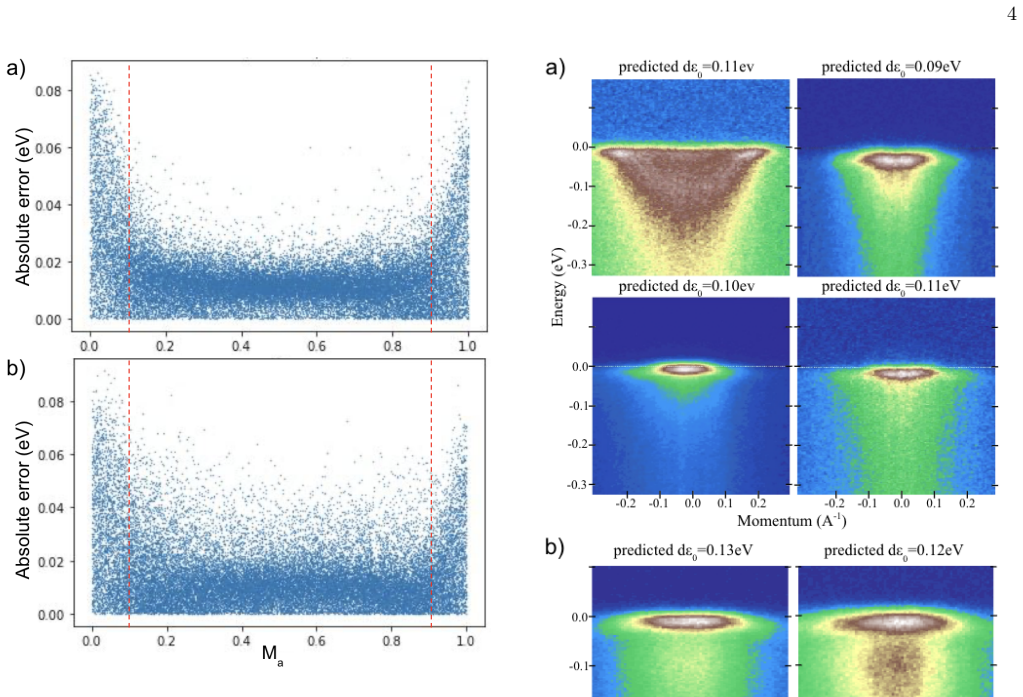
The central claim is that the bilayer splitting in BSCCO exists across the entire doping range, including severely underdoped samples in the superconducting state, and that its magnitude does not decrease with underdoping. The authors train a CNN on thousands of spectra generated from a two-band model in which the two split bands share a common complex self-energy $\Sigma(\omega)$—the energy-dependent correction that broadens and shifts the spectral lines—including a resonance peak that mimics magnetic fluctuations; the model is built with and without a Kramers-Kronig-consistent real part. After validation on synthetic data, the network is applied to real ARPES spectra from optimally doped ($T_c=90$ K, $x=0.16$) and underdoped ($T_c=76$ K, $x=0.10$) BSCCO. The classification stage unambiguously predicts bilayer splitting in all experimental spectra, and the regression stage gives splitting values $0.10(1)$ eV and $0.13(1)$ eV, respectively. From this the authors conclude that the bilayer splitting does not vanish with underdoping.
Load-bearing premise
The load-bearing premise is that the synthetic spectra used to train the network faithfully mimic real photoemission measurements—including the broadening from magnetic fluctuations and ignoring background signals and momentum-dependent measurement factors—so that a network trained only on synthetic data can correctly read the band splitting in real data.
Editorial extensions
If this is right
- The bilayer splitting is present in BSCCO at optimal doping and in the severely underdoped superconducting state, with inferred values $0.10(1)$ eV and $0.13(1)$ eV.
- The magnitude of the splitting does not decrease with underdoping, so theories of cuprates that predict a vanishing or strongly suppressed interlayer coupling in the underdoped regime would need to be revised.
- Training CNNs on physically modeled spectra can substitute for large experimental training sets, offering a general route for extracting parameters from ARPES and similar spectroscopies.
- The classification-then-regression pipeline can be reused for other spectral-feature extraction problems where coherent and incoherent contributions overlap.
Reading between the lines
- The absolute splitting values depend on how faithfully the generative model captures real self-energy and matrix-element effects; a natural check is whether the predicted $d\varepsilon_0$ for one sample is stable across different photon energies, since the physical splitting should be photon-energy independent while the matrix elements in the model are not.
- The qualitative trend—no decrease of splitting with underdoping—is probably more robust than the absolute numbers, because any systematic bias from the self-energy parameterization would affect both doping levels similarly; this makes the qualitative conclusion the paper's stronger result.
- The framework could be extended to map the full doping-temperature phase diagram of bilayer cuprates with a single trained network, or adapted to separate bilayer splitting from pseudogap effects and other self-energy structures in the same spectra.
Editorial analysis
A structured set of objections, weighed in public.
Referee Report
Summary. The manuscript applies a convolutional neural network (EfficientNetB0) trained on synthetic ARPES spectra to the question of bilayer splitting in bilayer BSCCO. The synthetic data are generated from a two-band model with a shared self-energy (Eqs. 1-8), whose imaginary part contains a magnetic-resonance peak; the CNN is trained for two tasks: binary classification of the presence of two zones (the 'no-split' class realized by setting one matrix element to zero) and regression of the bare splitting d_epsilon_0. After reporting an in-distribution validation accuracy of 81% for classification and R^2 ~ 0.87 (and 0.80 for a second data set) for regression, the authors apply the network to two real ARPES spectra of optimally doped (x = 0.16, T_c = 90 K) and underdoped (x = 0.10, T_c = 76 K) BSCCO in the superconducting state. The classifier labels both as split and the regression yields d_epsilon_0 = 0.10(1) eV and 0.13(1) eV, from which the authors conclude that bilayer splitting is present across the entire doping range and does not decrease with underdoping, contrary to some theoretical expectations.
Significance. If the claimed result were validated, the finding that bilayer splitting does not shrink on underdoping would settle a long-standing controversy in cuprate photoemission, and the paper would serve as a useful proof-of-concept for training CNN-based spectral analyzers on physically motivated generative models. The authors deserve credit for reporting honest in-distribution metrics (81% classification accuracy; R^2 = 0.87 and 0.80 for regression), for verifying the Kramers-Kronig consistency of the self-energy (Fig. 2 and Eqs. 6-8), and for testing edge cases of weak secondary zones (Fig. 7). The pipeline is falsifiable in principle, since it yields specific quantitative predictions for real spectra that could be checked by independent fitting or by control measurements. However, the physical conclusion as stated is not established by the evidence presented, for the reasons detailed in the major comments below.
major comments (5)
- [§III (Results, Fig. 8); Conclusions] The claim that the CNN 'unambiguously predicts the existence of bilayer splitting in all the spectra' and 'rules out the possibility that the bilayer splitting vanishes with underdoping' is not supported by the classifier's reported in-distribution validation accuracy of 81% (Section III): roughly one in five held-out spectra from the same generator is mislabeled, so 'unambiguous' overstates the performance even on the training manifold itself. Because the doping-dependent conclusion rests entirely on the classifier output for the two real spectra in Fig. 8, the authors should at minimum report the classifier's false-positive rate on single-band spectra (one matrix element set to zero) generated with the large resonance strength P and small width G that characterize the underdoped superconducting state, since that is precisely the regime in which a peak-dip-hump line shape can be mistaken for a second band.
- [§II (Eqs. 1-8); §III (Fig. 8)] The transfer of the CNN from the synthetic generator to real ARPES data is asserted but never validated. No spectrum with an independently known splitting value is used to test the network, and the generative family of Eqs. (1)-(8) excludes features of the real spectra it is applied to: no background, no momentum- or photon-energy-dependent matrix elements (Ma and Mb are constant per spectrum), and one shared self-energy for both bands. The 'no-split' class is defined only as exactly one matrix element equal to zero, so the classifier has never seen a realistic single-band spectrum with background and a strong self-energy kink. A concrete, feasible control is to apply the trained classifier to ARPES data of an isostructural single-layer cuprate, or to synthetic spectra augmented with background and out-of-family self-energies; without such a control, the reported 0.10(1) and 0.13(1) eV values remain outputs of the model family rather than measured properties of the real spectra.
- [§III (Figs. 7 and 8)] The parenthetical uncertainty in '0.10(1) eV' and '0.13(1) eV' is never defined: the paper describes no ensemble, bootstrap, or cross-validation procedure from which a standard error could be derived. This matters because the text accompanying Fig. 7 states that the regression models 'have some bias near 0.1 eV,' which is exactly the region of the reported optimally doped value, and because the paper's key conclusion — that splitting does not decrease with underdoping — rests entirely on the 0.03 eV difference between the two reported values. Without a defined uncertainty and a quantified bias correction for the regression output, that comparison is not established.
- [Abstract; Conclusions] The conclusion that bilayer splitting is present 'across the entire doping range' and 'does not decrease with underdoping' is drawn from exactly two real samples: one optimally doped (x = 0.16) and one underdoped (x = 0.10), both shown in Fig. 8. Two doping points cannot support a claim about the entire doping range, and the statement that the splitting 'does not decrease' is a claim about a trend that would require at least an additional intermediate doping value; as presented, the evidence shows only that the single underdoped sample produced a larger output value than the single optimally doped sample.
- [§III (data generation and training distribution)] The description of the training distribution is incomplete and internally inconsistent. The sentence 'the training data were restricted to the range of Ma/Mb < 0.1 and Mb/Ma < 0.1' cannot be read literally, since the two inequalities cannot hold simultaneously; the intended allowed range of the matrix-element ratio is therefore unclear, and it is never stated how this range relates to the real spectra in Fig. 8, whose photon energies and hence matrix-element regimes are not given. In addition, the ranges of the self-energy parameters (C, alpha, beta, P, G, omega_0), the hopping t, and the bare splitting d_epsilon_0 used for data generation are not reported. Because the domain of validity of the CNN is exactly its training distribution, and because real spectra include photon-energy regimes in which one band is dominant (cf. Fig. 1, panels f, i, l), the reader cannot assess whether the network operated inside or outside its trained domain when producing the values 0.10 and 0.13 eV.
minor comments (5)
- [§I; §III heading] There is a typo in Section I: 'underdoped samo-ple below Tc' should read 'underdoped sample below Tc', and the Section III header 'RESUL TS' is misspelled.
- [Eq. (1)] In Eq. (1), the spectral functions are written as A_a(w,k) and A_b(w,k) with the variable w, while Eq. (2) defines A_{a,b}(omega,k); the symbol w appears to be a typo for omega and should be made consistent.
- [Fig. 8] The experimental spectra in Fig. 8 lack provenance details: no reference or dataset identifier for the measurements by the IFW Dresden group at BESSY is given, and the photon energies and measurement geometry are not specified, even though Fig. 1 demonstrates that these strongly affect the visibility of the splitting.
- [§II] The paper provides no code or data availability statement, and the hyperparameter search mentioned in Section II is not reported (the chosen dense-layer sizes, dropout probabilities, and the outcome of the search are not given), which limits reproducibility.
- [Conclusions] The phrase 'contrary to some theoretical predictions' does not name the predictions being ruled out; since the paper's main claim is precisely that it contradicts these predictions, the relevant references should be given explicitly.
Circularity Check
No significant circularity: the CNN prediction is model-dependent but not equivalent to its inputs by construction.
full rationale
The paper's derivation chain is: (i) generate synthetic ARPES spectra from a two-band model with a resonance self-energy, labeling each image by the input splitting dε0 or by one-band/two-band class; (ii) train a CNN to classify/regress that label; (iii) apply the trained CNN to two real BSCCO spectra and read off predicted splittings; (iv) conclude that bilayer splitting persists and does not decrease with underdoping. There is no step in which the predicted quantity is defined from the real data's own labels, and no parameter is fitted to the real spectra and then renamed as a prediction. The CNN weights are learned from simulated images, not from the experimental spectra, so the 0.10(1) eV and 0.13(1) eV outputs are not forced by construction. The fact that dε0 is defined by Eqs. (1)-(3) is simply the choice of supervised target; the generative model also includes one-band examples (Ma or Mb set to zero), so the classifier is not tautologically positive. The main weakness is external validity: the network is never tested on real spectra with independently known splitting, and the 81% validation accuracy shows that even in-distribution performance is imperfect. Those are correctness and generalizability concerns, not circularity. The self-citations (refs. [9]-[11], [14]) are prior experimental/analysis work used as context or empirical input, not as the sole justification of the conclusion; the conclusion rests on the CNN output for real data. Therefore no circularity score above 0 is warranted.
Assumptions & free parameters
free parameters (6)
- Self-energy parameters (C, alpha, beta, P, G, omega0) =
not disclosed
- Hopping t in dispersions =
not disclosed
- Bare splitting d_epsilon0 range =
not disclosed
- Matrix element ratios Ma/Mb =
restricted to <0.1 or >10
- Gaussian noise standard deviation =
[0,50] in arbitrary units
- CNN hyperparameters =
not fully specified
assumptions (4)
- domain assumption ARPES intensity is a sum of two independent split bands with a common self-energy
- ad hoc to paper The self-energy form of Eq. (4)/(7) captures all relevant incoherent effects in the cuprates
- ad hoc to paper A CNN trained on synthetic spectra from this model generalizes to real experimental spectra
- domain assumption Fermi-Dirac distribution and a single k-axis dispersion with cosine form suffice
Cite this review
Pith. "Pith review of Disentangling Coherent and Incoherent Effects in Superconductor Photoemission Spectra via Machine Learning." pith.science (2026). https://pith.science/paper/KEZWLEZA
@misc{pith2026241211129,
  author       = {Pith},
  title        = {Pith review of: Disentangling Coherent and Incoherent Effects in Superconductor Photoemission Spectra via Machine Learning},
  year         = {2026},
  howpublished = {\url{https://pith.science/paper/KEZWLEZA}},
  note         = {Machine review of arXiv:2412.11129}
}
read the original abstract
Disentangling coherent and incoherent effects in the photoemission spectra of strongly correlated materials is generally a challenging problem due to the involvement of numerous parameters. In this study, we employ machine learning techniques, specifically Convolutional Neural Networks (CNNs), to address the long-standing issue of the bilayer splitting in superconducting cuprates. We demonstrate the effectiveness of CNN training on modeled spectra and confirm earlier findings that establish the presence of bilayer splitting across the entire doping range. Furthermore, we show that the magnitude of the splitting does not decrease with underdoping, contrary to expectations. This approach not only highlights the potential of machine learning in tackling complex physical problems but also provides a robust framework for advancing the analysis of electronic properties in correlated superconductors.
Figures


Figures from the paper (3 more)


Reference graph
Works this paper leans on
-
[1]
P. W. Anderson, The Resonating Valence Bond State in La 2CuO4 and Superconductivity, Science 235, 1196 (1987)
1987
-
[2]
R. Liu, B. W. Veal, A. P. Paulikas, J. W. Downey, P. J. Kosti´ c, S. Fleshler, U. Welp, C. G. Olson, X. Wu, A. J. Arko, and J. J. Joyce, Fermi-surface topology of yba2cu3ox with varied oxygen stoichiometry: A photoe- mission study, Phys. Rev. B 46, 11056 (1992)
work page 1992
-
[3]
O. Andersen, A. Liechtenstein, O. Jepsen, and F. Paulsen, LDA energy bands, low-energy Hamiltonians, t′, t′′, t⊥(k), and J⊥J, Journal of Physics and Chemistry of Solids 56, 1573 (1995)
work page 1995
-
[4]
J. M. Luttinger and J. C. Ward, Ground-state energy of a many-fermion system. ii, Phys. Rev. 118, 1417 (1960)
1960
-
[5]
H. Ding, A. F. Bellman, J. C. Campuzano, M. Randeria, M. R. Norman, T. Yokoya, T. Takahashi, H. Katayama- Yoshida, T. Mochiku, K. Kadowaki, G. Jennings, and G. P. Brivio, Electronic Excitations in Bi 2Sr2CaCu2O8: Fermi Surface, Dispersion, and Absence of Bilayer Split- ting, Phys. Rev. Lett. 76, 1533 (1996)
work page 1996
-
[6]
P. W. Anderson, The Theory of Superconductivity in the High-Tc Cuprate Superconductors(1997)
work page 1997
-
[7]
D. L. Feng, N. P. Armitage, D. H. Lu, A. Damascelli, J. P. Hu, P. Bogdanov, A. Lanzara, F. Ronning, K. M. Shen, H. Eisaki, C. Kim, Z.-X. Shen, J.-i. Shimoyama, and K. Kishio, Bilayer Splitting in the Electronic Structure of Heavily Overdoped Bi 2Sr2CaCu2O8+δ, Phys. Rev. Lett. 86, 5550 (2001)
work page 2001
- [8]
Show all 21 references
-
[9]
A. A. Kordyuk, S. V. Borisenko, M. S. Golden, S. Legner, K. A. Nenkov, M. Knupfer, J. Fink, H. Berger, L. Forr´ o, and R. Follath, Doping dependence of the Fermi surface in Bi2Sr2CaCu2O8+δ, Phys. Rev. B 66, 014502 (2002)
2002
-
[10]
S. V. Borisenko, A. A. Kordyuk, T. K. Kim, A. Koitzsch, M. Knupfer, J. Fink, M. S. Golden, M. Eschrig, H. Berger, and R. Follath, Anomalous enhancement of 6 the coupling to the magnetic resonance mode in under- doped Pb-Bi2212, Phys. Rev. Lett. 90, 207001 (2003)
2003
-
[11]
Chuang, A
Y.-D. Chuang, A. D. Gromko, A. V. Fedorov, Y. Aiura, K. Oka, Y. Ando, M. Lindroos, R. S. Markiewicz, A. Ban- sil, and D. S. Dessau, Bilayer Splitting and Coherence Effects in Optimal and Underdoped Bi2Sr2CaCu 2O8+δ, Phys. Rev. B 69, 094515 (2004)
2004
-
[12]
Eschrig, The effect of collective spin-1 excitations on electronic spectra in high- tc superconductors, Advances in Physics 55, 47 (2006)
M. Eschrig, The effect of collective spin-1 excitations on electronic spectra in high- tc superconductors, Advances in Physics 55, 47 (2006)
2006
-
[13]
T. Dahm, V. Hinkov, S. V. Borisenko, A. A. Ko- rdyuk, V. B. Zabolotnyy, J. Fink, B. Buchner, D. J. Scalapino, W. Hanke, and B. Keimer, Strength of the spin-fluctuation-mediated pairing interaction in a high- temperature superconductor, Nat. Phys. 5, 217 (2009)
2009
-
[14]
A. A. Kordyuk, S. V. Borisenko, A. Koitzsch, J. Fink, M. Knupfer, and H. Berger, Bare electron dispersion from experiment: Self-consistent self-energy analysis of pho- toemission data, Phys. Rev. B 71, 214513 (2005)
2005
-
[15]
S. A. Ekahana, G. I. Winata, Y. Soh, A. Tamai, R. Mi- lan, G. Aeppli, and M. Shi, Transfer learning application of self-supervised learning in arpes, Machine Learning: Science and Technology 4, 035021 (2023)
2023
-
[16]
T. K. Imamura, M., Unsupervised learning of spatially- resolved arpes spectra for epitaxially grown graphene via non-negative matrix factorization, Sci Rep 14, 24200 (2024)
2024
-
[17]
J. Liu, D. Huang, Y.-f. Yang, and T. Qian, Removing grid structure in angle-resolved photoemission spectra via deep learning method, Phys. Rev. B 107, 165106 (2023)
2023
-
[18]
K. He, X. Zhang, S. Ren, and J. Sun, Deep residual learning for image recognition, CoRR abs/1512.03385 (2015), 1512.03385
2015 arXiv
-
[19]
Tan and Q
M. Tan and Q. V. Le, Efficientnet: Rethinking model scaling for convolutional neural networks, CoRR abs/1905.11946 (2019), 1905.11946
2019 arXiv
-
[20]
G. E. Hinton, N. Srivastava, A. Krizhevsky, I. Sutskever, and R. Salakhutdinov, Improving neural networks by preventing co-adaptation of feature detectors, CoRR abs/1207.0580 (2012), 1207.0580
2012 arXiv
-
[21]
D. P. Kingma and J. Ba, Adam: A method for stochastic optimization (2017), arXiv:1412.6980 [cs.LG]
2017 arXiv
Reviewed August 11, 2026 · model on record in the stance chip above.
Discussion (0). Continue with ORCID to comment.