REVIEW 2 major objections 5 minor 10 cited by
Minimal Plateau Inflation in light of ACT DR6 Observations
T0 review · 2 major / 5 minor · reviewed 2026-08-07 · deepseek-v4-flash
Pith's one-line read Minimal plateau inflation with n=2 and matter-like reheating survives the latest ACT-based dataset at both 1σ and 2σ.
desk verdict Qualitative ranking is plausible, but the paper's headline numbers come from a large-field approximation used outside its domain; exact slow-roll moves the claimed 2σ points outside the ACT contour. read the letter →
The pith
A machine-rendered reading of the paper's core claim, the machinery that carries it, and where it could break.
The reading
What carries the argument
The load-bearing object is the plateau potential $V(\phi) = \Lambda \phi^n / (1 + (\phi/\phi_*)^n)$, plus its supergravity variant with an exponential suppression $\exp(-\phi^2/2M_p^2)$, together with analytic slow-roll formulas expressing $1-n_s$ and $r$ in terms of $n$, $N_k$, and $\phi_*$. Reheating is parametrized as a phase with constant equation of state $w_\phi = (n-2)/(n+2)$; combining the Stefan-Boltzmann expression for $T_{\rm RH}$ with entropy conservation yields a one-parameter relation between $T_{\rm RH}$ and $N_k$. Closing the system is the PGW constraint: the blue-tilted gravitational-wave spectrum produced during stiff reheating ($w_\phi > 1/3$) is bounded by $\Delta N_{\rm eff} \leq 0.17$, which translates into a lower limit $T_{\rm RH}^{\rm GW}$ on the reheating temperature. These pieces convert the two-dimensional observational contour in $(n_s, r)$ into allowed windows for $\phi_*$, $N_k$, and $T_{\rm RH}$.
What would settle it
A future CMB measurement that pushes $n_s$ decisively above roughly 0.978 at the pivot scale, or detects $r$ above about $10^{-3}$, would rule out the $n=2$ minimal plateau family with the field scales considered here. Equivalently, a precise measurement of $\Delta N_{\rm eff}$ significantly above the standard-model value, at a level inconsistent with the blue PGW spectrum computed from Eq. (10), would falsify the stiff-reheating exclusion story because it would imply additional radiation that the model's PGW bound does not account for.
Extended reading notes
Core claim
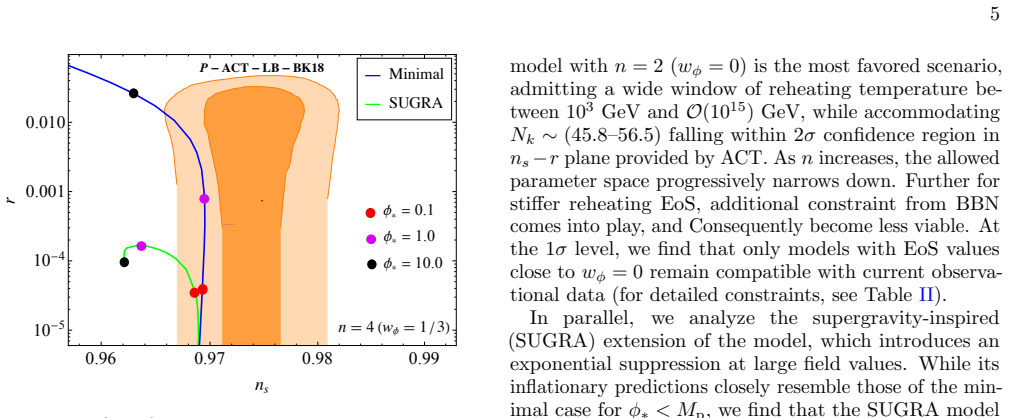
The central claim is that the minimal plateau model with $n=2$ ($w_\phi = 0$) remains consistent with P-ACT-LB-BK18 at both 1σ and 2σ, while at 1σ only matter-like or near-matter-like reheating survives. For $n=6, 10, 14$, the stiff equations of state force $T_{\rm RH}$ below the BBN or PGW bound for much of the parameter space, so the viable $(\phi_*, N_k, T_{\rm RH})$ windows contract sharply. The SUGRA extension closely tracks the minimal model when $\phi_* \ll M_p$ but is more tightly constrained for $\phi_* > M_p$; it remains compatible with observations only for $n=2$ at both confidence levels.
Load-bearing premise
The mapping between reheating temperature, e-folding number, and the $(n_s, r)$ predictions assumes one constant equation of state during reheating and instantaneous thermalization when the inflaton and radiation densities become equal; if the inflaton's equation of state drifts during the oscillating epoch or decay is gradual, the derived $T_{\rm RH}$ and $N_k$ windows would shift, and even the $n=2$ case could move outside the 1σ region.
Editorial extensions
If this is right
- For $n=2$, the model predicts $(n_s, r)$ inside the P-ACT-LB-BK18 1σ contour with a reheating temperature anywhere from $10^3$ to $10^{15}$ GeV, so no reheating-scale fine-tuning is required.
- For $n \geq 6$, the allowed $\phi_*$ is pushed upward and $T_{\rm RH}$ is forced below the BBN or PGW bound for most parameter values, making stiff phases practically excluded.
- The PGW/$\Delta N_{\rm eff}$ bound does real work: it removes parameter space that the CMB-only $n_s$/$r$ contours would leave open, especially for $w_\phi > 1/3$.
- At 1σ, only $w_\phi \approx 0$ reheating survives, so if the dataset tightens without shifting, higher-$n$ plateau models will be excluded unless a different reheating mechanism is introduced.
- The SUGRA extension, while similar to the minimal model for small $\phi_*$, is the first to be squeezed as precision improves because its constraints on $\phi_*$ and $T_{\rm RH}$ are tighter across all $n$.
Reading between the lines
- If the reheating equation of state is not constant—for example, if the inflaton decays gradually or its oscillations are anharmonic—the $T_{\rm RH}$–$N_k$ relation changes, and the $n=2$ window could narrow; a full reheating simulation would be the natural next test.
- The same analytic machinery should apply to any one-parameter plateau potential, so the qualitative hierarchy (small-$n$, matter-like reheating favored; stiff phases killed by $\Delta N_{\rm eff}$) is likely generic across that model family.
- A future detection of $r$ near the current upper limit would select the smaller-$\phi_*$ end of the $n=2$ parameter space, which also implies lower reheating temperatures; this gives a concrete observational link between B-mode experiments and reheating physics.
- The $\Delta N_{\rm eff}$ bound implicitly assumes standard-model relativistic degrees of freedom at reheating; adding new light species would change $g_*$ and $g_{*S}$, shifting the derived $T_{\rm RH}$ windows and potentially reopening part of the stiff-phase parameter space.
Editorial analysis
A structured set of objections, weighed in public.
Referee Report
Summary. The paper studies a class of minimal plateau inflationary potentials, V = Λφ^n/(1+(φ/φ*)^n) and a supergravity-inspired extension, in light of the recent ACT DR6 combined dataset. It derives slow-roll predictions for (ns, r), connects the inflationary e-fold number Nk to the reheating temperature through a constant reheating equation of state, imposes the PGW/ΔNeff bound, and compares the resulting model predictions with P-ACT-LB-BK18. The central claim is that the n = 2 minimal model with matter-like reheating (wφ = 0) remains consistent with the data at both 1σ and 2σ, with TRH between roughly 1e3 and 1e15 GeV and Nk between 46 and 56, while larger n and stiffer reheating equations of state are increasingly disfavored.
Significance. This is a timely, focused test of a simple plateau model against the new ACT DR6 measurements. A strength of the paper is that the model predictions are direct and not obtained by fitting the model to the data being compared; the free parameters are the potential scale, the exponent n, the field scale φ*, and the reheating temperature. The inclusion of reheating dynamics and the PGW-induced ΔNeff bound adds physical value beyond a pure slow-roll analysis. However, the quantitative constraints, especially in Table I and the Conclusions, rely on analytic slow-roll expressions used outside their domain of validity, so the quoted parameter ranges require revision.
major comments (2)
- [§II, Eqs. (3)-(4), and Table I] The analytic expressions in Eq. (3) are derived in the large-field plateau limit φ_k ≫ φ*, and Eq. (4) neglects the field value at the end of inflation, but the constraints in Table I allow φ*/Mp = 8.5 for n = 2. For this value and Nk = 50, Eq. (4) gives φ_k/φ* ≃ 1.5, so the condition φ_k ≫ φ* is badly violated. Using the non-plateau-expanded first-order slow-roll formulas for V ∝ φ²/(1+(φ/φ*)²), with N integrated from φ_end (ε = 1) to φ_k, I find ns ≃ 0.964 and r ≃ 0.044 at N = 50, whereas Eq. (3) gives ns ≃ 0.970 and r ≃ 0.034. Because the quoted 2σ P-ACT-LB-BK18 region is approximately ns > 0.9675 and r < 0.038, the exact point lies outside the 2σ contour. The large-φ* tail of Table I (φ*/Mp up to 8.5, Nk down to 45.8) and the corresponding low-TRH part of the allowed window in the Conclusions are therefore unsupported. The full (n, φ*, Nk) parameter space should be recomputed with exact slow roll, including the φ_end correction to Nk, and the same caveat applies to the SUGRA columns in Tables I and II where Eq. (3) is used.
- [§III, Eqs. (5)-(9)] The reheating analysis assumes a single constant equation of state wφ = (n−2)/(n+2) from the end of inflation until thermalization. Near the minimum of the potential this is a good approximation for coherent oscillations, but at the start of the reheating phase the field is not yet in the asymptotic oscillatory regime for the full potential (1), and the effective equation of state can differ from (n−2)/(n+2). Because the mapping between TRH and Nk in Eqs. (7)-(9) is used to define the allowed windows in Tables I and II, the paper should either quantify the correction from this transient phase or explicitly state the domain of validity of the constant-EoS assumption. This is particularly relevant for the claimed lower bound TRH ≳ 1e3 GeV for n = 2, which combines the low-Nk tail with the reheating mapping.
minor comments (5)
- [§II, Eq. (3)] The display of Eq. (3) contains typographical artifacts: “n2” should read n², and the exponent of (φ*/Mp) should be displayed unambiguously. The quoted numerical examples are consistent with the correct relation r = 8 n² (φ*/Mp)^{2n/(n+2)} [n(n+2) Nk]^{-γ}, so the underlying formula is recoverable, but the printed form should be fixed.
- [§II, Eq. (4)] There is a misspelling “numner” for “number,” and the sentence introducing Eq. (4) should clarify that this is the large-field approximation for Nk and state its range of validity.
- [§II, Eq. (2)] The statement that Eq. (2) reduces to Eq. (1) for φ > Mp > φ* is imprecise because the exponential factor exp(−φ²/(2Mp²)) is not negligible for φ just above Mp. The reduction is valid only when φ is sufficiently large that the exponential is subdominant compared with (φ/φ*)^n; the text should state this condition more carefully.
- [§III, Eqs. (7)-(9)] The values of g*RH and g*S,RH used in the numerical evaluation are not stated. Since the reheating temperature and Nk windows depend on these through Eqs. (7)-(9), the adopted values should be specified, and the sensitivity of the quoted ranges to them should be mentioned.
- [Throughout] The manuscript contains numerous small typographical and grammatical errors, for example “This bound yields a constraints” in §III, “sate” for “state,” and “T0(=2.735, K)” in Eq. (8). A careful proofread is needed.
Circularity Check
No significant circularity: the model predictions are computed from the stated potentials and compared with external P-ACT-LB-BK18 data; the self-citations are auxiliary and non-load-bearing.
full rationale
The paper's derivation chain is not circular. Equations (1)-(4) define the model and give slow-roll predictions for n_s and r as functions of n, phi_*, and N_k; these are standard first-principles slow-roll relations for the stated potential. The allowed parameter ranges in Tables I and II are obtained by intersecting these predicted curves with the externally measured P-ACT-LB-BK18 constraints (n_s = 0.9743 +/- 0.0034 and r < 0.038), not by fitting a model parameter to the target data and then re-predicting it. The reheating relations in Eqs. (5)-(9) are standard energy-density matching and entropy-conservation formulas, and the PGW/Delta_N_eff bound in Eqs. (10)-(11) is an external observational constraint translated into a lower bound on T_RH via a parameter-free spectral formula. The citations to the authors' earlier work [44,45,57-59] supply the potential class and the PGW formula, but those results are auxiliary inputs with stated assumptions and are not fitted to, or derived from, the P-ACT-LB-BK18 data being compared. The skeptic's objection that the large-field approximation in Eq. (3) is used outside its validity range for phi_*/M_p up to 8.5 is a correctness or approximation issue, not a circularity: an approximation used outside its domain does not make the argument reduce to its own inputs. No fitted parameter is renamed as a prediction, and no uniqueness or exclusion claim rests solely on a self-citation. Therefore no circular step is identified.
Assumptions & free parameters
free parameters (3)
- φ* (field scale) =
e.g., φ*/Mp ≤ 8.5 for n=2 at 2σ; varies across n
- n (potential exponent) =
n = 2, 4, 6, 10, 14 considered
- TRH (reheating temperature) =
e.g., 10^3 GeV to 2.7×10^15 GeV for n=2 at 2σ
assumptions (6)
- domain assumption Slow-roll approximation is valid during horizon exit
- domain assumption Inflaton coherent oscillation behaves as a fluid with EoS wϕ=(n-2)/(n+2) throughout reheating
- domain assumption Reheating completes abruptly at ρϕ=ρRH with instantaneous thermalization
- standard math PGW spectrum in the stiff era follows the analytic k scaling and the ∆Neff bound integrates as in Eq (10)
- domain assumption The external data constraints (ns=0.9743±0.0034, r<0.038, ∆Neff≤0.17) are correct and applicable
- ad hoc to paper The empirical potential forms in Eqs (1) and (2) are the relevant inflationary potentials
Cite this review
Pith. "Pith review of Minimal Plateau Inflation in light of ACT DR6 Observations." pith.science (2026). https://pith.science/paper/KFBTLVFB
@misc{pith2026250518267,
  author       = {Pith},
  title        = {Pith review of: Minimal Plateau Inflation in light of ACT DR6 Observations},
  year         = {2026},
  howpublished = {\url{https://pith.science/paper/KFBTLVFB}},
  note         = {Machine review of arXiv:2505.18267}
}
abstract
We explore a class of minimal plateau inflationary models constrained by the latest cosmological observations from ACT DR6, Planck 2018, BICEP/Keck 2018, and DESI, collectively referred to as P-ACT-LB-BK18. These models, characterized by a non-polynomial potential, are analyzed using both inflationary and post-inflationary reheating dynamics, and the limits on the viable model parameter space are obtained. Our results show that the minimal model with matter-like post inflationary reheating phase remains consistent with current data at both $1\sigma$ and $2\sigma$ levels. The inflaton potential's exponent $n$ and reheating epoch are intertwined in that upon its increase, corresponding to the stiffer reheating equation of state, the viable model parameter space in accordance with ACT shrinks, which is further facilitated by the primordial gravitational waves (PGWs) overproduction. We further explored a supergravity-inspired extension of the model under study with similar results, but with tighter constraints on the model parameters. These results emphasize the importance of jointly analyzing CMB data and reheating physics to test inflationary models.
Figures


Figures from the paper (1 more)

Forward citations
Cited by 10 Pith papers
-
Beyond monomial $\alpha$-attractors
Binomial α-attractor T-models yield non-universal ns near c≈−1/2 and a transient radiation-like reheating phase only under large quartic/quadratic hierarchies, undermining fine-tuned large-p monomial assumptions.
-
Gravitational waves from self-resonance during reheating with a quantum-corrected inflaton potential
A Coleman-Weinberg correction that cancels the inflaton's quadratic term at the potential minimum triggers quartic self-resonance and a peaked GW background at 10^8-10^10 Hz; a negative quadratic term instead gives a ...
-
Closing in on $\alpha$-attractors
Under perturbative reheating, monomial α-attractor T-models cannot make the scalar spectral index exceed 0.9682, and n_s is maximized at α≈1.
-
GUT-Scale Smooth Hybrid Inflation with a Stabilized Modulus in Light of ACT and SPT Data
A smooth hybrid inflation model, augmented with a stabilized modulus, reproduces the spectral index measured by ACT and SPT while keeping Higgs v.e.v.s at the GUT scale.
-
Kinetically Modified Palatini Inflation Meets ACT Data
Palatini chaotic inflation with kinetic mixing f_K = f_R^m can shift the predicted spectral index up to the ACT DR6 value n_s = 0.974 while keeping r below current bounds.
-
Induced-Gravity Palatini-Like Higgs Inflation in Supergravity Confronts ACT DR6
A Palatini-supergravity Higgs-inflation model with induced gravity predicts a scalar spectral index ns≈0.972-0.974, consistent with ACT DR6, and favors split supersymmetry with gravitino mass 40-60 PeV.
-
The BAO-CMB Tension and Implications for Inflation
The upward shift in the scalar spectral index n_s in CMB+BAO analyses is driven by the combined effects of a known CMB degeneracy and the tension between CMB and DESI BAO data, not by new information about n_s itself.
-
Constraining Quintessential Inflation with ACT: A Gauss-Bonnet Gateway
Exponential and sech Gauss–Bonnet couplings restore ACT-compatible ns and r for quintessential inflation, while tanh fails for a structural sign reason; reheating remains BBN-safe.
-
Pure Natural Inflation Passes the ACT
Pure natural inflation remains viable against latest ACT+DESI constraints, with a non-trivial fraction of parameter space allowed under standard reheating scenarios.
-
Confronting Mukhanov Parametrization of Inflationary Equation-of-State with ACT-DR6
Mukhanov's equation-of-state model of inflation still fits ACT-DR6-era data, with alpha set by the scalar tilt and beta set by the tensor-to-scalar ratio.
Reference graph
Works this paper leans on
- [1]
- [2]
- [3]
-
[4]
A. D. Linde, Phys. Lett. B 129, 177 (1983)
1983
- [5]
-
[6]
A. D. Linde, Phys. Rev. D 49, 748 (1994), arXiv:astro- ph/9307002
arXiv 1994
-
[7]
A. A. Starobinsky, Phys. Lett. B 91, 99 (1980)
1980
- [8]
Show all 59 references
- [9]
- [10]
-
[11]
Freese, J
K. Freese, J. A. Frieman, and A. V. Olinto, Phys. Rev. Lett. 65, 3233 (1990)
1990
-
[12]
Roest, JCAP 01, 007, arXiv:1309.1285 [hep-th]
D. Roest, JCAP 01, 007, arXiv:1309.1285 [hep-th]
-
[13]
Ferrara, R
S. Ferrara, R. Kallosh, A. Linde, and M. Porrati, Phys. Rev. D 88, 085038 (2013), arXiv:1307.7696 [hep-th]
2013 arXiv
-
[14]
Kallosh, A
R. Kallosh, A. Linde, and D. Roest, Phys. Rev. Lett. 112, 011303 (2014), arXiv:1310.3950 [hep-th]
2014 arXiv
- [15]
- [16]
-
[17]
Galante, R
M. Galante, R. Kallosh, A. Linde, and D. Roest, Phys. Rev. Lett. 114, 141302 (2015), arXiv:1412.3797 [hep-th]
2015 arXiv
-
[18]
C. L. Bennett, A. Banday, K. M. Gorski, G. Hinshaw, P. Jackson, P. Keegstra, A. Kogut, G. F. Smoot, D. T. Wilkinson, and E. L. Wright, Astrophys. J. Lett. 464, L1 (1996), arXiv:astro-ph/9601067
1996 arXiv
-
[19]
M. G. Hauser et al., Astrophys. J. 508, 25 (1998), arXiv:astro-ph/9806167
1998 arXiv
- [20]
-
[21]
S. Aoki, H. Otsuka, and R. Yanagita, (2025), arXiv:2504.01622 [hep-ph]
2025 arXiv
-
[22]
Berera, S
A. Berera, S. Brahma, Z. Qiu, R. O. Ramos, and G. S. Rodrigues, (2025), arXiv:2504.02655 [hep-th]
2025
-
[23]
Dioguardi, A
C. Dioguardi, A. J. Iovino, and A. Racioppi, (2025), arXiv:2504.02809 [gr-qc]
2025 arXiv
-
[24]
I. D. Gialamas, A. Karam, A. Racioppi, and M. Raidal, (2025), arXiv:2504.06002 [astro-ph.CO]
2025
- [25]
-
[26]
Antoniadis, J
I. Antoniadis, J. Ellis, W. Ke, D. V. Nanopoulos, and K. A. Olive, (2025), arXiv:2504.12283 [hep-ph]
2025 arXiv
-
[27]
J. Kim, X. Wang, Y.-l. Zhang, and Z. Ren, (2025), arXiv:2504.12035 [astro-ph.CO]
2025 arXiv
- [28]
-
[29]
Q. Gao, Y. Gong, Z. Yi, and F. Zhang, (2025), arXiv:2504.15218 [astro-ph.CO]
2025
-
[30]
M. He, M. Hong, and K. Mukaida, (2025), arXiv:2504.16069 [astro-ph.CO]
2025
-
[31]
Pallis (2025) arXiv:2504.20273 [hep-ph]
C. Pallis (2025) arXiv:2504.20273 [hep-ph]
2025
-
[32]
Drees and Y
M. Drees and Y. Xu, (2025), arXiv:2504.20757 [astro- ph.CO]
2025
-
[33]
M. R. Haque, S. Pal, and D. Paul, (2025), arXiv:2505.04615 [astro-ph.CO]
2025 arXiv
-
[34]
M. R. Haque, S. Pal, and D. Paul, (2025), arXiv:2505.01517 [astro-ph.CO]
2025 arXiv
- [35]
-
[36]
C. T. Byrnes, M. Cortˆ es, and A. R. Liddle, (2025), arXiv:2505.09682 [astro-ph.CO]
2025
-
[37]
Maity, (2025), arXiv:2505.10534 [astro-ph.CO]
S. Maity, (2025), arXiv:2505.10534 [astro-ph.CO]
2025 arXiv
- [38]
-
[39]
Peng, Z.-C
Z.-Z. Peng, Z.-C. Chen, and L. Liu, (2025), arXiv:2505.12816 [astro-ph.CO]
2025
-
[40]
Z. Yi, X. Wang, Q. Gao, and Y. Gong, (2025), arXiv:2505.10268 [astro-ph.CO]
2025
-
[41]
I. D. Gialamas, T. Katsoulas, and K. Tamvakis, (2025), arXiv:2505.03608 [gr-qc]
2025
-
[42]
Mohammadi, Q
Yogesh, A. Mohammadi, Q. Wu, and T. Zhu, (2025), arXiv:2505.05363 [astro-ph.CO]
2025 arXiv
-
[43]
Kallosh and A
R. Kallosh and A. Linde, (2025), arXiv:2505.13646 [hep- th]
2025
-
[44]
Maity and P
D. Maity and P. Saha, Class. Quant. Grav. 36, 045010 (2019), arXiv:1902.01895 [gr-qc]
2019 arXiv
- [45]
-
[46]
E. W. Kolb and M. S. Turner,The Early Universe, Vol. 69 (Taylor and Francis, 2019)
2019
-
[47]
Shtanov, J
Y. Shtanov, J. H. Traschen, and R. H. Brandenberger, Phys. Rev. D 51, 5438 (1995), arXiv:hep-ph/9407247
1995 arXiv
-
[48]
Kofman, A
L. Kofman, A. D. Linde, and A. A. Starobinsky, Phys. Rev. D 56, 3258 (1997), arXiv:hep-ph/9704452
1997 arXiv
-
[49]
Allahverdi, R
R. Allahverdi, R. Brandenberger, F.-Y. Cyr-Racine, and A. Mazumdar, Ann. Rev. Nucl. Part. Sci. 60, 27 (2010), arXiv:1001.2600 [hep-th]
2010 arXiv
-
[50]
K. D. Lozanov, (2019), arXiv:1907.04402 [astro-ph.CO]
2019 arXiv
-
[51]
M. A. G. Garcia, K. Kaneta, Y. Mambrini, and K. A. Olive, JCAP 04, 012, arXiv:2012.10756 [hep-ph]
2012 arXiv
-
[52]
M. R. Haque, D. Maity, and R. Mondal, JHEP 09, 012, arXiv:2301.01641 [hep-ph]
-
[53]
M. R. Haque, D. Maity, and R. Mondal, Phys. Rev. D 109, 063543 (2024), arXiv:2311.07684 [hep-ph]
2024 arXiv
-
[54]
L. H. Ford, Phys. Rev. D 35, 2955 (1987)
1987
-
[55]
L. Dai, M. Kamionkowski, and J. Wang, Phys. Rev. Lett. 113, 041302 (2014), arXiv:1404.6704 [astro-ph.CO]
2014 arXiv
-
[56]
J. L. Cook, E. Dimastrogiovanni, D. A. Easson, and L. M. Krauss, JCAP 04, 047, arXiv:1502.04673 [astro-ph.CO]
-
[57]
M. R. Haque, D. Maity, T. Paul, and L. Sriramkumar, Phys. Rev. D 104, 063513 (2021), arXiv:2105.09242 [astro- 8 ph.CO]
2021 arXiv
- [58]
-
[59]
Chakraborty, M
A. Chakraborty, M. R. Haque, D. Maity, and R. Mondal, Phys. Rev. D 108, 023515 (2023), arXiv:2304.13637 [astro- ph.CO]
2023 arXiv
Reviewed August 7, 2026 · model on record in the stance chip above.
Discussion (0). Sign in to comment.