REVIEW 2 major objections 7 minor 1 cited by
JGHand: Joint-Driven Animatable Hand Avater via 3D Gaussian Splatting
T0 review · 2 major / 7 minor · reviewed 2026-08-09 · deepseek-v4-flash
Pith's one-line read JGHand establishes that a 3D Gaussian Splatting hand avatar driven only by 3D joint keypoints can render photorealistic hand images in real time, with higher PSNR and SSIM and lower LPIPS than prior state-of-the-art methods.
desk verdict A credible, well-ablated hand-avatar pipeline with one genuinely new skeleton transformation, but the shadow module's undefined f carries the entire SOTA margin and needs to be specified before the claim is accepted. read the letter →
The pith
A machine-rendered reading of the paper's core claim, the machinery that carries it, and where it could break.
The reading
What carries the argument
Two load-bearing mechanisms carry the argument. The first is the zero-error skeleton transformation that maps canonical joint positions to an arbitrary input skeleton, composed as $B = P K' F' R F K$, where $K$ normalizes bone vectors, $F$ moves them into local frames, $R$ applies hierarchically computed abduction and flexion angles, $F'$ maps back along the kinematic chain, $K'$ rescales to target bone lengths, and $P$ aligns palm planes. The second is per-pixel depth shadow simulation: the renderer produces a depth image by opacity blending, then applies a convolution kernel whose $N$ samples compare each pixel's depth to its neighbors through a differentiable function $f$ to form a shadow mask that is merged into the final image.
What would settle it
Take a trained JGHand model, replace the unspecified $f$ in the shadow mask with a fixed monotone function such as $f(a,b)=\text{sigmoid}(a-b)$, and re-measure PSNR and LPIPS on a held-out hand dataset captured under different lighting; if the visual-quality gap over the no-shadow ablation disappears, the shadow gain depends on the tuned mapping rather than on physical self-occlusion.
Extended reading notes
Core claim
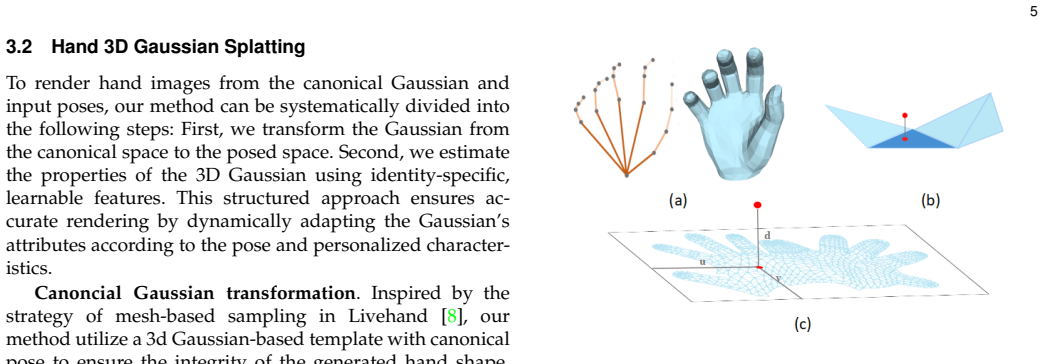
The central claim is that a 3D Gaussian Splatting hand avatar can be driven entirely by 3D joint keypoints, replacing the shape and pose parameters of morphable models, without sacrificing rendering quality or speed. Concretely, JGHand builds a canonical Gaussian template from the MANO mean model, deforms it to the target pose with a zero-error skeleton transformation $B = P K' F' R F K$, skins the Gaussians with Fast-SNARF weights, predicts per-Gaussian appearance from a uvd-coordinate triplane plus pose-aware angular features, and adds a depth-based shadow mask to capture finger self-occlusion. On InterHand2.6M and HandCo it reports higher PSNR and SSIM, lower LPIPS, and faster inference than HTML, 3D-PSHR, HandAvatar, and LiveHand.
Load-bearing premise
The depth-based shadow module relies on an unspecified differentiable function $f$ that maps pairs of depth values to shadow weights, so the roughly 2.5 dB PSNR gain it brings in the ablation could be tuned to the training data and may not transfer to other capture conditions.
Editorial extensions
If this is right
- A pose-estimation network can drive JGHand directly from keypoint outputs, making end-to-end training with pose estimation a natural next step.
- At 0.040 seconds per frame, the avatar supports interactive and real-time applications on a single RTX 3090.
- The zero-error transformation handles arbitrary bone lengths, so the same model can be retargeted to hands of different sizes without re-fitting parameters.
- Interpolating joint rotation angles yields smooth novel poses, enabling keyframe-based animation from sparse skeletons.
Reading between the lines
- Because control is keypoint-only, JGHand could tap off-the-shelf 2D and 3D hand keypoint estimators from monocular RGB, removing the need for MANO fitting in avatar pipelines.
- The depth-convolution shadow mask is shape-agnostic, so the same idea could be tested on other articulated objects such as feet, ears, or animal paws where self-occlusion shadows matter.
- A testable next step the paper leaves implicit is replacing the hand-tuned shadow sampling radius with a learned kernel or conditioning it on camera distance, which could improve generalization across datasets.
- The isotropic-Gaussian choice trades a small numerical loss for pose stability, suggesting that a curriculum starting isotropic and switching to anisotropic late in training might recover the gap while keeping stability.
Signed reviews
Editorial analysis
A structured set of objections, weighed in public.
Referee Report
Summary. The paper proposes JGHand, an animatable 3D Gaussian Splatting hand avatar driven solely by 3D joint keypoints. It introduces a differentiable skeleton transformation from a canonical pose to arbitrary poses and bone lengths, a per-pixel depth-based shadow simulation for finger self-occlusion, and a triplane/MLP-based Gaussian property estimator conditioned on identity and joint angles. Experiments on InterHand2.6M (three sequences) and HandCo (one sequence) report higher PSNR/SSIM and lower LPIPS than HTML, 3D-PSHR, HandAvatar, and LiveHand, with an average inference time of 0.040s per frame. Ablations demonstrate contributions from the skeleton transformation, the shadow module, and the isotropic Gaussian constraint.
Significance. If the method is fully specified and reproducible, it is a meaningful step toward practical keypoint-driven hand avatars: it removes the need for MANO pose/shape parameters at inference, achieves real-time rendering, and outperforms existing neural hand avatar methods on public benchmarks. The use of public datasets, re-trained baselines for most competitors, and systematic ablations are strengths. The central concerns are that the shadow simulation function is under-defined and the 'zero-error' transformation is a construction property rather than an empirical result; both need to be clarified before the reported gains can be independently verified.
major comments (2)
- [Sec. 3.3, Eq. (12)] The shadow mapping function f in Eq. (12) is never defined; the text only states that it is a differentiable mapping returning values between 0 and 1. The subsequent combination of the shadow mask with the rendered RGB image is described only as "combined pixel by pixel" without an explicit formula. This is load-bearing: Table 4 shows that removing the shadow module drops PSNR from 33.44 to 30.92 on test/capture0, which is below the 32.32 dB of LiveHand in Table 2, so the claimed margin over prior state-of-the-art is carried almost entirely by this unspecified component. Please provide the exact form of f (or the depth-difference threshold and kernel), the sampling radius, and the combination rule, and clarify whether any parameters of f are learned or fixed.
- [Sec. 4.1, Table 1] The reported MPJPE of 0 for the proposed transformation is a tautology, because the transformation matrix B in Eq. (1) is computed from the target joints J precisely to satisfy J = B J^c. This does not constitute an experimental validation; it is a property of the construction. The meaningful experimental result in Table 1 is the Chamfer distance (0.92 vs 5.14), which measures the LBS-deformed mesh error. Please present the zero joint error as an analytical guarantee rather than an empirical advantage, and keep the mesh-based error as the only experimental metric in this comparison.
minor comments (7)
- [Title and throughout] The word "Avater" should be "Avatar" in the title and elsewhere.
- [Sec. 3.3, Eq. (11)] The depth blending formula in Eq. (11) uses d_j and o_j; please clarify whether d_j is the depth of the Gaussian center or the splatted depth, and how this relates to the standard 3DGS alpha blending.
- [Sec. 4.1, Table 1] The reference "HALO [17]" in Table 1 should be "HALO [18]" to match the bibliography entry for Karunratanakul et al.
- [Sec. 4.2] The statement that "we re-trained them on the aforementioned datasets" is inconsistent with the subsequent note that 3D-PSHR results are referenced from the original paper because code is unavailable; please clarify which methods were re-trained and which were taken from published results.
- [Sec. 4.4 / Fig. 11] The interpolation of poses is described only in the caption; please specify in the text how the interpolation of joint angles is performed (e.g., linear interpolation on angles or spherical linear interpolation on quaternions).
- [Sec. 5, Limitations] The acknowledged limitation that training requires complete hand texture is important and should be stated in the Introduction or Abstract to set expectations for generalization.
- [Secs. 3.2, 4.2, Implementation Details] Typographical errors should be corrected: "Canoncial Gaussian transformation", "the the 3D Gaussian", "learning rete", and "HandAvater".
Circularity Check
Zero-error skeleton transformation is tautological by construction; the rendering-quality claim is independently evaluated and not circular.
-
self definitional
[Section 3.1 (Eqs. 1-6) and Section 4.1 (Table 1)]
"For the input skeleton, the pose is defined by a set of angles computed from the joints' positions. ... Based on the non-zero hierarchical rotation angles {θa,f i | i = 1,...,20}, rotate the bone vectors based on the kinematics hierarchy to be consistent with the target pose. ... Restore the rotated bone vectors to the target bone length, align them to their parent joints, and restore the joint points. ... We utilize the transformed joint coordinates and vertex positions to compare with the ground-truth ... ours 0"
The transformation B in Eq. (1) is constructed by reading target bone lengths and rotation angles directly off the target joints J that it is then applied to. The pipeline explicitly extracts angles and lengths from J, builds B = P K′F ′RF K, and applies it to the canonical skeleton. Therefore J = B J^c holds by construction, making the MPJPE of 0 in Table 1 an identity rather than a measured prediction. The 'zero-error' contribution is self-definitional: it demonstrates internal consistency of the parameterization, not a generalization result. The useful part is that the same B also deforms the 3D Gaussians coherently, which is evaluated through rendering quality, not through the zero-error joint claim.
full rationale
The central rendering-quality claim is not circular: Table 2 compares PSNR/SSIM/LPIPS on held-out InterHand2.6M and HandCo test frames against re-trained baselines, and the speed claim in Table 3 is a measured runtime. No load-bearing self-citation chain exists; the cited HALO, Fast-SNARF, SSAO, and 3DGS works are external prior art. The undefined shadow function f in Eq. (12) is a serious reproducibility and generalization gap, because the ablation in Table 4 shows the shadow module contributes about 2.5 dB PSNR, but an unspecified function is not itself a circular reduction. The genuine circular element is the zero-error skeleton transformation: its exactness is guaranteed by extracting the target pose's angles and bone lengths before evaluating the transformation on that same target. Because that tautological result is presented as a headline contribution, but the image-quality and real-time results do not depend on the tautology itself, the score is 5 rather than 6+.
Assumptions & free parameters
free parameters (5)
- Number of canonical Gaussians per bone N_b =
3000
- Shadow kernel sampling count =
64
- Loss weights =
lambda_rgb=1, lambda_ssim=0.2, lambda_lpips=0.2, lambda_mask=0.2, lambda_reg=1, lambda_iso=0.05
- Angle normalization extremes =
Not reported
- MLP architecture and triplane resolution =
Not reported
assumptions (5)
- domain assumption MANO mean pose and shape is a suitable canonical template for all subjects
- domain assumption Fast-SNARF skinning weights interpolate correctly at 3D Gaussian positions
- domain assumption Opacity-blended depth from Gaussian splatting approximates true geometry
- ad hoc to paper The unspecified shadow function f in Eq. (12) can model self-occlusion shadows
- domain assumption Zero-error joint transformation implies adequate mesh deformation under LBS
Cite this review
Pith. "Pith review of JGHand: Joint-Driven Animatable Hand Avater via 3D Gaussian Splatting." pith.science (2026). https://pith.science/paper/KHO3HR46
@misc{pith2026250119088,
  author       = {Pith},
  title        = {Pith review of: JGHand: Joint-Driven Animatable Hand Avater via 3D Gaussian Splatting},
  year         = {2026},
  howpublished = {\url{https://pith.science/paper/KHO3HR46}},
  note         = {Machine review of arXiv:2501.19088}
}
read the original abstract
Since hands are the primary interface in daily interactions, modeling high-quality digital human hands and rendering realistic images is a critical research problem. Furthermore, considering the requirements of interactive and rendering applications, it is essential to achieve real-time rendering and driveability of the digital model without compromising rendering quality. Thus, we propose Jointly 3D Gaussian Hand (JGHand), a novel joint-driven 3D Gaussian Splatting (3DGS)-based hand representation that renders high-fidelity hand images in real-time for various poses and characters. Distinct from existing articulated neural rendering techniques, we introduce a differentiable process for spatial transformations based on 3D key points. This process supports deformations from the canonical template to a mesh with arbitrary bone lengths and poses. Additionally, we propose a real-time shadow simulation method based on per-pixel depth to simulate self-occlusion shadows caused by finger movements. Finally, we embed the hand prior and propose an animatable 3DGS representation of the hand driven solely by 3D key points. We validate the effectiveness of each component of our approach through comprehensive ablation studies. Experimental results on public datasets demonstrate that JGHand achieves real-time rendering speeds with enhanced quality, surpassing state-of-the-art methods.
Figures


Figures from the paper (8 more)


Forward citations
Cited by 1 Pith paper
-
Glove2Hand: Synthesizing Natural Hand-Object Interaction from Multi-Modal Sensing Gloves
A 3D-Gaussian-plus-diffusion pipeline translates multi-modal glove HOI videos into photorealistic bare-hand videos, yielding the HandSense dataset that improves contact estimation and occluded tracking.
Reference graph
Works this paper leans on
-
[1]
G. Moon, T. Shiratori, and K. M. Lee, “Deephandmesh: A weakly- supervised deep encoder-decoder framework for high-fidelity hand mesh modeling,” in Computer Vision–ECCV 2020: 16th Euro- pean Conference, Glasgow, UK, August 23–28, 2020, Proceedings, Part II 16. Springer, 2020, pp. 440–455. 1
work page 2020
-
[2]
Html: A parametric hand texture model for 3d hand reconstruction and personalization,
N. Qian, J. Wang, F. Mueller, F. Bernard, V . Golyanik, and C. Theobalt, “Html: A parametric hand texture model for 3d hand reconstruction and personalization,” in Computer Vision– ECCV 2020: 16th European Conference, Glasgow, UK, August 23–28, 2020, Proceedings, Part XI 16 . Springer, 2020, pp. 54–71. 1, 2, 8
work page 2020
-
[3]
Nimble: a non-rigid hand model with bones and muscles,
Y. Li, L. Zhang, Z. Qiu, Y. Jiang, N. Li, Y. Ma, Y. Zhang, L. Xu, and J. Yu, “Nimble: a non-rigid hand model with bones and muscles,” ACM T ransactions on Graphics (TOG), vol. 41, no. 4, pp. 1–16, 2022. 1, 2
work page 2022
-
[4]
Lisa: Learning implicit shape and appearance of hands,
E. Corona, T. Hodan, M. Vo, F. Moreno-Noguer, C. Sweeney, R. Newcombe, and L. Ma, “Lisa: Learning implicit shape and appearance of hands,” in Proceedings of the IEEE/CVF Conference on Computer Vision and Pattern Recognition , 2022, pp. 20 533–20 543. 1, 2
work page 2022
-
[5]
Hand avatar: Free-pose hand animation and rendering from monocular video,
X. Chen, B. Wang, and H.-Y. Shum, “Hand avatar: Free-pose hand animation and rendering from monocular video,” in Proceedings of the IEEE/CVF Conference on Computer Vision and Pattern Recognition , 2023, pp. 8683–8693. 1, 2, 7, 8
work page 2023
-
[6]
Handnerf: Neural radiance fields for animatable interacting hands,
Z. Guo, W. Zhou, M. Wang, L. Li, and H. Li, “Handnerf: Neural radiance fields for animatable interacting hands,” in Proceedings of the IEEE/CVF Conference on Computer Vision and Pattern Recognition , 2023, pp. 21 078–21 087. 1
work page 2023
-
[7]
Nerf: Representing scenes as neural radiance fields for view synthesis,
B. Mildenhall, P . P . Srinivasan, M. Tancik, J. T. Barron, R. Ra- mamoorthi, and R. Ng, “Nerf: Representing scenes as neural radiance fields for view synthesis,” Communications of the ACM , vol. 65, no. 1, pp. 99–106, 2021. 1, 2, 5
work page 2021
-
[8]
Livehand: Real-time and photorealistic neural hand ren- dering,
A. Mundra, J. Wang, M. Habermann, C. Theobalt, M. Elgharib et al. , “Livehand: Real-time and photorealistic neural hand ren- dering,” in Proceedings of the IEEE/CVF International Conference on Computer Vision, 2023, pp. 18 035–18 045. 1, 2, 5, 7, 8
work page 2023
Show all 37 references
-
[9]
Ohta: One-shot hand avatar via data-driven implicit priors,
X. Zheng, C. Wen, Z. Su, Z. Xu, Z. Li, Y. Zhao, and Z. Xue, “Ohta: One-shot hand avatar via data-driven implicit priors,” in Proceedings of the IEEE/CVF Conference on Computer Vision and Pattern Recognition, 2024, pp. 799–810. 1, 2, 7
2024
-
[10]
3d gaus- sian splatting for real-time radiance field rendering
B. Kerbl, G. Kopanas, T. Leimk ¨uhler, and G. Drettakis, “3d gaus- sian splatting for real-time radiance field rendering.” ACM T rans. Graph., vol. 42, no. 4, pp. 139–1, 2023. 1, 3, 5, 7
2023
-
[11]
3dgs- avatar: Animatable avatars via deformable 3d gaussian splatting,
Z. Qian, S. Wang, M. Mihajlovic, A. Geiger, and S. Tang, “3dgs- avatar: Animatable avatars via deformable 3d gaussian splatting,” in Proceedings of the IEEE/CVF Conference on Computer Vision and Pattern Recognition, 2024, pp. 5020–5030. 1, 3, 5
2024
-
[12]
Splattingavatar: Realistic real-time human avatars with mesh-embedded gaussian splatting,
Z. Shao, Z. Wang, Z. Li, D. Wang, X. Lin, Y. Zhang, M. Fan, and Z. Wang, “Splattingavatar: Realistic real-time human avatars with mesh-embedded gaussian splatting,” in Proceedings of the IEEE/CVF Conference on Computer Vision and Pattern Recognition , 2024, pp. 1606–1616. 1
2024
-
[13]
Neca: Neural cus- tomizable human avatar,
J. Xiao, Q. Zhang, Z. Xu, and W.-S. Zheng, “Neca: Neural cus- tomizable human avatar,” inProceedings of the IEEE/CVF Conference on Computer Vision and Pattern Recognition , 2024, pp. 20 091–20 101. 1
2024
-
[14]
Ash: Animatable gaussian splats for efficient and photoreal human rendering,
H. Pang, H. Zhu, A. Kortylewski, C. Theobalt, and M. Habermann, “Ash: Animatable gaussian splats for efficient and photoreal human rendering,” in Proceedings of the IEEE/CVF Conference on Computer Vision and Pattern Recognition , 2024, pp. 1165–1175. 1
2024
-
[15]
Gghead: Fast and generalizable 3d gaussian heads,
T. Kirschstein, S. Giebenhain, J. Tang, M. Georgopoulos, and M. Nießner, “Gghead: Fast and generalizable 3d gaussian heads,” arXiv preprint arXiv:2406.09377 , 2024. 1
2024 arXiv
-
[16]
Gaussian head avatar: Ultra high-fidelity head avatar via dy- namic gaussians,
Y. Xu, B. Chen, Z. Li, H. Zhang, L. Wang, Z. Zheng, and Y. Liu, “Gaussian head avatar: Ultra high-fidelity head avatar via dy- namic gaussians,” in Proceedings of the IEEE/CVF Conference on Computer Vision and Pattern Recognition , 2024, pp. 1931–1941. 1
2024
-
[17]
Embodied hands: Mod- eling and capturing hands and bodies together,
J. Romero, D. Tzionas, and M. J. Black, “Embodied hands: Mod- eling and capturing hands and bodies together,” arXiv preprint arXiv:2201.02610, 2022. 2, 5, 7
2022 arXiv
-
[18]
A skeleton-driven neural occupancy representation for articulated hands,
K. Karunratanakul, A. Spurr, Z. Fan, O. Hilliges, and S. Tang, “A skeleton-driven neural occupancy representation for articulated hands,” in 2021 International Conference on 3D Vision (3DV) . IEEE, 2021, pp. 11–21. 2, 3, 4, 7
2021
-
[19]
Dynamic 3d gaussians: Tracking by persistent dynamic view synthesis,
J. Luiten, G. Kopanas, B. Leibe, and D. Ramanan, “Dynamic 3d gaussians: Tracking by persistent dynamic view synthesis,” arXiv preprint arXiv:2308.09713, 2023. 3
2023 arXiv
-
[20]
Gauhuman: Articulated gaussian splatting from monocular human videos,
S. Hu, T. Hu, and Z. Liu, “Gauhuman: Articulated gaussian splatting from monocular human videos,” in Proceedings of the IEEE/CVF Conference on Computer Vision and Pattern Recognition , 2024, pp. 20 418–20 431. 3
2024
-
[21]
Hugs: Human gaussian splats,
M. Kocabas, J.-H. R. Chang, J. Gabriel, O. Tuzel, and A. Ranjan, “Hugs: Human gaussian splats,” in Proceedings of the IEEE/CVF conference on computer vision and pattern recognition , 2024, pp. 505–
2024
-
[22]
Gart: Gaus- sian articulated template models,
J. Lei, Y. Wang, G. Pavlakos, L. Liu, and K. Daniilidis, “Gart: Gaus- sian articulated template models,” in Proceedings of the IEEE/CVF Conference on Computer Vision and Pattern Recognition , 2024, pp. 19 876–19 887. 3
2024
-
[23]
Animatable gaussians: Learning pose-dependent gaussian maps for high-fidelity human avatar modeling,
Z. Li, Z. Zheng, L. Wang, and Y. Liu, “Animatable gaussians: Learning pose-dependent gaussian maps for high-fidelity human avatar modeling,” in Proceedings of the IEEE/CVF Conference on Computer Vision and Pattern Recognition , 2024, pp. 19 711–19 722. 3
2024
-
[24]
Gea: Reconstructing expressive 3d gaussian avatar from monocular video,
X. Liu, C. Wu, X. Liu, J. Liu, J. Wu, C. Zhao, H. Feng, E. Ding, and J. Wang, “Gea: Reconstructing expressive 3d gaussian avatar from monocular video,” arXiv preprint arXiv:2402.16607 , 2024. 3
2024 arXiv
-
[25]
Expressive body capture: 3d hands, face, and body from a single image,
G. Pavlakos, V . Choutas, N. Ghorbani, T. Bolkart, A. A. Osman, D. Tzionas, and M. J. Black, “Expressive body capture: 3d hands, face, and body from a single image,” inProceedings of the IEEE/CVF conference on computer vision and pattern recognition , 2019, pp. 10 975–10 985. 3
2019
-
[26]
Manus: Markerless hand-object grasp capture using articulated 3d gaussians,
C. Pokhariya and N. Ishaan, “Manus: Markerless hand-object grasp capture using articulated 3d gaussians,” in IEEE/CVF Com- puter Vision and Pattern Recognition Conference (CVPR). CVPR 2024,
2024
-
[27]
Loopreg: Self-supervised learning of implicit surface correspon- dences, pose and shape for 3d human mesh registration,
B. L. Bhatnagar, C. Sminchisescu, C. Theobalt, and G. Pons-Moll, “Loopreg: Self-supervised learning of implicit surface correspon- dences, pose and shape for 3d human mesh registration,”Advances in Neural Information Processing Systems , vol. 33, pp. 12 909–12 922,
-
[28]
Fast-snarf: A fast deformer for articulated neural fields,
X. Chen, T. Jiang, J. Song, M. Rietmann, A. Geiger, M. J. Black, and O. Hilliges, “Fast-snarf: A fast deformer for articulated neural fields,” IEEE T ransactions on Pattern Analysis and Machine Intelli- gence, vol. 45, no. 10, pp. 11 796–11 809, 2023. 5
2023
-
[29]
Constraint study for a hand exoskeleton: human hand kinematics and dynamics,
F. Chen Chen, S. Appendino, A. Battezzato, A. Favetto, M. Mousavi, and F. Pescarmona, “Constraint study for a hand exoskeleton: human hand kinematics and dynamics,” Journal of Robotics, vol. 2013, no. 1, p. 910961, 2013. 5
2013
-
[30]
Weakly supervised 3d hand pose estimation via biomechanical constraints,
A. Spurr, U. Iqbal, P . Molchanov, O. Hilliges, and J. Kautz, “Weakly supervised 3d hand pose estimation via biomechanical constraints,” in European conference on computer vision . Springer, 2020, pp. 211–228. 5
2020
-
[31]
Screen space ambient occlusion,
L. Bavoil and M. Sainz, “Screen space ambient occlusion,” NVIDIA developer information: http://developers. nvidia. com, vol. 6, no. 2, 2008. 6
2008
-
[32]
Image quality assessment: from error visibility to structural similarity,
Z. Wang, A. C. Bovik, H. R. Sheikh, and E. P . Simoncelli, “Image quality assessment: from error visibility to structural similarity,” IEEE transactions on image processing , vol. 13, no. 4, pp. 600–612,
-
[33]
The unreasonable effectiveness of deep features as a perceptual metric,
R. Zhang, P . Isola, A. A. Efros, E. Shechtman, and O. Wang, “The unreasonable effectiveness of deep features as a perceptual metric,” in Proceedings of the IEEE conference on computer vision and pattern recognition, 2018, pp. 586–595. 6
2018
-
[34]
Interhand2. 6m: A dataset and baseline for 3d interacting hand pose estimation from a single rgb image,
G. Moon, S.-I. Yu, H. Wen, T. Shiratori, and K. M. Lee, “Interhand2. 6m: A dataset and baseline for 3d interacting hand pose estimation from a single rgb image,” in Computer Vision–ECCV 2020: 16th European Conference, Glasgow, UK, August 23–28, 2020, Proceedings, Part XX 16 . ...
2020
-
[35]
Contrastive represen- tation learning for hand shape estimation,
C. Zimmermann, M. Argus, and T. Brox, “Contrastive represen- tation learning for hand shape estimation,” in DAGM German Conference on Pattern Recognition . Springer, 2021, pp. 250–264. 7
2021
-
[36]
Pytorch: An im- perative style, high-performance deep learning library,
A. Paszke, S. Gross, F. Massa, A. Lerer, J. Bradbury, G. Chanan, T. Killeen, Z. Lin, N. Gimelshein, L. Antiga et al., “Pytorch: An im- perative style, high-performance deep learning library,” Advances in neural information processing systems , vol. 32, 2019. 7 11
2019
-
[37]
3d points splatting for real-time dynamic hand reconstruction,
Z. Jiang, H. Rahmani, S. Black, and B. M. Williams, “3d points splatting for real-time dynamic hand reconstruction,” arXiv preprint arXiv:2312.13770, 2023. 7, 8
2023 arXiv
Reviewed August 9, 2026 · model on record in the stance chip above.
Discussion (0). Continue with ORCID to comment.