Logics Containing wK4: Selection \`a la Fine
Pith reviewed 2026-07-01 02:10 UTC · model grok-4.3
The pith
Generalizing Fine's iterative selection to weakly transitive logics yields a frame-theoretic proof of the finite model property for strongly cofinal subframe logics extending wK4.
A machine-rendered reading of the paper's core claim, the machinery that carries it, and where it could break.
Core claim
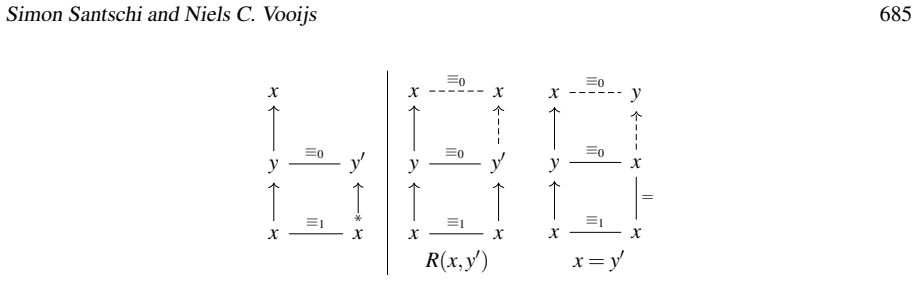
Adapting the iterative selection construction to weakly transitive frames shows that every strongly cofinal subframe logic extending wK4 has the finite model property; the same technique demonstrates that these logics satisfy a finite width property, thereby placing both of Fine's theorems in the same generalized setting.
What carries the argument
Iterative selection method, which successively chooses points in a frame to build a finite subframe while preserving satisfaction of modal formulas, now operating under weak transitivity and strong cofinality.
If this is right
- Every strongly cofinal subframe logic above wK4 possesses the finite model property via an explicit frame construction.
- Fine's Finite Width Theorem holds for all weakly transitive logics satisfying the same subframe condition.
- The finite model property and finite width results are obtained from one uniform selection procedure rather than separate arguments.
Where Pith is reading between the lines
- The method may apply directly to other modal logics whose frames satisfy weak transitivity but not full transitivity.
- Similar selection constructions could be tested on subframe logics that are cofinal but not strongly cofinal to determine the exact boundary of the technique.
- The frame-theoretic proof opens the possibility of extracting explicit bounds on model size that algebraic proofs do not immediately supply.
Load-bearing premise
The selection construction produces finite models precisely when the logic is weakly transitive and the subframe property is strongly cofinal.
What would settle it
A concrete counterexample would be any strongly cofinal subframe logic extending wK4 that fails to have the finite model property, or any instance where the iterative selection step fails to terminate with a finite frame.
Figures



read the original abstract
We generalize Fine's Iterative Selection Method to the weakly transitive setting. In particular, this provides a transparent frame-theoretic proof of the finite model property for (strongly) cofinal subframe logics extending wK4, which was previously established using algebraic methods. Using the same construction, we generalize Fine's Finite Width Theorem to the weakly transitive setting, connecting these two celebrated theorems of Fine.
Editorial analysis
A structured set of objections, weighed in public.
Referee Report
Summary. The paper generalizes Fine's Iterative Selection Method from the transitive case to weakly transitive frames. It supplies a frame-theoretic proof of the finite model property for (strongly) cofinal subframe logics extending wK4 (previously obtained algebraically) and, via the same construction, extends Fine's Finite Width Theorem to the weakly transitive setting, thereby connecting the two results.
Significance. If the iterative selection construction is verified, the work supplies a transparent, purely frame-theoretic route to the FMP for this family of logics and unifies two classical theorems of Fine under a single method. This strengthens the toolkit for subframe logics over wK4 and may facilitate further generalizations.
minor comments (2)
- The abstract states that the construction succeeds precisely under weak transitivity plus strong cofinality; the main text should contain an explicit statement (perhaps as a numbered theorem or proposition) of the precise hypotheses under which the selection procedure terminates with a finite model.
- Notation for the selection function and the cofinal subframe relation should be introduced with a short table or diagram in §2 or §3 to aid readability for readers coming from the transitive case.
Simulated Author's Rebuttal
We thank the referee for the positive summary of our work and the recommendation of minor revision. The report correctly identifies the main contributions: the generalization of Fine's iterative selection method to weakly transitive frames, the resulting frame-theoretic proof of the finite model property for strongly cofinal subframe logics over wK4, and the extension of the finite width theorem. No specific major comments appear in the report, so we have no individual points requiring rebuttal or revision at this stage.
Circularity Check
No significant circularity
full rationale
The paper generalizes Fine's Iterative Selection Method (an external prior result) to weakly transitive frames and uses it to reprove the finite model property for cofinal subframe logics over wK4 via frame theory rather than algebra. No equations, fitted parameters, self-citations, or ansatzes are described that reduce the central claim to its own inputs by construction. The work is self-contained against the cited external benchmark (Fine's theorems) with no load-bearing internal reductions.
Axiom & Free-Parameter Ledger
Reference graph
Works this paper leans on
-
[1]
A. Baltag, N. Bezhanishvili & D. Fernández-Duque (2023): The Topological Mu-Calculus: Completeness and Decidability. Journal of the ACM 70(5):33, doi:10.1145/3623268
-
[2]
G. Bezhanishvili & N. Bezhanishvili (2012): Canonical Formulas for wK4. The Review of Symbolic Logic 5(4), pp. 731–762, doi:10.1017/S1755020312000251. 690 Logics Containing wK4: Selection à la Fine
-
[3]
G. Bezhanishvili, L. Esakia & D. Gabelaia (2011):Spectral and T0-Spaces in d-Semantics. In N. Bezhanishvili, S. Löbner, K. Schwabe & L. Spada, editors: Logic, Language, and Computation , Lecture Notes in Computer Science, Springer Berlin Heidelberg, pp. 16–29, doi:10.1007/978-3-642-22303-7_2
-
[4]
G. Bezhanishvili, S. Ghilardi & M. Jibladze (2011): An Algebraic Approach to Subframe Logics. Modal Case. Notre Dame Journal of Formal Logic 52(2), pp. 187–202, doi:10.1215/00294527-1306190
-
[5]
Blackburn, M
P. Blackburn, M. de Rijke & Y . Venema (2001):Modal Logic. Cambridge Tracts in Theoretical Computer Science 53, Cambridge University Press
2001
-
[6]
Chagrov & M
A. Chagrov & M. Zakharyaschev (1997): Modal Logic. Oxford Logic Guides 35, Oxford University Press
1997
-
[7]
Q. Chen & M. Ma (2025): The McKinsey Axiom on Weakly Transitive Frames. Studia Logica 113(6), pp. 1543–1566, doi:10.1007/s11225-024-10145-x
-
[8]
Esakia (2001): Weak transitivity—a restitution
L.L. Esakia (2001): Weak transitivity—a restitution . Logical investigations 8, pp. 244–255
2001
-
[9]
Fine (1974): Logics containing K4
K. Fine (1974): Logics containing K4. part I. The Journal of Symbolic Logic 39(1), doi:10.2307/2272340. arXiv:2272340
-
[10]
Fine (1985): Logics containing K4
K. Fine (1985): Logics containing K4. part II. The Journal of Symbolic Logic 50(3), doi:10.2307/2274318. arXiv:2274318
-
[11]
Kracht (1990): Internal Definability and Completeness in Modal Logic
M. Kracht (1990): Internal Definability and Completeness in Modal Logic. Ph.D. thesis, Freie Universität Berlin
1990
-
[12]
A. Kudinov & I. Shapirovsky (2025): Two Types of Filtrations forwK4 and Its Relatives, doi:10.1007/s11225- 025-10207-8. arXiv:2401.00457
-
[13]
J.C.C. McKinsey & A. Tarski (1944): The algebra of topology. Annals of Mathematics 45(1), pp. 141–191, doi:10.2307/1969080. arXiv:1969080
-
[14]
Wolter (1993): Lattices Of Modal Logics
F. Wolter (1993): Lattices Of Modal Logics. Ph.D. thesis, Freie Universität Berlin
1993
-
[15]
Zakharyaschev (1992): Canonical Formulas for K4
M. Zakharyaschev (1992): Canonical Formulas for K4. Part I: Basic Results. The Journal of Symbolic Logic 57(4), pp. 1377–1402, doi:10.2307/2275372. arXiv:2275372
-
[16]
Zakharyaschev (1996): Canonical Formulas for K4
M. Zakharyaschev (1996): Canonical Formulas for K4. Part II: Cofinal Subframe Logics. The Journal of Symbolic Logic 61(2), pp. 421–449, doi:10.2307/2275669. arXiv:2275669
-
[17]
Zakharyaschev (1997): Canonical Formulas for K4
M. Zakharyaschev (1997): Canonical Formulas for K4. Part III: The Finite Model Property. The Journal of Symbolic Logic 62(3), pp. 950–975, doi:10.2307/2275581. arXiv:2275581
discussion (0)
Sign in with ORCID, Apple, or X to comment. Anyone can read and Pith papers without signing in.