REVIEW 4 major objections 5 minor 64 references
Mobile oscillators in a mobile multi-cluster network
T0 review · 4 major / 5 minor · reviewed 2026-08-06 · deepseek-v4-flash
Pith's one-line read The paper establishes that stable synchronization between two moving clusters of chaotic oscillators is governed by spatial closeness, with explicit Lyapunov conditions.
desk verdict The moving-cluster model is a real extension, but the paper's central Lyapunov proof is circular and mathematically invalid; the numerics alone do not support the advertised stability claims. read the letter →
The pith
A machine-rendered reading of the paper's core claim, the machinery that carries it, and where it could break.
The reading
What carries the argument
The argument is carried by a Lyapunov function V_i for the error between oscillators in the two clusters, together with the local-center-of-mass coupling. The Lyapunov function is an energy-like sum of squared errors plus an integral of past errors; bounding its derivative produces the three algebraic conditions in Eq. 17, maximized over nodes to give Eq. 19. The key simplification is the identity (1/(4m2)) Σ_{j≠i} g2_ij = 1/4, which assumes each oscillator has exactly m2 neighbors in the other cluster, and the introduction of a maximal degree Z so that the coupling terms can be grouped. This converts the stability question into a set of parameter inequalities that can be checked numerically and compared with the measured largest Lyapunov exponent.
What would settle it
Run the same two-cluster model with random agent positions and record (1/(4m2)) Σ_{j≠i} g2_ij for every node at every time step; if the ensemble average deviates from 1/4 by a nonzero margin, the Lyapunov bound in Eq. 13 is not the exact stability boundary it is presented as. A second check is to find parameter pairs where f_emax ≤ 0 and f_3max ≤ 0 hold but f_1max and f_2max do not vanish, and test whether the numerically computed largest Lyapunov exponent still goes negative; the paper's conditions predict it should not.
Extended reading notes
Core claim
Two mobile clusters of chaotic Rössler oscillators, each confined to its own patch of space, are coupled internally by proximity and externally through the other cluster's moving average when the cluster centers are within a distance threshold s0. The paper's central result is that complete synchronization inside a cluster is stable exactly when four maximal quantities satisfy the sign conditions f_emax ≤ 0, f_1max = 0, f_2max = 0, and f_3max ≤ 0; these combine the initial error, two connectivity-mismatch terms between clusters, and a bound built from intra-cluster coupling ε, inter-cluster coupling μ, the node degree Z, and the cluster-connectivity switch D_XY. The first two mismatch conditions force the oscillators in a cluster to share a common value y2, meaning intra-cluster synchronization is a prerequisite. Numerically, the conditions separate parameter pairs that converge to zero from those that do not, matching the largest-Lyapunov-exponent results, and the phase diagrams show that the inter-cluster threshold s0 is the main switch: once s0 is large enough, the system passes directly from disorder to complete synchronization.
Load-bearing premise
The analytical stability bound assumes that at every instant each oscillator is connected to exactly m2 oscillators in the other cluster, so the average connectivity term collapses to 1/4; in the actual moving network m2 is a per-node count that changes with the agents' positions, so this equality is not exact for random configurations.
Editorial extensions
If this is right
- If two clusters are separated by more than the threshold s0, inter-cluster coupling switches off completely, so their oscillators cannot synchronize; synchronization between clusters therefore requires their center-of-mass distance to stay within s0.
- When the four stability conditions f_emax ≤ 0, f_1max = 0, f_2max = 0, and f_3max ≤ 0 hold, complete synchronization inside each cluster is stable, and the numerically observed largest Lyapunov exponent becomes negative.
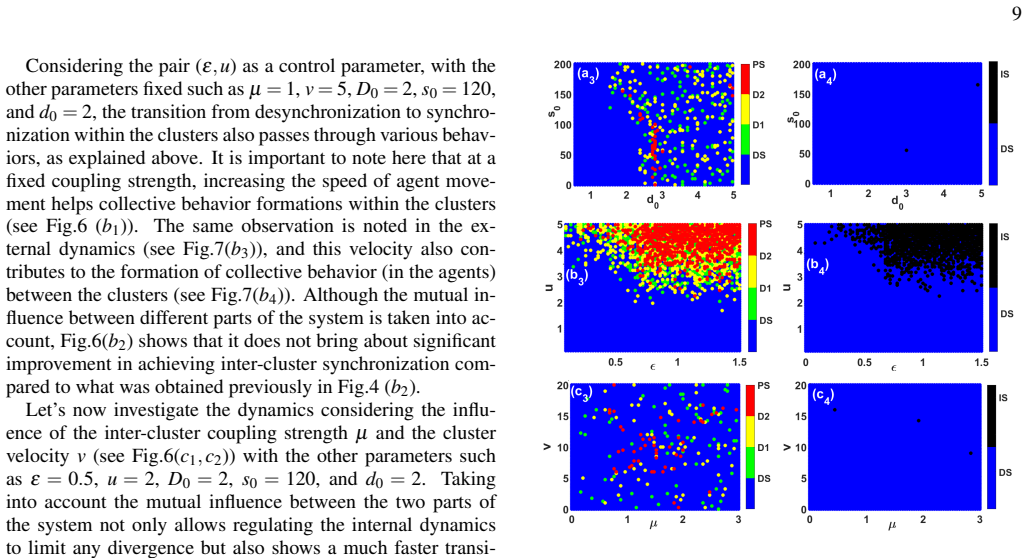
- Larger values of s0 push the system from disorder directly to complete synchronization, skipping intermediate states in which only one cluster is synchronized.
- Mutual influence between agent positions and oscillator states removes the divergence region found with one-way coupling, because the oscillators' vision range regulates the agents' motion.
- Increasing agent density by raising N in the same area speeds up intra-cluster synchronization without moving the critical s0 threshold.
Reading between the lines
- An implicit consequence is that inter-cluster synchronization cannot outpace intra-cluster synchronization: the f1i = 0 and f2i = 0 conditions force each cluster's oscillators to share a common y2 first.
- One extension beyond the paper would replace pairwise cluster distances with center-of-mass separations between cluster pairs in a network of more than two clusters, which would directly test whether the same Lyapunov conditions generalize.
- A testable extension would vary the cluster speed v while holding s0 fixed; the phase diagrams suggest a window of relative speeds in which inter-cluster synchronization is lost even though intra-cluster synchronization persists.
- Because f3max depends on the maximum degree Z, the same conditions predict that denser networks or larger agent vision d0 should require weaker inter-cluster coupling μ to synchronize, which the appendix's N-dependence qualitatively supports.
Editorial analysis
A structured set of objections, weighed in public.
Referee Report
Summary. This manuscript studies a two-cluster network of mobile Rössler oscillators in which agents move within bounded regions, clusters move relative to one another, and intra/inter-cluster couplings depend on vision thresholds. The authors numerically characterize phase and complete synchronization using the Kuramoto order parameter and the Master Stability Function, present phase diagrams in the (d0,s0), (ε,u), and (μ,v) planes, and extend simulations to N=100 and 200. The paper's central analytical claim is a Lyapunov stability criterion for complete synchronization, summarized in Eqs.17-19, which is asserted to yield parameter conditions on ε, s0, μ, Z, and γ. I find that the analytical derivation is not valid: the differentiation of the Lyapunov function is incorrect, and the conditions f1i=0 and f2i=0 are satisfied only on the synchronization manifold, making the stability proof circular.
Significance. If the analytical criterion were correct, it would be a useful contribution to the stability theory of mobile, multi-cluster oscillator networks, connecting parameter thresholds for intra- and inter-cluster synchronization. The numerical exploration is a real strength: the phase diagrams in Figs.4 and 6, the dependence on the cluster-distance threshold s0, and the finite-size checks in Appendix A provide reproducible qualitative predictions and could be useful to the mobile-oscillator community. However, the advertised analytical result is the centerpiece of the paper, and it fails for the reasons detailed below. The manuscript does not provide code or machine-checkable proofs, and the numerical results alone do not compensate for the invalidity of the claimed Lyapunov stability conditions.
major comments (4)
- [III.B, Eqs.17-19] The conditions f1i=0 and f2i=0 in Eq.17 are declared part of the stability criterion, yet the text immediately after Eq.17 states that these equalities imply y2_j = y2_i for all i,j, i.e., the complete intra-cluster synchronization that the derivation is supposed to establish. The Lyapunov argument therefore does not prove convergence from generic initial data: it merely asserts that the error terms vanish on the target synchronized state. Furthermore, replacing f1i=0 and f2i=0 by f1max=0 and f2max=0 in Eq.19 weakens the condition, since a maximum of zero does not force the squared terms (ε/2)(f1i)^2 and (μDxy/2)(f2i)^2 in Eq.16 to vanish for each i. These conditions cannot be read as parameter-only criteria.
- [III.B, Eqs.10-11] The derivative of the integral term in the Lyapunov candidate Eq.10 is computed incorrectly in Eq.11. By the fundamental theorem of calculus, d/dt ∫_0^t [γ1(e1_i)^2 + γ2(e3_i)^2] ds equals γ1(e1_i(t))^2 + γ2(e3_i(t))^2; there is no subtraction of γ1(e1_i(0))^2 or γ2(e3_i(0))^2. The spurious initial-value terms enter Eq.15 and produce the first inequality in Eq.17, 2γ∥e_i(t)∥^2 - γ∥e_i(0)∥^2 ≤ 0. This condition is not a legitimate consequence of the Lyapunov function as defined, so the claimed stability condition is not derived.
- [III.B, Eqs.13-14] The bound leading to Eq.14 is not valid. Eq.13 contains the positive sums ε/2 Σ_{j≠i} g1_ij (e2_j)^2 and μDxy/(4m2) Σ_{j≠i} g2_ij (e2_j)^2, which involve squared errors at neighbors. The paper instead states inequalities of the form Σ_{j≠i} g1_ij (e2_i)^2 ≤ Z1 (e2_i)^2, i.e., it replaces e2_j by e2_i inside the sum. Even if such a bound held for the displayed expression, it does not control the terms that actually appear in Eq.13. Consequently the coefficient f3max in Eq.18 and the condition f3max≤0 in Eq.19 are not established.
- [III.B, text before Eq.14 and Eq.9] Two additional technical problems affect the derivation. First, the identity (1/(4m2))Σ_{j≠i} g2_ij = 1/4 before Eq.14 assumes that every oscillator i has exactly m2 neighbors in the other cluster; in the model, m2 is a time-varying, per-node count determined by the vision threshold (Eqs.6-7), so the identity does not hold for generic configurations. Second, the nonlinear term e1_i e3_i in the e3-error equation of Eq.9 is discarded as negligible, but a Lyapunov proof must bound such a term rather than drop it. Both issues further undermine the claimed analytical stability result.
minor comments (5)
- [Section II, Eqs.4-5] The symbols x2 and y2 are used both for the second state variable of an oscillator and for the local center-of-mass coupling terms; this overloaded notation makes the error derivation difficult to follow.
- [Fig.5 caption] The caption lists both D0=2 and d0=2, although D0 is only introduced later in Eq.21; please clarify which vision parameter is used in that figure.
- [References] The reference list contains apparent errors: Ref.8 has an implausible author and title combination, and Ref.21 includes a truncated author name and an inconsistent page range; these should be corrected.
- [Throughout] The text includes typographical and grammatical errors such as 'refered' in Section I, the unmatched parenthesis 'spatial phase synchrony)' in Section I, and the phrase 'emerging from the unknown' in the abstract.
- [Section IV] The statement that stability of complete synchronization is 'analytically and numerically demonstrated' overstates the analytical part; the numerical evidence stands, but the analytical claim is not supported by the present derivation.
Circularity Check
The analytical stability criterion Eqs.17-19 is circular: it requires f1i=0 and f2i=0, which the paper itself equates to y2_j=y2_i (the target synchronized state), and Fig.5 then 'confirms' the criterion by observing these terms vanish in synchronized runs.
-
self definitional
[Section III B, Eqs. (17)-(19) and following text]
"Therefore, the stability conditions for synchronization between clusters are provided by Eq.17, derived from Eq.16. ... f1i = 0, f2i = 0 (17) From Eq.17, it follows that f1i = 0 and f2i = 0, implying y2_j = y2_i for all i and j. In other words, the oscillators within a cluster synchronize"
The paper's advertised result is a stability criterion for inter-cluster complete synchronization. But Eq.17 makes f1i=0 and f2i=0 part of the required conditions, and the paper immediately explains that these equalities imply y2_j=y2_i for all i,j, i.e., the target complete-synchronization state inside each cluster. Therefore the stated conditions are satisfied only on the synchronization manifold: the positive state-dependent terms (epsilon/2)(f1i)^2 and (mu*Dxy/2)(f2i)^2 in Eq.16 are forced to zero by assuming the very state whose stability is to be proved. The remaining inequalities do not bound these f terms off the manifold, so Eqs.17-19 do not certify convergence from generic initial conditions and are not parameter-only conditions.
-
self definitional
[Section III B, Fig.5 discussion]
"In contrast to the previous results, the pairs (epsilon = 0.5, s0 = 110) and (epsilon = 0.8, s0 = 110) show a convergence toward zero for f_1max and f_2max (see Figs.5(b2) and (c2)), with f_emax <= 0 (see Fig.5(a2)) and f_3max <= 0 (see Fig.5(d2))."
This sentence is offered as numerical confirmation of the analytical stability conditions. However, by the paper's own implication after Eq.17, f1i=0 and f2i=0 mean the oscillators within a cluster are completely synchronized. Running a simulation that reaches synchronization and then observing f1max and f2max go to zero is a restatement of the synchronized state, not an independent test of whether Eqs.17-19 make that state stable. It therefore adds no non-circular evidence for the claimed stability criterion.
full rationale
The numerical phase and complete-synchronization measurements (order parameter r, LLE via MSF) and the parameter scans in Figs.2-4 are self-contained and not circular. However, the advertised analytical stability criterion for inter-cluster complete synchronization is Eqs.17-19. The derivation of Vdot in Eq.16 leaves positive, state-dependent terms (epsilon/2)(f1i)^2 and (mu*Dxy/2)(f2i)^2. To force Vdot<=0, the authors impose f1i=0 and f2i=0 as part of the stability conditions, and then state that these imply y2_j=y2_i for all i,j, i.e., that the oscillators within a cluster are completely synchronized. Thus the conditions are satisfied exactly on the synchronization manifold; they are not parameter-only conditions and they do not show that arbitrary errors decay. The two inequalities f_emax<=0 and f_3max<=0 are insufficient without a bound on the f terms. Fig.5's use of f1max and f2max tending to zero in synchronized runs is a restatement of the target state rather than an independent stability certificate. The core analytical claim therefore reduces by construction to the state it is supposed to certify (score 8). The same-author citation for MSF details (ref. 61) is not load-bearing circularity because MSF is an externally established method, and the m2 identity comment is at most a technical side issue, not the reason for this score.
Assumptions & free parameters
free parameters (3)
- gamma1 =
gamma1 = (1 + y3_m)/2
- gamma2 =
gamma2 = y1_m - c + (1 + y3_m)/2
- Z =
Z = max(Z1, Z2)
assumptions (4)
- domain assumption The Rössler parameters a=0.2, b=0.2, c=5.7 place the oscillators in the chaotic regime.
- domain assumption The Master Stability Function approach, applied as in the appendix of ref. 61, remains valid for the time-varying intra-cluster adjacency matrices.
- ad hoc to paper The nonlinear term e1_i e3_i in the error dynamics can be disregarded as negligible.
- ad hoc to paper Each oscillator i has exactly m2 neighbors in the other cluster, giving degree m2 and (1/(4m2)) * sum g2_ij = 1/4.
Cite this review
Pith. "Pith review of Mobile oscillators in a mobile multi-cluster network." pith.science (2026). https://pith.science/paper/KJOSGR44
@misc{pith2026250619617,
  author       = {Pith},
  title        = {Pith review of: Mobile oscillators in a mobile multi-cluster network},
  year         = {2026},
  howpublished = {\url{https://pith.science/paper/KJOSGR44}},
  note         = {Machine review of arXiv:2506.19617}
}
read the original abstract
Different collective behaviors emerging from the unknown have been examined in networks of mobile agents in recent years. Mobile systems, far from being limited to modeling and studying various natural and artificial systems in motion and interaction, offer versatile solutions across various domains, facilitating tasks ranging from navigation and communication to data collection and environmental monitoring. We examine the relative mobility between clusters, each composed of different elements in a multi-clusters network-a system composed of clusters interconnected to form a larger network of mobile oscillators. Each mobile oscillator exhibits both external (i.e., position in a 2D space) and internal dynamics (i.e., phase oscillations). Studying the mutual influence between external and internal dynamics, often leads the system towards a state of synchronization within and between clusters. We show that synchronization between clusters is affected by their spatial closeness. The stability of complete synchronization observed within the clusters is demonstrated through analytical and numerical methods.
Figures


Figures from the paper (5 more)



Reference graph
Works this paper leans on
-
[1]
author author P. Holme \ and\ author J. Saramäki ,\ title title Temporal networks , \ @noop journal journal Physics Reports \ volume 519 ,\ pages 97--125 ( year 2012 ) ,\ note temporal Networks NoStop
work page 2012
-
[2]
author author N. Fujiwara , author J. Kurths , \ and\ author A. D\' az-Guilera ,\ title title Synchronization in networks of mobile oscillators , \ @noop journal journal Phys. Rev. E \ volume 83 ,\ pages 025101 ( year 2011 ) NoStop
work page 2011
-
[3]
author author S. Majhi , author B. K. \ Bera , author D. Ghosh , \ and\ author M. Perc ,\ title title Chimera states in neuronal networks: A review , \ @noop journal journal Physics of Life Reviews \ volume 28 ,\ pages 100--121 ( year 2019 ) NoStop
work page 2019
-
[4]
author author G. S. \ Caldwell ,\ title title Attraction to tropical mixed-species heron flocks: Proximate mechanism and consequences , \ @noop journal journal Behavioral Ecology and Sociobiology \ volume 8 ,\ pages 99 -- 103 ( year 1981 ) NoStop
work page 1981
-
[5]
author author A. Erg\" u n , author C. A. \ Lawrence , author M. A. \ Kohanski , author T. A. \ Brennan , \ and\ author J. J. \ Collins ,\ title title A network biology approach to prostate cancer , \ @noop journal journal Molecular Systems Biology \ volume 3 ,\ pages 82 NoStop
-
[6]
author author A. R. \ Subbalakshmi , author S. Sahoo , author K. Biswas , \ and\ author M. K. \ Jolly ,\ title title A computational systems biology approach identifies slug as a mediator of partial epithelial-mesenchymal transition (emt) , \ @noop journal journal Cells Tissues Organs \ volume 211 ,\ pages 689--702 ( year 2023 ) NoStop
work page 2023
-
[7]
author author G. R. \ Simo , author T. Njougouo , author R. P. \ Aristides , author P. Louodop , author R. Tchitnga , \ and\ author H. A. \ Cerdeira ,\ title title Chimera states in a neuronal network under the action of an electric field , \ @noop journal journal Phys. Rev. E \ volume 103 ,\ pages 062304 ( year 2021 ) NoStop
work page 2021
-
[8]
author author S. Kitayama \ and\ author Y. K. \ Arakawa , Masao ,\ title title Chimera states in a neuronal network under the action of an electric field , \ @noop journal journal Optimization and Engineering \ volume 12 ,\ pages 1573--2924 ( year 2011 ) NoStop
work page 2011
Show all 64 references
-
[9]
author author J. A. \ Carrillo , author M. Fornasier , author G. Toscani , \ and\ author F. Vecil ,\ title Particle, kinetic, and hydrodynamic models of swarming , \ \ ( publisher Birkh \"a user Boston ,\ address Boston ,\ year 2010 )\ pp.\ pages 297--336 NoStop
2010
-
[10]
author author I. D. \ Couzin \ and\ author N. R. \ Franks ,\ title title Self-organized lane formation and optimized traffic flow in army ants , \ @noop journal journal Proceedings of the Royal Society of London. Series B: Biological Sciences \ volume 270 ,\ pages 139--146 ( y...
2003
-
[11]
author author R. E. \ Park ,\ title title Human nature and collective behavior , \ @noop journal journal American Journal of Sociology \ volume 32 ,\ pages 733--741 ( year 1927 ) NoStop
1927
-
[12]
author author D. M. \ Abrams \ and\ author S. H. \ Strogatz ,\ title title Chimera states for coupled oscillators , \ @noop journal journal Phys. Rev. Lett. \ volume 93 ,\ pages 174102 ( year 2004 ) NoStop
2004
-
[13]
Zhu , author Z
author author Y. Zhu , author Z. Zheng , \ and\ author J. Yang ,\ title title Chimera states on complex networks , \ @noop journal journal Phys. Rev. E \ volume 89 ,\ pages 022914 ( year 2014 ) NoStop
2014
-
[14]
author author V. N. \ Belykh , author G. V. \ Osipov , author V. S. \ Petrov , author J. A. K. \ Suykens , \ and\ author J. Vandewalle ,\ title title Cluster synchronization in oscillatory networks , \ @noop journal journal Chaos: An Interdisciplinary Journal of Nonlinear Scie...
2008
-
[15]
Pikovsky , author M
author author A. Pikovsky , author M. Rosenblum , \ and\ author J. Kurths ,\ title title Synchronization , \ @noop journal journal Cambridge university press \ volume 12 ( year 2001 ) NoStop
2001
-
[16]
Njougouo , author V
author author T. Njougouo , author V. Camargo , author P. Louodop , author F. Fagundes Ferreira , author P. K. \ Talla , \ and\ author H. A. \ Cerdeira ,\ title title Synchronization in a multilevel network using the hamilton--jacobi--bellman (hjb) technique , \ @noop journal ...
2022
-
[17]
author author S. Valdez ,\ title title Revolver as a pivotal art work: structure, harmony, and vocal harmonization , \ in\ @noop booktitle 'Every Sound There Is' \ ( publisher Routledge ,\ year 2017 )\ pp.\ pages 89--108 NoStop
2017
-
[18]
Hartcher-O’Brien , author C
author author J. Hartcher-O’Brien , author C. Brighouse , \ and\ author C. A. \ Levitan ,\ title title A single mechanism account of duration and rate processing via the pacemaker--accumulator and beat frequency models , \ @noop journal journal Current Opinion in Behavioral Sc...
2016
-
[19]
Missonnier , author G
author author P. Missonnier , author G. Gold , author F. R. \ Herrmann , author L. Fazio-Costa , author J.-P. \ Michel , author M.-P. \ Deiber , author A. Michon , \ and\ author P. Giannakopoulos ,\ title title Decreased theta event-related synchronization during working memor...
2006
-
[20]
title title A fresh look at the use of nonparametric analysis in actimetry , \ @noop journal journal Sleep Medicine Reviews \ volume 20 ,\ pages 84--91 ( year 2015 ) NoStop
2015
-
[21]
Ling , author G
author author H. Ling , author G. Mclvor , author V. vander , author R. Kasper , Vaughan , author A. Thornton , \ and\ author N. Ouellette ,\ title title Costs and benefits of social relationships in the collective motion of bird flocks , \ @noop \ ,\ pages 943--948 ( year 201...
2019
-
[22]
author author A. M. \ Reynolds , author G. E. \ McIvor , author A. Thornton , author P. Yang , \ and\ author N. T. \ Ouellette ,\ title title Stochastic modelling of bird flocks: accounting for the cohesiveness of collective motion , \ @noop journal journal Journal of The Roya...
2022
-
[23]
Pavlov \ and\ author A
author author D. Pavlov \ and\ author A. Kasumyan ,\ title Patterns and mechanisms of schooling behavior in fish , \ \ ( publisher Journal of Ichthyology ,\ year 2000 )\ p.\ pages S163 NoStop
2000
-
[24]
Abdessameud , author I
author author A. Abdessameud , author I. Polushin , \ and\ author A. Tayebi ,\ title title Motion coordination of thrust-propelled underactuated vehicles with intermittent and delayed communications , \ @noop journal journal Systems and Control Letters \ volume 79 ,\ pages 15-...
2015
-
[25]
Li , author J
author author H. Li , author J. Zhao , \ and\ author Z. Zhan ,\ title title Truck and unmanned vehicle routing problem with time windows: A satellite synchronization perspective , \ @noop journal journal Journal of Advanced Transportation \ volume 2022 ,\ pages 6599089 NoStop
2022
-
[26]
author author K. P. \ O’Keeffe , author H. Hong , \ and\ author S. H. \ Strogatz ,\ title title Oscillators that sync and swarm , \ @noop journal journal Nature communications \ volume 8 ,\ pages 1504 ( year 2017 ) NoStop
2017
-
[27]
author author G. K. \ Sar \ and\ author D. Ghosh ,\ title title Dynamics of swarmalators: A pedagogical review , \ @noop journal journal Europhysics Letters \ volume 139 ,\ pages 53001 ( year 2022 ) NoStop
2022
-
[28]
author author S. J. \ Kongni , author V. Nguefoue , author T. Njougouo , author P. Louodop , author F. F. \ Ferreira , author R. Tchitnga , \ and\ author H. A. \ Cerdeira ,\ title title Phase transitions on a multiplex of swarmalators , \ @noop journal journal Physical Review ...
2023
-
[29]
Ghosh , author S
author author S. Ghosh , author S. Pal , author G. K. \ Sar , \ and\ author D. Ghosh ,\ title title Amplitude responses of swarmalators , \ @noop journal journal Physical Review E \ volume 109 ,\ pages 054205 ( year 2024 ) NoStop
2024
-
[30]
author author D. J. \ Skinner ,\ title title Thermodynamic and topological characterization of living systems , \ @noop journal journal Massachusetts Institute of Technology \ ( year 2022 ) NoStop
2022
-
[31]
Nagpal , author A
author author R. Nagpal , author A. Patel , \ and\ author M. C. \ Gibson ,\ title title Epithelial topology , \ @noop journal journal BioEssays \ volume 30 ,\ pages 260--266 ( year 2008 ) NoStop
2008
-
[32]
Ghosh , author M
author author D. Ghosh , author M. Frasca , author A. Rizzo , author S. Majhi , author S. Rakshit , author K. Alfaro-Bittner , \ and\ author S. Boccaletti ,\ title title The synchronized dynamics of time-varying networks , \ @noop journal journal Physics Reports \ volume 949 ,...
2022
-
[33]
Rakshit , author S
author author S. Rakshit , author S. Majhi , author B. K. \ Bera , author S. Sinha , \ and\ author D. Ghosh ,\ title title Time-varying multiplex network: Intralayer and interlayer synchronization , \ @noop journal journal Physical Review E \ volume 96 ,\ pages 062308 ( year 2...
2017
-
[34]
author author D. J. \ Stilwell , author E. M. \ Bollt , \ and\ author D. G. \ Roberson ,\ title title Sufficient conditions for fast switching synchronization in time-varying network topologies , \ @noop journal journal SIAM Journal on Applied Dynamical Systems \ volume 5 ,\ p...
2006
-
[35]
Majhi , author D
author author S. Majhi , author D. Ghosh , \ and\ author J. Kurths ,\ title title Emergence of synchronization in multiplex networks of mobile r\"ossler oscillators , \ @noop journal journal Phys. Rev. E \ volume 99 ,\ pages 012308 ( year 2019 ) NoStop
2019
-
[36]
author author A. C. J. \ Malar , author M. Kowsigan , author N. Krishnamoorthy , author S. Karthick , author E. Prabhu , \ and\ author K. Venkatachalam ,\ title title Multi constraints applied energy efficient routing technique based on ant colony optimization used for disaste...
2021
-
[37]
Poklonskiy \ and\ author S
author author E. Poklonskiy \ and\ author S. Totkal ,\ title title Superradiation of mobile oscillators , \ @noop journal journal East European Journal of Physics \ ,\ pages 14--18 ( year 2022 ) NoStop
2022
-
[38]
Xu , author X
author author C. Xu , author X. Tang , author H. L\"u , author K. Alfaro-Bittner , author S. Boccaletti , author M. c. v. \ Perc , \ and\ author S. Guan ,\ title title Collective dynamics of heterogeneously and nonlinearly coupled phase oscillators , \ @noop journal journal Ph...
2021
-
[39]
author author S. N. \ Chowdhury , author S. Majhi , author M. Ozer , author D. Ghosh , \ and\ author M. Perc ,\ title title Synchronization to extreme events in moving agents , \ @noop journal journal New Journal of Physics \ volume 21 ,\ pages 073048 ( year 2019 ) NoStop
2019
-
[40]
Sun \ and\ author B
author author W. Sun \ and\ author B. Kennett ,\ title title Uppermost mantle p wavespeed structure beneath eastern china and its surroundings , \ @noop journal journal Tectonophysics \ volume 683 ,\ pages 12--26 ( year 2016 ) NoStop
2016
-
[41]
Cavraro , author R
author author G. Cavraro , author R. Arghandeh , author K. Poolla , \ and\ author A. von Meier ,\ title title Data-driven approach for distribution network topology detection , \ in\ @noop booktitle 2015 IEEE Power and Energy Society General Meeting \ ( year 2015 )\ pp.\ pages...
2015
-
[42]
Blonder \ and\ author A
author author B. Blonder \ and\ author A. Dornhaus ,\ title title Time-ordered networks reveal limitations to information flow in ant colonies , \ @noop journal journal PloS one \ volume 6 ,\ pages e20298 ( year 2011 ) NoStop
2011
-
[43]
Petrungaro , author K
author author G. Petrungaro , author K. Uriu , \ and\ author L. G. \ Morelli ,\ title title Synchronization dynamics of mobile oscillators in the presence of coupling delays , \ @noop journal journal Physical Review E \ volume 99 ,\ pages 062207 ( year 2019 ) NoStop
2019
-
[44]
Ling , author W.-B
author author X. Ling , author W.-B. \ Ju , author N. Guo , author C.-Y. \ Wu , \ and\ author X.-M. \ Xu ,\ title title Explosive synchronization in network of mobile oscillators , \ @noop journal journal Physics Letters A \ volume 384 ,\ pages 126881 ( year 2020 ) NoStop
2020
-
[45]
Xiao , author L
author author F. Xiao , author L. Xie , \ and\ author B. Wei ,\ title title Explosive synchronization of weighted mobile oscillators , \ @noop journal journal Physica A: Statistical Mechanics and its Applications \ volume 596 ,\ pages 127099 ( year 2022 ) NoStop
2022
-
[46]
Levis , author I
author author D. Levis , author I. Pagonabarraga , \ and\ author A. D \' az-Guilera ,\ title title Synchronization in dynamical networks of locally coupled self-propelled oscillators , \ @noop journal journal Physical Review X \ volume 7 ,\ pages 011028 ( year 2017 ) NoStop
2017
-
[47]
Perez-Diaz , author R
author author F. Perez-Diaz , author R. Zillmer , \ and\ author R. Gro ,\ title title Control of synchronization regimes in networks of mobile interacting agents , \ @noop journal journal Physical Review Applied \ volume 7 ,\ pages 054002 ( year 2017 ) NoStop
2017
-
[48]
Frasca , author A
author author M. Frasca , author A. Buscarino , author A. Rizzo , author L. Fortuna , \ and\ author S. Boccaletti ,\ title title Synchronization of moving chaotic agents , \ @noop journal journal Physical review letters \ volume 100 ,\ pages 044102 ( year 2008 ) NoStop
2008
-
[49]
Nguefoue , author T
author author V. Nguefoue , author T. Njougouo , author P. Louodop , author H. Fotsin , \ and\ author H. A. \ Cerdeira ,\ title title Network of mobile systems: mutual influence of oscillators and agents , \ @noop journal journal The European Physical Journal Special Topics \ ...
2022
-
[50]
Szell , author R
author author M. Szell , author R. Lambiotte , \ and\ author S. Thurner ,\ title title Multirelational organization of large-scale social networks in an online world , \ @noop journal journal Proceedings of the National Academy of Sciences \ volume 107 ,\ pages 13636--13641 ( ...
2010
-
[51]
author author B. M. \ Adhikari , author A. Prasad , \ and\ author M. Dhamala ,\ title title Time-delay-induced phase-transition to synchrony in coupled bursting neurons , \ @noop journal journal Chaos: An Interdisciplinary Journal of Nonlinear Science \ volume 21 ( year 2011 ) NoStop
2011
-
[52]
Cardillo , author M
author author A. Cardillo , author M. Zanin , author J. G \'o mez-Gardenes , author M. Romance , author A. J. \ Garc \' a del Amo , \ and\ author S. Boccaletti ,\ title title Modeling the multi-layer nature of the european air transport network: Resilience and passengers re-sc...
2013
-
[53]
author author G. K. \ Sar \ and\ author D. Ghosh ,\ title title Flocking and swarming in a multi-agent dynamical system , \ @noop journal journal Chaos: An Interdisciplinary Journal of Nonlinear Science \ volume 33 ( year 2023 ) NoStop
2023
-
[54]
Arrow , author J
author author H. Arrow , author J. McGrath , \ and\ author J. Berdahl ,\ @noop title Small Groups as Complex Systems: Formation, Coordination, Development, and Adaptation \ ( publisher SAGE Publications ,\ year 2000 ) NoStop
2000
-
[55]
author author J. Huan ,\ title title Migratory processes and habits of wildebeest and zebra on the serengeti savannah of east africa , \ @noop journal journal Theoretical and Natural Science \ volume 6 ,\ pages 421--425 ( year 2023 ) NoStop
2023
-
[56]
Thaker , author A
author author M. Thaker , author A. T. \ Vanak , author C. R. \ Owen , author M. B. \ Ogden , \ and\ author R. Slotow ,\ title title Group dynamics of zebra and wildebeest in a woodland savanna: Effects of predation risk and habitat density , \ @noop journal journal PLOS ONE \...
2010
-
[57]
author author O. E. \ R \"o ssler ,\ title title Continuous chaos—four prototype equations , \ @noop journal journal Annals of the New York Academy of Sciences \ volume 316 ,\ pages 376--392 ( year 1979 ) NoStop
1979
-
[58]
author author H. E. \ Hannachi , author D. Elmaghraoui , \ and\ author S. Jaziri ,\ title title Moir \'e interlayer exciton relative and center of mass motions coupling. effect on 1 s-np interlayer exciton thz transitions , \ @noop journal journal The European Physical Journal...
2023
-
[59]
author author Y. Kuramoto ,\ title title Collective synchronization of pulse-coupled oscillators and excitable units , \ @noop journal journal Physica D: Nonlinear Phenomena \ volume 50 ,\ pages 15--30 ( year 1991 ) NoStop
1991
-
[60]
Njougouo , author V
author author T. Njougouo , author V. Camargo , author P. Louodop , author F. Fagundes Ferreira , author P. K. \ Talla , \ and\ author H. A. \ Cerdeira ,\ title title Dynamics of multilayer networks with amplification , \ @noop journal journal Chaos: An Interdisciplinary Journ...
2020
-
[61]
author author V. N. \ Meli , author T. Njougouo , author S. J. \ Kongni , author P. Louodop , \ and\ author H. Fotsin ,\ title title Mobile oscillators network with amplification , \ @noop journal journal Chaos, Solitons & Fractals \ volume 177 ,\ pages 114278 ( year 2023 ) NoStop
2023
-
[62]
author author L. M. \ Pecora \ and\ author T. L. \ Carroll ,\ title title Master stability functions for synchronized coupled systems , \ @noop journal journal Physical review letters \ volume 80 ,\ pages 2109 ( year 1998 ) NoStop
1998
-
[63]
Kakmeni , author S
author author F. Kakmeni , author S. Bowong , author D. Senthikumar , \ and\ author J. Kurths ,\ title title Practical time-delay synchronization of a periodically modulated self-excited oscillators with uncertainties , \ @noop journal journal Chaos: An Interdisciplinary Journ...
2010
-
[64]
Sekieta \ and\ author T
author author M. Sekieta \ and\ author T. Kapitaniak ,\ title title Practical synchronization of chaos via nonlinear feedback scheme , \ @noop journal journal International Journal of Bifurcation and Chaos \ volume 6 ,\ pages 1901--1907 ( year 1996 ) NoStop
1901
Reviewed August 6, 2026 · model on record in the stance chip above.
Discussion (0). Continue with ORCID to comment.