REVIEW 3 major objections 4 minor 3 references
Non-Uniform Noise-to-Signal Ratio in the REINFORCE Policy-Gradient Estimator
T0 review · 3 major / 4 minor · reviewed 2026-08-03 · deepseek-v4-flash
Pith's one-line read The noise-to-signal ratio of the REINFORCE gradient estimator is exactly computable for LQG and polynomial systems, and it blows up as policies approach optimality.
desk verdict The exact variance/NSR computation for LQG and polynomial systems is real and likely correct, but the abstract's exponential-in-horizon NSR claim is not proven by the supplied theorems. read the letter →
The pith
A machine-rendered reading of the paper's core claim, the machinery that carries it, and where it could break.
The reading
What carries the argument
The load-bearing mechanism is exact Gaussian-moment evaluation: for centered Gaussian vectors, moments of products of quadratic forms are computed by Wick/Isserlis contractions, captured in the paper's IS_Omega shorthand (Lemma 2). For multi-step LQG, Theorem 4 lifts the T-step system into a single-step system with block lower-triangular matrices, so the return becomes one quadratic form in the initial state and one in the stacked exploration noise; parity bookkeeping (only even-degree terms survive in centered Gaussian expectations) reduces the variance expansion to sums of trace terms. For polynomial systems, Proposition 9 shows that the gradient estimator is itself a polynomial in Gaussia
What would settle it
Run the one-step double-integrator experiment with sigma_0 >> sigma and measure NSR by Monte Carlo for several ratios; Eq. (8) predicts linear growth in sigma_0^2/sigma^2, and any statistically significant deviation from the closed-form value would falsify the exact-moment machinery.
Extended reading notes
Core claim
The paper's central claim is that the noise-to-signal ratio (NSR) of the REINFORCE estimator is exactly characterizable for two structured classes of control problems, and that this exactness exposes a non-uniform, often diverging NSR landscape. For LQG systems with Gaussian linear policies, Theorems 3 and 5 express the mean gradient and the estimator's second moment as explicit Gaussian-moment functions (Wick/Isserlis); for polynomial dynamics with polynomial feedback, Proposition 9 shows the estimator is a polynomial in Gaussian variables, so all needed moments are exactly computable. In both settings the NSR is obtained without Monte Carlo approximation, scaling inversely with policy cova
Load-bearing premise
The exact formulas require the initial state and exploration noise to be centered Gaussian variables; if either is non-Gaussian or has a nonzero mean, or if the true gradient vanishes, the exact NSR identities do not apply.
Editorial extensions
If this is right
- NSR diverges as the policy covariance goes to zero, so any REINFORCE-style update faces an exploration–exploitation tension near deterministic optimal policies.
- For unstable closed-loop dynamics, estimator variance can grow exponentially with horizon, making long-horizon tasks with unstable controllers especially noisy.
- The exact formulas allow computing NSR along an optimization path without Monte Carlo rollouts, turning a statistical diagnostic into a deterministic one.
- The upper bounds for nonlinear systems show variance scales with the policy Jacobian, so policies with sharp state-to-action changes can have worse gradient estimates.
- Gradient descent on the deterministic objective converges, while SGD and Adam with the same policy can oscillate or collapse once the NSR is large.
Reading between the lines
- A testable extension the paper leaves implicit: because the lifted dynamics reduce multi-step LQG to one-step form, the same exact-moment construction should apply to REINFORCE with a state-dependent baseline, subtracting a function of state and changing only the polynomial degree of the estimator.
- The NSR formulas amount to a deterministic diagnostic: monitoring the exact expression along a run could decide when to lower the learning rate or raise exploration covariance, a use the paper does not explore.
- For neural policies, Theorem 10 suggests that penalizing the Jacobian norm of the policy mean (or otherwise limiting sensitivity) would directly shrink the variance bound; this is not tested here.
Editorial analysis
A structured set of objections, weighed in public.
Referee Report
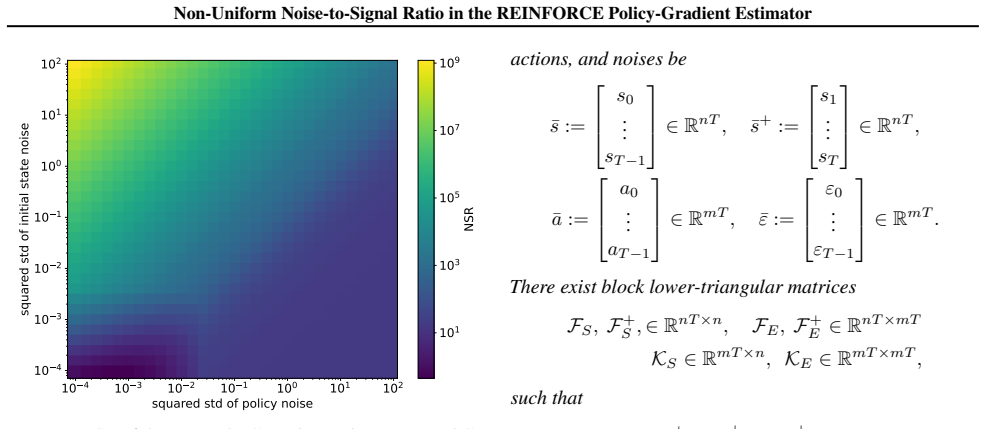
Summary. The paper studies the variance and noise-to-signal ratio (NSR) of the REINFORCE policy-gradient estimator in finite-horizon control problems. For linear-quadratic systems with linear-Gaussian policies, it derives exact expressions for the mean and second moment of the estimator via Gaussian Isserlis/Wick identities and a lifted-state representation (Theorems 3 and 5), with mean-gradient formulas in Eqs. (15)-(16). It extends exact Gaussian-moment evaluation to polynomial dynamics with polynomial feedback (Proposition 9) and gives variance upper bounds for general nonlinear systems (Theorem 10). Numerical experiments on LQG, polynomial, and MLP-policy systems show NSR increasing near optima and occasional policy collapse. The abstract and contributions also claim that NSR grows exponentially with horizon for unstable closed-loop dynamics.
Significance. If the exact-moment theorems hold, this is a useful contribution to policy-gradient variance analysis: it provides non-asymptotic, parameter-free characterizations (no fitted constants) for LQG and polynomial systems, and it identifies the initial-state covariance/policy-covariance scaling. The explicit gradient formulas and the lifted decomposition are valuable. The practical claim that NSR is highly non-uniform and worsens near optima is supported by the exact formulas in the examples. However, the exponential-horizon NSR claim is not established by the supplied bounds, and this weakens the paper's headline.
major comments (3)
- [§2.2, Theorems 7–8] The contribution list and Section 5 state that 'we prove the NSR can grow exponentially with the horizon when the closed-loop dynamics are unstable.' This is not supported by the proof chain. Theorem 7 gives upper bounds on Var_Fro(bG_K) and Var_Fro(bG_l); Theorem 8 bounds ||F_S||. NSR is Var_Fro(bG)/||∇J||^2. For ρ(F)>1, the true gradient in Eq. (15) contains P_t and Λ_{t+1}, both of which grow exponentially with T, so the denominator also grows exponentially. The Θ analysis in §2.2 absorbs all T- and F-dependence, so it cannot justify the horizon-growth statement. Figure 3 plots variance, not NSR. To retain the claim, the paper needs a lower bound on the variance and an upper bound on ||∇J||^2 in the same regime, or the claim should be downgraded to variance growth.
- [§2.2, Analysis of NSR after Theorem 7] The scaling statement '∥E[bGK]∥^2_F, ∥E[bGℓ]∥^2_2 = Θ((σ^2+σ0^2)^2) if they are nonzero' is not correct for the log-std gradient: Eq. (16) gives ∇ℓJ = -2 diag(Σ Σ γ^t(...)), whose squared norm is Θ(σ^4), independent of σ0. The subsequent NSR bound uses a denominator that omits this separate σ^4 contribution. The α→∞ conclusion may survive, but the Θ justification as written is wrong and needs to be rewritten. Moreover, non-degeneracy conditions for the gradients being nonzero are not stated, and NSR is undefined at the deterministic optimum (Corollary 6).
- [§2.2, Figure 3] Figure 3 and the sentence 'This verifies the prediction of Theorem 7 and 8. Thus, in long-horizon tasks, closed-loop instability can dramatically worsen the NSR' conflate variance with NSR. The figure shows true variance growth with T; it does not show NSR. If the gradient also grows exponentially, the figure is consistent with NSR remaining bounded. The authors should either plot NSR for these systems using the exact Theorem 5 procedure, or change the interpretation to variance growth.
minor comments (4)
- [Theorem 5] The theorem statement refers to equations in the proof for the exact decompositions. For a theorem claiming exact computation, these formulas should be restated as a standalone algorithm or proposition so the reader can verify them without reading the proof.
- [Theorem 10(ii)] The phrase 'where C is a constant' is unnecessarily vague; the proof gives C = 2T^2 sqrt(m(m+14)). State this explicitly.
- [Theorem 7] The proof bounds E[||bG||^2], not the variance itself. The inequality chain Var ≤ E[||bG||^2] is valid, but the theorem should make clear that it is a second-moment bound, which is why the derived NSR bound is only an upper bound.
- [Throughout] Notation is occasionally overloaded, e.g., the block covariance is written as Σ := I_T ⊗ Σ while Σ also denotes the per-step policy covariance. A bar or subscript would improve clarity. There are also minor typos such as 'F+S ,∈R^{nT×n}' in Theorem 4.
Circularity Check
No circularity: NSR formulas are derived from first principles, not fitted; the self-citations are contextual.
full rationale
I walked the derivation chain. The central claims (Theorems 3, 5, Proposition 9) compute the score-function gradients and the second moments directly: the gradients come from differentiating the expected return under the linear-Gaussian policy (Eqs. (6)-(7) and (15)-(16)), and the second moments come from expanding the REINFORCE estimator, using the lifted quadratic return decomposition R = -(x+2y+z) (Eqs. (10)-(14)), and applying Isserlis/Wick moment evaluation (Lemma 2, proved in Appendix C). No constant or parameter is fitted to data, and no target quantity (variance or NSR) is assumed. NSR is then assembled by its definition Var/||∇J||^2 from two independently derived pieces. The σ,σ0 scaling laws, including the σ→0 blow-up in the one-step case, follow algebraically from the E1,K term Θ(σ0^6/σ^2) divided by the gradient norm Θ(σ0^4); Corollary 6 follows from Eq. (16) with Qa≻0. Proposition 9 is a direct consequence of the fact that polynomial maps of Gaussians remain polynomial and Isserlis evaluates the resulting monomial moments; citing Magnus for this classical fact is not load-bearing. The self-citations (Han & Yang 2024; Muppidi et al. 2024) appear only in contextual remarks and do not carry the argument. I also checked the paper's own stated limitations: exactness is explicitly conditioned on centered Gaussian s0 and εt, and NSR is only reported away from stationary points; these are scope conditions, not circular inputs. The only substantive concern is a non-circular proof gap: the headline that NSR grows exponentially in T for unstable closed-loop systems is not fully established by Theorem 7, which upper-bounds only the variance, while the gradient denominator in NSR may itself grow with T through Pt and Λt. That is an over-claim or missing argument, but it is not a reduction of a prediction to its inputs, so it does not raise the circularity score.
Assumptions & free parameters
assumptions (6)
- standard math Isserlis/Wick theorem for Gaussian moments
- standard math Policy gradient lemma / score-function identity ∇θJ=E[∇θ log π R]
- domain assumption Centered Gaussian initial state and exploration noise
- domain assumption Finite-horizon, discounted MDP with rewards r(s_{t+1},a_t)
- domain assumption Q_a≻0 for Corollary 6 deterministic optimum
- domain assumption Finite fourth moments for Theorem 10
Cite this review
Pith. "Pith review of Non-Uniform Noise-to-Signal Ratio in the REINFORCE Policy-Gradient Estimator." pith.science (2026). https://pith.science/paper/KJW4776S
@misc{pith2026260201460,
  author       = {Pith},
  title        = {Pith review of: Non-Uniform Noise-to-Signal Ratio in the REINFORCE Policy-Gradient Estimator},
  year         = {2026},
  howpublished = {\url{https://pith.science/paper/KJW4776S}},
  note         = {Machine review of arXiv:2602.01460}
}
read the original abstract
Policy-gradient methods are widely used in reinforcement learning, yet training often becomes unstable or slows down as learning progresses. We study this phenomenon through the noise-to-signal ratio (NSR) of a policy-gradient estimator, defined as the estimator variance (noise) normalized by the squared norm of the true gradient (signal). Our main result is that, for (i) finite-horizon linear systems with Gaussian policies and linear state-feedback, and (ii) finite-horizon polynomial systems with Gaussian policies and polynomial feedback, the NSR of the REINFORCE estimator can be characterized exactly-either in closed form or via numerical moment-evaluation algorithms-without approximation. For general nonlinear dynamics and expressive policies (including neural policies), we further derive a general upper bound on the variance. These characterizations enable a direct examination of how NSR varies across policy parameters and how it evolves along optimization trajectories (e.g. SGD and Adam). Across a range of examples, we find that the NSR landscape is highly non-uniform and typically increases as the policy approaches an optimum; in some regimes it blows up, which can trigger training instability and policy collapse.
Figures


Figures from the paper (3 more)


Reference graph
Works this paper leans on
-
[2]
Plugging into (68) gives E[∥ bGℓ∥2 2]≤TE h (2∥Σ−1/2 ¯ε∥4 2+2mT)R(τ) 2 i
Therefore, T−1X t=0 ∥gt∥2 2≤2∥ Σ−1/2 ¯ε∥4 2+2mT. Plugging into (68) gives E[∥ bGℓ∥2 2]≤TE h (2∥Σ−1/2 ¯ε∥4 2+2mT)R(τ) 2 i . Assume the standard multi-step quadratic decomposition of the return R(τ) =−(x+ 2y+z), x:=s ⊤ 0 M sss0, y:=s ⊤ 0 M se ¯ε, z:= ¯ε⊤M ee ¯ε, Proof ofK-part expansion.Define S:=F ⊤ S FS, E:=F ⊤ E FE, Step 1: expand(⋆).Since∥F Ss0∥2 2=s ⊤ ...
-
[666]
PMLR, 2024. Henderson, P., Islam, R., Bachman, P., Pineau, J., Precup, D., and Meger, D. Deep reinforcement learning that mat- ters. InProceedings of the AAAI conference on artificial intelligence, volume 32, 2018. Ilyas, A., Engstrom, L., Santurkar, S., Tsipras, D., Janoos, F., Rudolph, L., and Madry, A. A closer look at deep policy gradients.arXiv prepr...
arXiv 2024
-
[1978]
Our setting involves a non-homogeneous polynomial, hence we state the following lemma
derives formulas for expectations of products of quadratic forms of the type E hQN i=1 (u⊤Aiu) i . Our setting involves a non-homogeneous polynomial, hence we state the following lemma. Lemma 11.Forξ∼ N(0, Im), define w(ξ) := mX i=1 (ξ2 i −1) 2. Then for anyu∈R m and anyM∈S m, E[w(ξ)] = 2m,(26) E[w(ξ) (ξ⊤u)2] = (2m+ 8)∥u∥ 2,(27) E[w(ξ) (ξ⊤M ξ)] = (2m+ 8) ...
Reviewed August 3, 2026 · model on record in the stance chip above.
Discussion (0). Continue with ORCID to comment.