Satellite Mission Planning with Rydberg Atoms
Pith reviewed 2026-06-26 08:16 UTC · model grok-4.3
The pith
Formulating satellite mission planning as a maximum independent set problem allows solution on a Rydberg-atom quantum processor.
A machine-rendered reading of the paper's core claim, the machinery that carries it, and where it could break.
Core claim
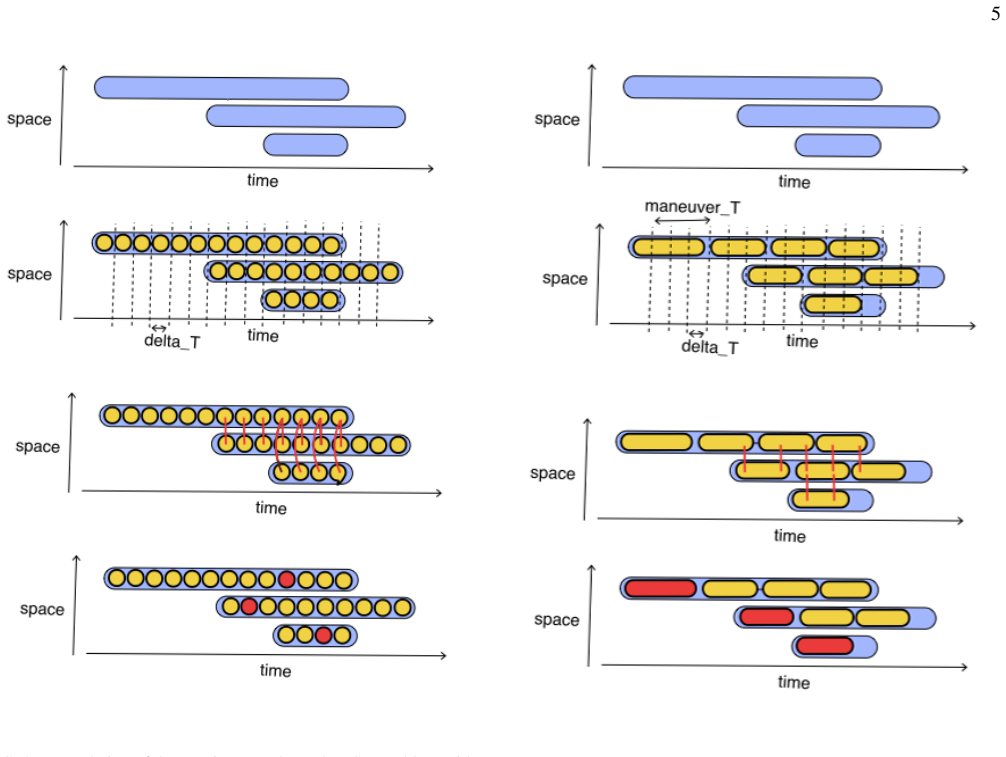
By formulating the planning problem as a Maximum Independent Set problem, we are able to solve the problem with a QPU based on Rydberg atoms. We explore two ways of solving the MIS problem on the QPU, one relying on the graphs and on the Quadratic Unconstrained Binary Optimization Framework (QUBO). We show that the QUBO methodology is the most relevant and explore it more deeply with numerical experiments.
What carries the argument
Reduction of satellite scheduling constraints to a Maximum Independent Set instance, solved on the Rydberg QPU via either direct graph methods or QUBO encoding.
If this is right
- Daily schedules for multi-satellite fleets become generatable by solving the MIS instance on the quantum device.
- Agility constraints remain compatible with the same MIS encoding.
- The QUBO formulation outperforms direct graph solving for this hardware.
- Rydberg QPUs become applicable to this class of combinatorial scheduling tasks.
Where Pith is reading between the lines
- If encoding overhead stays manageable at larger scales, quantum methods could shorten planning cycles for satellite operators.
- The same MIS reduction might transfer to other resource-allocation problems in space operations.
- Hybrid classical-quantum pipelines could appear, with the QPU handling the combinatorial core after classical preprocessing.
Load-bearing premise
Satellite scheduling constraints can be faithfully encoded into an MIS or QUBO instance whose solution on the Rydberg QPU yields a usable operational schedule without prohibitive overhead or approximation error.
What would settle it
Running the encoded MIS or QUBO instance on real Rydberg hardware and obtaining a schedule that violates agility limits, target coverage, or other operational constraints.
Figures




read the original abstract
Quantum computers relying on cold atoms are being built and promise a high flexibility in the way information in encoded into the physical system. In particular, the analog mode is spiking interest in the field of optimization as a classically intractable number of configurations can be tackled. In this work, we investigate a problem that requires every-day scheduling of critical tasks involving a large number of actors. Namely, fixing the planning for a Earth Observation satellite fleet composed of several of units exposed to a high density of targets to be scanned. We explore numerical schemes that convert the formulated problem into a cold-atoms friendly setup. We begin by a naive formulation of the Satellite Mission Planning problem without taking account for the agility of the satellites. We then extend the problem to take it into account based on the literature. By formulating the planning problem as a Maximum Independent Set problem, we are able to solve the problem with a QPU based on Rydberg atoms. We explore two ways of solving the MIS problem on the QPU, one relying on the graphs and on the Quadratic Unconstrained Binary Optimization Framework (QUBO). We show that the QUBO methodology is the most relevant and explore it more deeply with numerical experiments. We conclude on the potential utility of using a QPU to solve the Satellite Mission Planning problem in an operational context.
Editorial analysis
A structured set of objections, weighed in public.
Referee Report
Summary. The manuscript claims that the satellite mission planning problem for Earth-observation satellite fleets can be encoded as a Maximum Independent Set (MIS) instance (first in a naive form ignoring agility, then extended per literature), solved on a Rydberg-atom QPU either directly via the graph or via a QUBO mapping, that the QUBO route is preferable, and that numerical experiments support the potential operational utility of such QPUs.
Significance. If the encoding is faithful and the QPU experiments demonstrate scalable, accurate solutions on instances of operational size, the work would illustrate a concrete use-case for analog Rydberg hardware in combinatorial scheduling. The exploratory framing and focus on a practical domain are positive, but the absence of any quantitative results, error analysis, or classical baselines in the provided text limits the ability to assess whether a genuine advantage is shown.
major comments (2)
- [Numerical experiments (abstract)] The abstract states that numerical experiments were performed and that the QUBO methodology is 'the most relevant,' yet no problem sizes, success probabilities, runtime comparisons, or error metrics are supplied. Without these data it is impossible to verify whether the claimed preference for QUBO or the overall utility conclusion is supported.
- [Formulation and mapping (abstract)] The central mapping claim ('By formulating the planning problem as a Maximum Independent Set problem, we are able to solve the problem with a QPU') is presented without any description of how satellite-specific constraints (visibility windows, agility, target density) are encoded into the MIS/QUBO Hamiltonian or how solution quality is validated against the original scheduling semantics.
Simulated Author's Rebuttal
We thank the referee for their detailed and constructive report. We address the two major comments point by point below and indicate the revisions we will make to strengthen the manuscript.
read point-by-point responses
-
Referee: [Numerical experiments (abstract)] The abstract states that numerical experiments were performed and that the QUBO methodology is 'the most relevant,' yet no problem sizes, success probabilities, runtime comparisons, or error metrics are supplied. Without these data it is impossible to verify whether the claimed preference for QUBO or the overall utility conclusion is supported.
Authors: We agree that the abstract is insufficiently specific regarding the numerical experiments. The manuscript body contains the experiments (simulations and QPU runs) that led to the preference for the QUBO route, but the abstract does not report the supporting metrics. We will revise the abstract to include a concise summary of the tested instance sizes, observed success probabilities for the two mappings, and the classical baseline comparisons performed. revision: yes
-
Referee: [Formulation and mapping (abstract)] The central mapping claim ('By formulating the planning problem as a Maximum Independent Set problem, we are able to solve the problem with a QPU') is presented without any description of how satellite-specific constraints (visibility windows, agility, target density) are encoded into the MIS/QUBO Hamiltonian or how solution quality is validated against the original scheduling semantics.
Authors: The encoding procedure and validation approach are described in the main text: the naive MIS formulation maps targets to vertices with conflicts as edges; the agile extension augments the conflict graph using maneuver-time constraints drawn from the satellite-scheduling literature; visibility windows restrict the vertex set per satellite; and the QUBO is obtained from the MIS Ising Hamiltonian via the standard quadratic penalty transformation. Solution quality is checked by verifying that returned independent sets satisfy the original non-overlap and agility constraints when decoded back to schedules. We acknowledge that the abstract is too terse to convey these steps. We will add one or two sentences to the abstract (or a short paragraph in the introduction) that outline the constraint encoding and validation method. revision: yes
Circularity Check
No significant circularity; formulation is an application of known MIS/QUBO mapping
full rationale
The paper's core contribution is a direct encoding of satellite scheduling constraints into an MIS (or QUBO) instance for solution on a Rydberg-atom QPU, followed by numerical experiments comparing graph-based and QUBO approaches. No derivation step reduces by construction to its own inputs, no fitted parameters are relabeled as predictions, and no load-bearing uniqueness or ansatz is imported via self-citation. The work is self-contained as an exploratory mapping exercise with no internal reduction to tautology.
Axiom & Free-Parameter Ledger
Reference graph
Works this paper leans on
-
[1]
Early work [11, 12] discretized visi- bility time windows (DTOs) and applied B&B on directed graphs
Exact Methods To address this issue, two Exact Methods, Branch and Bound (B&B) and Mixed Integer Linear Programming (MILP) have been developed to provide optimal or near- optimal solutions. Early work [11, 12] discretized visi- bility time windows (DTOs) and applied B&B on directed graphs. More recent work [13] developed a deterministic MILP model offerin...
-
[2]
Heuristics Heuristics offer faster, though potentially suboptimal, solu- tions. These include: •Constructive heuristics, which build schedules step- by-step and are useful under complex operational con- straints (for example [16] work for the French Pleiades project). We can find methods like Greedy algorithm, Dynamic Programming method, Constraint Progra...
-
[3]
Metaheuristics These general frameworks adapt to complex problems and dominate the Agile Earth Observation Satellite Scheduling Problem (AEOSSP). Key methods include: •Evolutionary Algorithms, such as Genetic Algorithms (GA) and Ant Colony Optimization (ACO), which are popular for multi-objectives scheduling (e.g., profit maximization and fairness). For i...
-
[4]
Though currently limited in handling operational constraints, some promising approaches have emerged
Machine Learning Machine learning (ML) has growing potential in AEOSSP, especially for improving adaptability and autonomy in dy- namic environments. Though currently limited in handling operational constraints, some promising approaches have emerged. •Deep learning-based scheduling, like the Long Short- Term Memory (LSTM)-based model in [27], enables fas...
-
[5]
These multi-agent systems could also can be combined with learning-based techniques (like RL) for coopera- tive learning and task allocation
demonstrates the advantages of addressing the Earth observation satellite scheduling problem using a self-Adaptive Multi-Agent System (AMAS) approach. These multi-agent systems could also can be combined with learning-based techniques (like RL) for coopera- tive learning and task allocation. B. Quantum approaches Since the availability of quantum computin...
-
[6]
Each satellite will have a different trajectory, which will allow it to take a set of certain set of observations
Extracting Data Take Opportunities Let’s explain how the MIS can be used to solve the mis- sion planning problem. Each satellite will have a different trajectory, which will allow it to take a set of certain set of observations. For each satellite, we define the Data Take Op- portunity (DTO) as the time window during which a satellite can complete an requ...
-
[7]
Rydberg atoms reminders There are two ways to use Rydberg atoms. The digital gate- based mode is not implemented yet in the literature, and we instead focus on the analog one, which dynamics is described by the Ising model with the following Hamiltonian. ˆH(t) =ℏ NX i=1 Ω(t) 2 ˆσx i −δ(t) ˆni + X i<j C6 |ri −r j|6 ˆniˆnj (6) whereΩis the amplitude of the ...
-
[8]
, xN) = X i>j (Qij+Qji)xixj+ X i Qiixi ≡xQx T , (7) whereQis the QUBO matrix containing coefficients
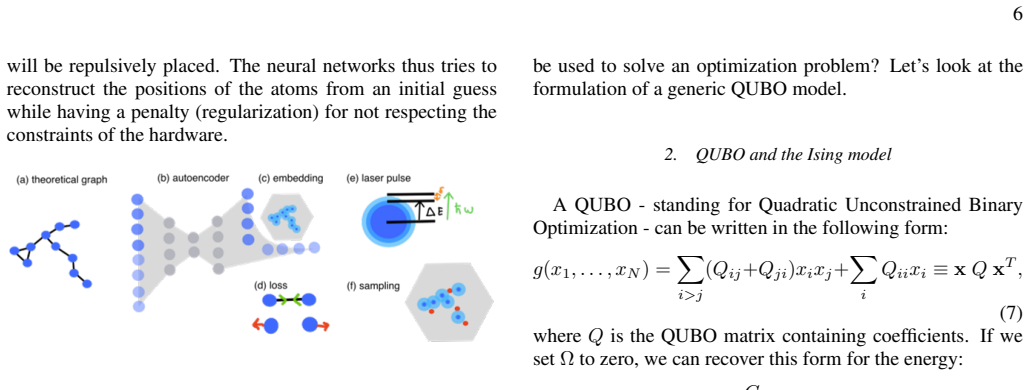
QUBO and the Ising model A QUBO - standing for Quadratic Unconstrained Binary Optimization - can be written in the following form: g(x1, . . . , xN) = X i>j (Qij+Qji)xixj+ X i Qiixi ≡xQx T , (7) whereQis the QUBO matrix containing coefficients. If we setΩto zero, we can recover this form for the energy: E(x1, . . . , xN) = X i>j C6 |ri −r j|6 xixj +δ X i ...
-
[9]
Minimization procedure In order to prepare such a fundamental state, we rely on a adiabatic methodology. There are two hypothesis: • If we prepare the system in the fundamental state of the Hamiltonian at hand • If we change the Hamiltonian sufficiently slowly com- pared to the energy gaps between the eigenmodes then, we can maintain the system in the fun...
-
[10]
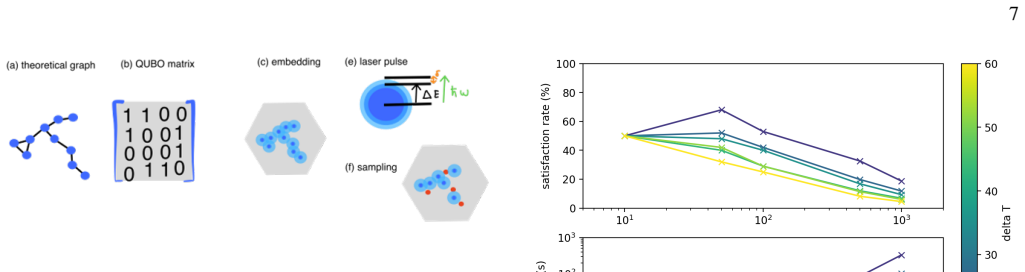
Implementation For the implementation, we follow this python packagehttps://github.com/pasqal-io/ qubo-solver. 7 FIG. 7. QUBO method (a) The solving graph is computed and (b,c) embedded onto the QPU respecting the constraints by considering edges as off diagonal terms of the QUBO matrix (d) The atom is impinged with a detuned laser with a given amplitude ...
-
[11]
Networkx First, the quick method contained in the NETWORKX python graph management package is provided, and can run to obtain base lines for our experiments. FIG. 8. Benchmark: classical. Top figure: global satisfaction rate. It represents the number of requests planned divided by the total num- ber of requests that were expected. As the number of request...
-
[12]
Both the autoencoder and the QUBO methods are supported
Rydberg Second, the Rydberg solvers implement routines to connect to the QPU, or emulate them locally. Both the autoencoder and the QUBO methods are supported. VI. NUMERICAL EXPERIMENTS
-
[13]
These virtual satellites will have to schedule an observation of a set ofN O cities during one day
Visiting cities In order to simplify the problem for the numerical experi- ments, we chooseN S virtual satellites that correspond to the trajectories of the ISS onN S different days. These virtual satellites will have to schedule an observation of a set ofN O cities during one day. Figure 1 illustrates the trajectory of three virtual satellites during one...
-
[14]
The impact of the number of satellites with the MIS strategy has already been covered by [5], so we fix the number of satellite to 3
Benchmark In order to benchmark our strategies, we design a dataset with random cities and fake satellites trajectories. The impact of the number of satellites with the MIS strategy has already been covered by [5], so we fix the number of satellite to 3. The number of requests per day varies from 10 to 2000. We also vary the discretization time step, whic...
2000
-
[15]
For the completion rates, all runs converge to a similar solution up to 1000 requests
-
[16]
There is one outlier for the QUBOSolver experiment with∆T= 30s
-
[17]
But hopefully we were able to retrieve the effective run FIG
The total time to solution is prohibitive as there was only one QPU available at the time of the simulations. But hopefully we were able to retrieve the effective run FIG. 10. Time vs subgraph size: agile method time in green, which are computed as total run time mi- nus waiting time for QPU availability
-
[18]
The effective run time increases with the number of re- quests because of the DECOMPOSE method used to split the graphs into smaller ones
-
[19]
We can expect that this will remain true for large numbers of requests
The slope of time to solution vs number of requests QPU solver is lower than the one for the emulations or classical solver. We can expect that this will remain true for large numbers of requests
-
[20]
Even though we do not report any speedup for now, we expect the future QPU generations to have a frequency of 10 orders of magnitudes higher, which could mean that in a near future we could expect to recover classical time to solution or maybe better ones. VII. CONCLUSION The goal of the work was to establish the potential utility of using a QPU based on ...
2021
-
[21]
Quantum computing with neutral atoms.Quantum, 4:327, 2020
Lo ¨ıc Henriet, Lucas Beguin, Adrien Signoles, Thierry Lahaye, Antoine Browaeys, Georges-Olivier Reymond, and Christophe Jurczak. Quantum computing with neutral atoms.Quantum, 4:327, 2020
2020
-
[22]
A comparison of techniques for scheduling earth-observing satel- lites
Al Globus, James Crawford, Jason Lohn, and Anna Pryor. A comparison of techniques for scheduling earth-observing satel- lites. InApplications of Artificial Intelligence Conference, 2004
2004
-
[23]
Graph colouring problems and their applications in scheduling.Periodica Polytechnica Electrical Engineering (Archives), 48(1-2):11–16, 2004
D ´aniel Marx. Graph colouring problems and their applications in scheduling.Periodica Polytechnica Electrical Engineering (Archives), 48(1-2):11–16, 2004
2004
-
[24]
A graph coloring algorithm for large scheduling problems.Journal of research of the national bu- reau of standards, 84(6):489, 1979
Frank Thomson Leighton. A graph coloring algorithm for large scheduling problems.Journal of research of the national bu- reau of standards, 84(6):489, 1979
1979
-
[25]
A maximum indepen- dent set method for scheduling earth-observing satellite constel- lations.Journal of Spacecraft and Rockets, 58(5):1416–1429, 2021
Duncan Eddy and Mykel J Kochenderfer. A maximum indepen- dent set method for scheduling earth-observing satellite constel- lations.Journal of Spacecraft and Rockets, 58(5):1416–1429, 2021
2021
-
[26]
An improved distributed algorithm for max- imal independent set
Mohsen Ghaffari. An improved distributed algorithm for max- imal independent set. InProceedings of the twenty-seventh annual ACM-SIAM symposium on Discrete algorithms, pages 270–277. SIAM, 2016
2016
-
[27]
Distributed approximation of max- imum independent set and maximum matching
Reuven Bar-Yehuda, Keren Censor-Hillel, Mohsen Ghaffari, and Gregory Schwartzman. Distributed approximation of max- imum independent set and maximum matching. InProceedings of the ACM Symposium on Principles of Distributed Comput- 10 ing, pages 165–174, 2017
2017
-
[28]
Density-friendly graph de- composition
Nikolaj Tatti and Aristides Gionis. Density-friendly graph de- composition. InProceedings of the 24th International Confer- ence on World Wide Web, pages 1089–1099, 2015
2015
-
[29]
Maximum inde- pendent set: Self-training through dynamic programming
Lorenzo Brusca, Lars CPM Quaedvlieg, Stratis Skoulakis, Grigorios G Chrysos, and V olkan Cevher. Maximum inde- pendent set: Self-training through dynamic programming. In Advances in neural information processing systems (NeurIPS), 2023
2023
-
[30]
Neural maximum independent set
Thomas Pontoizeau, Florian Sikora, Florian Yger, and Tristan Cazenave. Neural maximum independent set. InJoint Euro- pean Conference on Machine Learning and Knowledge Discov- ery in Databases, pages 223–237. Springer, 2021
2021
-
[31]
A new single model and derived algorithms for the satellite shot planning problem using graph theory concepts
Virginie Gabrel, Alain Moulet, C ´ecile Murat, and Vangelis Th Paschos. A new single model and derived algorithms for the satellite shot planning problem using graph theory concepts. Annals of Operations Research, 69(0):115–134, 1997
1997
-
[32]
Mathematical programming for earth observation satellite mission planning
Virginie Gabrel and C ´ecile Murat. Mathematical programming for earth observation satellite mission planning. InOperations research in space and air, pages 103–122. Springer, 2003
2003
-
[33]
Mixed-integer programming models for optimal con- stellation scheduling given cloud cover uncertainty.European Journal of Operational Research, 275(2):431–445, 2019
Christopher G Valicka, Deanna Garcia, Andrea Staid, Jean-Paul Watson, Gabriel Hackebeil, Sivakumar Rathinam, and Lewis Ntaimo. Mixed-integer programming models for optimal con- stellation scheduling given cloud cover uncertainty.European Journal of Operational Research, 275(2):431–445, 2019
2019
-
[34]
A branch and bound algorithm for agile earth observation satellite scheduling
Xiaogeng Chu, Yuning Chen, and Lining Xing. A branch and bound algorithm for agile earth observation satellite scheduling. Discrete Dynamics in Nature and Society, 2017(1):7345941, 2017
2017
-
[35]
Optimization-based scheduling method for agile earth- observing satellite constellation.Journal of Aerospace Infor- mation Systems, 15(11):611–626, 2018
Doo-Hyun Cho, Jun-Hong Kim, Han-Lim Choi, and Jaemyung Ahn. Optimization-based scheduling method for agile earth- observing satellite constellation.Journal of Aerospace Infor- mation Systems, 15(11):611–626, 2018
2018
-
[36]
Selecting and schedul- ing observations of agile satellites.Aerospace Science and Technology, 6(5):367–381, 2002
Michel Lemaitre, G ´erard Verfaillie, Frank Jouhaud, Jean- Michel Lachiver, and Nicolas Bataille. Selecting and schedul- ing observations of agile satellites.Aerospace Science and Technology, 6(5):367–381, 2002
2002
-
[37]
Autonomous planning for an agile earth-observing satel- lite
Gr ´egory Beaumet, G ´erard Verfaillie, Marie-Claire Charmeau, et al. Autonomous planning for an agile earth-observing satel- lite. InProc. ISAIRAS, pages 1–6. Citeseer, 2008
2008
-
[38]
An emergency task autonomous planning method of agile imaging satellite.EURASIP Journal on Image and Video Processing, 2018(1):29, 2018
Yanjie Song, Danjie Huang, Ziyu Zhou, and Yingwu Chen. An emergency task autonomous planning method of agile imaging satellite.EURASIP Journal on Image and Video Processing, 2018(1):29, 2018
2018
-
[39]
Preference-based evolutionary many-objective opti- mization for agile satellite mission planning.IEEE Access, 6:40963–40978, 2018
Longmei Li, Hao Chen, Jun Li, Ning Jing, and Michael Em- merich. Preference-based evolutionary many-objective opti- mization for agile satellite mission planning.IEEE Access, 6:40963–40978, 2018
2018
-
[40]
Agile earth observ- ing satellites mission planning using genetic algorithm based on high quality initial solutions
Zang Yuan, Yingwu Chen, and Renjie He. Agile earth observ- ing satellites mission planning using genetic algorithm based on high quality initial solutions. In2014 IEEE congress on evolu- tionary computation (CEC), pages 603–609. IEEE, 2014
2014
-
[41]
Bin Du, Shuang Li, Yuchen She, Wendan Li, He Liao, and Hongfei Wang. Area targets observation mission planning of agile satellite considering the drift angle constraint.Jour- nal of Astronomical Telescopes, Instruments, and Systems, 4(4):047002–047002, 2018
2018
-
[42]
Saturated and consistent neighborhood for selecting and scheduling photographs of agile earth observing satellite
Djamal Habet and Michel Vasquez. Saturated and consistent neighborhood for selecting and scheduling photographs of agile earth observing satellite. InProc. 5th Metaheuristics Int. Conf, volume 28, pages 1–6. Citeseer, 2003
2003
-
[43]
Maximizing the value of an earth observation satellite orbit.Journal of the Op- erational Research Society, 56(8):962–968, 2005
Jean-Franc ¸ois Cordeau and Gilbert Laporte. Maximizing the value of an earth observation satellite orbit.Journal of the Op- erational Research Society, 56(8):962–968, 2005. [24]http://www.roadef.org/challenge/2003/en/
2005
-
[44]
An adaptive large neighborhood search metaheuristic for agile satellite scheduling with time-dependent transition time.Com- puters & Operations Research, 86:41–53, 2017
Xiaolu Liu, Gilbert Laporte, Yingwu Chen, and Renjie He. An adaptive large neighborhood search metaheuristic for agile satellite scheduling with time-dependent transition time.Com- puters & Operations Research, 86:41–53, 2017
2017
-
[45]
An iterated local search algorithm for agile earth observation satellite scheduling problem
Guansheng Peng, Pieter Vansteenwegen, Xiaolu Liu, Lining Xing, and Xianglong Kong. An iterated local search algorithm for agile earth observation satellite scheduling problem. In2018 SpaceOps Conference, page 2311, 2018
2018
-
[46]
On- board observation task planning for an autonomous earth ob- servation satellite using long short-term memory.IEEE access, 6:65118–65129, 2018
Shuang Peng, Hao Chen, Chun Du, Jun Li, and Ning Jing. On- board observation task planning for an autonomous earth ob- servation satellite using long short-term memory.IEEE access, 6:65118–65129, 2018
2018
-
[47]
A data-driven parallel scheduling approach for multiple agile earth observation satellites.IEEE Transac- tions on Evolutionary Computation, 24(4):679–693, 2019
Yonghao Du, Tao Wang, Bin Xin, Ling Wang, Yingguo Chen, and Lining Xing. A data-driven parallel scheduling approach for multiple agile earth observation satellites.IEEE Transac- tions on Evolutionary Computation, 24(4):679–693, 2019
2019
-
[48]
Deep reinforcement learning for the agile earth observation satellite scheduling problem.Mathematics, 11(19):4059, 2023
Jie Chun, Wenyuan Yang, Xiaolu Liu, Guohua Wu, Lei He, and Lining Xing. Deep reinforcement learning for the agile earth observation satellite scheduling problem.Mathematics, 11(19):4059, 2023
2023
-
[49]
Dynamic mission plan- ning performances for agile earth observing satellites with adaptive multi-agent system
Benjamin Marchand, Benjamin Francesconi, Adrien Girard, Elsy Kaddoum, and Alexandre Perles. Dynamic mission plan- ning performances for agile earth observing satellites with adaptive multi-agent system. InInternational Workshop on Planning & Scheduling for Space (IWPSS 2025), 2025
2025
-
[50]
Quantum algorithms applied to satellite mission planning for earth observation, 2023
Serge Rainjonneau, Igor Tokarev, Sergei Iudin, Saaketh Rayaprolu, Karan Pinto, Daria Lemtiuzhnikova, Miras Koblan, Egor Barashov, Mohammad Kordzanganeh, Markus Pflitsch, and Alexey Melnikov. Quantum algorithms applied to satellite mission planning for earth observation, 2023
2023
-
[51]
Ag- ile earth observation satellite scheduling with a quantum an- nealer.IEEE Transactions on Aerospace and Electronic Sys- tems, 57(5):3520–3528, 2021
Tobias Stollenwerk, Vincent Michaud, Elisabeth Lobe, Math- ieu Picard, Achim Basermann, and Thierry Botter. Ag- ile earth observation satellite scheduling with a quantum an- nealer.IEEE Transactions on Aerospace and Electronic Sys- tems, 57(5):3520–3528, 2021
2021
-
[52]
Quantum optimization methods for satellite mission planning.IEEE Access, 12:71808–71820, 2024
Ant ´on Makarov, Carlos P ´erez-Herrad´on, Giacomo Franceschetto, M ´arcio M Taddei, Eneko Osaba, Paloma del Barrio Cabello, Esther Villar-Rodriguez, and Izaskun Oregi. Quantum optimization methods for satellite mission planning.IEEE Access, 12:71808–71820, 2024
2024
-
[53]
Neural-powered unit disk graph em- bedding: qubits connectivity for some qubo problems
Chiara Vercellino, Paolo Viviani, Giacomo Vitali, Alberto Scionti, Andrea Scarabosio, Olivier Terzo, Edoardo Giusto, and Bartolomeo Montrucchio. Neural-powered unit disk graph em- bedding: qubits connectivity for some qubo problems. In2022 IEEE International Conference on Quantum Computing and Engineering (QCE), pages 186–196, 2022
2022
discussion (0)
Sign in with ORCID, Apple, or X to comment. Anyone can read and Pith papers without signing in.