Q-RAIL: A Reliability-Aware Framework for Quantum Federated Learning on Heterogeneous Noisy Hardware
Pith reviewed 2026-06-29 21:38 UTC · model grok-4.3
The pith
Q-RAIL weights quantum federated learning updates by client-specific noise budgets to improve accuracy on heterogeneous NISQ hardware.
A machine-rendered reading of the paper's core claim, the machinery that carries it, and where it could break.
Core claim
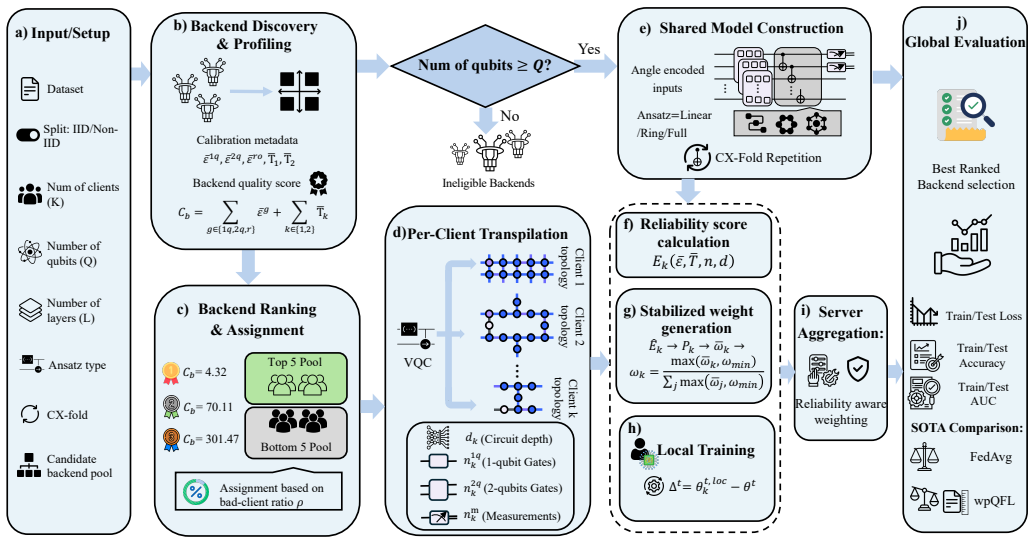
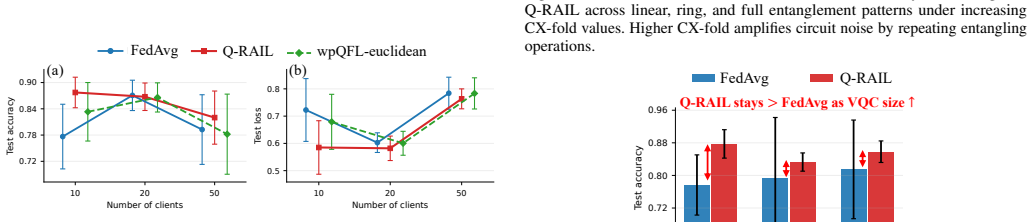
Q-RAIL computes a client-specific effective noise budget from backend calibration metadata together with transpiled circuit statistics. This budget is converted into stabilized aggregation weights using temperature scaling, uniform mixing, and a minimum-weight floor. On the primary MNIST benchmark under strong hardware skew, Q-RAIL improves final test accuracy from FedAvg's 0.777 to 0.877.
What carries the argument
Client-specific effective noise budget from calibration metadata and transpiled circuit statistics, used to derive temperature-scaled aggregation weights.
Load-bearing premise
The effective noise budget from calibration metadata and circuit statistics serves as a reliable indicator of how much a client's update will help the global model.
What would settle it
An experiment in which clients with low computed noise budgets produce updates that degrade the aggregated model more than high-noise clients, causing the weighted scheme to underperform uniform averaging.
Figures

read the original abstract
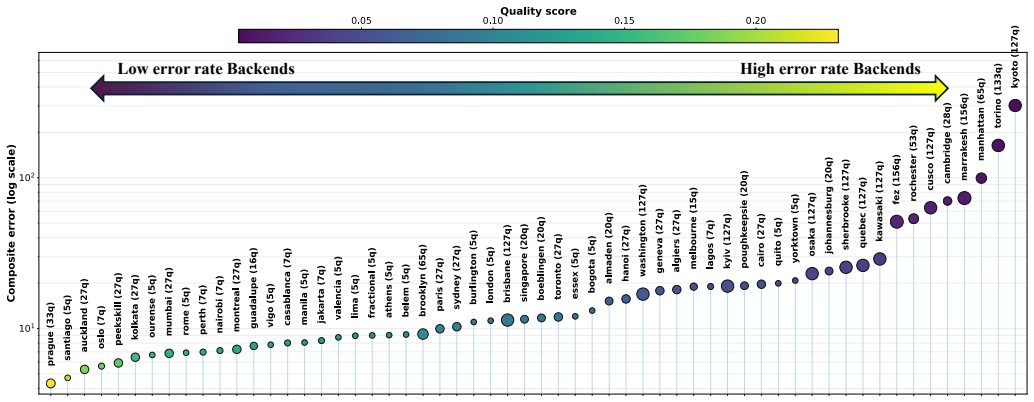
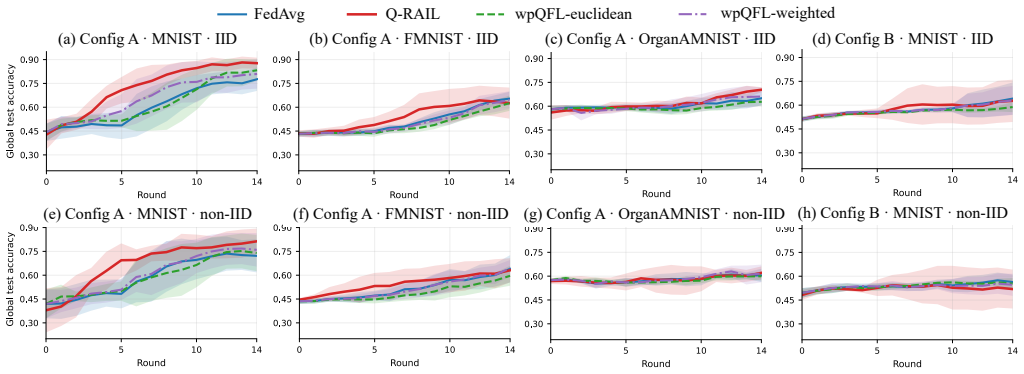
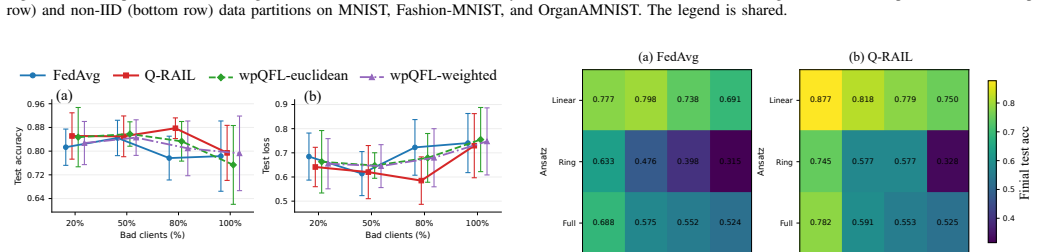
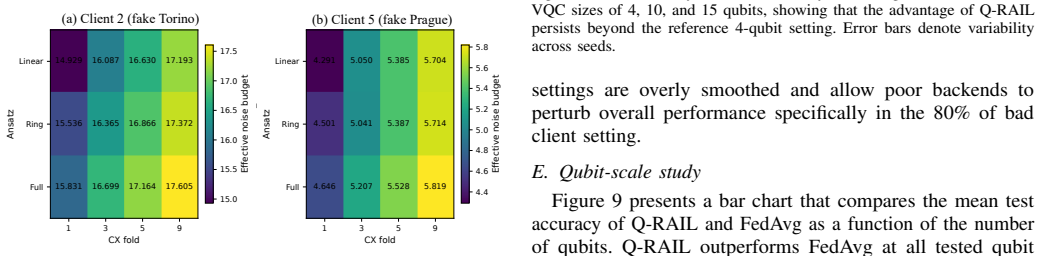
Quantum federated learning (QFL) on NISQ hardware is highly sensitive to backend heterogeneity: some clients contribute informative updates, while others contribute noise-dominated drift that uniform averaging cannot distinguish. We propose Q-RAIL (Quantum Reliability-Aware Federated Inference and Learning), a circuit- and calibration-aware aggregation method for hardware-heterogeneous QFL. Q-RAIL computes a client-specific effective noise budget from backend calibration metadata together with transpiled circuit statistics. This budget is converted into stabilized aggregation weights using temperature scaling, uniform mixing, and a minimum-weight floor. Q-RAIL was evaluated across multiple experimental settings, including an ablation study, and benchmarked against state-of-the-art methods on three datasets: MNIST, Fashion-MNIST, and OrganAMNIST. On the primary MNIST benchmark under strong hardware skew, Q-RAIL improves final test accuracy from FedAvg's 0.777 to 0.877, a +10.0-point gain corresponding to about 44.8% relative error reduction, while also exceeding the strongest wpQFL baseline (0.833). At the same time, test loss drops from 0.722 to 0.585, and test AUC rises from 0.920 to 0.973. Under non-IID MNIST, Q-RAIL reaches 0.813 vs 0.722 for FedAvg. It also outperforms FedAvg in 12/12 ansatz/CX-fold stress configurations and remains stronger at 4, 10, and 15 qubit setups. Overall, the results support calibration-driven, circuit-aware aggregation as a practical path toward robust QFL on heterogeneous quantum hardware.
Editorial analysis
A structured set of objections, weighed in public.
Referee Report
Summary. The paper introduces Q-RAIL, a reliability-aware aggregation framework for quantum federated learning on heterogeneous NISQ hardware. It derives client-specific effective noise budgets from backend calibration metadata and transpiled circuit statistics, converts these into temperature-scaled aggregation weights with uniform mixing and a minimum-weight floor, and reports empirical results on MNIST, Fashion-MNIST, and OrganAMNIST. On the primary MNIST benchmark under strong hardware skew, it claims a test accuracy increase from 0.777 (FedAvg) to 0.877, with corresponding drops in loss and rises in AUC, plus consistent outperformance across ablations, non-IID settings, and 12/12 ansatz/CX-fold configurations.
Significance. If the central proxy assumption holds, Q-RAIL provides a practical, calibration-driven approach to robust QFL that directly addresses hardware heterogeneity, a key barrier on NISQ devices. The ablation study and cross-configuration stress tests (including 4/10/15 qubit setups) are positive empirical features that would support broader adoption if the gains prove robust. The work is entirely empirical with no machine-checked proofs or parameter-free derivations.
major comments (2)
- [Abstract] Abstract: the headline claim of a +10.0-point accuracy gain (0.777 to 0.877, 44.8% relative error reduction) and outperformance versus wpQFL (0.833) is presented as point estimates with no error bars, statistical tests, data-split details, or full hyperparameter tables; this directly affects assessment of whether the reported deltas are reliable.
- [Weighting scheme description] Weighting scheme description: the method's rationale rests on the effective noise budget serving as a faithful proxy for client update informativeness, yet no direct validation is supplied (e.g., per-client correlation of the derived weight with measured update divergence, per-client accuracy, or gradient alignment); without this, the ablation results cannot distinguish the specific proxy from any monotonic function of circuit depth or CX count.
minor comments (2)
- The abstract states outperformance in 12/12 configurations and at multiple qubit counts but does not enumerate the configurations or provide a summary table; adding one would improve clarity.
- Reproducibility would benefit from explicit statements on random seeds, exact data partitioning for the non-IID MNIST case, and the precise form of the temperature scaling and minimum-weight floor.
Simulated Author's Rebuttal
We thank the referee for their constructive and detailed feedback. We address each major comment below and commit to revisions that strengthen the empirical presentation of our results.
read point-by-point responses
-
Referee: [Abstract] Abstract: the headline claim of a +10.0-point accuracy gain (0.777 to 0.877, 44.8% relative error reduction) and outperformance versus wpQFL (0.833) is presented as point estimates with no error bars, statistical tests, data-split details, or full hyperparameter tables; this directly affects assessment of whether the reported deltas are reliable.
Authors: We agree that presenting only point estimates in the abstract limits evaluation of result reliability. In the revision we will rerun the primary MNIST experiments across 5 independent random seeds, report mean ± standard deviation for accuracy, loss, and AUC, include p-values or confidence intervals for the key deltas versus FedAvg and wpQFL, add data-split details, and provide a supplementary hyperparameter table. These changes will be reflected in both the abstract and the results section. revision: yes
-
Referee: [Weighting scheme description] Weighting scheme description: the method's rationale rests on the effective noise budget serving as a faithful proxy for client update informativeness, yet no direct validation is supplied (e.g., per-client correlation of the derived weight with measured update divergence, per-client accuracy, or gradient alignment); without this, the ablation results cannot distinguish the specific proxy from any monotonic function of circuit depth or CX count.
Authors: We acknowledge that the current ablations do not include explicit per-client correlation analysis between the derived effective noise budget and update-quality metrics, leaving open the possibility that performance gains could arise from any monotonic function of circuit statistics. In the revised manuscript we will add a dedicated analysis (new figure and table) that computes, for each client, the Pearson correlation between the Q-RAIL weight and (i) KL divergence of the client update from the global model, (ii) cosine similarity of client gradients, and (iii) per-client contribution to test accuracy. This will directly test the informativeness-proxy assumption and differentiate it from simpler depth- or CX-based weighting. revision: yes
Circularity Check
No circularity; empirical method benchmarked against external baselines
full rationale
The paper presents Q-RAIL as a heuristic aggregation rule that computes client weights from external calibration metadata and transpiled circuit statistics, then applies temperature scaling and a floor. No equations or claims reduce a derived quantity to a fitted parameter defined by the paper itself, nor do any load-bearing steps rely on self-citations for uniqueness theorems or ansatzes. All performance claims rest on direct comparisons to FedAvg and wpQFL on MNIST, Fashion-MNIST, and OrganAMNIST under stated hardware skew conditions, making the evaluation self-contained against independent benchmarks.
Axiom & Free-Parameter Ledger
Reference graph
Works this paper leans on
-
[1]
Federated quantum machine learning,
S. Y .-C. Chen and S. Yoo, “Federated quantum machine learning,” Entropy, 2021
2021
-
[2]
A review of applications in federated learning,
L. Li, Y . Fan, M. Tse, and K.-Y . Lin, “A review of applications in federated learning,”Computers & Industrial Engineering, vol. 149, p. 106854, 2020
2020
-
[3]
The effects of quantum hardware properties on the performances of variational quantum learning algorithms,
G. Buonaiuto, F. Gargiulo, G. De Pietro, M. Esposito, and M. Pota, “The effects of quantum hardware properties on the performances of variational quantum learning algorithms,”Quantum Machine Intelligence, vol. 6, no. 1, p. 9, 2024
2024
-
[4]
Cloud quantum computing concept and development: a systematic literature review,
H. Soeparno and A. S. Perbangsa, “Cloud quantum computing concept and development: a systematic literature review,”Procedia Computer Science, vol. 179, pp. 944–954, 2021
2021
-
[5]
Communication-efficient learning of deep networks from decentralized data,
B. McMahan, E. Moore, D. Ramage, S. Hampson, and B. A. y Arcas, “Communication-efficient learning of deep networks from decentralized data,” inArtificial intelligence and statistics. Pmlr, 2017, pp. 1273–1282
2017
-
[6]
Federated optimization in heterogeneous networks,
T. Li, A. K. Sahu, M. Zaheer, M. Sanjabi, A. Talwalkar, and V . Smith, “Federated optimization in heterogeneous networks,”Proceedings of Machine learning and systems, vol. 2, pp. 429–450, 2020
2020
-
[7]
Tifl: A tier-based federated learning system,
Z. Chai, A. Ali, S. Zawad, S. Truex, A. Anwar, N. Baracaldo, Y . Zhou, H. Ludwig, F. Yan, and Y . Cheng, “Tifl: A tier-based federated learning system,” inProceedings of the 29th international symposium on high- performance parallel and distributed computing, 2020, pp. 125–136
2020
-
[8]
Scaffold: Stochastic controlled averaging for federated learning,
S. P. Karimireddy, S. Kale, M. Mohri, S. Reddi, S. Stich, and A. T. Suresh, “Scaffold: Stochastic controlled averaging for federated learning,” inInternational conference on machine learning. PMLR, 2020, pp. 5132–5143
2020
-
[9]
Quantum computing in the nisq era and beyond,
J. Preskill, “Quantum computing in the nisq era and beyond,”Quantum, vol. 2, p. 79, 2018
2018
-
[10]
Transpilation defaults and configuration options,
IBM Quantum, “Transpilation defaults and configuration options,” https: //qiskit.qotlabs.org/docs/guides/defaults-and-configuration-options, 2024, accessed: 2026-04-11
2024
-
[11]
Representing quantum computers for the transpiler,
——, “Representing quantum computers for the transpiler,” https://qiskit. qotlabs.org/docs/guides/represent-quantum-computers, 2024, accessed: 2026-04-11
2024
-
[12]
View backend details,
——, “View backend details,” https://qiskit.qotlabs.org/docs/guides/ qpu-information, 2024, accessed: 2026-04-11
2024
-
[13]
Quantum federated learning with quantum data,
M. Chehimi and W. Saad, “Quantum federated learning with quantum data,” inICASSP 2022-2022 IEEE International Conference on Acoustics, Speech and Signal Processing (ICASSP). IEEE, 2022, pp. 8617–8621
2022
-
[14]
Quantum federated learning: a comprehensive literature review of foundations, challenges, and future directions,
R. Ballester, J. Cerquides, and L. Artiles, “Quantum federated learning: a comprehensive literature review of foundations, challenges, and future directions,”Quantum Machine Intelligence, vol. 7, no. 2, p. 73, 2025
2025
-
[15]
Experimentally validated quantum-secure federated learning over a multi-user quantum network
Z.-P. Liu, X.-Y . Cao, H.-W. Liu, X.-R. Sun, Y . Bao, Y .-S. Lu, H.-L. Yin, and Z.-B. Chen, “Practical quantum federated learning and its experimental demonstration,”arXiv preprint arXiv:2501.12709, 2025
work page internal anchor Pith review Pith/arXiv arXiv 2025
-
[16]
Target (v2.0),
IBM Quantum, “Target (v2.0),” https://quantum.cloud.ibm.com/docs/en/ api/qiskit/2.0/qiskit.transpiler.Target, 2024, accessed: 2026-04-11
2024
-
[17]
Introduction to transpilation,
——, “Introduction to transpilation,” https://qiskit.qotlabs.org/docs/ guides/transpile, 2024, accessed: 2026-04-12
2024
-
[18]
Toward heterogeneous quantum federated learning: Challenges and solutions,
R. Rahman, D. C. Nguyen, C. K. Thomas, and W. Saad, “Toward heterogeneous quantum federated learning: Challenges and solutions,” IEEE Network, 2025
2025
-
[19]
Introduction to quantum noise, measurement, and amplification,
A. A. Clerk, M. H. Devoret, S. M. Girvin, F. Marquardt, and R. J. Schoelkopf, “Introduction to quantum noise, measurement, and amplification,”Reviews of Modern Physics, vol. 82, no. 2, pp. 1155–1208, 2010
2010
-
[20]
Quantum machine learning,
J. Biamonte, P. Wittek, N. Pancotti, P. Rebentrost, N. Wiebe, and S. Lloyd, “Quantum machine learning,”Nature, vol. 549, no. 7671, pp. 195–202, 2017
2017
-
[21]
Variational quantum algorithms,
M. Cerezo, A. Arrasmith, R. Babbush, S. C. Benjamin, S. Endo, K. Fujii, J. R. McClean, K. Mitarai, X. Yuan, L. Cincioet al., “Variational quantum algorithms,”Nature Reviews Physics, vol. 3, no. 9, pp. 625–644, 2021
2021
-
[22]
Evaluating the noise resilience of variational quantum algorithms,
E. Fontana, N. Fitzpatrick, D. M. Ramo, R. Duncan, and I. Rungger, “Evaluating the noise resilience of variational quantum algorithms,” Physical Review A, vol. 104, no. 2, p. 022403, 2021
2021
-
[23]
Investigating the effect of noise on the training performance of hybrid quantum neural networks,
M. Kashif, E. Sychiuco, and M. Shafique, “Investigating the effect of noise on the training performance of hybrid quantum neural networks,” in2024 International Joint Conference on Neural Networks (IJCNN). IEEE, 2024, pp. 1–10
2024
-
[24]
Federated learning with matched averaging,
H. Wang, M. Yurochkin, Y . Sun, D. Papailiopoulos, and Y . Khazaeni, “Federated learning with matched averaging,”arXiv preprint arXiv:2002.06440, 2020
-
[25]
Fedfa: Federated feature augmentation,
T. Zhou and E. Konukoglu, “Fedfa: Federated feature augmentation,” arXiv preprint arXiv:2301.12995, 2023
-
[26]
Performance analysis and design of a weighted personalized quantum federated learning,
D. Gurung and S. R. Pokhrel, “Performance analysis and design of a weighted personalized quantum federated learning,”IEEE Transactions on Artificial Intelligence, 2025
2025
-
[27]
Sporadic federated learning approach in quantum environment to tackle quantum noise,
R. Rahman, A. Pokharel, and D. C. Nguyen, “Sporadic federated learning approach in quantum environment to tackle quantum noise,” in Proceedings of the Computer Vision and Pattern Recognition Conference, 2025, pp. 1829–1838
2025
-
[28]
Tackling heterogeneity in quantum federated learning: An integrated sporadic-personalized approach,
R. Rahman, S. Shaon, and D. C. Nguyen, “Tackling heterogeneity in quantum federated learning: An integrated sporadic-personalized approach,”IEEE Transactions on Computers, 2026
2026
-
[29]
Qfal: Quantum federated adversarial learning,
W. E. Maouaki, N. Innan, A. Marchisio, T. Said, M. Bennai, and M. Shafique, “Qfal: Quantum federated adversarial learning,”arXiv preprint arXiv:2502.21171, 2025
-
[30]
Robqfl: Robust quantum federated learning in adversarial environment,
W. El Maouaki, N. Innan, A. Marchisio, T. Said, M. Shafique, and M. Bennai, “Robqfl: Robust quantum federated learning in adversarial environment,” in2025 IEEE International Conference on Quantum Artificial Intelligence (QAI). IEEE, 2025, pp. 128–134
2025
-
[31]
Designing robust quantum neural networks via optimized circuit metrics,
W. El Maouaki, A. Marchisio, T. Said, M. Shafique, and M. Bennai, “Designing robust quantum neural networks via optimized circuit metrics,” Advanced Quantum Technologies, vol. 8, no. 6, p. 2400601, 2025
2025
-
[32]
Advqunn: A methodology for analyzing the adversarial robustness of quanvolutional neural networks,
W. El Maouaki, A. Marchisio, T. Said, M. Bennai, and M. Shafique, “Advqunn: A methodology for analyzing the adversarial robustness of quanvolutional neural networks,” in2024 IEEE International Conference on Quantum Software (QSW). IEEE, 2024, pp. 175–181
2024
-
[33]
Fakeproviderforbackendv2 (latest version),
IBM Quantum, “Fakeproviderforbackendv2 (latest version),” https://quantum.cloud.ibm.com/docs/en/api/qiskit-ibm-runtime/ fake-provider-fake-provider-for-backend-v2, 2024, accessed: 2026-04- 12
2024
-
[34]
Gradient-based learning applied to document recognition,
Y . LeCun, L. Bottou, Y . Bengio, and P. Haffner, “Gradient-based learning applied to document recognition,”Proceedings of the IEEE, vol. 86, no. 11, pp. 2278–2324, 1998
1998
-
[35]
Fashion-MNIST: a Novel Image Dataset for Benchmarking Machine Learning Algorithms
H. Xiao, K. Rasul, and R. V ollgraf, “Fashion-mnist: a novel image dataset for benchmarking machine learning algorithms,”arXiv preprint arXiv:1708.07747, 2017
work page internal anchor Pith review Pith/arXiv arXiv 2017
-
[36]
Medmnist v2: A large-scale lightweight benchmark for 2d and 3d biomedical image classification,
J. Yang, R. Shi, D. Wei, Z. Liu, L. Zhao, B. Ke, H. Pfister, and B. Ni, “Medmnist v2: A large-scale lightweight benchmark for 2d and 3d biomedical image classification,”Scientific Data, vol. 10, no. 1, p. 41, 2023
2023
-
[37]
Medmnist classification decathlon: A lightweight automl benchmark for medical image analysis,
J. Yang, R. Shi, and B. Ni, “Medmnist classification decathlon: A lightweight automl benchmark for medical image analysis,” inIEEE 18th International Symposium on Biomedical Imaging (ISBI), 2021, pp. 191–195
2021
-
[38]
A bayesian analysis of some nonparametric problems,
T. S. Ferguson, “A bayesian analysis of some nonparametric problems,” The Annals of Statistics, vol. 1, no. 2, pp. 209–230, 1973
1973
discussion (0)
Sign in with ORCID, Apple, or X to comment. Anyone can read and Pith papers without signing in.