REVIEW 3 major objections 5 minor 1 cited by
Gauge-symmetric Pauli pools make deterministic QITE accurate to 0.1% on Z2 lattice gauge theories.
Reviewed by Pith at T0; open to challenge. T0 means a machine referee read the full paper against a public rubric. the ladder, T0–T4 →
T0 review · deepseek-v4-flash
2026-08-02 15:54 UTC pith:KMLHOU5X
load-bearing objection Useful Pauli-pool reduction formulas and a careful QITE benchmark, but the headline <0.1% claim overreaches the data at the high-coupling, large-size corner. the 3 major comments →
Ground state preparation in (2+1)-dimensional pure mathbb{Z}₂ lattice gauge theory via deterministic quantum imaginary time evolution
The pith
A machine-rendered reading of the paper's core claim, the machinery that carries it, and where it could break.
Core claim
The paper establishes that deterministic QITE, with a gauge-symmetry-reduced Pauli pool of weight four, prepares the ground state of pure Z2 lattice gauge theory in 2+1 dimensions with a relative energy error below 0.1% for ladders with up to twelve plaquettes and couplings λ in [0.5, 5.0]. This accuracy holds even though the pool is chosen heuristically and is far smaller than the full Pauli set; the reduction to P_G,odd preserves gauge invariance exactly and cuts both measurement and gate costs. The error increases slowly with system size and, at larger coupling, no longer decreases with Δτ, pointing to the unitary approximation error as the limiting factor.
What carries the argument
The central object is the reduced Pauli pool P_G,odd: Pauli strings on the link-support D that (i) commute with every Gauss-law generator, meaning their Y/Z support lies on closed loops, and (ii) contain an odd number of Y operators. Its size is |P_G,odd| = 2^{n_link(D)-1}(2^{n_plaq(D)}-1), and quotienting by bulk Gauss operators divides this further by 2^{n_G(D)}. This pool defines the unitary e^{-iΔτ A_P} that approximates each imaginary-time step, keeps the evolved state gauge-invariant, and shrinks the one-plaquette pool from 255 to 8 operators – directly reducing the measurement and gate overhead that typically bottlenecks QITE.
Load-bearing premise
The weight-four Pauli pool, chosen heuristically rather than from a proven bound, is large enough to approximate the imaginary-time step e^{-Δτ h} at couplings up to λ=5; if it is not, the <0.1% agreement collapses as the unitary approximation error grows.
What would settle it
Repeat the (6,3), λ=2.0 run at Δτ=0.003 and compare QITE to ITE: if the gap does not shrink, the unitary-approximation floor from the weight-4 pool is confirmed. To rule out MPS artifacts, double the bond dimension; if energies shift above the 0.1% threshold, the claim needs revision.
If this is right
- The reduced pool P_G,odd makes QITE gauge-invariant by construction, so symmetry is preserved even when coefficients are noisy.
- For a one-plaquette support the Pauli pool shrinks from 255 to 8 operators, and for larger supports the reduction is even steeper, lowering the measurement overhead from exponential in all links to exponential only in the number of plaquettes.
- In the studied ladder geometries (N_y=3, up to N_x=7), the QITE energy matches DMRG to <0.1% for λ ∈ [0.5, 5.0].
- The QITE-specific error is controlled by Δτ at weak coupling, but saturates at stronger coupling (λ=2), pointing to the Pauli pool support as the limiting factor.
- The error grows only mildly with system size, suggesting the method is not immediately limited by lattice size in this parameter range.
Where Pith is reading between the lines
- If the weight-4 pool remains adequate at larger lattice sizes, near-term quantum hardware could prepare these gauge-theory ground states with a small constant number of measurements per step, since the reduced pool eliminates the exponential measurement overhead.
- The quotient-group reduction (dividing by bulk Gauss operators) suggests the effective cost scales with the number of plaquettes rather than links for large interiors; verifying that on a genuine 2D patch of 4x4 plaquettes would test this.
- A direct test of the saturation hypothesis: increasing the Pauli pool weight (e.g., from 4 to 6) at fixed λ=2.0 should lower the error floor seen in Fig. 5; the paper leaves this to future work.
- The ladder geometry (N_y=3) is quasi-1D; extending to full 2D with N_y=4 may increase the pool weight needed, so the 0.1% accuracy should be re-checked rather than assumed to carry over.
Editorial analysis
A structured set of objections, weighed in public.
Referee Report
Summary. The manuscript applies the deterministic quantum imaginary time evolution (QITE) algorithm of Motta et al. to the (2+1)-dimensional pure Z2 lattice gauge theory on a square lattice with open boundary conditions. It constructs a Pauli pool that is compatible with Gauss's law and the odd-Y parity condition, generalizing a previous result to arbitrary supports, and derives counting formulas for the reduced and quotient pools (Eqs. (39) and (41)). The paper reports tensor-network (TEBD) simulations of QITE for ladder geometries with N_y^site=3, N_x^site=3,...,7, comparing against Suzuki-Trotterized imaginary time evolution and DMRG on the dual transverse-field Ising model. The central numerical claim is that relative energy errors below 0.1% are achieved for couplings 0.5≤λ≤5.0 up to twelve plaquettes (N_link=32), with an analysis of the dependence on time step and system size.
Significance. The resource-counting results are a useful extension of Ref. [27]: Eq. (39) reduces a one-plaquette Pauli pool from 255 to 8 operators, and Eq. (41) gives a further reduction for bulk Gauss-law generators. The numerical methodology is sound in structure: the QITE coefficients are obtained by solving the linear system (10)-(11) from instantaneous expectation values, no parameter is fitted to the DMRG energy, and the DMRG reference is independently constructed through the exact Wegner duality. The TEBD/ITE comparison appropriately separates the QITE-specific unitary-approximation error from Trotter error. If the 0.1% accuracy claim is established over the full stated regime, the paper demonstrates a practical and resource-reduced route to ground-state preparation in a small two-dimensional Z2 gauge theory, relevant for near-term quantum simulators. The main weakness is that the claimed coupling-size corner of the parameter regime is not actually simulated.
major comments (3)
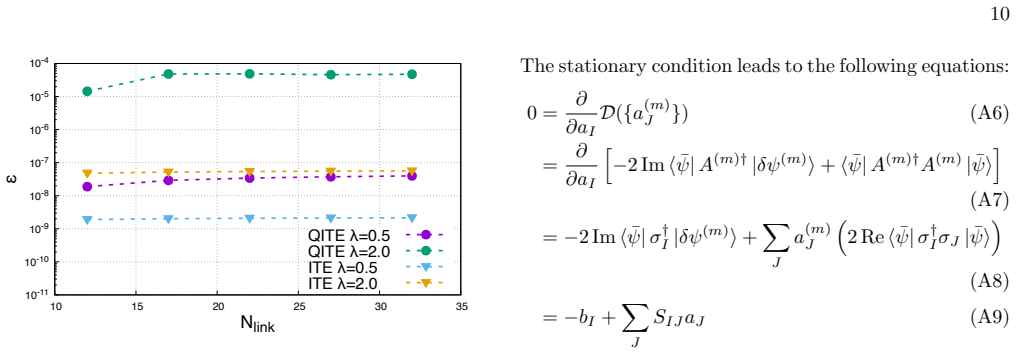
- [Abstract and Sec. IV.B-C, Figs. 4-6] The claim 'relative error less than 0.1% ... up to a twelve-plaquette system and coupling values in 0.5≤λ≤5.0' is not supported at the combined extreme (N_x=7, N_y=3, λ=5.0). Fig. 4 (right) varies λ only for (N_x,N_y)=(3,3); Fig. 6 varies N_x only for λ=0.5 and λ=2.0. Since Fig. 5 shows the QITE-specific error saturating as Δτ→0 at λ=2.0, and Fig. 6 shows that this error increases with N_link, the untested corner is precisely where the 0.1% bound is most likely to fail. Please either add simulations for λ=5.0 at larger system sizes, or restrict the claim to the explicitly scanned region.
- [Sec. IV.A] The statement that the bond dimension is chosen 'large enough so that the systematic errors in the MPS representation are negligible' is not supported by a convergence scan. The paper reports an SVD cutoff of 10^-14 and a DMRG maximum bond dimension of 200, but does not give the actual bond dimensions used for TEBD, nor a DMRG energy convergence check at N_link=32. Because the 0.1% bound is measured against the DMRG energy, uncontrolled MPS truncation could contribute to the observed growth of QITE error in Fig. 6. A bond-dimension or truncation-error scan is needed to make the reference energies and the QITE-vs-ITE comparison conclusive.
- [Sec. IV.C] The saturation of the QITE error at λ=2.0 as Δτ→0 is attributed to 'unitary approximation error (ii-a)', but no pool-size dependence is shown to confirm this mechanism. A scan over Pauli pool weights (e.g., weight-6 or larger supports on the same system) would test this hypothesis and would also inform how the error may behave at λ=5.0. Without such evidence, the error budget at larger coupling remains a conjecture, which weakens the extrapolation implied by the abstract.
minor comments (5)
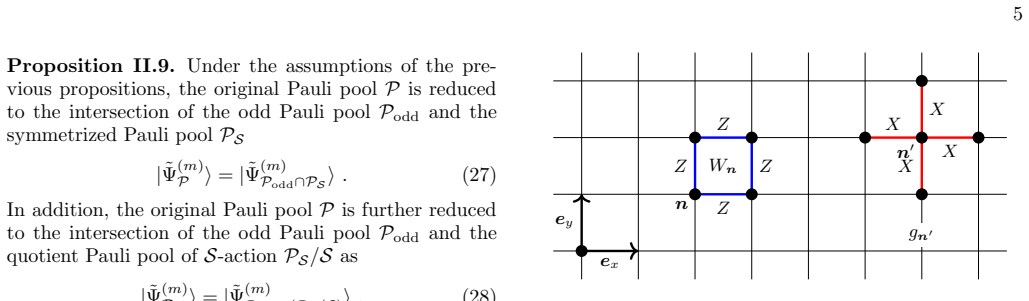
- [Table I] Two rows have D=10 but yield different quotient counts (2048 and 1024). The table lacks a column or diagram identifying the geometry of the support (e.g., one plaquette, two adjacent plaquettes, 1x2 rectangle, 2x2 square). Please add explicit geometry labels so the counts can be reproduced.
- [Sec. IV.A] Please report the concrete bond dimensions used in the TEBD simulations for each system size, in addition to the SVD cutoff, so the reader can assess the numerical cost and the claimed convergence.
- [Eq. (43)] The figure labels use only 'ε' while the text defines the absolute relative error. Consider labeling the axes as '|E-E_DMRG|/|E_DMRG|' for clarity.
- [Eqs. (25)-(28)] The notation P_odd ∩ (P_S/S) is slightly abusive because the quotient pool contains equivalence classes, not Pauli strings. State explicitly that a fixed representative is chosen for each class, as suggested in Definition II.7, and use that convention consistently in the intersection.
- [Fig. 2 caption] The caption says 'The left is the support composed of four plaquettes. The center example represents ...' but the figure appears to show three panels. Clarify which panel is 'left', 'center', and 'right'.
Circularity Check
No significant circularity: QITE coefficients are solved from instantaneous expectation values, the Pauli-pool reductions are proved in the paper, and the DMRG comparison is an independent external benchmark.
full rationale
Walking the derivation chain: the QITE update solves Eq. (10) with S and b from Eq. (11), derived in Appendix A from a first-order expansion of the state distance; no parameter is fitted to the DMRG energy. The Pauli-pool reductions (Props. II.4, II.6, II.8, II.9) are proven in Appendix B via block-diagonal structure of S and vanishing b components, and the gauge-theory count (Eqs. (39)/(41)) is proven in Appendix C; the one-plaquette 255→8 value is cross-checked against [27], not imported as a premise. The DMRG reference is independent: it is obtained on the Wegner-dual transverse-field Ising model [30]. No self-citations by the present authors appear, and no uniqueness theorem is invoked to force the choice of Pauli pool. The weight-4 Pauli pool is explicitly labeled a heuristic 'at the expense of extra errors,' and the observed Δτ-saturation is attributed to unitary-approximation error as a hypothesis for future work. The limitations—the λ=5.0/large-N_link corner is not directly simulated, and MPS truncation error is asserted without a bond-dimension scan—are coverage/validation gaps, not reductions of the prediction to its inputs. Thus no step is equivalent by construction to an input.
Axiom & Free-Parameter Ledger
free parameters (3)
- Pauli pool support weight =
w=4 links (one plaquette, or adjacent plaquettes for link terms)
- Maximal imaginary time τ_max =
2.0
- MPS/TEBD bond dimension and DMRG settings =
TEBD bond dim 'large enough' (unspecified); SVD cutoff 1e-14; DMRG χ=200, 5 sweeps
axioms (5)
- domain assumption The Z2 LGT ground state is non-degenerate.
- standard math Wegner duality: pure Z2 LGT on square lattice ≡ transverse-field Ising model on dual lattice.
- domain assumption [σ,g]=0 for all g∈G[D] iff supp(σ_¯X) is a union of closed loops (Eq. 35).
- ad hoc to paper A weight-4 Pauli pool suffices to approximate the imaginary-time step at the studied couplings/sizes.
- ad hoc to paper MPS truncation errors are negligible.
read the original abstract
In this paper, we apply the deterministic quantum imaginary time evolution (QITE) algorithm to obtain the ground state of a $2+1$-dimensional pure $\mathbb{Z}_2$ lattice gauge theory. We first construct the set of Pauli operators commuting with Gauss's law constraints, generalizing a previous result. This makes the deterministic QITE gauge-invariant and reduces both the measurement and gate costs significantly without adding extra algorithm errors in the QITE. Then, the classical numerical simulation of the deterministic QITE using tensor networks is performed, and the results are compared with the density matrix renormalization group (DMRG) to evaluate the accuracy of the algorithm. Specifically, we investigate the coupling and system size dependence, and find that the deterministic QITE can achieve a relative error of less than $0.1\%$ up to a twelve-plaquette system and coupling values in a regime that we study. Furthermore, the error dependence on the number of time steps is studied and discussed.
Figures


Forward citations
Cited by 1 Pith paper
-
Arbitrary-Distance Quantum Error Correction with Gauss's Law for $\mathbb Z_2$ Lattice Gauge Theory
Gauss's law constraints in Z2 lattice gauge theory can be made into quantum error-correcting codes of arbitrary distance, with provably optimal encoding rate within the constructed family.
Reference graph
Works this paper leans on
-
[1]
Partition the support asD=D X ⊔ D¯X , where DX := supp(σX ) andD ¯X := supp(σ ¯X )
-
[2]
supportD partitionD=DX ⊔ D¯X YY Y Y Z Z Z Y YX I X X Pauli assignment forDX andD¯X FIG
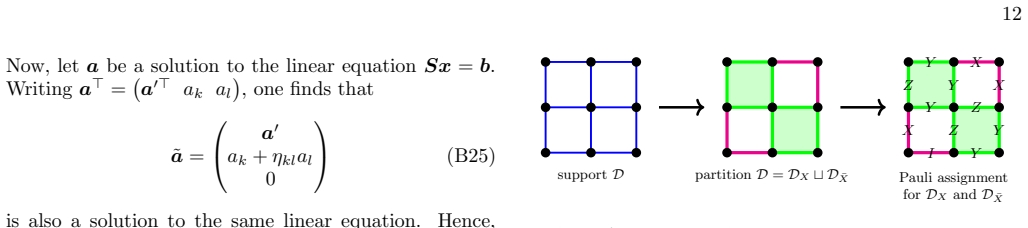
AssignI, XandY, Zfor each qubitq∈ D X and q∈ D¯X , respectively. supportD partitionD=DX ⊔ D¯X YY Y Y Z Z Z Y YX I X X Pauli assignment forDX andD¯X FIG. 7: An example of a partition and Pauli assignment for a four plaquette supportD, shown as blue links. Green links denote a specific partitionD ¯X = supp(σ ¯X )∈Γ and green plaquettes denote the correspond...
-
[3]
S. P. Jordan, K. S. M. Lee, and J. Preskill, Quantum Al- gorithms for Quantum Field Theories, Science336, 1130 (2012), arXiv:1111.3633 [quant-ph]
Pith/arXiv arXiv 2012
-
[4]
C. W. Baueret al., Quantum Simulation for High- Energy Physics, PRX Quantum4, 027001 (2023), arXiv:2204.03381 [quant-ph]
Pith/arXiv arXiv 2023
-
[5]
A. Di Meglioet al., Quantum Computing for High- Energy Physics: State of the Art and Challenges, PRX Quantum5, 037001 (2024), arXiv:2307.03236 [quant-ph]
Pith/arXiv arXiv 2024
-
[6]
Z. Davoudi, Tasi/cern/kitp lecture notes on” toward quantum computing gauge theories of nature”, arXiv preprint arXiv:2507.15840 (2025)
arXiv 2025
-
[7]
J. C. Halimeh, N. Mueller, J. Knolle, Z. Papi´ c, and Z. Davoudi, Quantum simulation of out-of- equilibrium dynamics in gauge theories, arXiv preprint arXiv:2509.03586 (2025)
Pith/arXiv arXiv 2025
-
[8]
S. McArdle, T. Jones, S. Endo, Y. Li, S. C. Benjamin, and X. Yuan, Variational ansatz-based quantum simula- tion of imaginary time evolution, npj Quantum Inf.5, 75 (2019), arXiv:1804.03023 [quant-ph]
Pith/arXiv arXiv 2019
-
[9]
Gomes, A
N. Gomes, A. Mukherjee, F. Zhang, T. Iadecola, C.-Z. Wang, K.-M. Ho, P. P. Orth, and Y.-X. Yao, Adaptive variational quantum imaginary time evolution approach for ground state preparation, Advanced Quantum Tech- nologies4, 2100114 (2021)
2021
-
[10]
Gacon, J
J. Gacon, J. Nys, R. Rossi, S. Woerner, and G. Car- leo, Variational quantum time evolution without the quantum geometric tensor, Physical Review Research6, 013143 (2024)
2024
-
[11]
M. Motta, C. Sun, A. T. K. Tan, M. J. O. Rourke, E. Ye, A. J. Minnich, F. G. S. L. Brand˜ ao, and G. K.-L. Chan, Determining eigenstates and thermal states on a quan- tum computer using quantum imaginary time evolution, 14 Nature Phys.16, 205 (2019), arXiv:1901.07653 [quant- ph]
Pith/arXiv arXiv 2019
-
[12]
T. L. Silva, M. M. Taddei, S. Carrazza, and L. Aolita, Fragmented imaginary-time evolution for early-stage quantum signal processors, Scientific Reports13, 18258 (2023)
2023
-
[13]
H. H. S. Chan, D. M. Ramo, and N. Fitzpatrick, Simu- lating non-unitary dynamics using quantum signal pro- cessing with unitary block encoding, arXiv preprint arXiv:2303.06161 (2023)
Pith/arXiv arXiv 2023
-
[14]
L. Zhang, J. Lai, X. Wu, and X. Wang, Quantum imaginary-time evolution with polynomial resources in time, arXiv preprint arXiv:2507.00908 (2025)
Pith/arXiv arXiv 2025
-
[15]
Gluza, J
M. Gluza, J. Son, B. H. Tiang, R. Zander, R. Seidel, Y. Suzuki, Z. Holmes, and N. H. Ng, Double-bracket quantum algorithms for quantum imaginary-time evolu- tion, Physical review letters136, 020601 (2026)
2026
-
[16]
T. Liu, J.-G. Liu, and H. Fan, Probabilistic nonunitary gate in imaginary time evolution, Quant. Inf. Proc.20, 204 (2021), arXiv:2006.09726 [quant-ph]
Pith/arXiv arXiv 2021
-
[17]
S.-H. Lin, R. Dilip, A. G. Green, A. Smith, and F. Poll- mann, Real-and imaginary-time evolution with com- pressed quantum circuits, PRX Quantum2, 010342 (2021)
2021
-
[18]
Kosugi, Y
T. Kosugi, Y. Nishiya, H. Nishi, and Y.-i. Matsushita, Imaginary-time evolution using forward and backward real-time evolution with a single ancilla: First-quantized eigensolver algorithm for quantum chemistry, Physical Review Research4, 033121 (2022)
2022
-
[19]
K. Yeter-Aydeniz, E. Moschandreou, and G. Siopsis, Quantum imaginary-time evolution algorithm for quan- tum field theories with continuous variables, Phys. Rev. A105, 012412 (2022), arXiv:2107.00791 [quant-ph]
Pith/arXiv arXiv 2022
-
[20]
Yeter-Aydeniz, R
K. Yeter-Aydeniz, R. C. Pooser, and G. Siopsis, Practi- cal quantum computation of chemical and nuclear energy levels using quantum imaginary time evolution and lanc- zos algorithms, npj Quantum Information6, 63 (2020)
2020
-
[21]
Gomes, F
N. Gomes, F. Zhang, N. F. Berthusen, C.-Z. Wang, K.- M. Ho, P. P. Orth, and Y. Yao, Efficient step-merged quantum imaginary time evolution algorithm for quan- tum chemistry, Journal of Chemical Theory and Compu- tation16, 6256 (2020)
2020
-
[22]
Nishi, T
H. Nishi, T. Kosugi, and Y.-i. Matsushita, Implemen- tation of quantum imaginary-time evolution method on nisq devices by introducing nonlocal approximation, npj Quantum Information7, 85 (2021)
2021
-
[23]
Huang, Y
Y. Huang, Y. Shao, W. Ren, J. Sun, and D. Lv, Efficient quantum imaginary time evolution by drifting real-time evolution: An approach with low gate and measurement complexity, Journal of Chemical Theory and Computa- tion19, 3868 (2023)
2023
-
[24]
A. A. Mel´ endez, C. G. Almud´ ever, M. A. Garcia-March, R. G´ omez-Lurbe, L. Ion, M. L. Bera, R. M. Sanz, S. Mehrabankar, T. Pandit, A. P´ erez,et al., Adaptive time compressed qite (acq) and its geometrical interpre- tation, arXiv preprint arXiv:2510.15781 (2025)
Pith/arXiv arXiv 2025
-
[25]
S.-N. Sun, M. Motta, R. N. Tazhigulov, A. T. K. Tan, G. K.-L. Chan, and A. J. Minnich, Quantum Computation of Finite-Temperature Static and Dynam- ical Properties of Spin Systems Using Quantum Imagi- nary Time Evolution, PRX Quantum2, 010317 (2021), arXiv:2009.03542 [quant-ph]
Pith/arXiv arXiv 2021
-
[26]
J. W. Pedersen, E. Itou, R.-Y. Sun, and S. Yunoki, Quan- tum Simulation of Finite Temperature Schwinger Model via Quantum Imaginary Time Evolution, PoSLA T- TICE2023, 220 (2024), arXiv:2311.11616 [hep-lat]
Pith/arXiv arXiv 2024
-
[27]
Z. Davoudi, N. Mueller, and C. Powers, Towards Quan- tum Computing Phase Diagrams of Gauge Theories with Thermal Pure Quantum States, Phys. Rev. Lett.131, 081901 (2023), arXiv:2208.13112 [hep-lat]
Pith/arXiv arXiv 2023
-
[28]
R. Maeno, Efficient construction ofZ 2 gauge-invariant bases for the quantum minimally entangled typical ther- mal states algorithm, arXiv preprint arXiv:2603.10932 (2026)
Pith/arXiv arXiv 2026
-
[29]
X. Wang, Y. Chai, M. Demidik, X. Feng, K. Jansen, and C. T¨ uys¨ uz, Symmetry enhanced variational quantum imaginary time evolution, arXiv preprint arXiv:2307.13598 (2023)
Pith/arXiv arXiv 2023
-
[30]
V. Ale, T. Rainaldi, E. Rico, F. Ringer, and G. Siop- sis, Simulating quantum electrodynamics in 2+ 1 di- mensions with qubits and qumodes, arXiv preprint arXiv:2511.14506 (2025)
arXiv 2025
-
[31]
S. R. White, Density matrix formulation for quantum renormalization groups, Phys. Rev. Lett.69, 2863 (1992)
1992
-
[32]
F. J. Wegner, Duality in Generalized Ising Models and Phase Transitions Without Local Order Parameters, J. Math. Phys.12, 2259 (1971)
1971
-
[33]
J. B. Kogut, An introduction to lattice gauge theory and spin systems, Rev. Mod. Phys.51, 659 (1979)
1979
-
[34]
U. Borla, J. J. Osborne, S. Moroz, and J. C. Halimeh, String breaking in a 2+1 dZ 2 lattice gauge theory, arXiv preprint arXiv:2501.17929 (2025)
Pith/arXiv arXiv 2025
-
[35]
K. Xu, U. Borla, S. Moroz, and J. C. Halimeh, String breaking dynamics and glueball formation in a 2+1 d lattice gauge theory, arXiv preprint arXiv:2507.01950 (2025)
Pith/arXiv arXiv 2025
-
[36]
T. Sugihara, Matrix product representation of gauge in- variant states in aZ 2 lattice gauge theory, JHEP07, 022, arXiv:hep-lat/0506009
-
[37]
L. Tagliacozzo and G. Vidal, Entanglement Renormal- ization and Gauge Symmetry, Phys. Rev. B83, 115127 (2011), arXiv:1007.4145 [cond-mat.str-el]
Pith/arXiv arXiv 2011
-
[38]
Y. Liu, Y. Meurice, M. P. Qin, J. Unmuth-Yockey, T. Xi- ang, Z. Y. Xie, J. F. Yu, and H. Zou, Exact Blocking Formulas for Spin and Gauge Models, Phys. Rev. D88, 056005 (2013), arXiv:1307.6543 [hep-lat]
Pith/arXiv arXiv 2013
-
[39]
Y. Wu and W.-Y. Liu, Accurate Gauge-Invariant Tensor- Network Simulations for Abelian Lattice Gauge The- ory in (2+1)D: Ground-State and Real-Time Dynamics, Phys. Rev. Lett.135, 130401 (2025), arXiv:2503.20566 [cond-mat.str-el]
Pith/arXiv arXiv 2025
-
[40]
W.-T. Xu, M. Knap, and F. Pollmann, Tensor-network study of the roughening transition in a (2 + 1)DZ2 lattice gauge theory with matter, Phys. Rev. Lett.135, 036503 (2025), arXiv:2503.19027 [cond-mat.str-el]
Pith/arXiv arXiv 2025
-
[41]
T. A. Cochranet al., Visualizing dynamics of charges and strings in (2 + 1)D lattice gauge theories, Nature642, 315 (2025), arXiv:2409.17142 [quant-ph]
Pith/arXiv arXiv 2025
-
[42]
A. Yamamoto, Real-time simulation of (2+1)- dimensional lattice gauge theory on qubits, PTEP 2021, 013B06 (2021), arXiv:2008.11395 [hep-lat]
Pith/arXiv arXiv 2021
-
[43]
Alexandrou, A
C. Alexandrou, A. Athenodorou, K. Blekos, G. Polykratis, and S. K¨ uhn, Realizing string breaking dynamics in aZ 2 lattice gauge theory on quantum hardware, Physical Review D112, 114506 (2025)
2025
-
[44]
F. Azad, M. Inajetovic, S. K¨ uhn, and A. Pappa, Barren- plateau free variational quantum simulation ofZ 2 lattice gauge theories, arXiv preprint arXiv:2507.19203 (2025). 15
Pith/arXiv arXiv 2025
-
[45]
K. Xu, U. Borla, K. Hemery, R. Joshi, H. Dreyer, E. Ri- naldi, and J. C. Halimeh, Observation of glueball excita- tions and string breaking in a 2+1DZ 2 lattice gauge the- ory on a trapped-ion quantum computer, arXiv e-prints , arXiv:2604.07435 (2026), arXiv:2604.07435 [hep-lat]
Pith/arXiv arXiv 2026
-
[46]
Emonts, A
P. Emonts, A. Kelman, U. Borla, S. Moroz, S. Gazit, and E. Zohar, Finding the ground state of a lattice gauge the- ory with fermionic tensor networks: A 2+1d z2 demon- stration, Physical Review D107, 014505 (2023)
2023
-
[47]
Irmejs, M.-C
R. Irmejs, M.-C. Ba˜ nuls, and J. I. Cirac, Quantum simu- lation of z 2 lattice gauge theory with minimal resources, Physical Review D108, 074503 (2023)
2023
-
[48]
Lumia, P
L. Lumia, P. Torta, G. B. Mbeng, G. E. Santoro, E. Erco- lessi, M. Burrello, and M. M. Wauters, Two-dimensional z 2 lattice gauge theory on a near-term quantum sim- ulator: Variational quantum optimization, confinement, and topological order, PRX Quantum3, 020320 (2022)
2022
-
[49]
J. Cobos, J. Fraxanet, C. Benito, F. di Marcanto- nio, P. Rivero, K. Kap´ as, M. A. Werner, ¨O. Legeza, A. Bermudez, and E. Rico, Real-time dynamics in a (2+ 1)-d gauge theory: The stringy nature on a superconduct- ing quantum simulator, arXiv preprint arXiv:2507.08088 (2025)
Pith/arXiv arXiv 2025
-
[50]
Mueller, T
N. Mueller, T. Wang, O. Katz, Z. Davoudi, and M. Cetina, Quantum computing universal thermalization dynamics in a (2+ 1) d lattice gauge theory, Nature Com- munications16, 5492 (2025)
2025
-
[51]
Y. Ding, X. Cui, and Y. Shi, Digital quantum simulation and pseudoquantum simulation ofZ 2 gauge higgs model, arXiv preprint arXiv:2108.13410 (2021)
Pith/arXiv arXiv 2021
-
[52]
Wiese, Ultracold quantum gases and lattice sys- tems: quantum simulation of lattice gauge theories, An- nalen der Physik525, 777 (2013)
U.-J. Wiese, Ultracold quantum gases and lattice sys- tems: quantum simulation of lattice gauge theories, An- nalen der Physik525, 777 (2013)
2013
-
[53]
F. Di Marcantonio, S. Pradhan, S. Vallecorsa, M. C. Ba˜ nuls, and E. R. Ortega, Roughening and dynamics of an electric flux string in a (2+ 1) d lattice gauge theory, arXiv preprint arXiv:2505.23853 (2025)
Pith/arXiv arXiv 2025
-
[54]
Homeier, A
L. Homeier, A. Bohrdt, S. Linsel, E. Demler, J. C. Hal- imeh, and F. Grusdt, Realistic scheme for quantum simu- lation of z 2 lattice gauge theories with dynamical matter in (2+ 1) d, Communications Physics6, 127 (2023)
2023
-
[55]
Gonz´ alez-Cuadra, L
D. Gonz´ alez-Cuadra, L. Tagliacozzo, M. Lewenstein, and A. Bermudez, Robust topological order in fermionic z 2 gauge theories: From aharonov-bohm instability to soliton-induced deconfinement, Physical Review X10, 041007 (2020)
2020
-
[56]
Sukeno and T
H. Sukeno and T. Okuda, Measurement-based quan- tum simulation of abelian lattice gauge theories, SciPost Physics14, 129 (2023)
2023
-
[57]
Borla, S
U. Borla, S. Gazit, and S. Moroz, Deconfined quantum criticality in ising gauge theory entangled with single- component fermions, Physical Review B110, L201110 (2024)
2024
-
[58]
W.-T. Xu, F. Pollmann, and M. Knap, Critical behavior of fredenhagen-marcu string order parameters at topolog- ical phase transitions with emergent higher-form symme- tries, npj Quantum Information11, 74 (2025)
2025
-
[59]
Kogut and L
J. Kogut and L. Susskind, Hamiltonian formulation of wilson’s lattice gauge theories, Phys. Rev. D11, 395 (1975)
1975
-
[60]
A. Y. Kitaev, Fault tolerant quantum computation by anyons, Annals Phys.303, 2 (2003), arXiv:quant- ph/9707021
arXiv 2003
-
[61]
E. Dennis, A. Kitaev, A. Landahl, and J. Preskill, Topo- logical quantum memory, J. Math. Phys.43, 4452 (2002), arXiv:quant-ph/0110143
Pith/arXiv arXiv 2002
-
[62]
Vidal, Efficient simulation of one-dimensional quan- tum many-body systems, Phys
G. Vidal, Efficient simulation of one-dimensional quan- tum many-body systems, Phys. Rev. Lett.93, 040502 (2004), arXiv:quant-ph/0310089
Pith/arXiv arXiv 2004
-
[63]
Fishman, S
M. Fishman, S. R. White, and E. M. Stoudenmire, The ITensor Software Library for Tensor Network Calcula- tions, SciPost Phys. Codebases , 4 (2022)
2022
discussion (0)
Sign in with ORCID, Apple, or X to comment. Anyone can read and Pith papers without signing in.