D⁰-D_s^+ Elliptic-Flow Splitting under Event-Shape Engineering: A Probe of Sequential Charm Hadronization
Pith reviewed 2026-06-28 09:25 UTC · model grok-4.3
The pith
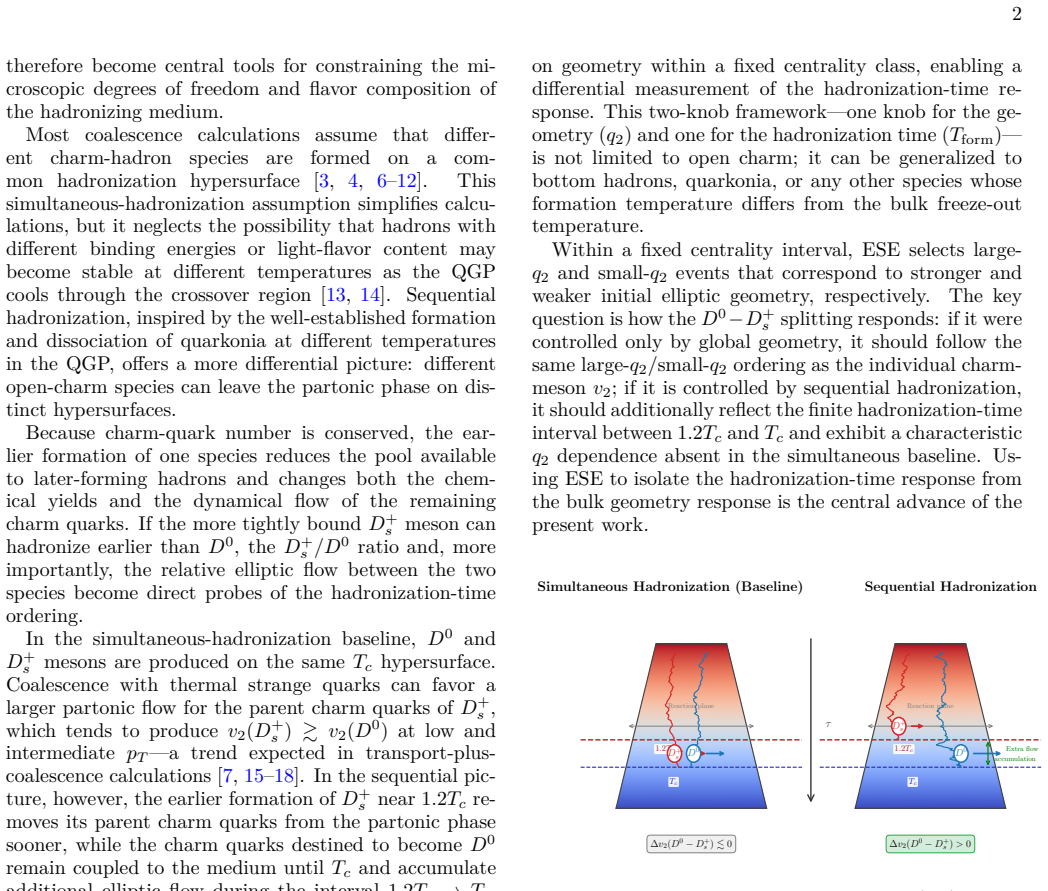
Event-shape engineering shows sequential charm hadronization by making the D0-Ds+ elliptic flow splitting grow positive with initial geometry.
A machine-rendered reading of the paper's core claim, the machinery that carries it, and where it could break.
Core claim
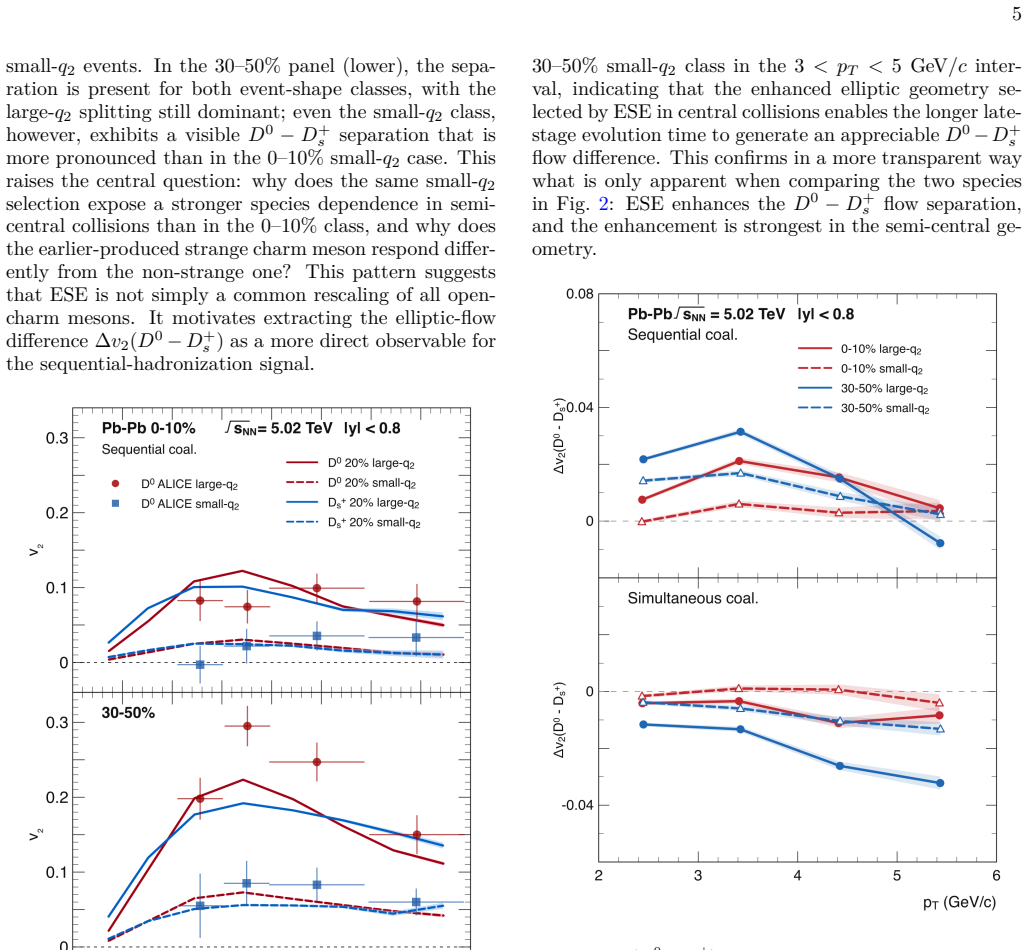
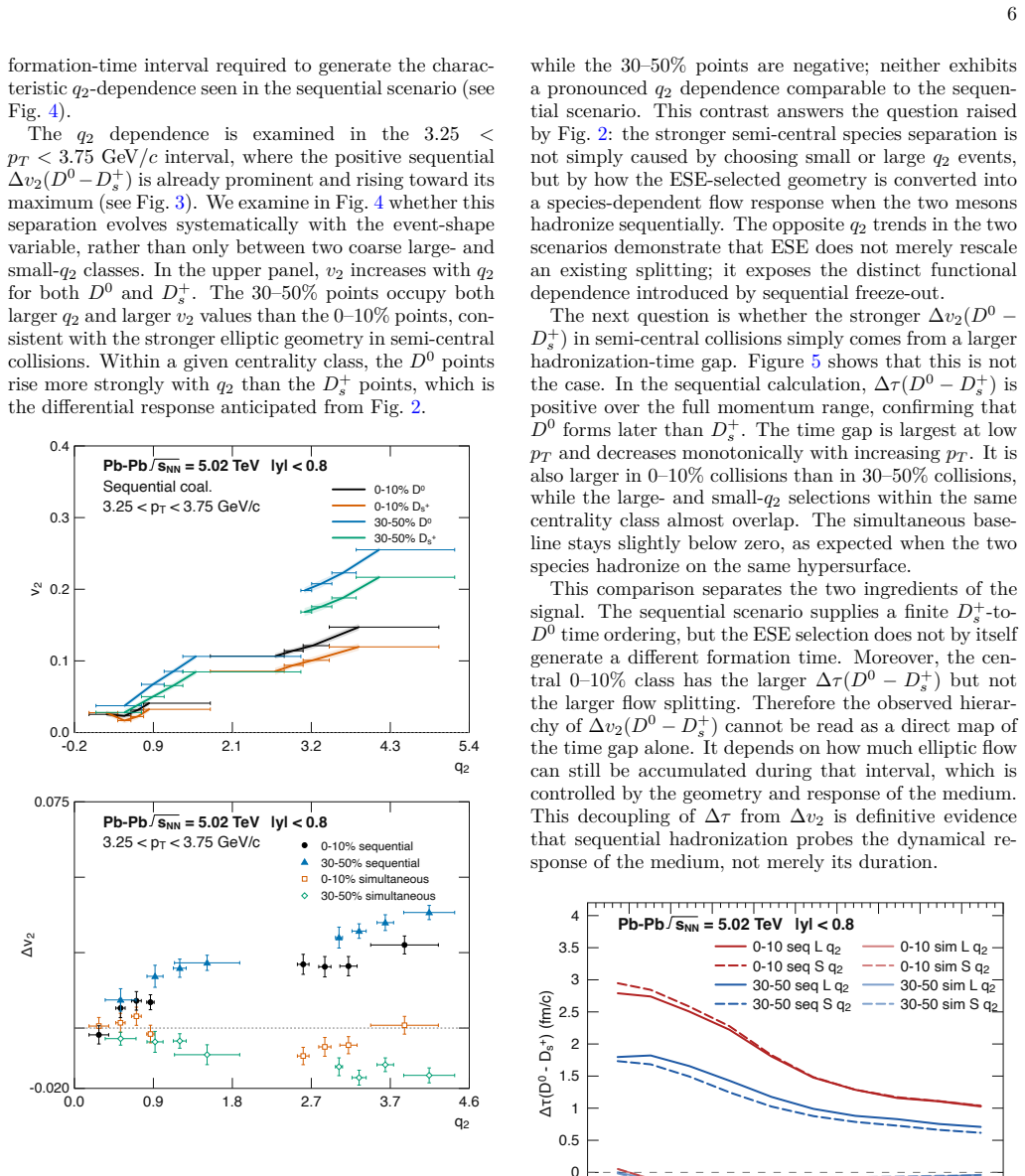
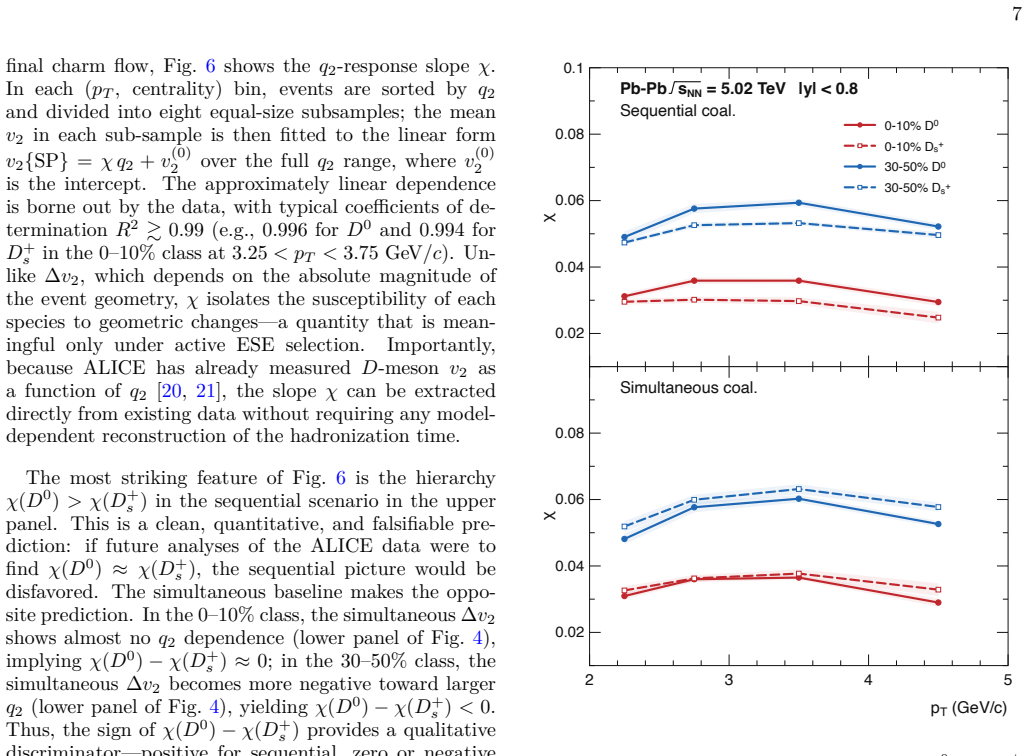
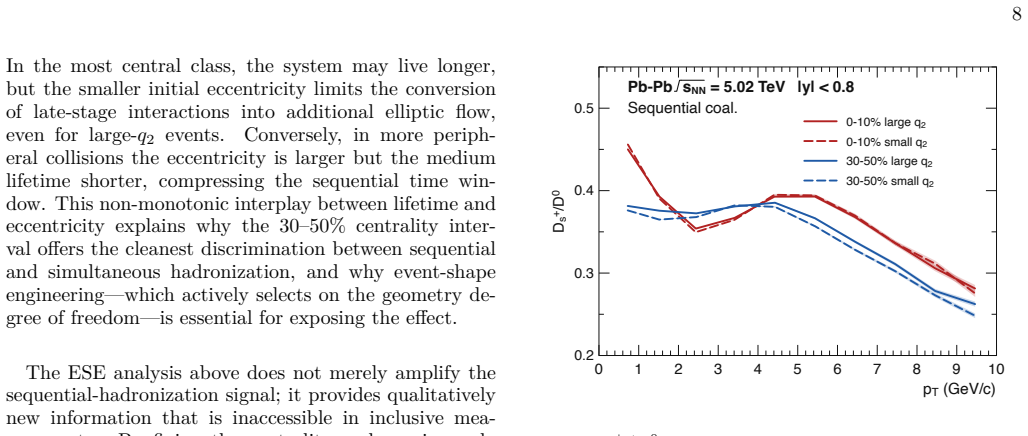
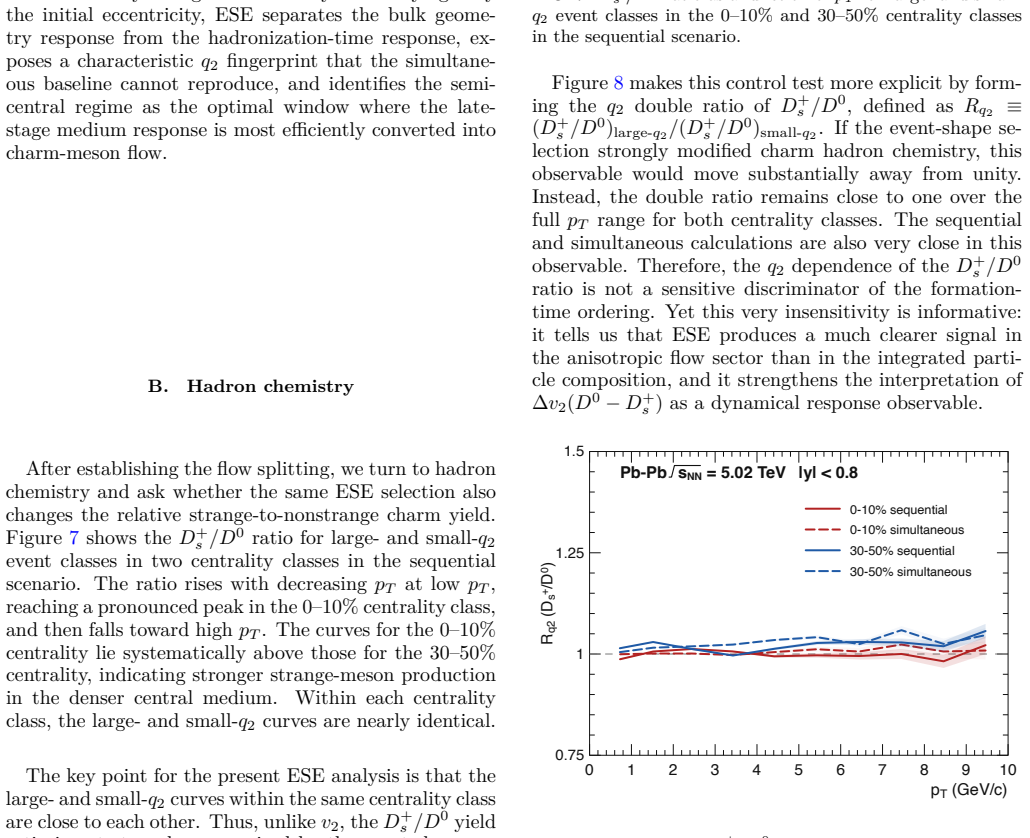
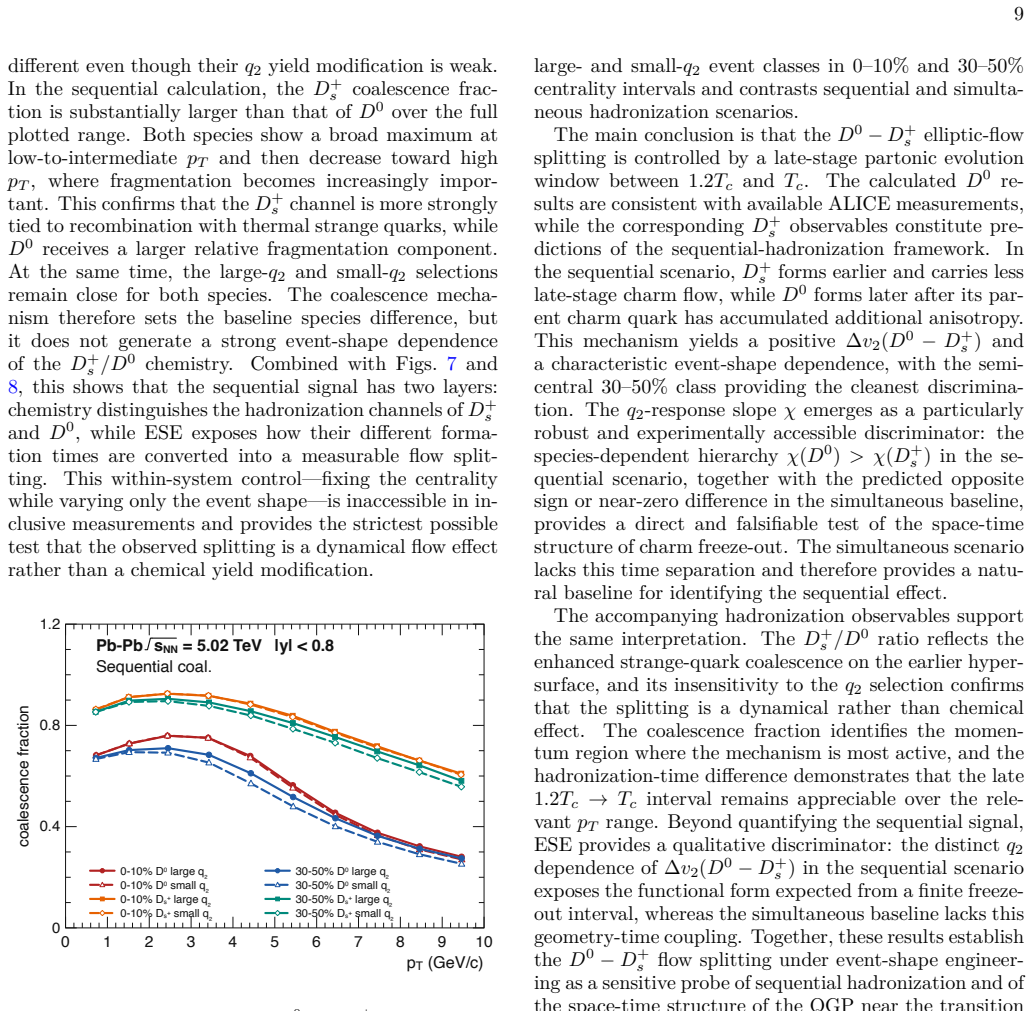
By selecting events on q2 in 0-10 percent and 30-50 percent centrality classes at 5.02 TeV, the positive Delta v2(D0-Ds+) grows systematically with q2 in the sequential scenario, and the response slope chi obeys chi(D0) greater than chi(Ds+), a hierarchy absent when both species form simultaneously; the q2 ratios of Ds+/D0 yields stay near unity, confirming the splitting is a dynamical flow effect rather than a yield change.
What carries the argument
The response slope chi of elliptic flow to the event-shape parameter q2, which isolates the geometry-driven flow conversion from the timing of hadronization.
If this is right
- The positive splitting and species-dependent chi hierarchy appear only under sequential formation and scale with q2.
- Semi-central collisions provide the clearest window due to the non-monotonic lifetime-eccentricity interplay.
- Yield ratios remaining near unity isolates the effect as flow conversion rather than chemical modification.
- Delta v2 and chi under ESE serve as differential probes of formation timing near the QCD transition.
Where Pith is reading between the lines
- The same ESE method could be applied to other charm species such as D+ or Lambda_c to map a fuller formation sequence.
- If confirmed, the hierarchy would constrain the temperature window between 1.2 Tc and Tc for different bound states.
- This differential probe might resolve tensions in inclusive heavy-flavor flow data by separating geometry from timing.
- Extension to lower beam energies could test whether the sequential window shrinks or widens with changing QGP lifetime.
Load-bearing premise
The hydrodynamic or transport model used to generate the v2 and q2 distributions correctly encodes the space-time evolution and species-dependent hadronization times without extra biases that could create the reported splitting and slope hierarchy.
What would settle it
Data showing that Delta v2(D0-Ds+) stays near zero or decreases with rising q2, or that the response slopes lack the D0-greater-than-Ds+ ordering in 30-50 percent collisions, would falsify the sequential prediction.
Figures
read the original abstract
Recent work has proposed sequential hadronization of open-charm hadrons in the quark-gluon plasma, wherein more tightly bound species such as $D_s^+$ form earlier near $1.2 T_c$ and $D^0$ forms later at $T_c$. That work showed that this mechanism naturally reverses the sign of the $D^0-D_s^+$ elliptic-flow splitting relative to the conventional simultaneous baseline. In this work, we demonstrate that event-shape engineering (ESE) provides a sharper discrimination between the two pictures than inclusive measurements alone. By selecting large-$q_2$ and small-$q_2$ events in 0--10\% and 30--50\% centrality classes in Pb-Pb collisions at $\sqrt{s_{\mathrm{NN}}}=5.02$ TeV, we show that the geometry-driven enhancement of charm-meson $v_2$ can be separated from the hadronization-time response: the positive $\Delta v_2(D^0-D_s^+)$ in the sequential scenario grows systematically with $q_2$, while the corresponding response slope $\chi$ reveals a species-dependent hierarchy $\chi(D^0) > \chi(D_s^+)$ that is robust against the overall flow normalization and absent in the simultaneous baseline. In the simultaneous case, the splitting is near zero or negative and does not follow the same geometry scaling. Notably, the semi-central 30--50\% class emerges as the optimal window, because the non-monotonic interplay between QGP lifetime and initial eccentricity maximizes the late-stage flow conversion. The $q_2$ ratios of the $D_s^+/D^0$ yield ratio remain close to unity, confirming that the splitting is a dynamical flow effect rather than a chemical yield modification. These results establish $\Delta v_2(D^0-D_s^+)$ and the response slope $\chi$ under ESE as complementary differential probes of the space-time structure of charm hadronization near the QCD transition temperature.
Editorial analysis
A structured set of objections, weighed in public.
Referee Report
Summary. The manuscript claims that event-shape engineering (ESE) via q2 selection in 0-10% and 30-50% centrality classes of Pb-Pb collisions at 5.02 TeV provides a sharper probe of sequential charm hadronization than inclusive v2 measurements. In the sequential scenario (Ds+ near 1.2 Tc, D0 at Tc), positive Δv2(D0-Ds+) grows systematically with q2 while the response slope χ exhibits the hierarchy χ(D0) > χ(Ds+), robust against overall flow normalization; the simultaneous baseline instead yields near-zero or negative splitting without the same geometry scaling. The 30-50% class is identified as optimal due to QGP lifetime and eccentricity interplay, and Ds+/D0 yield ratios near unity confirm the effect is dynamical rather than chemical.
Significance. If the central discrimination holds, the work supplies a useful differential observable for mapping the space-time structure of charm hadronization near the QCD transition. The separation of geometry-driven flow enhancement from hadronization-time response via ESE, together with the identification of an optimal semi-central window, adds practical guidance for future measurements.
major comments (2)
- [Model and simulation description] The discrimination between sequential and simultaneous scenarios rests on a single hydrodynamic/transport realization without reported variations of charm-medium coupling (drag/diffusion coefficients) or alternative space-time mappings of formation hypersurfaces. This leaves open whether the reported χ(D0) > χ(Ds+) hierarchy and positive q2 scaling of Δv2 arise specifically from hadronization timing or from species-dependent transport biases already present in the model.
- [Results on response slopes and robustness tests] The assertion that the χ hierarchy is robust against overall flow normalization is stated but not demonstrated by explicit rescaling or parameter variation; without such checks, it is unclear whether the hierarchy survives changes to the flow response parameters that are independent of the hadronization temperatures.
minor comments (1)
- [Abstract] The abstract references specific hadronization temperatures but supplies no model equations, parameter values, or statistical uncertainties, making it difficult to assess the quantitative strength of the claimed q2 dependence and χ hierarchy.
Simulated Author's Rebuttal
We thank the referee for the careful reading and constructive comments on our manuscript. We address each major comment below and indicate where revisions will be made to improve the presentation and robustness of the results.
read point-by-point responses
-
Referee: [Model and simulation description] The discrimination between sequential and simultaneous scenarios rests on a single hydrodynamic/transport realization without reported variations of charm-medium coupling (drag/diffusion coefficients) or alternative space-time mappings of formation hypersurfaces. This leaves open whether the reported χ(D0) > χ(Ds+) hierarchy and positive q2 scaling of Δv2 arise specifically from hadronization timing or from species-dependent transport biases already present in the model.
Authors: We agree that the analysis uses one hydrodynamic plus transport realization. However, both scenarios employ identical drag and diffusion coefficients; the sole difference is the formation temperature (and thus the hypersurface) for each species. The ESE q2 selection isolates the timing effect because the simultaneous baseline produces no positive Δv2 growth with q2, while the sequential case does. Species-dependent transport biases would be present equally in both scenarios and cannot explain the differential q2 scaling. We will add a paragraph in Sec. II clarifying this point and referencing earlier sensitivity studies on coupling variations, while noting that a full parameter scan lies beyond the present scope. revision: partial
-
Referee: [Results on response slopes and robustness tests] The assertion that the χ hierarchy is robust against overall flow normalization is stated but not demonstrated by explicit rescaling or parameter variation; without such checks, it is unclear whether the hierarchy survives changes to the flow response parameters that are independent of the hadronization temperatures.
Authors: We thank the referee for this observation. Although the differential response is expected to be independent of overall normalization, we did not show explicit rescaling. In the revised manuscript we will add a short subsection (or appendix) performing a constant-factor rescaling of the v2 values (e.g., ×0.8 and ×1.2) and demonstrate that the χ(D0) > χ(Ds+) ordering remains unchanged. This will make the robustness explicit. revision: yes
Circularity Check
No significant circularity; model predictions remain independent of fitted inputs
full rationale
The provided abstract and context describe hydrodynamic/transport simulations that implement sequential (Ds+ at ~1.2 Tc, D0 at Tc) versus simultaneous hadronization and then compute ESE-selected v2 splitting and response slopes χ. No equations, parameter fits, or self-citations are quoted that reduce the reported Δv2(q2) growth or χ(D0) > χ(Ds+) hierarchy to a tautology or to the same fitted values by construction. The discrimination is presented as an output of the space-time evolution under the two scenarios, with the q2 ratios of yields stated to remain near unity as an internal consistency check rather than a redefinition of the observable. This constitutes a standard model-based prediction chain without the enumerated circular patterns.
Axiom & Free-Parameter Ledger
free parameters (2)
- Ds+ hadronization temperature =
1.2 Tc
- D0 hadronization temperature =
Tc
axioms (2)
- domain assumption Hydrodynamic evolution accurately captures the collective flow response to initial eccentricity
- domain assumption Charm quarks thermalize sufficiently to inherit the medium flow before hadronization
Reference graph
Works this paper leans on
-
[1]
A. Beraudo et al. , Extraction of Heavy-Flavor Trans- port Coefficients in QCD Matter, Nucl. Phys. A 979, 21 (2018) , arXiv:1803.03824 [nucl-th]
Pith/arXiv arXiv 2018
-
[2]
Dong, Y.-J
X. Dong, Y.-J. Lee, and R. Rapp, Open Heavy-Flavor Production in Heavy-Ion Collisions, Annu. Rev. Nucl. Part. Sci. 69, 417 (2019) . 10
2019
- [3]
-
[4]
R. J. Fries, B. Muller, C. Nonaka, and S. A. Bass, Hadron production in heavy ion collisions: Fragmentation and recombination from a dense parton phase, Phys. Rev. C 68, 044902 (2003) , arXiv:nucl-th/0306027
Pith/arXiv arXiv 2003
-
[5]
R. J. Fries, V. Greco, and P. Sorensen, Coalescence Models For Hadron Formation From Quark Gluon Plasma, Ann. Rev. Nucl. Part. Sci. 58, 177 (2008) , arXiv:0807.4939 [nucl-th]
Pith/arXiv arXiv 2008
-
[6]
T. Song, H. Berrehrah, D. Cabrera, J. M. Torres-Rincon, L. Tolos, W. Cassing, and E. Bratkovskaya, Tomogra- phy of the Quark-Gluon-Plasma by Charm Quarks, Phys. Rev. C 92, 014910 (2015) , arXiv:1503.03039 [nucl-th]
Pith/arXiv arXiv 2015
-
[7]
S. Plumari, V. Minissale, S. K. Das, G. Coci, and V. Greco, Charmed Hadrons from Coalescence plus Fragmentation in relativistic nucleus-nucleus collisions at RHIC and LHC, Eur. Phys. J. C 78, 348 (2018) , arXiv:1712.00730 [hep-ph]
Pith/arXiv arXiv 2018
-
[8]
A. Beraudo, A. De Pace, M. Monteno, M. Nardi, and F. Prino, Development of heavy-flavour flow-harmonics in high-energy nuclear collisions, JHEP 02 (02), 043, arXiv:1712.00588 [hep-ph]
-
[9]
M. He and R. Rapp, Charm-Baryon Production in Proton-Proton Collisions, Phys. Lett. B 795, 117 (2019) , arXiv:1902.08889 [nucl-th]
Pith/arXiv arXiv 2019
- [10]
-
[11]
A. Andronic, P. Braun-Munzinger, M. K. Köh- ler, A. Mazeliauskas, K. Redlich, J. Stachel, and V. Vislavicius, The multiple-charm hierarchy in the statistical hadronization model, JHEP 07 (07), 035, arXiv:2104.12754 [hep-ph]
-
[12]
J. Zhao, J. Aichelin, P. B. Gossiaux, V. Ozvenchuk, and K. Werner, Heavy-flavor hadron production in relativistic heavy ion collisions at energies available at BNL RHIC and at the CERN LHC in the EPOS4HQ framework, Phys. Rev. C 110, 024909 (2024) , arXiv:2401.17096 [hep- ph]
arXiv 2024
-
[13]
M. Nahrgang, J. Aichelin, P. B. Gossiaux, and K. Werner, Influence of hadronic bound states above Tc on heavy- quark observables in Pb + Pb collisions at at the CERN Large Hadron Collider, Phys. Rev. C 89, 014905 (2014) , arXiv:1305.6544 [hep-ph]
Pith/arXiv arXiv 2014
-
[14]
R. Bellwied, S. Borsanyi, Z. Fodor, S. D. Katz, and C. Ratti, Flavor dependence of the QCD transition on physical quark masses, Phys. Rev. Lett. 111, 202302 (2013), arXiv:1305.6297 [hep-lat]
Pith/arXiv arXiv 2013
-
[15]
S. Cao, G.-Y. Qin, and S. A. Bass, Energy loss, hadronization and hadronic interactions of heavy fla- vors in relativistic heavy-ion collisions, Phys. Rev. C 92, 024907 (2015) , arXiv:1505.01413 [nucl-th]
Pith/arXiv arXiv 2015
-
[16]
A. Beraudo, A. De Pace, M. Monteno, M. Nardi, and F. Prino, Heavy flavors in heavy-ion collisions: quench- ing, flow and correlations, Eur. Phys. J. C 75, 121 (2015) , arXiv:1410.6082 [hep-ph]
Pith/arXiv arXiv 2015
- [17]
-
[18]
Zhao et al., Hadronization of heavy quarks, Phys
J. Zhao et al., Hadronization of heavy quarks, Phys. Rev. C 109, 054912 (2024) , arXiv:2311.10621 [hep-ph]
arXiv 2024
-
[19]
Z.-X. Xu, W. Dai, B.-W. Zhang, J. Zhao, and P. Zhuang, Sequential hadronization of open-charm mesons in Pb-Pb collisions, arXiv:2510.16299 [nucl-th] (2025), arXiv:2510.16299
arXiv 2025
-
[20]
S. Acharya et al. (ALICE), Event-shape engineering for the D-meson elliptic flow in mid-central Pb-Pb col- lisions at √sNN = 5 .02 TeV, JHEP 02 (02), 150, arXiv:1809.09371 [nucl-ex]
-
[21]
S. Acharya et al. (ALICE), Transverse-momentum and event-shape dependence of D-meson flow harmonics in Pb–Pb collisions at √sN N = 5.02 TeV, Phys. Lett. B 813, 136054 (2021) , arXiv:2005.11131 [nucl-ex]
arXiv 2021
-
[22]
M. L. Sambataro, Y. Sun, V. Minissale, S. Plumari, and V. Greco, Event-shape engineering analysis of D meson in ultrarelativistic heavy-ion collisions, Eur. Phys. J. C 82, 833 (2022) , arXiv:2206.03160 [hep-ph]
arXiv 2022
-
[23]
L.-G. Pang, H. Petersen, and X.-N. Wang, Pseudo- rapidity distribution and decorrelation of anisotropic flow within the open-computing-language implementa- tion CL Visc hydrodynamics, Phys. Rev. C 97, 064918 (2018), arXiv:1802.04449 [nucl-th]
Pith/arXiv arXiv 2018
-
[24]
X.-Y. Wu, G.-Y. Qin, L.-G. Pang, and X.-N. Wang, (3+1)-D viscous hydrodynamics at finite net baryon den- sity: Identified particle spectra, anisotropic flows, and flow fluctuations across energies relevant to the beam- energy scan at RHIC, Phys. Rev. C 105, 034909 (2022) , arXiv:2107.04949 [hep-ph]
arXiv 2022
-
[25]
M. Cacciari, S. Frixione, N. Houdeau, M. L. Mangano, P. Nason, and G. Ridolfi, Theoretical predictions for charm and bottom production at the LHC, JHEP 10 (10), 137, arXiv:1205.6344 [hep-ph]
-
[26]
M. L. Miller, K. Reygers, S. J. Sanders, and P. Stein- berg, Glauber modeling in high energy nuclear collisions, Ann. Rev. Nucl. Part. Sci. 57, 205 (2007) , arXiv:nucl- ex/0701025
arXiv 2007
-
[27]
S. Wang, W. Dai, B.-W. Zhang, and E. Wang, Diffusion of charm quarks in jets in high-energy heavy-ion colli- sions, Eur. Phys. J. C 79, 789 (2019) , arXiv:1906.01499 [nucl-th]
arXiv 2019
-
[28]
W. Dai, S. Wang, S.-L. Zhang, B.-W. Zhang, and E. Wang, Transverse Momentum Balance and Angular Distribution of b¯b Dijets in Pb+Pb collisions, Chin. Phys. C 44, 104105 (2020) , arXiv:1806.06332 [nucl-th]
arXiv 2020
-
[29]
S. Wang, W. Dai, B.-W. Zhang, and E. Wang, Ra- dial profile of bottom quarks in jets in high-energy nuclear collisions, Chin. Phys. C 45, 064105 (2021) , arXiv:2012.13935 [nucl-th]
arXiv 2021
-
[30]
S. Wang, W. Dai, B.-W. Zhang, and E. Wang, Z 0 boson associated b-jet production in high-energy nu- clear collisions*, Chin. Phys. C 47, 054102 (2023) , arXiv:2005.07018 [hep-ph]
arXiv 2023
-
[31]
S. Cao, G.-Y. Qin, and S. A. Bass, Heavy-quark dynam- ics and hadronization in ultrarelativistic heavy-ion colli- sions: Collisional versus radiative energy loss, Phys. Rev. C 88, 044907 (2013) , arXiv:1308.0617 [nucl-th]
Pith/arXiv arXiv 2013
-
[32]
P. B. Gossiaux, R. Bierkandt, and J. Aichelin, Tomogra- phy of a quark gluon plasma at RHIC and LHC energies, Phys. Rev. C 79, 044906 (2009) , arXiv:0901.0946 [hep- ph]
Pith/arXiv arXiv 2009
-
[33]
Kubo, The fluctuation-dissipation theorem, Rept
R. Kubo, The fluctuation-dissipation theorem, Rept. Prog. Phys. 29, 255 (1966)
1966
-
[34]
L. Altenkort, O. Kaczmarek, R. Larsen, S. Mukherjee, P. Petreczky, H.-T. Shu, and S. Stendebach (HotQCD), Heavy Quark Diffusion from 2+1 Flavor Lattice QCD 11 with 320 MeV Pion Mass, Phys. Rev. Lett. 130, 231902 (2023), arXiv:2302.08501 [hep-lat]
arXiv 2023
-
[35]
X.-F. Xue, Z.-X. Xu, W. Dai, J. Zhao, and B.-W. Zhang, Bayesian inference of heavy-quark dissipation and jet transport parameters from D-meson observables in heavy-ion collisions at energies available at the CERN Large Hadron Collider, Phys. Rev. C 113, 054902 (2026) , arXiv:2512.07169 [nucl-th]
Pith/arXiv arXiv 2026
-
[36]
X.-f. Guo and X.-N. Wang, Multiple scattering, par- ton energy loss and modified fragmentation functions in deeply inelastic e A scattering, Phys. Rev. Lett. 85, 3591 (2000), arXiv:hep-ph/0005044
Pith/arXiv arXiv 2000
-
[37]
B.-W. Zhang, E. Wang, and X.-N. Wang, Heavy quark energy loss in nuclear medium, Phys. Rev. Lett. 93, 072301 (2004) , arXiv:nucl-th/0309040
Pith/arXiv arXiv 2004
-
[38]
B.-W. Zhang, E.-k. Wang, and X.-N. Wang, Multiple par- ton scattering in nuclei: Heavy quark energy loss and modified fragmentation functions, Nucl. Phys. A 757, 493 (2005) , arXiv:hep-ph/0412060
Pith/arXiv arXiv 2005
-
[39]
Majumder, Hard collinear gluon radiation and mul- tiple scattering in a medium, Phys
A. Majumder, Hard collinear gluon radiation and mul- tiple scattering in a medium, Phys. Rev. D 85, 014023 (2012), arXiv:0912.2987 [nucl-th]
Pith/arXiv arXiv 2012
-
[40]
W.-t. Deng and X.-N. Wang, Multiple Parton Scatter- ing in Nuclei: Modified DGLAP Evolution for Frag- mentation Functions, Phys. Rev. C 81, 024902 (2010) , arXiv:0910.3403 [hep-ph]
Pith/arXiv arXiv 2010
- [41]
-
[42]
L. Ravagli and R. Rapp, Quark Coalescence based on a Transport Equation, Phys. Lett. B 655, 126 (2007) , arXiv:0705.0021 [hep-ph]
Pith/arXiv arXiv 2007
-
[43]
J. Zhao, S. Shi, N. Xu, and P. Zhuang, Sequential Coales- cence with Charm Conservation in High Energy Nuclear Collisions (2018), arXiv:1805.10858 [hep-ph]
Pith/arXiv arXiv 2018
-
[44]
J. Zhao, S. Shi, N. Xu, and P. Zhuang, Sequential hadronization in heavy ion collisions, Nucl. Phys. A 1005, 121898 (2021) , arXiv:2004.12305 [hep-ph]
arXiv 2021
-
[45]
J. Zhao, J. Aichelin, P. B. Gossiaux, and K. Werner, Cor- relations between heavy mesons and the creation of the charmonia, bottomonia, and Bc mesons in high energy pp collisions (2025), arXiv:2511.08796 [hep-ph]
arXiv 2025
-
[46]
S. Shi, J. Zhao, and P. Zhuang, Heavy flavor dissociation in framework of multi-body Dirac equations, Chin. Phys. C 44, 084101 (2020) , arXiv:1905.10627 [nucl-th]
arXiv 2020
-
[47]
H. w. Crater and P. Van Alstine, TWO-BODY DIRAC EQUATIONS, Annals Phys. 148, 57 (1983)
1983
-
[48]
H. W. Crater and P. Van Alstine, Two-body Dirac Equa- tions for Particles Interacting Through World Scalar and Vector Potentials, Phys. Rev. D 36, 3007 (1987)
1987
-
[49]
Sazdjian, The Connection of Two Particle Relativistic Quantum Mechanics With the Bethe-Salpeter Equation, J
H. Sazdjian, The Connection of Two Particle Relativistic Quantum Mechanics With the Bethe-Salpeter Equation, J. Math. Phys. 28, 2618 (1987)
1987
-
[50]
Sazdjian, N BODY BOUND STATE RELATIVISTIC W A VE EQUATIONS,Annals Phys
H. Sazdjian, N BODY BOUND STATE RELATIVISTIC W A VE EQUATIONS,Annals Phys. 191, 52 (1989)
1989
-
[51]
S. P. Klevansky, The Nambu–Jona-Lasinio model of quantum chromodynamics, Rev. Mod. Phys. 64, 649 (1992)
1992
-
[52]
A. Bazavov et al. (HotQCD), Chiral crossover in QCD at zero and non-zero chemical potentials, Phys. Lett. B 795, 15 (2019) , arXiv:1803.02706 [hep-lat]
arXiv 2019
-
[53]
Peterson, D
C. Peterson, D. Schlatter, I. Schmitt, and P. M. Zerwas, Scaling Violations in Inclusive e+ e- Annihilation Spec- tra, Phys. Rev. D 27, 105 (1983)
1983
-
[54]
S. K. Das, J. M. Torres-Rincon, L. Tolos, V. Minissale, F. Scardina, and V. Greco, Propagation of heavy baryons in heavy-ion collisions, Phys. Rev. D 94, 114039 (2016) , arXiv:1604.05666 [nucl-th]
Pith/arXiv arXiv 2016
-
[55]
M. Lisovyi, A. Verbytskyi, and O. Zenaiev, Combined analysis of charm-quark fragmentation-fraction measure- ments, Eur. Phys. J. C 76, 397 (2016) , arXiv:1509.01061 [hep-ex]
Pith/arXiv arXiv 2016
-
[56]
M. He, R. J. Fries, and R. Rapp, Ds-Meson as Quan- titative Probe of Diffusion and Hadronization in Nu- clear Collisions, Phys. Rev. Lett. 110, 112301 (2013) , arXiv:1204.4442 [nucl-th]
Pith/arXiv arXiv 2013
-
[57]
J. M. Torres-Rincon, G. Montaña, À. Ramos, and L. To- los, In-medium kinetic theory of D mesons and heavy- flavor transport coefficients, Phys. Rev. C 105, 025203 (2022), arXiv:2106.01156 [hep-ph]
arXiv 2022
discussion (0)
Sign in with ORCID, Apple, or X to comment. Anyone can read and Pith papers without signing in.