Three-particle di-light-cone distribution amplitudes of the B-meson in heavy-quark effective theory
Pith reviewed 2026-06-26 16:50 UTC · model grok-4.3
The pith
Eight independent three-particle di-light-cone distribution amplitudes of the B-meson are reduced to models fixed by a minimal set of hadronic parameters through tree-level operator relations.
A machine-rendered reading of the paper's core claim, the machinery that carries it, and where it could break.
Core claim
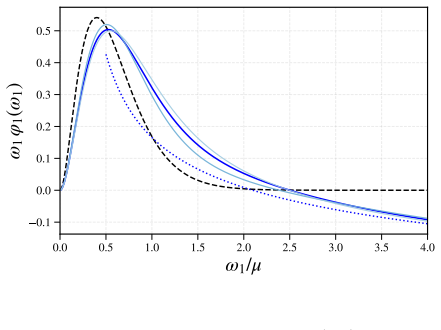
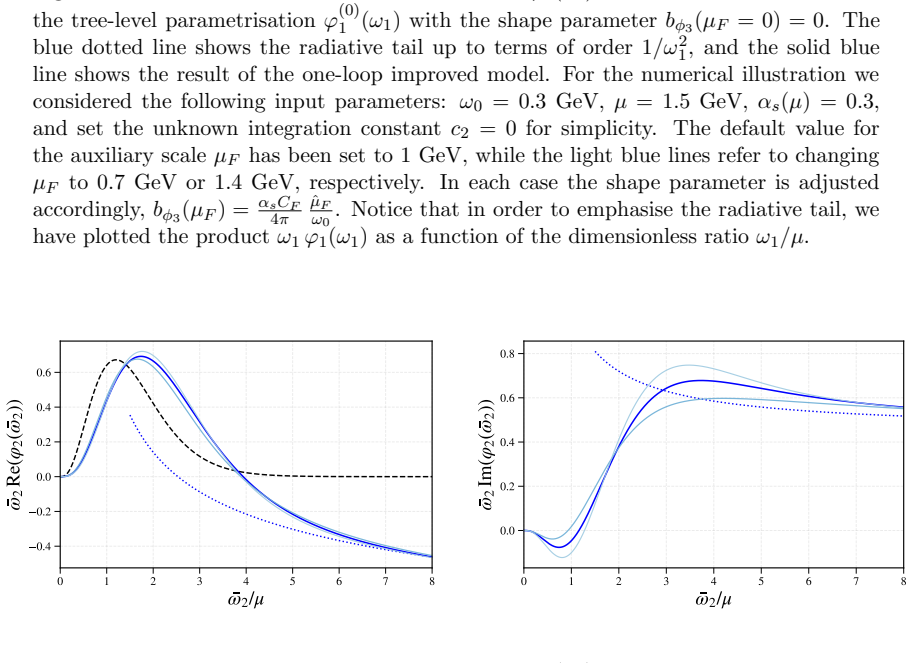
The complete Lorentz decomposition of generic trilocal HQET operators yields eight independent di-light-cone distribution amplitudes organized in a definite-twist basis; local operator identities and equations-of-motion constraints then produce tree-level relations among their normalization integrals and first moments that are fixed by a minimal set of hadronic parameters, permitting simple momentum-space models for all of them, with the leading-twist distribution additionally incorporating its perturbative radiative tail at order alpha_s.
What carries the argument
Trilocal HQET operators whose vacuum-to-B matrix elements define the eight independent twist-organized di-light-cone distribution amplitudes.
If this is right
- All eight independent DLCDAs have their normalizations and first moments determined by the same minimal set of hadronic parameters.
- Explicit momentum-space models become available for every independent DLCDAs.
- The leading-twist DLCDAs receive an explicit perturbative correction of order alpha_s that modifies their large-momentum behavior.
- The models supply concrete input for non-factorizable soft-gluon contributions in rare and non-leptonic B-meson decays.
Where Pith is reading between the lines
- The models can be inserted directly into existing factorization formulas to produce numerical estimates of three-particle soft-gluon corrections in specific decay channels.
- Lattice computations of the underlying trilocal matrix elements would provide an independent check on the tree-level moment relations.
- The same operator-identity technique could be applied to construct models for higher-particle or higher-twist amplitudes in the same framework.
Load-bearing premise
Tree-level relations obtained from local operator identities and equations of motion remain sufficient to fix the normalizations and first moments once a minimal set of hadronic parameters is supplied.
What would settle it
A direct lattice-QCD evaluation of any normalization integral or first moment that deviates from the value predicted by the minimal-parameter relations.
Figures

read the original abstract
We present a systematic study of the three-particle di-light-cone distribution amplitudes (DLCDAs) of the $B$-meson. They are defined through $B$-meson--to--vacuum matrix elements of trilocal HQET operators, in which the light antiquark and the gluon field-strength tensor are located on two back-to-back light rays. In this sense, the DLCDAs generalise the conventional $B$-meson light-cone distribution amplitudes to configurations where soft fields couple to collinear degrees of freedom in two distinct directions. As such, they parametrise the non-perturbative dynamics associated with non-factorisable soft-gluon contributions in rare and non-leptonic exclusive $B$-meson decays. We derive the complete Lorentz decomposition of the matrix elements of generic trilocal operators, identify eight independent DLCDAs, and organise them in a basis of definite twist. Using local operator identities and equations-of-motion constraints, we obtain tree-level relations for their normalisation integrals and first moments in terms of a minimal set of hadronic parameters. These relations allow us to construct simple momentum-space models for all independent DLCDAs. For the leading-twist distribution, we further incorporate the perturbative radiative tail at order $\alpha_s$ and discuss its impact on the resulting parametrisation.
Editorial analysis
A structured set of objections, weighed in public.
Referee Report
Summary. The manuscript presents a systematic study of three-particle di-light-cone distribution amplitudes (DLCDAs) of the B-meson defined via matrix elements of trilocal HQET operators with the light antiquark and gluon field-strength tensor on back-to-back light rays. It derives the complete Lorentz decomposition of these matrix elements, identifies eight independent DLCDAs organized in a definite-twist basis, and uses local operator identities together with equations-of-motion constraints to obtain tree-level relations for their normalization integrals and first moments in terms of a minimal set of hadronic parameters. These relations are then employed to construct simple momentum-space models for all independent DLCDAs, with an O(α_s) perturbative radiative tail added for the leading-twist case.
Significance. If the central results hold, the work supplies a concrete parametrization of non-factorizable soft-gluon contributions in two distinct light-like directions, extending the conventional two-particle B-meson LCDA framework in a manner directly applicable to rare and non-leptonic exclusive decays. The explicit counting of independent structures, the reduction to a minimal parameter set via standard HQET identities, and the provision of explicit models (including the radiative tail) constitute clear strengths that facilitate phenomenological use without introducing additional non-perturbative inputs beyond the stated tree-level relations.
minor comments (3)
- The abstract and introduction refer to 'a minimal set of hadronic parameters' without an explicit enumeration or table linking them to standard quantities (e.g., the B-meson decay constant or moments of two-particle LCDAs); a dedicated paragraph or table listing these parameters and their numerical inputs would improve clarity.
- The construction of the momentum-space models in the final section would benefit from an explicit statement of the support properties (e.g., the integration limits over the two light-cone momentum fractions) and a brief comparison to existing three-particle models in the literature.
- Notation for the eight DLCDAs (twist labels, superscript indices) should be introduced once in a single table or equation block rather than piecemeal, to aid the reader in tracking the twist organization.
Simulated Author's Rebuttal
We thank the referee for the positive summary and significance assessment of our work, as well as the recommendation for minor revision. No specific major comments were provided in the report.
Circularity Check
No significant circularity; derivation from standard HQET identities
full rationale
The paper performs an explicit Lorentz decomposition of trilocal HQET matrix elements into eight twist-organized DLCDAs, then applies local operator identities and equations of motion to obtain tree-level relations among normalization integrals and first moments expressed in terms of a minimal set of external hadronic parameters. These steps are standard in the light-cone operator formalism and do not reduce the target quantities to themselves by definition or by fitting. No load-bearing self-citation chain, ansatz smuggling, or renaming of known results is present; the constructed momentum-space models follow directly from the derived relations rather than presupposing them. The analysis is therefore self-contained against external benchmarks.
Axiom & Free-Parameter Ledger
free parameters (1)
- minimal set of hadronic parameters
axioms (2)
- domain assumption Heavy-quark effective theory provides the correct operator basis for B-meson matrix elements at leading order in 1/m_b
- domain assumption Local operator identities and equations of motion hold at tree level for the trilocal operators
Reference graph
Works this paper leans on
-
[1]
M. Beneke, G. Buchalla, M. Neubert and C. T. Sachrajda,QCD factorization forB→ππ decays: Strong phases and CP violation in the heavy quark limit,Phys. Rev. Lett.83(1999) 1914–1917, [hep-ph/9905312]
Pith/arXiv arXiv 1999
-
[2]
M. Beneke, G. Buchalla, M. Neubert and C. T. Sachrajda,QCD factorization for exclusive, nonleptonic B meson decays: General arguments and the case of heavy light final states,Nucl. Phys. B591(2000) 313–418, [hep-ph/0006124]
Pith/arXiv arXiv 2000
-
[3]
M. Beneke, G. Buchalla, M. Neubert and C. T. Sachrajda,QCD factorization inB→πK, ππ decays and extraction of Wolfenstein parameters,Nucl. Phys. B606(2001) 245–321, [hep-ph/0104110]
Pith/arXiv arXiv 2001
-
[4]
P. Colangelo and A. Khodjamirian,QCD sum rules, a modern perspective,hep-ph/0010175
-
[5]
A. Khodjamirian, B. Meli´ c and Y.-M. Wang,A guide to the QCD light-cone sum rules for b-quark decays,Eur. Phys. J. ST233(2024) 271–298, [2311.08700]
arXiv 2024
-
[6]
A. G. Grozin and M. Neubert,Asymptotics of heavy meson form-factors,Phys. Rev. D55 (1997) 272–290, [hep-ph/9607366]. 23
Pith/arXiv arXiv 1997
-
[7]
M. Beneke and T. Feldmann,Symmetry breaking corrections to heavy to lightBmeson form-factors at large recoil,Nucl. Phys. B592(2001) 3–34, [hep-ph/0008255]
Pith/arXiv arXiv 2001
-
[8]
H. Kawamura, J. Kodaira, C.-F. Qiao and K. Tanaka,B-meson light cone distribution amplitudes in the heavy quark limit,Phys. Lett. B523(2001) 111, [hep-ph/0109181]
Pith/arXiv arXiv 2001
-
[9]
S. Descotes-Genon and C. T. Sachrajda,Factorization, the light cone distribution amplitude of the B meson and the radiative decayB→γℓν ℓ,Nucl. Phys. B650(2003) 356–390, [hep-ph/0209216]
Pith/arXiv arXiv 2003
-
[10]
B. O. Lange and M. Neubert,Renormalization group evolution of the B meson light cone distribution amplitude,Phys. Rev. Lett.91(2003) 102001, [hep-ph/0303082]
Pith/arXiv arXiv 2003
-
[11]
V. M. Braun, D. Y. Ivanov and G. P. Korchemsky,TheBmeson distribution amplitude in QCD,Phys. Rev. D69(2004) 034014, [hep-ph/0309330]
Pith/arXiv arXiv 2004
-
[12]
A. Khodjamirian, T. Mannel and N. Offen,B-meson distribution amplitude from theB→π form-factor,Phys. Lett. B620(2005) 52–60, [hep-ph/0504091]
Pith/arXiv arXiv 2005
-
[13]
S. J. Lee and M. Neubert,Model-independent properties of the B-meson distribution amplitude,Phys. Rev. D72(2005) 094028, [hep-ph/0509350]
Pith/arXiv arXiv 2005
-
[14]
M. Beneke and J. Rohrwild,B meson distribution amplitude fromB→γℓν,Eur. Phys. J. C 71(2011) 1818, [1110.3228]
Pith/arXiv arXiv 2011
-
[15]
G. Bell, T. Feldmann, Y.-M. Wang and M. W. Y. Yip,Light-Cone Distribution Amplitudes for Heavy-Quark Hadrons,JHEP11(2013) 191, [1308.6114]
Pith/arXiv arXiv 2013
-
[16]
T. Feldmann, B. O. Lange and Y.-M. Wang,B-meson light-cone distribution amplitude: Perturbative constraints and asymptotic behavior in dual space,Phys. Rev. D89(2014) 114001, [1404.1343]
Pith/arXiv arXiv 2014
-
[17]
V. M. Braun, Y. Ji and A. N. Manashov,Two-loop evolution equation for theB-meson distribution amplitude,Phys. Rev. D100(2019) 014023, [1905.04498]
Pith/arXiv arXiv 2019
- [18]
-
[19]
C. Wang, Y.-M. Wang and Y.-B. Wei,QCD factorization for the four-body leptonic B-meson decays,JHEP02(2022) 141, [2111.11811]
arXiv 2022
-
[20]
T. Feldmann, P. L¨ ughausen and D. van Dyk,Systematic parametrization of the leading B-meson light-cone distribution amplitude,JHEP10(2022) 162, [2203.15679]
arXiv 2022
-
[21]
V. M. Braun, Y. Ji and A. N. Manashov,Higher-twistB-meson Distribution Amplitudes in HQET,JHEP05(2017) 022, [1703.02446]
Pith/arXiv arXiv 2017
-
[22]
V. M. Braun, A. N. Manashov and N. Offen,Evolution equation for the higher-twistB-meson distribution amplitude,Phys. Rev. D92(2015) 074044, [1507.03445]
Pith/arXiv arXiv 2015
-
[23]
S. Descotes-Genon and N. Offen,Three-particle contributions to the renormalisation of B-meson light-cone distribution amplitudes,JHEP05(2009) 091, [0903.0790]
Pith/arXiv arXiv 2009
- [24]
- [25]
- [26]
-
[27]
C. Cornella, M. Ferr´ e, M. K¨ onig and M. Neubert,The simplest B decay, precisely,JHEP06 (2026) 027, [2601.14361]
Pith/arXiv arXiv 2026
- [28]
-
[29]
M. L. Piscopo and A. V. Rusov,Non-factorisable effects in the decays B 0 s →D + s π− and B 0 →D +K− from LCSR,JHEP10(2023) 180, [2307.07594]
arXiv 2023
-
[30]
T. Feldmann and N. Gubernari,Non-factorisable contributions of strong-penguin operators in Λb →Λℓ +ℓ− decays,JHEP03(2024) 152, [2312.14146]
arXiv 2024
-
[31]
CKM 2025 – 13th International Workshop on the CKM Unitarity Triangle
P. B¨ oer,Overview of recent progress in QCD factorisation for non-leptonic B-meson decays. Talk given at “CKM 2025 – 13th International Workshop on the CKM Unitarity Triangle”, https:// indico.cern.ch/ event/ 1440982/ contributions/ 6583204/ attachments/ 3134960/ 5562294/ Boeer CKM25.pdf(2025)
2025
-
[32]
B¨ oer, M
P. B¨ oer, M. Neubert and M. Stillger,Factorization of Weak Annihilation Amplitudes in NonleptonicB-Meson Decays,in preparation
- [33]
-
[34]
R. Bartocci, P. B¨ oer and T. Hurth,Renormalisation group evolution of the shape function g 17 in B→X sγand B→X sℓ+ℓ− at subleading power,JHEP04(2025) 066, [2411.16634]
arXiv 2025
-
[35]
B. Geyer and O. Witzel,B-meson distribution amplitudes of geometric twist vs. dynamical twist,Phys. Rev. D72(2005) 034023, [hep-ph/0502239]
Pith/arXiv arXiv 2005
-
[36]
T. Feldmann and D. Vladimirov,Radiative tail of the three-particle light-cone distribution amplitudes for theΛ b baryon in HQET,JHEP07(2025) 108, [2505.02570]
arXiv 2025
-
[37]
T. Nishikawa and K. Tanaka,QCD Sum Rules for Quark-Gluon Three-Body Components in theBMeson,Nucl. Phys. B879(2014) 110–142, [1109.6786]
Pith/arXiv arXiv 2014
-
[38]
M. Rahimi and M. Wald,QCD sum rules for parameters of theB-meson distribution amplitudes,Phys. Rev. D104(2021) 016027, [2012.12165]
arXiv 2021
-
[39]
V. M. Braun and I. E. Filyanov,Conformal Invariance and Pion Wave Functions of Nonleading Twist,Z. Phys. C48(1990) 239–248
1990
-
[40]
H. Kawamura and K. Tanaka,Operator product expansion forB-meson distribution amplitude and dimension-5 HQET operators,Phys. Lett. B673(2009) 201–207, [0810.5628]
Pith/arXiv arXiv 2009
-
[41]
Beneke and P
M. Beneke and P. B¨ oer, Work in progress. 25
discussion (0)
Sign in with ORCID, Apple, or X to comment. Anyone can read and Pith papers without signing in.