Dark Matter Interpretation of the Super-Kamiokande Antineutrino Excess and Predictions for JUNO
Pith reviewed 2026-05-20 03:59 UTC · model grok-4.3
The pith
The Super-Kamiokande antineutrino excess can be interpreted as dark matter annihilating dominantly into neutrinos.
A machine-rendered reading of the paper's core claim, the machinery that carries it, and where it could break.
Core claim
The central claim is that the small excess of electron antineutrino events in the 20 MeV range reported by Super-Kamiokande can be explained by dark matter annihilation dominantly into neutrinos. This corresponds to a thermal s-wave dark matter candidate with mass in the tens of MeV range. Such candidates fit naturally into rich dark sector extensions of the Standard Model, and the hypothesis predicts observable signals for future neutrino experiments including JUNO.
What carries the argument
Dominant dark matter annihilation into neutrinos for a thermal s-wave relic with mass in the tens of MeV, which reproduces the reported antineutrino excess spectrum.
If this is right
- The dark matter mass is fixed to the tens of MeV range to match the observed energy of the excess.
- Annihilation must be dominantly into neutrinos to avoid altering the spectrum with other channels.
- JUNO and similar experiments will be able to test the hypothesis with future data collection.
- The mass scale allows embedding into extended dark sector models beyond minimal setups.
Where Pith is reading between the lines
- Confirmation would link a neutrino telescope excess directly to a low-mass thermal relic, offering a new window on dark sector-neutrino couplings.
- The scenario could be cross-checked against cosmological constraints on MeV-scale dark matter from big bang nucleosynthesis or the cosmic microwave background.
- It suggests searching for related signals in other low-energy neutrino or dark matter direct detection channels that might share the same underlying interaction.
Load-bearing premise
The reported Super-Kamiokande excess is a genuine signal from dark matter rather than an unaccounted background or statistical fluctuation, with annihilation proceeding dominantly into neutrinos.
What would settle it
Absence of a matching excess in JUNO data at the predicted rate and energy spectrum, or a detailed reanalysis showing the Super-Kamiokande events are consistent with background.
Figures

read the original abstract
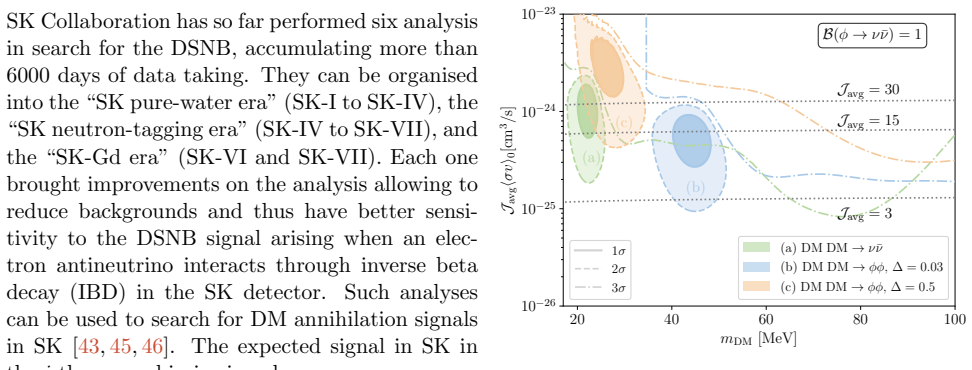
Super-Kamiokande has reported a small excess of electron antineutrino events in the 20 MeV energy range, in the search for the diffuse supernova neutrino background. We interpret this signal as a possible indication of dark matter that annihilates dominantly into neutrinos, pointing to a thermal dark matter candidate with $s$-wave annihilation and with mass in the tens of MeV range. This mass scale naturally fits into rich dark sector extensions of the Standard Model. Neutrino experiments, including JUNO, will be able to test this hypothesis in the coming years.
Editorial analysis
A structured set of objections, weighed in public.
Referee Report
Summary. The paper interprets a reported small excess of electron antineutrino events in the 20 MeV range from Super-Kamiokande's diffuse supernova neutrino background search as a possible signal from dark matter annihilation dominantly into neutrinos. This points to a thermal s-wave DM candidate with mass in the tens of MeV, naturally fitting rich dark sector extensions of the SM, and provides predictions for testing the hypothesis with JUNO and other neutrino experiments.
Significance. If the excess is confirmed as a DM signal and the rate is shown to match the thermal relic cross section without free normalization, this would link neutrino observations to light thermal DM in a falsifiable way, offering a concrete target for upcoming experiments like JUNO. The emphasis on predictions strengthens the interpretative claim by making it testable rather than purely post-hoc.
major comments (2)
- [Interpretation and rate calculation section] The central claim that the SK excess corresponds to a thermal s-wave DM candidate requires demonstrating that the velocity-averaged annihilation cross section fixed by the relic density (~3×10^{-26} cm³/s) produces the observed event rate when folded with local DM density, SK exposure, energy resolution, and background subtraction. Without an explicit rate calculation or fit in the main text (e.g., in the section deriving the expected signal or comparing to data), the identification rests on an unverified assumption rather than a derived consistency.
- [DM model and spectral fit] The abstract states the mass is in the 'tens of MeV range' to fit the 20 MeV excess, but the manuscript should specify how the annihilation spectrum and kinematics are folded with detector response to match the observed energy distribution; if the fit allows a free normalization factor differing by more than a factor of a few from the thermal value, this undermines the 'thermal s-wave' identification.
minor comments (2)
- [Introduction] Clarify the precise energy window and event selection criteria used for the SK excess to allow direct comparison with the predicted DM spectrum.
- [JUNO predictions] Add a table or plot showing the predicted JUNO event rate as a function of exposure and energy threshold, including background estimates.
Simulated Author's Rebuttal
We thank the referee for the careful reading of our manuscript and for the constructive comments, which have helped us strengthen the presentation of our results. We address each major comment below and have revised the manuscript accordingly.
read point-by-point responses
-
Referee: [Interpretation and rate calculation section] The central claim that the SK excess corresponds to a thermal s-wave DM candidate requires demonstrating that the velocity-averaged annihilation cross section fixed by the relic density (~3×10^{-26} cm³/s) produces the observed event rate when folded with local DM density, SK exposure, energy resolution, and background subtraction. Without an explicit rate calculation or fit in the main text (e.g., in the section deriving the expected signal or comparing to data), the identification rests on an unverified assumption rather than a derived consistency.
Authors: We agree that an explicit rate calculation is essential to support the central claim. In the revised manuscript we have added a new subsection that derives the expected event rate from first principles. We adopt the canonical thermal relic value ⟨σv⟩ ≈ 3 × 10^{-26} cm³ s^{-1} for s-wave annihilation, the local DM density ρ_⊙ = 0.3 GeV cm^{-3}, the Super-Kamiokande exposure and fiducial volume appropriate to the DSNB search, and fold in the detector energy resolution together with the inverse-beta-decay detection efficiency. After subtracting the estimated backgrounds, the predicted number of events is consistent with the reported excess for a DM mass of order 25 MeV. The relevant formulas, numerical inputs, and comparison to data are now shown explicitly in the main text. revision: yes
-
Referee: [DM model and spectral fit] The abstract states the mass is in the 'tens of MeV range' to fit the 20 MeV excess, but the manuscript should specify how the annihilation spectrum and kinematics are folded with detector response to match the observed energy distribution; if the fit allows a free normalization factor differing by more than a factor of a few from the thermal value, this undermines the 'thermal s-wave' identification.
Authors: We have expanded the discussion of the spectral modeling. For DM annihilation into neutrinos the rest-frame spectrum is monochromatic at E_ν = m_DM; this is boosted to the lab frame, convolved with the detector resolution (∼10–15 % at 20 MeV), and folded with the inverse-beta-decay cross section to obtain the visible positron energy distribution. In the revised manuscript we overlay the predicted spectrum on the data with the normalization fixed to the thermal relic cross section. The resulting normalization factor lies within a factor of ∼2 of the thermal value, which we now state explicitly. Both the abstract and the main text have been updated to include these details and the comparison plot. revision: yes
Circularity Check
No significant circularity; SK excess interpretation uses external relic density and detector response
full rationale
The paper interprets the reported SK antineutrino excess as DM annihilation dominantly to neutrinos, identifying a thermal s-wave candidate with mass in the tens of MeV. This relies on standard thermal relic cross-section (~3e-26 cm^3/s for s-wave), local DM density, and SK exposure/resolution to match the excess rate, then extrapolates the same parameters to predict JUNO rates. These steps use independent cosmological inputs and experimental details rather than fitting a free normalization and renaming it a prediction or deriving via self-citation. No load-bearing self-citations, self-definitional loops, or ansatz smuggling are present; the central claim remains an interpretation against external benchmarks.
Axiom & Free-Parameter Ledger
axioms (1)
- domain assumption The observed excess is not dominated by unmodeled backgrounds or statistical fluctuations.
Lean theorems connected to this paper
-
IndisputableMonolith/Cost/FunctionalEquation.leanwashburn_uniqueness_aczel unclear?
unclearRelation between the paper passage and the cited Recognition theorem.
⟨σ tot v⟩FO ≃ 3.8 (4.3)×10^{-26} cm³ s^{-1} for mDM = 10 (100) MeV … J-factor … dΦν̄/dEν̄ = ⟨σv⟩0 / (4π κ mDM²) … χ²(α, θ⃗)
-
IndisputableMonolith/Foundation/RealityFromDistinction.leanreality_from_one_distinction unclear?
unclearRelation between the paper passage and the cited Recognition theorem.
thermal s-wave candidate with mass in the tens of MeV range
What do these tags mean?
- matches
- The paper's claim is directly supported by a theorem in the formal canon.
- supports
- The theorem supports part of the paper's argument, but the paper may add assumptions or extra steps.
- extends
- The paper goes beyond the formal theorem; the theorem is a base layer rather than the whole result.
- uses
- The paper appears to rely on the theorem as machinery.
- contradicts
- The paper's claim conflicts with a theorem or certificate in the canon.
- unclear
- Pith found a possible connection, but the passage is too broad, indirect, or ambiguous to say the theorem truly supports the claim.
Reference graph
Works this paper leans on
-
[1]
Suzuki,The Super-Kamiokande experi- ment,Eur
Y. Suzuki,The Super-Kamiokande experi- ment,Eur. Phys. J. C79(2019) 298. [2]Super-Kamiokandecollaboration,First gadolinium loading to Super-Kamiokande, Nucl. Instrum. Meth. A1027(2022) 166248 [2109.00360]. [3]Super-Kamiokandecollaboration,Second gadolinium loading to Super-Kamiokande, Nucl. Instrum. Meth. A1065(2024) 169480 [2403.07796]
-
[2]
J. F. Beacom and M. R. Vagins,GAD- ZOOKS! Anti-neutrino spectroscopy with large water Cherenkov detectors,Phys. Rev. Lett.93(2004) 171101 [hep-ph/0309300]
work page internal anchor Pith review Pith/arXiv arXiv 2004
-
[3]
G. S. Bisnovatyi-Kogan and Z. F. Seidov, Medium-Energy Neutrinos in the Universe, Soviet Astronomy26(1982) 132
work page 1982
-
[4]
L. M. Krauss, S. L. Glashow and D. N. Schramm,Anti-neutrinos Astronomy and Geophysics,Nature310(1984) 191
work page 1984
-
[5]
A. Dar,Has a Cosmological Neutrino Back- ground from Gravitational Stellar Collapse Been Detected?, in20th Rencontres de Moriond: Electroweak Interactions, pp. 329– 340, 1985
work page 1985
-
[6]
N. Ekanger, S. Horiuchi, H. Nagakura and S. Reitz,Diffuse supernova neutrino back- ground with up-to-date star formation rate 6 measurements and long-term multidimen- sional supernova simulations,Phys. Rev. D 109(2024) 023024 [2310.15254]
- [7]
- [8]
-
[9]
Search for Supernova Relic Neutrinos at Super-Kamiokande
A. Santos,In pursuit of the Diffuse Su- pernova Neutrino Background at the Super- Kamiokande and Hyper-Kamiokande exper- iments, Ph.D. thesis, Institut polytech- nique de Paris, LLR - Laboratoire Leprince- Ringuet - IN2P3 - Institut National de Physique Nucl´ eaire et de Physique des Par- ticules du CNRS - X - ´Ecole polytechnique - IP Paris - Institut Po...
work page internal anchor Pith review Pith/arXiv arXiv 2025
-
[10]
M. Harada,Review of diffuse SN neutrino background,Neutrino 2024 Proceedings (Zen- odo), Talk(2024, June 20)
work page 2024
-
[11]
Spectrum of the relic neutrino background from past supernovae and cosmological models
T. Totani and K. Sato,Spectrum of the relic neutrino background from past supernovae and cosmological models,Astropart. Phys.3 (1995) 367 [astro-ph/9504015]
work page internal anchor Pith review Pith/arXiv arXiv 1995
-
[12]
D. H. Hartmann and S. E. Woosley,The cosmic supernova neutrino background,As- tropart. Phys.7(1997) 137
work page 1997
-
[13]
R. A. Malaney,Evolution of the cosmic gas and the relic supernova neutrino back- ground,Astropart. Phys.7(1997) 125 [astro-ph/9612012]
work page internal anchor Pith review Pith/arXiv arXiv 1997
-
[14]
The Supernova Relic Neutrino Background
M. Kaplinghat, G. Steigman and T. P. Walker,The Supernova relic neutrino back- ground,Phys. Rev. D62(2000) 043001 [astro-ph/9912391]
work page internal anchor Pith review Pith/arXiv arXiv 2000
-
[15]
Constraints on the Star Formation Rate from Supernova Relic Neutrino Observations
M. Fukugita and M. Kawasaki,Con- straints on the star formation rate from su- pernova relic neutrino observations,Mon. Not. Roy. Astron. Soc.340(2003) L7 [astro-ph/0204376]
work page internal anchor Pith review Pith/arXiv arXiv 2003
-
[16]
The Diffuse Supernova Neutrino Background is detectable in Super-Kamiokande
S. Horiuchi, J. F. Beacom and E. Dwek,The Diffuse Supernova Neutrino Background is detectable in Super-Kamiokande,Phys. Rev. D79(2009) 083013 [0812.3157]
work page internal anchor Pith review Pith/arXiv arXiv 2009
-
[17]
Diffuse neutrino flux from failed supernovae
C. Lunardini,Diffuse neutrino flux from failed supernovae,Phys. Rev. Lett.102 (2009) 231101 [0901.0568]
work page internal anchor Pith review Pith/arXiv arXiv 2009
-
[18]
Shockwaves in Supernovae: New Implications on the Diffuse Supernova Neutrino Background
S. Galais, J. Kneller, C. Volpe and J. Gava, Shockwaves in Supernovae: New Implications on the Diffuse Supernova Neutrino Back- ground,Phys. Rev. D81(2010) 053002 [0906.5294]
work page internal anchor Pith review Pith/arXiv arXiv 2010
-
[19]
Spectrum of the Supernova Relic Neutrino Background and Metallicity Evolution of Galaxies
K. Nakazato, E. Mochida, Y. Niino and H. Suzuki,Spectrum of the Supernova Relic Neutrino Background and Metallicity Evolu- tion of Galaxies,Astrophys. J.804(2015) 75 [1503.01236]
work page internal anchor Pith review Pith/arXiv arXiv 2015
-
[20]
A. Priya and C. Lunardini,Diffuse neu- trinos from luminous and dark supernovae: prospects for upcoming detectors at theO(10) kt scale,JCAP11(2017) 031 [1705.02122]
work page internal anchor Pith review Pith/arXiv arXiv 2017
-
[21]
Diffuse neutrino supernova background as a cosmological test
J. Barranco, A. Bernal and D. Delepine,Dif- fuse neutrino supernova background as a cos- mological test,J. Phys. G45(2018) 055201 [1706.03834]. 7
work page internal anchor Pith review Pith/arXiv arXiv 2018
-
[22]
S. Horiuchi, K. Sumiyoshi, K. Nakamura, T. Fischer, A. Summa, T. Takiwaki et al., Diffuse supernova neutrino background from extensive core-collapse simulations of8- 100M⊙ progenitors,Mon. Not. Roy. Astron. Soc.475(2018) 1363 [1709.06567]
work page internal anchor Pith review Pith/arXiv arXiv 2018
-
[23]
A. De Gouvˆ ea, I. Martinez-Soler, Y. F. Perez- Gonzalez and M. Sen,Fundamental physics with the diffuse supernova background neu- trinos,Phys. Rev. D102(2020) 123012 [2007.13748]
-
[24]
S. Horiuchi, T. Kinugawa, T. Takiwaki, K. Takahashi and K. Kotake,Impact of bi- nary interactions on the diffuse supernova neutrino background,Phys. Rev. D103 (2021) 043003 [2012.08524]
- [25]
-
[26]
Z. Tabrizi and S. Horiuchi,Flavor Triangle of the Diffuse Supernova Neutrino Background, JCAP05(2021) 011 [2011.10933]
- [27]
-
[28]
P. Ivanez-Ballesteros and M. C. Volpe,Neu- trino nonradiative decay and the diffuse su- pernova neutrino background,Phys. Rev. D 107(2023) 023017 [2209.12465]
-
[29]
P. Mart´ ınez-Mirav´ e, I. Tamborra, M.´A. Aloy and M. Obergaulinger,Diffuse neutrino back- ground from magnetorotational stellar core collapses,Phys. Rev. D110(2024) 103029 [2409.09126]
-
[30]
K. Nakazato, R. Akaho, Y. Ashida and T. Tsujimoto,Impacts of Black-hole-forming Supernova Explosions on the Diffuse Neu- trino Background,Astrophys. J.975(2024) 71 [2406.13276]
-
[31]
A. Beauchˆ ene,Diffuse Supernova Neu- trino Background: Insights from Super- Kamiokande & Prospects with Hyper- Kamiokande,Neutrino 2024 Proceedings (Zenodo), Poster(2024)
work page 2024
-
[32]
R. Rogly,Overview of the model-dependent approach for the Diffuse Supernova Neutrino Background search with the SK-Gd experi- ment,Neutrino 2024 Proceedings (Zenodo), Poster(2024)
work page 2024
- [33]
-
[34]
M. Cirelli, A. Strumia and J. Zupan,Dark Matter,2406.01705
work page internal anchor Pith review Pith/arXiv arXiv
-
[35]
Testing MeV dark matter with neutrino detectors
S. Palomares-Ruiz and S. Pascoli,Testing MeV dark matter with neutrino detectors, Phys. Rev. D77(2008) 025025 [0710.5420]
work page internal anchor Pith review Pith/arXiv arXiv 2008
-
[36]
Dark Matter-Neutrino Interaction in Light of Collider and Neutrino Telescope Data
R. Primulando and P. Uttayarat,Dark Matter-Neutrino Interaction in Light of Col- lider and Neutrino Telescope Data,JHEP06 (2018) 026 [1710.08567]
work page internal anchor Pith review Pith/arXiv arXiv 2018
-
[37]
Dark matter-neutrino interactions through the lens of their cosmological implications
A. Olivares-Del Campo, C. Bœhm, S. Palomares-Ruiz and S. Pascoli,Dark matter-neutrino interactions through the lens of their cosmological implications,Phys. Rev. D97(2018) 075039 [1711.05283]
work page internal anchor Pith review Pith/arXiv arXiv 2018
-
[38]
C. A. Arg¨ uelles, A. Diaz, A. Kheirandish, A. Olivares-Del-Campo, I. Safa and A. C. Vincent,Dark matter annihilation to neu- trinos,Rev. Mod. Phys.93(2021) 035007 [1912.09486]. [47]JUNOcollaboration,Neutrino Physics with JUNO,J. Phys. G43(2016) 030401 [1507.05613]. [48]JUNOcollaboration,Prospects for detect- ing the diffuse supernova neutrino back- groun...
-
[39]
Precise Relic WIMP Abundance and its Impact on Searches for Dark Matter Annihilation
G. Steigman, B. Dasgupta and J. F. Bea- com,Precise Relic WIMP Abundance and its Impact on Searches for Dark Matter An- nihilation,Phys. Rev. D86(2012) 023506 [1204.3622]. 8
work page internal anchor Pith review Pith/arXiv arXiv 2012
-
[40]
Constraining Light Dark Matter with Diffuse X-Ray and Gamma-Ray Observations
R. Essig, E. Kuflik, S. D. McDermott, T. Volansky and K. M. Zurek,Constraining Light Dark Matter with Diffuse X-Ray and Gamma-Ray Observations,JHEP11(2013) 193 [1309.4091]
work page internal anchor Pith review Pith/arXiv arXiv 2013
-
[41]
T. R. Slatyer,Indirect dark matter signa- tures in the cosmic dark ages. I. Generalizing the bound on s-wave dark matter annihilation from Planck results,Phys. Rev. D93(2016) 023527 [1506.03811]
work page internal anchor Pith review Pith/arXiv arXiv 2016
-
[42]
Novel cosmic-ray electron and positron constraints on MeV dark matter particles
M. Boudaud, J. Lavalle and P. Salati,Novel cosmic-ray electron and positron constraints on MeV dark matter particles,Phys. Rev. Lett.119(2017) 021103 [1612.07698]
work page internal anchor Pith review Pith/arXiv arXiv 2017
-
[43]
K. C. Y. Ng, B. M. Roach, K. Perez, J. F. Beacom, S. Horiuchi, R. Krivonos et al.,New Constraints on Sterile Neutrino Dark Mat- ter fromN uST ARM31 Observations,Phys. Rev. D99(2019) 083005 [1901.01262]
work page internal anchor Pith review Pith/arXiv arXiv 2019
- [44]
-
[45]
M. Cirelli, N. Fornengo, J. Koechler, E. Pinetti and B. M. Roach,Putting all the X in one basket: Updated X-ray constraints on sub-GeV Dark Matter,JCAP07(2023) 026 [2303.08854]
-
[46]
T. Siegert, F. Calore and P. D. Serpico,Sub- GeV dark matter annihilation: limits from Milky Way observations with INTEGRAL, Mon. Not. Roy. Astron. Soc.528(2024) 3433 [2401.03795]
-
[47]
Y.-N. Wang, X.-C. Duan, T.-P. Tang, Z. Wang and Y.-L. S. Tsai,Exploring sub- GeV dark matter via s-wave, p-wave, and res- onance annihilation with CMB data,JCAP 08(2025) 059 [2502.18263]
-
[48]
C. M. Ho and R. J. Scherrer,Limits on MeV Dark Matter from the Effective Number of Neutrinos,Phys. Rev. D87(2013) 023505 [1208.4347]
work page internal anchor Pith review Pith/arXiv arXiv 2013
-
[49]
K. M. Nollett and G. Steigman,BBN And The CMB Constrain Neutrino Coupled Light WIMPs,Phys. Rev. D91(2015) 083505 [1411.6005]
work page internal anchor Pith review Pith/arXiv arXiv 2015
- [50]
- [51]
- [52]
-
[53]
P. Ballett, M. Hostert and S. Pascoli,Dark Neutrinos and a Three Portal Connection to the Standard Model,Phys. Rev. D101(2020) 115025 [1903.07589]
-
[54]
Abdullahi et al.,From oversimplified to overlooked: The case for exploring rich dark sectors,Nucl
A. Abdullahi et al.,From oversimplified to overlooked: The case for exploring rich dark sectors,Nucl. Phys. B1020(2025) 117148 [2505.05663]
-
[55]
G. Elor, N. L. Rodd, T. R. Slatyer and W. Xue,Model-Independent Indirect Detec- tion Constraints on Hidden Sector Dark Mat- ter,JCAP06(2016) 024 [1511.08787]
work page internal anchor Pith review Pith/arXiv arXiv 2016
-
[56]
Thermal Dark Matter Through the Dirac Neutrino Portal
B. Batell, T. Han, D. McKeen and B. Shams Es Haghi,Thermal Dark Matter Through the Dirac Neutrino Portal,Phys. Rev. D97 (2018) 075016 [1709.07001]
work page internal anchor Pith review Pith/arXiv arXiv 2018
-
[57]
M. Blennow, E. Fernandez-Martinez, A. Olivares-Del Campo, S. Pascoli, S. Rosauro-Alcaraz and A. V. Titov, Neutrino Portals to Dark Matter,Eur. Phys. J. C79(2019) 555 [1903.00006]
-
[58]
Are small neutrino masses unveiling the missing mass problem of the Universe?
C. Boehm, Y. Farzan, T. Hambye, S. Palomares-Ruiz and S. Pascoli,Is it possible to explain neutrino masses with scalar dark matter?,Phys. Rev. D77(2008) 043516 [hep-ph/0612228]
work page internal anchor Pith review Pith/arXiv arXiv 2008
-
[59]
Radiative Model of Neutrino Mass with Neutrino Interacting MeV Dark Matter
A. Arhrib, C. Bœhm, E. Ma and T.-C. Yuan, Radiative Model of Neutrino Mass with Neu- trino Interacting MeV Dark Matter,JCAP 04(2016) 049 [1512.08796]
work page internal anchor Pith review Pith/arXiv arXiv 2016
-
[60]
S.-P. Li and X.-J. Xu,Dark matter pro- duced from right-handed neutrinos,JCAP06 (2023) 047 [2212.09109]. 9
-
[61]
Using the Milky Way satellites to study interactions between cold dark matter and radiation
C. Boehm, J. A. Schewtschenko, R. J. Wilkinson, C. M. Baugh and S. Pascoli,Us- ing the Milky Way satellites to study interac- tions between cold dark matter and radiation, Mon. Not. Roy. Astron. Soc.445(2014) L31 [1404.7012]
work page internal anchor Pith review Pith/arXiv arXiv 2014
-
[62]
K. Akita and S. Ando,Constraints on dark matter-neutrino scattering from the Milky- Way satellites and subhalo modeling for dark acoustic oscillations,JCAP11(2023) 037 [2305.01913]
- [63]
-
[64]
T. Brinckmann, J. H. Chang, P. Du and M. LoVerde,Confronting interacting dark radiation scenarios with cosmological data,Phys. Rev. D107(2023) 123517 [2212.13264]
- [65]
- [66]
- [67]
-
[68]
A. Granelli, M. Lucente, E. Merkel, S. Pascoli and S. Rosauro-Alcaraz, “in preparation.” [81]GRA VITYcollaboration,Mass distribution in the Galactic Center based on interfer- ometric astrometry of multiple stellar or- bits,Astron. Astrophys.657(2022) L12 [2112.07478]
-
[69]
Abuter et al.,Improved GRAVITY astro- metric accuracy from modeling optical aber- rations,Astron
R. Abuter et al.,Improved GRAVITY astro- metric accuracy from modeling optical aber- rations,Astron. Astrophys.647(2021) A59 [2101.12098]
-
[70]
J. F. Navarro, C. S. Frenk and S. D. M. White,The Structure of cold dark mat- ter halos,Astrophys. J.462(1996) 563 [astro-ph/9508025]
work page internal anchor Pith review Pith/arXiv arXiv 1996
-
[71]
M. Benito, A. Cuoco and F. Iocco,Han- dling the Uncertainties in the Galactic Dark Matter Distribution for Particle Dark Matter Searches,JCAP03(2019) 033 [1901.02460]
work page internal anchor Pith review Pith/arXiv arXiv 2019
- [72]
-
[73]
Precise quasielastic neutrino/nucleon cross section
A. Strumia and F. Vissani,Precise quasielas- tic neutrino/nucleon cross-section,Phys. Lett. B564(2003) 42 [astro-ph/0302055]. [87]Super-Kamiokandecollaboration,Solar neutrino results in Super-Kamiokande-III, Phys. Rev. D83(2011) 052010 [1010.0118]. [88]Super-Kamiokandecollaboration,Solar neutrino measurements using the full data pe- riod of Super-Kamiokan...
work page internal anchor Pith review Pith/arXiv arXiv 2003
-
[74]
MeV Dark Matter: Has It Been Detected?
C. Boehm, D. Hooper, J. Silk, M. Casse and J. Paul,MeV dark matter: Has it been de- tected?,Phys. Rev. Lett.92(2004) 101301 [astro-ph/0309686]
work page internal anchor Pith review Pith/arXiv arXiv 2004
-
[75]
Constraints on dark matter and the shape of the Milky Way dark halo from the 511 keV line
Y. Ascasibar, P. Jean, C. Boehm and J. Knoedlseder,Constraints on dark mat- ter and the shape of the Milky Way dark halo from the 511-keV line,Mon. Not. Roy. Astron. Soc.368(2006) 1695 [astro-ph/0507142]
work page internal anchor Pith review Pith/arXiv arXiv 2006
-
[76]
D. la Torre Luque; Pedro, S. Balaji, M. Fair- bairn, F. Sala and J. Silk,511 keV galactic photons from a dark matter spike,JCAP09 (2025) 034 [2410.16379]
-
[77]
S. Das, M. R. Krumholz, R. M. Crocker, T. Siegert and L. Eisenberger,Relaxation of Energy Constraints for Positrons Gen- erating the Galactic Annihilation Signal, 2506.00847. 10 [94]NANOGravcollaboration,The NANOGrav 15 yr Data Set: Search for Signals from New Physics,Astrophys. J. Lett.951(2023) L11 [2306.16219]. 11
discussion (0)
Sign in with ORCID, Apple, or X to comment. Anyone can read and Pith papers without signing in.