Graph restricted tensors: building blocks for holographic networks
Pith reviewed 2026-05-21 15:37 UTC · model grok-4.3
The pith
Encoding maximal entanglement constraints as graphs yields a broad family of non-stabilizer tensors for holographic networks.
A machine-rendered reading of the paper's core claim, the machinery that carries it, and where it could break.
Core claim
Graph-restricted tensors are defined by representing selected bipartition constraints as edges or conditions in a graph; the resulting tensors encompass prior special states and admit explicit analytic forms for graphs inspired by holographic models, thereby showing that a large set of non-stabilizer tensors exists and is useful for such networks.
What carries the argument
Graph-restricted tensor: a quantum state tensor whose components satisfy entanglement constraints imposed by a graph that specifies which bipartitions must be maximally entangled.
If this is right
- Known constructions including AME states and dual-unitary operators are recovered as special cases of the same graph framework.
- Explicit analytic solutions exist for graphs motivated by holographic tensor networks.
- Non-stabilizer tensors become available as building blocks for lattice models of the holographic principle.
- The approach generates original examples beyond those previously studied in the literature.
Where Pith is reading between the lines
- Different choices of graph topology may correspond to distinct patterns of bulk entanglement in holographic models.
- The same construction could be tested on small qubit systems to produce explicit states for numerical studies of holographic duality.
- Varying the graphs might generate tensors with controlled entanglement properties useful for other few-body quantum tasks.
Load-bearing premise
The graph encoding fully captures all necessary constraints for maximal bipartite entanglement on the chosen partitions without requiring additional physical or algebraic conditions beyond those stated in the framework definition.
What would settle it
For one of the concrete graphs presented, compute whether the reported analytic solution actually achieves the claimed maximal entanglement on every required bipartition and whether it lies outside the stabilizer family.
Figures



read the original abstract
We analyze few-body quantum states with particular correlation properties imposed by the requirement of maximal bipartite entanglement for selected partitions of the system into two complementary parts. A novel framework to treat this problem by encoding these constraints in a graph is advocated; the resulting objects are called ``graph-restricted tensors''. This framework encompasses several examples previously treated in the literature, such as 1-uniform multipartite states, quantum states related to dual unitary operators and absolutely maximally entangled states (AME) corresponding to 2-unitary matrices. Original examples of presented graph-restricted tensors are motivated by tensor network models for the holographic principle. In concrete cases we find exact analytic solutions, demonstrating thereby that there exists a vast landscape of non-stabilizer tensors useful for the lattice models of holography.
Editorial analysis
A structured set of objections, weighed in public.
Referee Report
Summary. The manuscript introduces a graph-based framework for 'graph-restricted tensors' that encode constraints ensuring maximal bipartite entanglement for chosen partitions of few-body quantum systems. It unifies prior examples including 1-uniform multipartite states, states from dual-unitary operators, and absolutely maximally entangled (AME) states from 2-unitary matrices. Original examples are motivated by holographic tensor-network models, and the authors report exact analytic solutions in concrete cases to argue for a vast landscape of non-stabilizer tensors applicable to holographic lattice models.
Significance. If the claimed analytic solutions are free of hidden assumptions and the tensors integrate into holographic networks while preserving entanglement properties, the work would supply new, systematically constructed building blocks beyond stabilizer states for lattice holography. The unification of existing classes under a single graph-encoding scheme is a clear organizational strength.
major comments (3)
- [Abstract / concrete-cases section] Abstract and the section presenting concrete cases: the assertion of 'exact analytic solutions' is central to the claim of a vast landscape, yet the provided text does not display the full derivations or explicit tensor constructions, leaving open whether the solutions satisfy the graph constraints independently or rely on post-hoc adjustments.
- [holographic-examples section] Section on holographic motivation: the utility for lattice models of holography is stated as motivation rather than demonstrated; no explicit construction integrates a graph-restricted tensor into a holographic network or verifies bulk-boundary correspondence or other holographic properties.
- [framework-definition section] Framework definition: the claim that the graph encoding alone fully captures all constraints for maximal bipartite entanglement on the chosen partitions is load-bearing but not accompanied by a proof or exhaustive check that no additional algebraic or physical conditions are required.
minor comments (2)
- [Notation / early framework] Notation for the graph-restricted tensor should be introduced with a single clear definition before the first example to prevent ambiguity when comparing to prior 1-uniform or AME constructions.
- [Figures] Figure captions for any tensor-network diagrams should explicitly label the partitions corresponding to the graph edges.
Simulated Author's Rebuttal
We thank the referee for the careful reading and constructive comments on our manuscript. We address each major comment point by point below, indicating where revisions will be made to strengthen the presentation.
read point-by-point responses
-
Referee: [Abstract / concrete-cases section] Abstract and the section presenting concrete cases: the assertion of 'exact analytic solutions' is central to the claim of a vast landscape, yet the provided text does not display the full derivations or explicit tensor constructions, leaving open whether the solutions satisfy the graph constraints independently or rely on post-hoc adjustments.
Authors: We agree that the main text prioritizes presentation of results over exhaustive derivations for conciseness. The solutions satisfy the graph constraints directly by construction, as can be verified by substituting the explicit forms into the defining conditions for maximal bipartite entanglement on the specified partitions. In the revised version we will add an appendix containing the full step-by-step analytic derivations together with the explicit tensor components for each concrete case, confirming that the constraints are met independently. revision: yes
-
Referee: [holographic-examples section] Section on holographic motivation: the utility for lattice models of holography is stated as motivation rather than demonstrated; no explicit construction integrates a graph-restricted tensor into a holographic network or verifies bulk-boundary correspondence or other holographic properties.
Authors: The section presents the holographic tensor-network models as motivation for the choice of graph structures, consistent with the scope of the present work which centers on defining the graph-restricted tensor framework and deriving analytic solutions. A complete integration into a holographic network with explicit verification of bulk-boundary correspondence lies beyond the current manuscript and is reserved for follow-up work. We will revise the text to make this distinction clearer in the introduction and outlook. revision: partial
-
Referee: [framework-definition section] Framework definition: the claim that the graph encoding alone fully captures all constraints for maximal bipartite entanglement on the chosen partitions is load-bearing but not accompanied by a proof or exhaustive check that no additional algebraic or physical conditions are required.
Authors: The graph is constructed precisely so that its edges and vertices encode the chosen bipartitions together with the requirement that the corresponding reduced density operators are maximally mixed. Satisfaction of the graph conditions is therefore equivalent to the desired entanglement properties by definition. To address the concern we will insert a short formal paragraph in the framework section that spells out this equivalence and notes that no further algebraic conditions arise within the stated scope. revision: yes
Circularity Check
No significant circularity: graph-restricted tensors defined directly from independent graph constraints
full rationale
The paper defines graph-restricted tensors by encoding maximal bipartite entanglement constraints directly into a graph structure, then derives analytic solutions for concrete cases that satisfy these stated constraints. This construction is self-contained and does not reduce any claimed result to fitted inputs, self-citations, or prior ansatzes by construction. The framework encompasses earlier examples from the literature but treats them as special cases rather than deriving the central claims from them. No load-bearing step equates a prediction to its own inputs or relies on uniqueness theorems imported from the authors' prior work. The derivation therefore stands on first-principles graph encoding and explicit solutions without circular reduction.
Axiom & Free-Parameter Ledger
axioms (2)
- domain assumption Maximal bipartite entanglement can be imposed exactly by restricting the support of the tensor according to a graph structure.
- standard math The resulting tensors correspond to valid quantum states (normalized, positive semidefinite reduced density matrices).
invented entities (1)
-
graph-restricted tensor
no independent evidence
Lean theorems connected to this paper
-
IndisputableMonolith/Foundation/AlexanderDuality.leanalexander_duality_circle_linking unclear?
unclearRelation between the paper passage and the cited Recognition theorem.
A novel framework to treat this problem by encoding these constraints in a graph is advocated; the resulting objects are called 'graph-restricted tensors'.
-
IndisputableMonolith/Cost/FunctionalEquation.leanwashburn_uniqueness_aczel unclear?
unclearRelation between the paper passage and the cited Recognition theorem.
Original examples of presented graph-restricted tensors are motivated by tensor network models for the holographic principle... exact analytic solutions, demonstrating thereby that there exists a vast landscape of non-stabilizer tensors
What do these tags mean?
- matches
- The paper's claim is directly supported by a theorem in the formal canon.
- supports
- The theorem supports part of the paper's argument, but the paper may add assumptions or extra steps.
- extends
- The paper goes beyond the formal theorem; the theorem is a base layer rather than the whole result.
- uses
- The paper appears to rely on the theorem as machinery.
- contradicts
- The paper's claim conflicts with a theorem or certificate in the canon.
- unclear
- Pith found a possible connection, but the passage is too broad, indirect, or ambiguous to say the theorem truly supports the claim.
Reference graph
Works this paper leans on
-
[1]
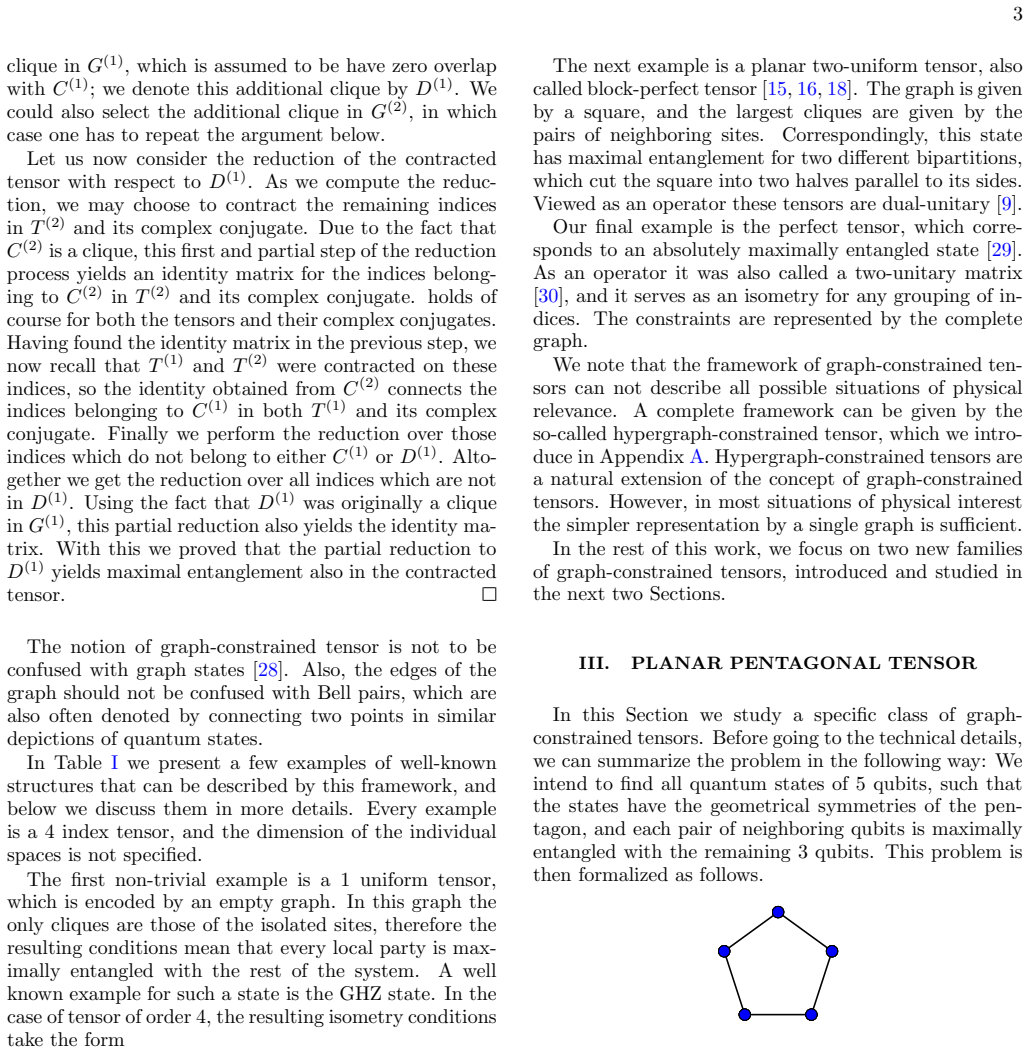
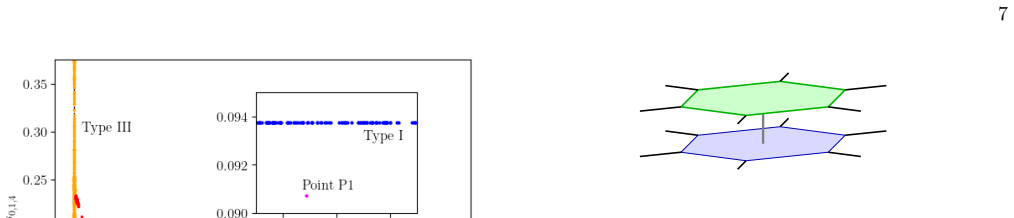
It is simple to notice that due to the isometric properties ofT, nodeN’s largest eigenvalue is 1, and the corresponding (unnormalized) eigenvector is given byP i |ii⟩, since application of this vector corresponds to the reduction ofTto only one subsystem. Figure 5. Contraction of the bulk and four pairs of boundary indices between planar hexagonal tensor ...
-
[2]
, ∆hexb = ln(4) ln(3 + 2 √
-
[3]
≈0.78. (33) The minimum of ∆ hexa is obtained ata min =√ 2−1 /32 and is equal ∆ hexa|a=amin = ln(8)/ln(3 + 2 √ 2)≈1.18, whereas in the limitsa→0 anda→ √ 2/16 it tends to infinity. Unfortunately, these two values do not coincide for anyawithin the considered range, so it is troublesome to give them a physical interpretation. Sim- ilar phenomena were observ...
work page 2023
-
[4]
However, we were not able to find any analytical formula for these solutions
Type II We have observed numerically that these solutions are characterized by the relation (a1 −a 2)2 + 3(a3 −a 4)2 = 1 8 .(B1) These solutions have ∆s 013 ̸= 0 and ∆s 014 ̸= 0 and thus the hyperbolic tiling with the corresponding tensors would yield non-trivial correlation functions. However, we were not able to find any analytical formula for these solutions
-
[5]
Therefore, the corresponding ten- sors are not interesting as building blocks of holographic codes
Type III These solutions satisfy additional relations |a1|=|a 10|,|a 2|=|a 9|,|a 3|=|a 4|=|a 12| (B2) For these solutions,the entropy of reduced stateρ 013 is equal ∆s 013 = 0. Therefore, the corresponding ten- sors are not interesting as building blocks of holographic codes. There are several solutions satisfying conditions (B2). For instance, a one-para...
-
[6]
3 corresponds to isolated points marked as P1 and P2
Isolated points We found two solutions for graph-restricted 7-index tensor, which in Fig. 3 corresponds to isolated points marked as P1 and P2. For Point P2 we obtained an exact solution, which satisfies the constraints (23). Below we 12 provide explicit formulas for the casej= 1, k= 0. One of them (P1A) reads, in variables of (22) a1 = p 445 √ 2 + 650 + ...
- [7]
-
[8]
Or ´us, Tensor networks for complex quantum systems, Nat
R. Or´ us, Tensor networks for complex quantum systems, Nat. Rev. Phys.1, 538 (2019), arXiv:1812.04011 [cond- mat.str-el]
-
[9]
o hler , author A. Swoboda , author S. R. \ Manmana , author U. Schollw \
S. Paeckel, T. K¨ ohler, A. Swoboda, S. R. Manmana, U. Schollw¨ ock, and C. Hubig, Time-evolution meth- ods for matrix-product states, Ann. Phys.411, 167998 (2019), arXiv:1901.05824 [cond-mat.str-el]
-
[10]
A. Berezutskii, M. Liu, A. Acharya, R. Ellerbrock, J. Gray, R. Haghshenas, Z. He, A. Khan, V. Kuzmin, D. Lyakh, D. Lykov, S. Mandr` a, C. Mansell, A. Mel- nikov, A. Melnikov, V. Mironov, D. Morozov, F. Neukart, A. Nocera, M. A. Perlin, M. Perelshtein, M. Stein- berg, R. Shaydulin, B. Villalonga, M. Pflitsch, M. Pis- toia, V. Vinokur, and Y. Alexeev, Tenso...
-
[11]
A. Jahn and J. Eisert, Holographic tensor network mod- els and quantum error correction: a topical review, Quantum Sci. Tech.6, 033002 (2021), arXiv:2102.02619 [quant-ph]. 14
-
[12]
Holographic quantum error-correcting codes: Toy models for the bulk/boundary correspondence
F. Pastawski, B. Yoshida, D. Harlow, and J. Preskill, Holographic quantum error-correcting codes: toy models for the bulk/boundary correspondence, JHEP2015, 149, arXiv:1503.06237 [hep-th]
work page internal anchor Pith review Pith/arXiv arXiv
-
[13]
J. Maldacena, The large n limit of superconformal field theories and supergravity, International Journal of Theoretical Physics38, 1113–1133 (1999), arXiv:hep- th/9711200 [hep-th]
-
[14]
Witten, Anti de Sitter space and holography, ATMP 2, 253 (1998)
E. Witten, Anti de Sitter space and holography, ATMP 2, 253 (1998)
work page 1998
-
[15]
Exactly solvable many-body dynamics from space-time duality
B. Bertini, P. W. Claeys, and T. Prosen, Exactly solvable many-body dynamics from space-time dual- ity, arXiv e-prints 10.48550/arXiv.2505.11489 (2025), arXiv:2505.11489 [cond-mat.stat-mech]
work page internal anchor Pith review Pith/arXiv arXiv doi:10.48550/arxiv.2505.11489 2025
- [16]
-
[17]
M. Mesty´ an, B. Pozsgay, and I. M. Wanless, Multi- directional unitarity and maximal entanglement in spa- tially symmetric quantum states, SciPost Phys.16, 010 (2024), arXiv:2210.13017 [quant-ph]
-
[18]
Absolutely maximally entangled pure states of multipartite quantum systems
G. Rajchel-Mieldzio´ c, R. Bistro´ n, A. Rico, A. Laksh- minarayan, and K. ˙Zyczkowski, Absolutely maximally entangled pure states of multipartite quantum sys- tems, arXiv e-prints 10.48550/arXiv.2508.04777 (2025), arXiv:2508.04777 [quant-ph]
work page internal anchor Pith review Pith/arXiv arXiv doi:10.48550/arxiv.2508.04777 2025
-
[19]
S. Aravinda, S. A. Rather, and A. Lakshminarayan, From dual-unitary to quantum Bernoulli circuits: Role of the entangling power in constructing a quantum ergodic hierarchy, Phys. Rev. Res.3, 043034 (2021), arXiv:2101.04580 [quant-ph]
-
[20]
C. Cao, J. Pollack, and Y. Wang, Hyperinvariant multi- scale entanglement renormalization ansatz: Approximate holographic error correction codes with power-law corre- lations, Phys. Rev. D105, 026018 (2022)
work page 2022
-
[21]
J. Berger and T. J. Osborne, Perfect tangles, arXiv e- prints (2018), arXiv:1804.03199 [quant-ph]
work page internal anchor Pith review Pith/arXiv arXiv 2018
-
[22]
R. J. Harris, N. A. McMahon, G. K. Brennen, and T. M. Stace, Calderbank-Shor-Steane holographic quan- tum error-correcting codes, Phys. Rev. A98, 052301 (2018), arXiv:1806.06472 [quant-ph]
work page internal anchor Pith review Pith/arXiv arXiv 2018
-
[23]
Wang, Planar k-uniform states: a generalization of planar maximally entangled states, Quant
Y.-L. Wang, Planar k-uniform states: a generalization of planar maximally entangled states, Quant. Inf. Proc.20, 271 (2021), arXiv:2106.12209 [quant-ph]
-
[24]
M. Doroudiani and V. Karimipour, Planar maximally entangled states, Phys. Rev. A102, 012427 (2020), arXiv:2004.00906 [quant-ph]
-
[25]
Hyper-invariant tensor networks and holography
G. Evenbly, Hyperinvariant Tensor Networks and Holography, Phys. Rev. Lett.119, 141602 (2017), arXiv:1704.04229 [quant-ph]
work page internal anchor Pith review Pith/arXiv arXiv 2017
-
[26]
P. Hayden, S. Nezami, X.-L. Qi, N. Thomas, M. Wal- ter, and Z. Yang, Holographic duality from random ten- sor networks, Journal of High Energy Physics2016, 10.1007/jhep11(2016)009 (2016)
-
[27]
Space-time random tensor networks and holographic duality
X.-L. Qi and Z. Yang, Space-time random ten- sor networks and holographic duality, arXiv preprint: 1801.05289 (2018)
work page internal anchor Pith review Pith/arXiv arXiv 2018
-
[28]
N. Bao, G. Penington, J. Sorce, and A. C. Wall, Beyond toy models: distilling tensor networks in full AdS/CFT, Journal of High Energy Physics11, 69 (2019)
work page 2019
-
[29]
A. Jahn, M. Gluza, F. Pastawski, and J. Eisert, Hologra- phy and criticality in matchgate tensor networks, Science Advances5, eaaw0092 (2019)
work page 2019
-
[30]
A. Jahn, Z. Zimbor´ as, and J. Eisert, Tensor network mod- els of AdS/qCFT, Quantum6, 643 (2022)
work page 2022
- [31]
-
[32]
L. Chen, L.-Y. Hung, Y. Jiang, and B.-X. Lao, Quan- tum 2D Liouville Path-Integral Is a Sum over Geometries in AdS 3 Einstein Gravity, arXiv preprint: 2403.03179 (2024)
-
[33]
R. Bistro´ n, M. Hontarenko, and K. ˙Zyczkowski, Bulk- boundary correspondence from hyperinvariant ten- sor networks, Phys. Rev. D111, 026006 (2025), arXiv:2409.02029 [quant-ph]
-
[34]
Absolutely Maximally Entangled Qudit Graph States
W. Helwig, Absolutely maximally entangled qudit graph states, arxiv e-prints (2013), arXiv:1306.2879 [quant-ph]
work page internal anchor Pith review Pith/arXiv arXiv 2013
-
[35]
Maximally multipartite entangled states
P. Facchi, G. Florio, G. Parisi, and S. Pascazio, Max- imally multipartite entangled states, Phys. Rev. A77, 060304 (2008), arXiv:0710.2868 [quant-ph]
work page internal anchor Pith review Pith/arXiv arXiv 2008
-
[36]
Absolutely Maximally Entangled states, combinatorial designs and multi-unitary matrices
D. Goyeneche, D. Alsina, J. I. Latorre, A. Riera, and K. ˙Zyczkowski, Absolutely maximally entangled states, combinatorial designs, and multiunitary matrices, Phys. Rev. A92, 032316 (2015), arXiv:1506.08857 [quant-ph]
work page internal anchor Pith review Pith/arXiv arXiv 2015
-
[37]
Wang, Planar k-uniform states: a generalization of planar maximally entangled states, Quantum Inf
Y. Wang, Planar k-uniform states: a generalization of planar maximally entangled states, Quantum Inf. Pro- cess.20, 1 (2021)
work page 2021
-
[38]
W. R. Inc., Mathematica, Version 12.1.1.0, https://www.wolfram.com/mathematica
-
[39]
N. Ramadas and A. Lakshminarayan, Local unitary equivalence of absolutely maximally entangled states constructed from orthogonal arrays, J. Phys. A: Math. Theor.58, 125301 (2025), arXiv:2411.04096 [quant-ph]
-
[40]
Classification of five-qubit absolutely maximally entangled states
I. Tan, Classification of four-qubit pure codes and five- qubit absolutely maximally entangled states (2025), arXiv:2507.02185 [quant-ph]
work page internal anchor Pith review Pith/arXiv arXiv 2025
-
[41]
Absolutely maximally entangled states of seven qubits do not exist
F. Huber, O. G¨ uhne, and J. Siewert, Absolutely Maxi- mally Entangled States of seven qubits do not exist, Phys. Rev. Lett.118, 200502 (2017), arXiv:1608.06228 [quant- ph]
work page internal anchor Pith review Pith/arXiv arXiv 2017
- [42]
-
[43]
Multi-Qubit Systems: Highly Entangled States and Entanglement Distribution
A. Borras, A. R. Plastino, J. Batle, C. Zander, M. Casas, and A. Plastino, Multiqubit systems: highly entan- gled states and entanglement distribution, Journal of Physics A Mathematical General40, 13407 (2007), arXiv:0803.3979 [quant-ph]
work page internal anchor Pith review Pith/arXiv arXiv 2007
-
[44]
Genuinely multipartite entangled states and orthogonal arrays
D. Goyeneche and K. ˙Zyczkowski, Genuinely multipartite entangled states and orthogonal arrays, Phys. Rev. A90, 022316 (2014), arXiv:1404.3586 [quant-ph]
work page internal anchor Pith review Pith/arXiv arXiv 2014
-
[45]
J. E. Tapiador, J. C. Hernandez-Castro, J. A. Clark, and S. Stepney, Highly entangled multi-qubit states with sim- ple algebraic structure, Journal of Physics A Mathemat- ical General42, 415301 (2009), arXiv:0904.3874 [quant- ph]
work page internal anchor Pith review Pith/arXiv arXiv 2009
-
[46]
X. Zha, C. Yuan, and Y. Zhang, Generalized criterion for a maximally multi-qubit entangled state, Laser Physics Letters10, 045201 (2013), arXiv:1204.6340 [quant-ph]
work page internal anchor Pith review Pith/arXiv arXiv 2013
- [47]
-
[48]
R. Milbradt, L. Scheller, C. Aßmus, and C. B. Mendl, Ternary unitary quantum lattice models and circuits in 15 2 + 1 dimensions, Phys. Rev. Lett.130, 090601 (2023), arXiv:2206.01499 [cond-mat.stat-mech]
-
[49]
D. B. M Rossi, M Huber and C. Macchiavello, Quan- tum hypergraph states, New J. Phys.15, 113022 (2013), arXiv:1211.5554 [quant-ph]
work page internal anchor Pith review Pith/arXiv arXiv 2013
discussion (0)
Sign in with ORCID, Apple, or X to comment. Anyone can read and Pith papers without signing in.