Modeling carbon outgassing from chondritic planetesimals
Pith reviewed 2026-06-29 00:40 UTC · model grok-4.3
The pith
Carbon outgassing depletes more than half the carbon from most carbonaceous chondrite planetesimals but less than half from non-carbonaceous ones.
A machine-rendered reading of the paper's core claim, the machinery that carries it, and where it could break.
Core claim
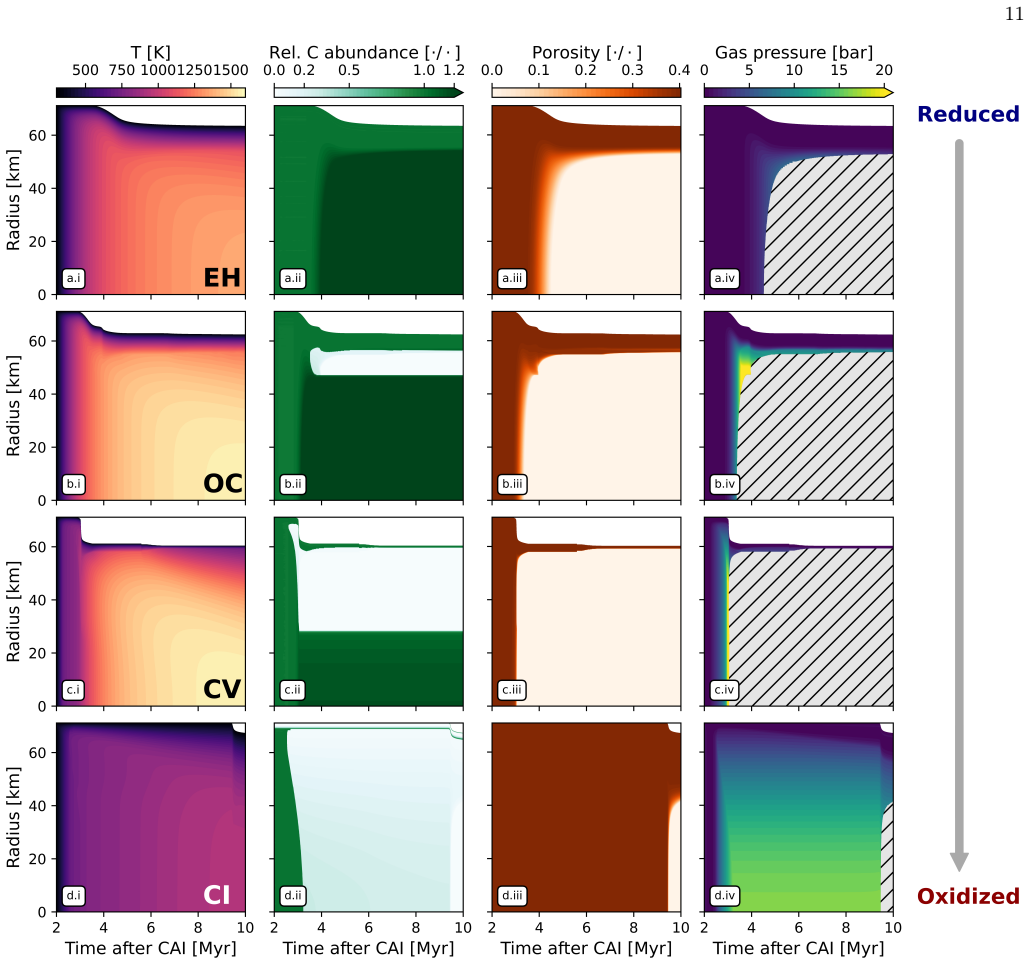
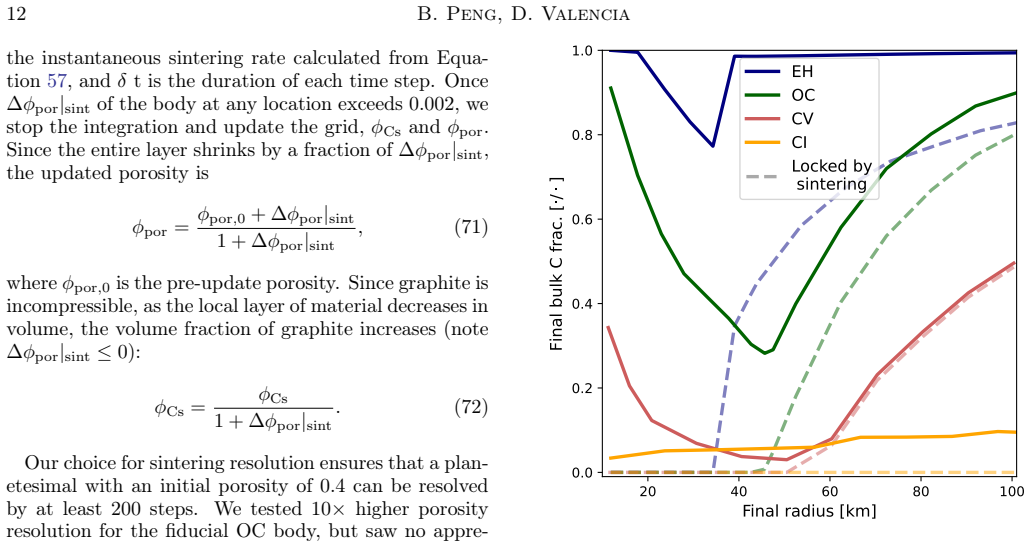
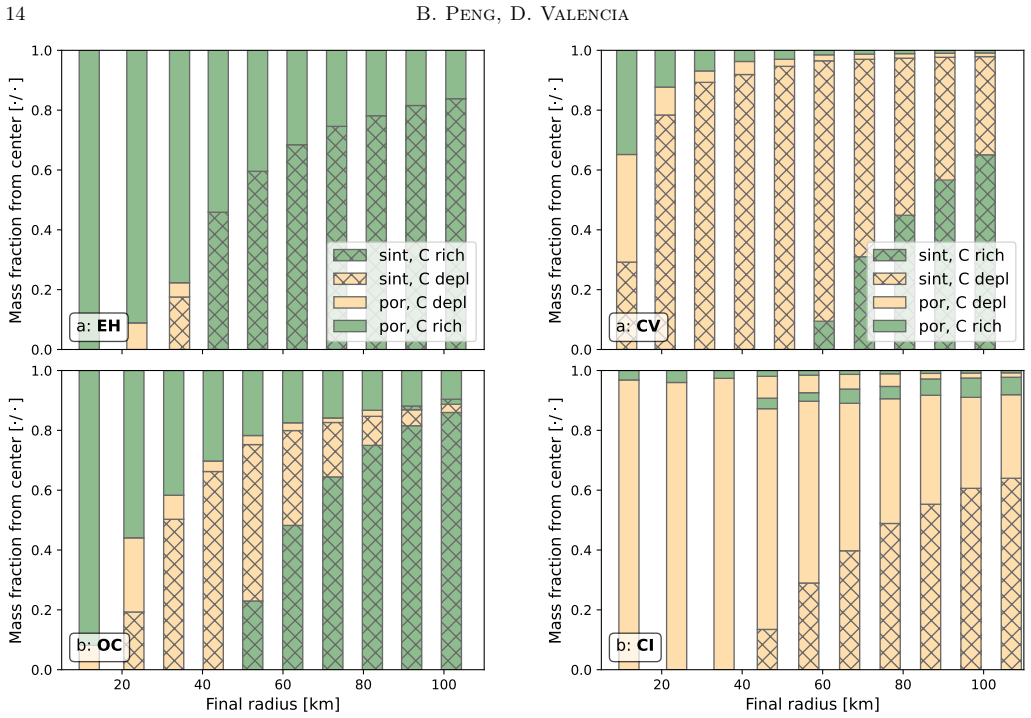
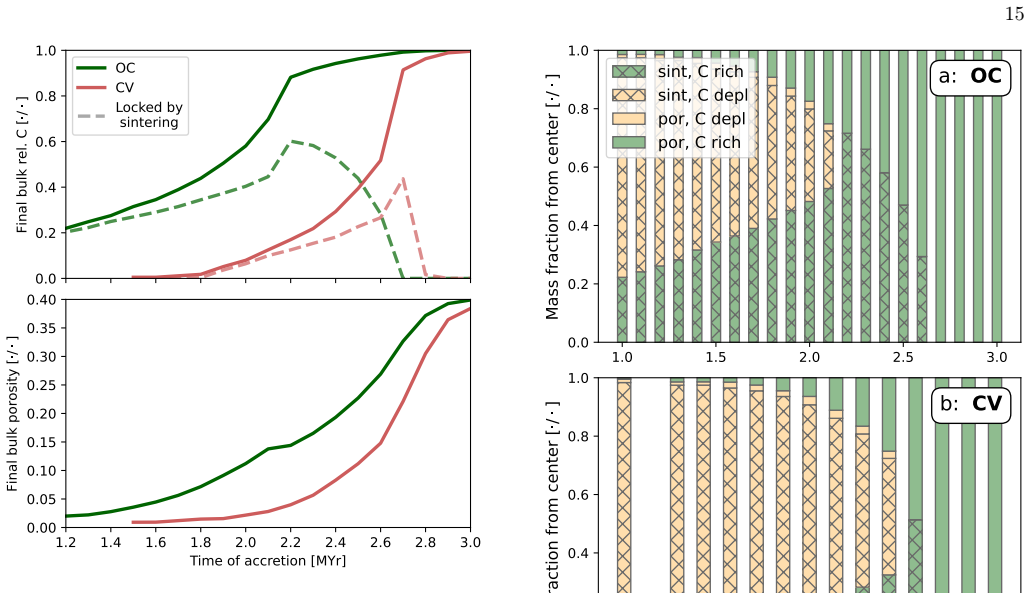
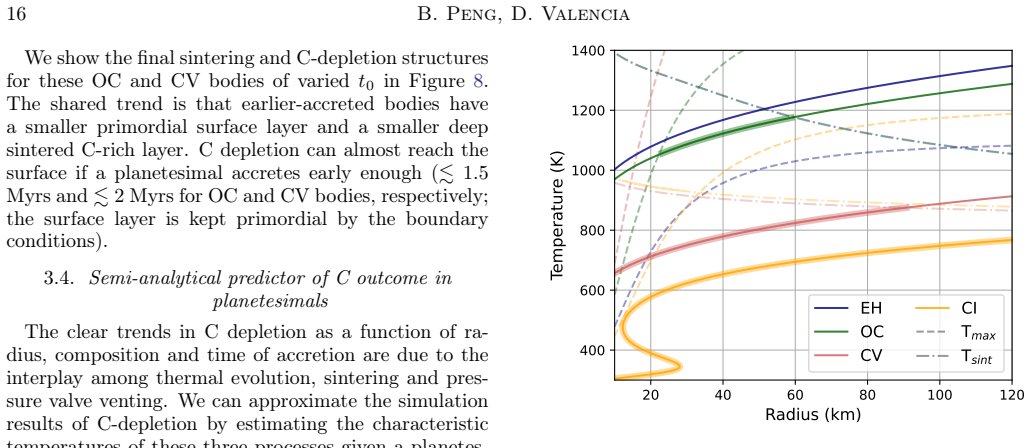
For 10-100 km planetesimals formed at 2 Myr after CAI formation, more than 50 percent of C is depleted in almost all CC bodies while less than 50 percent is depleted in almost all NC bodies. C depletion is more efficient on CC planetesimals than NCs due to the former's oxidized environment. Both the largest and the smallest bodies tend to preserve more C, the former due to sintering locking condensed C in against escape, while the latter due to efficient conductive cooling. Earlier accreted planetesimals deplete more C: bodies formed before about 1 Myr deplete most of their C. The results favor NC planetesimals as the C carriers during terrestrial planets' accretion from a mix of C-depleted
What carries the argument
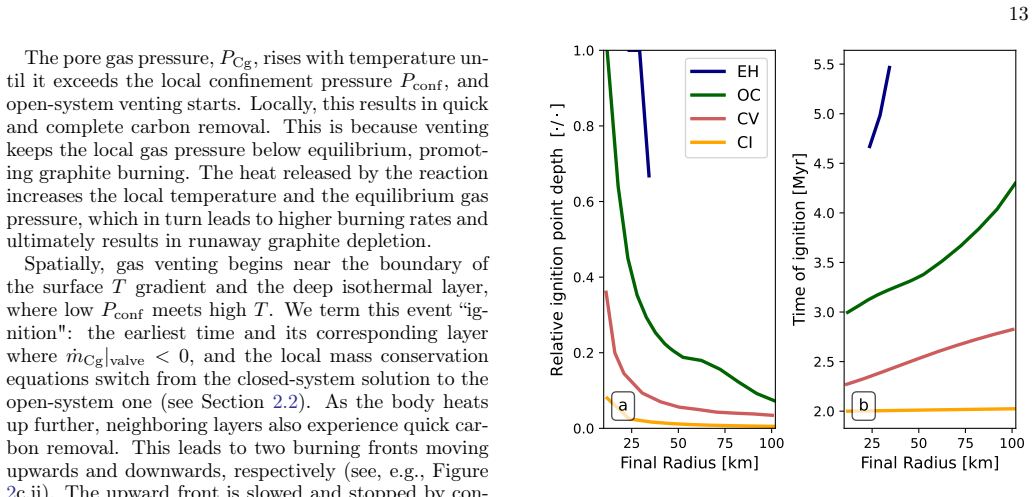
The pressure-triggered global fracture venting mechanism that allows direct escape of CO/CO2 gas produced by redox reactions when local pressure exceeds confinement levels.
If this is right
- NC planetesimals are favored as the C carriers during terrestrial planets' accretion.
- Terrestrial planets likely accreted from a mix of C-depleted and C-rich bodies from both CC and NC reservoirs.
- Earlier accreted planetesimals deplete more C, with bodies formed before about 1 Myr depleting most of their C.
- Both the largest and the smallest bodies tend to preserve more C due to sintering and conductive cooling respectively.
Where Pith is reading between the lines
- Outgassing at the planetesimal stage can help explain Earth's overall volatile depletion relative to primitive chondrites.
- The same fracture-venting process could influence delivery of other volatiles such as water during accretion.
- Direct sampling or remote sensing of C/H ratios on asteroids from known CC and NC parent bodies could test the size- and time-dependent predictions.
Load-bearing premise
Global fractures form and vent excess gas directly to space whenever local gas pressure exceeds confinement levels.
What would settle it
Carbon abundance measurements in meteorites showing no systematic difference in depletion between CC-derived and NC-derived samples in the 10-100 km size range formed near 2 Myr after CAIs.
Figures




read the original abstract
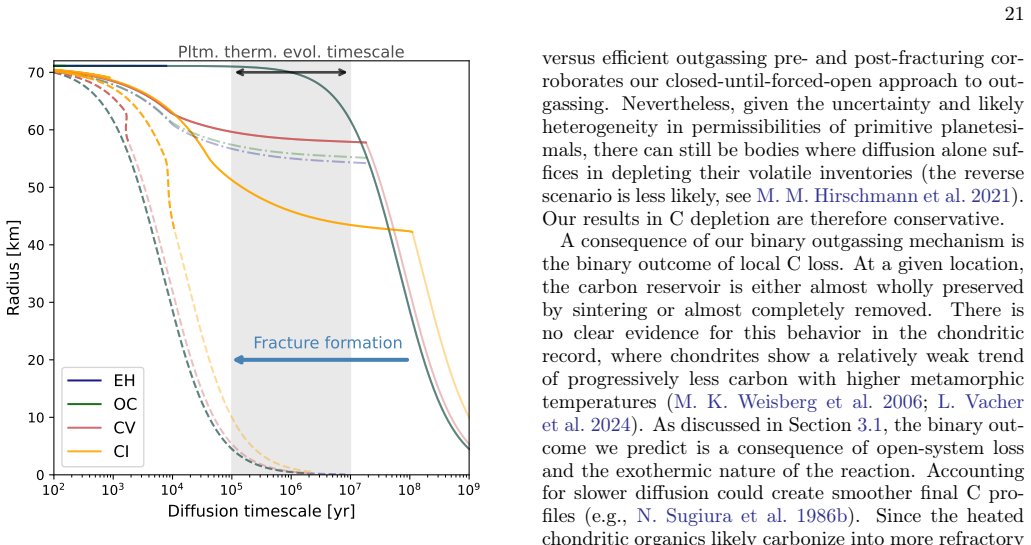
The thermochemical evolution of planetesimals is an underprobed stage of volatile delivery to terrestrial planets during their formation, and may contribute to the volatile depletion of the Earth relative to primitive chondrites. We have developed a model of C outgassing from porous, chondritic planetesimals. Our model tracks the thermal evolution and the production of CO/CO2 gas using the redox states of ordinary and enstatite chondrites (OC and EC, respectively, collectively the "NCs"), and CI and CV carbonaceous chondrites ("CCs"). We posit the formation of global fractures when local gas pressure exceeds confinement levels, which vent the excess directly to space, leading to efficient C depletion. We also account for sintering and the enthalpy of dehydration from wet carbonaceous chondrite bodies. We find that C depletion is more efficient on CC planetesimals than NCs due to the former's oxidized environment: for 10-100 km planetesimals formed at 2 Myr after CAI formation, > 50% of C is depleted in almost all CC bodies while < 50% is depleted in almost all NC bodies. Both the largest and the smallest bodies tend to preserve more C, the former due to sintering locking condensed C in against escape, while the latter due to efficient conductive cooling. Earlier accreted planetesimals deplete more C: bodies formed before ~ My deplete most of their C. Our results favor NC planetesimals as the C carriers during terrestrial planets' accretion. Terrestrial planets likely accreted from a mix of C-depleted and C-rich bodies from both CC and NC reservoirs.
Editorial analysis
A structured set of objections, weighed in public.
Referee Report
Summary. The paper develops a thermochemical model tracking thermal evolution, CO/CO2 production from redox reactions in NC (ordinary/enstatite) and CC (CI/CV) chondrites, and C outgassing from porous planetesimals. It posits global fractures that vent excess gas directly to space when local pressure exceeds confinement, incorporates sintering and dehydration enthalpy, and reports that for 10-100 km bodies accreted at 2 Myr after CAI, >50% C is depleted in nearly all CC planetesimals while <50% is depleted in nearly all NC ones, favoring NC bodies as the primary C carriers during terrestrial planet accretion.
Significance. If the central results hold, the work supplies a size- and redox-dependent mechanism for planetesimal C depletion that could explain Earth's volatile budget relative to chondrites and the relative roles of NC versus CC reservoirs in accretion. Credit is due for grounding the model in established chondrite redox states and physical processes (sintering, dehydration) rather than fitting free parameters directly to the reported depletion fractions.
major comments (2)
- [Abstract] Abstract: The headline quantitative claim (>50% C depletion in almost all CC bodies vs. <50% in NC bodies for 10-100 km planetesimals at 2 Myr) depends on efficient near-complete removal of CO/CO2 via the posited global-fracture venting. This mechanism is introduced without a fracture-criterion equation, without derivation from first principles, and without any comparison to diffusive or porous-flow alternatives; if fractures do not form or vent globally, retained gas would lower net depletion and erase the reported CC-NC contrast.
- [Abstract] Abstract: No error bars, sensitivity tests on the two free parameters (planetesimal radius, accretion time), or validation against independent constraints (e.g., measured C abundances in meteorites or other outgassing models) are presented, so the robustness of the size-dependent and redox-dependent depletion percentages cannot be assessed from the available text.
minor comments (1)
- [Abstract] The abstract introduces the acronyms NCs and CCs after first use; a parenthetical definition on first appearance would improve readability.
Simulated Author's Rebuttal
We thank the referee for the constructive review and for recognizing the model's grounding in established chondrite redox states and physical processes. We address each major comment below and will revise the manuscript accordingly to improve clarity and robustness.
read point-by-point responses
-
Referee: [Abstract] Abstract: The headline quantitative claim (>50% C depletion in almost all CC bodies vs. <50% in NC bodies for 10-100 km planetesimals at 2 Myr) depends on efficient near-complete removal of CO/CO2 via the posited global-fracture venting. This mechanism is introduced without a fracture-criterion equation, without derivation from first principles, and without any comparison to diffusive or porous-flow alternatives; if fractures do not form or vent globally, retained gas would lower net depletion and erase the reported CC-NC contrast.
Authors: We agree that the global-fracture venting assumption is essential to the reported depletion contrast. The manuscript posits fractures when local gas pressure exceeds confinement levels, enabling direct venting to space. However, no explicit fracture-criterion equation, first-principles derivation, or comparison to diffusive/porous-flow alternatives is provided. This is a valid point. We will add a dedicated methods subsection deriving the criterion (gas pressure versus lithostatic pressure plus tensile strength of sintered material), discuss its physical motivation, and compare outgassing efficiency to alternative transport mechanisms. We will also test reduced venting efficiency to quantify its effect on the CC-NC difference. revision: yes
-
Referee: [Abstract] Abstract: No error bars, sensitivity tests on the two free parameters (planetesimal radius, accretion time), or validation against independent constraints (e.g., measured C abundances in meteorites or other outgassing models) are presented, so the robustness of the size-dependent and redox-dependent depletion percentages cannot be assessed from the available text.
Authors: The referee correctly notes the lack of formal error bars, systematic sensitivity tests, and quantitative validation against meteorite C abundances or other models. While the results span 10-100 km radii and a range of accretion times, and the redox states are taken from measured chondrite properties, no uncertainty quantification or direct comparisons are shown. We will incorporate sensitivity tests on radius and accretion time (including variations in thermal conductivity and permeability), add error estimates where feasible, and include a validation section comparing predicted depletions to published meteorite carbon data and prior outgassing models. revision: yes
Circularity Check
No significant circularity; model outputs derive from independent physical inputs
full rationale
The paper's depletion fractions emerge from a forward thermochemical model that ingests established redox states of chondrite classes, conductive cooling, sintering, and an explicit (if unverified) fracture-venting assumption. No equation or result is shown to be defined in terms of the target depletion percentages, no parameters are fitted to the CC-NC contrast, and no load-bearing step reduces to a self-citation chain. The central claim therefore remains an independent model prediction rather than a tautology.
Axiom & Free-Parameter Ledger
free parameters (2)
- planetesimal radius
- accretion time after CAI
axioms (2)
- domain assumption Global fractures form when local gas pressure exceeds confinement levels, venting excess gas directly to space
- domain assumption Redox states of OC/EC versus CI/CV chondrites control CO/CO2 gas production rates
Reference graph
Works this paper leans on
-
[1]
Nittler, L. R., & Stroud, R. M. 2017, Chemie der Erde / Geochemistry, 77, 227, doi: 10.1016/j.chemer.2017.01.007
-
[2]
Anderson, D. E., Bergin, E. A., Blake, G. A., et al. 2017, ApJ, 845, 13, doi: 10.3847/1538-4357/aa7da1
-
[3]
A., Telus, M., McCubbin, F
Anzures, B. A., Telus, M., McCubbin, F. M., et al. 2024, in LPI Contributions, Vol. 3040, 55th Lunar and Planetary Science Conference, 1250
2024
-
[4]
Beck, A. E. 1976, Geophysics, 41, 133, doi: 10.1190/1.1440596
-
[5]
Bergin, E. A., Blake, G. A., Ciesla, F., Hirschmann, M. M., & Li, J. 2015, Proceedings of the National Academy of Science, 112, 8965, doi: 10.1073/pnas.1500954112
-
[6]
R., Füri, E., Lodders, K., & Marty, B
Bermingham, K. R., Füri, E., Lodders, K., & Marty, B. 2020, SSRv, 216, 133, doi: 10.1007/s11214-020-00748-w
-
[7]
2023, MNRAS, 520, 2055, doi: 10.1093/mnras/stad182
Binkert, F., & Birnstiel, T. 2023, MNRAS, 520, 2055, doi: 10.1093/mnras/stad182
-
[8]
Bischoff, A., Scott, E. R. D., Metzler, K., & Goodrich, C. A. 2006, in Meteorites and the Early Solar System II, ed. D. S. Lauretta & H. Y. McSween, 679
2006
-
[9]
Bland, P. A., Jackson, M. D., Coker, R. F., et al. 2009, Earth and Planetary Science Letters, 287, 559, doi: 10.1016/j.epsl.2009.09.004 Braukmüller, N., Wombacher, F., Funk, C., & Münker, C. 2019, Nature Geoscience, 12, 564, doi: 10.1038/s41561-019-0375-x
-
[10]
Brearley, A. J., Scott, E. R. D., Keil, K., et al. 1989, GeoCoA, 53, 2081, doi: 10.1016/0016-7037(89)90326-8
-
[11]
Britt, D. T., & Consolmagno, G. J. 2003, M&PS, 38, 1161, doi: 10.1111/j.1945-5100.2003.tb00305.x
-
[12]
2024, Communications Chemistry, 7, 118, doi: 10.1038/s42004-024-01200-8
Christ, O., Nestola, F., & Alvaro, M. 2024, Communications Chemistry, 7, 118, doi: 10.1038/s42004-024-01200-8
-
[13]
Cody, G. D., Alexander, C. M. O., Yabuta, H., et al. 2008, Earth and Planetary Science Letters, 272, 446, doi: 10.1016/j.epsl.2008.05.008
-
[14]
2008, Chemie der Erde / Geochemistry, 68, 1, doi: 10.1016/j.chemer.2008.01.003
Consolmagno, G., Britt, D., & Macke, R. 2008, Chemie der Erde / Geochemistry, 68, 1, doi: 10.1016/j.chemer.2008.01.003
-
[15]
Corrigan, C. M., Zolensky, M. E., Dahl, J., et al. 1997, M&PS, 32, 509, doi: 10.1111/j.1945-5100.1997.tb01296.x Di Blasi, C., Branca, C., & Galgano, A. 2017, Energy Technology, 5, 19, doi: https://doi.org/10.1002/ente.201600091
-
[16]
M., Jogo, K., Nagashima, K., et al
Doyle, P. M., Jogo, K., Nagashima, K., et al. 2015, Nature Communications, 6, 7444, doi: 10.1038/ncomms8444
-
[17]
A., Cottrell, E., Hauri, E., Lee, K
Fischer, R. A., Cottrell, E., Hauri, E., Lee, K. K. M., & Le Voyer, M. 2020, Proceedings of the National Academy of Sciences, 117, 8743, doi: 10.1073/pnas.1919930117
-
[18]
Fu, R. R., & Elkins-Tanton, L. T. 2014, Earth and Planetary Science Letters, 390, 128, doi: 10.1016/j.epsl.2013.12.047
-
[20]
Elkins-Tanton, L. T. 2017, Silicate Melting and Volatile Loss During Differentiation in Planetesimals, ed. L. T. Elkins-Tanton & B. P. Weiss, Cambridge Planetary Science (Cambridge University Press), 115–135, doi: 10.1017/9781316339794.006
-
[21]
2017, A&A, 606, A16, doi: 10.1051/0004-6361/201730480
Gail, H.-P., & Trieloff, M. 2017, A&A, 606, A16, doi: 10.1051/0004-6361/201730480
-
[22]
2008, Icarus, 194, 42, doi: 10.1016/j.icarus.2007.09.007
Genda, H., & Ikoma, M. 2008, Icarus, 194, 42, doi: 10.1016/j.icarus.2007.09.007
-
[23]
Giri, A., Dionne, C. J., & Hopkins, P. E. 2022, npj Computational Mathematics, 8, 55, doi: 10.1038/s41524-022-00741-7
-
[24]
A., Collinet, M., Treiman, A., et al
Goodrich, C. A., Collinet, M., Treiman, A., et al. 2022, M&PS, 57, 1589, doi: 10.1111/maps.13889
-
[25]
Grady, M. M., & Wright, I. P. 2003, SSRv, 106, 231, doi: 10.1023/A:1024645906350
-
[26]
Grimm, R. E., & McSween, Jr., H. Y. 1989, Icarus, 82, 244, doi: 10.1016/0019-1035(89)90038-9
-
[27]
Gu, J. T., Peng, B., Ji, X., et al. 2024, Earth and Planetary Science Letters, 629, 118618, doi: 10.1016/j.epsl.2024.118618
-
[28]
Gualtieri, A. F., Giacobbe, C., & Viti, C. 2012, American Mineralogist, 97, 666, doi: 10.2138/am.2012.3952
-
[29]
Jan Hermann, Zeno Schätzle, and Frank Noé
Harris, C. R., Millman, K. J., van der Walt, S. J., et al. 2020, Nature, 585, 357, doi: 10.1038/s41586-020-2649-2
-
[30]
Meteoritics & Planetary Science 33, 1113-1122,10.1111/j.1945-5100.1998.tb01716.x
Hashizume, K., & Sugiura, N. 1998, M&PS, 33, 1181, doi: 10.1111/j.1945-5100.1998.tb01722.x
-
[31]
2012, A&A, 537, A45, doi: 10.1051/0004-6361/201117177
Kleine, T. 2012, A&A, 537, A45, doi: 10.1051/0004-6361/201117177
-
[32]
Hevey, P. J., & Sanders, I. S. 2006, M&PS, 41, 95, doi: 10.1111/j.1945-5100.2006.tb00195.x
-
[33]
Hirakawa, N., Kebukawa, Y., Furukawa, Y., et al. 2021,
2021
-
[34]
Earth, Planets and Space, 73, 16, doi: 10.1186/s40623-020-01352-6
-
[35]
Hirschmann, M. M. 2012, Earth and Planetary Science Letters, 341-344, 48 , doi: https://doi.org/10.1016/j.epsl.2012.06.015
-
[36]
Hirschmann, M. M. 2018, Earth and Planetary Science Letters, 502, 262, doi: 10.1016/j.epsl.2018.08.023 27
-
[37]
Hirschmann, M. M., Bergin, E. A., Blake, G. A., Ciesla, F. J., & Li, J. 2021, Proceedings of the National Academy of Science, 118, e2026779118, doi: 10.1073/pnas.2026779118
-
[38]
Huber, M. L., Sykioti, E. A., Assael, M. J., & Perkins, R. A. 2016, Journal of Physical and Chemical Reference Data, 45, 013102, doi: 10.1063/1.4940892
-
[39]
Hunter, J. D. 2007, Computing in Science & Engineering, 9, 90, doi: 10.1109/MCSE.2007.55
-
[40]
2006, ApJ, 648, 696, doi: 10.1086/505780
Ikoma, M., & Genda, H. 2006, ApJ, 648, 696, doi: 10.1086/505780
-
[41]
2020, Journal of Geophysical Research (Solid Earth), 125, e2020JB019896, doi: 10.1029/2020JB019896
Jain, C., & Korenaga, J. 2020, Journal of Geophysical Research (Solid Earth), 125, e2020JB019896, doi: 10.1029/2020JB019896
-
[42]
2019, Journal of Geophysical Research (Solid Earth), 124, 310, doi: 10.1029/2018JB016558
Jain, C., Korenaga, J., & Karato, S.-i. 2019, Journal of Geophysical Research (Solid Earth), 124, 310, doi: 10.1029/2018JB016558
-
[43]
1994, GeoCoA, 58, 9, doi: 10.1016/0016-7037(94)90442-1
Jakobsson, S., & Oskarsson, N. 1994, GeoCoA, 58, 9, doi: 10.1016/0016-7037(94)90442-1
-
[44]
Jaramillo, I. C., Gaddam, C. K., Vander Wal, R. L., et al. 2014, Combustion and Flame, 161, 2951, doi: 10.1016/j.combustflame.2014.04.016
-
[45]
2021, Science Advances, 7, eabc0444, doi: 10.1126/sciadv.abc0444
Johansen, A., Ronnet, T., Bizzarro, M., et al. 2021, Science Advances, 7, eabc0444, doi: 10.1126/sciadv.abc0444
-
[46]
Kanchika, S., & Wakai, F. 2018, Journal of the European Ceramic Society, 38, 4283, doi: https://doi.org/10.1016/j.jeurceramsoc.2018.05.015
-
[47]
Kebukawa, Y., Nakashima, S., & Zolensky, M. E. 2010, M&PS, 45, 99, doi: 10.1111/j.1945-5100.2009.01008.x
-
[48]
2019, Geochemical Perspectives Letters, 12–17, doi: 10.7185/geochemlet.1918
Keppler, H., & Golabek, G. 2019, Geochemical Perspectives Letters, 12–17, doi: 10.7185/geochemlet.1918
-
[49]
Kimura, M., Grossman, J. N., & Weisberg, M. K. 2008, M&PS, 43, 1161, doi: 10.1111/j.1945-5100.2008.tb01120.x
-
[50]
King, A. J., Schofield, P. F., & Russell, S. S. 2021, GeoCoA, 298, 167, doi: 10.1016/j.gca.2021.02.011
-
[51]
2020, M&PS, 55, 1848, doi: 10.1111/maps.13548
Kiryu, K., Kebukawa, Y., Igisu, M., et al. 2020, M&PS, 55, 1848, doi: 10.1111/maps.13548
-
[52]
Klarmann, L., Ormel, C. W., & Dominik, C. 2018, A&A, 618, L1, doi: 10.1051/0004-6361/201833719
-
[53]
S., Burkhardt, C., Budde, G., & Kleine, T
Kruijer, T. S., Burkhardt, C., Budde, G., & Kleine, T. 2017, Proceedings of the National Academy of Science, 114, 6712, doi: 10.1073/pnas.1704461114 Le Guillou, C., & Brearley, A. 2014, GeoCoA, 131, 344, doi: 10.1016/j.gca.2013.10.024
-
[54]
Lee, J.-E., Bergin, E. A., & Nomura, H. 2010, ApJL, 710, L21, doi: 10.1088/2041-8205/710/1/L21
-
[55]
Li, C., & Brown, T. C. 2001, Carbon, 39, 725, doi: 10.1016/S0008-6223(00)00189-5
-
[56]
Hirschmann, M. M. 2021, Science Advances, 7, eabd3632, doi: 10.1126/sciadv.abd3632
-
[57]
Golabek, G. J., & Hands, T. O. 2021, Science, 371, 365, doi: 10.1126/science.abb3091
-
[58]
K., Nakajima, M., & Fischer, R
Lichtenberg, T., Schaefer, L. K., Nakajima, M., & Fischer, R. A. 2023, in Astronomical Society of the Pacific Conference Series, Vol. 534, Protostars and Planets VII, ed. S. Inutsuka, Y. Aikawa, T. Muto, K. Tomida, & M. Tamura, 907, doi: 10.48550/arXiv.2203.10023
-
[59]
Lindgren, P., Lee, M. R., Sparkes, R., et al. 2020, GeoCoA, 289, 69, doi: 10.1016/j.gca.2020.08.021
-
[60]
2003, ApJ, 591, 1220, doi: 10.1086/375492
Lodders, K. 2003, ApJ, 591, 1220, doi: 10.1086/375492
-
[62]
Macke, R. J., Consolmagno, G. J., & Britt, D. T. 2011b, M&PS, 46, 1842, doi: 10.1111/j.1945-5100.2011.01298.x
-
[63]
Mackenzie, J. K., & Shuttleworth, R. 1949, Proceedings of the Physical Society B, 62, 833, doi: 10.1088/0370-1301/62/12/310
-
[64]
MacPherson, G. J., & Krot, A. N. 2014, M&PS, 49, 1250, doi: 10.1111/maps.12316
-
[65]
2018, GeoCoA, 235, 21, doi: 10.1016/j.gca.2018.04.032
Mahan, B., Siebert, J., Blanchard, I., et al. 2018, GeoCoA, 235, 21, doi: 10.1016/j.gca.2018.04.032
-
[66]
2012, A&A, 542, A82, doi: 10.1051/0004-6361/201118176
Fray, N. 2012, A&A, 542, A82, doi: 10.1051/0004-6361/201118176
-
[67]
Mathur, S., Tondon, P. K., & Saxena, S. C. 1967, Molecular Physics, 12, 569, doi: 10.1080/00268976700100731
-
[68]
Matsui, T., Sugiura, N., & Brar, N. S. 1986, Meteoritics, 21, 109, doi: 10.1111/j.1945-5100.1986.tb01229.x
-
[69]
2022, GeoCoA, 316, 150, doi: 10.1016/j.gca.2021.08.042
Matsuoka, M., Nakamura, T., Miyajima, N., et al. 2022, GeoCoA, 316, 150, doi: 10.1016/j.gca.2021.08.042
-
[70]
1967, Carbon, 5, 331, doi: 10.1016/0008-6223(67)90049-8
Mentser, M., & Ergun, S. 1967, Carbon, 5, 331, doi: 10.1016/0008-6223(67)90049-8
-
[71]
Millat, J., & Wakeham, W. A. 1989, Journal of Physical and Chemical Reference Data, 18, 565, doi: 10.1063/1.555827
-
[72]
Moore, C. B., & Lewis, C. F. 1967, J. Geophys. Res., 72, 6289, doi: 10.1029/JZ072i024p06289
-
[73]
Moskovitz, N., & Gaidos, E. 2011, M&PS, 46, 903, doi: 10.1111/j.1945-5100.2011.01201.x
-
[74]
Muenow, D. W., Keil, K., & McCoy, T. J. 1995, Meteoritics, 30, 639, doi: 10.1111/j.1945-5100.1995.tb01161.x
-
[75]
2005, Journal of Mineralogical and Petrological Sciences, 100, 260, doi: 10.2465/jmps.100.260
Nakamura, T. 2005, Journal of Mineralogical and Petrological Sciences, 100, 260, doi: 10.2465/jmps.100.260
-
[76]
2012, A&A, 543, A141, doi: 10.1051/0004-6361/201219157 28B
Neumann, W., Breuer, D., & Spohn, T. 2012, A&A, 543, A141, doi: 10.1051/0004-6361/201219157 28B. Peng, D. V alencia
-
[77]
2014, A&A, 567, A120, doi: 10.1051/0004-6361/201423648
Neumann, W., Breuer, D., & Spohn, T. 2014, A&A, 567, A120, doi: 10.1051/0004-6361/201423648
-
[78]
Neumann, W., Kruijer, T. S., Breuer, D., & Kleine, T. 2018, Journal of Geophysical Research (Planets), 123, 421, doi: 10.1002/2017JE005411
-
[79]
2024, Scientific Reports, 14, 14017, doi: 10.1038/s41598-024-63768-4
Neumann, W., Ma, N., Bouvier, A., & Trieloff, M. 2024, Scientific Reports, 14, 14017, doi: 10.1038/s41598-024-63768-4
-
[80]
1992, Jounral of Phase Equilibria, 13, 543, doi: https://doi.org/10.1007/BF02665767
Okamoto, H. 1992, Jounral of Phase Equilibria, 13, 543, doi: https://doi.org/10.1007/BF02665767
-
[81]
2024, A&A, 692, A11, doi: 10.1051/0004-6361/202451908
Okamoto, T., & Ida, S. 2024, A&A, 692, A11, doi: 10.1051/0004-6361/202451908
-
[82]
2023, Science, 379, abo0431, doi: 10.1126/science.abo0431
Okazaki, R., Marty, B., Busemann, H., et al. 2023, Science, 379, abo0431, doi: 10.1126/science.abo0431
discussion (0)
Sign in with ORCID, Apple, or X to comment. Anyone can read and Pith papers without signing in.