REVIEW 4 major objections 7 minor 9 cited by
Wait, We Don't Need to "Wait"! Removing Thinking Tokens Improves Reasoning Efficiency
T0 review · 4 major / 7 minor · reviewed 2026-08-07 · deepseek-v4-flash
Pith's one-line read Suppressing 'Wait'-type reflection tokens during decoding cuts reasoning length by up to 51% without hurting accuracy.
desk verdict The core result is real and useful—masking reflection tokens cuts CoT length across models and modalities—but the abstract's 'without compromising utility' is not supported by the paper's own numbers. read the letter →
The pith
A machine-rendered reading of the paper's core claim, the machinery that carries it, and where it could break.
The reading
What carries the argument
The load-bearing mechanism is a logit processor that bans reflection-associated tokens during decoding. Formally, for each model $\alpha$ the method builds $K_\alpha = \{v \in V_\alpha \mid \exists k_s \in K, \text{is\_substr}(k_s, v)\}$ from an initial keyword list $K$ ('wait', 'alternatively', 'hmm', 'however', 'check', 'double-check', 'oh', 'maybe', 'verify', 'again', and others), then sets the logits of every $v \in K_\alpha$ to a large negative value so the sampler effectively cannot choose them. The intervention changes no weights and needs no training data; it only removes the surface tokens that mark reflection, leaving the underlying sampler free to continue the current line of reasoning.
What would settle it
Run NoWait on a benchmark built from problems that genuinely require backtracking—e.g., multi-step algebra with an early false lead that must be abandoned—and compare accuracy and answer distributions against the unmodified model. If accuracy falls systematically on those problems while total token length drops, then reflection is doing functional work and the utility-preserving claim is false; if accuracy stays flat, the overthinking view is confirmed.
Extended reading notes
Core claim
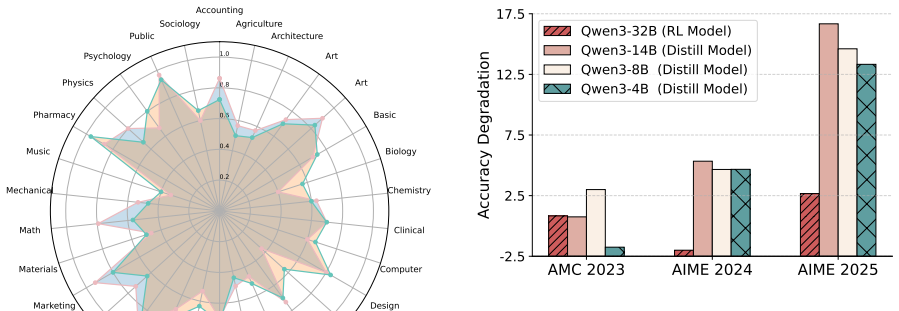
The discovery is that reflection keywords are a controllable symptom of overthinking, not a required reasoning step. NoWait acts at the token level: for each target model it builds a keyword list from frequent reflection words observed in QwQ-32B runs, expands each word to all vocabulary tokens containing it as a substring (e.g., ' wait', 'Wait', '.wait'), filters implausible matches, and then sets the logits of those tokens to a large negative value during generation. The model continues sampling but cannot emit the reflection markers, so it stops launching new verification branches and instead completes the reasoning path it is on. Across QwQ-32B, Phi4-Reasoning-Plus, Qwen3-32B, Kimi-VL-A3B-Thinking, and QvQ-72B-Preview, NoWait cuts chain-of-thought length by 13–60% on individual benchmark-model pairs, with headline reductions of 27–51%, while accuracy changes range from a 6.00-point gain (Phi4 on AMC 2023) to a 7.25-point loss (Kimi-VL on EMMA-mini). The paper also reports that RL-trained models stay stable under suppression, whereas distilled Qwen3 models lose more than 12 points on AIME 2025.
Load-bearing premise
The claim that NoWait is utility-preserving rests on treating final-answer accuracy on the ten selected benchmarks as a complete measure of reasoning utility; if suppressing reflection quietly degrades robustness, calibration, or out-of-distribution reasoning that the benchmarks do not capture, the headline conclusion is not established.
Editorial extensions
If this is right
- Reasoning models can reach the same final answers without emitting explicit self-reflection, so a large fraction of the tokens they currently spend on 'Wait'–'Hmm' verification loops is redundant.
- NoWait is plug-and-play: any deployed R1-style model, text or multimodal, can get 13–60% token reductions by adding a logit processor at inference time, with no retraining or extra data.
- Token savings translate directly into lower latency and lower serving cost, which is the practical obstacle the paper targets for resource-limited deployment.
- Distilled reasoning models are not safe targets for this intervention on hard tasks, since their accuracy drops sharply when reflection keywords are suppressed; RL-trained models are the intended beneficiaries.
- Prompt-based efforts to skip thinking (NoThink) cannot reliably stop RL-trained models from reasoning and hurt accuracy, whereas token-level suppression is a more precise control.
Reading between the lines
- A natural extension the paper leaves implicit: suppressing reflection tokens could be combined with token-budget or early-exit methods, since the two attack different sources of verbosity (reflection loops vs. long single-path reasoning).
- If reflection keywords are mostly stylistic artifacts of RL training, then a training objective that penalizes reflection-token emission could produce models that are natively concise, making the inference-time intervention unnecessary.
- The sharp contrast between RL-trained and distilled models suggests keyword suppression could double as a probe: apply it and observe accuracy degradation to infer whether a model's reasoning was learned through reinforcement learning or distilled from longer traces.
- Because the paper measures utility only through benchmark final-answer accuracy, a deployment-minded reader should check calibration and robustness on reworded or distribution-shifted versions of the same problems before treating the token savings as free.
Editorial analysis
A structured set of objections, weighed in public.
Referee Report
Summary. The paper proposes NoWait, a training-free inference-time intervention that suppresses reflection keywords (e.g., "Wait", "Hmm", "Alternatively") during decoding of R1-style large reasoning models. The method is evaluated on ten benchmarks spanning textual math reasoning, visual QA, and video QA, across five model series (QwQ, Phi4, Qwen3, Kimi-VL, QvQ), with additional experiments on distilled Qwen3, Llama-Nemotron, and DeepSeek-R1-distill models. The central empirical claim is that NoWait reduces chain-of-thought length by 27%–51% while "without compromising model utility". The paper also compares against NoThink, Token-Budget, and O1-Pruner, and analyzes cases where NoWait produces more concise but still correct reasoning.
Significance. The core finding is practically valuable: a simple, plug-and-play logit intervention can substantially reduce decoding length in modern reasoning models. The length-reduction results are consistent across the tables and appear credible: every evaluated model shows meaningful token reductions, sometimes with accuracy gains on math benchmarks. The paper also provides a useful mechanistic hypothesis (reflection keywords act as unnecessary validation loops) and a large-scale evaluation across text, image, and video modalities. However, the utility-preservation claim is broader than the data support. Several reported accuracy drops are large (e.g., Kimi-VL on EMMA-mini, distilled Qwen3 on AIME 2025), and the paper itself concludes that distilled models cannot reason without "Wait". The contribution is therefore promising but needs a qualified and statistically grounded presentation before the headline claim can be accepted.
major comments (4)
- [Abstract and Section 4.3 / Table 6] The unqualified claim "without compromising model utility" is contradicted by the paper's own results. Table 6 shows large accuracy losses under NoWait, including GPQA-D drops for every evaluated model (Qwen3-32B: 69.19 to 63.13; Llama-Nemotron-Nano-8B: 54.10 to 42.83; DeepSeek-R1-Distill-Qwen-7B: 49.10 to 40.91) and AIME 2025 drops exceeding 12 points for all distilled Qwen3 models (e.g., Qwen3-14B: 78.00 to 61.33). Table 3 also shows a 7.25-point drop for Kimi-VL-A3B on EMMA-mini and a 4.00-point drop for QvQ on EMMA-mini. Section 4.3 explicitly states that distilled models "cannot reasoning without Wait". The abstract and conclusion should be narrowed to, for example, "on RL-trained models and on average over the ten reported benchmarks, with a disclosed tolerable accuracy drop", and the distilled-model results should be presented as a limitation rather than as evidence of utility preservation.
- [Section 3.2, Metrics and Experiment Details] The five-run averages are reported without variance, confidence intervals, or significance tests. This is load-bearing for the "without compromising" claim because many differences are small (e.g., QwQ-32B on AIME 2024: 71.33 vs. 73.33; Qwen3-32B on AIME 2025: 64.44 vs. 66.67) and could easily be within run-to-run noise, while other differences (e.g., Kimi-VL EMMA-mini: -7.25) may be significant but are not analyzed. The authors should report standard deviations or bootstrap intervals for the main accuracy and length numbers, and ideally a paired test for the accuracy comparisons on the same benchmark instances.
- [Section 3.1 and Table 1] The reflection keyword list K is empirically selected from 32 runs of QwQ-32B on AIME 2025 (Section 3.1), and the headline results in Table 1 include QwQ-32B on AIME 2025. This creates a selection-on-evaluation overlap: the same model and benchmark used to build the keyword list also provide the main demonstration. Although the list is small and plausibly transferable, the paper should disclose this overlap explicitly and ideally validate the keyword list on a held-out set or show that results are robust to removing individual keywords.
- [Section 3.3, 3.5, and 4.3] The framing that NoWait works across "five R1-style model series" conflates RL-based and distilled models. The Qwen3 series includes both Qwen3-32B (RL) and Qwen3-4B/8B/14B (distilled), and Section 4.3 shows that the distilled variants lose accuracy sharply, especially on AIME 2025. The manuscript should clearly scope the claim to the evaluated models and distinguish the RL-based case from the distilled case throughout, rather than summarizing both as evidence for utility preservation.
minor comments (7)
- [Section 1] The benchmark name is misspelled as "GQPA-D" in the introduction; it should be "GPQA-D" (also used correctly later in Section D.1).
- [Section 4.3, Figure 4 caption] The caption contains a typo: "Qwen3 Seires" should be "Qwen3 Series".
- [Section 4.1] The text says "As we discussed in Table 3.4" but this should refer to Section 3.4 (the comparison analysis), not a table number.
- [Section 3.1] The phrase "15 most frequent monolingual words" is ambiguous; the authors should clarify that the list is English word forms and explain why only monolingual (presumably English) keywords are used for a method that is claimed to generalize across multimodal and multilingual inputs.
- [Appendix Figures 6-13] The body text refers to figures by numbers such as "Figure 12" and "Figure 9", but the appendix figures are numbered sequentially from 6 to 13; the cross-references should be checked and aligned.
- [Section 4.2, Figures 3 and 5] The radar maps show accuracy differences visually but lack numeric axis labels and a scale. Adding numbers or a table would make it easier to verify the claim of "remarkably small accuracy divergence".
- [Section 3.2 and Appendix B.1] The token budget for NoThink is 10,000 while NoWait and the original models use 32,768; this asymmetry should be justified, since a lower budget may penalize NoThink on both length and accuracy in the comparison.
Circularity Check
One mild in-sample keyword-selection overlap; the central NoWait efficiency claim is otherwise a direct empirical intervention with no derivation-to-fit circularity.
-
fitted input called prediction
[Section 3.1 (Method) and Table 1 (QwQ-32B on AIME 2025)]
"To empirically establish the list, we conduct 32 independent runs of the QwQ-32B (Qwen, 2025) on AIME 2025 (MAA Committees). Using “\n\n” as delimiters, we identify the 15 most frequent monolingual words as our identified keywords K={k i}."
The reflection-keyword list K is fitted by frequency statistics on QwQ-32B/AIME 2025, and Table 1 then reports the NoWait length reduction for that exact model/benchmark (LEN 15240 to 10548, -31%). Because NoWait acts by suppressing precisely these fitted keywords, the in-sample length reduction is not an independent test of the method; the banned tokens were chosen from the same distribution on which the reduction is reported. This is a mild fitted-input/prediction overlap rather than a full equivalence: accuracy changes and the cross-model reductions are still empirical, so the paper's central claim does not reduce to the keyword fit.
full rationale
NoWait is a direct, training-free inference intervention: it suppresses a list of reflection-associated tokens and measures accuracy and generation length afterward. There is no fitted predictive model and no equation in which the reported result is derived from its own inputs, so the core efficiency claim is not circular by construction. The only self-referential step is the empirical selection of the keyword list on QwQ-32B/AIME 2025 followed by evaluation on that same model and benchmark, which mildly inflates the in-sample Table 1 result but does not undermine the independent cross-model and cross-benchmark measurements. Self-citations are present (e.g., Zhou et al. 2025) but appear only as background for the 'Aha Moment' phenomenon and are not load-bearing for the NoWait results. The contradiction between the abstract's 'without compromising model utility' and the large accuracy drops in Table 6 / Section 4.3 is a correctness/calibration concern, not a circularity concern, so it does not raise the circularity score. Overall, the paper exhibits only a minor in-sample selection issue, not a derivation-to-fit or self-citation circularity.
Assumptions & free parameters
free parameters (2)
- Reflection keyword list K =
17 words: wait, alternatively, hmm, but, however, alternative, another, check, double-check, oh, maybe, verify, other…
- Logit suppression magnitude =
Not specified, only "a large negative value"
assumptions (3)
- domain assumption Benchmark accuracy on the ten chosen datasets is a valid proxy for model utility.
- ad hoc to paper The token-level keyword list generalizes across the five evaluated model series.
- domain assumption Suppressing targeted tokens via logit masking does not perturb the rest of the sampling distribution in a way that changes answer quality.
Cite this review
Pith. "Pith review of Wait, We Don't Need to "Wait"! Removing Thinking Tokens Improves Reasoning Efficiency." pith.science (2026). https://pith.science/paper/KWJVDNEI
@misc{pith2026250608343,
  author       = {Pith},
  title        = {Pith review of: Wait, We Don't Need to "Wait"! Removing Thinking Tokens Improves Reasoning Efficiency},
  year         = {2026},
  howpublished = {\url{https://pith.science/paper/KWJVDNEI}},
  note         = {Machine review of arXiv:2506.08343}
}
read the original abstract
Recent advances in large reasoning models have enabled complex, step-by-step reasoning but often introduce significant overthinking, resulting in verbose and redundant outputs that hinder efficiency. In this study, we examine whether explicit self-reflection, signaled by tokens such as "Wait" and "Hmm", is necessary for advanced reasoning. We propose NoWait, a simple yet effective approach that disables explicit self-reflection by suppressing these tokens during inference. Extensive experiments on ten benchmarks across textual, visual, and video reasoning tasks show that NoWait reduces chain-of-thought trajectory length by up to 27%-51% in five R1-style model series, without compromising model utility. NoWait thus offers a plug-and-play solution for efficient and utility-preserving multimodal reasoning.
Figures


Figures from the paper (8 more)


Forward citations
Cited by 9 Pith papers
-
Fewer Tokens, Smaller Cache: Reward-Coordinated Efficient Reasoning
ReCo coordinates KV-cache compression, reflection-token logit penalties, and confidence-based early stopping under one per-step process reward, reducing tokens and latency while largely preserving accuracy.
-
Towards Efficient Large Language Reasoning Models via Extreme-Ratio Chain-of-Thought Compression
Extra-CoT trains a semantic compressor on math CoT data, applies mixed-ratio SFT, and uses CHRPO reinforcement learning to achieve over 73% token reduction on MATH-500 with 0.6% accuracy gain on Qwen3-1.7B.
-
Mid-Think: Training-Free Intermediate-Budget Reasoning via Token-Level Triggers
A prompt combining the 'Okay' reasoning cue with the '</think>\n\n' no-think cue gives LLMs an intermediate reasoning budget without training, and also speeds up RL fine-tuning.
-
Are Large Reasoning Models Interruptible?
Interrupting large reasoning models or changing the problem mid-thought sharply degrades accuracy, with up to 60% drops and distinct failure modes: reasoning leakage, panic, and self-doubt.
-
Reconsidering Overthinking: Penalizing Internal and External Redundancy in CoT Reasoning
A dual-penalty RL method that compresses chain-of-thought traces by separately penalizing internal semantic stagnation and external post-answer continuation reduces reasoning length by about 40% while preserving accur...
-
MixReasoning: Switching Modes to Think
A reasoning model can cut token usage by roughly a third to a half without losing accuracy if it switches to brief output on low-uncertainty steps and expands only at high-uncertainty forks.
-
Failure Cases Are Better Learned But Boundary Says Sorry: Facilitating Smooth Perception Change for Accuracy-Robustness Trade-Off in Adversarial Training
A paper whose abstract describes new adversarial training experiments, but whose full text is a different paper on CoT compression, leaving the claims unsupported.
-
Skywork-R1V3 Technical Report
A 38B open-source VLM reaches 76.0% on MMMU using RL post-training and connector-only tuning, with a critical-token entropy metric for checkpoint selection.
-
Towards Concise and Adaptive Thinking in Large Reasoning Models: A Survey
A comprehensive review that categorizes methods for shortening and adaptively triggering chain-of-thought reasoning in large language models.
Reference graph
Works this paper leans on
-
[1]
Marah Abdin, Sahaj Agarwal, Ahmed Awadallah, Vidhisha Balachandran, Harkirat Behl, Lingjiao Chen, Gustavo de Rosa, Suriya Gunasekar, Mojan Javaheripi, Neel Joshi, and 1 others. 2025. Phi-4-reasoning technical report. arXiv preprint arXiv:2504.21318
arXiv 2025
-
[2]
Pranjal Aggarwal and Sean Welleck. 2025. L1: Controlling how long a reasoning model thinks with reinforcement learning. arXiv preprint arXiv:2503.04697
arXiv 2025
-
[3]
AI-MO . 2024. AMC 2023 . https://huggingface.co/datasets/AI-MO/aimo-validation-amc. Accessed: 2024-05-20
work page 2024
-
[4]
Bradley Brown, Jordan Juravsky, Ryan Ehrlich, Ronald Clark, Quoc V Le, Christopher R \'e , and Azalia Mirhoseini. 2024. Large language monkeys: Scaling inference compute with repeated sampling. arXiv preprint arXiv:2407.21787
arXiv 2024
-
[5]
Qiguang Chen, Libo Qin, Jinhao Liu, Dengyun Peng, Jiannan Guan, Peng Wang, Mengkang Hu, Yuhang Zhou, Te Gao, and Wanxiang Che. 2025 a . Towards reasoning era: A survey of long chain-of-thought for reasoning large language models. arXiv preprint arXiv:2503.09567
arXiv 2025
-
[7]
Xingyu Chen, Jiahao Xu, Tian Liang, Zhiwei He, Jianhui Pang, Dian Yu, Linfeng Song, Qiuzhi Liu, Mengfei Zhou, Zhuosheng Zhang, and 1 others. 2024 b . Do not think that much for 2+ 3=? on the overthinking of o1-like llms. arXiv preprint arXiv:2412.21187
arXiv 2024
-
[8]
Zhe Chen, Weiyun Wang, Yue Cao, Yangzhou Liu, Zhangwei Gao, Erfei Cui, Jinguo Zhu, Shenglong Ye, Hao Tian, Zhaoyang Liu, and 1 others. 2024 c . Expanding performance boundaries of open-source multimodal models with model, data, and test-time scaling. arXiv preprint arXiv:2412.05271
arXiv 2024
-
[9]
Zhipeng Chen, Yingqian Min, Beichen Zhang, Jie Chen, Jinhao Jiang, Daixuan Cheng, Wayne Xin Zhao, Zheng Liu, Xu Miao, Yang Lu, and 1 others. 2025 b . An empirical study on eliciting and improving r1-like reasoning models. arXiv preprint arXiv:2503.04548
arXiv 2025
Show all 57 references
-
[10]
Jeffrey Cheng and Benjamin Van Durme. 2024. Compressed chain of thought: Efficient reasoning through dense representations. arXiv preprint arXiv:2412.13171
2024 arXiv
-
[11]
Alejandro Cuadron, Dacheng Li, Wenjie Ma, Xingyao Wang, Yichuan Wang, Siyuan Zhuang, Shu Liu, Luis Gaspar Schroeder, Tian Xia, Huanzhi Mao, and 1 others. 2025. The danger of overthinking: Examining the reasoning-action dilemma in agentic tasks. arXiv preprint arXiv:2502.08235
2025 arXiv
-
[12]
Kaituo Feng, Kaixiong Gong, Bohao Li, Zonghao Guo, Yibing Wang, Tianshuo Peng, Benyou Wang, and Xiangyu Yue. 2025. Video-r1: Reinforcing video reasoning in mllms. arXiv preprint arXiv:2503.21776
2025 arXiv
-
[13]
Google. 2025. Gemini 2.5 Pro, Generative AI on Vertex AI . https://cloud.google.com/vertex-ai/generative-ai/docs/models/gemini/2-5-pro
2025
-
[14]
Daya Guo, Dejian Yang, Haowei Zhang, Junxiao Song, Ruoyu Zhang, Runxin Xu, Qihao Zhu, Shirong Ma, Peiyi Wang, Xiao Bi, and 1 others. 2025. Deepseek-r1: Incentivizing reasoning capability in llms via reinforcement learning. arXiv preprint arXiv:2501.12948
2025 arXiv
-
[15]
Tingxu Han, Zhenting Wang, Chunrong Fang, Shiyu Zhao, Shiqing Ma, and Zhenyu Chen. 2024. Token-budget-aware llm reasoning. arXiv preprint arXiv:2412.18547
2024 arXiv
-
[16]
Yunzhuo Hao, Jiawei Gu, Huichen Will Wang, Linjie Li, Zhengyuan Yang, Lijuan Wang, and Yu Cheng. 2025. Can mllms reason in multimodality? emma: An enhanced multimodal reasoning benchmark. arXiv preprint arXiv:2501.05444
2025 arXiv
-
[17]
Wenxuan Huang, Bohan Jia, Zijie Zhai, Shaosheng Cao, Zheyu Ye, Fei Zhao, Zhe Xu, Yao Hu, and Shaohui Lin. 2025. Vision-r1: Incentivizing reasoning capability in multimodal large language models. arXiv preprint arXiv:2503.06749
2025 arXiv
-
[18]
Baohao Liao, Yuhui Xu, Hanze Dong, Junnan Li, Christof Monz, Silvio Savarese, Doyen Sahoo, and Caiming Xiong. 2025. Reward-guided speculative decoding for efficient llm reasoning. arXiv preprint arXiv:2501.19324
2025 arXiv
-
[19]
Kevin Lin, Charlie Snell, Yu Wang, Charles Packer, Sarah Wooders, Ion Stoica, and Joseph E Gonzalez. 2025. Sleep-time compute: Beyond inference scaling at test-time. arXiv preprint arXiv:2504.13171
2025 arXiv
-
[20]
Zichen Liu, Changyu Chen, Wenjun Li, Penghui Qi, Tianyu Pang, Chao Du, Wee Sun Lee, and Min Lin. 2025. Understanding r1-zero-like training: A critical perspective. arXiv preprint arXiv:2503.20783
2025 arXiv
-
[21]
Pan Lu, Hritik Bansal, Tony Xia, Jiacheng Liu, Chunyuan Li, Hannaneh Hajishirzi, Hao Cheng, Kai-Wei Chang, Michel Galley, and Jianfeng Gao. 2024. Mathvista: Evaluating mathematical reasoning of foundation models in visual contexts. In Proceedings of International Conference on...
2024
-
[22]
Haotian Luo, Li Shen, Haiying He, Yibo Wang, Shiwei Liu, Wei Li, Naiqiang Tan, Xiaochun Cao, and Dacheng Tao. 2025. O1-pruner: Length-harmonizing fine-tuning for o1-like reasoning pruning. arXiv preprint arXiv:2501.12570
2025 arXiv
-
[23]
Wenjie Ma, Jingxuan He, Charlie Snell, Tyler Griggs, Sewon Min, and Matei Zaharia. 2025 a . Reasoning models can be effective without thinking. arXiv preprint arXiv:2504.09858
2025 arXiv
-
[24]
Xinyin Ma, Guangnian Wan, Runpeng Yu, Gongfan Fang, and Xinchao Wang. 2025 b . Cot-valve: Length-compressible chain-of-thought tuning. arXiv preprint arXiv:2502.09601
2025 arXiv
-
[25]
Aime problems and solutions
MAA Committees . Aime problems and solutions. https://artofproblemsolving.com/wiki/index.php/AIME_Problems_and_Solutions. Accessed: 2024-05-20
2024
-
[26]
Niklas Muennighoff, Zitong Yang, Weijia Shi, Xiang Lisa Li, Li Fei-Fei, Hannaneh Hajishirzi, Luke Zettlemoyer, Percy Liang, Emmanuel Cand \`e s, and Tatsunori Hashimoto. 2025. s1: Simple test-time scaling. arXiv preprint arXiv:2501.19393
2025 arXiv
-
[27]
Tergel Munkhbat, Namgyu Ho, Seo Hyun Kim, Yongjin Yang, Yujin Kim, and Se-Young Yun. 2025. Self-training elicits concise reasoning in large language models. arXiv preprint arXiv:2502.20122
2025 arXiv
-
[28]
OpenAI . 2024. https://arxiv.org/abs/2410.21276 GPT-4o System Card . Preprint, arXiv:2410.21276
2024 arXiv
-
[29]
OpenAI. 2024. Introducing OpenAI o1 . https://openai.com/o1/
2024
-
[30]
Qwen. 2025. https://qwenlm.github.io/blog/qwq-32b/ QwQ-32B: Embracing the Power of Reinforcement Learning
2025
-
[31]
Shyam Sundhar Ramesh, Yifan Hu, Iason Chaimalas, Viraj Mehta, Pier Giuseppe Sessa, Haitham Bou Ammar, and Ilija Bogunovic. 2024. Group robust preference optimization in reward-free rlhf. Advances in Neural Information Processing Systems, 37:37100--37137
2024
-
[32]
David Rein, Betty Li Hou, Asa Cooper Stickland, Jackson Petty, Richard Yuanzhe Pang, Julien Dirani, Julian Michael, and Samuel R Bowman. 2024. Gpqa: A graduate-level google-proof q&a benchmark. In Proceedings of First Conference on Language Modeling
2024
-
[33]
Haozhan Shen, Peng Liu, Jingcheng Li, Chunxin Fang, Yibo Ma, Jiajia Liao, Qiaoli Shen, Zilun Zhang, Kangjia Zhao, Qianqian Zhang, and 1 others. 2025 a . Vlm-r1: A stable and generalizable r1-style large vision-language model. arXiv preprint arXiv:2504.07615
2025 arXiv
-
[34]
Yi Shen, Jian Zhang, Jieyun Huang, Shuming Shi, Wenjing Zhang, Jiangze Yan, Ning Wang, Kai Wang, and Shiguo Lian. 2025 b . Dast: Difficulty-adaptive slow-thinking for large reasoning models. arXiv preprint arXiv:2503.04472
2025
-
[35]
Charlie Snell, Jaehoon Lee, Kelvin Xu, and Aviral Kumar. 2024. Scaling llm test-time compute optimally can be more effective than scaling model parameters. arXiv preprint arXiv:2408.03314
2024 arXiv
-
[36]
Yang Sui, Yu-Neng Chuang, Guanchu Wang, Jiamu Zhang, Tianyi Zhang, Jiayi Yuan, Hongyi Liu, Andrew Wen, Hanjie Chen, Xia Hu, and 1 others. 2025. Stop overthinking: A survey on efficient reasoning for large language models. arXiv preprint arXiv:2503.16419
2025 arXiv
-
[37]
Hanshi Sun, Momin Haider, Ruiqi Zhang, Huitao Yang, Jiahao Qiu, Ming Yin, Mengdi Wang, Peter Bartlett, and Andrea Zanette. 2024. Fast best-of-n decoding via speculative rejection. arXiv preprint arXiv:2410.20290
2024 arXiv
-
[38]
Kimi Team, Angang Du, Bohong Yin, Bowei Xing, Bowen Qu, Bowen Wang, Cheng Chen, Chenlin Zhang, Chenzhuang Du, Chu Wei, and 1 others. 2025. Kimi-vl technical report. arXiv preprint arXiv:2504.07491
2025 arXiv
-
[39]
Qwen Team. 2024. https://qwenlm.github.io/blog/qvq-72b-preview/ QVQ: To See the World with Wisdom
2024
-
[40]
Qwen Team. 2025. https://qwenlm.github.io/blog/qwen3/ Qwen3: Think Deeper, Act Faster
2025
-
[41]
Jason Wei, Xuezhi Wang, Dale Schuurmans, Maarten Bosma, Fei Xia, Ed Chi, Quoc V Le, Denny Zhou, and 1 others. 2022. Chain-of-thought prompting elicits reasoning in large language models. In Proceedings of the Advances in Neural Information Processing Systems
2022
-
[42]
Yuyang Wu, Yifei Wang, Tianqi Du, Stefanie Jegelka, and Yisen Wang. 2025. When more is less: Understanding chain-of-thought length in llms. arXiv preprint arXiv:2502.07266
2025 arXiv
-
[43]
Bingquan Xia, Bowen Shen, Dawei Zhu, Di Zhang, Gang Wang, Hailin Zhang, Huaqiu Liu, Jiebao Xiao, Jinhao Dong, Liang Zhao, and 1 others. 2025. Mimo: Unlocking the reasoning potential of language model--from pretraining to posttraining. arXiv preprint arXiv:2505.07608
2025 arXiv
-
[44]
Silei Xu, Wenhao Xie, Lingxiao Zhao, and Pengcheng He. 2025. Chain of draft: Thinking faster by writing less. arXiv preprint arXiv:2502.18600
2025 arXiv
-
[45]
Chenxu Yang, Qingyi Si, Yongjie Duan, Zheliang Zhu, Chenyu Zhu, Zheng Lin, Li Cao, and Weiping Wang. 2025 a . Dynamic early exit in reasoning models. arXiv preprint arXiv:2504.15895
2025
-
[46]
Jihan Yang, Shusheng Yang, Anjali Gupta, Rilyn Han, Li Fei-Fei, and Saining Xie. 2024. Thinking in Space: How Multimodal Large Language Models See, Remember and Recall Spaces . arXiv preprint arXiv:2412.14171
2024 arXiv
-
[47]
Shu Yang, Junchao Wu, Xin Chen, Yunze Xiao, Xinyi Yang, Derek F Wong, and Di Wang. 2025 b . Understanding aha moments: from external observations to internal mechanisms. arXiv preprint arXiv:2504.02956
2025 arXiv
-
[48]
Wang Yang, Xiang Yue, Vipin Chaudhary, and Xiaotian Han. 2025 c . Speculative thinking: Enhancing small-model reasoning with large model guidance at inference time. arXiv preprint arXiv:2504.12329
2025 arXiv
-
[49]
Ping Yu, Jing Xu, Jason Weston, and Ilia Kulikov. 2024. Distilling system 2 into system 1. arXiv preprint arXiv:2407.06023
2024 arXiv
-
[50]
Xiang Yue, Yuansheng Ni, Kai Zhang, Tianyu Zheng, Ruoqi Liu, Ge Zhang, Samuel Stevens, Dongfu Jiang, Weiming Ren, Yuxuan Sun, Cong Wei, Botao Yu, Ruibin Yuan, Renliang Sun, Ming Yin, Boyuan Zheng, Zhenzhu Yang, Yibo Liu, Wenhao Huang, and 3 others. 2024 a . Mmmu: A massive mul...
2024
-
[51]
Xiang Yue, Tianyu Zheng, Yuansheng Ni, Yubo Wang, Kai Zhang, Shengbang Tong, Yuxuan Sun, Botao Yu, Ge Zhang, Huan Sun, Yu Su, Wenhu Chen, and Graham Neubig. 2024 b . Mmmu-pro: A more robust multi-discipline multimodal understanding benchmark. arXiv preprint arXiv:2409.02813
2024 arXiv
-
[52]
Yang Yue, Zhiqi Chen, Rui Lu, Andrew Zhao, Zhaokai Wang, Shiji Song, and Gao Huang. 2025. Does reinforcement learning really incentivize reasoning capacity in llms beyond the base model? arXiv preprint arXiv:2504.13837
2025 arXiv
-
[53]
Anqi Zhang, Yulin Chen, Jane Pan, Chen Zhao, Aurojit Panda, Jinyang Li, and He He. 2025 a . Reasoning models know when they're right: Probing hidden states for self-verification. arXiv preprint arXiv:2504.05419
2025 arXiv
-
[54]
Jingyi Zhang, Jiaxing Huang, Huanjin Yao, Shunyu Liu, Xikun Zhang, Shijian Lu, and Dacheng Tao. 2025 b . R1-vl: Learning to reason with multimodal large language models via step-wise group relative policy optimization. arXiv preprint arXiv:2503.12937
2025 arXiv
-
[55]
Yilun Zhao, Lujing Xie, Haowei Zhang, Guo Gan, Yitao Long, Zhiyuan Hu, Tongyan Hu, Weiyuan Chen, Chuhan Li, Junyang Song, and 1 others. 2025. Mmvu: Measuring expert-level multi-discipline video understanding. arXiv preprint arXiv:2501.12380
2025 arXiv
-
[56]
aha moment
Hengguang Zhou, Xirui Li, Ruochen Wang, Minhao Cheng, Tianyi Zhou, and Cho-Jui Hsieh. 2025. R1-zero's" aha moment" in visual reasoning on a 2b non-sft model. arXiv preprint arXiv:2503.05132
2025 arXiv
-
[57]
online" 'onlinestring :=
ENTRY address archivePrefix author booktitle chapter edition editor eid eprint eprinttype howpublished institution journal key month note number organization pages publisher school series title type volume year doi pubmed url lastchecked label extra.label sort.label short.list...
-
[58]
write newline
" write newline "" before.all 'output.state := FUNCTION n.dashify 't := "" t empty not t #1 #1 substring "-" = t #1 #2 substring "--" = not "--" * t #2 global.max substring 't := t #1 #1 substring "-" = "-" * t #2 global.max substring 't := while if t #1 #1 substring * t #2 gl...
Reviewed August 7, 2026 · model on record in the stance chip above.
Discussion (0). Sign in to comment.